8 Thankful Quotes

“…May we also unite in most humbly offering our prayers and supplications to the great Lord and Ruler of Nations and beseech Him—To pardon our national and other transgressions, To enable us all, whether in public or private stations, to perform our several and relative duties properly and punctually, To render our national government a blessing to all the people, by constantly being a government of wise, just, and constitutional laws, discreetly and faithfully executed and obeyed, To protect and guide all nations and to bless them with good government, peace, and concord, To promote the knowledge and practice of true religion and virtue, and the increase of science, And generally to grant unto all mankind such a degree of temporal prosperity as He alone knows to be best.” —George Washington’s Thanksgiving Proclamation in 1789 

“Let your soul lose itself in wonder, for wonder is in this way a very practical emotion. Holy wonder will lead you to grateful worship and heartfelt thanksgiving. It will cause within you godly watchfulness; you will be afraid to sin against such a love as this.” —C.H. Spurgeon 

“As flowers carry dewdrops trembling on the edge of the petals, and ready to fall at the first waft of wind or brush of bird, so the heart should carry its beaded works of thanksgiving, and, at the first breath of heavenly flavor, let down the shower perfumed with the heart’s gratitude.” —Henry Ward Beecher 

“Thanksgiving will draw our hearts toward God and keep us in fellowship with Him; it will take our attention from ourselves and give the Spirit room in our hearts.” —Andrew Murray 

“If we pray without ceasing, we shall not want matter for thanksgiving in everything. We shall see cause to give thanks for sparing and preventing, for common and uncommon, past and present, temporal and spiritual mercies. Not only for prosperous and pleasing, but also for afflicting providences, for chastisements and corrections; for God designs all for our good, though we at present see not how they tend to it.” —Matthew Henry 

“Blessed is that home which has in it an altar of sacrifice and of prayer, where daily thanksgivings ascend to heaven and where morning and night praying is done.” —E.M. Bounds 

“Not to lose myself and reader in this digression, the sum is, the unspeakable blessings which the priesthood of Christ hath obtained for us are a strong obligation for the duty of praise and thanksgiving; of which that in some measure we may discharge ourselves, He hath furnished us with sacrifices of that kind to be offered unto God.” —John Owen

“Gratitude is from the same root word as ‘grace,’ which signifies the free and boundless mercy of God. Thanksgiving is from the same root word as ‘think,’ so that to think is to thank.” —Willis P. King 

Linger In Gratitude

I just finished a series of messages at Calvary Assembly of God called Fading Gratitude. It was intended to give some practical thoughts that would stimulate our continual gratitude—not just thankfulness on a day called Thanksgiving.

Sarah Young does a masterful job speaking the words of Scripture as though it were Jesus speaking first-person to us. This word is so appropriate on the heels of this series and on the eve of our Thanksgiving celebration.

“I want you to linger in gratitude. This is a most delightful place—where the joy of My presence shines warmly upon you. 

“You often and pray fervently for something until you receive the answer you desire. When I grant your request, you respond joyfully and thankfully. But your tendency is to move on rather quickly to the next matter. I want you to remain for a while in an attitude of grateful joy. Instead of experiencing only a short-lived burst of gratitude, let this pleasure flow freely into the future by training yourself to recall what I have done. One way is to tell others about it. This blesses both them and you, and it pleases Me. Another way is to write down the prayer-answer someplace where you will see it again and again.

“Keep bringing your gratitude to Me. This thankfulness will bless you doubly—with happy memories of answered prayer and with the delight of sharing enjoy it with Me.” —Jesus (in Sarah Young’s Jesus Always, emphasis mine)

Poetry Saturday—I Do It Unto Thee

Lord of all pots and pans and things,
since I’ve no time to be a great saint
by doing lovely things…
make me a saint by getting meals,
and washing up the plates.
Warm all the kitchen with Thy love,
and light it with Thy peace;
forgive me all my worrying,
and make my grumbling cease.
Thou Who didst love to give men food,
in room, or by the sea,
accept the service that I do,
I do it unto Thee.
Amen. —Brother Lawrence

Honoring Veterans The Right Way [repost]

Disclaimer: I’m a patriotic crier. I love the United States of America, and proudly call her the greatest nation in history. So whenever I watch a patriotic movie, or serve at a veteran’s funeral, or even sing the national anthem before a Cedar Springs football game, I get misty.

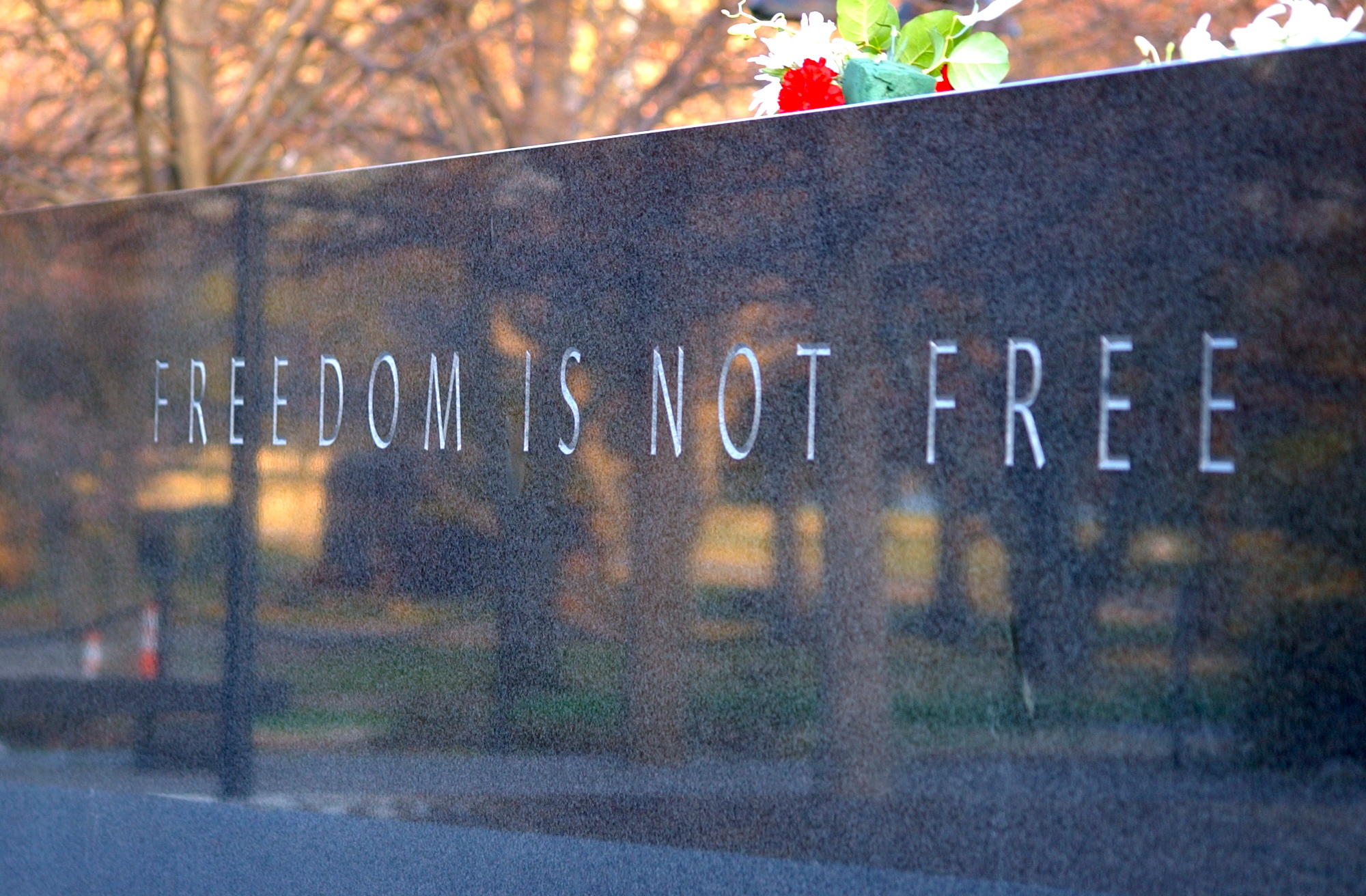
I believe we owe a huge debt of gratitude to our veterans. But I also believe we may not be honoring that debt in the right way.

We usually honor our soldiers, sailors, airmen and Marines who have given “their last full measure of devotion” by playing taps at their funeral, firing a 21-gun salute, or even putting a flag in the sacred ground of their burial site every year at Memorial Day.

But what about our vets who are still living? Don’t they deserve more than just an occasional visit on Veterans Day?

In many ways, we treat Veterans Day like we do Thanksgiving Day: it’s just one day on our calendar to take care of our obligations to be grateful, and then we can continue on with business-as-usual until the next year.

Wouldn’t it be more fitting for us to treat Veterans Day—like Thanksgiving Day—as a culmination of another year full of gratitude? After all, it’s very likely that we wouldn’t even be able to enjoy our business-as-usual lives if it were not for the sacrifices of our veterans.

The Apostle Paul gives us a good pattern to follow. Four times in his letters he says, “I thank God for you every time I remember you” (Romans 1:9; Philippians 1:3; 2 Timothy 1:3; Philemon 4). In these times of thanks, he is remembering others who put their lives on the line for freedom, just as our veterans have done for us.

Here are at least three things we can learn from Paul’s thankfulness to apply to our gratitude for our veterans —

  1. Keep mementos of remembrance around you. Perhaps it’s an American flag, or a picture, or a Veterans Day program. Simply find something that will jog your memory frequently about the debt of gratitude we owe to our vets.
  2. Pray for our veterans. Paul often told his friends that when he was filled with thoughts of gratitude about them, he turned those thoughts into prayers for them.
  3. Turn your feelings into actions. When you see one of your mementos and say a prayer for a veteran, take it a step further. Jot a note to a vet, send an email, send flowers, or take them out to lunch. Perhaps you could invite a veteran into your home for Thanksgiving or Christmas or Easter, or “adopt” a veteran on Mother’s Day or Father’s Day.

The point is this: Let’s not make honoring our veterans something we only do on November 11. Let’s remember them often, be thankful for them always, and turn those thoughts and gratitude into action all year long.

Thursdays With Spurgeon—The Wonder Of Christ

This is a weekly series with things I’m reading and pondering from Charles Spurgeon. You can read the original seed thought here, or type “Thursdays With Spurgeon” in the search box to read more entries.

The Wonder Of Christ

     Works of art require some education in the beholder before they can be thoroughly appreciated. … Because of failures in our character and faults in our life, we are not capable of understanding all the separate beauties and the united perfection of the character of Christ, or of God, His Father. … 

     You cannot fail to notice that men, through the alienation of their natures, are continually misrepresenting God because they cannot appreciate His perfection.… Men will misunderstand Him because they are imperfect themselves and are not capable of admiring the character of God. …

     Did you ever notice, when you read the history of Jesus Christ, that you could never say He was noble for any one virtue at all? … 

     It is because of the complete perfection of Jesus Christ that we are not accustomed to say of Him that He was eminent for His zeal, or for His love, or for His courage. We say of Him that He was a perfect character, but we are not able very easily to perceive where the shadows and the lights blended, where are the meekness of Christ blended into His courage and where His loveliness blended into His boldness in denouncing sin.

     We are not able to detect the points where they meet. And I believe the more thoroughly we are sanctified, the more it will be a subject of wonder to us how it could be that virtues that seem so diverse were in so majestic a manner united into one character. It is just the same of God.

From Mercy, Omnipotence, And Justice

As we grow in our understanding of processes and techniques, our appreciation of a work of art or a symphony grows as well. We may go from “Oh, I like that” to “That is amazing” to “This is an exquisite masterpiece! 

Christians should experience the same wonder and awe of the character of God seen in Jesus and revealed to us by the Holy Spirit. 

I believe the reason the angels around God’s throne are constantly calling out, “Holy, Holy, Holy!” is because at every moment they are perceiving a new facet of His sheer awesomeness. They are calling out to one another, “Did you see that?! Holy!” And another responds back, “Yes, and look at that! Holy!” 

We are invited to join in that chorus. The apostle Paul prayed that our eyes would be opened and our vision expanded to see new depths, and heights, and widths, and lengths of the awesomeness of our God (see Ephesians 3:16-19).

Turning From Moral Folly To Wisdom

“The man who says, ‘I want to go to heaven, but I don’t want to live a pure life; I want to be free to continue with my present life. I will change a little and do better, but I have no desire to be pure,’ or the man who says, ‘I want to escape hell and make heaven my home at last, but I have no particular desire to cease to live as I have lived’ is deceiving himself. You are hearing the language of a moral fool. This is not the language of wisdom, but the folly of the damned. … 

“The penitent man wants to be changed. If you are still sufficiently in love with yourself and all you want is a little improvement, I see no possibility of faith approaching your heart. Unless a man comes to Christ seeking to be a different person, to be humble, meek, and self-effacing, he is not coming to Christ at all. Unless we hate evil and love righteousness, at least to the degree we are able at the moment, we are still in the bonds of iniquity and the enemies of righteousness. … 

“Join me in this prayer: “Oh, I want to be other than what I am. I want to be different. I want to change. I am not satisfied. I want to believe in Thee, and trust in Thee, and throw myself boldly on Thee, and I want to be made like Thyself. I do not want only to escape hell, I want to escape sin. I not only want to go to Heaven at last, but I want to have Heaven in my heart now. I not only want to dwell with the redeemed, I want to be like the redeemed here on earth. I want to be another kind of person.” —A.W. Tozer, in The Wisdom of God

8 Quotes From “Jesus In Me”

Anne Graham Lotz has given us a delightful book that feels like a living room chat with a friend as we discuss how the Holy Spirit operates in our lives. Check out my full book review of Jesus In Me by clicking here. 

“The Holy Spirit is not a thing but a Person. His personhood is emphasized in John 16, when eleven times in eight verses, He is referred to by the personal, masculine pronouns He, Him, or His.” 

“Could it be that you have missed the comfort of the Comforter because it has come indirectly through someone or something else? Like Mary Magdalene at the empty tomb, are your tears blinding you to the presence of Jesus right there beside you? Right there within you? My prayer is that He will use these words to comfort you as you experience the constant companionship of the Holy Spirit. Ask Him to open your eyes to the nearness of the One who is, in fact, Jesus in you.” 

“Whether your situation involves a misunderstanding with your neighbors, or a disagreement within your church, or tension in your home, or slander in your school, or gossip in your office, the Holy Spirit is able to defend you and plead your cause. Always. Ask Him. He’s never lost a case.” 

“Multiple times God has told me He would strengthen me through the howling winds of hardship. In Jeremiah He clearly warned me that people would fight against me but that He would make me an iron pillar. Through Isaiah He told me that people would rage against me and oppose me but that I was not to be afraid because He would strengthen me. He encouraged me from Revelation that if I would endure patiently and with humility, He would make me ‘a pillar in the temple of my God.’” 

“It’s a huge relief to know that it’s not my job to convict anyone else of sin. That’s the Holy Spirit’s job. Which leaves me free to love people just as they are. Yes, I can counsel and advise if they are open to it. Yes, I can speak the truth in love. Yes, I can point out the potential consequences of their sin. But in the end the most effective thing I can do is to pray for them with a heart full of love. Because the power to transform is His alone.” 

“As we choose to fix our eyes on Jesus, pursue righteousness, live by the truth, and fulfill God’s purpose for our lives, the Holy Spirit will guide us, sharpening our focus in the midst of life’s distractions and confusion.” 

“Maintaining the fire requires intentionally establishing some common spiritual disciplines. They are simple choices but not always easy. They include daily prayer, daily Bible reading, sharing the gospel, continuous obedience as you live out what God says in His Word, continuous trust as you relinquish your expectations and let Him have His way, deepening surrender to His authority—especially during times of pain and suffering.” 

“He uses all things without exception, not just some things, for my ultimate good. And my ultimate good is not health, wealth, prosperity, happiness, or sometimes the things we associate with ‘good.’ My ultimate good is to fulfill God’s purpose of shaping me into the image of Jesus Christ so I bring glory to Him.” 

Intimate Prayer Requests

“When you bring Me prayer requests, lay out your concerns before Me. Speak to Me candidly; pour out your heart. Then thank Me for the answers that I have set into motion long before you can discern results. When your requests come to mind again, continue to thank Me for the answers that are on the way. If you keep on stating your concerns to Me, you will live in a state of tension. When you thank Me for how I am answering your prayers, your mind-set becomes more positive. Thankful prayers keep your focus on My presence and My promise.” —Jesus (in Sarah Young’s 40 Days With Jesus)

10 Quotes From “Start With The Heart”

Kathy Koch has given parents, teachers, and anyone who works with younger children, and excellent resource to improve your relationship with your kiddos and empower them to greater success. Check out my full book review of Start With The Heart by clicking here. 

“For your children to want what you want for them, for changes to occur, and for improvements to remain, your hearts must be intertwined. Your motivational power and influence over their obedience comes out of the love you have for each other.” [see Proverbs 23:26] 

“Affirm your children when they do use the character qualities you’re emphasizing and correct them when they don’t. … Specifically, look for gratitude and joy. The lack of one or both of these emotions causes children (and adults) to use character qualities inconsistently.” 

“Here is my list of understandings that can secure children’s hearts and increase your influence so you’ll be able to motivate them to be responsible, brave, and so much more.

  • Parent by faith
  • Parent with grace and mercy
  • Forgive quickly and often
  • Ask to be forgiven quickly and often
  • Tell your children you are confident in God
  • Prioritize children, not their behavior
  • You can dislike what children do while you still like and love them
  • Be who you want your children to be
  • Raise the children you were given, not the children you wish you had
  • Remember needs and wants are different
  • Listen when children are little if you want them to talk with you when they’re older
  • When children have a problem, remember they are not the problem
  • Teach children to fail well
  • Prioritize progress, not perfection” 

“Children are even more susceptible to the influences around them. We should have and model solid character so our behavior, attitudes, and decisions glorify God. We should also prioritize our character so we don’t lead a child astray. Making every effort to use these qualities ourselves matters. And, of course, apologizing when we don’t is key to maintaining a positive relationship.” 

“The desire to develop self-control is birthed in self-respect. Self-control makes it possible to use other character qualities successfully.” 

“Do we choose to see our children’s circumstances and respond appropriately? Although consistency is usually appropriate when raising and motivating children, if we don’t have compassion and individualize our reactions and decisions when it’s appropriate, why would our children? Modeling this character quality matters tremendously.” 

“Initiative: Children may never develop this quality if you remind them of everything they must do. Rather, it’s birthed when you help them grow in appropriate independence. … Is it possible that your children may not be motivated as you’d like because you rescue them to early, too often? … I know you value the things you worked hard for. Don’t rob children of that same satisfaction. Allow them to persevere.” 

“Prayer is a powerful tool—use it! Your personal and specific prayers for your children communicate your deep love for them and your dependence on God. Your prayers are a significant way your children learn who you hope they’ll be and what you hope they’ll do. Pray they’ll develop a heart for Christ. Model and teach what they need for their heart to be transformed into His likeness. This will change their character and, therefore, their motivation and motives, too.” 

“Just making statements like these can be empowering:

  • I need to take off arguing and put on first-time obedience.
  • I need to take off bullying and put on kindness.
  • I need to take off distractions and put on focus.
  • I need to take off ‘I don’t want to’ and put on ‘do it anyway.’” 

“This might surprise you, but all children are motivated. … It doesn’t help to ask, ‘How do I get my kids motivated?’ Rather, we need to ask, ‘How can I redirect their motivation?’” 

Stay tuned: more quotes coming soon…

Read Your Bible More

“Read your Bible more and more every year. Read it whether you feel like reading it or not. And pray without ceasing that the joy return and pleasures increase.

“Three reasons this is not legalism:

  1. You are confessing your lack of desire as sin, and pleading as a helpless child for the desire you long to have. Legalists don’t cry like that. They strut.
  2. You are reading out of desperation for the effects of this heavenly medicine. Bible-reading is not a cure for a bad conscience; it’s chemo for your cancer. Legalists feel better because the box is checked. Saints feel better when their blindness lifts, and they see Jesus in the Word. Let’s get real. We are desperately sick with worldliness, and only the Holy Spirit, by the Word of God, can cure this terminal disease.
  3. It is not legalism because only justified people can see the preciousness and power of the Word of God. Legalists trudge with their Bibles on the path toward justification. Saints sit down in the shade of the Cross and plead for the blood-bought pleasures.

“So let’s give heed to Mr. Ryle and never grow weary of the slow, steady, growth that comes from the daily, disciplined, increasing, love affair with reading the Bible. 

‘Do not think you are getting no good from the Bible, merely because you do not see that good day by day. The greatest effects are by no means those which make the most noise, and are most easily observed. The greatest effects are often silent, quiet, and hard to detect at the time they are being produced. Think of the influence of the moon upon the earth, and of the air upon the human lungs. Remember how silently the dew falls, and how imperceptibly the grass grows. There may be far more doing than you think in your soul by your Bible-reading’ (J.C. Ryle, in Practical Religion).” —John Piper