This is a weekly series with things I’m reading and pondering from Oswald Chambers. You can read the original seed thought here, or type “Thursdays With Oswald” in the search box to read more entries.
On Rituals And Vows To God
There is a use for ritual in a man’s religious life. Because anything is necessary at one time of life, it does not follow that it is necessary all through. … When a man is in a right relationship to God ritual is an assistance; the place of worship in the atmosphere are both conducive to worship. …
Any amount of futile religion is based on this line of things—“I have been eating too much, but now Lent has come and I will fast for a time.” There is nothing genuine in it, it has not the grip of God about it. When a man comes into the presence of God he refrains himself and remembers that he is not there to suffer from his own reactions, to get comfort for himself, to pray along the line of “O Lord, bless me.” He is there to refrain from his own personal needs and to get into the scope of God’s outlook. …
No man can keep himself a Christian, it is impossible; it is God Who keeps a man a Christian. … Jesus Christ came for the weak, for the ungodly and the sinful, and He says, “Blessed are the poor in spirit,” not—“Blessed is the man who has the power to decide and to keep his vow.” Jesus Christ calls the man who says—“I cannot do it; others may have the strength, but I haven’t.” Jesus Christ says to such, “Blessed are you.” It is not our vows before God that tell, but our coming before God, exactly as we are in all our weakness, and being held and kept by God.
From Shade Of His Hand
These words from Oswald Chambers are his commentary on Solomon’s words in Ecclesiastes 5:1-7. In this passage, Solomon warns against making hasty vows. Solomon says it’s better to remain silent than to make a vow and not follow through.
Chambers reminds us that it is impossible for us to keep a vow in our own strength. We don’t make vows to try to impress God, or as a part of a ritual, or because we think we need to do something special to “make up” for where we’ve fallen short. God wants us to come to Him in our weakness and say, “I can’t do this, but Christ in me can do this. I need Your help!” This is the posture and attitude that God honors and delights to help.
This is a weekly series with things I’m reading and pondering from Oswald Chambers. You can read the original seed thought here, or type “Thursdays With Oswald” in the search box to read more entries.
What Makes Life Worth Living?
Think of the devastations and havoc throughout the world just now. What is going to make up to the people who are broken? To say that “every cloud has a silver lining” is a kind lie. Unless a man can get into a relationship with the God Whom the Bible reveals, life is not worth living. …
Solomon says whether you are wise or foolish, upright or not, a king or tyrannized over by a king, successful or a failure, in society or solitary, stubborn or sagacious, all alike ends the same way. All is passing, and we cannot find our lasting joy in any element we like to touch. It is disastrous for a man to try and find his true joy in any phase of life, or in the fulfillment of ambition, or in physical or intellectual solitariness, or in society; he will find his joy only in a personal relationship to God. …
When once a man is there, he receives a hundredfold more of all he gave up to get there, and he never demands an infinite satisfaction from those other relationships. The man or woman who does not know God demands an infinite satisfaction from other human beings they cannot give, and in the case of the man, he becomes tyrannical and cruel. It springs from this one thing, the human heart must have satisfaction, but there is only one Being Who can satisfy the last abyss of the human heart, and that is the Lord Jesus Christ.
From Shade Of His Hand
As a Christian, you have an opportunity to show people how much joy there is for a life in Christ. And then Peter tells us to be ready to tell people the Source of your joy (see 1 Peter 3:15-16).
Do you have the spiritual courage and moral backbone to show and tell? Chambers says, “The Christian faith is exhibited by the man who has the spiritual courage to say that that is the God he trusts in, and it takes some moral backbone to do it.”
Have you ever been stumped by someone’s argument against Christianity or the Bible? Has anyone ever made fun of you because the Bible sounds like a fairy tale? Over 100 years ago Oswald Chambers described how our post-Christian world was beginning to treat Christianity and the Bible on which it’s based—
“We have made ambition and competition the very essence of civilized life. No wonder there is no room for Jesus Christ, and no room for the Bible. We are all so scientifically orthodox nowadays, so materialistic and certain that rationalism is the basis of things, that we make the Bible out to be the most revolutionary, unorthodox and heretical of books.”
It’s that “rationalism” that we need to address. We need to ask scoffers and seekers alike, “What makes you so sure of your beliefs? How did you come to that conclusion?”
Every human being exercises some sort of faith—that the chair will hold them when they sit down, that their spouse will honor their marriage vows, and that their worldview is correct. We need to explore what kind of faith they (and we) have:
Unreasonable faith—believing in something in spite of the evidence.
Blind faith—believing in something without any evidence.
Reasonable faith—believing in something because of the evidence.
I want to show evidence that makes it reasonable to believe in the Bible.
Empirical evidence—
The bibliographical test: determining whether the text of the historical record has been transmitted accurately.
Josh McDowell states, “No other work in all literature has been so carefully and accurately copied as the Old Testament.” He can make this claim because the profession of “scribe” was one of the most professional and exacting of all professions. The rigorous standards employed to prove the accuracy of a copy of a biblical manuscript was higher than for any other literature.
Most of our modern-day Bibles are based on a 1000-year-old manuscript. But after the Dead Sea scrolls were discovered, we found biblical manuscripts going back to 250 B.C. that confirmed the accuracy of the manuscripts we already had. This led Dr. Peter Flint to conclude: “The biblical Dead Sea Scrolls are up to 1,250 years older than the traditional Hebrew Bible, the Masoretic text. We have been using a one-thousand-year-old manuscript to make our Bibles. We’ve now got scrolls going back to 250 BC. … Our conclusion is simply this—the scrolls confirm the accuracy of the biblical text by 99 percent.”
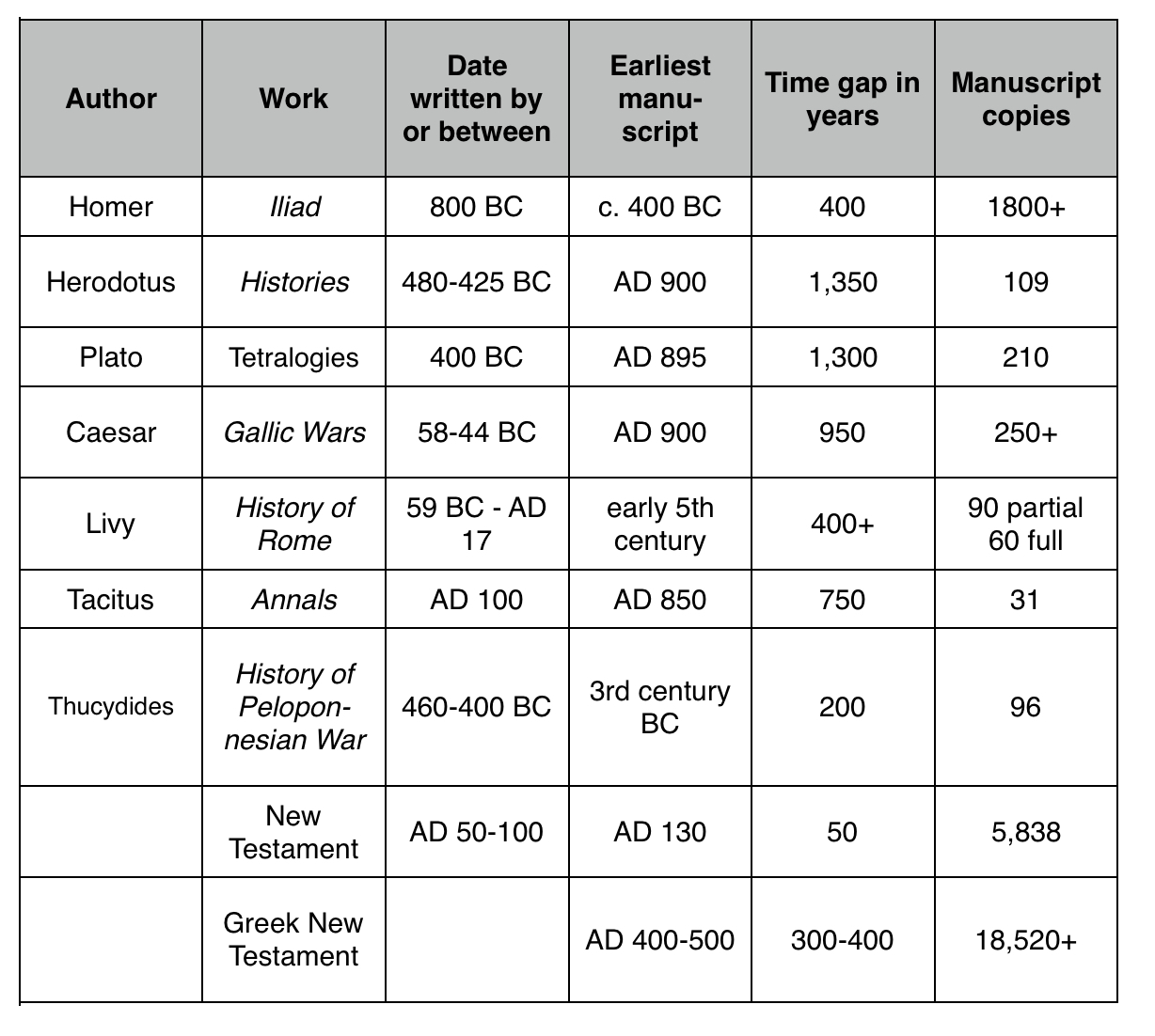
Then regarding the New Testament, Josh McDowell says, “I believe there is more evidence for the reliability of the New Testament than for any other ten pieces of classical literature put together.” Check out this chart reproduced from McDowell’s book God-Breathed to see by comparison to other literature, how close in dating the earliest biblical manuscripts are, and how many of those manuscripts have been discovered!
2. The external evidence test: determining whether the historical record has been verified or affirmed by data outside of itself.
Over one-fourth of the Bible is prophetic, and two-thirds of its prophesies have already been fulfilled. For example, 700 years before His birth, the city in which Jesus was to be born was identified by a man named Micah.
Time and time again archeologists discover articles that verify the claims in the Bible. This led archeologist Nelson Glueck to conclude, “It may be stated categorically that no archeological discovery has ever controverted a single biblical reference. Scores of archeological findings have been made which confirm in clear outline or in exact detail historical statements in the Bible.”
3. The internal evidence test: determining how of the historical record stands up to the test of internal validity.
The Bible was written by 45 different authors, over a span of 1500 years, on 3 different continents, and in 3 different languages. Yet there are no contradictions!
Anecdotal evidence—
Changed lives. My life is one that has been amazingly impacted by the God of the Bible, as was a man named Saul, who had a total about-face after encountering Jesus. As a result, Christianity was spread far and fast through his writings and world travels.
2. Changed societies. Wherever the Christian faith of the Bible has been put into practice, societies improve. Leonard Sweet notes—
“Before Christianity, there were cults that practiced all sorts of human sacrifice as well as self-mutilation and self-castration. Before Christianity, the weak were despised, the poor maligned, the handicapped abandoned. Before Christianity, infanticide was rampant, slavery run-of-the-mill, and gladiatorial combat a form of entertainment. In Jesus’ day, Corinth was famous for its temple prostitutes, continuing a long-standing tradition symbolized by the Corinthian athlete Xenophon.… Aristotle…not only condoned institutionalized slavery but provided an elaborate argument in favor of it. As if that weren’t enough, Aristotle called man ‘begotten’ and woman ‘misbegotten,’ and because a woman’s reasoning was ‘without authority’ accepted no female students.
“Only Jesus and His followers known as the church insisted on the concept of human dignity and the value of every human soul. Only the church built hospitals and took care of the abandoned and disabled. Only the church celebrated charity and selflessness as the highest virtue and elevated the status of women.”
Is all of this “proof positive” that the Bible is God’s Word? No, it’s not. But I think the evidence is compelling enough that it is certainly reasonable to reach this conclusion.
Here are some great application questions from this lesson:
Other than because it says so in the Bible, how do I know that it is God’s Word?
This is a weekly series with things I’m reading and pondering from Oswald Chambers. You can read the original seed thought here, or type “Thursdays With Oswald” in the search box to read more entries.
Jesus Makes Joy Possible
“These things have I spoken unto you,” said Jesus, “that My joy may be in you.” What joy did Jesus have? He failed apparently in everything He came to do; all His disciples forsook Him, He was crucified, and yet He talked of His joy. The joy of Our Lord lay in doing what the Father sent Him to do. His purpose was not to succeed, but to fulfill the design of His coming—“For I am come down from heaven not to do Mine own will, but the will of Him that sent Me.” …
“God shall judge the righteous and the wicked.” But who is God? I have never seen God, or spoken to Him. An omnipresent, omniscient, omnipotent Being does not amount to anything to me; He is an abstract finding of man’s intellect. Can God take on hands and feet and man’s way of doing things, and manifest Himself on the plane on which we live? The Bible says that that is what God did do. Jesus Christ lived a human life on this earth…. What Jesus Christ exhibited was not omnipotence and omniscience and omnipresence, but absolute holiness in human flesh, and He said “he that hath seen Me hath seen the Father.” …
The essence of Christianity is not adherence to principles; but a personal relationship to God through Jesus Christ at work in the whole of my life.
From Shade Of His Hand
Are you basing your “success” on what you are accomplishing? If so, prepare yourself for disappointment.
But if you define “success” as a growing relationship with Jesus Christ, be prepared for an eternity of limitless joy!
This is a weekly series with things I’m reading and pondering from Oswald Chambers. You can read the original seed thought here, or type “Thursdays With Oswald” in the search box to read more entries.
Living In The Now
Jesus did not use figurative language in talking about the Hereafter. He said: “Let not your heart be troubled”—“My Business is with the Hereafter.” Our business is to live a godly life in the present order of things, and not to push out beyond the durations God has placed as limits. …
I have no power to choose whether or not I will take the consequences of my choice; no power to say whether or not I will be born…but I have power to choose which way I will use the times as they come. …
Jesus Christ taught a reasonable life on the basis of faith in God—“Be carefully careless about everything saving your relationship to Me. Don’t be disturbed today by thoughts about tomorrow, leave tomorrow alone, and bank in confidence on God’s organization of what you do not see. Yesterday is past, there is no road back to it, tomorrow is not; live in the immediate present, and yours is the life of a child.” …
Jesus Christ deliberately chose “the long, long trail”; we choose “the short cut,” and continually go wrong until we understand the meaning of the 23rd Psalm, “The Lord is my Shepherd, He leads me in the right paths.”
From Shade Of His Hand
In Shade Of His Hand, Oswald Chambers is taking an in-depth look at the book of Ecclesiastes. In chapter 3 of Ecclesiastes, Solomon says there is a time for everything.
Chambers reminds us that we don’t choose the time we will be born, and we don’t choose the time we will die—God alone chooses those. But everything between birth and death is our choice. Jesus taught us that our choices and our level of joy in the moment will be much better if we seek God’s wisdom for all of those choices we make.
This is a weekly series with things I’m reading and pondering from Oswald Chambers. You can read the original seed thought here, or type “Thursdays With Oswald” in the search box to read more entries.
Cynical Or Satisfied
It is no use trying to find true joy in being either a fool or a wise man. Solomon drives us back every time to the one thing, that a man’s chief end is to glorify God and enjoy Him for ever. …
The only way we can enjoy our “tree of life” is by fulfilling the purpose of our creation. Jesus Christ prayed “that they may have My joy fulfilled in themselves.” The thing that kept Jesus Christ all through was not that He held aloof from actual things, but that He had a kingdom within. … Our Lord’s whole life was rooted and grounded in God, consequently He was never wearied or cynical.
From Shade Of His Hand
In this book, Oswald Chambers is commenting on Solomon’s words in Ecclesiastes. Solomon tried everything he could think of to try to make sense of life and to try to find lasting joy. But everything he tried left him flat.
That’s because we weren’t created to find ultimate fulfillment or purpose in the things of earth, but to find purpose, joy and contentment in a personal relationship to our Creator. Jesus lived His life on earth as a blazing example of a what a joy-filled, purpose-centered, God-glorifying life looks like. The wonder of the Incarnation is that He shows us the kind of eternal life we were meant to have.
So here’s the choice Solomon presents to us: Try to find fulfillment under the sun and end up cynical, or find fulfillment in the Son of God and know truly satisfying, eternal joy. Which will you choose this Advent season?
This is a weekly series with things I’m reading and pondering from Oswald Chambers. You can read the original seed thought here, or type “Thursdays With Oswald” in the search box to read more entries.
A New Look At Some Old Bible Studies
It is important to notice the difference between the Wisdom of the Hebrews and the Wisdom of the Greeks. The Wisdom of the Hebrews is based on an accepted belief in God; that is, it does not try to find out whether or not God exists, all its beliefs are based on God, and in the actual world of things as they are, all its mental energy is bent on practical living. The Wisdom of the Greeks, which is the wisdom of our day, is speculative; that is, it is concerned with the origin of things, with the riddle of the universe, etc., consequently the best of our wits is not given it to practical living.
The value of the Book of Job is not in what it teaches, but that it expresses suffering, and the inscrutability of suffering. In the Book of Psalms, Wisdom is applied to things as they are and to prayer. The Book of Proverbs applies Wisdom to the practical relationships of life, and Ecclesiastes applies Wisdom to the enjoyment of things as they actually are; there is no phase of life missed out, and it is shown that enjoyment is only possible by being related to God.
The record of the whirl of things as they are is marvelously stated in these books of Wisdom: Job—how to suffer; Psalms—how to pray; Proverbs—how to act; Ecclesiastes—how to enjoy; Song of Solomon—how to love. …
Solomon sums up the whole thing as follows: If you try to find enjoyment in this order of things, you will end in vexation and disaster. If you try to find enjoyment in knowledge, you only increase your capacity for sorrow and agony and distress. The only way you can find relief and the right interpretation of things as they are it is by basing your faith in God, and by remembering that man’s chief end is to glorify God and enjoy Him forever. Jesus Christ is the One Who can transmute everything we come across.
From Shade Of His Hand
Sometimes the “wisdom” books of the Bible can be difficult to understand in our modern day, Western culture. But perhaps you may be able to read them differently with these insights that Oswald Chambers shares.
Why not try giving a new look at some old Bible studies, and then comment below on how it worked for you.
This is a weekly series with things I’m reading and pondering from Oswald Chambers. You can read the original seed thought here, or type “Thursdays With Oswald” in the search box to read more entries.
Christ’s Incarnation Means Our Freedom
Other religions deal with sins; the Bible alone deals with sin. The first thing Jesus Christ faced in man was this heredity of sin, and it is because we have ignored it in our presentation of the Gospel that the message of the Gospel has lost its sting, its blasting power; we have driveled it into insurance tickets for heaven, and made it deal only with the wastrel element of mankind. …
The revelation is not that Jesus Christ was punished for our sins, but that He was made to be sin. “Him who knew no sin” was made to be sin, that by His identification with it and removal of it, we might become what He was. … Jesus Christ went straight through identification with sin that every man and woman on earth might be freed from sin by His atonement. He went through the depths of damnation and came out more than conqueror; consequently everyone of us who is willing to be identified with Him is freed from the disposition of sin, freed from the connection with the body of sin, and can come out more than a conqueror too because of what Jesus Christ has done. …
The Holy Spirit will take my spirit, soul and body and bring them back into communion with God, and lead me into identification with the death of Jesus Christ, until I know experimentally that my old disposition, my right to myself, is crucified with Him, and my human nature is now free to obey the commands of God.
From The Shadow Of An Agony
As we approach the time of year we celebrate the Incarnation of Jesus, it’s amazing to think that He didn’t come just to identify with our sin, but to be made sin! Without Jesus Christ’s death on a Cross in our place, there is no hope for us.
As we celebrate the First Advent, it’s a good idea to keep in the front our our minds what Christ’s Incarnation means for us. It means we can be freed from sin—free to obey God, and free to look forward to Christ’s Second Advent, where He will take away His saints to be with Him forever!
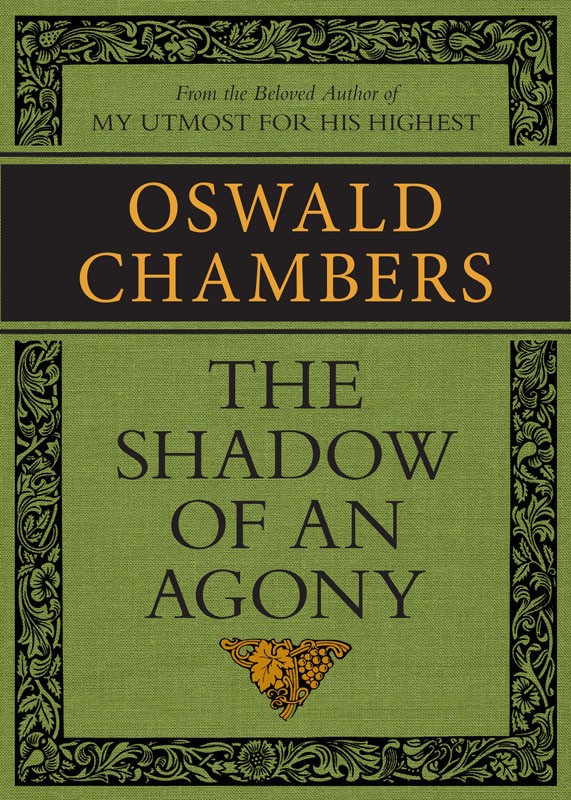
In The Shadow Of An Agony, Oswald Chambers explores how we should process the hard events of our lives which seem to totally rock our neat and orderly world. Check out my book review by clicking here, and then enjoy a few quotes from this book.
“If Jesus Christ were only a martyr, His Cross would be of no significance; but if the Cross of Jesus Christ is the expression of the secret heart of God, the lever by which God lifts back the human race to what it was designed to be, then there is a new attitude to things.”
“The agony of a man’s affliction is often necessary to put him into the right mood to face the fundamental things of life. The Psalmist says, ‘Before I was afflicted I went astray: but now I have kept Thy Word.’ The Bible is full of the fact that there has to be an approach to the holy ground. If I am not willing to be lifted up, it is no use talking about the higher heights. … No man can do wrong in his heart and see right afterwards. If I am going to approach the holy ground, I must get into the right frame of mind—the excellency of a broken heart.”
“Jesus Christ did not come to give us pretty ideas of God, or sympathy with ourselves; He came from a holy God to enable men, by the sheer power of His Redemption, to become holy.”
“No man is the same after an agony; he is either better or worse, and the agony of a man’s experience is nearly always the first thing that opens his mind to understand the need of Redemption worked out by Jesus Christ.”
“The attitude of the Bible to the human race is not a common-sense one. The Christian aspect deals with the a specimen of a human race which is a magnificent ruin of what it was designed to be. Supposing the view of the Bible to be right, to whom it is it ‘up to’ to right the wrong? The Creator. Has He done it? He has, and He has done it absolutely single-handed. The tremendous revelation of Christianity is not the Fatherhood of God, but the Babyhood of God—God became the weakest thing in His own creation, and in flesh and blood He levered it back to where it was intended to be. No one helped Him; it was done absolutely by God manifest in human flesh. God has undertaken not only to repair the damage, but in Jesus Christ the human race is put in a better condition than when it was originally designed.”
“We have been taken up with creeds and doctrines, and when a man is hit we do not know what to give him; we have no Jesus Christ, we have only theology. For one man who can introduce another to Jesus Christ by the way he lives and by the atmosphere of his life, there are a thousand who can only talk jargon about Him.”
“The New Testament view of a saint is a more rugged type. You and I are a mixture of dust and Deity, and God takes that sordid human stuff and turns it into a saint by Regeneration. A saint does not mean a man who has not enough sin to be bad, but a man who has received from Jesus Christ a new heredity that turns him into another man.”
“Our guide as to what emotions we are going to allow is this—What will be the logical outcome of this emotion? If it has to do with sin and satan, then grip it on the threshold of your mind and allow it no more way. You have no business to harbor an emotion the outcome of which you can see to be bad; if it is an emotion to be generous, then be generous, or the emotion will react and make you a selfish brute.”
“When I receive the Spirit of God, I am lifted not out of reason, but into touch with the infinite Reason of God.”
“Any fool will give up wrongdoing and the devil, if he knows how to do it; but it takes a man in love with Jesus Christ to give up the best he has for Him.”
“Churchianity is an organization; Christianity is an organism. Organization is an enormous benefit until it is mistaken for the life.”
“The stupendous difference between the religion of Jesus Christ and every other religion under heaven is that His religion is one which brings help to the bottom of hell, not a religion that can deal only with what is fine and pure.”
Every Thursday I share a section of the current Oswald Chambers book I am reading, in a series called “Thursdays With Oswald.” If you would like to be notified when these posts go live, just enter your email address in the box on the right, and then click “Sign me up!”
Book Reviews From 2016
December 27, 2016 — Craig T. Owens#struggles
Alive
An Angel’s Story
Answering Jihad
Archeological Study Bible
Chase The Lion
Churchill’s Trial
Culture
Hope … The Best Of All Things
How To Read A Book
I Stand At The Door And Knock
Jesus Always
Letters To A Birmingham Jail
Light & Truth—Acts & The Larger Epistles
Light & Truth—Revelation
Light & Truth—The Lesser Epistles
More Than A Carpenter
Of Antichrist And His Ruin
On This Day
One Of The Few
Our Iceberg Is Melting
Shaken
So, Anyway…
Streams In The Desert
The American Patriot’s Almanac
The Bad Habits Of Jesus
The Beauty Of Intolerance
The Blessing Of Humility
The Dawn Of Indestructible Joy
The Duty Of Pastors
The Gospels Side-By-Side
The Mathematical Proof For Christianity
The Philosophy Of Sin
The Place Of Help
The Porn Circuit
The Psychology Of Redemption
The Seven Laws Of Love
The Shadow Of An Agony
The Tabernacle Of Israel
Think On These Things
Today’s Moment Of Truth
Useful Maxims
Your Sorrow Will Turn To Joy
Here are my book reviews for 2011.
Here are my book reviews for 2012.
Here are my book reviews for 2013.
Here are my book reviews for 2014.
Here are my book reviews for 2015.
Share this: