The Inverse Proportion Of Worldly Wealth

Listen to the podcast of this post by clicking on the player below, and you can also subscribe on AppleSpotify, or Audible. 

A young man came to Jesus and asked Him, “What must I do to inherit eternal life?” 

Jesus initially replied by listing some of the Ten Commandments that should be followed, and the young man quickly replied, “I have kept all of these since I was a boy!” 

Then Jesus said, “There is just one more thing: sell everything you have and give to the poor, you will have treasure in Heaven. Then come, and follow Me.” 

Even though this young man had received the answer that he was seeking, Luke records, “he became very sad because he was very wealthy.” (Check out this full exchange here.) 

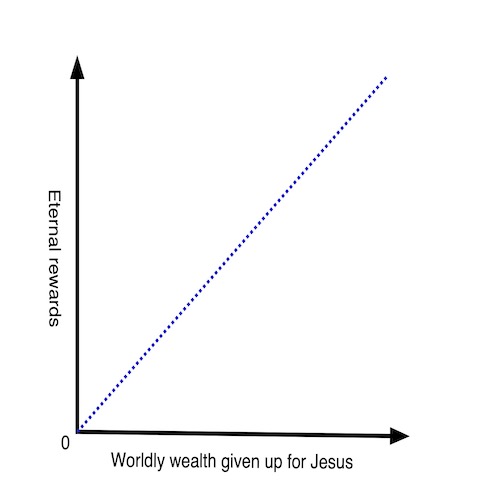
The word “very” is used twice by Luke (Luke 18:23). It speaks of a greatness or heaviness of something. It appears that when we are very wealthy, it is very hard to trust anything other than that wealth. The opposite also appears to be true: When worldly wealth is scant, our trust in God for our daily bread is high. This is what mathematicians would refer to as an inverse proportion. 

On the other hand, Jesus promised eternal rewards for those who replaced trust in possessions with trust in God (also see Matthew 6:19-21; Luke 18:28-30). This is what mathematicians would referred to as proportional. 

Both this proportional treasure and the inverse proportional trust in God are God’s indisputable realities. 

As this young man shows us, it’s not about what we do or about what commands we have kept. In fact, it’s not about us at all! It’s all about a total trust in the only One who is eternally trustworthy! 

You may also want to check out:

►► Would you please prayerfully consider supporting this ministry? My Patreon supporters get behind-the-scenes access to exclusive materials. ◀︎◀︎

Supernatural Interference

The foundational claim of Christianity is Jesus died AND rose to life again. The Apostle Paul says that if the resurrection didn’t happen, anyone who claims to be a Christian is in a world of hurt (1 Corinthians 15:3-4, 14, 17-20).  

“But resurrected from the dead?! Really? I believe in facts. I believe in the laws of science.” Me too! But I also believe that the supernatural is not the opposite of belief in the natural. Just like Paul said, “Why should any of you consider it incredible that God raises the dead?” (Acts 26:8). 

Noted astronomer Allan Rex Sandage said, “It is my science that drove me to the conclusion that the world is much more complicated than can be explained by science. It was only through the supernatural that I can understand the mystery of existence.”

And C.S. Lewis added, “How can anything be seen to be an exception till the rules are known? … Nothing can seem extraordinary until you have discovered what is ordinary. Belief in miracles, far from depending on an ignorance of the laws of nature, is only possible in so far as those laws are known.”  

Let me give you a simple example. Suppose I divide $5 evenly between two of my buddies. The laws of mathematics dictate that both of them will have $2.50. But what if one of my friends, through some sleight of hand, steals some of my other friend’s money? The fact that one of them now has more than half doesn’t change that mathematical law that $5 divided evenly is two sets of $2.50. 

The mathematician as a mathematician doesn’t know how likely one friend is to steal some of the other friend’s money. For that answer, he has to ask someone else. The changing of the outcome does not negate the laws. In fact, the more certain we are of the laws of mathematics the more clearly we know that something outside of them “interfered.” 

Concerning Jesus, there are three undeniable facts—

  1. Jesus died (John 19:28-34, 38-42; Mark 15:44-45; Matthew 27:62-66) 
  2. Death is irreversible
  3. Jesus is alive (1 Corinthians 15:3-8)

It appears the laws of biology have been interfered with, that a supernatural miracle has occurred. The supernatural fact that Jesus was resurrected does not change the biological fact that death is irreversible. We just didn’t expect the outside influence. Just like we didn’t expect one friend to steal money from another friend.

What does this mean for you and me? It means that you can trust God’s word. All of it! Jesus told us that He would die by crucifixion and that He would be resurrected three days later (John 10:18; Matthew 20:19). 

If that word came true, we can also trust this word: We can have our sins forgiven and receive God’s gift of eternal life—just as Christ was raised from the dead through the glory of the Father, we too may live a new life (Romans 6:4). 

The law of sin says: All of us have sinned and fallen short of God’s standard. The unbreakable law of sin is that the penalty for unforgiven sin is eternal death. That law cannot be broken, unless there is a Supernatural interference—a miracle!

Jesus interfered. He took our sins upon Himself. He supernaturally switched places with us and let the death penalty fall on Himself. And if we believe in that, we can have our sins forgiven and receive what we didn’t expect—eternal life with God! 

What a God we have! And how fortunate we are to have Him, this Father of our Master Jesus! Because Jesus was raised from the dead, we’ve been given a brand-new life and have everything to live for, including a future in heaven—an inheritance that is kept in heaven for you, pure and undefiled, beyond the reach of change and decay (1 Peter 1:3-4 MSG & NLT)

Book Reviews From 2016

BookshelfHere are the books I read and reviewed in 2016. Click a title to read the review…

#struggles

Alive

An Angel’s Story

Answering Jihad

Archeological Study Bible

Chase The Lion

Churchill’s Trial

Culture

Hope … The Best Of All Things

How To Read A Book

I Stand At The Door And Knock

Jesus Always

Letters To A Birmingham Jail

Light & Truth—Acts & The Larger Epistles

Light & Truth—Revelation

Light & Truth—The Lesser Epistles

More Than A Carpenter

Of Antichrist And His Ruin

On This Day

One Of The Few

Our Iceberg Is Melting

Shaken

So, Anyway…

Streams In The Desert

The American Patriot’s Almanac

The Bad Habits Of Jesus

The Beauty Of Intolerance

The Blessing Of Humility

The Dawn Of Indestructible Joy

The Duty Of Pastors

The Gospels Side-By-Side

The Mathematical Proof For Christianity

The Philosophy Of Sin

The Place Of Help

The Porn Circuit

The Psychology Of Redemption

The Seven Laws Of Love

The Shadow Of An Agony

The Tabernacle Of Israel

Think On These Things

Today’s Moment Of Truth

Useful Maxims

Your Sorrow Will Turn To Joy

Here are my book reviews for 2011.

Here are my book reviews for 2012.

Here are my book reviews for 2013.

Here are my book reviews for 2014.

Here are my book reviews for 2015.

8 Quotes From “The Mathematical Proof For Christianity”

The Mathematical Proof For ChristianityDan Delzell uses not only math, but many other sciences as well to give some great conversation-starters. Check out my full review of his book by clicking here.

“I live in Nebraska where I serve as a pastor. Imagine someone covering this entire state in silver dollars 6 feet deep. Then mark one coin and bury it anywhere across the state. Next, blindfold a man and have him choose one coin. The odds that he would choose the marked coin are the same odds as getting 8 prophecies all fulfilled in one man. God fulfilled about 300 prophecies in the Person of Jesus Christ. … There is no way one man could have fulfilled all 8 of these prophecies unless God was making it happen. Who else controls history? Who else could give us such irrefutable proof for Christianity? The odds are one in one hundred quadrillion. Here is what that number looks like: 1 in 100,000,000,000,000,000. (This mathematical proof was calculated by Professor Peter Stoner.)”

“What if jurors were presented with 300 pieces of evidence that all pointed to the same person, just like the 300 biblical prophecies all point to Christ. And so you see, you really can come face to face with reality, logic, reason, facts, evidence, and mathematical certainty before you decide whether to accept or reject the Bible.”

“The excessive skepticism shown toward the Bible by important historical schools of the eighteenth and nineteenth centuries, certain phases of which still appear periodically, has been progressively discredited. Discovery after discovery has established the accuracy of innumerable details, and has brought increased recognition to the value of the Bible as a source of history.” —William Albright, biblical and archeological scholar who mastered more than 26 ancient and modern languages 

“The order is for Christianity is: (1) Evidence; (2) Faith; and then (3) Assurance. Christianity stands upon evidence. It is personally received through faith that Jesus died for your sins on the Cross. It brings comforting assurance to those who have stepped out in faith to trust Christ. You will never have the assurance of salvation until you take a step of faith based on the evidence.”

“Jesus didn’t come here to merely provide man with one more option.”

“It may be stated categorically that no archeological discovery has ever controverted a single biblical reference. Scores of archeological findings have been made which confirm in clear outline or in exact detail historical statements in the Bible.” —Nelson Glueck, Jewish archeologist

“Archeological work has unquestionably strengthened confidence in the reliability of the scriptural record.” —Millar Burrows, University of Yale archeologist

“In addressing the manuscript evidence for the New Testament, John Warwick Montgomery correctly states that ‘to be skeptical of the resultant text of the New Testament books is to allow all of classical antiquity to slip into obscurity, for no documents of the ancient period are as well attested bibliographically as the New Testament.’”

The Mathematical Proof For Christianity (book review)

The Mathematical Proof For ChristianityThe Mathematical Proof For Christianity by Dan Delzell is really just one part of the big picture he presents. Dan uses mathematics, archeology, textual examination, logic, and sound semantics to present a compelling case for the authenticity of Scripture, and the Deity of Jesus Christ. But Dan is quick to add, “Mathematical proof for Christianity is powerful. But without faith in Christ, all the proof in the world won’t save your soul and bring you to heaven one day.”

If you are already a Christian, this book will do much to help you “be prepared to give an answer” (1 Peter 3:15) to seekers and skeptics. But I think the greatest value of this book would be as a conversation-starter with those who are seekers and skeptics. Giving them a copy of this book to read along with you will be a great way to have a meaningful conversation about your faith in Jesus. The subtitle of this book is “along with other reasons to believe,” and Dan does give many, many reasons.

No book written by a man will convince anyone to place their faith in Jesus (only the Bible can truly do that), but The Mathematical Proof is well-grounded in Scripture to help you use it as an effective tool in sharing your faith.

Check it out!

Scientists + God

Modern-day scientists want to exclude the very mention of God from anything. This is not science, but scientism. It is a belief system as surely as any religion is.

But the one thing scientism overlooks is the reliance on God that the greatest scientific minds in the world had.

Johannes Kepler“Oh You who through the light of nature has aroused in us a longing for the light of grace, so that we may be raised in the light of Your Majesty, to You, I give thanks, Creator and Lord, that You allow me to rejoice in Your works. Praise the Lord you heavenly harmonies, and you who know the revealed harmonies. For from Him, through Him and in Him, all is, which is perceptible as well as spiritual; that which we know and that which we do not know, for there is still much to learn.” —Johannes Kepler, the astronomer who discovered the laws of planetary motion

“It is reasonable to believe, however, that the Creator, if He paid attention to the relation of the orbits [of the planets] in their general aspect, paid attention also to the relation of the varying distances of the individual orbits in detail….” —Johannes Kepler

“Nevertheless, all the observations which could possibly be made in so short a time, I was enabled, by Divine Providence, to complete….” —Jeremiah Horrox, astronomer who used Kepler’s principles to chart the orbit of Venus 

Galileo Galilei“All these facts were discovered and observed a few days ago by the help of a telescope devised by me, through God’s grace first enlightening my mind.” —Galileo Galilei, mathematician, philosopher and astronomer

“I do not feel obliged to believe that the same God who has endowed us with sense, reason, and intellect has intended us to forgo their use.” —Galileo Galilei 

“In the absence of any other proof, the thumb alone would convince me of God’s existence.” —Sir Isaac Newton, physicist and mathematician

Isaac Newton“Gravity explains the motions of the planets, but it cannot explain who set the planets in motion. God governs all things and knows all that is or can be done.” —Isaac Newton

“This most beautiful system of the sun, planets, and comets, could only proceed from the counsel and dominion of an intelligent and powerful Being.” —Isaac Newton

“We are compelled to acknowledge the effect of a cause; chance alone could not have given a form nearly circular to the orbit of all the planets.” —Pierre Simon, one of the fathers of the scientific revolution 

12 Noteworthy Quotes From “There Is A God”

There Is A GodAs I said in my book review of Anthony Flew’s There Is A God, the real value of this book is in the arguments which contributed to Flew’s shift from atheism to theism. You can read my full book review by clicking here.

Frankly, it’s hard to share a lot of the quotes because the context of the full argument would be lacking, but I’ve been sharing a few of them over several posts. To wrap up this series, here are several other noteworthy quotes from this thought-provoking book.

“I would have liked to convince my father that I had found what he had been looking for, the ineffable something he had longed for all his life. I would have liked to persuade him that the search for God does not have to be in vain. But it was hopeless. He had known too many blind Christians, bleak moralists who sucked the joy from life and persuaded their opponents; he would never have been able to see the truth they were hiding.” —Katherine Tait, daughter of Bertrand Russell 

“Nothing can penetrate the loneliness of the human heart except the highest intensity of the sort of love the religious teachers have preached.” —Bertrand Russell

“In sum, to the Being who he considered to be the explanation of the world and its broad form, Aristotle ascribed the following attributes: immutability, immateriality, omnipotence, omniscience, oneness or indivisibility, perfect goodness and necessary existence. There is an impressive correspondence between this set of attributes and those traditionally ascribed to God within the Judaeo-Christian tradition. It is one that fully justifies us in viewing Aristotle as having had the same Divine Being in mind as the cause of the world that is the object of worship of these two religions.” —David Conway

“There can never be any real opposition between religion and science; for the one is the complement of the other. … Religion and natural science are fighting the joint battle in an incessant, never relaxing crusade against skepticism and against dogmatism, against unbelief and superstition … and therefore ‘On to God!’” —Max Planck

“God is a mathematician of a very high order and He used advanced mathematics in constructing the universe.” —Paul A.M. Dirac 

“Reason tells me of the extreme difficulty or rather impossibility of conceiving this immense and wonderful universe, including man with his capability of looking far backwards and far into the futurity, as a result of blind chance or necessity. When thus reflecting I feel compelled to look to a First Cause having an intelligent mind in some degree analogous to that of mine; and I deserve to be called a Theist.” —Charles Darwin

“Science can proceed only if the scientist adopts an essentially theological worldview. … Even the most atheistic scientist accepts as an act of faith the existence of a lawlike order in nature that is at least in part comprehensible to us.” —Paul Davies, Templeton Prize winner 

“It is crazy to postulate a trillion (casually unconnected) universes to explain the features of one universe, when postulating one entity (God) will do the job.” —Richard Swinburne

“The problem of how meaningful or semantic information can emerge spontaneously from a collection of mindless molecules subject to blind and purposeless forces percents a deep conceptual challenge.” —Paul Davies 

“One feature of life, though, remains certain: Life could not have evolved without a genetic mechanism—one able to store, replicate, and transmit to its progeny information that can change with time. … Precisely how the first genetic machinery involved also persists as an unresolved issue.” —Antonia Lazcano

“The world is rational. The order of the world reflects the order of the supreme mind governing it.” —Kurt Gödel

“The reality of rationality cannot be evaded with any appeal to natural selection. Natural selection presupposes the existence of physical entities that interact according to specific laws and of a code that manages the processes of life. And to talk of natural selection is to assume that there is some logic to what is happening in nature (adaptation) and that we are capable of understanding this logic.” —Roy Abraham Varghese

  • You can read some direct quotes from Anthony Flew by clicking here.
  • Some Albert Einstein quotes can be found by clicking here.
  • A fascinating mathematical explanation from Gerald Schroeder is found by clicking here.

Miracle Or “Cheating”?

C.S. Lewis at his deskI recently re-read C.S. Lewis′ book Miracles (you can read my full book review by clicking here). As you may have noticed, after reading and reviewing books on this blog, I also like to share some quotes that caught my attention. Doing this with Lewis is difficult, because in order to get the context of a particular quote, I think I would have to cite almost a full page or more. So over the next few weeks I plan to share some quotes from Miracles that require not as much context, or I will provide a bit of background to set the stage.

This particular quote is fairly long in itself, but I think you will understand the context within the quote—

“It is certain that the billiard balls will behave in a particular way, just as it is certain that if you divide a shilling unequally between two recipients then A’s share must exceed the half and B’s share fall short of it by exactly the same amount. Provided, of course, that A does not by sleight-of-hand steal some of B’s pennies at the very moment of the transaction. In the same way, you know what will happen to the two billiard balls—provided that nothing interferes. If one ball encounters a roughness in the cloth which the other does not, their motion will not illustrate the law in the way you had expected. Of course what happens as a result of the roughness in the cloth will illustrate the law in some other way, but your original prediction will have been false. Or again, if I snatch up a cue and give one of the balls a little help, you will get a third result: and that third result will equally illustrate the laws of physics, and equally falsify your prediction. I shall have ‘spoiled the experiment.’ All interferences leave the law perfectly true. But every prediction of what will happen in a given instance is made under the proviso ‘other things being equal’ or ‘if there are no interferences.’ Whether other things are equal in a given case and whether interferences may occur is another matter. The arithmetician, as a arithmetician, does not know how likely A is to steal some of B’s pennies when the shilling is being divided; you had better ask a criminologist. The physicist, as a physicist, does not know how likely I am to catch up a cue and ‘spoil’ his experiment with the billiard balls: you had better ask someone who knows me. In the same way, the physicist, as such, does not know how likely it is that some supernatural power is going to interfere with them: you has better ask a metaphysician. But the physicist does know, just because he is a physicist, that if the billiard balls are tampered with by any agency, natural or supernatural, which he has not taken into account, then their behavior must differ from what he expected. Not because the law is false, but because it is true. The more certain we are of the law the more clearly we know that if new factors have been introduced the result will vary accordingly. What we do not know, as physicists, is whether Supernatural power might be one of the new factors. … Miracle is, from the point of view of the scientist, a form of doctoring, tampering, (if you like) cheating.”

Responding To The Voice

FlatlandIn 1880, Edwin A. Abbott wrote Flatland, a book that would later become a favorite of Albert Einstein. Abbott was a college-trained mathematician and a theologian; in fact he was actually better known for his theological writings than for Flatland. Later on Einstein would say that “things should be made as simple as possible, not simpler.” In other words, don’t dumb-down the concept, but state it on a level where more people can grasp it. That’s why, I believe, Einstein loved Flatland.

Flatland is told through the eyes of Square, a two-dimensional shape that lives in Flatland. Square has length and width, but no height. So the inhabitants of Flatland can move back-and-forth, and side-to-side, but not up-and-down. To get an idea of this, put your eye right on the level of a tabletop, and look at an item on the table. Imagine you can only see what is touching the tabletop (but nothing that rises any higher or lower than that), and you will get an idea of Square’s two-dimensional world.

One day Sphere visits Flatland. Sphere is three-dimensional, so he can move up-and-down. This means that Square can only see the part of Sphere that happens to be in his line of sight at that immediate moment. So he sees just a “slice” or “layer” of Sphere as Sphere moves through Flatland. Sometimes Sphere is nothing more than a disembodied voice when he is hovering above Flatland.

This gives us a little bit of an idea of how we perceive God. He exists in dimensions that we cannot fully comprehend, so we only see “slices” of Him as He passes though our line of sight. Sometimes He is just a disembodied Voice—or as the Bible calls Him, the Word of God.

But the Word of God compressed Himself into our dimension (John 1:14). All of the fullness—all of the other-dimension-ness—of His omnipotence, omnipresence, omniscience came to our “level” in the Person of Jesus Christ (Philippians 2:6-7). The Word was the complete and total fullness of God (John 1:1-3; Colossians 2:9). But unlike Square who couldn’t fully know Sphere, God is fully knowable in The Word—in Jesus Christ!

The question is: What are you going to do with The Word? The Word of God (the Bible) allows us to fully know The Word of God (Jesus). But we need to be willing to let the Holy Spirit strip away our puny, smaller-dimensioned, finite thinking of God.

Alvin TofflerAlvin Toffler wrote, “The illiterate of the future are not those who cannot read or write, but those who cannot learn, unlearn, and relearn.”

I would modify this to say, “Those illiterate of The Word (Jesus) are not those who cannot read The Word (the Bible), but those who won’t let the Holy Spirit help them learn, unlearn, and relearn who God is.” 

There is so much more to learn about The Word (Jesus), so let the Holy Spirit guide you in your reading of The Word (the Bible). I pray as Paul did that you will begin to experience more of the multi-dimensional-ness of God as revealed in The Word—

I pray that out of God’s glorious riches He may strengthen you with power through His Spirit in your inner being, so that Christ may dwell in your hearts through faith. And I pray that you, being rooted and established in love, may have power, together with all the Lord’s holy people, to grasp how wide and long and high and deep is the love of Christ, and to know this love that surpasses knowledge—that you may be filled to the measure of all the fullness of God. (Ephesians 3:16-19)

If you have missed any of the messages in this series called Who Is Jesus?, you can find them all here.

Marriage Math

Listen to the podcast of this post by clicking on the player below, and you can also subscribe on AppleSpotify, or Audible.

Martin Luther said:

“There is no more lovely, friendly, and charming relationship, communion, or company than a good marriage.”

Unfortunately our culture has watered-down and diminished the value of marriage. Far too often marriage is seen as something which diminishes life, instead of enhancing it.

Perhaps this is because we have been viewing marriage with the wrong math.

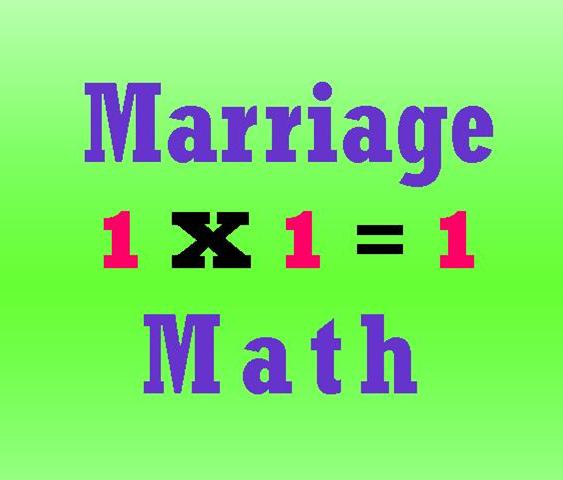
Marriage is NOT ½ + ½ = 1

That makes sense mathematically, but it’s inaccurate. God didn’t create us a half-people. God created us whole and complete. So our spouse is not our better half, he/she is our better whole.

Marriage is NOT 1 + 1 = 2

Again, this makes sense mathematically, but it is not biblical. Why? Because 2 is divisible, and the Bible makes it clear that a man and woman who are married are one flesh.

Marriage IS 1 X 1 = 1

Not only does this work mathematically, but biblically too. God sees marriage as one whole man and one whole woman coming together to make one whole marriage.

Not coincidentally, X (chi) is the first Greek letter of the name Christ. When Christ is at the center of a marriage, and when the husband and wife are more in love with Him than they are with their spouse, then a wholeness exists in the marriage.

1 X 1 = 1 is the type of marriage that glorifies God.

1 X 1 =1 is the type of marriage that is so lovely, friendly, and charming.

If you are single, keep yourself pure so you can bring your “oneness” as a gift to your future spouse. If you are married, keep the X—Jesus Christ—at the center of your marriage.

►► Would you please prayerfully consider supporting this ministry? ◀︎◀︎