Thursdays With Oswald—What’s Holding You Back?

Oswald ChambersThis is a weekly series with things I’m reading and pondering from Oswald Chambers. You can read the original seed thought here, or type “Thursdays With Oswald” in the search box to read more entries.

What’s Holding You Back?

[In these quotes, Oswald Chambers is commenting on a story recorded in Mark 10:17-22.]

    One thing you lack.” Do I really want to be perfect? Do I really desire at all costs to every other interest that God should make me perfect? Can I say with Robert Murray McCheyne—“Lord, make me as holy as You can make a saved sinner”? Is that really the desire of my heart? … 

     “Go, sell everything you have and give to the poor…. Then come follow Me.” These words mean a voluntary abandoning of riches and a deliberate, devoted attachment to Jesus Christ. We are so desperately wise in our own conceit that we continually make out that Jesus did not mean what He said, and we spiritualize His meaning into thin air. Jesus saw that this man depended on his riches. If He came to you or me He might not say that, but He would say something that dealt with whatever He saw we were depending on. …

     Never push an experience you have had into a principle by which to guide others. If you take what Jesus said to this man and make it mean that He taught we were to own nothing, you are evading what He taught, by making it external. Our Lord told the rich young ruler to loosen himself from his property because that was the thing that was holding him. …

     One of the most subtle errors is that God wants our possessions. He does not; they are not of any use to Him. He does not want my property, He wants myself.

From So Send I You

God wants you. All of you. He wants you without any strings attached to anything else.

“Is that really the desire of my heart?”

Listen closely to His voice. What is He asking you to loosen your hold on, so that you can hold on exclusively to Him? Don’t let temporary things hold you back from being perfectly His forever!

12 More Quotes From “Ordering Your Private World”

Gordon MacDonald did a phenomenal job synthesizing biblical principles as he teaches us how to pay attention to our private, inner world. One of the things I enjoyed was the number of other authors and teachers he quotes throughout Ordering Your Private World. Here are a few of those quotes he shared…

“The battle is lost or won in the secret places of the will before God, never first in the external world. … Nothing has any power over the man who has fought out the battle before God and won there. … I must get the things settled between myself and God in the secret places of my soul where no stranger intermeddles, and then I can go forth with the certainty that the battle is won.” —Oswald Chambers

“I took pleasure where it pleased me, and passed on. I forgot that every little action of the common day makes or unmakes character, and that therefore what one has done in the secret chamber, one has some day to cry aloud from the house-top. I ceased to be lord over myself. I was no longer the captain of my soul, and did not know it. I allowed pleasure to dominate me. I ended in horrible disgrace.” —Oscar Wilde 

“Think of no other greatness but that of the soul, no other riches but those of the heart.” —John Quincy Adams, in a letter to his daughter

“A public man, though he is necessarily available at many times, must learn to hide. If he is always available, he is not worth enough when he is available.” —Elton Trueblood

“Remember a long life of steady, consistent, holy labor will produce twice as much fruit as one shortened and destroyed by spasmodic and extravagant exertions; be careful and sparing of your strength when and where exertion is unnecessary.” —Catherine Booth, in a letter to her husband William Booth, founder of the Salvation Army

“There can be intemperance in work just as in drink. What feels like zeal may be only fidgets or even the flattering of one’s self-importance.” —C.S. Lewis

“The man of action has the present, but the thinker controls the future.” —Oliver Wendell Holmes

“No other pleasure suits every occasion, every age or every place. But the study of letters is the food of youth, the delight of old age, a delight at home and no burden abroad; it stays with us at night, and goes with us on our travels, near and far.” —Cicero

“We need to find God, and He cannot be found in noise and restlessness. God is the friend of silence. See how nature—trees, flowers, grass—grow in silence; see the stars, the moon and sun, how they move in silence…. The more we receive in silent prayer, the more we can give in our active life. We need silence to be able to touch souls. The essential thing is not what we say, but what God says to us and through us. All our words will be useless unless they come from within—words which do not give the light of Christ increase the darkness.” —Mother Teresa

“St. Augustine says, ‘God gives where He finds empty hands.’ A man whose hands are full of parcels can’t receive a gift. Perhaps these parcels are not always sins or earthly cares, but sometimes our own fussy attempts to worship Him in our way. Incidentally, what most often interrupts my own prayers is not great distractions but tiny ones—things one will have to do or avoid in the course of the next hour.” —C.S. Lewis

“Let inward prayer be your last act before you fall asleep and the first act when you awake.” —Thomas Kelly

“I know that there are certain mental and emotional and moral and spiritual attitudes that are anti-health: anger, resentments, fear, worry, desire to dominate, self-preoccupation, guilts, sexual impurity, jealousy, a lack of creative activity, inferiorities, a lack of love. These are the twelve apostles of ill health. So in prayer I’ve learned to surrender these things to Jesus Christ as they appear.” —E. Stanley Jones

You can check out my review of Gordon MacDonald’s Order Your Private World by clicking here. And you can read some quotes from Gordon by clicking here.

What Does The Bible Say About Church Leaders?

God’s plan has always been for His leaders to organize and oversee His ministry.

The important thing for us to distinguish is “His.” It’s not a man or woman saying, “I will be a leader,” or even a God-appointed leader saying, “I am going to build up my ministry.”

The New Testament gives us a fourfold purpose for the Body of Christ:

  1. Mobilizing for evangelism
  2. Organizing for more meaningful ministry
  3. Making disciple-makers
  4. Caring for one another

We see God’s leaders involved in all of these aspects—

Mobilizing for evangelism—Peter pointed out the need for an apostle to be appointed to replace Judas, thus returning their ranks to the 12 apostles just as Jesus had originally said (Acts 1:15-22).

Organizing for more meaningful ministry—Everywhere Paul founded a church, he also appointed leaders to oversee and shepherd that church.

Making disciple-makers—Paul tells us that God appointed five offices of leaders in the church who had the specific task of preparing church members to do the ministry of building maturity in the church (Ephesians 4:11-16).

Caring for one another—The First Church set the pace for providing care for all who were in need, including organizing leaders to oversee specific care ministries (Acts 6:1-5).

What about a church congregation’s responsibility to their leaders? I see five areas:

  1. Hold them accountable to the Word (Acts 17:11). The Bible has to be THE standard to which leaders are held.
  2. Give them your confidence and submission after they have shown accountability to their biblical mandate (Hebrews 13:17).
  3. Pray for them (Ephesians 6:19).
  4. Pay them (1 Timothy 5:17).
  5. Be very careful about accusing them (1 Timothy 5:19).

A church and its leaders following this biblical pattern is a church that can effectively fulfill the Great Commission which Jesus gave us.

Thursdays With Oswald—The One God Uses

Oswald ChambersThis is a weekly series with things I’m reading and pondering from Oswald Chambers. You can read the original seed thought here, or type “Thursdays With Oswald” in the search box to read more entries.

The One God Uses

     Missionary enterprise, to be Christian, must be based on the passion of obedience, not on the pathos of pity. … In the New Testament the emphasis is not on the needs of men, but on the command of Christ, “Go ye.” … 

     Any sense that the cause of Christ will be benefited if I give myself to it, or any trace of listening to the suggestion of others that I should be of value in my Lord’s service, receives no encouragement from Jesus. … 

     What is the test we put first for work at home or abroad? Sentimentally, we put the call of God first, but actually we are inclined to fix on the abilities of certain people. Our Lord pays not the remotest attention to natural abilities or natural virtues; He heeds only one thing—Does that man discern Who I am? does he know the meaning of My Cross? The men and women Jesus Christ is going to use in His enterprises are those in whom He has done everything. … 

     The one who says “Yes, Lord, but…” is always the one who is fiercely ready, but never goes. … 

     Beware of the inclination to dictate to God as to what you will allow to happen if you obey Him.

From So Send I You

God uses specific people for His service. They are ones who are:

  • Obedient to His call to “Go”
  • Humble
  • Changed from the inside out by Christ’s Atonement
  • Quick to follow
  • Not dictating to God the “where” or “when” or even the outcome of their obedience

Are you one whom God can use?

8 Quotes From Gordon MacDonald In “Ordering Your Private World”

In the quiet solitude of our inner lives is where real growth takes place. Or said another way: if we won’t make time to order our private world, our public world will be limited in its scope and effectiveness. Gordon MacDonald unpacks some fantastic principles to help us in his newly updated and expanded book Ordering Your Private World. Check out my full book review by clicking here, and then enjoy these quote from Gordon MacDonald.

“There is a busyness that reflects a plan of activity, a pattern of priorities, and a sense of purposefulness. It is a good and satisfying busyness through which one grows and increases competence. But there is also a busyness (a destructive busyness, actually) that reflects a chaotic way of life—a way of doing in which one is simply responding to the next thing in the day. The next thing! It makes no difference whether it has significance; it’s just the next thing, and one does it because it’s there to do.”

“A soul—our spiritual space—is empty when one tries to do soul-based things but makes little or no effort to keep that soul filled.”

“Driven people boast of their drivenness. They have forgotten how to play. Spiritual activity seems a waste of time. They are usually too busy for the pursuit of ordinary relationships in marriage, family, or friendship, or even to carry on a relationship with themselves—not to speak of one with God. Because driven people rarely think they have accomplished enough, they seize every available minute to attend more meetings, to study more material, to initiate more projects. They operate on the precept that a reputation for busyness is a sign of success and personal importance. Thus, they attempt to impress people with the fullness of their schedules.”

“Our careers, our assets, our natural and spiritual gifts, our health—are these things owned, or merely managed in the name of the One who gave them? Driven people consider them owned; called people do not. When driven people lose those things, it is a major crisis. When called people lose them, nothing of substance changes. The private world remains the same, perhaps even stronger.”

“It is worth taking time to ask how Our Lord’s command of time is demonstrated. … The first thing that impresses me is that Jesus clearly understood His mission. … A second insight into Jesus’ personal organization of time is that He understood His own limits. … Jesus included a third important element in His strategy of time budgeting, for He set time aside for the training of the Twelve.”

“Unmanaged time flows toward my weaknesses. Unmanaged time comes under the influence of dominant people in my world. Unmanaged time surrenders to the demands of all emergencies. Unmanaged time gets invested in things that gain public acclamation.”

“The unthinking Christ-follower does not realize it, but he is dangerously absorbed into the culture about him. Because his mind is untrained and unfilled, it lacks the ability to produce the hard questions with which the world needs to be challenged. The private world of a Christ-follower will be weak, defenseless, and disorganized if serious attention has not been given to this sector of intellectual growth.”

“We do not develop our intellects merely for our own personal advancement, but we put our thinking power to work for the use of others. … As my mind grows, it may make possible the growth of others.”

The Christian’s Secret Weapon

Over the past couple of weeks, people have been rattled by both real and imagined catastrophic events. We experienced a fabulous astronomical sight in a full solar eclipse, wept for our fellow citizens in Texas and Florida as hurricanes battered their businesses and homes, and then dealt with doomsayers who predicted the end of the world and the second coming of Jesus Christ.

Peter spent a lot of time right next to Jesus, soaking up His teaching and observing how Jesus lived. One thing Peter never saw in Jesus was panic.

So it’s not unexpected that Peter would write to followers of Jesus: Don’t fear what the world fears (1 Peter 3:14). Instead, Peter counsels his friends to keep their focus on Jesus.

Don’t run around in fear, but instead in your hearts set apart Christ as Lord. Some other translations say things like…

    • …revere Christ as Lord
    • …acknowledge Him as Lord
    • …worship Christ as Lord of your life
    • …keep your hearts at attention, in adoration before Christ (see 1 Peter 3:15)

In other words: let Jesus Christ be your focal point.

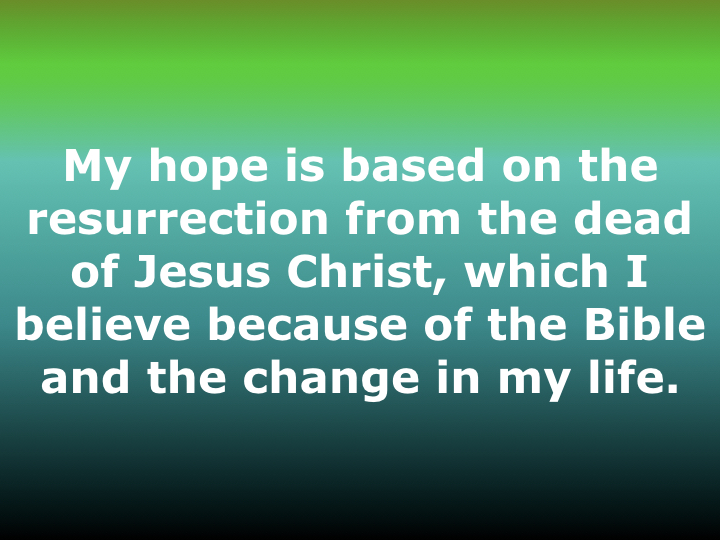
When you live this way—focused on the eternal Jesus and not the temporary shakings on earth—Earthlings are bound to notice that there is something different about you. So Peter tells us to always be prepared to give an answer to everyone who asks you the reason for the hope that you have.

Hope—not wishful thinking, but a rock-solid, joyful, confident expectation!

This hope is the Christian’s secret weapon!

This hope is unshakable during difficult times. This hope is unshakable on death’s doorstep. This hope is unshakable when the end of the world is predicted.

The Christian who has a personal experience of the hope that Jesus brings is never at the mercy of the happenings in the world nor the arguments from non-Christians.

But Peter cautions us to never use this hope as a club. He tells us to make sure we never use hope as a means of feeling superior to others. Instead we are to speak to others about our hope gently, respectfully, and with a clear conscience.

So here’s my question to you, fellow Christian: Can those around you see your hope? When they’re fearful and running for cover, do they see you right alongside them, or do they see you standing firm in hope as you keep your eyes fixed on Jesus. Your hope is a powerful persuader for a personal relationship with Jesus Christ!

If you’ve missed any messages in this series, you may find the complete list by clicking here.

The Mystery & Meaning Of Marriage

John Piper’s insight of both the Old Testament and New Testament meaning of marriage is profound!

Here are the links to the Scriptures he references:

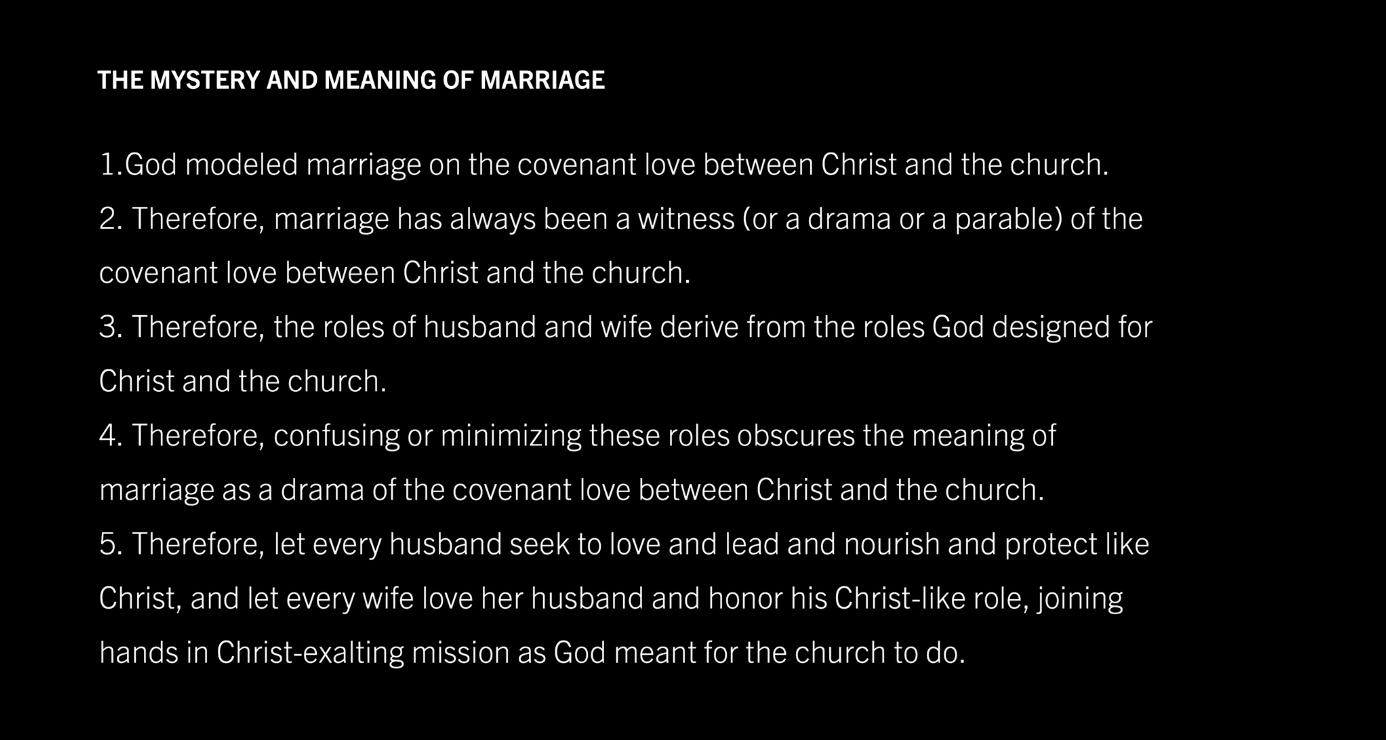
Piper’s conclusions:

  1. God modeled marriage on the covenant love between Christ and the church.
  2. Therefore, marriage has always been a witness (or a drama or a parable) of covenant love between Christ and the church.
  3. Therefore, the roles of husband and wife derive from the roles God designed for Christ and the church.
  4. Therefore, confusing or minimizing these roles obscures the meaning of marriage as a drama of the covenant love between Christ and the church.
  5. Therefore, let every husband seek to love and lead and nourish and protect like Christ, and let every wife love her husband and honor his Christ-like role, joining hands in Christ-exalting mission as God meant for the church to do.

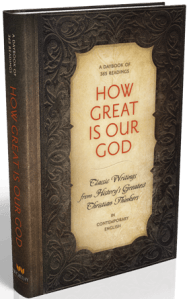
13 More Quotes From “How Great Is Our God”

Scholars, tradesmen, politicians, theologians, pastors, and martyrs—all have spoken or written about the greatness of God over the past two millennia. In How Great Is Our God we are treated to a sampling of these writings. Check out my full book review by clicking here, and then enjoy this second set of quotes.

“Some of us, no doubt, have to live outwardly solitary lives. We all live alone after fellowship and communion. We die alone, and in the depths of our souls we all live alone. So let us be thankful that the Master knows the bitterness of solitude, and has Himself walked that path. Jesus Christ’s union with the Father was deep, close, constant; altogether transcending any experience of ours. But still He sets before us the path of comfort for every lonely heart: ‘I am not alone, for the Father is with Me.’ If earth be dark, let us look to Heaven. If the world holds no friend, let us turn to Him who never leaves us. If dear ones are torn from our grasp, let us grasp God.” —Alexander Maclaren

“The blessedness of individuals must not be determined by the value of their known wealth, but according to the voice of their conscience within them.” —Ambrose

“If God gave you not only earth but heaven, that you should rule over sun, moon, and stars, and have the rule over the highest of the sons of men, it would not be enough to satisfy you, unless you had God Himself.” —Jeremiah Burroughs

“Father in Heaven! What is a man without You! What is all that he knows, vast accumulation though it may be, but a chipped fragment if he does not know You!” —Soren Kierkegaard

“Great are You, O Lord, and greatly to be praised; great is Your power, and Your wisdom is infinite. You awaken us to delight in Your praise; for You made us for Yourself, and our heart is restless, until it rests in You. They that seek the Lord shall praise Him: for they that seek shall find Him, and they that find shall praise Him. I will seek You, Lord, by calling on You; and will call on You, believing in You; for to us You have been preached.” —Augustine

“In the Old Testament, there are twenty times as many references to the second coming of Christ, as to His first coming. … The Cross must ever precede the Crown. He came with the Cross, fulfilling Isaiah 53; and now He is coming with the Crown, the Messiah and King.” —Aimee Semple McPherson

“The Word is the one Shepherd of things rational which may have an appearance of discord to those who have not ears to hear, but are truly at perfect concord. … For all the Scripture is the one perfect and harmonized instrument of God, which from different sounds gives forth one saving voice to those willing to learn, which stops and restrains every working of an evil spirit.” —Origen

“So desperate is the need that we have no time to engage in vain babblings. While we are discussing the exact location of the church of Galatia, men are perishing under the curse of the law; while we are setting the date of Jesus’ birth, the world is doing without its Christmas message.” —J. Gresham Machen

“If the Christian plan is true, then all others are false. If others are true, then there was no need of the sacrifice on the Cross.” —Albert Barnes

“I want through the day to walk with God; God has taken charge of me, He is going with me Himself; I am going to do His will all day in His strength; I am ready for all that may come.” —Andrew Murray

“When the time for the Advent of the Antichrist approaches, people’s minds will grow cloudy from carnal passions, and dishonor and lawlessness will grow stronger. Then the world will become unrecognizable. People’s appearances will change, and it will be impossible to distinguish men from women due to their shamelessness in dress and style of hair. 

There will be no respect for parents and elders, love will disappear, and Christian pastors, bishops, and priests will become vain men. At that time the morals and traditions of Christians and the Church will change. People will abandon modesty, and dissipation will reign. Falsehood and greed will attain great proportions; and lust, adultery, homosexuality, secret deeds, and murder will rule in society. 

At that future time, the churches of God will be deprived of God-fearing and pious pastors, and woe to the Christians remaining at that time; they will completely lose their faith because they will lack the opportunity of seeing the light of knowledge from anyone at all.” —Nilus the Elder (d. 430 AD) 

“It is the Bible itself that drives us out beyond ourselves and invites us, without regard to our worthiness or unworthiness, to reach for the last highest answer. … We need only dare to follow this drive, this spirit, this river, to grow out beyond ourselves toward the highest answer. This daring is faith; and we read the Bible rightly when we read it in faith. The Bible unfolds to us as we are met, guided, drawn on, and made to grow by the grace of God.” —Karl Barth

“Who is regulating affairs on this earth today—God or the devil? That God reigns supreme in Heaven, is generally conceded; that He does so over this world, is almost universally denied—if not directly, then indirectly. More and more are men relegating God to the background. … Therefore we need not be surprised that men exclude Him from the realm of human affairs. … In light of this [Isaiah 55:8-9], it is only to be expected that much of the Bible conflicts with the sentiments of the carnal mind, which is at enmity against God.” —Arthur Pink

You can check out the first set of quotes I shared from How Great Is Our God by clicking here. Stay tuned: more quotes coming soon!

This Is A Story

Is Jesus The Only Way?

“Sometimes people ask me ‘Is Jesus the only way?’ and of course the question alludes to a journey. It occurs to me that when attempting to be helpful in giving directions, some facts are more relevant than others. In this case, perhaps none more so than one: the question of destination. When asking ‘Is Jesus the only way?’ it begs at least one further question, which is ‘To what?’ or ‘To where?’

“In our society, it is not uncommon to hear the statement ‘All religions lead to God.’ Although it’s not a logical statement, I find the second part of it—the ‘lead to God’ bit—very interesting. There seems to be an awareness, however subconscious, however little thought through, that only God Himself is the appropriate destination. Where does this thought come from? …

“Don’t all religions lead to God? No, they don’t even claim to.

“I have found it helpful at times to ask, ‘What is the destination you are aiming for? What is the destination you hope would be true?’ It seems to me that in the search for truth and meaning, many of us are not primarily or only looking for logical answers, but for a response to the existential longing for true life.

“Jesus says that He has come so that we might have life and life in all its fullness—life abundantly. The Message translation puts it as ‘real and eternal life, more and better life than [you] ever dreamed of’ (John 10:10). But what I find so intriguing about this is that Jesus tells us not just that He will give us life, not just that He will change and transform our lives, not just that He will show us the way to life, but that He Himself is the life (John 14:6). In other words, He is the destination. There is one faith that does claim to lead to God: Jesus stands unique across the ages. He is not simply the means through which we might get to some other destination. He is not a means to an end. Relationship with Jesus is the end.” —Tanya Walker, in A New Kind Of Apologist