Listen to the podcast of this post by clicking on the player below, and you can also subscribe on Apple, Spotify, or Audible.
When we have a difficult coworker or team member, it’s very easy to fall into the trap of talking about them to others and avoid talking directly to them.
Getting counsel from others about this difficult person is important, but then we must use those insights to have a productive conversation directly with that team member. If we don’t talk directly to them, we’re ultimately gossiping about them, which is never productive. In fact, that gossiping will actually make the situation worse.
Shalom—the peace that comes from God—could be defined simply as “nothing missing.” But couldn’t it also be defined as “no one missing”? It sure could! What peace there is when no one is missing from Heaven! Check out more of this message here. And be sure to check out all of my videos on my YouTube channel.
“Despite the moon’s apparently simple shape, uniformitarian scientists have long had great difficulty explaining how it could form by natural processes apart from a supernatural Creator. One Harvard astrophysicist once quipped that the best explanation for the moon’s existence was observational error—the moon doesn’t really exist!” This is a very interesting post from the Institute for Creation Research.
“Do we not miss very much of the sweetness and efficacy of prayer by a want of careful meditation before it, and hopeful expectation after it? … We too often rush into the presence of God without forethought or humility. We are like people who present themselves before a king without a petition, and what wonder is it that we often miss the end of prayer? We should be careful to keep the stream of meditation always running, for this is the water to drive the mill of prayer. … Prayer without fervency is like hunting with a dead dog, and prayer without preparation is hawking with a blind falcon. Prayer is the work of the Holy Spirit, but He works by means. God made man, but He used the dust of the earth as a material. The Holy Ghost is the Author of prayer, but He employs the thoughts of a fervent soul as the gold with which to fashion the vessel. Let our prayers and praises be not the flashes of a hot and hasty brain but the steady burning of a well-kindled fire.” —Charles Spurgeon, in Spurgeon and the Psalms
What a powerful word to pastors from T.M. Moore’s post First Things First. “Pastors sometimes complain that their people don’t seem very hungry or thirsty for the things of the Lord. Sated on the junk food of getting-and-spending, generously ladled over with pop culture, God’s people have little appetite for Christ or His Word. But what about us? Does our hunger and thirst for Christ make them long for the same? Do they see in us that earnest desire to be with the Lord that tells them they’re missing something of great importance? Loving Christ and delighting to be with Him is infectious. If the people we serve see it in us, they’ll want it for themselves, more than anything this world might offer.”
We don’t read about Jesus getting angry that often, but what usually got Him upset was when people in need were being kept from the God who could meet their needs. Sadly, it was usually man-made rules and practices that kept people away. I don’t want to make Jesus angry, so I need to evaluate anything in my life that may be standing in the way of connecting needy people with a need-satisfying God.
“So in our broader culture, people no longer sin; they make mistakes. What about our Christian environment? In our case, sin is not denied. Instead it is often redefined to refer to the more flagrant sins of society. We tend to ignore our own sins of pride, selfishness, gossip, and the like. So, effectively, no one sins anymore. The reason is that we have lost sight of the biblical meaning of sin. Typically, if we are not actually murderers, felons, or adulterers, we tend to think of our common sins as no more serious than a parking violation. We are so used to living with pride, selfishness, envy, gossip, and a whole host of other ‘respectable sins’ that we don’t even think of them as sin. But the fact is that, as serial sinners, we are all as guilty before God as that murderer. You and I sin every day in thought, word, deed, and motive. And whether those sins appear great or small in our own sight, in reality every sin we commit is an act of rebellion against God, a rejection and attempted negation of His sovereignty and rulership over us.” —Jerry Bridges
Listen to the podcast of this post by clicking on the player below, and you can also subscribe on Apple, Spotify, or Audible.
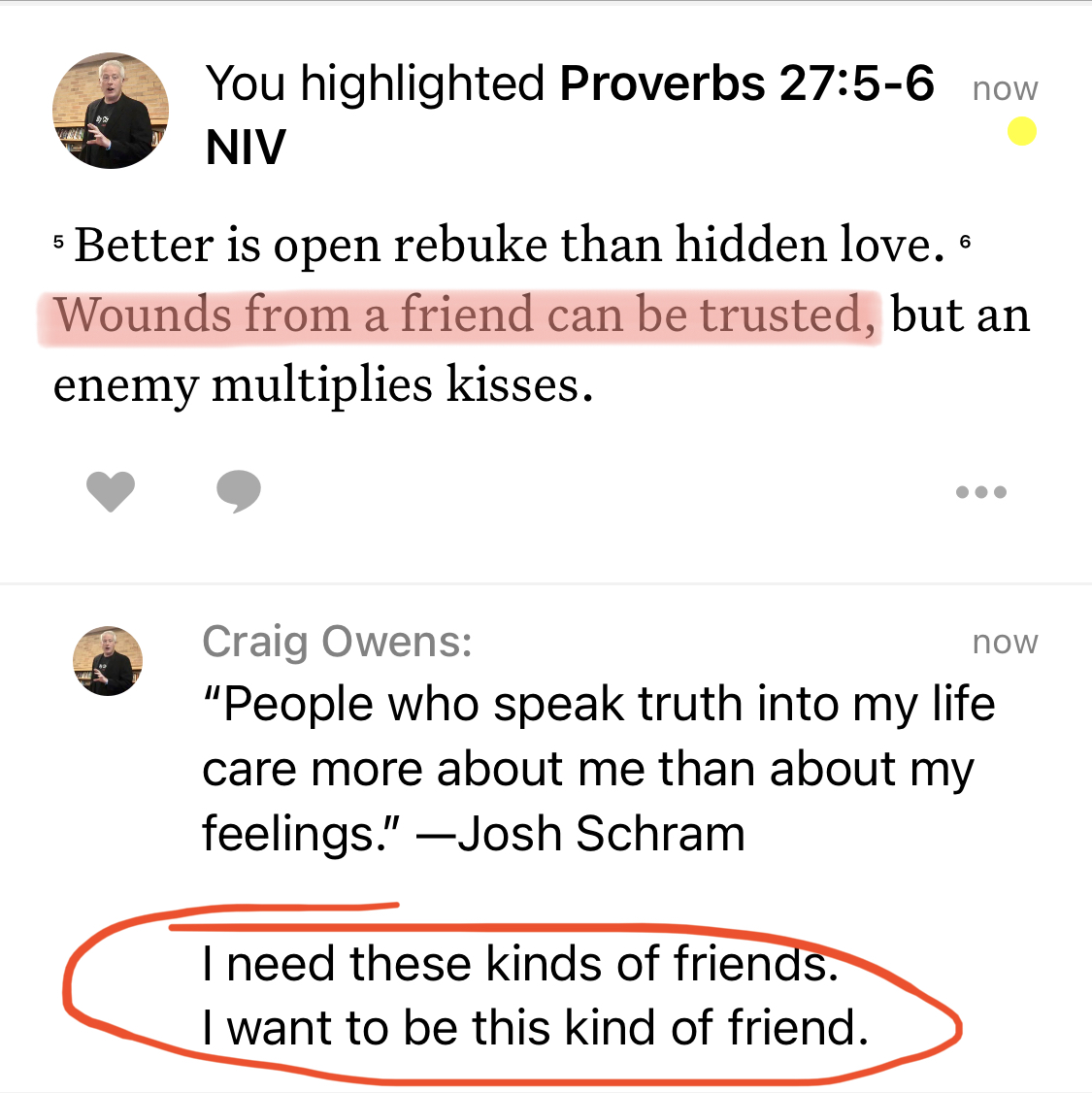
Wounds from a sincere friend are better than many kisses from an enemy (Proverbs 27:6 NLT).
Proverbs 27 may have more wisdom about our friends than any other chapter in this book. But sprinkled throughout the entire book of Proverbs is outstanding wisdom about our closest relationships. Allow me to share just a few observations with you.
Friends love me through my worst moments (17:17) because they have committed to stick closer than a brother to me (18:24).
I must be careful not to make friends with a hot-tempered person (22:24), and to be cautious of people who want to be friends with me only for what I can give them (19:4).
My true friends will wound me in love to help me become the best that God intended me to be (27:5-6, 9, 17), so I must never forsake these friends (27:10).
False friends will gossip to me and about me, but my true friends will guard my secrets and guard my reputation (16:28; 17:9).
In order to have true friends, I first have to be a true friend.
David was the gold standard for every king of Israel who followed him. Numerous times throughout the history of Israel, we will see a note that a certain king either followed God like David, or turned from God unlike David. Yet there exists a wart on David’s portrait: an adulterous affair with the wife of a man in his inner circle, and then subsequent lies and a murder to cover up the affair. “The thing David had done displeased the Lord” (see 2 Samuel 11).
But I’d like to turn your attention to when this affair occurred: “In the spring, at the time when kings go off to war…David remained in Jerusalem” (2 Samuel 11:1). He was without his usual comrades. The men who knew David best, who could probably sense if something was amiss, weren’t around to warn him. When David tried to find out the identity of the bathing beauty on the roof next door to his palace, an unnamed attendant tried to remind him, “Isn’t that Bathsheba, the wife of Uriah?” but David dismissed him.
Elijah was arguably the most forceful and fearless prophet in Israel’s history. Not only did he stand up to the evil kings of Israel, but he spoke out against the kings of surrounding nations, too. In answer to Elijah’s prayer, God brought a drought on the land, and again in answer to Elijah’s prayer, God sent rain. Elijah challenged the 450 prophets of the god Baal and the 400 prophets of the goddess Asherah to a duel to the death, which ended up in a decisive victory for Yahweh. Yet, shortly after this massive victory, Elijah was depressed to the point that he wanted to die.
What led to Elijah’s depression? Something very similar to David’s slide into adultery: He was alone. Elijah ran away from Queen Jezebel’s death threat, left his servant behind, and proceeded all by himself into the desert. It was when he was without a comrade that he prayed to God, “I’ve had enough. Take my life” (see 2 Kings 17–19).
And what about Peter? He boldly claimed his loyalty to Jesus, even to the point of wielding a sword at the guards who came to arrest his Master. But when Peter was alone, after the other disciples fled, he denied three times that he knew Jesus (Matthew 26:33, 51, 69–75).
God designed us to be in relationship with others. His statement to Adam in some of the earliest words of the Bible—“It is not good for you to be alone”—are words for us still today. —from the chapter “Going Farther”
We need true, God-fearing friends close to us. Ask God to bring those friends around you, and ask the Holy Spirit to make you into that kind of friend for those He does bring around you.
Max Lucado takes us in for a closer look at the Cross and all that Jesus did there for us. Please check out my full book review and then read this book—you will be glad you did!
“Maybe you’ve never spit on anyone, but have you gossiped? Slandered? Have you ever raised your hand in anger or rolled your eyes in arrogance, have you ever blasted your high beams in someone’s rearview mirror? Ever made someone feel bad so you would feel good? That’s what the soldiers did to Jesus. When you and I do the same, we do it to Jesus too. ‘I assure you, when you did it to one of the least of these My brothers and sisters, you were doing it to Me!’ (Matthew 25:40 NLT). How we treat others is how we treat Jesus. …
“Allow the spit of the soldiers to symbolize the filth in our hearts. And then observe what Jesus does with our filth. He carries it to the Cross. Through the prophet He said, ‘I did not hide My face from mocking and spitting’ (Isaiah 50:6). Mingled with His blood and sweat was the essence of our sin.”
“‘He canceled the record that contained the charges against us. He took it and destroyed it by nailing it to Christ’s Cross’ (Colossians 2:14 NLT). Between His hands and the wood there was a list. A long list. A list of our mistakes: our lusts and lies and greedy moments and prodigal years. A list of our sins. Dangling from the Cross is an itemized catalog of your sins. The bad decisions from last year. The bad attitudes from last week. There, in broad daylight for all of heaven to see, is a list of your mistakes. … The list God has made, however, cannot be read. The words can’t be deciphered. The mistakes are covered. The sins are hidden. Those at the top are hidden by His hand; those down the list are covered by His blood. Your sins are ‘blotted out’ by Jesus (KJV). ‘He has forgiven you all your sins: He has utterly wiped out the written evidence of broken commandments which always hung over our heads, and has completely annulled it by nailing it to the Cross’ (Colossians 2:14 Phillips).”
“Seats at God’s table are not available to the sloppy. But who among us is anything but. Unkempt morality. Untidy with truth. Careless with people. Our moral clothing is in disarray. Yes, the standard for sitting at God’s table is high, but the love of God for His children is higher. So He offers a gift.… a seamless robe… a robe worn by His Son, Jesus.”
“What appeared to be the cruelty of man was actually the sovereignty of God. Matthew tells us: ‘And when Jesus had cried out again in a loud voice, He gave up His spirit. At that moment the curtain of the temple was torn into from top to bottom’ (27:50-51). It’s as if the hands of heaven had been gripping the veil, waiting for this moment.”
“Why is the Cross the symbol of our faith? To find the answer look no farther than the Cross itself. Its design couldn’t be simpler. One beam horizontal—the other vertical. One reaches out—like God‘s love. The other reaches up—as does God’s holiness. One represents the width of His love; the other reflects the height of His holiness. The Cross is the intersection. The Cross is where God forgave His children without lowering His standards.”
“‘Just look what they did to me!’ we defy and point to our hurts. ‘Just look what I did for you,’ Jesus reminds and points to the Cross. Paul said it this way: ‘If someone does wrong to you, forgive that person because the Lord forgave you’ (Colossians 3:13). You and I are commanded—not urged, commanded—to keep no list of wrongs.”
“Knowing His last deeds would be forever pondered, don’t you think Jesus chose them carefully? Deliberately? Of course He did. There were no accidents that day. Jesus’ last moments were not left up to chance. God chose the path; He selected the nails. Our Lord planted the trio of crosses and painted the sign. God was never more sovereign than in the details of the death of His Son. … The message: ‘I did it for you. I did it all for you.’”
[Each chapter in the Book of Proverbs contains thoughts that fit into a theme; they are not just random thoughts gathered together. In this “Saturday In The Proverbs” series, I will share a theme that I see in each chapter. But the cool thing about God’s Word is that you may see an entirely different theme. That’s great! If you do, I would love for you to share it in the comments below.]
[Each chapter in the Book of Proverbs contains thoughts that fit into a theme; they are not just random thoughts gathered together. In this “Saturday In The Proverbs” series, I will share a theme that I see in each chapter. But the cool thing about God’s Word is that you may see an entirely different theme. That’s great! If you do, I would love for you to share it in the comments below.]
Wine is a mock, strong drink is a brawler, and whoever is led astray by it is not wise (Proverbs 20:1).
This collection of proverbs warns against things that impair a person’s judgment, or things that set us up for failure. Things like…
intemperance (v. 1)
making leaders angry (vv. 2, 8, 26)
starting petty quarrels (v. 3)
laziness (vv. 4, 13)
shallow thinking (vv. 5, 12, 25)
unfaithfulness or a lack of integrity (vv. 6, 7, 11, 27)
Now that you know these items that set you up for failure, ask the Holy Spirit to help you root any of these out of your lifebefore failure happens to you!
[Each chapter in the Book of Proverbs contains thoughts that fit into a theme; they are not just random thoughts gathered together. In this “Saturday In The Proverbs” series, I will share a theme that I see in each chapter. But the cool thing about God’s Word is that you may see an entirely different theme. That’s great! If you do, I would love for you to share it in the comments below.]
A wise servant will rule over a son who causes shame… (Proverbs 17:2).
There are inevitable outcomes for our attitudes and (in)actions. Or said another way: We always reap what we sow.
Not dealing with confrontation correctly →→ Strife (v. 1)
Wise work ethic →→ Leadership rewards (v. 2)
Allowing God to refine you →→ A pure heart (v. 3)
Listening to lies and slander →→ Punished by God (v. 4)
Mocking the less fortunate →→ Punished by God (v. 5)
Living well →→ Leaving a legacy for my children (v. 6)
Truthful, uplifting speech →→ Being treated like a prince (v. 7)
Lies and loose lips →→ Being treated like a fool (v. 7)
Giving gifts to others →→ Favor with others (v. 8)
Forgiving and forgetting an offense →→ Cementing a friendship (v. 9)
Telling others about an offense →→ Losing a friendship (v. 9)
Rebuking a wise man →→ Gaining wisdom (v. 10)
Rebuking a fool →→ Getting rebuked myself (v. 10)
Rebellion →→ Repaid with cruelty (v. 11)
Trade folly with a fool →→ Get mauled (v. 12)
Repay good with evil →→ Get stuck with evil (v. 13)
Keep picking a fight →→ Open a world of hurt (v. 14)
Justify the wicked or condemn the just →→ Displace God (vv. 15, 26)
Give wisdom to a fool →→ Get burned (v. 16)
Love your friends →→ Have help in difficult times (v. 17)
Make a bad deal →→ Get stuck with it for a long time (v. 18)
Love sin and promoting yourself →→ Watch it all crash down (v. 19)
Look for deceit →→ Fall into evil (v. 20)
Don’t discipline your children →→ No joy (vv. 21, 25)
Be happy →→ Make others happy (v. 22)
Be sad →→ Cause rotten feelings in others (v. 22)
Accept a bribe →→ Pervert justice (v. 23) and displease God (v. 15)
Keep focused on the here-and-now →→ Get wisdom for there-and-then (v. 24)
Use words sparingly →→ Bring calm (v. 27)
Stay silent when you have nothing good to say →→ Be thought of as wise (v. 28)
If you don’t like what you’re reaping in your life, check what you’re sowing.
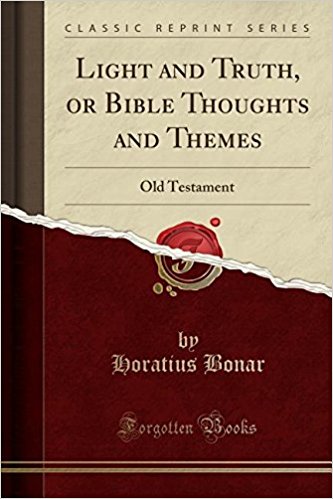
I like to think of Horatius Bonar as a tour guide as I read through the Bible, pointing out themes and insights I might have otherwise missed. Check out my full review of Light and Truth—Old Testament by clicking here.
“The elders[1 Chronicles 21:16]. They acknowledge the stroke and the sin: ‘It is the Lord.’ They clothe themselves in sackcloth, they fall upon their faces. So far as we know, they had not shared David’s sin, yet they at once place themselves by his side in confession and humiliation. David had sinned (v. 8), Israel had sinned (2 Samuel 24:1). They identify themselves with both. It is thus that we should take up a ruler’s sin, or a brother’s sin, or a nation’s sin; not blazoning it abroad in private gossip, or in the newspapers, but taking it on ourselves, and carrying it to God.”
“We do great injustice to the Old Testament saints and to their privileges, and no less so to the God who made them what they were, when we conceive of them as possessing an imperfect justification, or an imperfect and uncertain knowledge of their justification. Paul’s declaration was explicit on this point: ‘I know Whom I have believed’; and yet it was not a jot more explicit than that of Job: ‘I know that my Redeemer lives.’ When Paul said, ‘It is God that justifies, who is he that condemns?’ he was only speaking what Job had spoken in ages before: ‘I know that I shall be justified. Who is he that will plead with me?’” [Job 13:18-19]
“Everything in God’s character, has by the Cross of Christ been turned into a reason for trusting Him. The more man knows of Him the more he trusts. Trust is the natural and inseparable response of the soul to the divine revelation of the character of God. It is not what man sees in himself, of his good deeds or good feelings, of his graces, or his repentance, or his regeneration, or his faith; but what he sees in God, that calls out confidence.”
“It is with no distant, unheeding God that we have to do; but with that God who fixes the bounds of our habitation, who counts our hairs, who feeds the ravens, notes a sparrow’s death, clothes the lilies of the field. He is nearer to us than the nearest earthly object or being; more closely in contact with us than we are with one another.”
“We disjoined God from creation, and so see nothing in it of divine life and power. … The separation of God from His works is one of the awful features of human unbelief. How much more of Him should we know, were we to interpret His works aright. … These skies of His are not bent over us in beauty without a meaning. These seas of His do not roll for nothing. These flowers of His are not fragrant and fair for nothing. They do not say to us, ‘God is your enemy, He hates you’; but ‘God is your friend, He pities you, yearns over you, wishes to make you happy.’ How full a gospel does creation to preach to us, according to its kind and measure!”
I love technology! I love how social media and my iPhone can keep me in touch with family and friends. But one of the dark sides to this easy access to technology is the ease with which people can gossip—or even slander!—people publicly online. In his book #struggles, Craig Groeschel has some good counsel for avoiding gossip.
“God is crystal clear on how He feels about gossip. Solomon said, ‘There are six things the Lord hates, seven that are detestable to Him…a false witness who pours out lies and a person who stirs up conflict in the community’ (Proverbs 6:16, 19). What a perfect way to describe a gossip: ‘A false witness who pours out lies,’ and someone who ‘stirs up conflict in the community.’ God hates that.”
“The people being gossiped about hate it, and God hates it. So before you post, comment, or link, consider three sets of questions to keep yourself gossip-free online.
Is what I’m about to say helpful or hurtful? Will this build others up or tear them down? What’s my intention behind what I’m about to type? [Ephesians 4:29]
Am I making private matters public? Am I about to share something that would be better handled privately? [Proverbs 11:12-13]
Am I permitting—maybe even encouraging—others to gossip? It’s not only wrong to dish it out; it’s also wrong to eat it up. Notice that this verse [Proverbs 17:4] doesn’t say that only gossipers are wrongdoers. No, it says wrongdoers are also those who ‘listen to gossip.’ It’s not just wrong to spread gossip; it’s wrong to consume it. Why? Because what you permit, you promote.”
You can read my review of #struggles by clicking here. I have also posted other quotes from this book here and here.
If you argue your case with a neighbor… (Proverbs 25:9). Notice the first word of this proverb is “IF” which tells me I don’t have to argue. But if I do, then here are eight things to remember.





 This collection of proverbs warns against things that impair a person’s judgment, or things that set us up for failure. Things like…




 Craig T. Owens