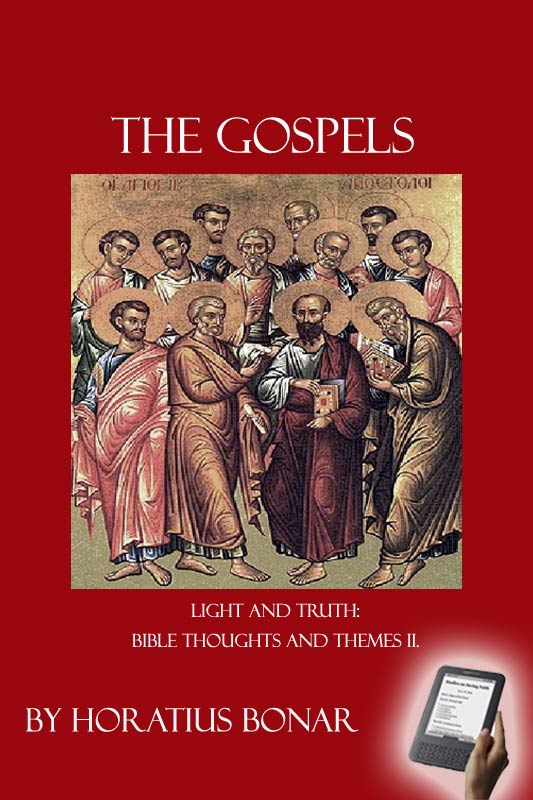
 There is a series of book by Horatius Bonar called Light And Truth. I am currently reading one of the books in the series as I read through the New Testament in my personal devotional time. Typically I post a book review after I’ve finished a book (which I will do with Light And Truth [update: the review is posted here]), and then I share some quotes from that book. In this case I’m mixing things up a bit: I’m sharing some quotes from the first half of this book today, and then I’ll post a review and more quotes after I finish the book. Enjoy!
(Note: Scripture references appearing in brackets following the quote reflects the passage or verse on which Bonar was commenting.)
“What is at the bottom of all the persecutions of various ages? It is Christ troubling the world. If He would let it alone, it would let Him alone. What means the outcry, and alarm, and misrepresentation, and anger, in days of revival? It is Christ troubling the world. What means the resistance to a fully preached gospel? It is Christ troubling the world. A fettered gospel, a circuitous gospel, a conditional gospel—a gospel that does not truly represent Christ—troubles no man; for in such cases it is another Christ that is announced, and not the Christ, the King of the Jews, that troubled Jerusalem. But a large, free, happy, unconditional gospel, that fully represents Jesus and His grace, Jesus and His completeness, does trouble men. It troubles all to whom it comes, in some measure. Some it troubles and then converts; some it only troubles. … The world’s only hope is to be ‘troubled’ by Christ. … Yet all this troubling is in love. He sounds His trumpet to awake the sleepers.” [Matthew 2:3]
“The Lord ends speaking and begins working; He comes down from the pulpit and enters the hospital. Such is His whole life: words and deeds intermingled; words of health and deeds of health. His lips breathe fragrance, and in His hand is the balm of Gilead. … [The leper] wants to be made clean, and he casts himself on Christ for this. He is the hyssop, the water, the blood, the ashes, the priest, the physician, all in one. Thus we still come, doubting neither the willingness nor the power, yet casting ourselves on the will of the Lord; not presuming to dictate, yet appealing to His sovereign Grace. As the needy, the sick, the unclean, we come; for the whole need not a physician, but they that are sick.” [Matthew 8:1-3]
“It is the voice of authority. It reminds us of Genesis 1:2-3. He speaks as one who knew that He could cure. Not hesitatingly. Nor are the words a prayer, but a command. He speaks, and it is done. … Thus love, authority, and power are all conjoined. It is the voice of Omnipotence. … He is the same Christ still; with the same love, and authority, and power. He is still a Healer, and the worst of diseases fly from His touch and voice. Let us go to Him with all that afflicts us. He calls and He will heal us of all. … Be persuaded to present thyself to Him, just as thou art give this divine Healer thy simple confidence. Take Him for what He is, and He will take thee for what thou art. Thus shalt thou meet in love; thou to be healed, and He to heal; thou to have the joy of being healed, and He to have the joy of healing thee, and to announce to heaven, in the presence of the angels of God, that another leper has been healed!” [Matthew 8:1-3]
“And is not this oftentimes the very point of the difficulty we experience in believing? We cling to the visible, the palpable prop—the human rope which we hold in our hand, unwilling to let go. We speak of our inability to believe; but what is this save our tenacity in holding on to the very things which God asks us to quit? We say that we ‘cannot lay hold’; should we not rather say that we ‘cannot let go’? We complain that we have no power to cling and grasp; whereas it should be that we have no will to let go.”
“As iniquity increases, faith decreases. … As iniquity increases, truth decreases. … As iniquity increases, righteousness and holiness decrease. … As iniquity increases, religion decreases. … As iniquity increases, delight in the things of God decreases. … But the special thing of which Our Lord predicts the decrease is love—love to God, love to himself, love to one another.” [Matthew 24:12]
“Our Lord will come! This is one of the great certainties of the unknown future. He may tarry, but He will come at last. Many obstacles made seem to rise up, but He will come. Men may not desire Him, but He will come. The Church may be cold, but He will come. Earth may think she has no need of Him, but He will come! The scoffer may say, where is the promise of His coming? but He will come. satan may do His utmost to oppose; but He will come. This is the great future certainty which Christ and His apostles have proclaimed to us. Our Lord will come! … The hour is, no doubt, fixed in God’s purpose, but the knowledge of that time is kept from us. They do wrong, then, who try to fix the hour, thus seeking to extract a secret from God. They do wrong who neglect the whole subject because this secret is connected with it. They do wrong who scoff at the whole subject because of the rash attempts or wretched failures of some pretended interpreters of prophecy. Thus, ‘we know,’ and ‘we know not’: we know that He will come, we do not when. … Beware of falling under any influences that would make you indifferent to the Lord’s appearing. Beware of worldly arguments; beware of pretended spiritual arguments; beware of confounding death and Christ’s coming; beware of the errors and seductions of the age.” [Matthew 22:42, 44]
“Ah, does not our faith often thus fail just at this point? We can go to Him for a little thing; we cannot go to Him for a great thing. We count it presumption to expect much. Instead of feeling that the worse the case, the greater the glory to His power and love, we stop short, and cease to expect anything from Him at all. I need not trouble the Master, we say, my case is so desperate; instead of saying, because my case is so desperate, I will trouble Him, I will give Him this opportunity of magnifying His skill and grace.” [Mark 5:36]
“Understand what is passing day by day; interpret events; connect them with the coming of the Son of Man. You see false Christs; you hear a Babel of opinions; you mark the new forms of immorality and infidelity; you are startled with the bold assaults made on Scripture, and on the Christ of God, on His blood, and Cross, and righteousness—connect all these with the coming of the Lord; interpret them as signs of the last days; do not treat them as common things; do not close your eyes upon them; do not be indifferent to them; do not admire them as tokens of intellectual development and human progress. Understand them all according to God’s purpose and mind. Examine them in the light of apostolic teachings and warnings. Be not deceived concerning them. Beware of the strong delusion. … Pray, then, for a needy church, that in all these respects God would visit her; raising her up; reviving her; rekindling her light; reinvigorating her strength; re-adorning her with all gifts and graces; reclothing her in apostolic raiment, and sending her forth to do His work with the old power and success of primitive days. Pray for a needy world. It is blind, and knows it not; poor, and thinks itself rich; foolish, and thinks itself wise. It is doubly needy. It is not aware of the extent of its ruin, and alienation, and depravity; not alive to its danger and hopeless prospects; not anticipating its doom. There is a hardening, and searing, and blinding process going on in connection with ‘modern progress.’” [Mark 13:33]



 Here are the books I read and reviewed in 2015. Click a title to read the review…


 Craig T. Owens
9 Quotes From “Light And Truth in the Gospels”
September 23, 2015 — Craig T. Owens“Man’s love of man is according to merit, on expectation of response; God’s love of man has no reference to deserving or to return. Man’s love of man is contracted, exclusive, and grudging; God’s love to man is as boundless as it is free. He forgives without condition; He loves without reserve; He blesses without measure or end.”
“God takes man as he is, simply a sinner, ‘without strength,’ and without goodness. He does not ask man to meet Him halfway between earth and heaven; He comes down all the way to earth in the Person of His Incarnate Son. He does not resort to half-measures, nor is He content with half-payment. He comes down to man in absolute and unconditional love; without terms or bargains; Himself paying the whole price, and thus leaving nothing for the sinner but to except the frank forgiveness which His boundless love has brought.”
“Our giving depends much on the state of our minds at the moment. When depressed, we have no pleasure in giving; we either refuse, or we give merely to get quit of the applicant. Darkness of mind shrivels us up, makes us selfish, neglectful of others. When full of joy, giving seems our element—our joy overflows in this way; we cannot help giving; we delight in applications; we seek opportunities of giving. So with the blessed God. Being altogether happy, His delight is to give; His perfect blessedness flows out in giving. We can never come wrongly to such an infinitely happy Being.”
“From Genesis to Revelation we hear His voice. It is the voice of love. ‘Come unto Me’ is the burden of the Old Testament as well as of the New. It is not merely that each chapter speaks of Jesus; but in each chapter Jesus speaks to us. And each verse, He is lying in wait for us.”
“Poor wanderer, you need not then try to cover your rags, or to hide your filth, or to try to make yourself more like what you were in order to attract your Father. It is just that which you are which excites His compassion. … God comes up to the sinner with the fullness of reconciliation in His heart. He does not stay to be entreated, or pleaded with, or persuaded. He hastens up to us, and embraces us in the fullness of His heart.”
“We poor prodigals must be gloriously clad! Not sack cloth, nor cast-off raiment, nor a servant’s dress; not Adam’s nor an angels’ righteousness; but something better than all—the robe of Jesus! … The prodigal is not to go in search of it. It must be brought out to him. On the spot; just where he is and as he is, bring it out, bring it to him. … It is not, ‘Give it to him, and let him put it on himself’; but, ‘Put it on.’ He has but to stand still and allow himself to be thus clothed and blessed. He does nothing. He does not need to do anything. Love does it all. The Father does it all.”
“What is the meaning of God sending His own Son, if less than salvation was intended; if less than Incarnation will do, less than blood, less than death, less than resurrection? Oh let us understand the greatness of God’s provision for us, and in that greatness, read at once our death and our life, our condemnation and our deliverance.”
“Yes; any time, any place, will do for Jesus. His grace is not circumscribed by temple walls, nor tied to ceremonies, nor limited to hours. Samaria, Jericho, Tyre, Jerusalem are all the same to Him. The temple, the highway, the hill-side, the sea-beach, the synagogue, the house, the boat, the graveyard, are all alike to Him and to His grace.”
“Over all Scripture the quickening, life-giving fragrance of His name is defused. Christ and life; life in Christ; Christ our life—these form the very essence, the sum and burden, of the Scriptures. ‘These are they that testify of Me.’”
Check out my review of Light And Truth by clicking here.
Share this: