Listen to the podcast of this post by clicking on the player below, and you can also subscribe on Apple, Spotify, or Audible.
Every monarch or president on the planet has certain protocols for anyone who interacts with them. There are requirements on how to walk into the room, titles that have to be used, the way you have to act, things you can or can’t say, and the list goes on and on.
So it’s natural to think that this is how we also have to approach the Sovereign King of the Universe. But this King so desires intimate conversation with His people that Jesus gave us this simple protocol: “Our Father” (Matthew 6:9-13).
Jesus told us that He wanted us to dispense with the world’s expected protocols. He said that when we approach God, those protocols are gone. In the preceding verses, He told us that we pray…
…NOT for show or else we are called hypocrites—putting on an act or performance to earn applause or approval.
…NOT with “alien” vocabulary or else we are pagans—adopting manners that aren’t our own as a means to be accepted.
The prayers of Jesus seldom sound like our modern idea of “prayer.” Instead, they sound more like an everyday conversation when He’s talking to His Father, and the sound like commands when He’s casting out demons or healing diseases (see examples in Matthew 8:3, 13, 26, 32; John 11:40-44).
Jesus also reminded us that we pray because…
He told us to
He wants us to seek God’s Kingdom
He wants us to receive God’s Kingdom
He wants us to live in the power of God’s Kingdom every single moment
Let me repeat: our protocol for prayer is nothing like the world’s protocols for interacting with rulers. Our protocol is simply coming to our Heavenly Father in simple, childlike love and anticipation.
Kingdom praying should be as natural as talking to the most loving Father you can imagine!
Check out the others messages in our series Kingdom Prayingby clicking here.
Jesus made it clear time and time again that He came to reveal the Kingdom of God to us. He described what the Kingdom was like and told us that He came to be the means by which we could enter God’s Kingdom.
He also told us how God’s children could access the power and privileges of our Heavenly Father through the means of prayer. He assured us with words like, “Do not be afraid, little flock, for your Father has been pleased to give you the Kingdom” (Luke 12:32).
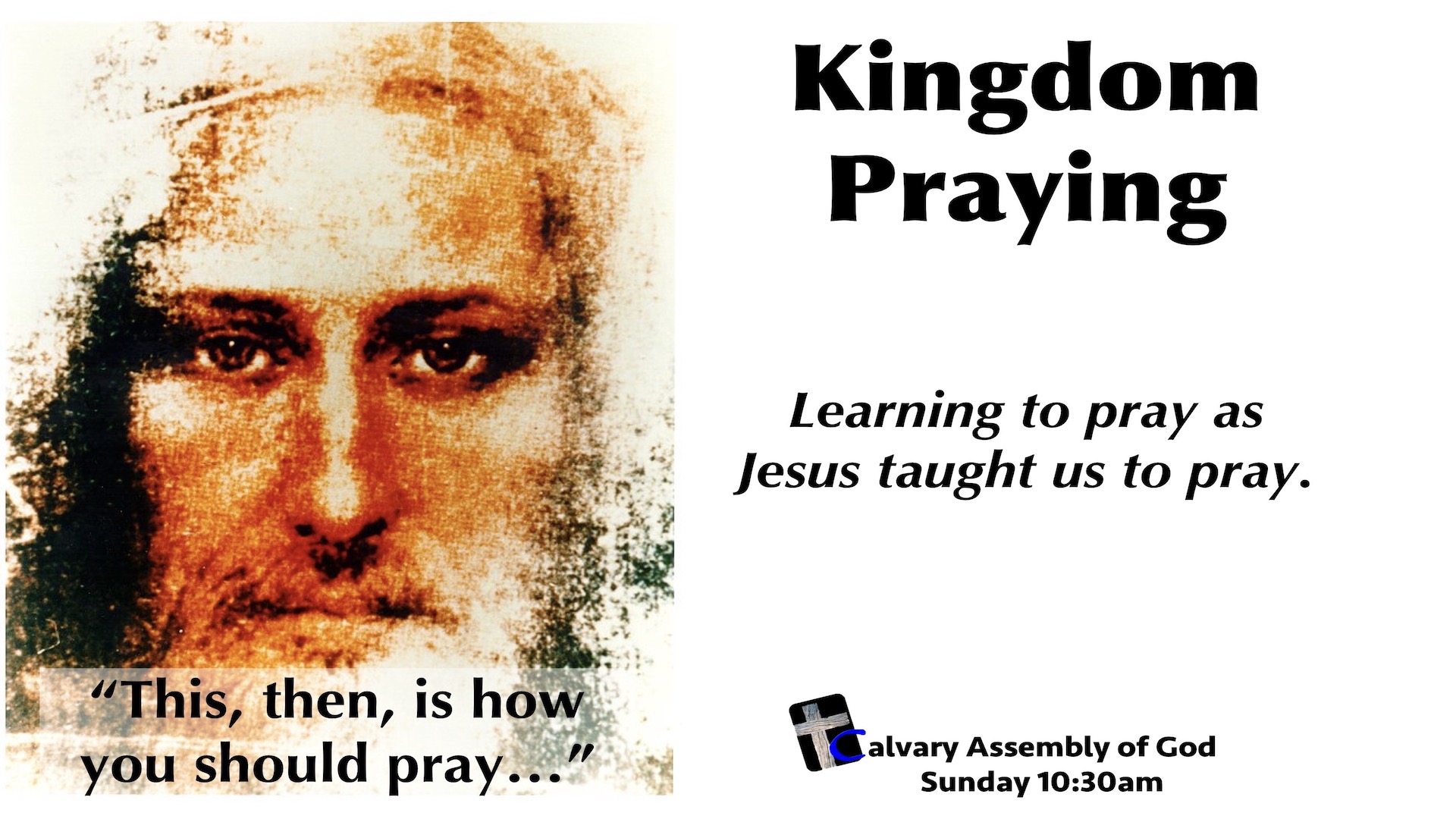
Jesus said quite simply that we had access to our Father through prayer. And then to make sure we didn’t miss out on this awesome privilege, He instructed us, “This, then, is how you should pray” (Matthew 6:8).
Please join me this Sunday as we go point-by-point through this Kingdom-accessing model prayer. We will learn just how truly expansive and all-encompassing this short prayer is.
Listen to the podcast of this post by clicking on the player below, and you can also subscribe on Apple, Spotify, or Audible.
I once worked with a guy that was the epitome of “all talk and no action.” After a while people just stopped listening to him or believing anything he said. But something worse is someone who says he will do something but doesn’t have the power to finish what he started. In that case, you may have believed him and not taken any steps of your own, so when he finally admits defeat, you are totally unprepared to step in to help finish the task.
I think that comes close to the two attitudes people had prior to the First Advent of Jesus in Bethlehem. Some people thought all of God’s promises had just become “all talk and no action.”
But after Jesus began His public ministry, His skeptics may have originally thought He was also“all talk and no action,” but when they saw how the people responded to Him, they realized He at least had the power to sway a crowd. But they certainty didn’t think He could finish what He started.
The religious elite—the Sanhedrin—had their own plans in the works, and it appeared to them that Jesus was just going to get in the way. So they hatched a plan to have Pontius Pilate, the Roman governor, have Jesus crucified. As Jesus is hanging on the Cross, you can hear the skepticism and derision in the voices of these religious elite—
In the same way the chief priests, the teachers of the law and the elders mocked Him. “He saved others,” they said, “but He can’t save Himself! He’s the King of Israel! Let Him come down now from the Cross, and we will believe in Him. He trusts in God. Let God rescue Him now if He wants Him, for He said, ‘I am the Son of God.’” (Matthew 27:41-43)
After all, they had experienced “messiahs” before (Acts 5:35-37) so they thought this Jesus from Nazareth was just the next in a long line of pretenders. “King of Israel, indeed! Ha!”
But when someone tells you what they are going to do, and then they actually do it, skeptics are turned into believers. We see this happen in people like Nathaniel, a whole village of Samaritans, and one of the thieves that was crucified alongside Jesus (John 1:43-51; John 4:9-42; Luke 23:39-42)
Even though Jesus told His disciples exactly what was going to happen to Him in Jerusalem—and then it did!—they were still skeptical of the claims of His resurrection until they saw it for themselves (Matthew 20:18-19; John 20:3-8).
Skeptics need to see and hear for themselves that Jesus has the power to do what He says He will do. We are the ones that preach this Good News to them by the way we live.
We have to live as good citizens of the King of kings so that people will “come and see” what a good and loving King He is. For those who are skeptical of the claims of Jesus the King, we have to live in a way that makes it real. We have to help them see the King of kings!
Advent isn’t just a long-ago event that we fondly remember. The First Advent is proof that God has the power to keep His word. And just as wehave seen the First Advent, so we will see the Second Advent.
King Solomon has two phrases that help us keep a biblical perspective. If we miss this, Solomon says, we are going to experience a lot of frustration. I have lots of new content every week, which you can check out on my YouTube channel.
The angel told Joseph what he needed to do, and Joseph responded immediately. This is how we should live too—No complaints, no excuses, just obedience.
“If we as leaders do not model, we lose moral authority. … The goal of teaching and preaching is not to inspire, but to transform, and transformation at the spiritual and moral level can only be instigated and maintained if the speaker is authentic. We cannot call others to abide if we do not abide, to holiness if we are not holy, to sacrifice if we do not sacrifice, to evangelism if we do not evangelize, or to Jesus if we are not with Him ourselves. … The steady legitimacy of our deeds prove the worth of our words. We demonstrate our words are worthy by living them.” —Dick Brogden, in Proverbs: Amplified and Applied
T.M. Moore writes, “In ancient Israel the tithe was a uniform rate for all people, regardless of income, social standing, or need. Everyone was expected to bring a tenth of his wealth—much of this in the form of property (animals or harvests)—to be administered by priests and Levites for the upkeep of the spiritual life of the nation. In our country, graduated tax rates, accompanied by a variety of flat taxes, have become the means for creating an ever-expanding central government and an entitlement society in which nearly half the population pay no income taxes at all and, thus, receive many services from the State at the expense of those who do pay taxes. (As an aside, it’s interesting to note that one of the early arguments for a graduated income tax appeared not in The Federalist Papers but in The Communist Manifesto.) It’s not difficult to see how such a system of taxation can be used to curry favor and purchase political power.” Check out all of T.M.’s posts in this excellent series.
J. Warner Wallace proposes that we should look at the fact that our Earth is “just right” as evidence of an intelligent Creator.
Listen to the podcast of this post by clicking on the player below, and you can also subscribe on Apple, Spotify, or Audible.
The book of Judges in the Bible records a dark time in Israel’s history. There is a phrase that is repeated multiple times in that book, “In those days Israel had no king; everyone did as they saw fit” (Judges 17:6, 18:1, 19:1, 21:25). The absence of godly leaders setting a God-honoring example for the people led to some ugly behaviors!
The Book of Ruth (which is set during this same time period) opens with the words, “In the days when the judges ruled, there was a famine in the land” (Ruth 1:1). This famine of both godly leadership and good harvests led Elimelech to leave Israel and allow his sons to marry women they shouldn’t have married. It also prompted opportunity seekers to seize Elimelech’s land, so that when his widow Naomi returned with her daughter-in-law Ruth, there was no source of income for them.
One godly leader, a prophetess named Deborah, held firmly to God’s word. Her unwavering devotion to God was an encouragement to Barak to lead his armies to victory over their oppressors. In her song after the victory was secured, Deborah sang—
When leaders lead in Israel, when the people willingly offer themselves, bless the Lord! … My heart is with the rulers of Israel who offered themselves willingly with the people. Bless the Lord! (Judges 5:2, 9 NKJV)
Notice this vital principle:
A mark of a godly leader is one whose obedience toward God helps others obey God.
Deborah’s obedience helped Barak obey God.
We see this again in the Book of Ruth when Boaz obeys God’s command to fulfill his responsibility as Naomi and Ruth’s kinsman-redeemer. His obedience helped Ruth also obey God.
Even in the New Testament, Joseph is a phenomenal example of this principle. Every single time the angel of God speaks to him about what he should do, Joseph’s immediate response is obedience. And then Matthew records that Joseph’s obedience is directly tied to prophecies about Jesus being fulfilled (Matthew 1:20-24; 2:13-15, 19-23).
Godly leaders must go first! When we are the first in obedience—no matter how difficult it may seem in the moment—we make it possible for others to obey God themselves.
This is part 75 in my series on godly leadership. You can check out all of my posts in this series by clicking here.
Listen to the podcast of this post by clicking on the player below, and you can also subscribe on Apple, Spotify, or Audible.
I did a series of Advent messages a few years ago called “The Carols of Christmas” with the premise that many of our old familiar carols had become too familiar and we had lost the true meaning in those beautiful songs.
I think the same is true with the sentiment of wanting to experience the glory of God. Sometimes you will hear people say, “We just want to see God’s glory!” but I’m not sure they really mean this or really want it.
Throughout the Bible, “glory” comes from the Hebrew word which means weightiness. When God appears—or even one of His angels glowing with His glorious presence—people collapse under the weight of His glory. Look at the examples of Moses, Isaiah, Daniel, and even John the beloved disciple of Jesus (Exodus 3:6; Isaiah 6:3-5; Daniel 8:15-17; Revelation 1:12-17).
In the light of Christ’s glory everything is exposed. We have no excuses for our sin. We are seen exactly as we are, and the fear of God’s judgment causes us to collapse under that weight.
But the First Advent story is filled with the phrase “Fear not.” Let me show you two examples. First, notice the strong emotions when the angels appear to the shepherds—
An angel of the Lord appeared to them, and the glory of the Lord shone around them, and they were terrified. But the angel said to them, “Do not be afraid. I bring you good news that will cause great joy for all the people.” (Luke 2:9-10)
What was this good news that would turn their fear into joy? Listen to the angelic message to Joseph—
Joseph son of David, do not be afraid to take Mary home as your wife, because what is conceived in her is from the Holy Spirit. She will give birth to a Son, and you are to give Him the name Jesus, because He will save His people from their sins. (Matthew 1:20-21)
Notice the phrase, “HE will save His people from their sins.” Part of what contributes to our fear of God’s glorious presence is knowing that we are helpless to remove our sins. The fact that Jesus would do this for us was foretold in prophecies like Isaiah 25:7-9 and 59:15-16.
How will Jesus do this? In 1 Corinthians 15:53, Paul says that in order to enter into God’s presence our perishable, mortal lives have to be exchanged for something imperishable and immortal. We are unable to do this, but in the Incarnation, the immortal God put on mortal flesh!
Paul goes on in 1 Corinthians 15 to say, “When the perishable has been clothed with the imperishable, and the mortal with immortality, then the saying that is written will come true: “Death has been swallowed up in victory.” Where, O death, is your victory? Where, O death, is your sting?” (1 Corinthians 15:54-55)!
If our sins were still clinging to us, spending eternity in the presence of the King of Glory would be torturous! Our fear of His weighty glory is only changed into joy when we accept that He has saved us from the penalty of our sins. Now our fear of His glory isn’t a crippling fear, but as we worship Him for His salvation our fear becomes reverential worship.
Or we could say it this way—When we fear the King of Glory we fear nothing else!
Charitie Lees Bancroft captures that idea in these stanzas of her poem:
When satan tempts me to despair
And tells me of the guilt within,
Upward I look and see Him there
Who made an end of all my sin.
Because the sinless Savior died,
My sinful soul is counted free;
For God the Just is satisfied
To look on Him and pardon me.
Behold Him there! The risen Lamb,
My perfect, spotless righteousness;
The great unchangeable “I AM,”
The King of glory and of grace!
One with Himself I cannot die,
My soul is purchased by His blood;
My life is hid with Christ on high,
With Christ, my Savior and my God.
With our sins forgiven by our faith in Jesus, we can now enjoy an eternity in the weighty, awesome presence of the King of Glory!
After this genealogy, we read that an angel says to Joseph, “Joseph son of David, do not be afraid to take Mary home as your wife, because what is conceived in her is from the Holy Spirit” (Matthew 1:20). And then notice this commentary from Matthew—
All this took place to fulfill what the Lord had said through the prophet: “The virgin will conceive and give birth to a Son, and they will call Him Immanuel”(which means “God with us”). (Matthew 1:22-23)
Matthew says, “all this took place to fulfill what the Lord had said.” All what? Everything that came before that statement: the genealogy with all its exceptional items, the 70-year exile of the Jewish people, the Immaculate Conception, the fulfillment of a 700-year-old prophecy.
I find this absolutely astounding! And so, apparently, did Joseph!
But remember that Jesus is not only “the son of David” but He is also called a “son of Abraham.” This means that Jesus came to be more than just the King of the Jews.
We have a cliché that says something like, “Don’t miss the forest for the trees.” By this, we mean that sometimes in the moment we only see one large tree or obstacle in front of us and we miss seeing the majesty of the whole forest. Or maybe we only see the obstacle and not the path that would take us where we need to go.
We are living between the Advents now so you would think that we have a good “forest” perspective, but even we sometimes get bogged down in the moment, wondering what God is doing. The story of Abraham should help us to see the whole forest of God’s plan a little better.
In Genesis 12:1-3 we read God’s promise to Abraham that all people on earth would be blessed by his obedience to God’s call. Listen to the opening words of Stephen’s sermon as he looked back on this—
The God of glory appeared to our father Abraham while he was still in Mesopotamia, before he lived in Harran. “Leave your country and your people,” God said, “and go to the land I will show you.” So he left the land of the Chaldeans and settled in Harran. After the death of his father, God sent him to this land where you are now living. (Acts 7:2-4)
Stephen reminds us that God spoke to Abraham while he was still living in Mesopotamia. Abraham must have shared this promise with his father because in Genesis 11:31 we read that Terah takes Abraham, Sarah, and Lot with him to make this journey, but they only traveled as far as Harran.
Why did they stop here? We’re not sure. Perhaps Terah was still grieving the death of his youngest son who had died before they left. Maybe Terah was concerned about his middle son Nahor who chose not to travel with them. Or maybe Terah was paralyzed by the magnitude of the journey still ahead of them. Whatever the reason, Terah allowed a “tree” to obscure his view of the whole “forest” of God’s plan.
Stephen then says that Abraham continued the journey to Canaan “after the death of his father.” But if we do the math, it appears that Terah was still biologically alive when Abraham left (see Genesis 11:26, 32; 16:3, 16).
Abraham had to trust God more than he respected his father, even to the point of considering his father as dead.
Later on, God gave Abraham a similar test with his own son. Abraham passed this test and God repeated His promise about blessing all people through Abraham(see Genesis 22:1-18).
In Romans 4, Paul explains that Abraham’s faith in God’s promise was rewarded, and that through our faith in Jesus we are connected to this same promise.
Just as there was an “all this took place to fulfill what the Lord had said” about Jesus—including the faith-filled obedience of Abraham and David—God has an “all this” for your life too.
God saw you before you were born. He had a plan for your life. He gave you gifts and talents to be used for His glory. There is not a single part—not a single experience—of your life that is accidental (Psalm 139:16; Ephesians 2:10; Romans 8:28).
Just as He used all this for Jesus, He is using all this for your life too. Will you trust Him?
Through David, God fulfilled the promise that Jesus would be King of the Jews. Through Abraham, God fulfilled the promise that Jesus would be King of all nations. Through Jesus, God fulfilled the promise that Jesus would be our Righteousness.
Abraham died without seeing the promise fulfilled. But we have seen the promise fulfilled, and that should fuel our faith to trust God to fulfill the promise He has for each of us. I pray that this assurance will be renewed in your heart as you celebrate Advent this year.
Listen to the podcast of this post by clicking on the player below, and you can also subscribe on Apple, Spotify, or Audible.
My podcast partner Greg and I just recorded an episode of our leadership podcast about Christmas traditions. I think there more traditions associated with this time of year than with any other event on our calendars. Traditions keep us connected to our roots, but they also help us feel like we can be in control of things.
There has been a tradition in countries with monarchies that whenever a king died, the people would say something like, “The king is dead. Long live the king!” They would say this because the next king ascended to the throne immediately after his predecessor died. Except when a nation had been defeated, the traditional cry of, “The king is dead” was unanswered by, “Long live the king!”
It appears at this moment that a new tradition has to be started—one where we take leadership over our own fates.
The apostle Peter noted that people awaiting the Second Coming of Jesus would question if that event was ever going to happen. And the prophet Malachi closed the Old Testament with people saying much the same thing: “There doesn’t seem to be any advantage to following God’s laws, so maybe we should just do things our own way” (2 Peter 3:3-4; Malachi 3:13-15).
But then we turn the page to the dawn of the New Testament, and Matthew writes his Gospel about the First Advent of Jesus. He wants to show us that although the line of earthly kings in Israel may have been broken, the promised King of kings had now come to earth.
I’m intrigued by the exceptions Matthew lists in his opening genealogy to illustrate this truth. First, as you might expect, the phrase “thefather of” appears 39 times. This tells us a biological fact of life. These men didn’t know if they had fathered a son or a daughter, what their child’s contribution to the world might be, or even if their child would live faithfully to God.
Matthew opens his genealogy by saying “the son of” twice. First, Matthew lists Jesus as the son of David—the king to whom God gave a very special promise of an eternal King coming from David’s family line. Then Matthew traces the genealogy back further to say “the son of Abraham”—the one through whom God said He would bless all nations (2 Samuel 7:11-16; Genesis 12:1-3).
And what about the exceptional women Matthew records in this male-dominated genealogy? We have Tamar, Judah’s daughter-in-law, who tricked him into fathering a child by her; Rahab, a Canaanite prostitute who put her faith in God; Ruth, a Moabitess who left her homeland because she trusted God; Bathsheba, an adulteress who became David’s wife; and then Mary, the mother of Jesus, who was called “highly favored” of God (Luke 1:28).
The phrase “son of” appears one more time when the angel calls Joseph by this title (Matthew 1:20). Jospeh is also called “thehusband of Mary” (Matthew 1:16).
Whereas Abraham and David were rewarded for their faithfulness to God and were told of future blessings, Joseph’s act was different. Joseph had a choice. He was told that the Child in Mary’s womb would be the Messiah. Now Jospeh had to decide: Would he choose to believe this? Would he choose to bear the shame and reproach to accept his role as father?
We have the a similar choice today: Will we choose to believe that God has announced His plan and that He is fulfilling His plan?
Here’s the simple truth. It appears as two statements, but it is really the same thought—
The Advent of Jesus has come. The Advent of Jesus will come.
The First Advent of Jesus should build our anticipation for the Second Advent. His First Advent should be proof that God keeps His promise.
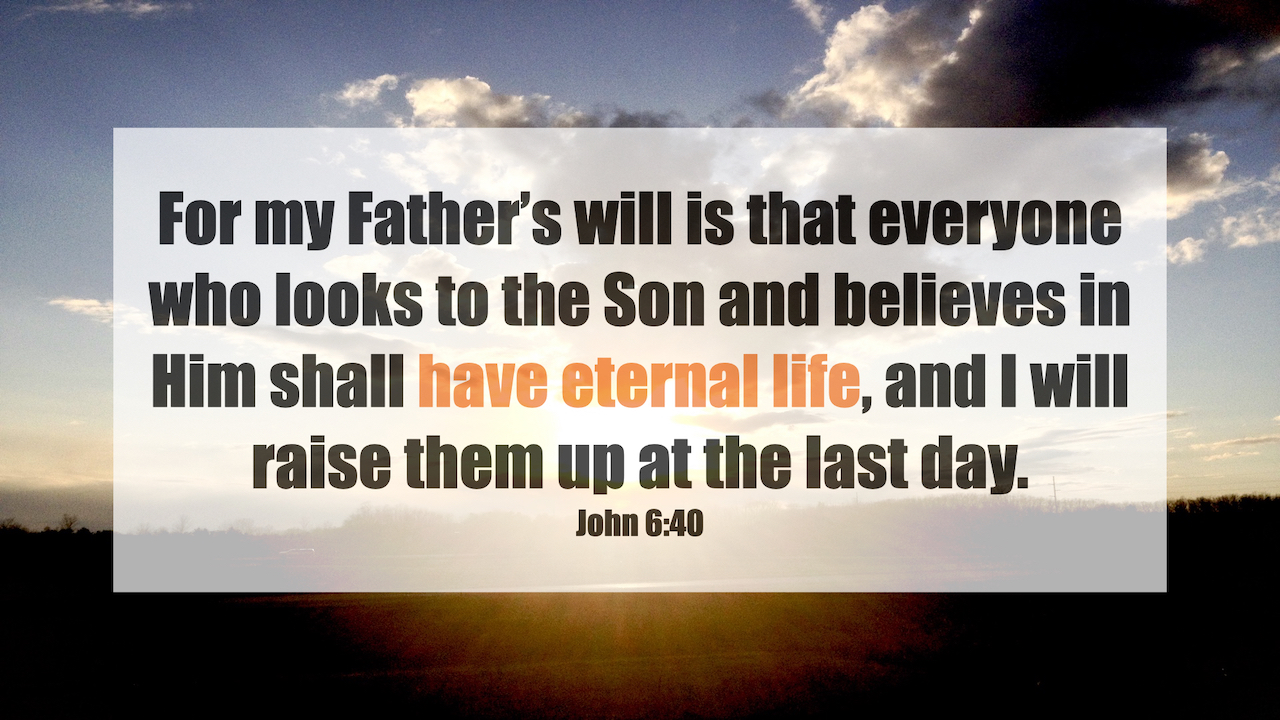
Jesus told us that believing God’s promise would bring us into God’s family. Jesus said, “For My Father’s will is that everyone who looks to the Son and believes in Him shall have eternal life, and I will raise them up at the last day” (John 6:40).
The apostle Paul also assures us, “So in Christ Jesus you are all children of God through faith” (Galatians 3:26).
Let’s not blindly follow the traditions of previous generations, but let us chose for ourselves to believe in God’s promised Messiah, to trust that He alone can give us eternal life, and then let us live in both celebration of His First Advent and expectation of His Second Advent.
Listen to the podcast of this post by clicking on the player below, and you can also subscribe on Apple, Spotify, or Audible.
Gratitude is our shield against the negativity, and gratitude is also our sword against the ambushers. But using these pieces of our armor is exhausting, which means we also need a way to recover from the attacks of negativity.
Jesus began His public ministry with a sermon that prompted Luke to record that “everyone spoke well of Him.” But in less than 60 seconds, after Jesus outlined how His ministry would unfold, Jesus is being criticized to the point where those same praising people are now ready to throw Jesus off a cliff (Luke 4:18-29)!
Elbert Hubbard wrote, “If you have something others don’t, know something others don’t, or do something others aren’t doing, then, rest assured, you will be criticized. … To avoid criticism say nothing, do nothing, and be nothing.”
Even though Hubbard is probably right, Christians don’t have the option to “say nothing, do nothing, be nothing,” because Jesus has called us to go into all the world, preach the Good News, and be salt and light. That means we will be victims of criticism. We can use our shield and sword of gratitude, but we are also going to need some medicine to help us recover too.
“Sticks and stones may break my bones but words will never hurt me” is a lie. Words do hurt.
Jesus told us these stinging words would be thrown at us like sticks and stones in Luke 6:22. When we are criticized, we have to be careful not to get embittered. How does that happen? We are naturally self-protective, so criticized people become critical and cynical unless they can be healed and have joy restored.If we hold on to our hurts, bitterness can fester in our hearts (Hebrews 12:14-15).
Look at David in Psalm 69. He acknowledged the attacks from his enemies and how it made him feel, but then he applies the healing medicine of gratitude—
But as for me, afflicted and in pain—may Your salvation, God, protect me. I will praise God’s name in song and glorify Him with thanksgiving. (Psalm 69:29-30)
Our healing is in our thanking!
Medical research has shown that gratitude improves physical health—it reduces stress and resets the heart’s healthy rhythm. This is just as true spiritually: gratitude is our medicine.
You may be thinking, “How can I bless critical people? How can I be grateful when I’m surrounded by such hostility?”
David also wrote Psalm 23 for us. This is the psalm that begins, “The Lord is my Shepherd, I shall not be in want.” But notice especially the words of verse 5: “You prepare a table before me in the presence of my enemies. You anoint my head with oil; my cup overflows.”
It is precisely in the presence of enemies that God invites us to abide with Him and to receive His medicine of anointing. But I also see that our Good Shepherd doesn’t just give us adequate blessings, but overflowing blessings—enough for me and more to share with those around me.
In the New Testament Greek, one word for “bless” is eulogeo which literally means “good words.” Jesus, Paul, and Peter all tell us that when we are victims of the sticks and stones of negative words, we are to respond by saying good words both to God and to those who are hurling evil words at us (Matthew 5:43-44; 1 Corinthians 4:12; 1 Peter 3:9).
Peter shows us exactly how Jesus did this when He was hanging on the Cross and enduring the sneers, mocking words, and insults from those surrounding Him (1 Peter 2:21-23; Luke 23:35-39). Instead of throwing evil words back at them, Jesus blessed them by saying, “Father, forgive them for they do not know what they are doing” (Luke 23:34).
Listen to the podcast of this post by clicking on the player below, and you can also subscribe on Apple, Spotify, or Audible.
Gratitude is a great attitude. It sets you apart from the crowd of complainers, and it causes people to ask, “What do you know that we don’t know?”
Wouldn’t you just love to silence the complainers in your life? Maybe you can relate to this poem by Shel Silverstein called Complainin’ Jack—
This morning my old jack-in-the-box
Popped out—and wouldn’t get back-in-the-box.
He cried, “Hey, there’s a tack-in-the-box,
And it’s cutting me through and through.
“There also is a crack-in-the-box,
And I never find a snack-in-the-box,
And sometimes I hear a quack-in-the-box,
‘Cause a duck lives in here too.”
Complain, complain is all he did—
I finally had to close the lid.
Since, as Christians, we can’t really “close the lid” on the complaining people around us, maybe there’s something else we can do. I can think of three possibilities.
We could entirely avoid complaining people. But to do this wouldn’t allow us to live our lives as the salt and light Jesus called us to (Matthew 5:13-16). After all, in order for salt to season or light to drive away darkness, the salt and light have to be in close proximity to those they are helping.
We could simply ignore the negativity. Be around it, but do nothing about it. But both Paul and Jesus call us to engage with people in a way that points them to the Good News of the Gospel (Philippians 2:14-16; Matthew 28:19).
If we cannot avoid complainers nor remain apathetic about them, we must find a way to engage them but protect our hearts in the process.
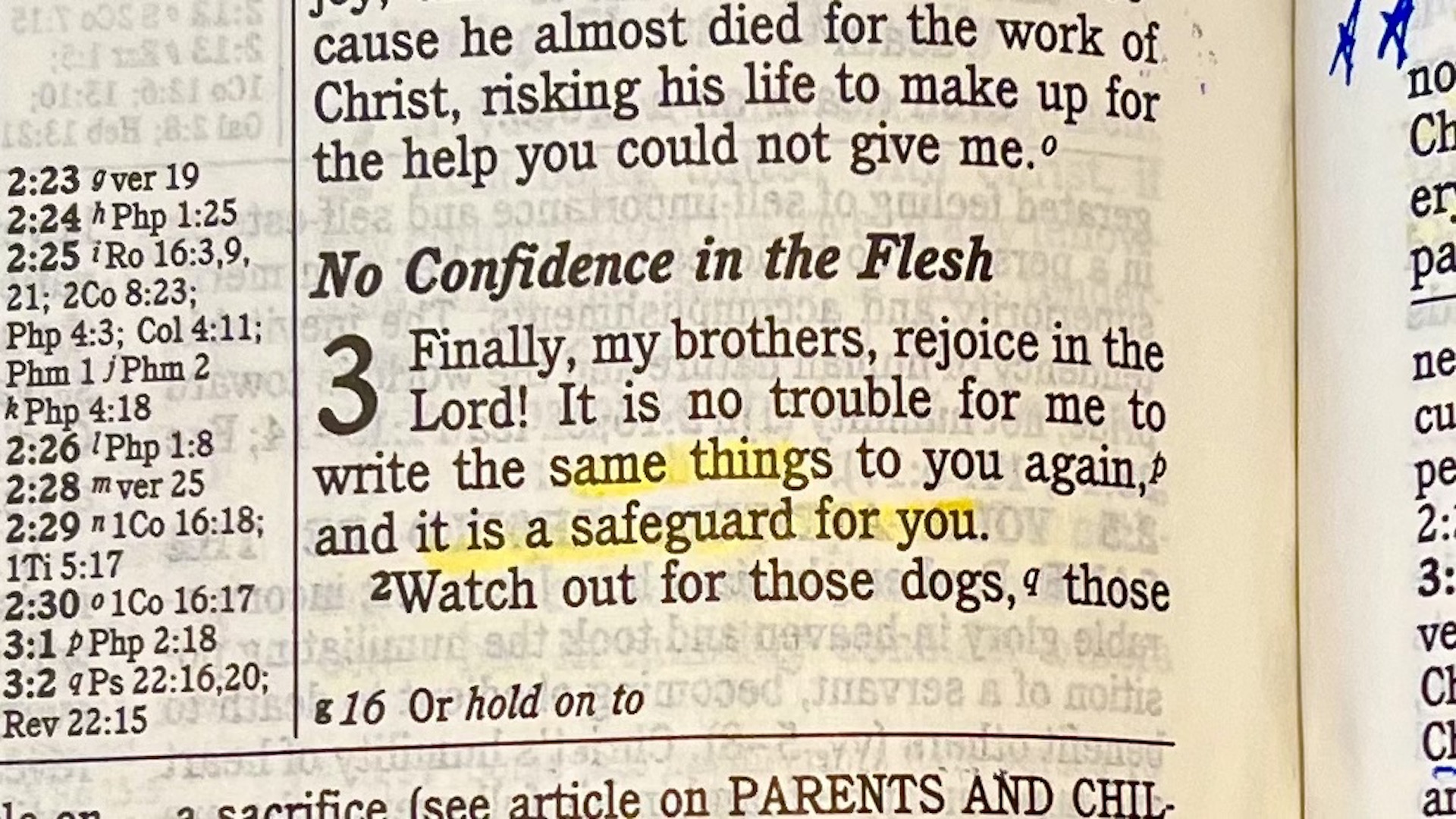
We learn from the apostle Paul’s letter to Philippi that gratitude is our shield against anything that would seek to steal our joy! “Further, my brothers and sisters, rejoice in the Lord! It is no trouble for me to write the same things to you again, and it is a safeguard for you” (Philippians 3:1).
In the Greek, the root word for “safeguard” means “fail.” But when we add the prefix it becomes cannot fail! So rejoicing makes us secure, firm, reliable.
Quite simply that means that gratitude is our attitude protector because gratitude is our shield against anything that would seek to steal our joy!
Jesus used the same word for rejoicing even when we are facing insults, exclusion, and persecution—
Blessed are you when people hate you, when they exclude you and insult you and reject your name as evil, because of the Son of Man. Rejoice in that day and leap for joy, because great is your reward in heaven. For that is how their ancestors treated the prophets. (Luke 6:22-23)
Both Jesus in this passage and Paul in Philippians 3:1 remind us that our rejoicing is IN the Lord. We are not expected to rejoice in our circumstances, but in who God is for us. Matthew Henry noted, “The more we rejoice in Christ the more willing we shall be to do and to suffer for Him, and the less danger we shall be in of being drawn away from Him.”
I also like both the proactive and reactive use of rejoicing that John Henry Jowett identifies when he says, “Gratitude is a vaccine, an antitoxin, and an antiseptic.” Rejoicing is never supposed to be a one-and-done action, but it is an ongoing lifestyle. As Paul wrote to the Christians in Philippi just a few verses later, “Rejoice in the Lord always. I will say it again: Rejoice!” (Philippians 4:4).
Gratitude is a shield—a vaccine, an antitoxin, and an antiseptic—but it doesn’t protect us unless we use it!
In order to use this shield whenever it’s needed, we have to be constantly reminded to be grateful. This is where we can leverage the power of our brain’s reticular activating system. I shared a short video about how to do this on The Podcast last week—check it out here.
Gratitude is a great attitude, and grateful people are a winsome testimony of God’s love and provision to those “complainin’ Jacks” we all encounter. Try it and see what a difference it will make with those you are around this week.



 Every monarch or president on the planet has certain protocols for anyone who interacts with them. There are requirements on how to walk into the room, titles that have to be used, the way you have to act, things you can or can’t say, and the list goes on and on.