Listen to the podcast of this post by clicking on the player below, and you can also subscribe on Apple, Spotify, or Audible.
Love should be blind. That is, we should be so enamored with the one we love that we are blind to all others. There are some sweet lyrics to a 1932 song called “I only have eyes for you”—
My love must be a kind of blind love
I can’t see anyone but you
and, dear, I wonder if you’ll find
love an optical illusion too
Are the stars out tonight?
I don’t know if it’s cloudy or bright
‘cause I only have eyes for you, dear
The moon may be high
But I can’t see a thing in the sky
‘cause I only have eyes for you
I don’t know if we’re in a garden
or on a crowded avenue
you are here and so am I
maybe millions of people go by
but they all disappear from view
‘cause I only have eyes for you
Instead of having dedicated eyes, what would you think of someone who was constantly “checking out” those other than their sweetheart? That’s what the song of ascent in Psalm 123 calls on us to contemplate.
Notice the use of the word “eyes” four times in just the opening two verses. The psalmist is asking us, “Do you only have eyes for God, or are you glancing elsewhere?”
The call throughout the Bible, from beginning to end, has always been for a steadfast, loving eye for our loving God. From Moses to Jesus, the call is to love God above all else—to only have eyes for Him (Deuteronomy 6:5; Mark 12:30). I think this is why Jesus taught us to pray for a daily look to our Father’s hand for each moment’s provision (Matthew 6:11).
This is not a begrudging “have to look” but an “I cannot help but continually look.” David said it this way, “Blessed be the Lord, Who daily loads us with benefits” (Psalm 68:19)!
When we continually keep our eyes on our loving Heavenly Father, we see more and more of His graceful favor toward us. It’s the proud and arrogant (in verses 3-4) that think they have to take care of themselves, or that they have to keep their eyes open to other possibilities.
God loves to shower His favor on those who only have eyes for Him: “Out of His fullness we have all received grace in place of grace already given” (John 1:16). This reminds me of the waves on the shore, where one wave of grace continually follows the previous wave of grace, which is quickly followed by yet another wave of grace. In fact, this idea is beautifully captured in the Amplified Bible’s rendering of this verse—
For out of His fullness (abundance) we have all received—all had a share and we were all supplied with—one grace after another and spiritual blessing upon spiritual blessing and even favor upon favor and gift heaped upon gift.
God’s grace isunearned by our efforts, undeserved despite our sins, and unending for all of eternity!
This song of ascent assures us that the humble servant who only has eyes for God is:
grateful for past blessings
unashamed of his total dependence on God’s provision
So the questions we need to ask ourselves are simply, “Where are my eyes? Do I only have eyes for my God, or do I keep my options open? Do I humbly and confidently bring my petitions to God, or do I take matters into my own hands?”
Since this is a song of ascent, let’s make sure that our song to God is always, “I only have eyes for You!”
Listen to the podcast of this post by clicking on the player below, and you can also subscribe on Apple, Spotify, or Audible.
The main point in Hebrew literature is usually found in the middle. In Psalm 122 that would be verse 5 where we seethe keyword in this verse is thrones—“thrones for judgment” and “thrones of the house of David.” Before this, we have the call to go up to Jerusalem (the City of Peace) in the first four verses, and after this, we have overwhelming, saturating peace in the last four verses.
But I wonder: How do thrones—especially a throne of judgment—bring about peace?
Remember that these are songs of ascent: we are called upward. I think “up” implicitly appears in verse 1—“I rejoiced with those who said to me, ‘Let us go UP to the house of the Lord,’—and “up” explicitly appears in verse 4—“That is where the tribes go UP, the tribes of the Lord, to praise the name of the Lord.”
There is clearly a longing to go up to meet with God, but I also detect a note of uncertainty. Let me show you what I see. First of all, verse 3 in the New Living Translation says about Jerusalem that “its seamless walls cannot be breached.” And yet the walls were breached in 586 BC when Jerusalem fell to the Babylonians. So anyone singing this song of ascent after the time of exile would have known that the walls weren’t as secure as David hoped they would be.
Second, verse 4 in the Contemporary English Version says that “every tribe of the Lord obeys Him.” And yet it was the disobedience of every tribe of the Lord that led to their defeat and then their 70-year exile. So, again, anyone singing this song of ascent after the time of exile would know about the punishment for disobedience.
In an earlier Psalm, David asked God who could go up to the Holy City, and then he answered his own question like this—
The one whose walk is blameless, who does what is righteous, who speaks the truth from their heart; whose tongue utters no slander, who does no wrong to a neighbor, and casts no slur on others; who despises a vile person but honors those who fear the Lord; who keeps an oath even when it hurts, and does not change their mind; who lends money to the poor without interest; who does not accept a bribe against the innocent. (Psalm 15:1-5)
That description also sounds a bit unachievable to me, because who has ever fulfilled all of the items on that list perfectly?
So we get to verse 5 and read about the thrones. The word “throne” means the seat of honor, authority, and power. It represents the place where the final and unchallengeable word is spoken. There is a final day of judgment before God’s throne, which John records in Revelation 20:11-15.
And yet, that day of judgment is not here yet. Jesus quoted the prophecy from Isaiah about Himself in His first sermon, but He purposely left off the last phrase about the day of judgment. He, instead, ended with the phrase where He had come to “proclaim the year of the Lord’s favor” (Isaiah 61:1-2; Luke 4:17-21). We see this thought again in John’s Gospel—
For God so loved the world that He gave His one and only Son, that whoever believes in Him shall not perish but have eternal life. For God did not send His Son into the world to condemn the world, but to save the world through Him. (John 3:16-17)
If we try to earn our own way into the Eternal Jerusalem, we will find that the walls can be breached, our obedience is not consistent, and that we are unable to keep that full list in Psalm 15. As a result, we face a throne of judgment.
But when we place our faith in what Jesus did for us on the Cross, where He paid the price for our sin, took away our unrighteousness, and gave us His righteousness in its place, then we will stand before the throne of shalom.
In the second half of Psalm 122, the words we read are peace, secure, peace, security, brothers and friends, peace, prosperity. That word “peace” is the Hebrew word shalom, which means nothing lost, nothing missing. Jesus wants us to be in the Eternal Jerusalem with Him for ever and ever.
Christ’s desire is that none should be separated from Him (see 2 Peter 3:9-14), so we could also say that shalom means no one lost, no one missing. We should want everyone—every tribe, nation, and people—to be with us in the Eternal Jerusalem forever!
I rejoiced with those who said to me, “Let us go UP to the house of Lord.” Let’s not go alone. Let’s bring as many people with us as we can to enjoy the eternal shalom of God’s Holy City!
If you’ve missed any of the other messages in our look at the Psalms of Ascent, you can find them all here.
Listen to the podcast of this post by clicking on the player below, and you can also subscribe on Apple, Spotify, or Audible.
When people ask me about end times events, it is usually from a posture of hand-wringing worry. But when Jesus told His followers about what is to come, He repeatedly told them not to be afraid.
If your mental health is struggling remember GIGO: garbage in, garbage out. We need to look at all our inputs: physical, emotional, and spiritual. Check out this full message by clicking here. And be sure to check out all of my videos on my YouTube channel.
In a post entitled The Quest For Immortality, John Stonestreet reminds us that we are more than just the physical bodies we have. He wrote, “Attempts to achieve immortality have continued (and continued to fail) right up to our own time. Medieval European alchemists believed they could produce ‘the philosopher’s stone,’ which would perfect the imperfect, turning lead into gold and making mortal life immortal. Enlightenment thinkers of the late 18th century rejected the mysticism of alchemy but continued to speculate about the means to attain physical immortality. Mary Shelley’s Frankensteinwas written as a cautionary tale about scientific hubris, in response to the more modern attempts of medicine and biology to preserve, extend, and improve life.” Check out this full post.
“You have to train your mind as much as your body.” —Venus Williams
“Peace is the normal condition and set of the soul of those who know the Kingdom’s presence in their lives. And only Jesus can give us the peace that overcomes the fears and troubles of the world, so that His Kingdom citizens may ‘be of good cheer’ [John 16:33] in all they do, come what may.”
“Hatred and anger are the greatest poison to the happiness of a good mind.” —Adam Smith
“Hard work beats talent when talent doesn’t work hard.” —Anonymous
I really love the He Gets Us presentation of Jesus. Check them out! I used the example Jesus showed us of proper self-care in my book Shepherd Leadership.
Listen to the podcast of this post by clicking on the player below, and you can also subscribe on Apple, Spotify, or Audible.
I’ve talked before about the benefits of calling the Old and New Testaments the First and Second Testaments. This helps me not to subconsciously slip into the thought that “old” means outdated or that “new” means a replacement of what came before it. When I say First and Second I remember that there cannot be a Second without a First, that the First anticipates the Second and the Second fulfills the First.
The people of the First Testament experienced the Spirit of God in an often-repeated phrase: “the Spirit of the Lord came on” someone. It usually came on them for a specific task or season. For instance…
70 leaders to help Moses (Numbers 11:25)
the judges that delivered Israel from their enemies (Judges 3:10, 6:34, 11:29, 14:6, 15:14)
the anointing for Israel’s king (1 Samuel 16:13)
empowerment for prophets to prophesy (Ezekiel 11:5)
When the Holy Spirit came on these men, there was a noticeable supernatural anointing and empowerment, but more times than not these men also had visible and sometimes crippling stumbles.
What happens on the outside often stays on the outside. Sort of like the little boy whose mom brought him to church one Sunday. The little boy was constantly standing up on his chair and disturbing everyone around him. Finally, the exasperated mother whispered, “If you don’t sit down I’m going to take you to the restroom and spank you.” The little boy immediately sat down with his arms tightly crossed. He looked at his mom and said, “Outside I may be sitting down but inside I’m standing up!”
God looks at the heart. He told the Israelites that their inward defiance didn’t outweigh their outward religious practices. And Jesus said that people who prophesied, cast out demons, and performed miracles, but still had an unrepentant heart, would hear Him say, “I never knew you” (Isaiah 1:12-13; Matthew 7:21-23).
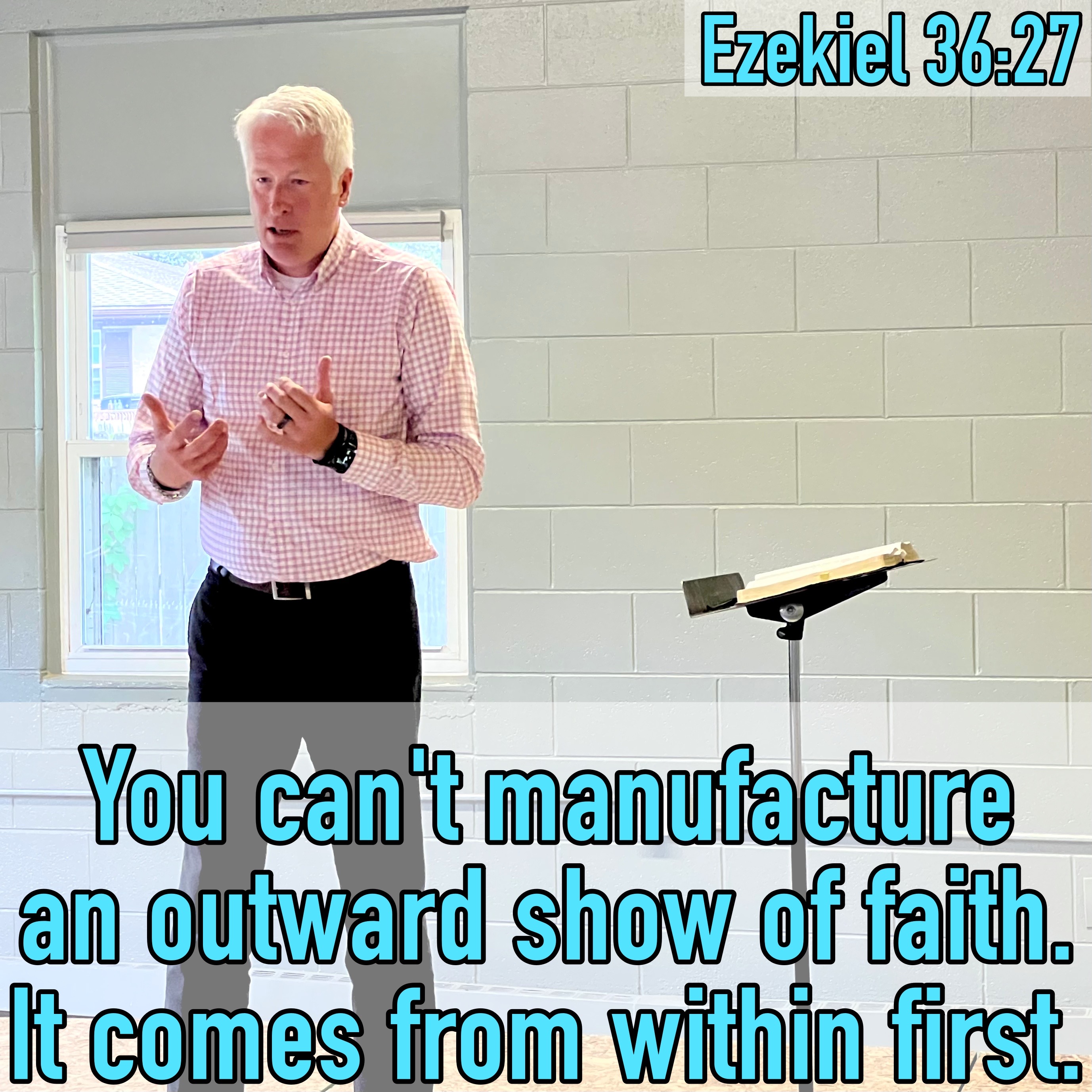
In the First Testament, we see a desire for the Holy Spirit to be more than on—a desire for Him to come in.David prayed, “Create in me a pure heart, O God, and renew a steadfast spirit within me” (Psalm 51:10). And God promised His people, “I will give them an undivided heart and put a new spirit in them … And I will put My Spirit in you and move you to follow my decrees and be careful to keep My laws” (Ezekiel 11:19, 36:27).
Paul identified this fruit of the Spirit as “love, joy, peace, forbearance, kindness, goodness, faithfulness, gentleness and self-control,” and he concluded with the phrase, “against such things there is no law” (Galatians 5:22-23). The law always sets limits, but when the Holy Spirit abides in us, the production of fruit is limitless!
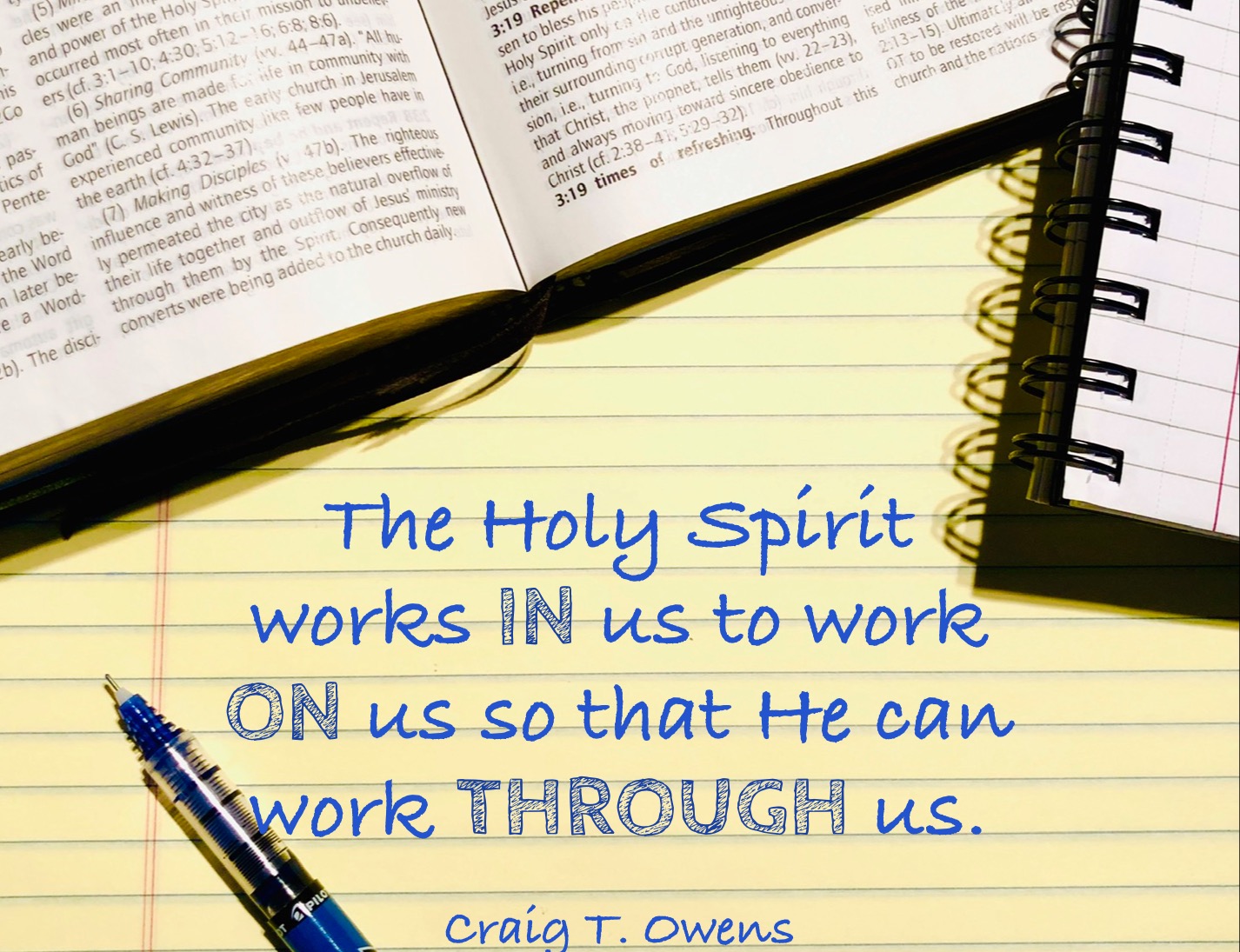
Being baptized in the Holy Spirit means that we allow Him to come in us and then to work on us. It’s only when the Holy Spirit has worked in us that can He flow through us to others. Jesus said that we would receive the Spirit’s empowerment to be witnesses—that’s an inward change that produces an outward fruit.
Listen to the podcast of this post by clicking on the player below, and you can also subscribe on Apple, Spotify, or Audible.
Let’s say you are thinking about buying a particular book. Are you more likely to buy that book because the author says it’s good, because a book reviewer says it’s good, or because a close friend says it’s good? I think all of us give more weight to the suggestions from our friends, especially because they have nothing to gain from making that suggestion.
In the same way, when someone close to us says, “I know from personal experience that following Jesus is the best decision that I have ever made. Making Jesus my Lord and Savior has completely changed everything for me,” it’s easier for us to make that same decision for ourselves.
The deeper the level of our intimacy with someone usually means we have more influence with them.
Jesus told us all about the Holy Spirit when He was discussing His ascension. He wasn’t going to leave us as orphans, but told us of the intimate connection the Spirit would make for us. For instance, Jesus said, “And I will ask the Father, and He will give you another Counselor to be with you for ever—the Spirit of Truth” (John 14:16-17).
Notice that Jesus considers the Holy Spirit an irreplaceable and coequal part of the Godhead—I will ask the Father, and He will give you another Counselor (see also Matthew 3:16-17; Luke 10:21; Matthew 28:19).
The word Jesus uses for Counselor is parakletos. This means One who comes alongside to help us. I like all the words the Amplified Bible uses: “Comforter—Counselor, Helper, Intercessor, Advocate, Strengthener, and Standby.” Indeed, Luke records numerous instances where the Holy Spirit is alongside Christians to strengthen and encourage them (for instance: Acts 4:8, 6:10, 9:31).
Notice as well that Jesus tells us that as a part of the Trinity the Holy Spirit is eternal: “to be with you for ever.” Because the Holy Spirit is fully God, He knows the end from before the beginning. His perspective is infinite, so He can guide us in ways that only One who can see everything could guide us. For example, He leads us to places we might not have chosen on our own (Luke 4:1; Acts 8:29), or stops us from going somewhere at the wrong time (Acts 16:7), or talking with people we might have overlooked (Acts 10:19, 11:12).
Jesus also calls the Him the Spirit of Truth. He reveals things that we could not have perceived with our natural minds (see Acts 5:1-9).
And Jesus calls the Holy Spirit a great Teacher, “The Counselor, the Holy Spirit, whom the Father will send in My name, will teach you all things and will remind you of everything I have said to you” (John 14:26). So we see the Holy Spirit helping us apply Scripture to our prayers (Acts 4:25-26) and to incredibly complex and delicate situations (Acts 11:15-18, 15:1-21).
The Holy Spirit is not a force to fear but a Person to know ever more intimately.
When our lives are transformed and expanding because of an intimate, ongoing, vibrate relationship with the Holy Spirit, we are witness (Acts 1:8). You cannot exhaust all that the Spirit has for you, so keep abiding and growing in that intimate relationship. Let it be said of you as it was said of Peter and John: “We can tell you have been with Jesus!” (Acts 4:13).
Listen to the podcast of this post by clicking on the player below, and you can also subscribe on Apple, Spotify, or Audible.
Do you talk to yourself?
Of course you do. We all talk to ourselves: it’s called “thinking.”
But do you talk out loud when you talk to yourself?
An unhealthy habit for most of us is that our thoughts are only a one-way monologue. That is, we are listening to our thoughts but we are not talking back to them. As a result, everything negative we’ve heard from our enemies is bouncing around in our heads. The more we hear it, the more likely we are to believe it.
In Psalm 42, we hear from a psalmist who is longing to experience God’s presence but at the same time there’s a nagging thought implanted by skeptics: “Where is your God?” The psalmist reminisces how it used to be, which means there is a nagging doubt in his mind that it may never be like that again.
But finally, the psalmist does the mentally healthy thing: he talks back to his thoughts. He asks himself a question and then he gives a new response—a response that is hope-filled instead of doubt-plagued.
Why are you downcast, O my soul? Why so disturbed within me? Put your hope in God, for I will yet praise Him, my Savior and my God. My soul is downcast within me; therefore I will remember You. (Psalm 42:5-6)
When the nagging thought of “Where is your God?” comes up again just a couple of verses later, he doesn’t linger or brood over this doubt-inducing thought but immediately talks back to that negative voice with hope-filled words (vv. 10-11).
The devil has a singular agenda: to separate you from God. He does this through lies and doubts. Jesus told us the devil’s native language is lies: “He was a murderer from the beginning, not holding to the truth, for there is no truth in him. When he lies, he speaks his native language, for he is a liar and the father of lies” (John 8:44).
The Bible tells us that the devil can also put thoughts and desires in our hearts, but they are all lies (see John 13:2; Acts 5:3).
We cannot let these lies go unchallenged, so here’s our battle strategy:
For the weapons of our warfare are not physical weapons of flesh and blood, but they are mighty before God for the overthrow and destruction of strongholds, inasmuch as we refute arguments and theories and reasonings and every proud and lofty thing that sets itself up against the true knowledge of God; and we lead every thought and purpose away captive into the obedience of Christ—the Messiah, the Anointed One. (2 Corinthians 10:4-5 AMP)
There are five questions we need to use to talk to ourselves about the thoughts we hear:
Is this thought unbiblical? (2 Timothy 3:16-17)
Does this thought rob God of the glory due His name (Psalm 29:1-11)?
Does this thought stifle my love for God or others (Mark 12:28-31)?
If I linger on this thought, does it rob me of peace (Isaiah 26:3-4)?
Does this thought make me apathetic toward sin (Genesis 4:7)?
If we answer “yes” to any of these questions, we must capture that thought and put it to death, which requires the sword of the Spirit, which is the Word of God (Ephesians 6:17). Because of what Jesus has done for us on the Cross, every promise in God’s Word is “yes and amen” in Jesus, and therefore is an invincible weapon against lying thoughts (2 Corinthians 1:20).
Here’s how we use those promises:
For the accuser of our brothers and sisters, who accuses them before our God day and night, has been hurled down.They triumphed over him by the blood of the Lamb AND by the word of their testimony. (Revelation 12:10-11)
Listen to your thoughts, but don’t listen too long before you start to challenge them with these five questions. Then demolish those lies—triumph over them by the blood of the Lamb and your spoken testimony. Speak the truth out loud for all to hear.
This is part 4 in our series on a Christian’s mental health. If you’ve missed any of the other messages I’ve shared, you can find them all by clicking here.
Listen to the podcast of this post by clicking on the player below, and you can also subscribe on Apple, Spotify, or Audible.
Jesus began to speak to them in parables… (Mark 12:1).
This is only the fourth parable that Mark records, and as the final parable that Jesus uses in this Gospel, it brings His public ministry to a close.
Jesus concludes this parable by quoting from Psalm 118. This psalm is the last of the “Hallel Psalms” to be sung at the conclusion of the Passover celebration—it is the psalm that looks eagerly to the Messiah‘s arrival. It contains the words that the crowds just used on Palm Sunday: “Lord, save us! Lord, grant us success! Blessed is He who comes in the name of the Lord” (Psalm 118:25-26; Mark 11:9-10).
At the conclusion of this parable, the religious leaders “knew He had spoken this parable against them” (Mark 12:12).
This is important for pastors as they prepare their sermons, but it’s also important for every Christian. We face challenges every day. The Holy Spirit can give us the timeliest of words. The Word of God is the inspired message for us. It is just as relevant and applicable today as it was the day the words were penned. The same Holy Spirit who inspired the authors of Scripture is the same Holy Spirit in us today who will illuminate and apply the Word for us (John 14:26).
Let’s not find our “timely word” from the ever-changing attitudes and opinions of culture, but let us continually go back to the unchanging, always-timely, always-relevant Word of God. That is the only place to find the timeliest of words every single time!
If you were one of Christ’s disciples, wouldn’t you think it would be time for Jesus to take a victory lap? Maybe He could show up at the next meeting of the Sanhedrin, or in Pontius Pilate’s courtroom, or King Herod Antipas’ throne room. You can almost hear their longing for this when they asked Jesus, “Lord, are You at this time going to restore the kingdom to Israel?” (Acts 1:6).
Jesus answered that question by saying, “Your race is just now beginning!” You see, Christ’s resurrection wasn’t the end of the race, but an important—absolutely indispensable—part of our ongoing race. “I will be raised back to life again” was a bold claim, but it wasn’t the final bold claim. There is one more for us to consider.
The resurrection of Jesus is our assurance that what Jesus says He will do, He will do. One of the things He promised is, “I am going to prepare a place for you and I will come back to get you” (John 14:1-3). The place Jesus has prepared for us is the end of our race—the finish line for which every Christian should be longing.
The disciples asked Jesus how they could know when His return was getting closer. He gave them a lot of things to watch for, but He concluded by saying, “And this gospel of the kingdom will be preached in the whole world as a testimony to all nations, and THEN the end will come” (Matthew 24:14).
In order for us to go Home, the whole world—people in all nations—have to hear the Good News of the Kingdom of God.
In one of the boldest claims of all, Jesus says He has ultimate authority, and that He is commissioning us to use His authority for the express purpose of our missionary work to all nations. Notice the “therefore” which indicates what we are to do with His authority—
All authority in heaven and on earth has been given to Me. Therefore go andmake disciples of all nations, baptizing them in the name of the Father and of the Son and of the Holy Spirit, and teaching them to obey everything I have commanded you. And surely I am with you always, to the very end of the age. … But you will receive power when the Holy Spirit comes on you; and you will beMy witnesses in Jerusalem, and in all Judea and Samaria, and to the ends of the earth. (Matthew 28:18-20; Acts 1:8)
The apostle Paul appreciated this analogy of running a race. Just before it was time for Paul to go Home, he told his friend Timothy, “I have fought the good fight, I have finished the race, I have kept the faith” (2 Timothy 4:7).
Earlier in his life, Paul used a running example when he wrote to the Christians at Corinth—
Do you not know that in a race all the runners run, but only one gets the prize? Run in such a way as to get the prize. Everyone who competes in the games goes into strict training. They do it to get a crown that will not last, but we do it to get a crown that will last forever. Therefore I do not run like someone running aimlessly; I do not fight like a boxer beating the air. No, I strike a blow to my body and make it my slave so that after I have preached to others, I myself will not be disqualified for the prize. (1 Corinthians 9:24-27)
Paul gives us three don’ts and three dos in this passage:
Don’t fail to train, don’t run aimlessly, don’t get disqualified by focusing on the temporal
Do go into strict training, do stay focused on the eternal, do run for the prize of hearing Jesus say, “Well done!”
Do you want to go Home? Do you want Jesus to come again to take all of His children Home? Then finish the race of telling everyone in the whole world the Good News about Jesus.