The Impossible Prayer

We have been looking at some bold pray-ers in the Bible, but today’s example takes it to a whole new level by praying an “impossible” prayer! Here are 4 valuable lessons we can learn from the prayer of Joshua. 

When this story opens, the city of Gibeon is calling on the Israelites to help them. Five Amorite kings have all ganged up on Gibeon because of the treaty they made with Israel, and they intended to crush them into oblivion! 

Joshua—without any debate, consultation, or hesitation—mobilizes his forces. Notice that there are no half-measures or hedging his bets. Joshua marches out with the entire army, including all of his elite warriors to rescue Gibeon. 

Joshua’s troops marched all night to cover the 21-miles to get to Gibeon by daybreak. Modern-day military experts say that an army can cover about 20-25 miles before they are at the point of total exhaustion, so Joshua took his men right up to this point. But this all-night march surprised the five attacking armies, so much so that the Bible says God threw those enemies into a panic and God even fought for them, raining hailstones down on the Amorites that killed more men than the Israelites did in their attack! 

After an all-night march and an all-day battle, the Amorites are on the run. This is when Joshua prays his “impossible” prayer. He asks God to let the earth stop rotating so that the sun and moon in the sky will give the Israelites enough light to complete their victory!!

AND GOD DOES IT!! 

How could Joshua pray such an “impossible” prayer like this? 

  1. He had already seen God do the “impossible” like drying up the Jordan River and knocking down the supposedly impenetrable walls of Jericho.
  2. God already told Joshua, “I have given them into your hand. Not one of them will be able to withstand you.” Joshua didn’t put an asterisk on God’s word—if God said every enemy would be defeated, that’s what Joshua was claiming. 
  3. Joshua was already moving forward in faith. He wasn’t sitting around waiting for God to do something. He was letting his marching be his praying. 
  4. By publicly praying this “impossible” thing, Joshua was ensuring that God would receive all the glory. The Bible says that Joshua prayed “with all Israel listening.” 

The sun stopped in its tracks in mid-sky; just sat there all day. There’s never been a day like that before or since—God took orders from a human voice! Truly, God fought for Israel (v. 14, The Message).

What about you? Does it feel like your problems are ganging up on you like a bunch of bullies? You, too, can pray an “impossible” prayer like Joshua did—

  1. Get God’s Word—what promise will you stand on? Don’t put any asterisks in there! 
  2. Know God’s peace—God told Joshua, “Do not be afraid of them.” 
  3. Watch God confuse your enemies—when the Israelites showed up God “threw them into confusion,” which literally means He discombobulated them so they couldn’t coordinate their counter-attack on Israel. 
  4. Publicly pray an “impossible” prayer while you fight! Tell others what your “impossible” prayer is so that God gets all the glory.

Join me this Sunday as we learn from another bold pray-er from the pages of Scripture. 

Come And See What Our God Has Done

Check out the opening verses of Psalm 66—

Shout joyful praises to God, all the earth!
Sing about the glory of His name!
Tell the world how glorious He is.
Say to God, “How awesome are Your deeds!
    Your enemies cringe before Your mighty power.
    Everything on earth will worship You;
    they will sing Your praises,
    shouting Your name in glorious songs.” Interlude 
Come and see what our God has done,
    what awesome miracles He performs for people! (66:1-5 NLT)

I’d like to explore with you this phrase—come and see what our God has done. 

In so many of the Psalms we get at least a little context. We might be told the type of song it is or the kinds of musical instruments to be sung. We might know who wrote the psalm or at least why he wrote it. We might even hear what was happening in the psalmist’s world at the time he wrote the song or maybe at what event he wanted the song to be sung. All of these things would give us context clues into when/where to use the song—when I’m afraid? when I’m under attack? when I’m happy? when I’m depressed? 

For this psalm all the context we know is—For the choir director: A song. A psalm. 

But let me ask you: does it really matter? If you’re up or down, flush with cash or barely hanging on, winning the fight or feeling like you’re being beaten down—in any circumstance, can you still say come and see what our God has done? 

I think the answer is yes. I think this is the reason why no context is given us, because this psalm is appropriate regardless of the circumstances.

Just as the apostle Paul wrote, “I know how to live on almost nothing or with everything. I have learned the secret of living in every situation, whether it is with a full stomach or empty, with plenty or little. For I can do everything through Christ, who gives me strength” (Philippians 4:12-13).

As Christians, we’ve been called to step alongside people in their messy, broken lives. Yes, we are to weep with those who weep, but we’re not to keep them there but to take them to the One who can heal their messy, broken lives. 

The reasons to say, “Come and see what our God has done” are all around us. 

Earth’s crammed with heaven, 
And every common bush afire with God; 
But only he who sees, takes off his shoes, 
The rest sit round it and pluck blackberries, 
And daub their natural faces unaware. —Elizabeth Barrett Browning

Don’t just pluck blackberries; realize that those berries are the produce of a loving Creator. Don’t miss the opportunities to give God glory. Good times are wonderful opportunities to start. But those are just the starting points. Find the reasons even in hard times—I have learned the secret of being content in any and every situation, whether well fed or hungry, whether living in plenty or in want.

Anywhere … everywhere … no matter the context … HE IS STILL GOD. He is still worthy to be praised. There is still ample reason for us to say, “Come and see what our God has done!” 

7 More Quotes From “Defiant Joy”

It may sound like an oxymoron—defiant joy—but it’s a powerful combination that Stasi Eldredge unpacks in her book. Check out my full review of Defiant Joy by clicking here. 

“Times of testing can also be times of refining and growth. The counterintuitive truth is that suffering can deepen our hope. It enlarges our hearts so that we can know the love and presence of Jesus in ways that we would not if we did not go through the stretching the process.” 

“The waiting can be hard when you are hungry, but when you know a feast is coming, you know that the waiting won’t last forever. Dear ones, the waiting is not going to last. But there is no shame in being hungry while you wait. … In our waiting God often deepens our hunger as well.” 

“We are alive. And to be alive means that we will feel. We don’t need to deny it, and we don’t need to have it rule us. We dare not marry it to cynicism, and we must not fuel it with fatalism. It is not the end of our reality. It is instead a clue that we are strangers in a strange land. And we are passing through. Sadness touches us all, but God can use it to enhance the beauty and joy of the lives we are living. Sadness can fuel our hope. It can arouse our expectancy.” 

“God displayed His fierce, constant love for us once and for all on the Cross of Calvary. The essence of His heart is no longer up for question. Because of all that Jesus won for us and our choice to receive it, God promises that we actually have nothing to fear.” 

“satan comes to rob us of our joy, our peace, and our connection to and faith in God. He whispers lies to us when we are vulnerable and does his best to warp our perception of our lives with his depressing and evil spin. His endless attacks can wear a person down if they are aware that the perceptions being suggested are coming straight from hell.

“satan is very good at stealing. He’s devoted all his malice to separating us from intimacy with our good Father and the experience of deep joy that comes straight from Jesus’ heart. The evil one uses the circumstances of our lives and of the world to bring discouragement and despair. That is why we must remember that though happiness is rooted in our circumstances, joy is rooted in eternity.” 

“Depth of character doesn’t come easily. It doesn’t come at all to those who refuse to admit the difficulties in their lives are painful. It comes when we fix our gaze on Jesus and the reality that this life is only part of the grand scheme of things.” 

“There is something forged in all of us that can only be forged through fire. Perhaps intense periods of struggle, pain, betrayal, persecution, and rejection are the times when the baptism by fire that Jesus talks about occurs. When we cling to Jesus and proclaim He is good in the midst of the licking flames, our spirits rise in a strength that is proven unshakable, and God is glorified beyond reckoning. Our pain becomes the terrain of God. It becomes sacred.” 

Check out some more quotes I shared from Defiant Joy here.

God Must Have Broken Things

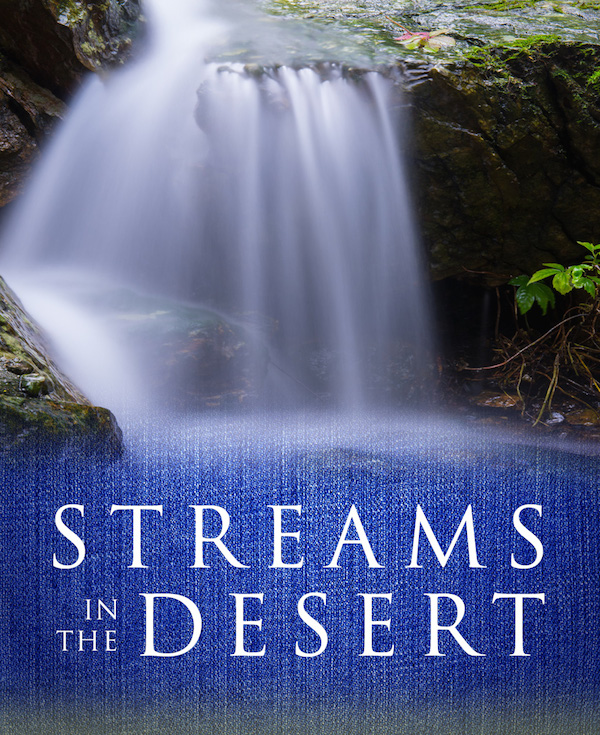
“It is when a beautiful grain of corn is broken up in the earth by death, that its inner heart sprouts forth and bears hundreds of other grains. And thus, on and on, through all history, and all biography, and all vegetation, and all spiritual life, God must have broken things. Those who are broken in wealth, and broken in self-will, and broken in their ambitions, and broken in their beautiful ideals, and broken in worldly reputation, and broken in their affections, and broken ofttimes in health; those who are despised and seem utterly forlorn and helpless, the Holy Ghost is seizing upon, and using for God’s glory. ‘The lame take the prey,’ Isaiah tells us [33:23].” —Lettie Cowman, in Streams In The Desert

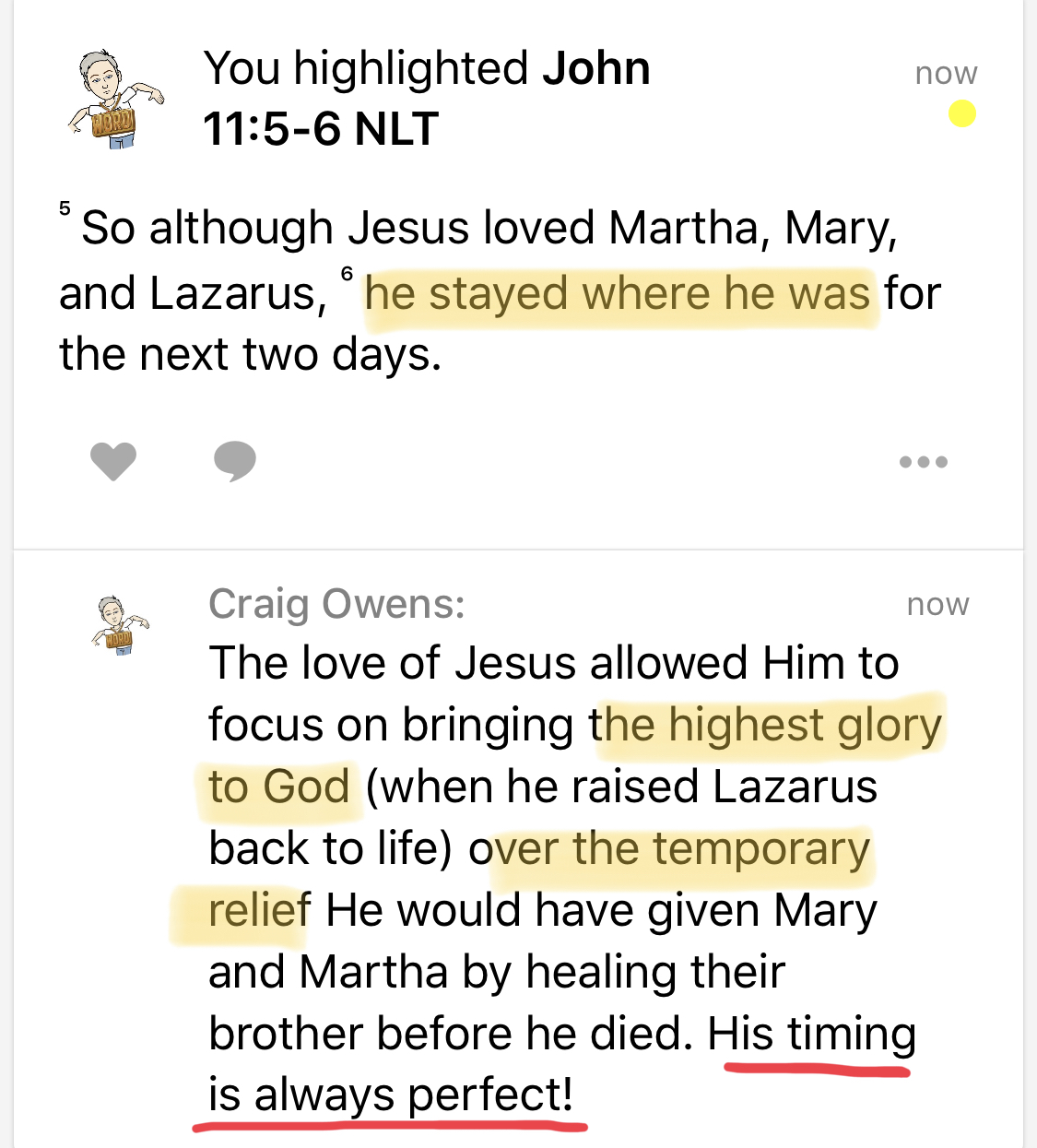
Christ’s Love Has Perfect Timing!

11 Quotes On The Gospel Of Matthew

J.C. Ryle has given us a wonderful commentary on the Gospels in his Expository Thoughts On The Gospels. Check out my full book review here, and then enjoy a few quotes from Ryle’s insights on the Gospel of Matthew. 

“The rulers of this world have often call themselves Great, Conqueror, Bold, Magnificent, and the like. The Son of God is content to call Himself Savior. These souls which desire salvation may draw near to the Father with boldness, and have access with confidence through Christ. It is His office and His delight to show mercy. ‘For God didn’t send His Son into the world to judge the world, but that the world should be saved through Him’ (John 3:17).” 

“Trust Him at all times with all your sorrows. He will not despise you. Pour out all your heart before Him in prayer, and keep nothing back. He can sympathize with His people.” 

“Let us beware of resting satisfied with head-knowledge. It is an excellent thing, when rightly used. But a man may have much of it, and yet perish everlastingly. What is the state of our hearts? This is the great question. A little grace is better than many gifts. Gifts alone save no one. Grace leads on to glory.” 

“Here is one among many reasons why we ought to be diligent readers of our Bibles. The Word is the sword of the Spirit. We shall never fight a good fight, if we do not use it as our principal weapon. The Word is the lamp for our feet. We shall never keep the King’s highway to heaven, if we do not journey by its light. … Knowledge of the Bible never comes by intuition, it can only be obtained by diligent, regular, daily, attentive, wakeful reading.” 

“Aim at letting men see that we find Christianity makes us happy. Never let us forget that there is no religion in looking melancholy and gloomy. Are we dissatisfied with Christ’s wages and Christ’s service? Surely not! Then let us not look as if we were.” 

“Let the prayer ‘Lord, increase our faith,’ always form part of our daily petitions. We never perhaps know the weakness of our faith until we are placed in the furnace of trial and anxiety. Blessed and happy is that person who finds by experience that his faith can stand the fire, and that he can say with Job, ‘though He slays me yet will I trust in Him’ (Job 13:15).” 

“The more clearly we see Christ’s power, the more likely we are to realize Gospel peace. Our position may be trying. Our hearts may be weak. The world may be difficult to journey through. Our faith may seem too small to carry us home. But let us take courage when we think on Jesus, and not be cast down. Greater is He that is for us than all those who are against us. Our Savior can raise the dead. Our Savior is Almighty.” 

“Great grace and common sense are perhaps one of the rarest combinations. … Our Lord Jesus Christ Himself is our most perfect example. None were ever so faithful as He. But none were ever so truly wise. Let us make Him our pattern, and walk in His steps.” 

“Let us not be ashamed to say that we expect a literal fulfillment of unfulfilled prophecy. Let us frankly allow that there are many things we do not understand, but still hold our ground tenaciously, believe much, wait long, and not doubt that all will one day be made clear.” 

“Are we ever mocked and persecuted and thought foolish because of our religion? Let us bear it patiently and pray for those who persecute us. They know not what they are doing. They will certainly alter their minds one day. We may yet hear them confessing that we were wise and they were foolish. The whole world shall one day acknowledge that the saints of God made a wise choice.” 

“We can never attach too much importance to the atoning death of Christ. It is the leading factor in the Word of God, on which the eyes of our soul are to be ever fixed. Without the shedding of His blood, there is no remission of sin. It is the cardinal truth on which the whole system of Christianity hinges. Without it the Gospel is an arch without a key stone, a fair building without a foundation, a solar system without a sun.” 

Quotes from Ryle’s comments on the Gospels of Mark, Luke, and John coming soon. 

The Value Of The Old Testament

“Jesus exalted the law of God, and made its importance more evident even than it had been before. In a word, ‘He magnified the law and made it honorable’ (Isaiah 42:21). …

“Let us beware of despising the Old Testament under any pretense whatever. Let us never listen to those who bid us throw it aside as an obsolete, antiquated, useless book. The religion of the Old Testament is the embryo of Christianity. The Old Testament is the Gospel in the bud. The New Testament is the Gospel in full flower. The Old Testament is the Gospel in the blade. The New Testament is the Gospel in full ear. …

“Let us, for another thing, beware of despising the law of the Ten Commandments. Let us not suppose for a moment that it is set aside by the Gospel, or that Christians have nothing to do with it. The coming of Christ did not alter the position of the Ten Commandments one hair’s breadth. If anything, it exalted and raised their authority (Romans 3:31). …

“In the last place, let us beware of supposing that the Gospel has lowered the standard of personal holiness, and that the Christian is not intended to be as strict and particular about his daily life as the Jew. … The more light we have, the more we ought to love God. The more clearly we see our own complete and full forgiveness in Christ, the more heartily we ought to work for His glory. …

“Jesus shows us that the law, as expounded by Him, was a far more spiritual and heart-searching rule than most of the Jews supposed.” —J.C. Ryle, in Expository Thoughts On The Gospels

10 More Quotes From “The Christian In Complete Armour”

The Christian In Complete Armour is a classic work about a Christian’s spiritual warfare. Check out my review of this amazingly insightful book by clicking here, and check out other quotes I’ve shared from this book by clicking here. 

“When you see men of power and intellect using their talents against God, weep for their souls.”

“God permits satan’s temporary reign in order to increase the saint’s eternal joy.”

“If you see someone taking along, treacherous journey alone and unprotected, you conclude he expects no thieves on the road and you might well question his wisdom. Many pretenders to Christianity travel in a similar fashion. They tell you they are on their way to heaven, yet they show little inclination to travel in the company of the saints—as if they had no need of fellowship on the journey! Most of them go unfortified, without anything even resembling armor. Others brandish some vain, flighty hopes of the mercy of God, without so much as a single Scripture for ammunition. Such ‘hope’ is a rusty pistol and will fly in the fool’s face when he tries to use it.”

“Do you think for a moment your Heavenly Father would give His archenemy a sword too mighty for you, His own child, to overcome?”

“Let this encourage those of you who belong to Christ: The storm may be tempestuous, but it is only temporary the clouds that are presently rolling over your head will pass, and then you will have fair weather, an eternal sunshine of glory.”

“Trusting in your own goodness will eventually destroy it. Inherent grace is weak. Force it to endure the yoke of the law, and sooner or later it will faint by the wayside, unequal to the task of pulling the heavy load of your old nature. What you need is Christ’s yoke, but you cannot take it until you shed the one that harnesses you to works.” 

“How we would ridicule the man who, when the sun shines in at his window, tries to trap the sunbeams indoors by closing the shutters. But we are just as foolish to take our present joy, then turn away from God’s presence, supposing that we have all we need. You can feel the heat from the sun only when you stand beneath its rays; you can feel God’s comfort only as you keep your face turned toward Him.”

“Watchfulness is more important for the Christian soldier than any other. In temporal battles soldiers fight against men who need sleep the same as themselves, but the saint’s enemy, satan, is always awake and walking his rounds. Since the devil never sleeps, the Christian puts himself in grave danger by falling asleep spiritually—that is, by becoming secure and careless. … The weakest temptation is strong enough to foil a Christian who is napping in security.”

“A thief is just getting up when honest men are going to bed. The devil, I am sure, begins to tempt when saints cease to watch.”

“While the Holy Spirit is a comforter, He is also a convincer: He comforts us by teaching us.”

Going Into The Heavy Presence Of God

“The King of glory” is a phrase that’s only used five times in the Bible, and all five times are packed into just four verses of Psalm 24. In this psalm, David lets us know who can enter into this awesome, heavy presence of the King of Glory. 

Why do I say “heavy”? The definition of the Hebrew word for glory always refers to a heaviness. There is something majestically, awesomely heavy about going before the All-Righteous, All-Powerful, All-Holy, All-Knowing, Absolutely Perfect God. Can any mere mortal enter into this presence? 

In an earlier psalm, David said, “For the Lord is righteous, He loves justice; the upright will see His face” (Psalm 11:7). But in this psalm, David asks, “Who can ascend Your holy hill? Who can come into Your presence?” (Psalm 24:3). 

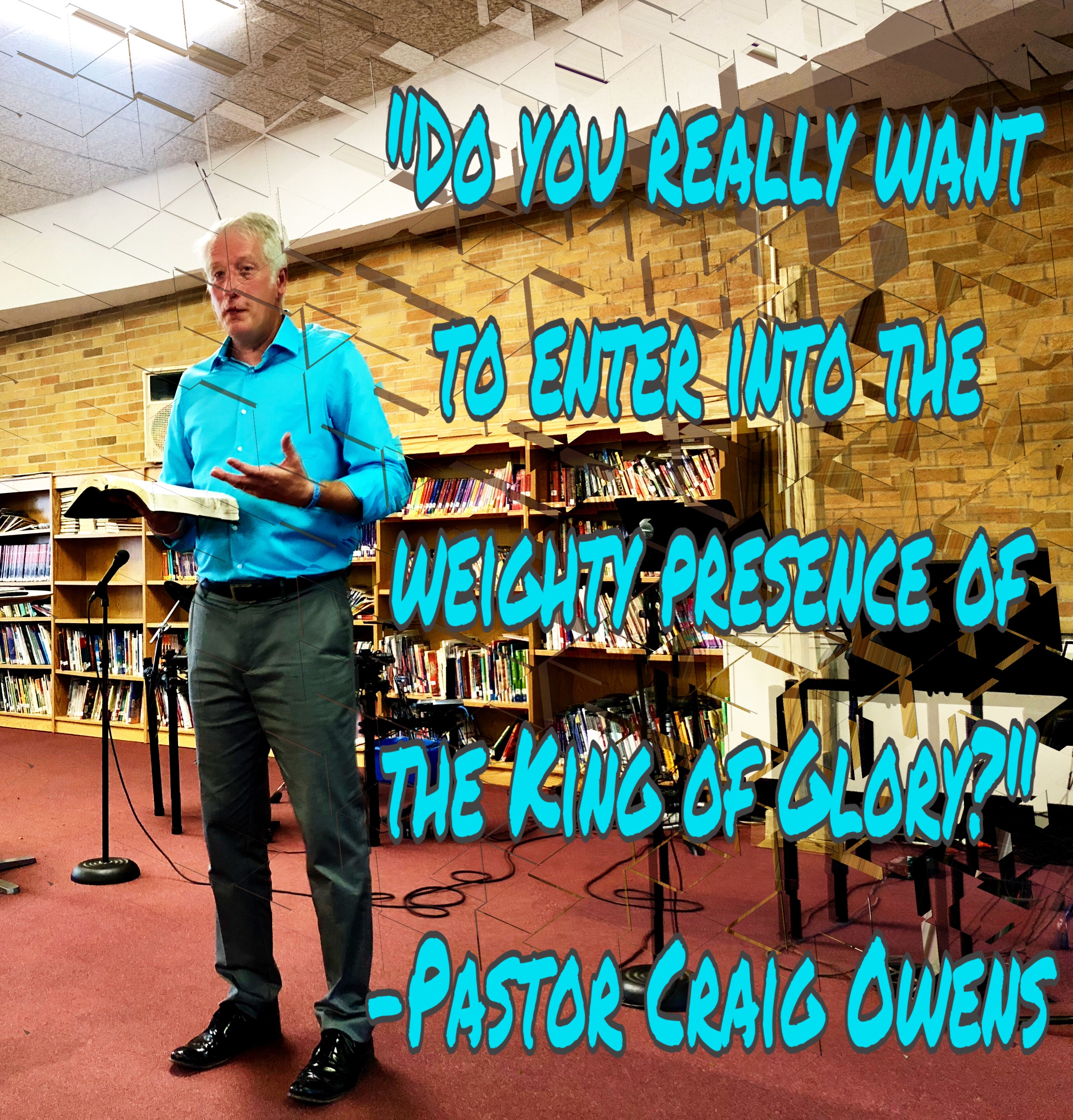
He answers the question with these words: the upright, the one with clean hands and a pure heart (he expands this list even more in Psalm 15), then he calls on us to Selah—pause and weigh this as if on a scale. David is asking, “Do you really want to enter into the weighty presence of the King of Glory?” 

If you do, something needs to happen first. David calls his generation (and our generation) the generation of Jacob. You can read the story of Jacob’s life beginning in Genesis 27. Jacob was a pragmatic man. If he could get away with something, he did. He only looked out for his own interests. He deceived, he connived, he bribed, he calculated his odds—he did what he had to so that he could advance himself. He didn’t realize God’s weight. He saw God only through a scarcity-mindset that gave God limits. He thought there was only a limited supply, and if somebody else was getting a blessing, then that meant there was less for him to get.

Then Jacob encountered God and discovered that he couldn’t do a thing against this weighty King of Glory. When he finally submitted to God, his name was changed to Israel. Jacob—the self-sufficient man—would never be allowed to enter the doors into God’s heavy glory. But Israel—the submitted man—may ascend the hill of the Lord and stand in His holy presence. Jacob means deceitful; Israel means the man without any deceit. 

For the rest of his life, Israel walked with a limp. It was a constant reminder that he simply wasn’t the man he was before he wrestled with God.

  • Jacob could only obtain what he could finagle; Israel is the recipient of all God’s blessings. 
  • Jacob could only keep his gains for this life; Israel got God’s blessings for eternity. 
  • Jacob might be vindicated by men; Israel is definitely and completely vindicated by God. 
  • Jacob couldn’t enter the presence of the King of Glory; Israel was welcomed as a prince into God’s presence.

Here’s the challenge I would give you… Use either Psalm 15 or Psalm 24:3-4 and let the Holy Spirit wrestle with you. Is there anything that’s holding you back from going through those doors into the weighty presence of the King of glory? If there is, confess it, repent from it, and even limp away from it (if you have to) so that you don’t miss out on God’s eternal blessings. 

Join me this coming Sunday as we continue our look at the Selahs in the Book of Psalms. 

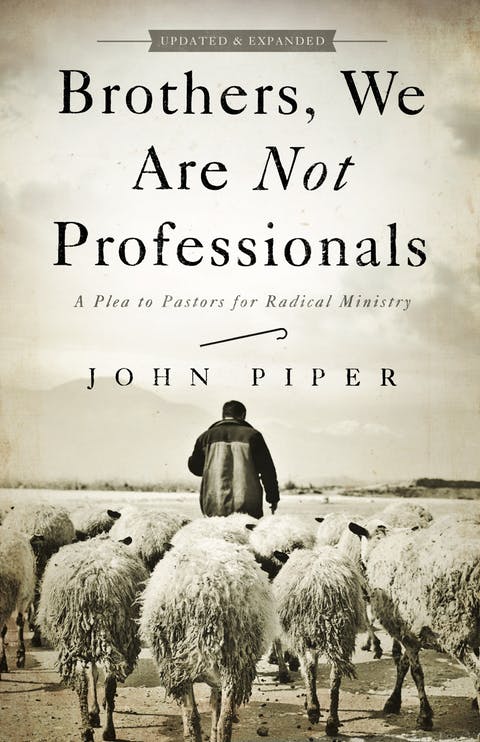
9 More Quotes From “Brothers, We Are Not Professionals”

Those in pastoral ministry are ministers; they are not professional, career-minded, corporate ladder-climbers. John Piper has written a book that I believe every pastor should read: Brothers, We Are Not Professionals. Here are a few more quotes from this excellent book. 

“Is not our most painful failure in the pastorate the inability to weep over the unbelievers in our neighborhoods and the carnal members of our churches? …  

“I must feel the truth of hell—that it exists and is terrible and horrible beyond imaginings forever and ever. ‘These will go away into eternal punishment’ (Matthew 25:46). Even if I try to make the ‘lake of fire’ (Revelation 20:15) or the ‘fiery furnace’ (Matthew 13:42) a symbol, I am confronted with the terrifying thought that symbols are not overstatements but understatements of reality. …

“I say to you, on the authority of Scripture, remember, remember, remember the horrid condition of being separated from Christ, without hope and without God, on the brink of hell. ‘Remember that you were at that time separated from Christ, alienated from the commonwealth of Israel and strangers to the covenants of promise, having no hope and without God in the world’ (Ephesians 2:12). … 

“When the heart no longer feels the truth of hell, the gospel passes from good news to simply news.” 

“Warning has value in stirring us up to take the glories of holiness and heaven seriously so that we come to see them for what they are and delight in them. But it is the delight in them that causes the true grief when we fall short.” 

“Pastors, you will know your people’s souls best by knowing your own. So try to be ruthlessly honest with yourself.” 

“If the heart is without passion, it will produce lifeless, jargon-laden spontaneity. And if the heart is aflame, no form will quench it.” 

“We ought to experience the deepest emotions about the deepest things. And we ought to speak often, and publicly, about what means most to us, in a way that shows its value.” 

“Eating, exercising, and sleeping are more spiritually relevant in the ministry than we may think. … The point is that we be intentional about how our eating affects the ability of our body to be a helpful partner in seeing the glory of God.” 

“When we say that what we do on Sunday morning is to ‘go hard after God,’ what we mean is that we are going hard after satisfaction in God, and going hard after God as our prize, and going hard after God as our treasure, our soul-food, our heart-delight, our spirit’s pleasure. Or to put Christ in His rightful place—it means that we are going hard after all that God is for us in Jesus Christ, crucified and risen.” 

“It will transform your pastoral leadership in worship if you teach your people that the basic attitude of worship on Sunday morning is not to come with your hands full to give to God but with your hands empty to receive from God.” 

“Brothers, we are leaders, and the burden of change lies most heavily on us.” 

You can read my full book review of Brothers, We Are Not Professionals by clicking here, and you can check out some other quotes from this book here.