Faith To Forgive

Listen to the podcast of this post by clicking on the player below, and you can also subscribe on AppleSpotify, or Audible. 

I shared this in my forthcoming book When Sheep Bite

In January 1647, Oliver Cromwell captured King Charles I during the British Revolution. Within just a few months, Charles escaped and was able to raise another army. A year later, in August 1648, Cromwell’s forces once again defeated the army Charles had raised, and once again Charles was taken prisoner. 

Oliver Cromwell put Charles on trial for his crimes, and after the guilty verdict was pronounced, Charles I was executed. A total of 59 people signed the former king’s death warrant. 

Fast forward eleven years and Oliver Cromwell had died and his son Richard had taken his place as Lord Protector of England. Unlike his father, there was great discontent with Richard’s leadership. As a result, the Loyalists were able to sweep Charles II into power. 

After assuming the throne of England, Charles II wanted the 59 death warrant signers put on trial, but fifteen of them had already died. That little fact didn’t stop King Charles II. He ordered that their bodies be exhumed, placed on trial, convicted of their crimes, and then hung. 

I’m no psychologist, but I think it’s safe to say that Charles II might have had a slight problem with unforgiveness!  

This is from a chapter I entitled “The ties that no longer bind.” The insidious nature of unforgiveness is that it ties us to the one who injured or offended us. 

Jesus taught us to pray, “Forgive us our debts, as we also have forgiven our debtors” (Matthew 6:12). The word He uses for “debts” means something justly or legally due, or an offense or sin that has been committed. So a debtor is one who morally or legally owes another for the wrong committed. 

So for these debts, we are taught to ask for forgiveness of God and to give that same forgiveness to others. Jesus uses the same root word for both “forgive” and “forgiven,” but there are nuances that make the picture quite clear. 

  • When we ask God to forgive our debts, it is the active voice (I have to ask for it) and it is stated in the second person (I have to receive it). When I ask my Heavenly Father for this, my offense has been paid-in-full because the legal and moral requirements aren’t due any longer. I couldn’t pay this debt on my own, but Jesus paid it for me (2 Corinthians 5:21).  
  • When I forgive someone who has wronged me, it is again the active voice (I have to give it), but it is now in the first person (I don’t wait around for the other person to ask for forgiveness). I let it go. I don’t hinder the other person or myself with waiting for the penalty to be paid any longer. 

This is the only part of this model prayer for which Jesus gives a commentary afterwards (in Matthew 6:14-15). With this, Jesus is teaching us that to say, “I’m forgiven” is also to say, “I’m forgiving.” 

Unlike Charles II, when we are forgiven and forgiving, the inevitable result is freedom for both ourselves and our offenders. 

If we practice this relentlessly, we are both freed ourselves and freeing others! 

When we ask God to forgive us, He forgives us immediately and completely (Psalm 103:12; Isaiah 1:18). We are to forgive our debtors just as quickly. 

When we pray, “Forgive as we also have forgiven,” we are both acknowledging His power to forgive us and requesting the faith need to be forgiving people. As C.S. Lewis noted, “To be a Christian means to forgive the inexcusable, because God has forgiven the inexcusable in you.” 

The Bible describes satan’s activity as stealing, killing, and destroying. He’s called the father of lies, so he uses slander to try to steal, kill, and destroy. His slander is: “God can’t forgive that” and “You shouldn’t let them off the hook for what they did to you.” 

These two thoughts are linked, just as “I’m forgiven” and “I’m forgiving” are linked. If I begin to  think that what someone did to me was too big for me to forgive, then I can also believe that there is a sin I have committed that is too big for God to forgive. But when I live both receiving and giving forgiveness, I can tune out this lie from hell. 

If you’ve missed any of the messages in this series called Kingdom Praying, you can find all of them here. 

►► Would you please prayerfully consider supporting this ministry? My Patreon supporters get behind-the-scenes access to exclusive materials. ◀︎◀︎

The King Of Glory

Listen to the podcast of this post by clicking on the player below, and you can also subscribe on AppleSpotify, or Audible. 

I did a series of Advent messages a few years ago called “The Carols of Christmas” with the premise that many of our old familiar carols had become too familiar and we had lost the true meaning in those beautiful songs. 

I think the same is true with the sentiment of wanting to experience the glory of God. Sometimes you will hear people say, “We just want to see God’s glory!” but I’m not sure they really mean this or really want it. 

Throughout the Bible, “glory” comes from the Hebrew word which means weightiness. When God appears—or even one of His angels glowing with His glorious presence—people collapse under the weight of His glory. Look at the examples of Moses, Isaiah, Daniel, and even John the beloved disciple of Jesus (Exodus 3:6; Isaiah 6:3-5; Daniel 8:15-17; Revelation 1:12-17). 

In the light of Christ’s glory everything is exposed. We have no excuses for our sin. We are seen exactly as we are, and the fear of God’s judgment causes us to collapse under that weight. 

But the First Advent story is filled with the phrase “Fear not.” Let me show you two examples. First, notice the strong emotions when the angels appear to the shepherds— 

An angel of the Lord appeared to them, and the glory of the Lord shone around them, and they were terrified. But the angel said to them, “Do not be afraid. I bring you good news that will cause great joy for all the people.” (Luke 2:9-10)

What was this good news that would turn their fear into joy? Listen to the angelic message to Joseph—

Joseph son of David, do not be afraid to take Mary home as your wife, because what is conceived in her is from the Holy Spirit. She will give birth to a Son, and you are to give Him the name Jesus, because He will save His people from their sins. (Matthew 1:20-21) 

Notice the phrase, “HE will save His people from their sins.” Part of what contributes to our fear of God’s glorious presence is knowing that we are helpless to remove our sins. The fact that Jesus would do this for us was foretold in prophecies like Isaiah 25:7-9 and 59:15-16.

How will Jesus do this? In 1 Corinthians 15:53, Paul says that in order to enter into God’s presence our perishable, mortal lives have to be exchanged for something imperishable and immortal. We are unable to do this, but in the Incarnation, the immortal God put on mortal flesh!  

Paul goes on in 1 Corinthians 15 to say, “When the perishable has been clothed with the imperishable, and the mortal with immortality, then the saying that is written will come true: “Death has been swallowed up in victory.” Where, O death, is your victory? Where, O death, is your sting?” (1 Corinthians 15:54-55)! 

If our sins were still clinging to us, spending eternity in the presence of the King of Glory would be torturous! Our fear of His weighty glory is only changed into joy when we accept that He has saved us from the penalty of our sins. Now our fear of His glory isn’t a crippling fear, but as we worship Him for His salvation our fear becomes reverential worship. 

Or we could say it this way—When we fear the King of Glory we fear nothing else! 

Charitie Lees Bancroft captures that idea in these stanzas of her poem:

When satan tempts me to despair
And tells me of the guilt within,
Upward I look and see Him there
Who made an end of all my sin.
Because the sinless Savior died,
My sinful soul is counted free;
For God the Just is satisfied
To look on Him and pardon me. 

Behold Him there! The risen Lamb,
My perfect, spotless righteousness;
The great unchangeable “I AM,”
The King of glory and of grace!
One with Himself I cannot die,
My soul is purchased by His blood;
My life is hid with Christ on high,
With Christ, my Savior and my God.

With our sins forgiven by our faith in Jesus, we can now enjoy an eternity in the weighty, awesome presence of the King of Glory! 

If you’ve missed any of the other messages in our series Long Live the King of Kings, you can find them all by clicking here. 

►► Would you please prayerfully consider supporting this ministry? My Patreon supporters get behind-the-scenes access to exclusive materials. Like this video where I talk about the logic in Psalm 119. ◀︎◀︎

Links & Quotes

The Holy Spirit loves to give us those “lightbulb moments” when the Word of God almost leaps off the page! I have lots of new content every week, which you can check out on my YouTube channel.

It has long been believed that some migratory animals use the earth’s magnetic force to help them navigate. Some researchers discovered that moths can see both the magnetic fields and the stars to plot their course. The lead researcher wrote, “If you have this tiny insect with a brain a tenth the volume of a grain of rice and eyes smaller than a pinhead, that they can do this is surprising.” The protein in their eyes that allow them to do this is unevolved—it’s always been there, implant from the beginning by our awesome Creator!

In the God Speaks Science reading plan on YouVersion, John Von Sloten wrote, “Creation is God’s first book. To read it we need science. Science is not the enemy of the Christian faith; it’s an ally! … We need to read biblical creation references with the Author’s omniscience and original intent in mind. To do that, we need science. … What if you try to connect the next scientific truth you encounter to an attribute of our ever-near God? If everything comes from God’s mind, then everything has something to say about God’s nature.”

Competitive leaders need to keep both winning and losing in perspective. Check out the full conversation Greg and I had about competition on The Craig and Greg Show.

I love studying the archeological discoveries that confirm the historicity of the Bible. Check out this compilation of the kings of Judah and Israel from The Bible Archeology Report. You may also be interested in this side-by-side chart I created of the timelines of these kings.

“Men of peace must not think about retribution or recrimination. Courageous people do not fear forgiving.” —Nelson Mandela

“Leaders inspire others because they are inspired by others.” —John Maxwell

“The most important single ingredient in the formula of success is knowing how to get along with people.” —Teddy Roosevelt

Links & Quotes

Put the good stuff from the Bible in your heart and mind regularly. When you do, the Holy Spirit can remind you of what you’ve studied and help you apply it to your daily situations. I have lots of new content every week, which you can check out on my YouTube channel.

“It pays to know the enemy—not least because at some time you may have the opportunity to turn him into a friend.” —Margaret Thatcher

John Stonestreet and Dr. Glenn Sunshine shared this, “The despicable and horrendous attacks by Hamas against civilians last week, including beheading children and kidnapping the elderly, seems a throwback to some distant, barbaric past of human history. We may have thought the world had long ago outgrown such barbarity, but it hasn’t. In fact, as shocking as it is, the kinds of atrocities carried out by the Hamas terrorists are the norms of warfare, at least throughout most of human history.” What changed this? Quite simply: a Christian worldview of just warfare.

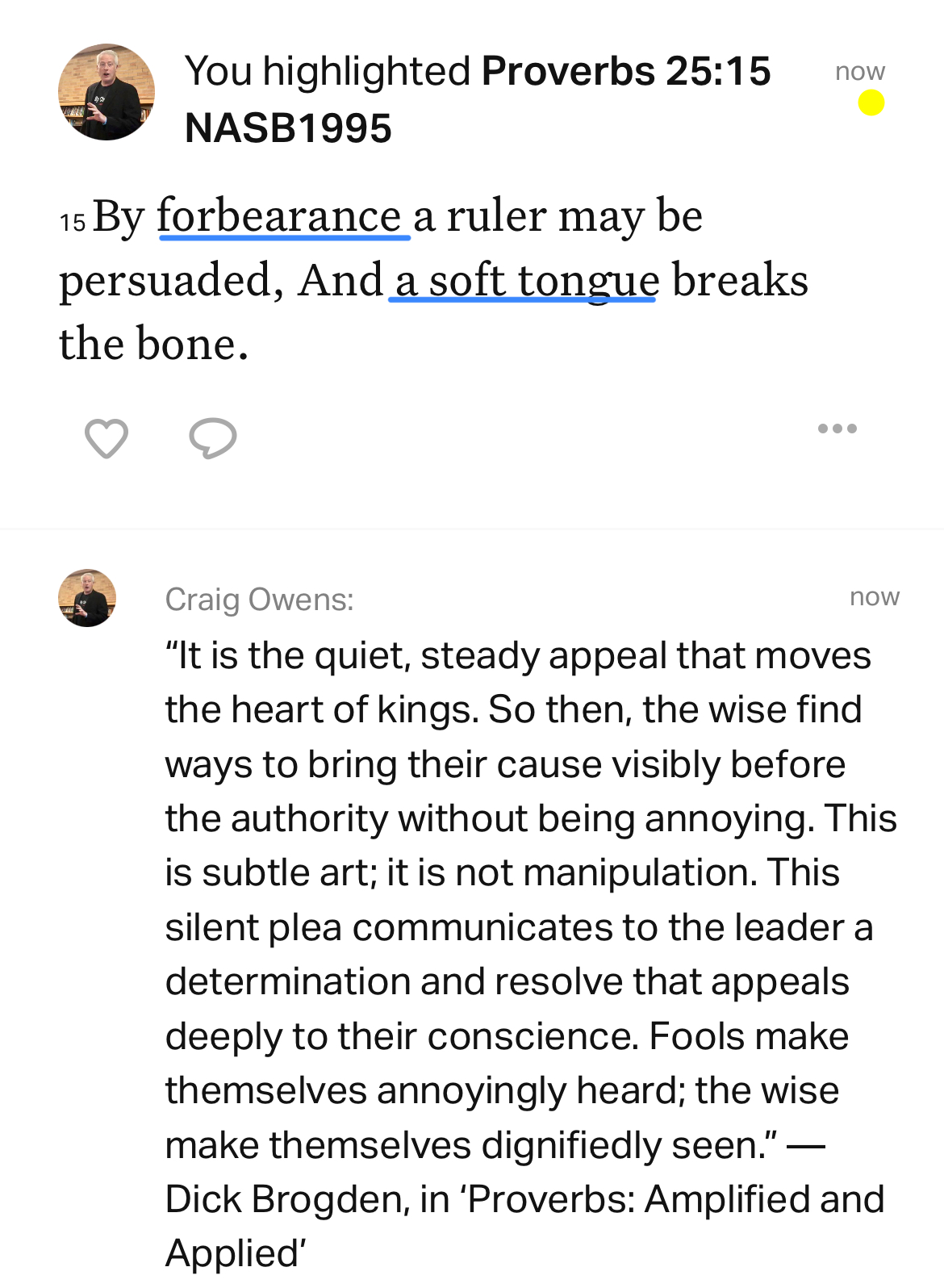
“It is the quiet, steady appeal that moves the heart of kings. So then, the wise find ways to bring their cause visibly before the authority without being annoying. This is subtle art; it is not manipulation. This silent plea communicates to the leader a determination and resolve that appeals deeply to their conscience. Fools make themselves annoyingly heard; the wise make themselves dignifiedly seen.” —Dick Brogden, in Proverbs: Amplified and Applied

Links & Quotes

God made you uniquely YOU! You have been made on purpose and for a purpose. I have lots of new content every week, which you can check out on my YouTube channel.

This is an exciting archeological discovery: the first Koine Greek rendering of a psalm ever discovered inscribed on stone rather than on parchment or papyrus.

“The wise recognize before the fight that adversity will come and therefore are not surprised by it. The wise recognize in the fight that adversity is a formidable foe and thus steel themselves for a long, hard struggle to the death. The wise recognize after winning a fight that the war is not over and so never let down their guard nor release their weapons.” —Dick Brogden, in Proverbs: Amplified and Applied

Astronomers have discovered planet-sized objects that are puzzling the best minds. In fact, they have had to create a new category for these objects: Jupiter Mass Binary Objects (JuMBOs). What is baffling the brightest minds is that these planets don’t orbit a star but appear to be gravitationally bound to other JuMBOs. My favorite line is this one: “The new phenomenon challenges current frameworks explaining how stars and planets form within nebula, with astrophysicists claiming such objects should not exist.” There is at least one who isn’t baffled: The One who created JuMBOs along with everything else in our universe.

T.M. Moore is in the midst of a series of posts about the Christian and the government. They are excellent! Here is just a short sample—“The Christian understands that government is a servant of God for good, and that God, therefore, must define the terms of goodness by which a government fulfills its appointed task. As Paul reminds us, the Law of God is holy and righteous and good (Romans 7:12). It is important, therefore, that Christians understand the Law of God and consider the best ways of bringing its influence to bear in the arena of public policy. … Public policy is not about what governments can do, but what they should do, that is, if they are to fulfill their callings as God’s servants for good. When it comes to applying the Law of God to public policy, Christians must make this first principle foundational in the logic with which they approach the work of influencing and shaping public policy.”

“The weak can never forgive. Forgiveness is an attribute of the strong.” —Mahatma Gandhi

Leaders are naturally wired to be either confident or humble. Both kinds of leaders need to remain coachable. Greg and I unpacked this idea on this episode of The Craig And Greg Show, and I also discuss it in greater depth in my book Shepherd Leadership.

No Condemnation

Listen to the podcast of this post by clicking on the player below, and you can also subscribe on AppleSpotify, or Audible. 

Caiaphas’ bold claim couldn’t be backed up, but every bold claim Jesus made was backed up. In the process of looking at those claims, we’ve actually already read another bold claim—one that was repeated three times. It is a bold claim made by the Roman governor Pontius Pilate.

When Jesus was first brought to Pilate, he attempted to “pass the buck” by sending Jesus to King Herod Antipas. Since Herod sent Jesus right back to Pilate, the governor took that as support for his bold claim. Check out what Pilate said: 

  • I have found no basis for your charges against Jesus
  • neither has Herod
  • Jesus has done nothing to deserve death 
  • I have found in Him no grounds for the death penalty (Luke 23:13-22)

Even Pilate’s wife supported him by saying, “Don’t have anything to do with that innocent Man” (Matthew 27:19). 

Pilate’s role in this case was as a modern-day judge. A judge weighs the evidence from the prosecution, compares that with the laws on the books, weighs the evidence from the defendant, and then makes his ruling. Pilate rules multiple times: Not guilty. But the accusers keep coming back with their loud voices but no more evidence. Even though “[Pilate] knew it was out of self-interest that they had handed Jesus over to him” (Matthew 27:18), the shouts of the religious leaders finally prevailed (Luke 23:23-25). 

Why was Pilate’s claim of the innocence of Jesus so bold? Because the Bible tells us, “ALL have sinned and fall short of the glory of God” (Romans 3:23). 

These religious elites had been trying to find an accusation against Jesus almost since the beginning of His public ministry. Many of these same accusers were present on the day they hauled a woman caught in the act of adultery before Jesus (John 8:2-11). They claimed she deserved to be stoned to death, but Jesus simply said, “Let those without any sin throw the first stone at her.” Jesus once again allowed His eloquent silence to work on their hearts, as they knew that not one of them was without sin, so they all dropped their stones and left. 

Jesus freed this woman from her sin when He refused to condemn her. After all, He was the only sinless One who could have been justified in throwing the first stone, but He knew that “God did not send His Son into the world to condemn the world, but to save the world through Him” (John 3:17). 

Jesus doesn’t condemn us, but He doesn’t want us to stay in our sin either, which is why He then told this woman, “Go now and leave your life of sin.” 

Jesus called all of us to live a perfect life: “Be perfect, therefore, as your heavenly Father is perfect” (Matthew 5:48). Yet like those men in John 8, we all would have to drop our stones and leave. 

And satan loves to remind God’s saints of this. John shares with us that “the accuser of our brothers and sisters…accuses them before our God day and night” (Revelation 12:10). The accuser wants to keep us trapped in the guilt of our sin—wants to see us condemned to an eternity separated from God’s presence. 

But when someone has placed their faith in the sacrifice Jesus made for us with His death on the Cross, Jesus takes us into Himself and there is now no condemnation for those IN Jesus because there is nothing in Jesus to be condemned! Because of what Jesus did, it’s not us who is condemned, but sin is condemned! As a result, we no longer have to live according to the sinful nature and suffer the condemnation of sin, but instead when we are in Jesus, “the righteous requirements of the law” are fully met in us (see Romans 8:1-4). 

We cannot do this on our own, but only through the power of the blood of Jesus. Look at the rest of this passage from Revelation: “For the accuser of our brothers and sisters, who accuses them before our God day and night, has been hurled down. They triumphed over him by the blood of the Lamb” (Revelation 12:10-11). 

What amazing news! The writer of Hebrews gives us more details in this passage: 

For by one sacrifice [Jesus] has made perfect forever those who are being made holy. The Holy Spirit also testifies to us about this. First He says: “This is the covenant I will make with them after that time, says the Lord. I will put My laws in their hearts, and I will write them on their minds.” Then He adds: “Their sins and lawless acts I will remember no more.” (Hebrews 10:14-17)

When we are in Jesus—when we have accepted by faith His work on the Cross—God can make the same bold claim to the devil that Pilate made to the religious leaders: “I find no basis for a charge!” This is how we can then fulfill the righteous requirement Jesus gives us to “Be perfect, therefore, as your heavenly Father is perfect.” 

Only Jesus can do this for us! 

If you’ve missed any of the other messages in our series of Bold Claims, you can find them all here. 

►► Would you please prayerfully consider supporting this ministry? My Patreon supporters get behind-the-scenes access to exclusive materials. ◀︎◀︎

Gut-Level Compassion

Listen to the podcast of this post by clicking on the player below, and you can also subscribe on AppleSpotify, or Audible. 

I think the best-known verse in the Bible may be, “For God so loved the world that He gave His one and only Son, that whoever believes in Him shall not perish but have eternal life” (John 3:16). This truly is amazing love! 

But on several occasions, the Gospel writers talk about the compassion of Jesus. This is a different word altogether. The root Greek word is “bowels.” To feel this kind of compassion means to feel it in your gut—to ache with the same pain that is afflicting someone else. 

But compassion means more than feeling the pain, it also means going into action to alleviate the pain. True compassion aches and then acts. 

Look at the compassion of Jesus—

  • He sees crowds of people “harassed and helpless, like sheep without a shepherd.” His compassionate response is to pray for His Father to send more shepherds to these sheep (Matthew 9:36-38). 
  • He sees people plagued by diseases—paralysis, deafness, blindness, even death—and He places His hands on them and brings complete healing (Matthew 14:14, 20:34; Mark 1:41, 9:22; Luke 7:11-15). 
  • He notices hungry people and He feeds them (Matthew 15:32; Mark 8:2). 
  • He encounters confused people and He teaches them the illuminating truth (Mark 6:34). 

(Check out the above Bible verses by clicking here.) 

This word isn’t just used for Jesus, but we see His compassionate heart behind the gut-level response of others. See the Christ-like compassion in…

  • …a crushing, insurmountable debt completely forgiven (Matthew 18:21-27). 
  • …a Samaritan caring for an injured Jew (Luke 10:30-35).
  • …a prodigal father fully forgiving and restoring his wayward son to himself (Luke 15:11-24). 

(Check out the above Bible verses by clicking here.)

This kind of compassion is costly. It cost Jesus time to be alone, it cost the king, the prodigal father, and the Samaritan money to forgive a debt, lose an inheritance, and pay medical bills. But Christ-like compassion knows there is no greater reward than aching and acting like Jesus. 

Christ-like compassion must be extended in faith. Like touching someone with unclean disease, or fasting to receive power to release a loved one shackled to a heavy burden, or embracing someone who hurt me, or canceling a debt owed to me, or helping someone who despises me. When we ache and act like this, we show the love of God in irrefutable ways. Our selfless, Christ-like compassion paints a vivid picture for a skeptical world to see and embrace the love of God that sent His Son to ransom us.

Let’s make it our prayer that we would ache with the needs of the people around us, and then to move in faith-filled, Christ-honoring, selfless action to alleviate that need. Then let us believe that our compassion will show others the love of a Savior. 

►► Would you please prayerfully consider supporting this ministry? My Patreon supporters get behind-the-scenes access to exclusive materials. ◀︎◀︎

Forgive Like You’ve Been Forgiven

Listen to the podcast of this post by clicking on the player below, and you can also subscribe on AppleSpotify, or Audible. 

Jesus said that the devil’s agenda was to steal, kill, and destroy (John 10:10). We see this on full display in the aftermath of the first sin in the way relationships humans had with each other changed. 

God said to Eve, “Your desire will be for your husband, and he will rule over you” (Genesis 3:16). Dr. Henry Halley commented, “The last two lines of this verse could be paraphrased, ‘You will now have a tendency to try to dominate your husband and he will have the tendency to act as a tyrant.’” And to Adam, God said that he would now have to work harder than ever before to harvest the food he needed for survival, which undoubtedly caused stress in his relationship with Eve. In the very next chapter, the strained relationship between Cain and Able resulted in the first homicide (Genesis 3:17-19, 4:1-8). 

In these relationships, intimacy was stolen, closeness was killed, and life was destroyed. 

An irreplaceable tool for avoiding this heartache and destruction that sin causes in our relationships is forgiveness. 

Peter asked Jesus, “How many times should I forgive my brother or sister who sins against me? Up to seven times?” (Matthew 18:21). In reply, Jesus told a story about a man who owed the equivalent of 20 years of a day laborer’s wages and a man who owed about three months of a day laborer’s wages. The first man who owed so much was forgiven entirely of his debt, but he wouldn’t forgive the paltry amount that was owed to him by the second man. 

To the forgiven but unforgiving man, Jesus said, “Shouldn’t you have had mercy on your fellow servant just as I had on you?” (see Matthew 18:22-35). 

That should be our standard: Not how others treat me, but how God has treated me! Not how much others owe me, but how much God has forgiven me!

Do I want God to put a quota on how many times I can be forgiven? Do I want there to be a limit on how big of an offense God will forgive in me?

Of course not!

That’s my standard. I must show the same mercy to others as I have been shown by God. 

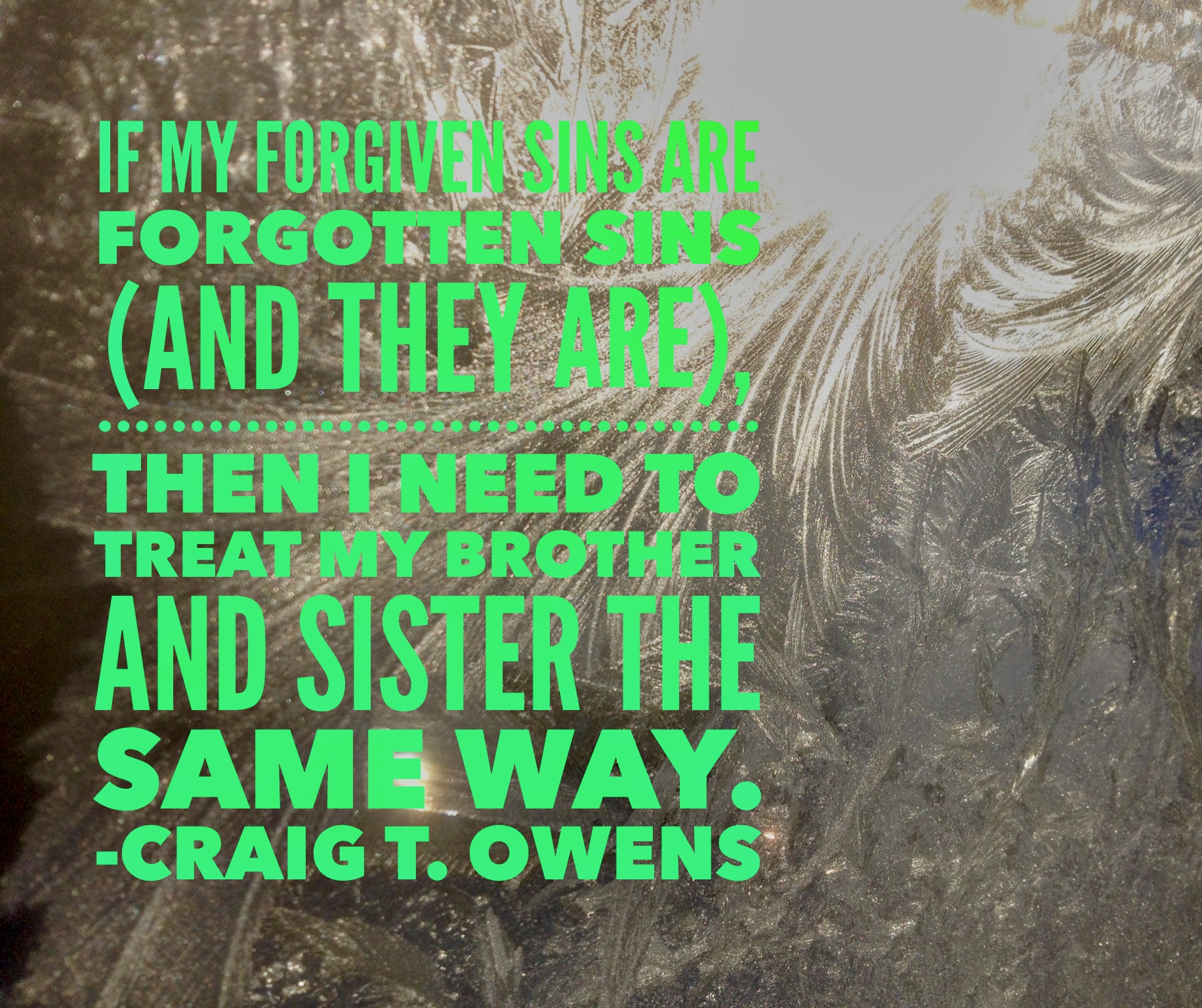
If my forgiven sins are forgotten sins (and they are), then I need to treat my brother and sister the same way. This is why Jesus told Peter to stop counting the number of offenses. We are to treat every offense as though it was the first and only offense.

The man who owed so much money asked for more time to repay his debt. But the master did more than that: He forgave the debt—he wiped it off the books completely, as though it had never happened! 

When God forgives our sin, He separates our sin from us as far as the east is from the west. He keeps no record of the offense ever having occurred (Psalm 103:10-12). 

This is to be our standard too. We are to forgive others as God has forgiven us. Forgiveness will restore intimacy, closeness, and life to our relationships. 

This is difficult to do. As Peter pointed out, a brother or sister—someone close to his heart—had sinned against him. But this is why Jesus taught us to pray, “Forgive us our sins, as we have forgiven those who sin against us” (Matthew 6:12). Or as Eugene Peterson paraphrases that verse in The Message, “Keep us forgiven with You and forgiving others.” 

May the Holy Spirit help us in this important work of ongoing, complete, and restoring forgiveness!

►► Would you please prayerfully consider supporting this ministry? My Patreon supporters get behind-the-scenes access to exclusive materials. ◀︎◀︎
Grateful For What You Have

Listen to the podcast of this post by clicking on the player below, and you can also subscribe on AppleSpotify, or Audible. 

We said last week that nobody likes to be around a complainer, although many complainers would say they’re not complaining but just sharing facts. In their mind, they have a legitimate right to let everyone know how they’ve been short-changed, gotten a bad deal, or experienced something that no one else has gone through.    

Have you ever heard your kids say, “I’m starving”? And perhaps you think, “Do you really know what starving is?” Or what about people waving their very expensive phones around as they complain, “Isn’t there any WiFi here?!” 

This isn’t a glass half-full or half-empty thing. This is really closing your eyes to the fact that many people don’t even have a glass, or if they do have a glass, they don’t have access to the water that they need. 

I was delivering some Christmas toys to a family and I discovered they had lost everything they owned. When I came to their house their furniture was mismatched, their food and clothes were donated, and their kids only had a couple of simple toys to play with. And yet this family was happy to be together! 

That sort of puts things in perspective, doesn’t it? 

We have to choose grumbling or gratefulness, but as E.M. Bounds noted, “Gratitude and murmuring never abide in the same heart at the same time.” So if you are complaining about what you don’t have, you cannot be grateful for what you do have. 

There is a fascinating story told in all four Gospels of a woman named Mary. She was an uninvited guest at a house where Jesus and His disciples had been invited to dinner. Jesus was not there because someone was grateful to have Him in his home, but because Simon the Pharisee and his cronies were trying to find a reason to accuse Jesus of wrongdoing. 

Simon was so focused on his “gotcha” moment that he completely overlooked his host duties. He didn’t wash Jesus’ feet, nor greet Him with a kiss, nor anoint Him with perfume, as the custom of the day demanded. But Mary, standing behind Jesus at the dinner table, washed Jesus’ feet with her tears, kissed His feet, and anointed Him with an entire bottle of costly perfume! She did all of this out of gratitude for what she had received from Jesus. 

First, I would like you to consider what Mary didn’t have:

  • a seat at the table—even though the dinner was in her hometown of Bethany, her brother Lazarus was invited to the meal, and her sister Martha was serving the meal 
  • a good reputation—twice Simon the Pharisee said, “Does Jesus even know what kind of woman she is? Does He know she is a sinner?” 
  • the acceptance or approval of others—even the disciples thought her gesture of anointing Jesus with so much perfume was a wasted extravagance 

Next, let’s look at what Simon did have:

  • an elevated position as a Pharisee 
  • considerable wealth—he had servants and a home large enough for a big dinner party 
  • healing from leprosy—the Gospels refer to him as “Simon the leper” which tells us that he had been healed of his leprosy 

Now, let’s consider what the disciples did have:

  • an enviable position as disciples of Jesus
  • a dinner invitation to Simon’s house
  • access to the financial resources that people gave to Christ’s ministry
  • and let us never overlook the fact that they had access to Jesus Himself like no one else had

Finally, let’s look at what Mary did have:

  • forgiveness—Luke says this about her, “A woman who HAD lived a sinful life” 

Gratitude is truly a great attitude. Grateful people stand out because they don’t grumble about what they don’t have, but they are focused on what they do have.  

Mary knew that she didn’t have the outward marks of success or favor or approval, but she did have the assurance that she had been forgiven. For that, she was more than willing to give everything she had to Jesus in thankful worship! 

And as a result, look what Mary now has:

  • the kind words of Jesus—He assured her that she was forgiven (Luke 7:47)
  • Jesus as her defender—He told His disciples, “Leave her alone” (John 12:7)
  • an eternal testimony—Jesus said that wherever the Gospel was preached, people would tell Mary’s story (Matthew 26:13) 

I think a good way to sum up the distinguishing way grateful people live is like this: They don’t grumble about what they don’t have, but they are extremely grateful for what they do have. 

When you find grumbling slipping out of your mouth, remind yourself of just how much you have been given. Even if you think to yourself, “I don’t have much,” you can be assured that you have Jesus, and He is more than enough! And with that assurance, let your gratitude be lifted up in extravagant, fragrant praise to God. 

If you’ve missed any of the messages in our series The Great Attitude of Gratitude, you can find the full list by clicking here. 

►► Would you please prayerfully consider supporting this ministry? My Patreon supporters get behind-the-scenes access to exclusive materials. ◀︎◀︎

Links & Quotes

Don’t wait until you feel like doing the next good thing, just do the next good thing and the good feelings will follow. Not only that, but you will motivate others too!

“Excellence is to do a common thing in an uncommon way.” —Booker T. Washington

This is a cool mini-biography of Gottfried von Leibniz, a German polymath, committed Lutheran, and one of the most wide-ranging intellects in all of history.

“Forgiveness does not excuse the offending behavior. Forgiveness excuses the offender. The fact that God forgives us of sin, does not make sinning okay. The fact that we forgive someone of their sin towards us, does not make the sin okay.” —Kanayo Situ

“The happiness of a man in this life does not consist in the absence but in the mastery of his passions.” —Alfred Lord Tennyson

“In life you can take things one of two ways: you can take them for granted or you can take them with gratitude.” —G.K. Chesterton

T.M. Moore has an excellent post on how we can prepare for temptation before it even comes. Please check out this whole post which concludes with this thought, “Make up your mind, each day, that you’re going to resist temptation with prayer, preparation, and resting in the Word of God. Let the Spirit Who brings conviction and repentance be at work within you before you come upon the nets and snares of temptation, and you’ll be in a much better position to overcome the evil that threatens to engulf you, with the good choices and conduct that please the Lord and honor Him.”

More amazing evidence of the creativity of our Creator. Researchers have discovered how plant roots adapt based on the presence or lack of water.