Vegetables And Dessert

a-testimony-to-othersHave you ever noticed that kids would prefer to eat dessert more than vegetables? Well, maybe you’re an adult and you still feel the same way! But “veggies before dessert” is still a good motto to live by.

Why?

What happens if you eat only dessert? Do you eventually get healthier or are you setting yourself up for some unfavorable health conditions? What about if you only eat vegetables? The flavor may not be as good, but at least you’ll be getting healthier.

Jesus told His followers to expect the “veggie” times in time. He said, “In this world you will have trouble.” And He told us, “Then you will be handed over to be persecuted and put to death, and you will be hated by all nations because of Me.” There were no ifs or maybes in those statements!

As Christians living on Earth, the Apostle Peter calls us “aliens and strangers.” That means that both our attitude and our lifestyle should be, well, alien compared to Earthlings. Especially when we’re in a veggie time of life.

Jesus was the Perfect Man. He never said anything wrong, and He never did anything wrong. Yet He was insulted, persecuted, and eventually killed in the most horrific way imaginable. But here’s the amazing thing: Jesus went through all of this without retaliating or threatening judgment on His persecutors. Peter said that the way Jesus went through this was intended to be an example for us.

The writer of Hebrews agreedLet us fix our eyes on Jesus, the Author and Perfecter of our faith, Who for the joy set before Him endured the Cross, scorning its shame, and sat down at the right hand of the throne of God. Consider Him Who endured such opposition from sinful men, so that you will not grow weary and lose heart

Notice it says, “for the joy set before Him.” Other translations say “because of the joy awaiting Him” or “He never lost sight of where He was headed” or “He never lost sight of the joy ahead of Him.” In other words, Jesus knew what God’s plan was from before the beginning of time, so He—as Peter said—kept on entrusting Himself to God.

We have to do the same thing!

I have to confess something. When I quoted the “veggie” part of a couple of verses earlier in this post, I left off the “dessert” part…

  • “I have told you these things, so that in Me you may have peace. In this world you will have trouble. But take heart! I have overcome the world.” (John 16:33)
  • Blessed are those who are persecuted because of righteousness, for theirs is the kingdom of heaven. Blessed are you when people insult you, persecute you and falsely say all kinds of evil against you because of Me. Rejoice and be glad, because great is your reward in heaven….” (Matthew 5:10-12)

The way you handle your vegetable times—disease, insults, financial setbacks, outright persecution—can be a testimony to others. The way you go through these trials could help others turn to the Shepherd and Overseer of their souls.

Are you in a trial now? Keep on entrusting yourself to Him Whose plans cannot be thwarted

It might seem all “veggies” now, but you are getting healthier, and the “dessert” you cannot even imagine is on its way!

If you’ve missed any messages in this series, you may find the complete list by clicking here.

11 Ways To Be A Good Minister

© Lori Oxford Photography

Here are 11 ways to “be a good minister of Christ Jesus” (1 Timothy 4:6)—

  1. Know the Scripture well enough to point out false doctrines (vv. 1-6a)
  2. Be a good teacher (v. 6b)
  3. Train myself to be godly (v. 7)
  4. Take care of my physical health (v. 8)
  5. Put my hope solidly in God (vv. 9, 10)
  6. Set an example worth following (vv. 11, 12)
  7. Use the Scriptures in everything I preach (v. 13)
  8. Turn my God-given gifts into strengths (v. 14)
  9. Have a good work ethic (v. 15a)
  10. Be consistently growing (v. 15b)
  11. Carefully and prayerfully evaluate my doctrine (v. 16)

Don’t Try To Change Your Bad Behavior

Thoughts to beahviorsAs I wrote previously, I believe Christians should be the best at getting along with others. First of all, Christians have been empowered by the Holy Spirit with the skills necessary to live at peace with everyone, IF we will only allow the Spirit to do the necessary work in us. And second, the way Christians treat others goes a long way toward either attracting or repelling others from a relationship with Jesus.

But here’s an important thing: If you don’t get along well with others now, don’t try to change your behavior!

Stephen Covey wrote, “To try to change outward behaviors does very little good in the long run if I fail to examine the basic paradigms from which those attitudes and behaviors flow.”

You see, behavior is the fruit. If we want to change the fruit, we need to back up a few steps.

The Apostle Paul used the life of Jesus as an example for Christians on how we can get along with others. But notice this: most of what Paul discusses is the “inside stuff.”

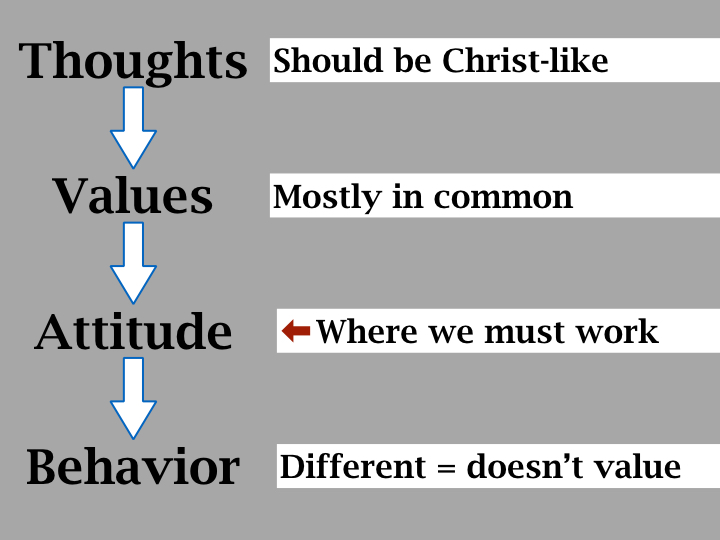
The progression goes like this (see Philippians 2:1-13)—

Thoughts → Values → Attitudes → Behaviors

(1) Thoughts—These need to be humble thoughts about God’s love toward us (v. 1).

(2) Values—Paul tells us to be “one in spirit and purpose” with others (v. 2). The definition of the Greek words here mean valuing the well-being of everyone. Paul then explains how our humility can lead to these win-win relationships (vv. 3, 4).

(3) Attitudes—“Your attitude should be the same as Christ Jesus” (v. 5). Jesus showed us what it was to have an attitude related toward obedience to God’s will.

(4) Behavior—If our thoughts, values and attitudes are rightly aligned to God, then our behavior will naturally be Christ-like as well. We see the example of Jesus in verses 6-8, and God’s reward for that behavior in verses 9-11. Then Paul calls on Christians to follow that pattern in our own lives (vv. 12, 13).

Most decent, reasonably-thinking human beings share the same values. Harry Truman said, “When we understand the other fellow’s viewpoint—understand what he is trying to do—nine times out of ten he is trying to do right.”

The problem is this: When the other person behaves differently from me, my natural tendency is to assume he doesn’t value what I value. In other words, I’m judging his value system on the way I normally behave.

The break-down is in my attitude. That’s the area I need to address. That’s the attribute of Jesus that Paul told us to copy.

So if I want to get along better with others, I shouldn’t try to change my behavior, but my attitude. My prayer should be: “I want this same attitude to be in me which was also in Christ Jesus. He served God and others, so I too want to follow His example of obedience, and I want to demonstrate my appreciation for all that Jesus has done for me by working hard to better get along with others. Help me change my attitude!”

Check out this video of the full message…

I hope you can join us next Sunday as we continue learning how to get along with others. Please join us in person or on Periscope.

Thursdays With Oswald—Experience Or Expression?

Oswald ChambersThis is a weekly series with things I’m reading and pondering from Oswald Chambers. You can read the original seed thought here, or type “Thursdays With Oswald” in the search box to read more entries.

Experience Or Expression?

     It is not sufficient to have an experience. If all I can do is to preach and recount the experiences God has given me, it is dangerously inefficient. … Experience must be worked out into expression; the expression is a strong family likeness to Jesus, and its mark is found in the secular life, not in the sequestered life. … 

     A witness is not one who is entranced by Jesus, by the revelation He gives, by what He has done; but one who has received the energy Jesus Himself had, and is become a witness that pleases Him, wherever he is placed, whatever he is doing, whether he is known or unknown. … 

     The spiritual life can never be lived in religious meetings, it can only be lived on sordid earth, where Jesus lived, amongst the things that makes human life what it is. 

From The Place Of Help

It’s not what I’ve experienced from Jesus, but how I am expressing that experience in my daily life. People don’t need me to be a storyteller of my experiences, but a living expression of the change that has taken place in me because of that experience with Christ!

All of the stories of my spiritual experiences can be undone in a single moment of un-Christlike living. But when I live a life energized by the power of Jesus in me, the story of His life-changing power is told without words.

Do I want to merely experience God’s life-changing power, or do I want to be a living expression of His life-changing power?

Links & Quotes

link quote

John Maxwell says, “Most teams don’t naturally get better on their own. Left alone, they don’t grow, improve, or reach championship caliber. Instead, they tend to wind down.” Read more in 4 leadership styles that trigger peak performance.

“There are some things which I feel I might do, as far as I am concerned, which I believe I might do without suffering any personal hurt, but which I would not do for your sakes and which I dare not do for the sake of many who would take license from my example to do a great deal more than I would do, and would make me the horse on which they would put the saddle of their sin. … The ill example of a Christian is ten times worse than that of one who is not a Christian, for if I see a sinner commit sin, his example is poison, but it is labelled. The inconsistent life of a Christian is unlabelled poison, and I am very likely to be injured by it.” —Charles Spurgeon

Holy service of praise - Calvin“There are a thousand passages, and a thousand testimonies, all bearing on the one Cross, the one propitiation, the one Lamb of God, the one blood, the one sacrifice. Any one of these testimonies in the hand of the Holy Spirit can pour in gladness into the soul. … Gloom dishonors God; joy honors Him. It speaks well of Him, and shows man what a God of goodness and grace He is.” —Horatius Bonar

Liquid Leadership (book review)

Liquid LeadershipIn Liquid Leadership, Brad Szollose proposes to teach leadership principles for those who have younger employees, or for those who lead organizations that need to relate to a younger demographic. Brad says that liquid leaders are able to flow effortlessly between older and younger generations.

Brad’s seven laws say that a liquid leader…

  1. …places people first.
  2. …cultivates an environment where it is free and safe to tell the truth.
  3. …nurtures a creative culture.
  4. …supports reinvention of the organization.
  5. …leads by example.
  6. …takes responsibility.
  7. …leaves a lasting legacy.

I agree with all of these points: not just for “liquid leaders” but for all leaders. If leadership principles (or laws, as Brad calls them) are true, then they are also applicable in every setting: Gen Y or Baby Boomer, for-profit or charity, Western or Eastern.

The “meat” of Liquid Leadership comes in the opening chapter, with the remaining chapters consisting primarily of Brad’s personal experiences, or his observations of other success/failure stories, to help bolster his point.

If you are looking for a book with good stories to make your case for leadership, check this out. But if you are looking for a book about serious leadership development, look elsewhere.

Poetry Saturday―Sermons We See

Edgar A. GuestI’d rather see a sermon than hear one any day;
I’d rather one should walk with me than merely show the way.
The eye’s a better pupil and more willing than the ear;
Fine counsel is confusing, but example’s always clear.
And the best of all preachers are the men who live their creeds.
For to see the good in action is what everybody needs.

I can soon learn how to do it if you’ll let me see it done;
I can watch your hands in actions, but your tongue too fast may run.
And the lectures you deliver may be very wise and true,
But I’d rather get my lesson by observing what you do.
For I may misunderstand you and the high advice you give,
But there’s no misunderstanding how you act and how you live.

When I see a deed of kindness, I am eager to be kind.
When a weaker brother stumbles and a strong man stays behind
Just to see if he can help him, then the wish grows strong in me
To become as big and thoughtful as I know that friend to be.
And all travelers can witness that the best of guides today
Is not the one who tells them, but the one who shows the way.

One good man teaches many, men believe what they behold;
One deed of kindness noticed is worth forty that are told.
Who stands with men of honor learns to hold his honor dear,
For right living speaks a language which to every one is clear.
Though an able speaker charms me with his eloquence, I say,
I’d rather see a sermon then to hear one, any day. —Edgar A. Guest

What To Do When You’re Burning Mad

Angry“Speak when you are angry, and you will make the best speech you’ll ever regret.” ―Laurence J. Peter

Of course we all get angry. If we let it out we might burn up the people around us, but if we hold it in we might blow up inside. What are we to do when we’re burning mad?

Nehemiah was in the midst of a massive building program, with enemies of Israel threatening to attack at any moment, and then people start coming to him with reports of the ungodly lifestyle among some of Israel’s leading families.

To say Nehemiah was hot is an understatement (Nehemiah 5:6). The Hebrew word means boiling mad, scorching hot! We would do very well to notice how he handled this situation.

First, “I pondered these accusations in my mind…” (v. 7a). He didn’t fire off the first thoughts that came to mind.

Second, “…then I accused the nobles and officials. I told them, ‘You are loan-sharking your own countrymen’” (v. 7b). He made a very specific point without elaborating on all the gory details.

Third, he gave them an opportunity to respond (v. 8).

Fourth, he called them all together and said, “What you’re doing isn’t right. You are not following God’s ways, and you are giving God a bad reputation to those outside our community” (v. 9).

Fifth, he used his personal lifestyle as an example (v. 10).

Finally, he asked them to change their behavior (v. 11).

Pretty simple:

  • Wait
  • Think
  • Make the accusation simple
  • Give them a chance to respond
  • Hold them to a high standard
  • Live out the standard yourself
  • Ask for a change of behavior

The next time you’re burning mad, try this and see what happens.

Attitude Check

Attitude checkWhen we realize that nothing can thwart God’s plan, and that you and I are a part of that plan, I think there could be a couple of attitudes that might pop up: (1) Confidence―not in my abilities, but in God’s; or (2) Humility―not thinking less of myself, but thinking of myself less.

Confidence without humility leads to self-destructive pride, and humility without confidence leads to self-destructive fear. We need confidence with humility, just like Jesus demonstrated in going to the old rugged Cross.

We can see the confidence in Jesus when He claims to be the “I AM” (John 8:54-59). But we can also see the humility of Jesus when He said He would lay His life down (John 10:11, 15:13).

These two attitudes converge powerfully in John 13:1-17 when we read that Jesus knew that God had put all authority under His command (vv. 1, 3), and then He used His confident authority to serve His friends by washing their feet.

Confidence without humility won’t serve because it thinks others must serve them. Humility without confidence won’t serve because it thinks others will take advantage of them. But Jesus was confidently humble (or humbly confident) so He could serve. It’s the only time Jesus said “I have set you an example” (v. 15). Our attitude is to mirror His, and we are to confidently and humbly serve.

A humbly-confident / confidently-humble servant is known by his or her:

  • Heart―E.G.O. (edging God out) or E.G.O. (exalting God only) [*]
  • Head―having his/her thoughts aligned with the Word of God
  • Hands―serving God and others (Matthew 20:25-28)

If you were to honestly reflect on this, where do you rate yourself?

  • Are you confident that God loves you and has a plan for your life, a plan that cannot be thwarted?
  • Are you humble enough to serve others? To give up your own agenda so that God is glorified?
  • Can you honestly say you have the right E.G.O.?
  • Are your thoughts becoming more and more aligned and shaped by God’s Word?

We’ll be continuing our series on The Old Rugged Cross next Sunday, and I would love to have you join us.

[*] My thanks to Kenneth Blanchard for his insightful description of E.G.O. in his book Lead Like Jesus

Setting The Example For Us

FundraiserWhen Paul was writing to his young protege Timothy he said, “Don’t let anyone look down on you because you are young, but set an example for the believers in speech, in life, in love, in faith and in purity” (1 Timothy 4:12). I was so proud of a couple of young people who did this for us at Calvary Assembly of God yesterday!

Savannah has been raising money for childhood cancer research. She shared with us how this is the least-funded form of cancer research, and that every three minutes a child is diagnosed with cancer. “That is unacceptable,” Savannah said. So in an amazing example-setting move for all of us, Savannah and two of her coworkers worked to bring in over $3000 in donations for childhood cancer research, and they shaved their heads as a sign of solidarity with the children undergoing cancer treatments. By the way, you can still donate to this noble cause by clicking here.

Then Josh brought us a challenging message entitled Are You Growing? Taking his text from 1 Corinthians 3:6, Josh reminded us that God makes things grow, but we can put ourselves in a place for Him to do that. Just as with a plant, our spiritual growth requires:

  • Sunshine—basking in God’s presence.
  • Water—soaking up God’s Word.
  • Nutrients—surrounding ourselves with the people and things that encourage growth.
  • Time—the dedication and investment in God’s process.

I am so proud of Josh and Savannah for setting an example for us to follow!