Not Succumbing To The Mob Mentality

Listen to the podcast of this post by clicking on the player below, and you can also subscribe on Apple, Spotify, or Audible. 

Mobs are scary things! Almost anyone can get caught up in the ugly mentality, vile words, and inexcusable actions. 

Even professional soldiers. When Jesus was arrested, He was turned over to “the governor’s soldiers” (Matthew 27:27). These are professional soldiers. Punishing people—even carrying out capital punishment—was their job. But they gave in to the mob’s thirst for blood and made a sport out of punishing Jesus, doing what was outside of their job description.

The mob outside Pilate’s courtroom was stirred up by the religious leaders, and they “shouted all the louder” for a murderer to be released to them instead of a Healer (vv. 20, 23). 

Even as Jesus hung helpless and dying on the Cross, the religious leaders continued to incite the crowds with their taunting, prompting even other condemned men to join in (vv. 39–44). 

How easy it is to get caught up with the loud voices of the hour and to join our voices and actions with theirs! Mobs are hungry things and they continually devour almost anyone around them.

But Jesus didn’t succumb to the mob mentality. He didn’t even say a single word to those who taunted Him so mercilessly. Instead, as Peter recorded for us,

“To this you were called, because Christ suffered for you, leaving you an example, that you should follow in His steps. ‘He committed no sin, and no deceit was found in His mouth.’ When they hurled their insults at Him, He did not retaliate; when He suffered, He made no threats. Instead, He entrusted Himself to Him who judges justly.” (1 Peter 2:21-23) 

The unexpected way that Jesus responded got people’s attention. A professional soldier, a centurion, after watching how Jesus conducted Himself as He died, had to admit He was the Son of God. 

A condemned thief that hung on a cross next to Jesus, who just moments before had been joining in the taunting of Jesus, used his nearly last breath to ask Jesus for forgiveness and for entrance into heaven.

Even Governor Pontius Pilate was so moved by the silence of Jesus, that he marveled!

It’s so tempting to join with the loud voices around us. It’s even more tempting to shout back at those who are insulting us. But let us remember the example of Jesus, and perhaps offer a prayer like this: 

“Holy Spirit, help me to not succumb to the loud voices, nor to lash out against people who torment me. But, like Jesus, may I entrust myself “to Him who judges justly.” May my quiet lifestyle be a testimony that gets the attention of others. In the name of Jesus I pray this. Amen!” 

►► Would you please prayerfully consider supporting this ministry? My Patreon supporters get behind-the-scenes access to exclusive materials. ◀︎◀︎

A Healthy On-And-Off

Listen to the podcast of this post by clicking on the player below, and you can also subscribe on Apple, Spotify, or Audible. 

I had a great time on the Thriving In Ministry podcast with Kyle Willis and Dace Clifton. 

The guys asked me a question about how I keep myself healthy, and I pointed them to a principle I observed in the life of Jesus. Check out this excerpt from the chapter “A Healthy Leader’s Sabbath” in my book Shepherd Leadership: The Metrics That Really Matter—

     Jesus had a human body just like ours. The demands of ministry caused stress on His body just as it does on our bodies. This is totally natural—this is the way God designed us. Our body helps us meet the demands of each day by releasing a hormone called cortisol. Cortisol helps us by managing how our body uses carbohydrates, fats, and proteins; keeping inflammation down; regulating blood pressure; controlling the sleep-wake cycle; and boosting our energy. … 

     Cortisol is naturally flushed from our bodies by a healthy on-and-off rhythm. God built this into His Creation by giving us daily rhythms of day and night, work and rest, and by providing a weekly Sabbath to rest and reflect. But as most shepherd leaders know, setting aside a consistent Sabbath day is extremely rare. Again, let’s look to Jesus: Do you see Him doing anything—or not doing anything—on the Sabbath day that He didn’t do the other days? On any day of the week, we see Him speaking in a synagogue, healing the sick, teaching crowds of people, giving instructions to His followers, correcting religious leaders, walking with friends, or stopping to eat at someone’s home.  

     Jesus had a healthy on-off rhythm: work-rest, minister-celebrate, expend-refresh. Jesus demonstrated that the Sabbath is not so much a day as it is an attitude of the heart. It’s listening to the Holy Spirit say something like, “You’ve been very busy this afternoon, so it’s time to take a nap” and then obeying that divine prompting. Resting and being refreshed—“sabbathing”—is not a luxury; it’s a necessity! That’s why, after a busy day of ministry, we see Jesus spending time in prayer, or taking a nap while crossing the lake when He didn’t have anyone to teach or heal, or finding time for a retreat with His disciples so they could rest and recuperate. 

I have five chapters in Shepherd Leadership about a leader’s overall health, and two chapters in particular where I talk about practical ways that we can create the time to practice sabbathing.

I’ll be sharing more clips from this Thriving In Ministry interview soon, so please stay tuned. Shepherd Leadership: The Metrics That Really Matter is available in print or ebook, and in audiobook through either Audible or Apple.

►► Would you please prayerfully consider supporting this ministry? ◀︎◀︎

The Importance Of Margin

Listen to the podcast of this post by clicking on the player below, and you can also subscribe on Apple, Spotify, or Audible. 

I had a great time on the Thriving In Ministry podcast with Kyle Willis and Dace Clifton. 

Jesus demonstrated an important principle for all leaders: In order for us to lead effectively over a long period of time, leaders must be healthy. Jesus showed us His mental, physical, spiritual, and emotional health. 

In my discussion with Kyle and Dace, we talked about the value of creating margins in our life to keep us at our full potential.  

I have five chapters in my book Shepherd Leadership: The Metrics That Really Matter where I dive deep into how leaders can work on being wholly healthy. I encourage you to check it out. You can also check out a short clip from a recent Craig And Greg Show episode where we discuss the importance of self-care.  

I’ll be sharing more clips from this Thriving In Ministry interview soon, so please stay tuned. Shepherd Leadership: The Metrics That Really Matter is available in print or ebook, and in audiobook through either Audible or Apple.

►► Would you please prayerfully consider supporting this ministry? ◀︎◀︎

The Confident-Humble Tension

Listen to the podcast of this post by clicking on the player below, and you can also subscribe on Apple, Spotify, or Audible. 

I had a great time on the Thriving In Ministry podcast with Kyle Willis and Dace Clifton. 

When I was trying to explain to my friends why I was writing Shepherd Leadership: The Metrics That Really Matter, I found that many were quite intrigued by the idea of the confident humility—or the humble confidence—that Jesus so perfectly demonstrated for us. 

Almost every leader I’ve met tends to be naturally wired as either a confident leader or a humble leader. Our effectiveness as a shepherd leader comes in allowing the Holy Spirit to help us maintain a healthy tension between those two poles. Jesus did this perfectly, and we are to follow His example. 

I have two chapters in my book discussing this tension. Here’s how I introduce the topic in the chapter “A confident leader’s attitude adjustment: 

God has created each of us uniquely—implanted with the temperament, talents, and personality He wanted each of us to have. God made you on purpose, and He made you for a purpose. But that being said, shepherd leaders are almost never perfectly balanced. If you’ve ever taken a temperaments assessment or any other kind of personality test, you know that you had some attributes that were more prominent than others. God never gives us weaknesses, but our areas of strength can become a self-imposed weakness if we rely on our strength instead of on our Strength Giver. 

Leaders tend toward two poles: confidence or humility. God made us this way on purpose. But to be the best shepherd leader, we each must allow the Holy Spirit to help us learn to lead in a more balanced way. If we lean too much toward confidence, we can come across as arrogant and even tyrannical. But if we lean too much toward humility, we can appear to be weak, indecisive, and unsure of our leadership direction. None of us will be perfect in this at every single moment, but with the proper attitude adjustments, we can learn to more consistently stay at the balanced point of being humbly confident or confidently humble. 

I’ll be sharing more clips from this interview soon, so please stay tuned. Shepherd Leadership: The Metrics That Really Matter is now available in print or ebook, and in audiobook through either Audible or Apple. 

►► Would you please prayerfully consider supporting this ministry? ◀︎◀︎

Manly Men

I talked about the example of Boaz’s integrity on Father’s Day, and his example has still been working on me. Especially when I read this bold statement from Charles Spurgeon— 

“Christ Jesus was the Man of men, the model Man, the manliest Man in all respects, and yet He was, of all men, the most fully subordinated to the divine law and the most obedient in all things to the Father’s will! See your calling, my brethren! You, too, are not to be common men, nor to belong to the herd that run foolishly after their own lusts, but you are to be model men, manly and brave yet always submissive to the great Father of your spirits. We are to be such men that those who look upon us may wish that they were such as we are.”

Fellas, check out this 4-minute challenge I gave to Christian men on Father’s Day by clicking on the media player below… ↓ 

To check out the messages I shared on Boaz and Ruth, please click here. 

I’d also invite you to follow my daily podcast on Apple, Spotify, or Audible. 

Thursdays With Spurgeon—Do I Have Faith?

This is a weekly series with things I’m reading and pondering from Charles Spurgeon. You can read the original seed thought here, or type “Thursdays With Spurgeon” in the search box to read more entries.

Listen to the podcast of this post by clicking on the player below, and you can also subscribe on iTunes or Spotify.

Do I Have Faith? 

     Man cannot please God without bringing to himself a great amount of happiness…. It is because [God] gives him the blessings of adoption, pours upon him the bounties of His grace, makes him a blessed man in this life, and ensures him a crown of everlasting life, which he will wear and which will shine with unfading luster when the wreaths of earth’s glory have all been melted away. … If, then, we are right in saying that to please God is to be happy, the one important question is, how can I please God? … 

     ‘Without faith it is impossible to please [God]’ (Hebrews 11:6). That is to say, do what you may, strive as earnestly as you can, live as excellently as you please, make what sacrifices you choose, be as eminent as you can for everything that is lovely and of good repute—yet none of these things can be pleasing to God unless they are mixed with faith. …  

     Have you faith? Shall I help you to answer that question? I will give you three tests, as briefly as ever I can, not to weary you….

    1. He who has faith has renounced his own righteousness. 
    2. Then true faith may be known by this: It begets a great esteem for the person of Christ. Do you love Christ? Could you die for Him? Do you seek to serve Him? Do you love His people? 
    3. He who has true faith will have true obedience. If a man says he has faith and has no works, he lies. If any man declares that he believes in Christ and yet does not lead a holy life, he lies.

From Faith

Both my parents and my grandparents on both sides of my family tree were Christians. They had faith in the God of the Bible. In my younger years, I thought just believing what they believed was good enough. But I had to come to a point where I could say, “I don’t have faith in God because my parents and grandparents do, but because I really believe it is true.” In other words, not just Jesus is the Savior, but Jesus is MY Savior. 

Does having faith mean I have no doubts? No, there are still things I don’t fully understand. Faith means believing God for the things I do understand and still trusting Him with the things I don’t understand yet. 

That’s pretty much the resume of every person in the great faith chapter of the Bible (Hebrews 11). For instance, Noah didn’t understand what a worldwide flood was, but he built an ark in faith; Abraham didn’t know how God would make him the father of many nations, but he moved from his homeland by faith; Joseph didn’t know how God would deliver the Israelites from Egypt, but he gave instructions by faith; and on and on the list goes. 

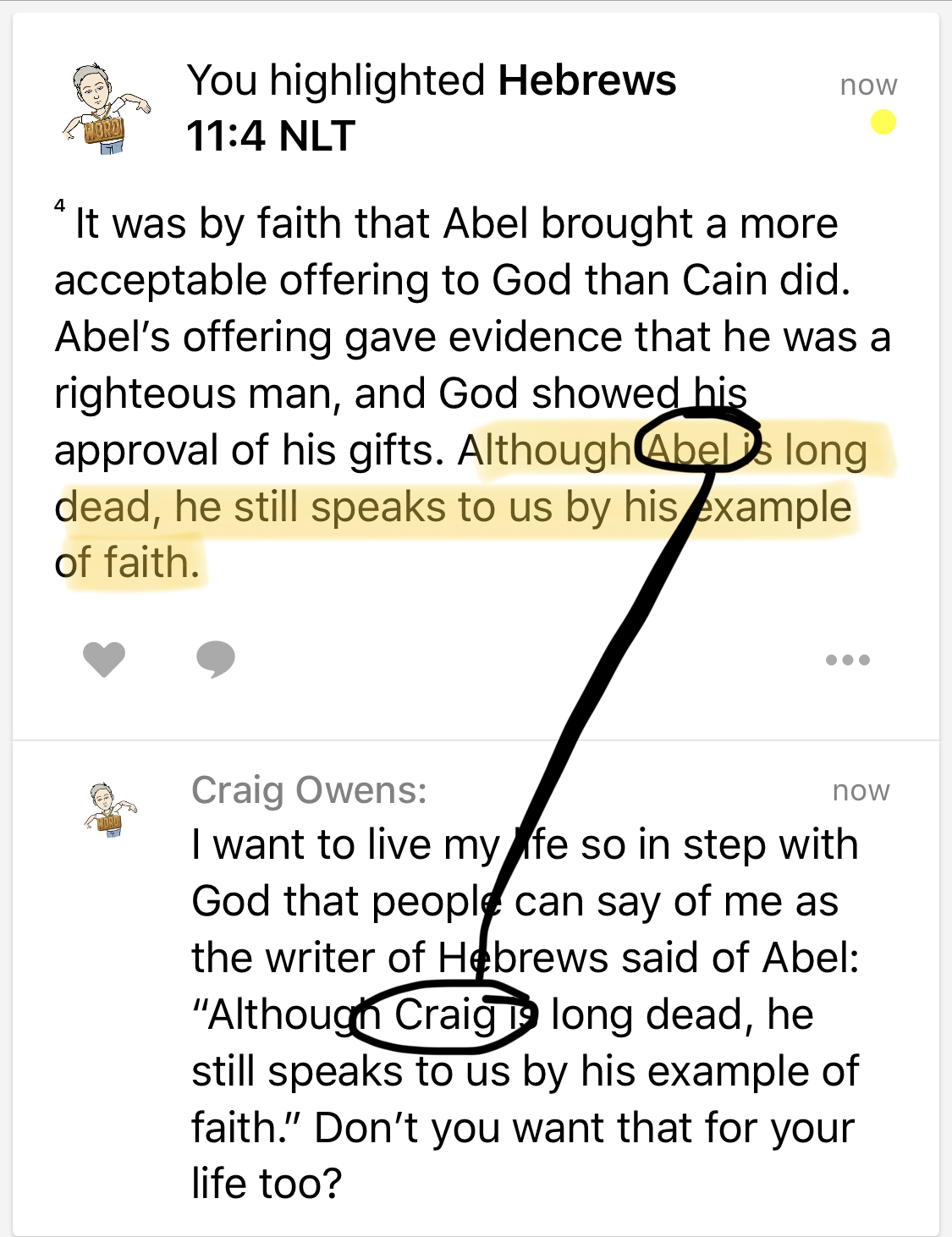
I commented on Hebrews 11:4 on YouVersion, “I want to live my life so in step with God that people can say of me as the writer of Hebrews said of Abel: ‘Although Craig is long dead, he still speaks to us by his example of faith.’ Don’t you want that for your life too?” 

The Bible itself tells us that faith comes into our heart by hearing the Word of God. If your faith is struggling, I would encourage you to open your Bible, ask the Holy Spirit to illuminate the Word to you, and begin reading with an open heart and mind. That’s exactly what I did, and I came to the conclusion that I believed the God of the Bible not because my parents did, but because He showed Himself to me to be Real. 

If you are struggling with your faith in God, I’d love to talk with you. Please get in touch with me and let’s begin a dialogue.

Practicing And Preaching In Difficult Times

…the things which happen to me have actually turned out for the furtherance of the gospel (Philippians 1:12).

About 4-5 years before Paul wrote this, he wrote to the church in Rome: “And we know that in all things God works for the good of those who love Him, who have been called according to His purpose” (Romans 8:28). 

Paul said, “All things” were being used in God’s plan for his life.

If I was one of those Philippian Christians I might respond, “Even in imprisonment?! C’mon, Paul, your liberty has been taken away and you can’t travel and preach anymore—can God use even that??” 

Paul would give me an emphatic “Yes!” 

A mark of a godly leader is one who practices what he preaches.

Paul said even his imprisonment was being used by God…

  • … the palace guards heard the gospel  
  • … others became bolder in their Christian testimony
  • … more people began preaching the good news about Jesus (see Philippians 1:13, 14, 18)

It’s still true today: God has a plan for your life, which He will work out even in the most difficult trials. 

How powerful it is when a leader continues to practice what he preaches even in the toughest of circumstances!

This is part 40 in my series on godly leadership. You can check out all of my posts in this series by clicking here.

The Autobiography Of Charles Spurgeon (book review)

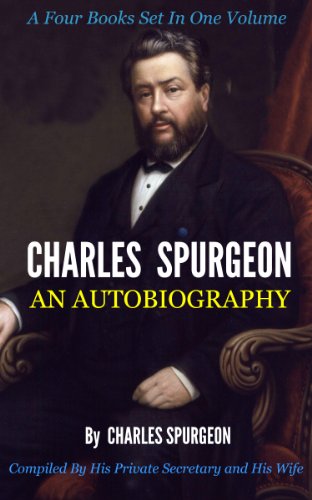
For a man who preached up to 10 times per week for nearly 40 years, you would think that people knew all about Charles Spurgeon’s personal life. Although he frequently used some small personal examples in his sermons, he still kept much of his personal life personal. In reading Spurgeon’s Autobiography, I expected to get an inside look, but that was not what I found. 

Like his sermons, Spurgeon’s Autobiography was fascinating. Like his sermons, his recollections of his past are thoroughly steeped in Scripture. I love this! This shows us that this Prince of Preachers didn’t just put on a performance when he stepped into his pulpit, nor did he simply teach Christian principles for others to apply only to their lives; instead, we see a man who truly patterned his life after the Bible. 

I also love the honesty in Spurgeon’s stories. He tells of his struggles before and after his conversion. He talks openly of his disagreements with some “church” people that didn’t behave very Christ-like. He discusses his battles with depression, and with those who were outright critics of his ministry. In other words, Spurgeon reveals himself without putting himself on some sort of pedestal. 

Charles Spurgeon’s sermons are always a delight to read, but I think you will find in his Autobiography a living sermon that we can all emulate. 

9 Quotes From “Shepherding God’s Flock”

T.M. Moore has given pastors a phenomenal training resource in Shepherding God’s Flock. Please be sure to check out my full book review by clicking here. 

“The work of church leaders today—and especially of that class of leaders called elders, with which this study is concerned—has been shaped and conditioned more by the temper of our times than by the teaching of God’s Word.” 

“According to Paul, any church that does not have in place elders—and other leaders working with them—who are functioning as shepherds is a church that is not in order.… A church without a strong ministry of shepherding is a flock without genuine pastoral care, oversight, and equipping. It may be very active, even happy, and may be ‘growing’ in what some consider impressive ways. But without shepherding as the framework and integrating dynamic, such a church will always be something less than what God intends.” 

“Where the work of shepherding is being faithfully pursued, the gospel goes forth with power, lost sheep are located, and the flocks of God grow as He adds new souls to the fold.” 

“Where faithful shepherds are at work, the Lord’s sheep will be well fed. Both milk and the meat of the Word will be their daily diet, according to the needs and callings of each. Well-fed sheep are healthy, strong, and fruitful in their own contributions.” 

“The work of shepherding begins in relationships of mutual love and trust, spiritual friendships where sheep and shepherd know, love, and care about one another.” 

“Only when the people feel known and loved, and only when they know and love those who are called to lead them—only then will they be willing to follow where the shepherds of the church are seeking to take them.” 

“In the Christian life, people tend to live up to or achieve, not the level of their abilities, for their abilities are virtually limitless, given the presence of the indwelling Spirit of God. Rather, they tend to live up to the level of their vision—of what they see for their lives in Christ. Unless we are leading them into God’s vision for their lives, the people of God will settle for something less than the prize of the upward call of God in Christ Jesus.” 

“When temptation arises we can follow one of two courses. Either we will fall through temptation into sin, or we will grow through temptation into a higher stage of sanctification. … The shepherd’s task is twofold: first, he must help the Lord’s sheep to recognize temptation, by grounding them firmly in the law and Word of God; second, he must equip and encourage them in finding the way of escape from temptation, so that they may grow as the Lord intends.” 

“Jesus’ approach to bearing witness was thus energetic, proactive, continuous, compassionate, and pioneering. Should we expect anything less from the shepherds He has left to bring other lost sheep into His fold?”

On Full Display

In the same way, let your good deeds shine out for all to see, so that everyone will praise your heavenly Father. (Matthew 5:16)

Jesus wants Christians to be leaders, to be pacesetting examples. That means that Christian leaders must be comfortable with others carefully watching their lives. 

A mark of a godly leader is one who is comfortable with public scrutiny.

“It is bad enough to be blind ourselves. It is a thousand times worse to be a blind guide.” —J.C. Ryle 

“Live an exemplary life among the natives so that your actions will refute their prejudices. Then they’ll be won over to God’s side and be there to join in the celebration when he arrives.” —1 Peter 2:12 MSG 

“Sermons must be practiced as well as preached…. If a man teach uprightly and walk crookedly, more will fall down in the night of his life than he built in the day of his doctrine.” —John Owen 

“Be a walking, talking, living example of what you preach, in every silent moment of your life, known and unknown; bear the scrutiny of God, until you can prove that you are indeed an example of what He can do.” —Oswald Chambers 

“Behave yourselves wisely—living prudently and with discretion—in your relations with those of the outside world (the non-Christians)…” —Colossians 4:5 AMP

“We hear that some people in your group refuse to work [or are behaving irresponsibly;  are living/walking in idleness/disorder]. They do nothing but busy themselves [meddle; interfere] in other people’s lives. We command those [such] people and beg [urge; encourage; exhort] them in the Lord Jesus Christ to work quietly [or settle down] and earn [ eat] their own food.” —2 Thessalonians 3:11-12 EXB)

“We should make less excuses for the weaknesses of a Christian than for any other man. A Christian has God’s honor at stake. When a man is regenerated and bears the Name of Christ the Spirit of God will see to it that he is scrutinized by the world, and the more we are able to meet that scrutiny the healthier will we be as Christians.” —Oswald Chambers 

This is part 37 in my series on godly leadership. You can check out all of my posts in this series by clicking here.