This is a weekly series with things I’m reading and pondering from Oswald Chambers. You can read the original seed thought here, or type “Thursdays With Oswald” in the search box to read more entries.
Christ’s Incarnation Means Our Freedom
Other religions deal with sins; the Bible alone deals with sin. The first thing Jesus Christ faced in man was this heredity of sin, and it is because we have ignored it in our presentation of the Gospel that the message of the Gospel has lost its sting, its blasting power; we have driveled it into insurance tickets for heaven, and made it deal only with the wastrel element of mankind. …
The revelation is not that Jesus Christ was punished for our sins, but that He was made to be sin. “Him who knew no sin” was made to be sin, that by His identification with it and removal of it, we might become what He was. … Jesus Christ went straight through identification with sin that every man and woman on earth might be freed from sin by His atonement. He went through the depths of damnation and came out more than conqueror; consequently everyone of us who is willing to be identified with Him is freed from the disposition of sin, freed from the connection with the body of sin, and can come out more than a conqueror too because of what Jesus Christ has done. …
The Holy Spirit will take my spirit, soul and body and bring them back into communion with God, and lead me into identification with the death of Jesus Christ, until I know experimentally that my old disposition, my right to myself, is crucified with Him, and my human nature is now free to obey the commands of God.
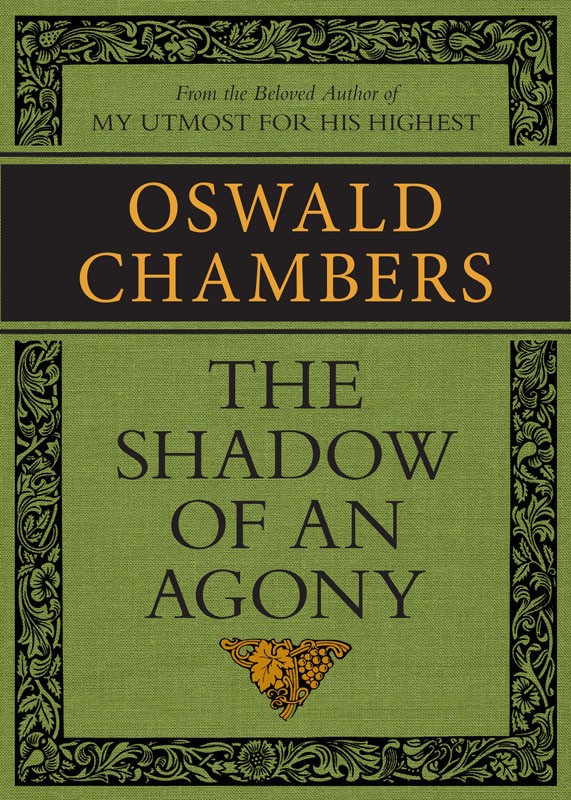
From The Shadow Of An Agony
As we approach the time of year we celebrate the Incarnation of Jesus, it’s amazing to think that He didn’t come just to identify with our sin, but to be made sin! Without Jesus Christ’s death on a Cross in our place, there is no hope for us.
As we celebrate the First Advent, it’s a good idea to keep in the front our our minds what Christ’s Incarnation means for us. It means we can be freed from sin—free to obey God, and free to look forward to Christ’s Second Advent, where He will take away His saints to be with Him forever!
In The Shadow Of An Agony, Oswald Chambers explores how we should process the hard events of our lives which seem to totally rock our neat and orderly world. Check out my book review by clicking here, and then enjoy a few quotes from this book.
“If Jesus Christ were only a martyr, His Cross would be of no significance; but if the Cross of Jesus Christ is the expression of the secret heart of God, the lever by which God lifts back the human race to what it was designed to be, then there is a new attitude to things.”
“The agony of a man’s affliction is often necessary to put him into the right mood to face the fundamental things of life. The Psalmist says, ‘Before I was afflicted I went astray: but now I have kept Thy Word.’ The Bible is full of the fact that there has to be an approach to the holy ground. If I am not willing to be lifted up, it is no use talking about the higher heights. … No man can do wrong in his heart and see right afterwards. If I am going to approach the holy ground, I must get into the right frame of mind—the excellency of a broken heart.”
“Jesus Christ did not come to give us pretty ideas of God, or sympathy with ourselves; He came from a holy God to enable men, by the sheer power of His Redemption, to become holy.”
“No man is the same after an agony; he is either better or worse, and the agony of a man’s experience is nearly always the first thing that opens his mind to understand the need of Redemption worked out by Jesus Christ.”
“The attitude of the Bible to the human race is not a common-sense one. The Christian aspect deals with the a specimen of a human race which is a magnificent ruin of what it was designed to be. Supposing the view of the Bible to be right, to whom it is it ‘up to’ to right the wrong? The Creator. Has He done it? He has, and He has done it absolutely single-handed. The tremendous revelation of Christianity is not the Fatherhood of God, but the Babyhood of God—God became the weakest thing in His own creation, and in flesh and blood He levered it back to where it was intended to be. No one helped Him; it was done absolutely by God manifest in human flesh. God has undertaken not only to repair the damage, but in Jesus Christ the human race is put in a better condition than when it was originally designed.”
“We have been taken up with creeds and doctrines, and when a man is hit we do not know what to give him; we have no Jesus Christ, we have only theology. For one man who can introduce another to Jesus Christ by the way he lives and by the atmosphere of his life, there are a thousand who can only talk jargon about Him.”
“The New Testament view of a saint is a more rugged type. You and I are a mixture of dust and Deity, and God takes that sordid human stuff and turns it into a saint by Regeneration. A saint does not mean a man who has not enough sin to be bad, but a man who has received from Jesus Christ a new heredity that turns him into another man.”
“Our guide as to what emotions we are going to allow is this—What will be the logical outcome of this emotion? If it has to do with sin and satan, then grip it on the threshold of your mind and allow it no more way. You have no business to harbor an emotion the outcome of which you can see to be bad; if it is an emotion to be generous, then be generous, or the emotion will react and make you a selfish brute.”
“When I receive the Spirit of God, I am lifted not out of reason, but into touch with the infinite Reason of God.”
“Any fool will give up wrongdoing and the devil, if he knows how to do it; but it takes a man in love with Jesus Christ to give up the best he has for Him.”
“Churchianity is an organization; Christianity is an organism. Organization is an enormous benefit until it is mistaken for the life.”
“The stupendous difference between the religion of Jesus Christ and every other religion under heaven is that His religion is one which brings help to the bottom of hell, not a religion that can deal only with what is fine and pure.”
Every Thursday I share a section of the current Oswald Chambers book I am reading, in a series called “Thursdays With Oswald.” If you would like to be notified when these posts go live, just enter your email address in the box on the right, and then click “Sign me up!”
What happens when all of your perfect plans, all of your neat and tidy ideas, come crashing down around you because of a tragedy? This is the topic Oswald Chambers took on in his book The Shadow Of An Agony when The Great War (or what we now call World War I) was ravaging the nations.
Many people have had their worldviews rocked because a tragedy hit them out of nowhere. What then? Do you throw out all you have believed was true? Oswald Chambers explorers this topic in depth in this book, and comes to the conclusion that these shaking events should send us back to the foundation of the Bible.
For example, Chambers says, “In the past the error of the Christian faith was that it paid no attention to a man’s actual life; it simply used human beings and made them catspaws for a religious line of things. The present error is that humanity utilizes Christianity; if Jesus Christ does not coincide with our line of things, we toss Him overboard; Humanity is on the throne. In the New Testament the point of view is God and Man in union.”
Throughout this book you will see that Jesus Christ stepped into our agony to make a way for us to go through it as more than conquerors.
In commenting on The Shadow Of An Agony, Samuel M. Zwemer said, “Oswald Chambers points out that because Jesus Christ is so like unto His brethren we can face this turmoil and stress, and stand with Him in the shadow of a great agony, undiscouraged and unafraid.”
And Pastor Walter H. Armstrong noted, “This book deals with root or rock principles. It comes, not from the surface, but ‘out of the depths.’ It is the work of a great brain and a great heart. It does not shirk the problems of life, but it looks them straight in the face. Over against the tragedy of sin and suffering it brings us to the tragedy of the Cross of Christ.”
If you are walking through a difficult time in your life, the insights Oswald Chambers shares in this book may be just the lifeline you’re looking for. This is also an excellent book to read to prepare yourself for any tragedies which may be lurking around the corner. Don’t get caught unaware, but use these faith-building thoughts to prepare you to stand firm through the trials of life.
Oswald Chambers always makes me think deeply, but The Philosophy Of Sin was a graduate-level, deep-thinking book on theology and philosophy for me! Check out my review of this book by clicking here. Below are some quotes I especially enjoyed.
“To people who are satisfied on too shallow a level the Bible is a book of impertinences, but whenever human nature is driven to the end of things, the Bible becomes the only Book and God the only Being in the world.”
“The life of nature is neither moral nor immoral; our bodies are neither moral nor immoral, we make them moral or immoral. Our Lord had a body, and we read that He hungered; it was not a sin for Him to be hungry, but it would have been a sin for Him to have eaten during the forty days in the wilderness, because His Father’s word at that time was that He should not eat. It is not a sin to have a body, to have natural appetites, it is a sin to refuse to sacrifice them at the word of God.”
“Lust simply means, ‘I must have this at once’; it may be a bodily appetite or a spiritual possession. The principal lust works on is, ‘I must have it at once, I cannot wait for God’s time, God is too indifferent,’ that is the way lust works.”
“If all Jesus Christ can do is to run a parallel counteraction with what satan can do, His right name is ‘Culture,’ not ‘Savior’; but His revealed nature was stated by the angel to Mary, and repeated over and over again, ‘Thou shalt call His name Jesus; for He shall save His people from their sins.’ The slight views of salvation, the sympathetic drifty views that all Jesus Christ can do is to put in us a principle that counteracts another principle, will cause anyone who is got to the last limit to blaspheme God for a thing like that. It all comes from a flimsy, wrong view of sin. If that is all He can do, what is the good of calling Him Savior? … It is sin that He came to cope with; He did not come to cope with the poor little mistakes of men, they cope with their own mistakes; He came to give them a totally new stock of heredity, that is, He came to implant into them His own nature, so that satan’s power in the soul is absolutely destroyed, not counteracted.”
“This aspect of the death of Jesus takes us into a spiritual domain beyond the threshold of the thinking of the majority of us. The cry of the Cross, ‘My God, My God, why hast Thou forsaken Me?’ is unfathomable to us. The only ones—and I want to say this very deliberately—the only ones who come near the threshold of understanding the cry of Jesus are not the martyrs, they knew that God had not forsaken them, His presence was so wonderful; not the lonely missionaries who are killed or forsaken, they experience exultant joy, for God is with them when men forsake them: the only ones who come near the threshold of understanding the experience of God-forsakenness are men like Cain—‘My punishment is greater than I can bear’; men like Esau, ‘…an exceedingly bitter cry’; men like Judas. Jesus Christ knew and tasted to a fuller depth than any man could ever taste what it is to be separated from God by sin.”
“How Jesus Christ does cleanse our conscience! It is freedom not only from sin and the damage sin has done, but emancipation from the impairing left by sin, from all the distortions left in mind and imagination.”
“The conscience formed in us by the Holy Spirit makes us amazingly sensitive to the things that tell against the honor of God.”
I’ll be sharing other quotes from this book in the near future, and I also share an extensive passage from the current Chambers’ book I am reading every Thursday. If you want to be notified when those quotes are posted, please enter your email address in the box to the right and click “Sign me up!”
I share quotes from Oswald Chambers and other inspirational authors daily on both Tumblr and Twitter.
“In praying for His enemies not only did Christ set before us a perfect example of how we should treat those who wrong and hate us, but He also taught us never to regard anyone as beyond the reach of prayer. If Christ prayed for His murderers, then surely we have encouragement to pray now for the very chief of sinners! Never lose hope. Does it seem a waste of time for you to continue praying for that man, that woman, that wayward child of yours? Does their case seem to become more hopeless every day? Does it look as though they had gone beyond the reach of divine mercy? Perhaps that one you have prayed for so long has been ensnared by one of the satanic cults of the day, or he may now be an avowed and blatant atheist, in a word, an open enemy of Christ. Remember then the Cross. Christ prayed for His enemies. Learn then not to look on any as beyond the reach of prayer.” —A.W. Pink
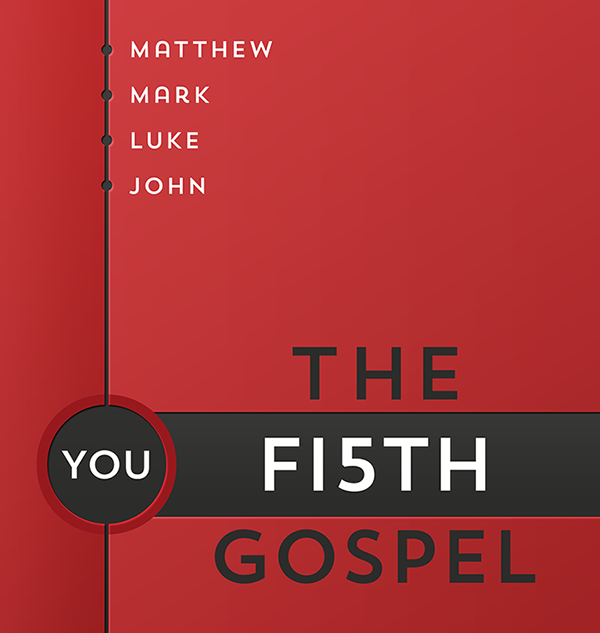
I have been watching the One Minute Apologist videos from Bobby Conway for quite awhile, and find them very helpful. Recently I finished a reading plan in YouVersion based on Bobby’s book The Fi5th Gospel. Here are a few quotes that especially caught my attention.
“If I am the only Gospel people will ever experience are they experiencing the true Gospel?”
“At no other time in human history has God so plainly and blatantly revealed Himself than at Calvary. At no point has He so graphically uncovered His heart for mankind. It was there, on a hill outside Jerusalem, the Messiah bled for us, suffering hellish agony and sin-induced banishment, all the while enduring the brutal wrath of a holy and righteous God.”
“The exclamation point to this graphic love letter to us was the resurrection—Jesus’ conquering moment of triumph over sin, satan, and the grave. This is what Christians are all about right? It’s how we are saved. Take away the Cross and we’re no different from any other religious idea. It’s Jesus Christ, His death and resurrection. Strip away all the modern church fluff and this is what you find at the core of our faith. It’s essential. Nonnegotiable. Undeniable. It’s what makes us who we are. It’s what makes Christians ‘Christian.’ And it’s why Jesus is the answer to all of life’s deepest issues.”
“The sacrifice [God] requires isn’t death on a cross, but rather death to our pride and fear of what other might think. God just wants us to be proud of Jesus and what He has done for us. He wants us to be unashamed of His Son.”
“Though we were originally created in God’s image, God’s reflection in us was marred in the Garden of Eden when Adam and Eve sinned. And though His image wasn’t completely erased, it was defaced and tarnished. When you trusted in Christ, the Holy Spirit began a beautiful work of ‘image restoration’ in you; masterfully remaking you to more accurately reflect God’s virtue. He began sculpting, forming, and transforming your character to better display Christ to the world. You become His image-bearer, and His ongoing work in your life distinguishes you from the world. This is a lifelong process, by the way, and one God is committed to completing.”
“None of us will ever perfectly represent God’s character. As long as we’re on this earth, we’ll have imperfections. And it’s these imperfections that some unbelievers are quick (and happy) to point out and expose. But there is value in listening to what others say, of taking an honest look in the mirror, of stepping into an unbeliever’s shoes to see what they perceive about Jesus and His bride. Think of it as a spiritual awareness-building exercise.”
This is a weekly series with things I’m reading and pondering from Oswald Chambers. You can read the original seed thought here, or type “Thursdays With Oswald” in the search box to read more entries.
6 Questions About Your Relationship With Jesus
“How much more shall the blood of Christ, Who through the enteral Spirit offered Himself without blemish unto God, cleanse your conscience from dead works to serve the living God?” (Hebrews 9:14)
Our right to ourselves in every shape and form was destroyed once and for ever by the death of Jesus, and we have to be educated into the realization of what this means in all its fullness. We have to come to a relationship to the Cross in thought as well as in life. …
We are here with no right to ourselves, for spiritual blessing for ourselves; we are here for one purpose only—to be made servants of God as Jesus was. …
“How much more” does the death of Jesus mean to us today than it ever has before? Are we beginning to be lost in wonder, love and praise at the marvelous loosening from sin, and are we so assimilating the nature of Jesus that we bear a strong family likeness to Him? …
The most devout among us are too flippant about this great subject of the death of Jesus Christ. When we stand before the Cross, is our every common pious mood stripped off? …
How does all the profound thought underlying the death of Jesus touch us? The writer to the Hebrews instantly connect it with conscience—“How much more shall the blood of Christ,…cleanse your conscience from dead works to serve the living God?” Has conscience the place in our salvation and sanctification that it ought to have? …
Are you thankful to God for your salvation and sanctification, thankful He has purged your conscience from dead works? Then go a step further; let Jesus Christ take you straight through into identification with His death until there is nothing left but the light at the foot of the Cross, and the whole sphere of the life is hid with Christ in God.
From The Philosophy Of Sin
I challenge you: take some time to thoughtfully answer these questions.
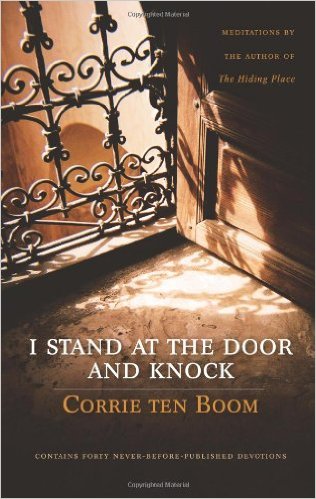
Corrie ten Boom was an amazing woman! To experience the horrors of a Nazi concentration camp, and still retain such a sweet, godly spirit is indeed a miracle of God’s grace. This beautiful spirit of hers come through loud and clear in her book I Stand At The Door And Knock (you may read my book review here). Below are just a few of the many quotes which I highlighted as I read.
“You see, if you and I want to be used, we needn’t rely on ourselves, because it is the Holy Spirit who does it. And that is why we can be at peace in our day-to-day lives. The fact that we wish to be used is a gift from the Holy Spirit in itself.”
“A piece of good advice is to forgive anyone immediately—and I mean immediately— if they say or do something against you. Then the devil won’t have a chance to keep a shadow in your heart.”
“Holiness can bring about a new conflict. We need to take care. The devil wants to lead us into the energy of our inner selves. Preaching yourself, relying on yourself, boasting about your faith, taking pride in your own experiences. And then the devil will say, ‘Revel in your own experiences.’ But that is not right. You should not rely on your past experiences. It may strengthen your faith, but holiness is living out the Jesus Christ living in you.”
“Imagine, when I had a watchmaker’s shop, you came to me and you bought a gold watch with a gold strap. Imagine that when I wrapped it up for you, I removed the gold strap and hid it. When you came home, you saw that you only had a watch. What would you do? You would say to everybody, ‘Don’t ever buy something from Corrie ten Boom; she doesn’t give you value for money.’ If you and I do not give ourselves entirely to the Lord, we do not give Him the value He has paid for us on the Cross. We were bought at a very high price. That Cross was horrendous. It was an extremely high price to pay for you and me.”
“In my short-sightedness, I thought I had to do everything with my own power, according to my abilities. But everything depends on Hisability, Hispower.”
“The devil may laugh at our plans. He smiles when we are up to our eyes in work. But he quakes when we pray. When we are faithful intercessors he often says to us, ‘Shouldn’t you stop? You have been doing this for such a long time, and can’t you see, the Lord doesn’t listen.’ But he is a liar. Not one of our prayers is lost. … satan laughs when we try hard. He mocks our wisdom, but he trembles when we pray.”
“While I was imprisoned during the war, I knew the Morse code, but it didn’t really help me. What actually supported me was every text and every Christian song I knew by heart. Learning Bible texts and Christian songs by heart is a preparation which we can all do today.”
“Lord Jesus, please forgive us that we so often live a life poor in You, while You suffered so heavily on the Cross so that we would become the King’s rich children. Holy Spirit, open our eyes. Give us a vision, an understanding of our wealth.”
“Religion is no security. The Antichrist will be very religious. A world religion will develop, and he himself will become its god.”
“Jesus said, ‘Do not let your hearts be troubled.’ Our citizenship is in heaven. We are heaven dwellers. Our home is there.”
“The Bible says, ‘Be filled with the Spirit’ (Ephesians 5:18), which means not only do I have the Holy Spirit, but also does the Holy Spirit have me?”
“We should not rely on our capacities, but on God’s capacities. We shouldn’t draw from our limited resources, but from His immense power.”
I will also be sharing some of Corrie’s quotes on Twitter and Tumblr, so follow me there for more great content.
6 Quotes From “Light & Truth—The Lesser Epistles”
July 13, 2016 — Craig T. Owens“It is a busy, lighthearted, laughing, pleasure-seeking world. But sin is here, and pain is here, and broken hearts are here, and weeping is here, and death is here, and the grave is here. Oh! in spite of all its laughter and vanity, it is an evil world. And the great proof of its evil is, that it cost the death of the Son of God to deliver you from it. … Give yourselves to Him Who came to deliver you from it, and Who stretches out His hands to you all day long, asking you to allow Him to deliver you. He yearns over you; and with sincere earnestness proffers to you His love, His friendship, His great salvation. Consent, O man, consent! His desire is to bless, and not to curse; to save, and not to destroy.” [Galatians 1:4]
“There never have been two gospels. There is not an Old Testament gospel and a New Testament Gospel. There is not one gospel for the Jew, and another for the Gentile, one gospel for the first century, and another for the nineteenth. It is but one gospel, as there is but one Cross and one Savior. Many ages, but one gospel; many sinners, but one gospel; many prophets and apostles, but one gospel. As our earth has had but one sun, so it has had but one gospel. Nor does it need more; that one is sufficient.” [Galatians 1:6-9]
“As the earth without rain or sunshine turns to barrenness, so is it with the Church or soul without the Spirit. … The age thinks it can do without the Spirit. Let the Church watch against this blasphemy. Let her keep hold of the Lord’s promise, the promise of the Father. Let her prize the gift; long for more of it. Let every saint seek more of it. Let our cry be continually: More of the Holy Spirit; more of His fullness; more of His gifts and graces!”
“Strength for the race is needed, hourly strength, superhuman strength; for it is no earthly race, but something lofty, supernatural, divine. Forgetting the supernatural source of strength, we betake ourselves to the internal or the simply external. And so we weary. For only God can supply the power which keeps us running. By Him only shall we run, and not be weary.” [Galatians 5:7]
“‘To Him who is able’—He is the Mighty One, the mighty God, the Lord God Almighty. Hear how this word ‘able’ is used. ‘He is able to subdue all things unto Himself’ (Philippians 3:21). ‘He is able to help them that are tempted’ (Hebrews 2:18). ‘He is able to save to the uttermost’ (Hebrews 7: 25). ‘He is able to keep us from falling’ (Jude 24). It is with the mighty God that we have to do; mightier than ourselves or our foes; mightier than earth or hell; omnipotent.” [Ephesians 3:20]
“Are you expecting the Lord? Are you living in this expectation? Is it a deep-seated, abiding, cherished hope? Is it a hope that tells upon your character, your life, your daily actings in public or private, your opinions, your whole man? Does it quicken you? Does it purify you? Does it keep you separate from the world? Does it keep you calm in the midst of earth’s most exciting events, or most untoward changes? Does it give you a new view of history as well as prophecy? … Let your expectation of the Lord’s coming be a calm and healthy one; not one that excites, but one that tranquilizes; not one that unfits for duty, but one that nerves you more firmly for it; not one that paralyzes exertion, but one that invigorates you for it; not one that makes you indifferent to present duty, but one that makes you doubly in earnest about everything that your hand findeth to do; not one that stops liberality, and prayer, and work, but one that increases all these a hundred fold; not one that dwells exclusively on the future’s dark side—the judgments that are at hand—but one that realizes the glory and the joy of Messiah’s approaching victory and triumphant reign.” [Philippians 3:20]
Share this: