Our Perfect King

Listen to the podcast of this post by clicking on the player below, and you can also subscribe on Apple, Spotify, or Audible. 

Our country has a policy of separation of church and state, and that appears to be a good thing. When the head of the government starts telling the church how to worship, or when the head of the church starts telling the government how to run its affairs, strife typically results. 

There have been some notable examples of wise kings who were God-fearing rulers, and some examples of religious leaders who had the wisdom to make just laws. But history has most often shown us that when a king imposes on the church a mode of worship or a pastor imposes on the king religious ways of governing, clashes result. Some of them have been bloody civil wars and some have spread into international conflicts. 

That being said, wouldn’t it be better for everyone if there was a way that one person could hold both of those offices simultaneously? If only there was some way to bring those different offices together. Very few people could ever accomplish this because it would require a perfect person with both absolute wisdom and complete God-honoring selflessness, someone so confident in both their wisdom and their relationship with God that they would never be swayed unfairly one way or the other. 

Last week we saw the first bold claim from Jesus: “I am the I AM.” With this title and authority, Jesus claimed to be the Head of the Church. This is a title Paul uses several times in his letter to the church at Ephesus (Ephesians 1:22, 5:23). Paul goes on to remind us that our aim as the Church body is to grow into maturity under the Headship of Jesus (Ephesians 4:15). 

Consider two other notable rulers during this same time period. As the high priest, Caiaphas would have laid claim to the title of “head of the church.” As the Roman governor, Pilate would have laid claim to the title of “head of the government in Judea.” Yet both of them clearly demonstrated that they had “become the symbol of those who make religious decisions based on political expediency rather than truth and justice,” as Dr. Donald Stamps noted. 

Paul goes father than calling Jesus simply the Head of the Church—

And He [Jesus] is the head of the body, the church; He is the beginning and the firstborn from among the dead, so that in everything He might have the supremacy. (Colossians 1:18) 

Not just Headship over the Church, but Headship over “everything.” 

After the bold claim of Jesus that He was the I AM, the Sanhedrin wanted to have Him put to death, so they took Jesus to Pontius Pilate (Luke 22:71—23:2; Matthew 27:1-2; John 18:28-37). 

Pilate “knew it was out of self-interest that they had handed Jesus over to him” (Matthew 27:18), but he still asked Jesus, “Are You the king of the Jews?” Just as Caiaphas was trying to save his position of power by keeping a delicate balance between the Jews and the Romans, Pilate was also trying to save his skin. Pilate was trying to appease both the Sanhedrin and Tiberius Caesar. 

Jesus answers Pilate’s question in a way Pilate never expected. Twice Jesus says “My kingdom,” noting that His kingdom is other-worldly. His kingdom comes from outside this world and therefore supersedes any government of this world. Pilate clearly has never heard anything like this, so after hearing this statement he announces, “You are a king, then!” 

Just as Jesus had answered the Sanhedrin with, “You are right in saying I am the Messiah,” now He answers Pilate, “You are right in saying I am a king.” 

Combining those two bold claims—“I am God” and “I am a King”—Jesus is the only One who can perfectly hold both offices without any conflict. This is what the prophecy in Isaiah 9:1-7 foretold, and this is the fulfillment that John shows us at the end of time (Revelation 17:14, 19:11-16). 

What does this mean for us? How are we now supposed to live knowing Jesus as our God and as our King? We should live confidently before our King and humbled before our God. We don’t fear earthly kings, but neither do we fight them. We don’t have to try to convince earthly kings to rule a certain way because they are God’s servants to accomplish God’s plan. We don’t have to get caught up in the politics of the day because this day will come to an end. 

We are subjects of a kingdom not of this world, so the kings of this world don’t get to decide our final destiny!

(If you would like to explore this topic further, check out my series of messages from 1 Peter called Aliens and Strangers.)

If you’ve missed any of the messages in our series called Bold Claims, you can find the full list of messages by clicking here. 

►► Would you please prayerfully consider supporting this ministry? My Patreon supporters get behind-the-scenes access to exclusive materials. ◀︎◀︎

Links & Quotes

I’m really excited for this! On March 9, I will be a guest on The Church Lobby podcast with Karl Vatters! Check it out wherever you get your podcasts.

T. M. Moore has been presenting an outstanding series of posts in the series To Stop The Lie. In his most recent post, he wrote, “Winds of false doctrine blow across the sails of the Church continuously, bringing lies against the ship of truth to drive it off its Kingdom course. Wafting in from worldly thinking, these false doctrines downplay the Word of God, make the needs of people rather than the glory of God the focal point of religion, introduce alien practices to worship and church life, and becalm the Body of Christ into complacency. Such lies must be exposed, deconstructed, and stopped.” Check out the post from which this quote came by clicking here, and then you can follow the thread to read the other posts in this series.

“We are more fulfilled when we are involved in something bigger than ourselves.” —John Glenn

NASA has a really cool interactive map that allows you to track the flight of asteroids and comets as they orbit around the sun. You can go forward or backward in time, zoom in or out, and angle the solar system to see the flights and orbits from a different perspective.

John Stonestreet has a good history lesson for us of past revivals on American soil, and the transformation that came about as a result. If you are a pastor and would like to join other pastors once per week for prayer for revival, please check out this prayer group.

Doug Clay has a reassuring post about the blessed hope Christians should have concerning Christ’s Second Coming. He writes, “Will Jesus return in 2023? That question stirs hope in some and anxiety in others. … The Rapture should calm anxious Christians rather than causing anxiety. No matter how bad things get, we know that our Blessed Hope is imminent!”

Too many people in leadership positions think that leadership means that others do things for them. In actuality, godly leaders view their elevated position as an opportunity to serve more—to do more things for more people. I dive deeper into this in my book Shepherd Leadership: The Metrics That Really Matter.

Book Reviews From 2022

Listen to the podcast of this post by clicking on the player below, and you can also subscribe on Apple, Spotify, or Audible.

I love reading, and I love sharing my love of good books with others! Here is a list of the books I read and reviewed in 2022. Click on a title to be taken to that review.

Autobiography of Calvin Coolidge

Cary Grant

Contending For Our All

Father Sergius

Hank Greenberg: The Story Of My Life

Living In A Gray World

Out Of The Depths

Roots Of Endurance

Simple Truths Of Leadership

Spurgeon And The Psalms

Susanna Wesley

The Holy War

The Legacy Of Sovereign Joy

The Poetry Of Prayer

The Self-Aware Leader

Who Says Elephants Can’t Dance?

Who’s Pushing Your Buttons?

Here are my book reviews for 2011.

Here are my book reviews for 2012.

Here are my book reviews for 2013.

Here are my book reviews for 2014.

Here are my book reviews for 2015.

Here are my book reviews for 2016.

Here are my book reviews for 2017.

Here are my book reviews for 2018.

       Here are my book reviews for 2019.

Here are my book reviews for 2020.

Here are my book reviews for 2021.

►► Would you please prayerfully consider supporting this ministry? My Patreon supporters get behind-the-scenes access to exclusive materials. ◀︎◀︎

Contending For Our All (book review)

Listen to the podcast of this post by clicking on the player below, and you can also subscribe on Apple, Spotify, or Audible. 

As someone who thoroughly enjoys studying history and leadership, “The swans are not silent” series of books by John Piper is right up my alley! The fourth book in this excellent series is Contending For Our All. 

As with all of the other books in this series, Contending For Our All explores the lives of three notable men of history around a common theme. This book focuses on the theme of dealing with controversies in the church through the lives of Athanasius, John Owen, and J. Gresham Machen. 

None of these men sought to be controversial, but neither did they shy away from addressing the unbiblical teachings of their day. Even though it cost them prestige, advancement, personal comfort, and even a few friends, these strong men knew that standing for biblical truth was their supreme privilege. Athanasius confronted the heresy of Arianism, Owen was one of the most influential voices for the Puritans, and Machen warned the evangelic church of its drift away from orthodoxy. 

These men counted the joy of serving Jesus even in the face of controversy as the greatest honor they could obtain. They served well and lovingly and earned the highest praise in the voice of their Master saying, “Well done, good and faithful servants.” Their lives are a timely reminder for all Christians living in today’s post-truth culture. 

As with all of the other books in this series, Pastor John does a remarkable job in sharing these biographies in a compelling and memorable manner, and in a way that makes the case for all Christians to stand strong as they too contend for truth. 

If you would like to read the other book reviews I’ve reviewed in this series, check them out here: 

►► My Patreon supporters will have exclusive access to all of the quotes and notes I compiled while reading this book. Would you please prayerfully consider supporting this ministry? My Patreon supporters get behind-the-scenes access to exclusive materials. ◀︎◀︎

Links & Quotes

Premier athletes know the value of flexibility for keeping them in the game. I think we would be wise to practice flexibility in our relationships too—this is definitely a game-changing move! Check out my weekly Monday Motivation videos on my YouTube channel. 

“The bravest are surely those who have the clearest vision of what is before them, glory and danger like, and yet notwithstanding, go out to meet it.” —Thucydides

This week we remember Columbus Day. You probably remember the rhyme: In 1492, Columbus sailed the ocean blue. Many people have thought Columbus set out to prove the world was round, but the History Channel has a mini-biography that debunks this claim.

One of my YouVersion friends (Nikki) commented a great reminder: “God can do way more with my surrender than with my striving.”

Thomas Zimmerman was an influential leader in the early days of the Assembly of God fellowship’s history. “Over a 50-year period, Thomas F. Zimmerman (1912-1991) served the Assemblies of God as pastor, district official, department leader, assistant general superintendent, and general superintendent. His leadership greatly increased the influence of the Pentecostal movement in the evangelical world, as well as in the broader American religious landscape.”

I post quality content nearly every day. If you don’t have time to read all that I share, please let me read it for you. The Craig T. Owens Audio Blog is just like this blog, except you get to hear me read my blog posts. Check it out my podcast on Spotify, Apple, and even Audible.

“The word ‘hell’ is used in the New Testament fourteen times, twelve times by Jesus Himself. It is not a myth created by dismal and angry preachers. It is a solemn warning from the Son of God who died to deliver sinners from its curse. We ignore it at great risk.” —John Piper

Christian apologist and cold-case detective J. Warner Wallace wrote, “the battleground on the abortion issue is beginning to shift, and this shift is going to cause us to rethink our approach to the debate.” Pro-life advocates need to check out Wallace’s post Justifying Homicide: The Future Battleground In The Abortion Debate.

Responsibility isn’t supposed to be fatal! Exceptional leaders accept and promote appropriate responsibility, while weak leaders play the blame game. But accepting responsibility doesn’t mean “falling on your sword”! You can check out the rest of this conversation I had with my podcast partner Greg Heeres on The Craig And Greg Show leadership podcast.

Links & Quotes

“Don’t quit until every base is uphill. I played just a little too long.” —Babe Ruth’s advice to Hank Greenberg, when Hank was considering retirement

As a part of my ongoing Monday Motivation series, I shared a thought of how we can see more miracles—

The Assemblies of God have always been a missions-centric fellowship. Check out this mini-biography of Alice Luce as a prime example.

The Bible isn’t a “once upon a time” collection of stories, but the accounts contained in Scripture are historically verifiable. I love this archaeological biography of Israel’s King Pekah. And be sure to check out my side-by-side chart of the kings and prophets of the divided kingdoms of Israel and Judah.

There is a psychological term called “projection” where we see in others what is really in ourselves. This is something Christians MUST guard against doing. Instead of going to the other person first, let’s go to our knees in prayer first. This is a short clip from a full-length teaching video I provided exclusively for my Patreon supporters.

“Blessed are those who can give without remembering and can take without forgetting.” —Elizabeth Bibesco

Links & Quotes

Ken Blanchard shared a blog post based on one of the chapters in his book Simple Truths Of Leadership (which I highly recommend to leaders!). He wrote, “When you catch yourself doing things right, everything in your life will improve—especially your relationships. Why? Because it’s fun to be around people who like themselves. After all, if you’re not your own best friend, who will be? And as my dad used to say, ‘If you don’t toot your own horn, others might use it as a spittoon!’”

For all Christians, but especially for those in leadership positions, Jon Bloom shares How to Watch for Wolves: Three Signs of False Teachers.

Fight The New Drug shares the research behind 15 Basic Facts About Human Sex Trafficking.

This is a great lesson from church history on the power of importunate prayer: The Hundred-Year Prayer Meeting.

Mary Slessor set a high bar for missionaries. John Stonestreet reminds us of this amazing woman.

Crucifixion Events

Listen to the podcast of this post by clicking on the player below, and you can also subscribe on Apple, Spotify, or Audible. 

The death of Jesus may be the most attested execution in all of history. It’s certainly the most meaningful execution, as the death of Jesus brought a fulfillment to prophecy that was made in the immediate aftermath of humanity’s first sin. 

I have frequently written about the historicity of the Bible. The crucifixion of Jesus is not a “once upon a time” or “in the make-believe land of Israel” story, but an actual event, which involved actual people, at an actual moment in history. Even the way the four Gospel writers record the crucifixion of Jesus attests to the historicity of this event.

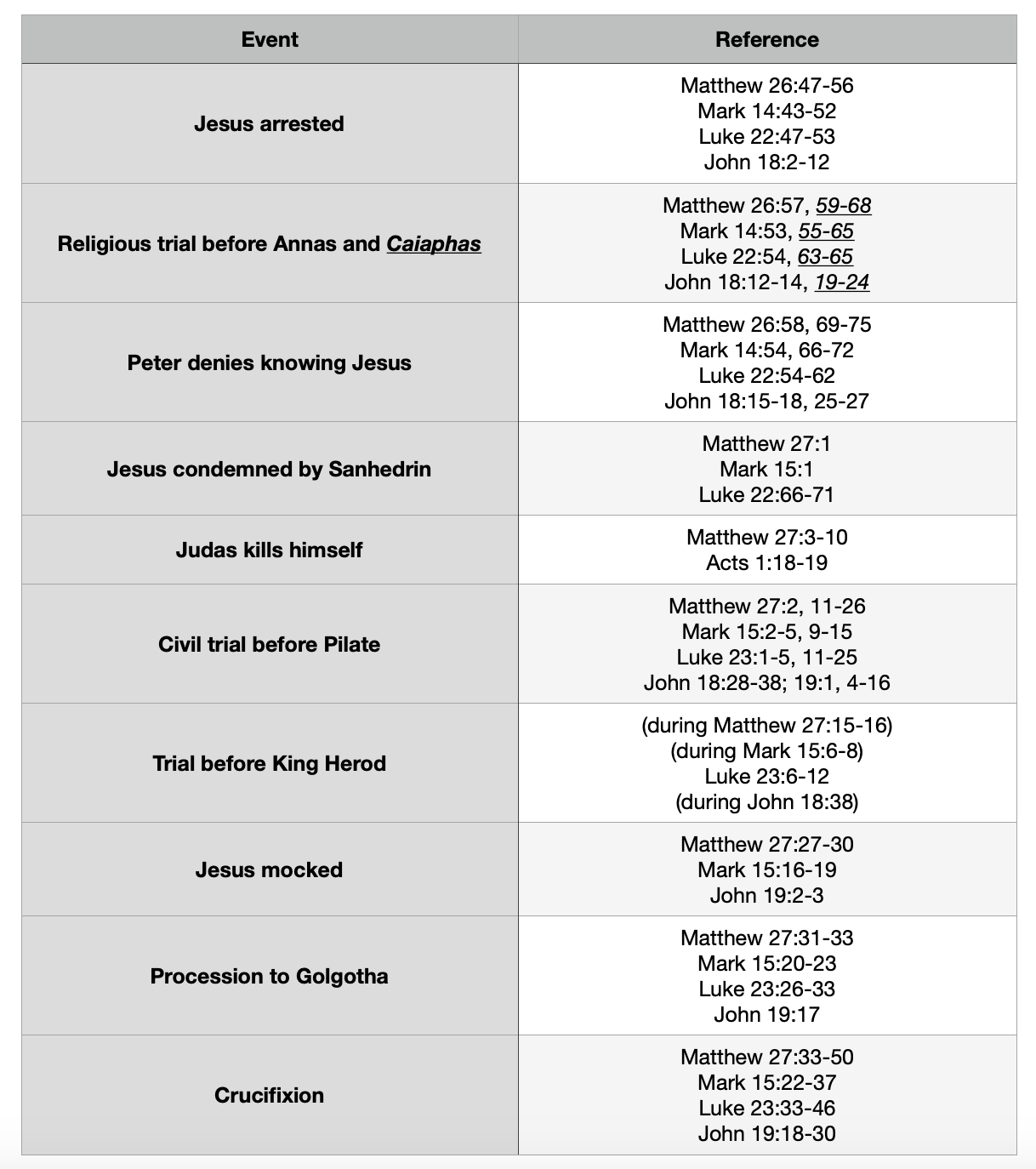
Check out this chart of the events that show how Matthew, Mark, Luke, and John record this historical moment. 

When did this moment in history occur? Consider this scholarly insight from The Archeological Study Bible—

“In what year was Jesus born, and when was He crucified? These are long-standing historical questions. The seemingly obvious answer to the first—that He was born in A.D. 1 (there is no year 0)—is incorrect, however, since the calculations on which our modern calendar is based were faulty. …

“The chronology of Jesus’ life, though clear in outline, cannot be fixed with absolute precision. Matthew and Luke both inform us that Jesus was born before the death of Herod (4 B.C.), though it would appear that His birth occurred toward the final years of Herod’s reign, suggesting an approximate date of 6-4 B.C. The next chronological marker comes from Luke 3:1, where we learn that John the Baptist’s ministry began during the fifteenth year of the reign of the emperor Tiberius. Since A.D. 14 is the generally accepted date for Tiberius’ accession to the throne, John’s ministry would have commenced between August A.D. 28 and December of 29. Jesus began His own ministry shortly after John had embarked on his, at some point in A.D. 28 or 29, making Jesus about 32 or 33 years old at the time. This fits well with Luke’s statement that Jesus was ‘about 30 years old’ (Luke 3:23).

“The duration of Jesus’ public ministry was approximately three years. While the exact chronology of this period is difficult to ascertain, the final phase of His ministry allows for closer scrutiny. It is clear that Jesus was crucified under Pontius Pilate, who governed Judea from A.D. 26-36. …

“Taking Friday, Nisan 14, as the day of the crucifixion, astronomical data informs us that the only years from A.D. 29-36 that could have seen Nisan 14 on a Friday are A.D. 30, 33 and 36. A.D. 36 is easily dismissed as too late, while A.D. 30 seems too early (although some who begin Jesus’ ministry in A.D. 28 and shorten His public ministry find it acceptable). This leaves A.D. 33 as the most likely date for the year of Jesus’ death and resurrection.” 

As you celebrate the victory over sin and death that Jesus won by His sacrificial death on the Cross, rejoice also that this is an actual historical event that bought your freedom from your sin. It is indeed miraculous, but it is also historic. Let’s never lose sight of either of those facets. 

►► Would you please prayerfully consider supporting this ministry? My Patreon supporters get behind-the-scenes access to exclusive materials. ◀︎◀︎
10 Quotes From “The Roots Of Endurance”

John Piper’s intertwining of the biographies of John Newton, Charles Simeon, and William Wilberforce in The Roots Of Endurance was masterfully done! Especially because, unlink the previous books in Pastor John’s “The swans are not silent series,” all three of these men knew each other and interacted with each other. Check out my full book review by clicking here. 

“Simeon with us—his heart glowing with love of Christ. How full he is of love, and of desire to promote the spiritual benefit of others. Oh! that I might copy him as he Christ.” —William Wilberforce, writing in his journal about Charles Simeon 

“It is hoped and believed that the Lord has raised you up for the good of His church and for the good of the nation.” —John Newton, in a letter to William Wilberforce 

“Unless God has raised you up for this very thing, you will be worn out by the opposition of man and devils. But if God be for you, who can be against you.” —John Wesley, at 87 years of age, in a letter to William Wilberforce 

“Frustration is normal, disappointment is normal, sickness is normal. Conflict, persecution, danger, stress—they are all normal. The mind-set that moves away from these will move away from reality and away from Christ. —John Piper 

The remaining six quotes are exclusive content for my Patreon supporters. In addition to book quotes, there are videos and behind-the-scenes views that only these supporters have access to. I would love it if you would prayerfully consider supporting my ministry for just $5 per month.

Susanna Wesley (book review)

Listen to the podcast of this post by clicking on the player below, and you can also subscribe on Apple, Spotify, or Audible. 

I think most people are familiar with the saying, “Behind every good man there is a good woman.” In the case of Samuel and Susanna Wesley almost the opposite is true: Susanna excelled as a godly mother despite the obstinacy and shortcomings of her husband Samuel. Arnold A. Dallimore delivers a fair overview of their lives in his biography of Susanna Wesley. 

Rev. Dallimore does an admirable job of telling Susanna’s story through the first person accounts of almost all of the Wesley family members. He has culled through the historical records, reading the letters of Samuel, Susanna, their children, and their relatives to give us a fairly unbiased look at this notable family. The subtitle of the book is, “The mother of John and Charles Wesley,” which is no small gift to the world! The preaching and song-writing ministries of these two brothers has had a huge impact on both the secular and church worlds, which is still being felt today. 

Samuel Wesley at times was distant from his family, to the extent of even abandoning them for a period of time, and was a very poor provider for his family. They were constantly in debt and struggling for the basic necessities. But despite these obstacles, Susanna created her own curriculum to instruct her children, and continued to correspond with them into their adulthood to give them her motherly wisdom. 

What a debt of gratitude we owe to this godly woman for not only persevering but thriving in the face of challenges that would have thwarted most people. And we also should be grateful to Arnold Dallimore for his well-researched biography of this amazing woman. 

(I previously reviewed Rev. Dallimore’s biography of George Whitefield.) 

►► Would you please prayerfully consider supporting this ministry? My Patreon supporters get behind-the-scenes access to exclusive materials. ◀︎◀︎