Listen to the podcast of this post by clicking on the player below, and you can also subscribe on Apple, Spotify, or Audible.
Many of the principles taught in the Bible are conveyed to us through graphic stories. Think about some of the imagery the prophets of the Old Testament used or even the parables Jesus used in the New Testament. In fact, even the Hebrew language of the Old Testament and the Greek language of the New Testament are very picturesque languages. John Bunyan takes full advantage of this in his book The Holy War.
If you have ever read a John Bunyan book or sermon, it is quite obvious that the Bible is his Source Book. In fact, Charles Spurgeon said of him, “Why, this man is a living Bible! Prick him anywhere—his blood is Bibline, the very essence of the Bible flows from him. He cannot speak without quoting a text, for his very soul is full of the Word of God.” Much like The Pilgrim’s Progress, The Holy War is steeped in biblical imagery that makes the story so engaging.
The title and subtitle of the book alone tell you the essence of the story: The holy war made by Shaddai upon Diabolus for the regaining of the metropolis of the world, or the losing and taking again of the town of Mansoul. With the assault taking place on Ear-gate and Eye-gate of Mansoul by such combatants as Lord Incredulity or Mr. Forget-Good, and the servants of King Shaddai such as Captain Conviction, Mr. Justice, and Mr. True-Man drawing up battle lines against the town, you can quickly see how picturesque the language truly is.
Much in the vein of C.S. Lewis’ The Screwtape Letters, Bunyan also lets us hear the correspondence and war counsels of Lucifer and his minions, as well as the conversation between King Shaddai and His Son Emmanuel.
As with anything I’ve ever read from John Bunyan, The Holy War is entertaining and insightful. If you have read and enjoyed The Pilgrim’s Progress, I think you will thoroughly enjoy this book as well.
Listen to the podcast of this post by clicking on the player below, and you can also subscribe on Apple, Spotify, or Audible.
C.S. Lewis said, “Friendship is born at that moment when one person says to another, ‘What! You too? I thought I was the only one!’” Truly there is a special bond when we find someone who “gets” us—someone who not only knows what we’re feeling, but how to help us too.
Jesus is described as One who went through all of the human suffering we will ever have to go through (Hebrews 2:14, 17-18). So no matter what you’re going through, Jesus “gets” you. He’s been through it and He knows exactly what you’re feeling and what help you need.
This is wonderful news for all of us! But isn’t it also comforting when we have a human companion that “gets” us too? One that will come alongside us through the challenging and painful times to help us?
In His love for His sheep, Jesus has given us under-shepherds. These are sheep that He has called and equipped to care for His flock. He did this with David—
He chose David His servant and took him from the sheep pens; from tending the sheep He brought him to be the shepherd of His people Jacob, of Israel His inheritance. And David shepherded them with integrity of heart; with skillful hands he led them. (Psalm 78:70-72)
David never forgot that his source of strength was the Chief Shepherd, and he penned a beautiful psalm of praise and reliance on Him (Psalm 23). David also made it a priority to point the sheep under his care to the Chief Shepherd. He prayed:
The Lord is my strength and my shield; my heart trusts in Him, and He helps me. My heart leaps for joy, and with my song I praise Him. The Lord is the strength of His people, a fortress of salvation for His anointed one. Save Your people and bless Your inheritance; be their Shepherd and carry them forever. (Psalm 28:7-9)
David “got” the needs of the sheep and with skill and integrity he both shepherded them as he was strengthened by the Chief Shepherd, and he entrusted them into the care of the Chief Shepherd.
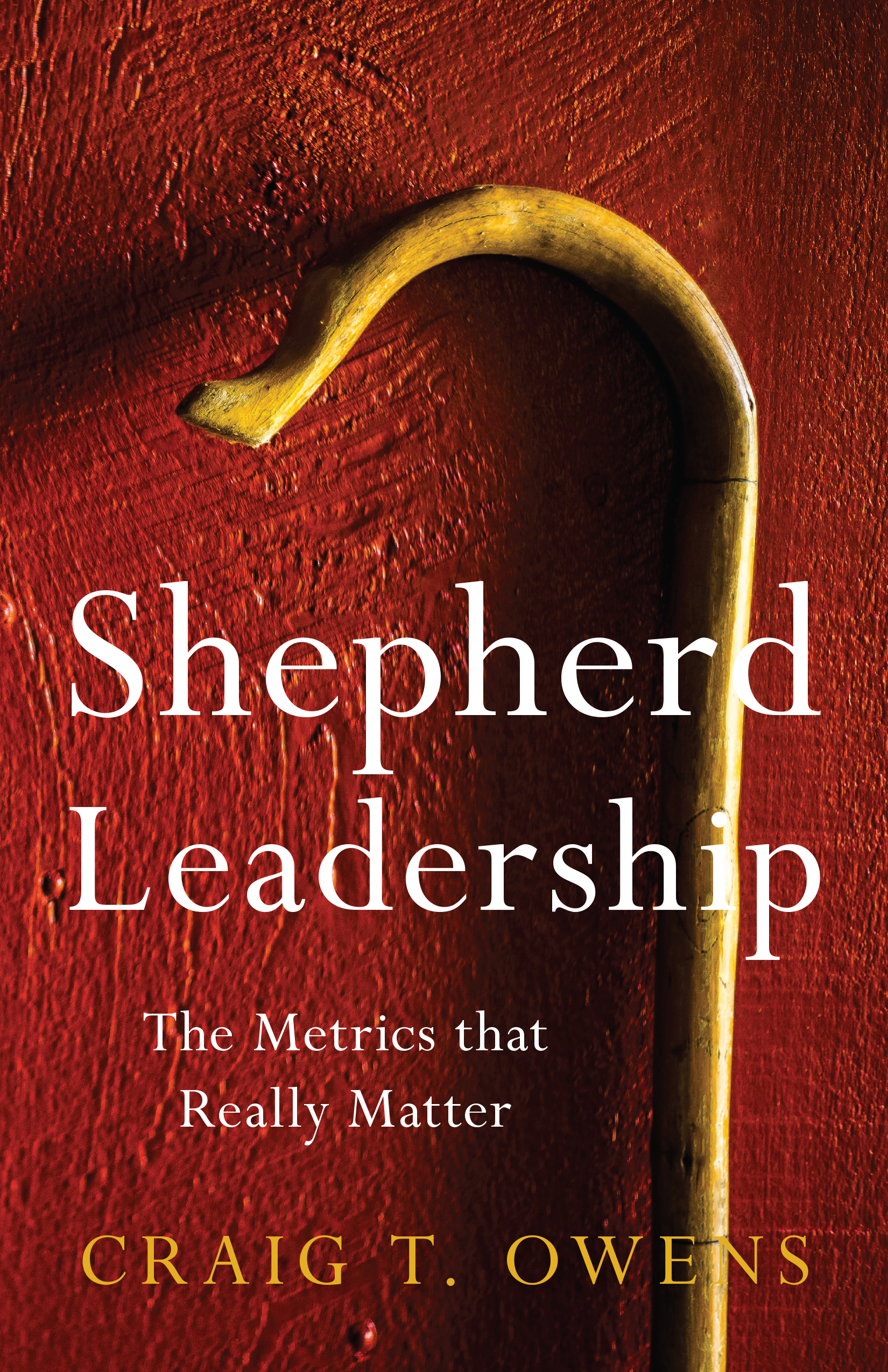
In the foreword to my book Shepherd Leadership, Dick Brogden wrote, “God plucked David from the sheepfold. God chose a sheep to be a shepherd. And though we all are stupid sheep, when God plucks us out of obscurity to serve others, we can have the humble confidence for as long as we are asked to lead that God has chosen us. That confidence both faithfully drives us to our knees and fearlessly propels us against our giants.”
If you have been called by the Chief Shepherd to be an under-shepherd, make sure you remain a sheepish shepherd—one that “gets” his or her sheep. Don’t be distant from the flock, but stay close by them in the pasture so that you can care for them, pray for them, and lead them to the Chief Shepherd.
I adapted David’s beautiful 23rd Psalm into a prayer that I hope all under-shepherds will use to gain the strength they need for the work to which the Chief Shepherd has called them—
BecauseYou are my Chief Shepherd, I lack nothing that is needed to care for the sheep You have placed under my care.
Just as You provide food for me in green pastures, and quiet waters for my thirst, I am equipped to feed the hungry and give drink to the thirsty.
You continually refresh my soul, so I can offer refreshing hospitality to those who have been beat up along life’s journey.
You guide me along the right paths for Your name’s sake, so I can show others the path into Your presence.
Even when I walk through the darkest valleys, I never fear because You are with me; You comfort me and provide all that I need so that I can care for the sick, the downhearted, and the weary without ever lapsing into my own pity party.
You continually prepare a table before me, even when I’m in the midst of enemies. You have anointed my head with oil and caused my cup of blessing to overflow, so I have more than enough to share with others.
I am secure that Your goodness and Your love will follow me all the days of my life, so I am equipped to lead others to the place where they too will dwell in Your house forever.
T.M. Moore wrote, “It’s not likely John the Baptist would be welcomed in many pulpits today. Even though Edwards used him as a model of ‘The True Excellency of a Gospel Minister,’ few and far between are the shepherds today who would even think of adopting his example.
“Edwards wrote, ‘He also shone bright in his conversation, and his eminent mortification and renunciation of the enjoyments of the world; his great diligence and laboriousness in his work, his impartiality in it, declaring the mind and will of God to all sorts without distinction; his great humility, rejoicing in the increase of the honour of Christ, though his honour was diminished, as the brightness of the star diminishes as the light of the sun increases; and in his faithfulness and courage, though it cost him his own life.’
“These days many pastors secure their ‘honor’ in subtle but significant ways. They go by ‘Reverend’ or ‘Doctor.’ Have reserved parking places and their name on the church sign. Adopt fashionable garb and speech. Try hard to be friends with all the right people. Such shepherds want to advance their honor; John worked to have his honor diminished, that the honor of Christ might increase.”
Vaughn Shoemaker (1902-1991) was an American editorial cartoonist. He won the 1938 and 1947 Pulitzer Prizes for Editorial Cartooning for his work with the Chicago Daily News. He was the creator of the character, John Q. Public, and a faithful Assemblies of God layman. I am a fourth-generational Pentecostal in the Assembly of God fellowship, so I love studying more about the men and women who have made this such a robust missions-minded fellowship! Read more of this amazing man here.
“This is a radical call for us to look hard at our present lives to see if they are shaped by the hope of the resurrection. Do we make decisions on the basis of gain in this world or gain in the next? Do we take risks for love’s sake that can only be explained as wise if there is a resurrection?” —John Piper
“Jesus will do the things we ask for if they make God’s greatness known. So how do we ask this way? We must ask from right relationships (Mark 11:24-25, 1 Peter 3:7), with right motives (James 4:3, Proverbs 16:2), through right living (James 5:16, Proverbs 15:29), in good faith (James 1:6-7), according to His will (1 John 5:14-15). In short, if you think Jesus would put His name on it, and it will make His Father famous, then ask and believe! But remember, we’re here for Him—He’s not here for us.” —Craig Groeschel, in Twisted
For parents and anyone else who works with students, this is a segment from the Axis ministry’s Culture Translator newsletter:
In his book Man’s Search for Meaning, Viktor Frankl writes that “success, like happiness, cannot be pursued; it must ensue, and it only does so as the unintended side-effect of one’s personal dedication to a cause greater than oneself… Happiness must happen, and the same holds for success: you have to let it happen by not caring about it.”
An idea like that would likely seem counterintuitive to many of the students in Professor Santos’ classes—students who have been raised from young ages to pay careful and constant attention to their academic viability. Students like these grow up with a hope and an expectation that achieving perfection (whether academic, relational, spiritual, or other) will finally yield the happiness, satisfaction, and recognition they’ve been looking for. But after achieving perfection, the next source of anxiety is maintainingperfection. As Christopher Fry once put it, “What, after all is a halo? It’s only one more thing to keep clean.”
Jesus concludes Matthew 5 by saying to his hearers, “Be perfect, therefore, as your heavenly Father is perfect.” It’s a verse most Christians may not want to touch, and one that anxious overachievers might point to as justification for their continual striving. But as C.S. Lewis points out in Mere Christianity, Jesus’ words presuppose our dependence on Him. He writes, “The command Be ye perfect is not idealistic gas. Nor is it a command to do the impossible. He is going to make us into creatures that can obey that command… The process will be long and in parts very painful, but that is what we are in for. Nothing less. He meant what He said.”
In other words, our betterment is in partnership with our Creator, and happiness is merely a by-product of our total surrender. Whoever has ears, let them hear.
Listen to the podcast of this post by clicking on the player below, and you can also subscribe on Apple, Spotify, or Audible.
C.S. Lewis, like many atheists, wondered if the God of the Bible might be an egomaniac because He is always encouraging people to praise Him. In his book Reflections on the Psalms, Lewis wrote a thoughtful response to this after he had become a Christian:
“Just as men spontaneously praise whatever they value, so they spontaneously urge us to join them in praising it. ‘Isn’t she lovely? Wasn’t it glorious? Don’t you think that magnificent?’ … I think we delight to praise what we enjoy because the praise not merely expresses but completes the enjoyment; it is its appointed consummation. It is not out of compliment that lovers keep on telling one another how beautiful they are; the delight is incomplete till it is expressed. … This is so even when our expressions are inadequate, as of course they usually are. But how if one could really and fully praise even such things to perfection—utterly ‘get out’ in poetry or music or pain the upsurge of appreciation which almost bursts you? Then indeed the object would be fully appreciated and our delight would have attained perfect development. The worthier the object, the more intense this delight would be.”
His phrase, “our expressions are inadequate” is especially true when we are attempting to appreciate and praise the Infinite, the Eternal, the Omnipresence, the Omnipotence of our God and Savior! But the biblical authors call for Christians to mature in this—we want to keep praising, keep expressing, until we finally find the perfect fulfillment in His presence.
Paul talks about the maturing nature of love—when I was a child, I talked like a child, I thought like a child, I reasoned like a child (1 Corinthians 13:11)—but then he prays for us to grow in both our understanding and our expressions of our Savior’s love (Ephesians 1:17-19).
I like the wording of Ephesians 1:19 in the King James Version: the exceeding greatness of His power to us-ward. The word “exceeding” means God pours out in a way that is beyond human imagining. The Greek word that Paul uses for “greatness” is only used here, and it reinforces the truth that God is beyond our full comprehension. And then Paul adds that this overflowing, incomparable power is directed “to us-ward”!
Paul then prays for us to be able to understand ever-increasing new dimensions of this transcendent power and ability that God directs to us through His Son Jesus, and for us to be able to express it (Ephesians 3:14-19). In other words, we are to grow in our experience of Jesus so that we can grow in our praise to Jesus.
The incomparable Jesus means at least four things for us. It means Jesus is…
…beyond comparison. Isaiah, God Himself, and the psalmists ask rhetorically, “Who is like God? Who could ever compare to Him?” (Isaiah 40:13-14, 18, 25; Psalm 89:5-8).
…matchless in His power. Isaiah 40:12 says God holds the waters of the world in the hollow of His hand. How much water is this? Scientists estimate the Earth’s water supply to be 326 quintillion gallons of water (that’s 326 followed by 18 zeros)! Not only does God hold all of the water, but He directs its activities on behalf of His children (Exodus 15:11-13).
…unequaled in knowledge.Isaiah 40:12, 26 tell us that all of the stars in our universe fit onto God’s outstretched hand, and that He knows all of the stars by name. How many stars is this? Astronomers calculate the heavens to contain 10 septillion stars (that’s 10 followed by 24 zeros)! Not only does God know each star by name, He knows each human by name, and thesmallest of details about each of them (Isaiah 49:16; Matthew 10:29-31).
…inimitable in His care. We humans can get to the end of our strength, but God never does. He cares for us unlike anyone else or anything else ever can (Isaiah 40:28-31). The Lord hears His people when they call to Him for help. He rescues them from all their troubles (Psalm 34:17).
Knowing we have a Savior like this, why would you ever settle for anything less The Genuine?!
Our incomparable Jesus wants us to pray in His incomparable name so that our incomparable Father can answer in a way that brings Him incomparable glory! We’re helped, He’s lifted up, and others are drawn to Him.
Listen to the podcast of this post by clicking on the player below, and you can also subscribe on Apple, Spotify, or Audible.
…I will hide My face from this city because of all its wickedness. Nevertheless, I will bring health and healing to it… (Jeremiah 33:5-6)
God’s anger at Judah’s sin is blazing hot! And rightly so: Dr. Henry Halley points out, “Most of the 20 Davidic kings who reigned over Judah during the 400 years between David and the Babylonian exile were very bad. Only a few were worthy of the name of David.” So it is understandable that God would need to punish that sinful nation.
Then comes that word “nevertheless.” In spite of the rampant sin, God’s promise of restoration is even greater than the pain of His punishment.
God promises healing, restoration, complete cleansing from sin, and more descendants of David and Levi than can be counted. And He promises this to the exact same people that He promised to punish.
I don’t know about you, but to me this almost seems like a contradiction. Does God want to punish them or does He want to bless them?
The apparent contradiction is hard for our finite brains to comprehend. That’s why God makes an important statement to Jeremiah before He begins describing the punishment and the blessings: “Call to Me and I will answer you and tell you great and unsearchable things you do not know” (v. 3).
Aha! When we call on God to help us with unsearchable things, we find there are no contradictions in God nor in the Bible itself.
C.S. Lewis wrote, “Heaven will solve our problems, but not, I think, by showing us subtle reconciliations between all our apparently contradictory notions. The notions will all be knocked from under our feet. We shall see that there never was any problem”—or any contradiction at all.
This is a weekly series with things I’m reading and pondering from Charles Spurgeon. You can read the original seed thought here, or type “Thursdays With Spurgeon” in the search box to read more entries.
Listen to the podcast of this post by clicking on the player below, and you can also subscribe on Apple, Spotify, or Audible.
Beautiful Homegoing
You shall come to the grave at full age, as a sheaf of grain ripens in its season. (Job 5:26)
The Christian’s death is always timely. ‘You shall come to the grave at full age.’
‘Ah,’ says one, ‘that is not true. Good people do not live longer than others. The most pious man may die in the prime of his youth.’ But look at my text. It does not say you will come to your grave in old age, but in a ‘full age.’ … All fruits do not get ripe and mellow at the same season. So it is with Christians. They are at a ‘full age’ when God chooses to take them home. …
There are two mercies to a Christian. The first is that he will never die too soon. And the second is that he will never die too late. …
‘But,’ say some, ‘how useful might they have been had they lived.’ Ah, but how damaging they might have been! And were it not better to die than to do something afterward that would disgrace them and bring disgrace to the Christian character? Were it not better for them to sleep while their work was going on than to break it down afterward? …
Again, the Christian never dies too late. … God is too good a Husbandman to leave His wheat in the field too long and let it shale out. …
Now the last thing is that a Christian will die with honor. … I think there are two funerals for every Christian: one is the funeral of the body, and the other of the soul. Funeral, did I say, of the soul? No, I meant not so. I meant not so. It is a marriage of the soul. For as soon as it leaves the body, the angel reapers stand ready to carry it away. They may not bring a fiery chariot as they had for Elijah. But they have their broad spreading wings. I rejoice to believe that angels will come as convoys to the soul across the ethereal plains. … I think the most honorable and glorious thing we will ever behold, next to Christ’s entrance into heaven and His glory there, is the entrance of one of God’s people into heaven.
From The Death Of The Christian
As I mentioned last week, this sermon was so providential in its timing for me because my precious mother went Home to be with Jesus just days before I opened to this sermon from Charles Spurgeon.
We are comforted by the promises Rev. Spurgeon shares because they are based on the truth in God’s Word. “Good people pass away; the godly often die before their time. But no one seems to care or wonder why. No one seems to understand that God is protecting them from the evil to come. For those who follow godly paths will rest in peace when they die” (Isaiah 57:1-2).
At my Mom’s graveside committal service I shared this—
One of my favorite authorsC.S. Lewis made a comment, “You don’t have a soul. You are a soul. You have a body.”
This part that we called Claudia Owens was just the body that carried around who she really was. What a beautiful soul that we got to experience for 78 years. What shined through was so sweet and graceful and wonderful. What a glimpse we got! But a joy to know that it was only a glimpse. That the part of my Mom that was so beautiful that we got to see, was only a fraction of her full beauty! The part that was really her, that is at Home with her Savior Jesus now is shining in all its brilliance. …
We will all miss her and we will grieve our loss. But as the apostle Paul reminded us, we don’t grieve as those who have no hope. We know that to be absent from the body is to be present with the Lord. We know that this body is sown perishable ravaged by the disease of cancer, but that my Mom is now in a place with no more tears or disease. We know that the same Savior that prepared a place for Claudia has prepared a place for us.
And we concluded with this prayer that can be offered up for every Christian who has died at their “full age”:
Heavenly Father,
We commit this body to the ground with the full assurance that her soul is in your everlasting presence. Holy Spirit, help us in our grief to be reminded of the hope of eternal life that we all share. Thank You, Jesus, for purchasing this hope on which we stand.
As I mentioned last week, if you don’t have this blessed assurance of the marriage of your soul when you take your last breath here on earth, please don’t hesitate to contact me.
Listen to the podcast of this post by clicking on the player below, and you can also subscribe on Apple, Spotify, or Audible.
I love reading, and I love sharing my love of good books with others! Here is a list of the books I read and reviewed in 2021. Click on a title to be taken to that review.
Listen to the podcast of this post by clicking on the player below, and you can also subscribe on Apple, Spotify, or Audible.
Many in-the-public-spotlight people will hire a publicist to make them look good. Although this publicist can try to direct the public’s opinion, they cannot control the actual word on the street about their client. What people are talking about in their private conversations is closer to the truth than the publicist’s spin.
Some skeptics of the claims of Christianity have tried to claim that the New Testament is really a publicity stunt: That the New Testament authors wrote their documents to try to control the narrative of the story of Jesus. But I find it fascinating what people were saying about Jesus from His birth—before He ever preached a sermon or performed a miracle.
Skeptics may want to claim that what Jesus said or did is a myth. But we need to ask, “Where do myths originate?” Myths come from legends, and legends come from historical facts. J.R.R. Tolkien says in the opening of the Fellowship Of The Ring, “And some things that should not have been forgotten were lost. History became legend. Legend became myth. And for two and half thousand years, the ring passed out of all knowledge.”
There are those that steadfastly cling to Fact long after others have gotten tired of the Legends, and now only see a Myth. Throughout history those that cling to something others think are out-dated have often been able to bring clarity to confusing things that the modern science of the day couldn’t do. Sometimes these Fact-clingers have been called seers or sorcerers or magicians.
Some of these magicians show up shortly after the birth of Jesus:
After Jesus was born in Bethlehem in Judea, during the time of King Herod, Magifrom the east came to Jerusalem and asked, “Where is the One who has been born King of the Jews? We saw His star when it rose and have come to worship Him.” (Matthew 2:1-11)
Some English translations of the Bible translate Magi as “wise men.” This is pretty accurate, but magi can also mean teachers, priests, physicians, astrologers, interpreters of dreams, or magicians. These Babylonian Persians had seen some sort of astronomical occurrence that led them to make a nearly 900-mile journey to Jerusalem.
For over 500 years these magicians had been clinging to a Fact taught to them by the chiefmagician of Babylon. Not a fellow Babylonian, but a Hebrew given the name Belteshazzar. He was one who could…
…tell someone what they had dreamed about and then interpret it
…solve the deepest riddles
…read and translate an unknown language
…call on supernatural powers to shut the mouths of lions
…foretell future world events
Belteshazzar the Magician also saw a vision of the pre-incarnate Jesus before Time even began, One whom he called “the Ancient of Days.” And he even saw all the way to the end of Time when this King of kings would judge the entire world.
These Persian magicians didn’t make an arduous 900-mile journey for a Myth. They didn’t bring gifts fit for a king to honor a Legend. They did all of this because of a Fact: Jesus is Fact.
We meet another magician on Barnabas and Paul’s first missionary journey. He was a man named Elymas. The English version of the Bible calls him a sorcerer, but in Greek the word is magos, the singular of the word magi.
He’s called a sorcerer because he tried to make Jesus a Myth. He worked for the Roman proconsul, a man called Sergius Paulus, whom Luke describes as “an intelligent man.” Elymas in essence said, “Sergius, use your intellect. There may have been someone called Jesus (in fact, my own father had that same name), but the stories about His miracles, death, and resurrection have to be mythical!” Sergius Paulus was convinced that the accounts of Jesus were myth until he heard the words of fact spoken by Barnabas and Paul.
C.S. Lewis wrote in Mere Christianity,
“A man who was merely a man and said the sort of things Jesus said would not be a great man or a moral teacher. He would either be a lunatic—on the level with the man who says he is a poached egg—or else he would be the devil of hell. You must take your choice. Either this was, and is, the Son of God; or else a madman or something worse. You can shut Him up for a fool… or you can fall at His feet and call Him Lord and God. But let us not come with any patronizing nonsense about His being a great human teacher. He has not left that open to us.”
So who do you say Jesus is? Is He a Myth? A Legend? A liar? A lunatic? Or is He the Ancient of Days, the Light of the world, the Lord of all Creation?
Christians, we must have this Fact clear in our own minds, and then—just as the Persian Magi did and as Barnabas and Paul did—let’s clearly tell about this Fact to the world’s skeptics, especially as the world’s modern telling of Christmas seems to be becoming more and more mythical.
Don’t rail on the Myths and Legends, but use them to show others the Fact of Jesus Christ—the Ancient of Days, Savior, and King!
(Watch the full message More Than A Legend by clicking on the link below.)
To catch up on all of the messages in our Advent series People Will Talk, please click here.
This is a weekly series with things I’m reading and pondering from Charles Spurgeon. You can read the original seed thought here, or type “Thursdays With Spurgeon” in the search box to read more entries.
Listen to the podcast of this post by clicking on the player below, and you can also subscribe on iTunes or Spotify.
Forgiven And Forgiving
Forgiving one another, even as God for Christ’s sake has forgiven you. (Ephesians 4:32)
Now observe how the apostle puts it. Does he say, ‘forgiving another’? No, that is not the text. If you look at it, it is ‘forgiving one another.’ One another! Ah, then that means that if you have to forgive today, it is very likely that you will, yourself, need to be forgiven tomorrow, for it is ‘forgiving one another.’ … Let us begin our Christian career with the full assurance that we will have a great deal to forgive in other people, but that there will be a great deal more to be forgiven in ourselves! …
Note again: When we forgive, it is a poor and humble business compared with God’s forgiving us, because we are only forgiving one another—that is, forgiving fellow servants. But when God forgives us, the Judge of all the earth is forgiving, not His fellows, but His rebel subjects, guilty of treason against His majesty! For God to forgive is something great—for us to forgive, though some think it great—should be regarded as a very small matter. … What we owe to God is infinite, but what our fellow creature owes to us is a very small sum. …
If anyone here who is a Christian finds a difficulty in forgiveness, I am going to give him three words that will help him wonderfully… Here they are again: ‘For Christ’s sake.’ …
I do not know how to put this next word I am going to say. It is a paradox. You must forgive or you cannot be saved. But at the same time, you must not do it from compulsion, you must do it freely. … Remember, it is of no use for you to put your money into that offering box as you go out unless you remember, first, to forgive your brother. God will not accept the gifts, prayers, or praises of an unrelenting heart. … The very prayer that teaches you to ask for mercy bids you say, ‘And forgive us our debts, as we forgive our debtors’ (Matthew 6:12). Unless you have forgiven others, you read your own death warrant when you repeat the Lord’s Prayer!
From Forgiveness Made Easy
We honor the forgiveness that God has extended to us by liberally forgiving others. And our forgiveness of others shows them just how loving and forgiving our God is too!
I add my prayer to Charles Spurgeon’s that you would grasp the truth that we can forgive one another for Christ’s sake because God has forgiven us for Christ’s sake. Let’s all grow in this Christian maturity!
Listen to the podcast of this post by clicking on the player below, and you can also subscribe on Apple, Spotify, or Audible.
One of the things I enjoy about my Apple Watch is the connection I have with others who also use an Apple Watch. For instance, I get notified when my wife has finished a workout, and one of the pre-set replies I could choose is, “I’ve got questions!” That’s a funny way of me saying, “How did you complete that workout?!”
In Psalm 75 and Psalm 76, Asaph tells us how God will deal with the wicked. But then Psalm 77 begins with Asaph using words like, “My soul refused to be comforted, my spirit is overwhelmed,” and then he launches into the tough questions like: “How long is this going to last? Has God forgotten me? Have I fallen out of favor with God? Has His mercy dried up? Can God keep what He has promised? Is God angry with me?” When I read all this, I feel like saying, “Asaph, I’ve got questions!”
Yet, these complaints of Asaph ring true to real life. Like when a friend called me last week and started our conversation by asking, “Why can’t things just go easy for me?”
Here’s the simple answer: The Story isn’t over yet. We are in a battle, and the enemy of our soul is still trying to take us out, or at least shut us up.
In Psalm 77, Asaph tells his story to Jeduthun (a Levite worship leader whose name means praising) in four chapters, with a Selah for each of the breaks between the chapters.
Chapter 1—Distress (vv. 1-3)
The word distress means confronted by an adversary. Ever been there? Every follower of God has been, so Asaph invites us to Selah: pause to contemplate things like (a) Is this distress causing me to reevaluate the foundation on which I stand? (b) What is it God is shaking in my life? When God shakes things up, it is to cause us to remember and muse about the ONLY sure foundation that can withstand any storm (see Matthew 7:24-27).
Chapter 2—Questioning (vv. 4-9)
Notice the words Asaph uses: thought, remembered, mused, inquired. He is asking those tough questions, but he is asking them in a way that he can carefully consider the answers. That means he is really taking a Selah pause with each question. I think he has come to this conclusion: “Aren’t all these really just rhetorical questions? And isn’t the answer to all of them a resounding ‘NO!’?” If you aren’t sure the answer to all of these questions is no, please read Romans 8:31-39.
Chapter 3—Recalling (vv. 10-15)
Notice the continuation of the words: thought, remember, meditate, consider. He also asks another question in v. 13 which he then answers in the next two verses. His call to Selah here is another pause to reflect: “Has God lost His power? Has He changed His mind?” And once again the answer is a loud and clear, “NO!” (see Isaiah 59:1; Hebrews 13:8)
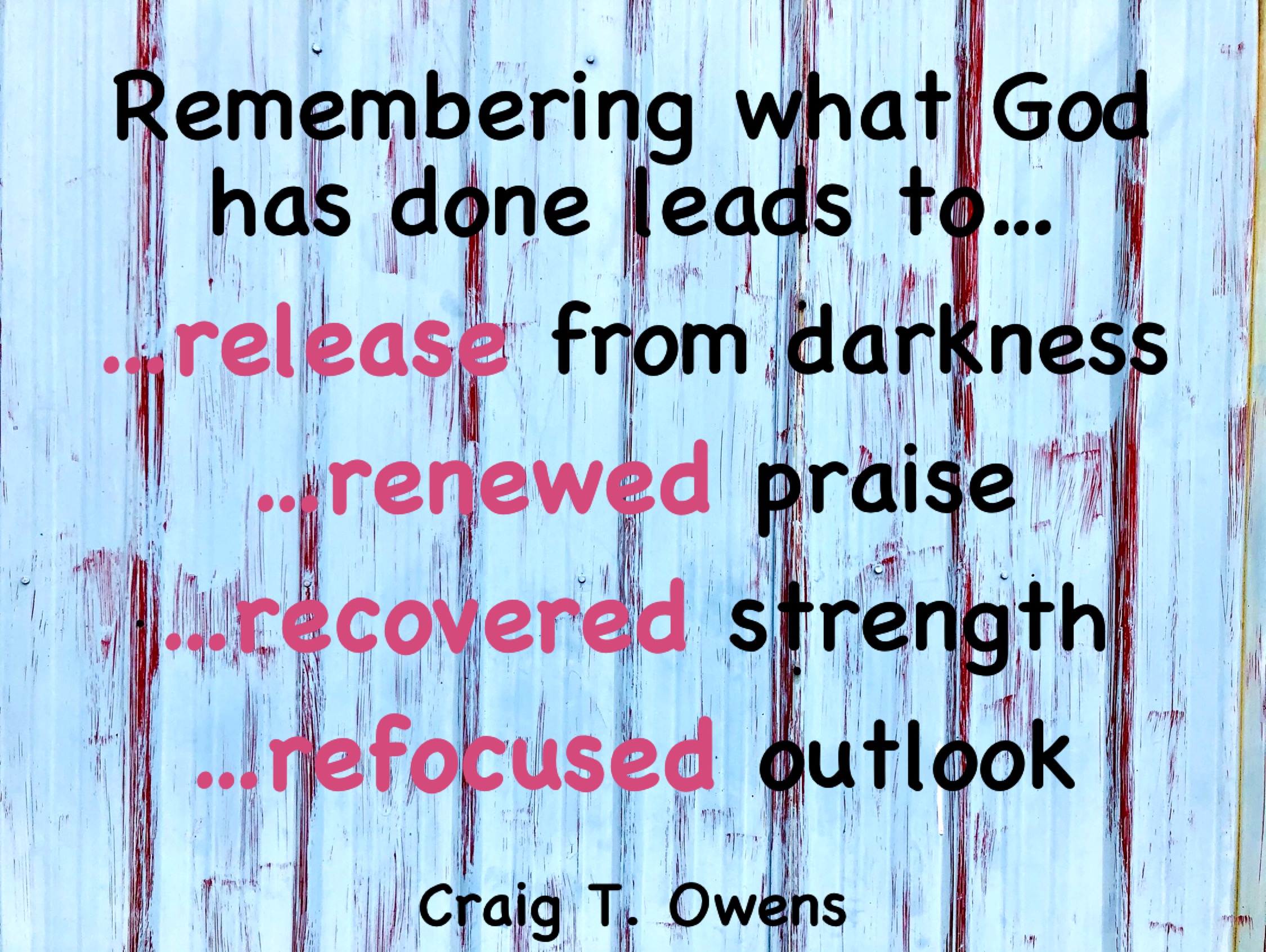
One of the important takeaways from this stanza of Psalm 77 is this: Looking back in gratitude at what God has done allows me to look forward in hope to what He is still going to do. My remembering what God has done in the past leads to:
Release from the darkness
Renewed praise
Recovered strength
Refocused outlook
Chapter 4—Hope (vv. 16-20)
Asaph says, “Look what God did! And since He is the same today as He was yesterday, guess what He’s still able to do!” We know this because the Bible says, “For no matter how many promises God has made, they are ‘Yes’ in Christ. And so through Him the ‘Amen’ is spoken by us to the glory of God” (2 Corinthians 1:20).
Remember I said earlier that God isn’t done telling His story yet? God isn’t done yet, He knows His Story, and His Story is still being told. But He’s also already told us how His story will end (see Revelation 21:4-6). And the end of His story is really just the beginning of the Real Story!
C.S. Lewis said it this way in the closing words of The Last Battle:
“And for us this is the end of all the stories, and we can most truly say that they all lived happily ever after. But for them it was only the beginning of the real story. All their life in this world and all their adventures in Narnia had only been the cover and the title page; now at last they were beginning Chapter 1 of the Great Story, which no one on earth has read; which goes on forever; in which every chapter is better than the one before.”
When you find yourself saying, “I’ve got questions: How long is this going to last,” Selah to remember that the Story isn’t over yet. The Storyteller knows how it ends, and He promises us: But what of that? For I consider that the sufferings of this present time—this present life—are not worth being compared with the glory that is about to be revealed to us and in us and for us and conferred on us! (Romans 8:18 AMP)



 Many of the principles taught in the Bible are conveyed to us through graphic stories. Think about some of the imagery the prophets of the Old Testament used or even the parables Jesus used in the New Testament. In fact, even the Hebrew language of the Old Testament and the Greek language of the New Testament are very picturesque languages. John Bunyan takes full advantage of this in his book The Holy War.











 Craig T. Owens