Shepherds individualize their care. Good shepherd leaders don’t have a one-size-fits-all approach for everyone around them. Good shepherd leaders know how to individualize the care that each and every person needs.Check out my book Shepherd Leadership where I go into more detail about these kinds of leaders.
“The Bible really seems to clinch the matter when it puts the two things together into one amazing sentence. The first half is, ‘Work out your own salvation with fear and trembling’—which looks as if everything depended on us and our good actions: but the second half goes on, ‘For it is God who worketh in you’—which looks as if God did everything and we nothing. I am afraid that is the sort of thing we come up against in Christianity. I am puzzled, but I am not surprised. You see, we are now trying to understand, and to separate into water-tight compartments, what exactly God does and what man does when God and man are working together. And, of course, we begin by thinking it is like two men working together, so that you could say, ‘He did this bit and I did that.’ But this way of thinking breaks down. God is not like that. He is inside you as well as outside: even if we could understand who did what, I do not think human language could properly express it. In the attempt to express it different Churches say different things. But you will find that even those who insist most strongly on the importance of good actions tell you you need Faith; and even those who insist most strongly on Faith tell you to do good actions.” —C.S. Lewis, on Philippians 2:12-13
“My religion consists of a humble admiration of the illimitable superior spirit who reveals Himself in the slight details we are able to perceive with our frail and feeble mind.” —Albert Einstein
The safest place to vent our hurts and frustrations is in God’s presence. He is not going to fall off His throne when you tell Him what’s really in your heart (because He already knows!). But it can bring healing to your hurt when your ears hear what’s really going on in your heart.
Listen to the podcast of this post by clicking on the player below, and you can also subscribe on Apple, Spotify, or Audible.
Our cravings are implanted by God and are fulfilled solely in our relationship with Him. Sometimes the journey seems long. If you have been in the car with kids, you know they are infamous for asking, “Are we there yet?” just a couple of minutes into the trip. We adults aren’t much better. Perhaps we have a little more patience but if we’re honest we may find ourselves asking, “How long is this going to take? It seems like it’s soooo long!”
We’ve discussed that a maturing attitude shift for us is exchanging “have to” for “get to.” This is when we begin to understand that something good—something far better than what we have now—is coming. This is the starting point to help us to wait well, to not get frustrated and bail out.
Jesus did this: “For the joy set before Him He endured the Cross” (Hebrews 12:2). He could see what was coming so He wouldn’t accept any lesser substitutes. But that same verse also calls us to be “looking away from all that will distract to Jesus” (Hebrews 12:2 AMP).
This attitude exchange helps us in three ways:
Maturing self-control
Understanding the rewards of delayed gratification
Having a joyful expectation of both what’s coming and what’s happening now
Self-control, delayed gratification, and joyful expectation are also the key components of a satisfying relationship. These then allow me to make another important exchange: “don’t” for “won’t.”
For example, in my relationship with my wife Betsy, no one has to tell me, “Don’t speak to her unkindly.” I won’t speak to her unkindly because that would damage our relationship. No one has to tell me, “Don’t flirt with other women.” I won’t do that because I know that would jeopardize our relationship, perhaps causing me to look elsewhere to satisfy my craving for a meaningful relationship.
In the book called Song of Solomon, the word “lovely” is used frequently between lovers who only have eyes for each other. Paul uses this keyword when he talks about us only having our eyes, and heart, and mind on Jesus—“Whatever is true, whatever is noble, whatever is right, whatever is pure, whatever is lovely, whatever is admirable—if anything is excellent or praiseworthy—think about such things” (Philippians 4:8).
David, who is described as a man after God’s own heart, wrote several psalms expressing his longing to be in God’s presence both now and for all eternity. Especially in Psalm 16 and Psalm 37, David shows us the don’t-for-won’t exchange (Psalm 16:1-11; 37:1-4).
Sometimes we will experience some lovely things here on earth, but those are nothing compared to the eternal rewards awaiting us. C.S. Lewis wrote, “Our Father refreshes us on the journey with some pleasant inns, but will not encourage us to mistake them for home.”
Even if we experience unpleasant things here, the apostle Paul reminds us, “But what of that? For I consider that the sufferings of this present time—this present life—are not worth being compared with the glory that is about to be revealed to us and in us and for us and conferred on us!”(Romans 8:18 AMP).
The marshmallow test is a famous experiment. Kids were given the choice to eat one marshmallow immediately or be rewarded with a second marshmallow if they waited. Researchers found that those who practiced self-control, delayed gratification, and joyful expectation faired much better later in life.
So I would encourage you to keep your marshmallow somewhere you will see it often. It will harden, but it will not mold or spoil. Every time you look at it, let it remind you that what’s coming is so much more than anything you could ever find here! Let this reminder help you exchange don’t for won’t as the Holy Spirit helps you keep your eyes only on Jesus.
We also said that although we would all like to have the job that was wonderful, even the crummy jobs deserve our best attitude and our best effort.
This is very much the same for our relationships. We would all love to only have relationships in our lives that are energizing, fulfilling, and win-win. But the reality is that many of our relationships may be the exact opposite of this.
Jesus said our love for others would show the world that we are His disciples. Oh yeah, and the love we show is supposed to be a “10” on the Jesus Love Scale (John 13:34-35). Why? Because that’s how Jesus loved us:
Now it is an extraordinary thing for one to give his life even for an upright man, though perhaps for a noble and lovable and generous benefactor someone might even dare to die. But God shows and clearly proves His own love for us by the fact that while we were still sinners, Christ (the Messiah, the Anointed One) died for us. (Romans 5:7-8 AMP)
Remember we said that God is Love? But love needs to have both a lover and beloved—someone reaching out and someone receiving. God is Father, Son, and Holy Spirit so God is Relational. The Father loving the Son and Spirit, the Son loving the Spirit and the Father, the Spirit loving the Father and the Son. All loving and promoting the Other.
God is also Happy in this Relationship.
Because we are created in God’s image, we have a God-implanted craving to love and to be loved, to have meaningful companionships (Genesis 1:26; 2:18).
Remember that Jesus was all-in for us so that we could have this love relationship with God.This same passage calls us to have the same attitude as Jesus had. But we can also back up just a couple of more verses to find out what fuels the relationships that satisfy our craving for companionship and please God (Philippians 2:1-11). Those characteristics include:
being like-minded in striving to find agreement with others
having the same love as Jesus demonstrated
being one in spirit—this unique Greek word reminds us we all have immortal souls. As C.S. Lewis reminded us, “It is a serious thing to live in a society of possible gods and goddesses, to remember that the dullest and most uninteresting person you talk to may one day be a creature which, if you saw it now, you would be strongly tempted to worship, or else a horror and a corruption such as you now meet, if at all, only in a nightmare. All day long we are, in some degree, helping each other to one of these destinations.”
being one in purpose
giving up selfish ambitions as we trade “me” for “we”
not indulging in vain conceit, but thinking more highly of others
being humble
always striving to find the win-win
When Alexander Dumas wrote The Three Musketeers his Musketeers have been given a famous line: “All for one and one for all, united we stand divided we fall.” This is actually quite biblical because the Bible only has saints in the plural form, never in the singular. And the apostle Paul reminds us, “And if one member suffers, all the parts share the suffering; if one member is honored, all the members share in the enjoyment of it” (1 Corinthians 12:26 AMP).
God is pleased when our attitude about our fellow saints is all for one and one for all—when all the saints love and nurture the individual saint, and when each individual saint loves and supports all the other saints.
We were created for this. We crave this. God is pleased when we live and love like this. And this is the only way we will experience the joy of God’s favor on our relationships.
Listen to the podcast of this post by clicking on the player below, and you can also subscribe on Apple, Spotify, or Audible.
There’s a misconception that many people have about God’s laws: they think that they are intended to rob us of enjoyment, that they restrict our lives and remove our pursuit of happiness.
In actuality, the exact opposite is true. God is love (1 John 4:8). That means everything God does is rooted in His love for us. Including the laws He gives us. He loves us and wants us to stay in the place where we don’t experience the heartache, pain, and disappointment of missing out on His blessings.
God is also happy. Paul calls it “the glory of the blessed God” (1 Timothy 1:11). The word “blessed” can easily be translated as happy. God is happy and He wants us to share in this ultimate happiness.
Consider the blessings that are in first and last of the Ten Commandments:
The first commandment says there is only one God. Far from this being restrictive, it’s a huge blessing. I don’t have to search and compare, I don’t have to make a list of pros and cons and then settle on the best option, but I can enjoy the one and only true God.
The tenth commandment says I don’t need to crave anything outside of what God has given me. Again, this is a huge blessing because it tells me that my loving Father has given me all that I need, that He alone satisfies my cravings.
John Piper gave the essence of idolatry in this line: “Preferring other things above God.” This is why God delights for us to delight in Him. When we do, He is our sole focus. When He is our focus, we enjoy Him immensely and we reject anything that would remove our gaze from Him.
That’s why there is a continuous linkage in all 176 verses of Psalm 119 between God’s laws and our delight—between obedience and satisfaction. When we obey God, we experience His happiness.
The apostle Paul called Christians to live this way: “Whatever happens, conduct yourselves in a manner worthy of the gospel of Christ” (Philippians 1:27). Gospel literally means “good news.” What good news are we supposed to proclaim? The good news that God is happy and that He wants to say to us, “Come and share your Master’s happiness” (Matthew 25:21)!
When I was a kid I struggled with this question: Do I love God just because He first loved me? I thought, “That seems like a cop out. Am I really saying that the only reason I have for loving Him is that He went first?” But then I realized it couldn’t be any other way. How could I love an angry God? How could I ever expect to approach a God who knew all my sins and had the final say on my punishment, and was just waiting for a chance to get His hands on me?
I can only love a loving God. I can only love Him because He first loved me (see Romans 5:8).
In a similar way, I can only crave God because He first craved a relationship with me. Otherwise I’m setting myself up for unimaginable heartbreak and disappointment!
Jesus said it was His Father’s “good pleasure” to reveal Himself to us. No one knows the Son except the Father, and no one knows the Father except the Son. Our heavenly Father craved a relationship with us, so He revealed His Son Jesus to us so that Jesus could reveal the Father to us (see Matthew 11:25-30; John 14:7).
Just as we could only love God because He loved us first, we could only crave a relationship with God because He craved a relationship with us first. It was always His plan to adopt us into His family—this is what gives Him great pleasure (Ephesians 1:5). Then God works in us to fulfill His craving for us, which empowers us to find our deepest longings satisfied exclusively in Him (Philippians 2:13).
Sometimes we get a small taste or experience of earthly pleasure that quickly fades away. C.S. Lewis reminded us, “If I find in myself a desire which no experience in this world can satisfy, the most probable explanation is that I was made for another world.”
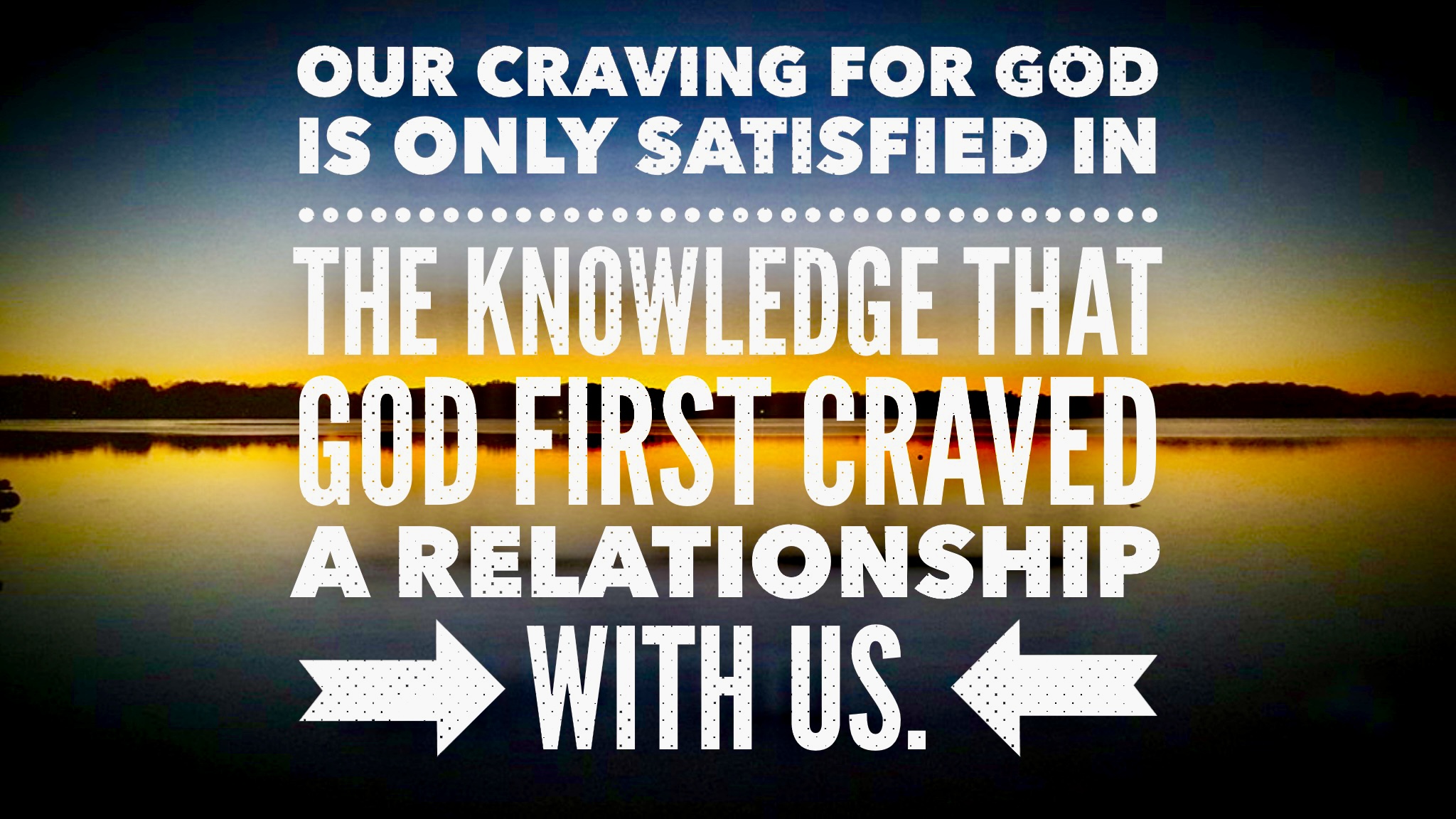
Our craving for God is only satisfied in the knowledge that God first craved a relationship with us. Only the intimacy of our Savior will fulfill our cravings. Anything else will end only in utter disappointment.
I co-host a leadership podcast with my good friend of 30+ years Greg Heeres. In an episode that came out last week, we were discussing the importance of friendships for leaders. All of us need friends that are investing in our lives. You may check out the rest of the conversation Greg and I had by clicking here.
Jonathan Woodward writes, “The right use of authority or power can make people glad. In our age, however, power is often immediately viewed with skepticism or outright disdain.” He also talks about our responsibility to the incorrect use of leadership authority: “It’s absolutely necessary to identify, challenge, and rebuke sinful leadership. It ensures that people are cared for and God is honored.” Check out The Power to Bless: Six Dimensions of Good Leadership.
More and more scientists are dissatisfied with the lack of evidence supporting the theory of evolution. ICR reports, “Indiana University Biologist Armin Moczek told The Guardian, ‘We still do not have a good answer. This classic idea of gradual change, one happy accident at a time, has so far fallen flat.’”
The churches in my hometown of Cedar Springs, MI, have partnered together to make sure students who are food insecure on the weekend are supplied with nutritious food to carry them through the weekend. If you would like to know more, or if you would like to help us, please check out the Cedar Springs Ministerial Association website.
“Because we love something else other than this world, we love even this world better than those who know no other.” —C.S. Lewis
This is one of the best interviews I have done. I so enjoyed this! And the good news is this is only part 1. We had such a good conversation that the hosts asked me to stick around to record another episode with them. Here is the first session…
My wife and I just celebrated our anniversary. We enjoyed the many words of congratulations we received, but that got me thinking about marriages where only one spouse is a Christian and I then recorded this thought—
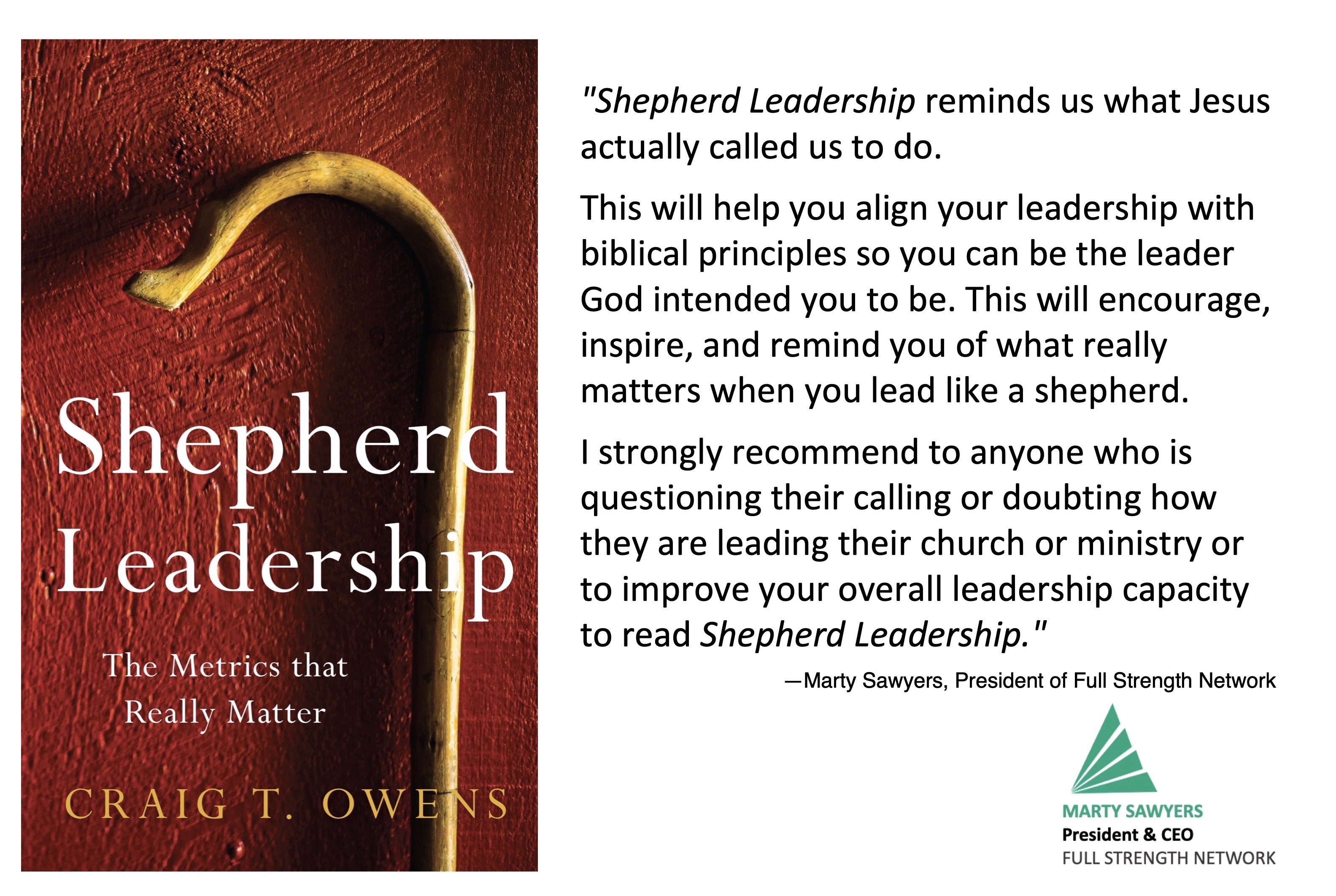
I was so honored to receive another great endorsement for my book Shepherd Leadership: The Metrics That Really Matter.
“It is not your business to succeed, but to do right; when you have done so, the rest lies with God.” —C.S. Lewis
“Homosexuality is not about some issue to debate; it’s about people to love.” —Dr. Preston Sprinkle, Living In A Gray World
“It is better to fail in originality than to succeed in imitation.” —Herman Melville
More fascinating news for creationists. Plants know how to defend themselves. “There are two main types of threat-detection mechanisms in plant cells—the ability to recognize distinctive chemical patterns that signify an invader, such as components of a bacterial cell, and the ability to recognize a disruption caused by invading pathogen.” Check out the full article here.
I shared an important reminder with my fellow pastors—
“God, give me a deep humility, a well-guided zeal, a burning love, and a single eye, and then let men or devils do their worst.” —George Whitefield, prayer when sailing for Georgia, December 30, 1777
Doug Clay, the General Superintendent of the Assembly of God wrote, “Our nation needs revival!
“Culture may well be at a deeply dark moment, but that’s when the Church can shine the brightest as Christ’s witness to the world. I’m reminded of Romans 8:19 (Message), ‘The created world itself can hardly wait for what’s coming next.’
“A.W. Tozer once said, ‘The world is waiting to hear an authentic voice, a voice from God—not an echo of what others are saying, but an authentic voice.’ Let’s rise and be that authentic voice to a generation that is desperately in need.”
“What satan put into the heads of our remote ancestors was the idea that they could ‘be like gods’—could set up on their own as if they had created themselves—be their own masters—invent some sort of happiness for themselves outside God, apart from God. And out of that hopeless attempt has come nearly all that we call human history—money, poverty, ambition, war, prostitution, classes, empires, slavery—the long terrible story of man trying to find something other than God which will make him happy.” —C.S. Lewis
Meet Piper. She was abandoned with her mother and one other sibling. The mother then left the two kittens behind, who were hiding in a storm pipe. We were able to rescue this little calico and named her Piper as a reminder of where she was rescued from.
Physicist Brian Cox discusses where God fits into scientists’ understanding of the universe. Two statements that are interesting to me—“we don’t know all the laws of science” (at 1:17), and “science is only an observational framework” (at 2:40). Both of these statements fit well with my biblical creationist paradigm.
C.S. Lewis identifies one of the harmful effects of pornography. “For me the real evil of masturbation would be that it takes an appetite which, in lawful use, leads the individual out of himself to complete (and correct) his own personality in that of another (and finally in children and even grandchildren) and turns it back: sends the man back into the prison of himself, there to keep a harem of imaginary brides. And this harem, once admitted, works against his ever getting out and really uniting with a real woman. For the harem is always accessible, always subservient, calls for no sacrifices or adjustments, and can be endowed with erotic and psychological attractions which no woman can rival.” —C.S. Lewis
“Joy is not a requirement of Christian discipleship; it is a consequence.” —Eugene Peterson
In my personal devotional time, I came across a sobering idea in the book of Amos about God’s love. I am reading through the Bible in Halley’s Study Bible, where I also read this: “The basket of ripe fruit [Amos 8] is another symbol that the sinful kingdom was ripe for ruin. And Amos reiterates the causes: greed, dishonesty, and merciless brutality toward the poor. Over and over, through many images, the Bible makes it plain that there is no possible way to escape the consequences of persistent sin.” —Dr. Henry Halley
J. Warner Wallace wrote, “The historic development of language and communication prepared the way for the birth of Jesus. God orchestrated this timing, along with the development of roads, postal services and a 200-year period peace within the Roman Empire (known as the Pax Romana) to prepare the world for the arrival of Jesus.”
Our church is taking time on Fridays to fast and pray. Here is a reminder of the expected results that I shared with our church family—
William Perkins defined theology as, “The science of living blessedly forever.” He also had this word for pastors as they teach theology: “The ‘demonstration of the Spirit’ becomes a reality when, in preaching, the minister of the Word conducts himself in such a way that everyone—even those who are ignorant of the gospel and are unbelievers—recognize that it is not so much the preacher who is speaking but the Spirit of God in him and by him…. This is what makes his ministry living and powerful.”
“Self-trust is the first secret of success.” —Ralph Waldo Emerson
John Piper identifies five digital dangers and gives us strategies for combating them. I especially thought these insights on pornography were powerful: “More insidious that X-rated videos, we can now not only watch but join the perversity in the privacy of our own den. Interactive porn will allow you to ‘do it’ or make them ‘do it’ virtually. I have never seen it. Nor do I ever intend to. It kills the spirit. It drives God away. It depersonalizes women. It quenches prayer. It blanks out the Bible. It cheapens the soul. It destroys spiritual power. It defiles everything. Resolution: I will never open any app or website for sexual stimulation, nor purchase or download anything pornographic.”
“I could well believe that it is God‘s intention, since we have refused milder remedies, to compel us into unity, by persecution even and hardship. satan is without doubt nothing else than a hammer in the hand of a benevolent and severe God. For all, either willingly or unwillingly, do the will of God: Judas and satan as tools or instruments, John and Peter as sons.” —C.S. Lewis
“The response of Jesus to those guilty of sexual sin is not to condemn nor condone the sin. I see in His example [John 8:10-12] a good pattern: (1) Love first—‘I don’t condemn you’; (2) Speak the truth—‘Sin no more.’” —Kevin Berry. The world has made “love” mean accepting whatever the other person is doing, and “truth” now means agreeing with the other person. With the Holy Spirit’s help, we can speak the truth in love without condemning nor condoning.
Listen to the podcast of this post by clicking on the player below, and you can also subscribe on Apple, Spotify, or Audible.
I am so grateful for the blessings of a godly mother and a godly wife! I can relate to Abraham Lincoln who said, “All I am, or can be, I owe to my angel mother. … I remember my mother’s prayers and they have always followed me. They have clung to me all my life.”
Mothers—both the natural, physical, and adoptive mothers—can save the rest of us from a world of hurt. We see this in a story in the Bible of a mother that saved innumerable people from the consequences of folly. This is an amazing story in 1 Samuel 25, so please take some time to read it for yourself.
King Saul and David have finally separated from each other, with Saul returning home to Gibeah and David returning to his stronghold at En Gedi. Eventually, David moved west from En Gedi to the Desert of Moan, where the town of Carmel was nearby.
A prominent citizen of Carmel was a man named Nabal. He is described as “very wealthy,” owning 1000 goats and 3000 sheep. But he apparently gained his wealth through less-than-honorable means because he is described as “surly and mean in his dealings.” We find out later in the story that he’s also hard-hearted and hard-headed, not listening to any counsel others may offer him.
That fits him because his name means “fool.” I find it hard to believe that his parents named him this from birth. If they did, it reminds me of the opening words of C.S. Lewis’ book The Voyage Of The Dawn Treader: “There was a boy named Clarence Eustace Scrubb, and he almost deserved it.” Instead, I think Nabal’s dealings were so mean, surely, and foolish that the name stuck. Perhaps he even wore that name as a badge of honor.
It came sheep-shearing time—which is really payday for shepherds—so David sends some of his servants to Nabal to ask for whatever he might find to give as a gift to “your servants and your son David.” David’s men had been a constant source of protection for Nabal’s herdsmen, so a gift of gratitude does seem appropriate.
Nabal doesn’t just say, “No,” but he insults David. As his foolish nature controlled him, he not only insulted David, but he insulted God too by implying that David wasn’t anointed by God, but was merely ruthlessly climbing a ladder of success. Probably Nabal thought this way because that’s how he himself gained his fortune.
Nabal’s response lit David’s fuse! In fact, David’s response to his men was just four words long: “Put on your swords!”
Fortunately, one of Nabal’s servants informed his wife Abigail of this.
In the same verse where Nabal is described as mean and surely, Abigail is described as “intelligent and beautiful.” Whereas Nabal’s name means fool, Abigail’s name means “my father’s joy.” She must have been born at just the right time for her father and she continues to be a just-in-time woman!
This servant brought Abigail word of Nabal’s foolish response, telling her that David’s men were indeed “a wall around us” while they were in the desert. And then he says, “Think carefully about what you should do because disaster is hanging over us!”
Abigail acts quickly, wisely, and humbly.
The first thing she does is send hundreds of pounds of food to David and his men. She sends the gift that Nabal probably should have sent. Then Abigail herself follows the gifts on her own donkey. When she encounters David and his armed men coming down the mountain pass, she humbly falls at his feet asking David to reconsider.
Abigail doesn’t tell David he shouldn’t be angry, but she points him to something bigger and more long-lasting than his immediate thought of revenge. She reminds him that he is God’s anointed leader, and she asks, “When you become king, do you want this bloodshed on your conscience?”
Abigail’s words have an immediate effect on David, who calls off the attack, praises Abigail, and praises God for sending Abigail to him. Abigail rescued Nabal’s family and workers from imminent destruction, and she saves David from the consequences of his rash response.
The next morning, when she relates this story to Nabal, he has either a stroke or a heart attack, and then dies ten days later. Justice is served, but it’s served by God and not by David.
Later on, David takes the now-widowed Abigail as his wife.
Abigail’s name scarcely appears anywhere else in the Bible, but there is one notable appearance:
Sons were born to David in Hebron: His firstborn was Amnon the son of Ahinoam of Jezreel; his second, Kileab the son of Abigail the widow of Nabal of Carmel; the third, Absalom the son of Maakah daughter of Talmai king of Geshur; the fourth, Adonijah the son of Haggith; the fifth, Shephatiah the son of Abital; and the sixth, Ithream the son of David’s wife Eglah. (2 Samuel 3:2-5)
Amnon, first in line for the throne, raped his half-sister Tamar and was then killed by Absalom, who was Tamar’s brother. Absalom, third in line for the throne, not only avenged his sister’s disgrace but led a coup against David, where he was killed in battle.
That leaves Kileab as the obvious heir to King David’s throne, yet this is the only place he is mentioned in the Bible. I think Abigail’s wise influence saved Kileab from the drama of aspiring to be king, a painful future, and perhaps a premature death.
From this amazing story, I would like to offer three takeaways for Moms:
Use your inner beauty to persuade foolhardy men—1 Peter 3:2-3
Use your Holy Spirit-given wisdom to dissuade foolishness—Matthew 10:19
Use your prayer life to bring a legacy of peace—Psalm 116:16
Godly mothers, please be encouraged today at how much influence you exert over others in your life. Your inner beauty, God-given wisdom, humility, and prayers are making more of an impact than you may ever know. I believe in heaven the full story will be shared, and you will be praised for being a wise and faithful servant.
May God continue to bless, empower, and use our Moms to save us from the consequences of our foolishness!










 Craig T. Owens