Inspiration, Illumination, And Boldness

Listen to the podcast of this post by clicking on the player below, and you can also subscribe on AppleSpotify, or Audible. 

David declared that the Holy Spirit inspired the words he penned. “The Spirit of the Lord spoke in and by me, and His word was upon my tongue” (2 Samuel 23:2). 

Both Jesus and Peter affirm this in the New Testament as well when they make mention that David’s words were given to him by the Holy Spirit (Matthew 22:43; Mark 12:36; Acts 1:16, 4:25). 

It’s not just the words of David, but all Scripture is God-breathed (2 Timothy 3:16; 2 Peter 1:21)! This is why we would be wise to pray before reading our Bibles to ask the One Who inspired the Scripture to illuminate our minds to understand it and guide us into its daily application (John 14:26, 16:13). 

Jesus desired that we go even farther than this. His directive to His followers was for them to be baptized in the Holy Spirit. This initial baptism took place on the first Pentecost celebration after Jesus had ascended to Heaven. Luke records it this way—

And they were all filled (diffused throughout their souls) with the Holy Spirit and began to speak in other (different, foreign) languages (tongues), as the Spirit kept giving them clear and loud expression in each tongue in appropriate words. (Acts 2:4 AMPC) 

And in the subsequent verses Luke makes it clear that these were intelligible languages and intelligent words that served as a testimony to the worldwide visitors that were in Jerusalem—

And when this sound was heard, the multitude came together and they were astonished and bewildered, because each one heard them—the apostles—speaking in his own particular dialect. And they were beside themselves with amazement, saying, “Are not all these who are talking Galileans? Then how is it that we hear, each of us, in our own (particular) dialect to which we were born? Parthians and Medes and Elamites and inhabitants of Mesopotamia, Judea and Cappadocia, Pontus and the province of Asia, Phrygia and Pamphylia, Egypt and the parts of Libya about Cyrene, and the transient residents from Rome, both Jews and the proselytes to Judaism from other religions, Cretans and Arabians too—we all hear them speaking in our own native tongues and telling of the mighty works of God!” (vv. 6-11 AMPC) 

In his sermon that followed this event, Peter states that the baptism in the Holy Spirit—with the physical evidence of speaking in tongues—is an evidence of Christ’s resurrection. “Being therefore lifted high by and to the right hand of God, and having received from the Father the promised blessing which is the Holy Spirit, He has made this outpouring which you yourselves both see and hear” (v. 33). 

Later on, when the Christians were facing the threat of persecution from the Jewish leadership, they prayed. In their prayer, they noted again the Spirit-inspired words that David penned and the desire of Jesus for them to be His missionaries (see Acts 4:24-30). 

God answers their prayer powerfully! “And when they had prayed, the place in which they were assembled was shaken; and they were all filled with the Holy Spirit, and they continued to speak the word of God with freedom and boldness and courage” (v. 31). 

The Holy Spirit gave us the Scripture, and He illuminates the Scripture to us. 

The Holy Spirit assures us of our salvation, and He empowers us to share this Good News with others. 

The Holy Spirit gives us words to speak, and He gives us the boldness and courage to speak them. 

He speaks, He illuminates, He empowers, He emboldens! If your theology limits the work of the Holy Spirit to some obscure corner of your world, you are robbing yourself of the power to live a God-glorifying, Jesus-promoting life. 

You may be interested in some additional posts and sermons where I discuss more about the initial physical evidence of speaking in tongues as the Holy Spirit empowers Christians—

You may also be interested in an extensive series of messages I have shared called We Are: Pentecostal. 

►► Would you please prayerfully consider supporting this ministry? My Patreon supporters get behind-the-scenes access to exclusive materials. ◀︎◀︎
Not That Other Stuff, But Prayer

Listen to the podcast of this post by clicking on the player below, and you can also subscribe on AppleSpotify, or Audible. 

The Church heard the threats from the Sanhedrin, warning them not to talk about Jesus anymore. Their first response was to go to God: “When they heard this, they raised their voices together in prayer to God“ (Acts 4:24). 

Not signing a petition or organizing a protest, but praying.
Not telling their friends to gain support, but praying.
Not attacking, but praying.
Not discussing, but praying.
Not strategizing, but praying.
Not complaining, but praying.
Not individually, but together.
Not later, but immediately.
Not going through the motions, but passionately.
Not aimlessly, but guided by Scripture.
Not humdrum, but expecting God’s power from on high.
Not for vengeance, but for a testimony.

God answered the Church powerfully! 

Then the people moved out boldly—“And when they had prayed, the place where they were assembled together was shaken; and they were all filled with the Holy Spirit, and they spoke the word of God with boldness” (Acts 4:31). 

Oh, for this type of unifying action today! It starts with prayer!

You may also like my blog post and sermon 4 Holy Spirit-Enhanced Habits, and my whole series on prayer called Be A First Responder.  

►► Would you please prayerfully consider supporting this ministry? My Patreon supporters get behind-the-scenes access to exclusive materials. ◀︎◀︎

Links & Quotes

A.W. Tozer said, “There’s an awesomeness about God which is missing in our day altogether; there’s little sense of admiring awe in the Church of Christ these days.” May we repent of little prayers and boldly pray to an awesome God who wants to do awesome things that will bring Him glory!

I have lots of new content every week, which you can check out on my YouTube channel.

I always smile at the archeological discoveries which confirm the historicity of the Bible! Discovery after discovery keeps reinforcing that the Bible is a reliable historical document—which is exactly what one would expect from the inspired Word of God. Here are two recent article: (1) An archeological biography of the Assyrian king Ashurbanipal, and (2) The excavation of a rare Roman prison in Corinth that “likely gives us a picture of those that held the apostles as recorded in the New Testament (e.g. Acts 5:18, 12:5, 16:23).”

This is a very informative Q&A session with cold case detective and Christian apologist J. Warner Wallace. But I especially like his answer to the first question: Do Christians have to investigate every other religion to be convinced that the Bible is true?

“Faith untried may be true faith, but it is sure to be little faith, and it is likely to remain dwarfish so long as it is without trials. Faith never prospers so well as when all things are against her: tempests are her trainers, and lightnings are her illuminators. … No flowers wear so lovely a blue as those which grow at the foot of the frozen glacier; no stars gleam so brightly as those which glisten in the polar sky; no water tastes so sweet as that which springs amid the desert sand; and no faith is so precious as that which lives and triumphs in adversity. … Faith increases in solidity, assurance, and intensity, the more it is exercised with tribulation. Faith is precious, and its trial is precious too.” —Charles Spurgeon 

“Mature Christians can be recognized by a variety of indicators. They feast on the Word of God (Hebrews 5:14), persevere in love and good works (Hebrews 6:9-10), bear the fruit of the Spirit rather than the marks of the flesh (Galatians 6:16-23), use their gifts to help build the church (1 Corinthians 12:7-11; Ephesians 4:12-16), teach the things of Jesus to others (Hebrews 5:12: Acts 1:8), and more. This, the New Testament insists, is the condition toward which every Christian strives.” —T.M. Moore (check out all of the Scriptures T.M. references here

“Now is the accepted time, not tomorrow, not some more convenient season. It is today that our best work can be done.” —W.E.B. Du Bois 

Jesus shows us that only secure people can serve others. Insecure people won’t ever make themselves vulnerable, and so they miss out on God’s blessing. I address this in more depth in my book Shepherd Leadership.

Determined And Empowered To Do God’s Will

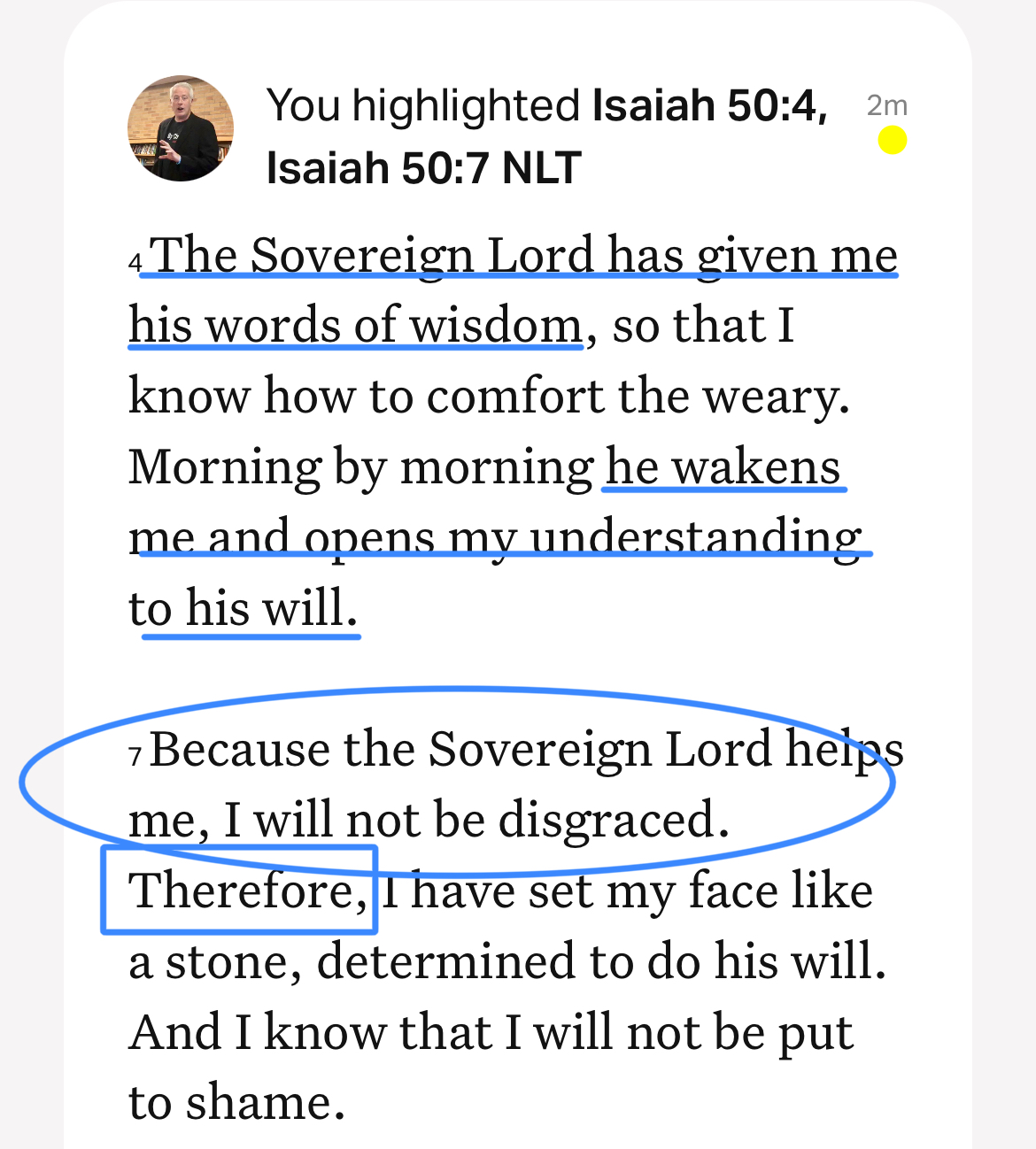
The Sovereign Lord has given me His words of wisdom, so that I know how to comfort the weary. Morning by morning He wakens me and opens my understanding to His will. … Because the Sovereign Lord helps me, I will not be disgraced. Therefore, I have set my face like a stone, determined to do His will. And I know that I will not be put to shame. (Isaiah 50:4, 7 NLT)

God’s words give me wisdom and strength. It doesn’t matter what others say when I live and speak the way God wants me to because God sees my obedience and He will reward me in the end. I don’t live for the applause of men, but only for the applause from nail-scarred hands.

Check out two related blog posts: 

I also spend quite a bit of time unpacking this idea of what really matters to God in my book Shepherd Leadership: The Metrics That Really Matter. 

Respectful Boldness

Listen to the podcast of this post by clicking on the player below, and you can also subscribe on AppleSpotify, or Audible. 

As we near the crucifixion of Jesus, we begin to see how politics plays a role in so many decisions. The Sanhedrin is trying to balance their popularity with the Jewish people and their standing with powerful leaders in the Roman government. Pontius Pilate is trying to balance how the Sanhedrin portrays him to the Jewish people and what those in Rome are telling Caesar Tiberius about him. King Herod Antipas also has issues with balancing the pressure from the Sanhedrin with the popularity of Jesus. 

Luke gives us a very telling statement about the politics of the day when he writes, “That day Herod and Pilate became friends—before this they had been enemies” (Luke 23:12). How did they become friends over this issue of what to do with Jesus? Remember that the Sanhedrin is a common thorn-in-the-side for both of them, and the political axiom that still holds to this day says, “The enemy of my enemy is my friend.” 

I point out all of the political maneuverings during this pivotal time because these political balancing acts are still being played out today and Christians will end up in the crosshairs. 

Pilate was trying to appease the Sanhedrin but there was no Roman law that Jesus had broken that was deserving of the death penalty they were demanding. So twice Pilate tells these religious leaders, “I will punish Him and then release Him.” In fact, without waiting for their approval, Pilate subjects Jesus to the tortuous punishment known as flagellation (Luke 23:13-22; John 19:1-11). 

I think Pilate believed that if they saw Jesus so humiliated and beaten down they would back off from their desire for His death. But Pilate miscalculated their commitment to seeing Jesus eliminated from the scene. 

Pilate finally gives in and says, “You take Him and crucify Him. As for me, I find no basis for a charge against Him.” But the Jewish religious leaders insisted, “We have a law, and according to that law He must die, because He claimed to be the Son of God.” 

If you have ever watched a movie about the gladiatorial games in the Roman Colosseum, you’ve probably viewed the scene where one combatant is disarmed and helpless. Before the victor strikes his deathblow he will look to Caesar in the stands. The Roman Caesar will either give a thumbs-up signal to pardon the victim or he will give a thumbs-down signal to send the defeated one to their death. 

Pilate has this same authority here in the region of Judea. The Sanhedrin knew Pilate had the power of life and death, so did the convicted prisoner Barabbas, and so did Jesus. 

Pilate asks Jesus, “Don’t You realize I have power either to free You or to crucify You?” 

There was another king who called himself “king of kings” but God called him “My servant.” He was King Nebuchadnezzar of Babylon. Daniel, an exile from Israel who was Nebuchadnezzar’s prime minister, reminded him where his authority originated, “The Most High is sovereign over all kingdoms on earth and gives them to anyone He wishes” (Daniel 4:17). 

In the same way, Jesus addressed Pilate, “You would have no power over Me if it were not given to you from above.” 

John Piper wrote: “This does not intimidate Jesus because Pilate’s authority over Jesus is subordinate to God’s authority over Pilate. Jesus gets His comfort at this moment not because Pilate’s will is powerless, but because Pilate’s will is guided. Not because Jesus isn’t in the hands of Pilate’s fear, but because Pilate is in the hands of Jesus’s Father.” 

Jesus shows us an important principle: Should we respect our leaders (even the ungodly ones)? Yes! Should we fear them? No! 

We don’t fear them because their power is limited to just this life and is under the control of the Most High God (Luke 12:4). Peter and John learned this lesson well, as we see in their interaction with the same Sanhedrin that turned Jesus over to Pilate (see Acts 4:1-10). What Jesus and these apostles demonstrate for us is respectful boldness.

In light of this, here are five things Christians should keep in mind. When persecution comes against us, we should respond like this: 

  1. Be prepared—Matthew 5:11-12; John 15:20
  2. Be respectful—1 Peter 2:17 
  3. Be loving—Matthew 5:44
  4. Be prayerful—Acts 4:27-30
  5. Be bold—Acts 4:18-20

(Check out all of the above Scriptures by clicking here.)

Jesus taught us there is a time for eloquent silence, but when the Holy Spirit needs us to speak, He will give us the respectfully bold words to share. Jesus said, 

On My account you will be brought before governors and kings as witnesses to them and to the Gentiles. But when they arrest you, do not worry about what to say or how to say it. At that time you will be given what to say, for it will not be you speaking, but the Spirit of your Father speaking through you. (Matthew 10:18-20)

Respectful? Yes. Fearful? No. Respectful, loving, prayerful boldness is how we will glorify the Most High God in the face of persecution. 

If you’ve missed any of the other messages in our series of Bold Claims, you can find them all here. 

►► Would you please prayerfully consider supporting this ministry? My Patreon supporters get behind-the-scenes access to exclusive materials. ◀︎◀︎
Be The One

Listen to the podcast of this post by clicking on the player below, and you can also subscribe on AppleSpotify, or Audible. 

John Maxwell was right: “Everything rises and falls on leadership.” 

As the leader goes, so goes the family, the neighborhood, the business, the church, the country. Just as Israel’s leaders fell into sin and took the people down with them, so too the religious and political leaders in America are leading people to sin. 

God told Ezekiel, “See how each of the princes of Israel who are in you uses his power to shed blood” (Ezekiel 22:6). These ungodly leaders were described as:

  • disintegrating the family 
  • mistreating orphans and widows 
  • despising God’s holiness 
  • slandering the righteous 
  • promoting idolatry 
  • living lewdly
  • winking at sexual depravity 
  • being dishonest in their business dealings
  • defrauding their neighbors 
  • treating people like possessions 
  • pursuing immoral gain
  • whitewashing evil (vv. 6-12, 25-28)

The bottom line: God says, “You have forgotten Me” (v. 12). 

This kind of evil must be punished by an All-Righteous God. 

But God is still merciful. He is still looking for just one who will turn away from the sins of the culture and live righteously. He is looking “for someone among them who would build up the wall and stand before Me in the gap on behalf of the land so I would not have to destroy it” (v. 30). 

God is looking for just one leader who will seek God’s glory and not personal gain, who will stand for righteousness even if he has to stand alone. 

Will you be that one? 

I pray I may be that one! 

I pray for godly leaders to stand up! “Holy God, may we stand for You in this evil culture. May Your Holy Spirit strengthen us to stand unmoved against the onslaught of depravity. Strengthen us against the evil one and against evil people, knowing that greater are You in us than the evil that is in the world. May we be the ones that refuse to bend our knee to anyone or anything but You. In the powerful name of Jesus, I pray this. Amen!” 

►► Would you please prayerfully consider supporting this ministry? My Patreon supporters get behind-the-scenes access to exclusive materials. ◀︎◀︎

Thursdays With Spurgeon—Encouragement For Preachers

This is a weekly series with things I’m reading and pondering from Charles Spurgeon. You can read the original seed thought here, or type “Thursdays With Spurgeon” in the search box to read more entries.

Listen to the podcast of this post by clicking on the player below, and you can also subscribe on AppleSpotify, or Audible. 

Encouragement For Preachers

…For the mouth of the Lord has spoken (Isaiah 1:20).

     We preach because ‘the mouth of the Lord has spoken.’ It would not be worth our while to speak what Isaiah had spoken if in it there was nothing more than Isaiah’s thought—neither should we care to meditate hour after hour upon the writings of Paul, if there was nothing more than Paul in them. … The true preacher, the man whom God has commissioned, delivers his message with awe and trembling because ‘the mouth of the Lord has spoken.’ … 

     Woe unto us if we dare to speak the Word of the Lord with less than our whole heart and soul and strength! Woe unto us if we handle the Word as if it were an occasion for display! If it were our own word, we might be studious of the graces of oratory. But if it is God’s Word, we cannot afford to think of ourselves. … Because the mouth of the Lord has spoken the truth of God, we therefore endeavor to preach it with absolute fidelity. …  

     Believing that ‘the mouth of the Lord has spoken,’ it is my duty to repeat God’s Word to you as correctly as I can after having heard it and felt it in my own soul. It is not mine to amend or adapt the gospel. …  Again, dear friends, as ‘the mouth of the Lord has spoken,’ we speak the divine truth with courage and full assurance. Modesty is a virtue, but hesitancy when we are speaking for the Lord is a great fault. …  

     We preach not the gospel by your leave. We do not ask tolerance nor court applause. We preach Christ crucified, and we preach boldly as we ought to speak because it is God’s Word not our own. … We cannot use ‘ifs’ and ‘buts,’ for we are dealing with God’s ‘shalls’ and ‘wills.’ If He says it is so, it is so. And there is the end of it. Controversy ceases when Jehovah speaks [Jeremiah 1:17-19].

From The Infallibility Of Scripture

Preaching God’s Word is not for the faint of heart. It takes one who is confidently humbled—confident that God has spoken and humbled that He would choose someone like me to speak His Word to His people. 

In my book Shepherd Leadership: The Metrics That Really Matter I wrote: 

Check this out: “Now Moses was a very humble man, more humble than anyone else on the face of the earth” (Numbers 12:3). Who wrote the book of Numbers? If you answered “Moses,” you are correct. Doesn’t that sound a bit brash to declare that you are more humble than anyone else on the earth? Yet, God allowed Moses to pen those words, making that a Holy Spirit-inspired statement of fact. Humility is a double-edged sword: it can serve a leader well when it is balanced with appropriate confidence, but it is a detriment to an organization’s health if it is self-de-basing humility that undercuts a leader’s credibility. 

The God-honoring preacher gets his message from the mouth of the Lord, and then confidently endeavors “to preach it with absolute fidelity.” Whether others praise of criticize, the humble leader says, “I am only God’s servant speaking God’s Word.” 

Preachers, let’s make sure that everything we confidently and humbly share from our pulpits is the whole counsel of what has been spoken by the mouth of the Lord.

►► Would you please prayerfully consider supporting this ministry? My Patreon supporters get behind-the-scenes access to exclusive materials. ◀︎◀︎
Prayer Expectations

Many of our prayers could be much bolder and much more specific than they are. Why is that? Because how we view God is going to determine what we pray and what we expect after we pray.

When we pray, we approach an All-Loving Father, and we approach an All-Powerful God. I have found that typically people get warmed by the idea of Father and get scared by the idea of God. They say things like: “What if my prayers don’t hallow God’s name? What if He’s mad at me? What if I pray an improper prayer?” 

God wants us to come to Him in prayer, so He makes Himself very accessible! The Father is both Father and God; the Son is both Friend and King; the Spirit is both Comforter and Convictor. We get ALL of this in One God. 

Charles Spurgeon had this word of encouragement: “If You are my Father, then You love me. If I am Your child, then You will regard me, and poor though my language is, You will not despise it.” Jesus came to earth fully God and fully man, making Him our perfect intermediary (see Job 9:32-35; 1 Timothy 2:5; Hebrews 7:25). And the Holy Spirit helps interpret our groaning prayers (Romans 8:26-27). 

Have you ever noticed that neither the prophets of the Old Testament, nor Jesus in the Gospels, nor the apostles in the New Testament ever prayed, “God, if this is Your will please do such-and-such”? They simply prayed. Or more accurately, they prayed so boldly and specifically it almost sounded like a command: “Stand up” or “Be clean” or “Go, your prayer has been answered.” 

When you and I are praying to an All-Loving and All-Powerful Father, with Jesus interceding for us, and the Spirit helping us, we too can pray these bold and highly specific prayers. 

After all, if you don’t pray specifically and expectantly, how will you know when your prayer is answered? 

I find John Piper’s acrostic very helpful in praying these bold and expectant prayers. He calls it APTAT: 

  • A—Admit I can’t do anything without Christ. This hallows His Name. 
  • P—Pray for help to do it. 
  • T—Trust a specific promise of God to help me (two general promises are found in Isaiah 41:10 and Romans 8:32). 
  • A—Act. Do the things I need to do: apply for the job, ask forgiveness, schedule a meeting. 
  • T—Thank Him when I’m done. 

Two final thoughts—

  1. Make prayer more of a listening relationship than a talking relationship. 
  2. Give yourself some grace as you are maturing; don’t expect immediate perfection. Start praying and then let the Father, the Son, and the Spirit help you mature in your prayer life. 

I hope you can join me this Sunday as we continue to work on our plans to pray.

Are You Available?

Have you ever had someone walk into your life—even if it was just for a moment—and say something you needed to hear? You might not have liked what they had to say, but it was definitely something you needed to hear. 

My hunch is that those timely messengers were not necessarily “experts” in the area in which they talked to you. They may have been a doctor talking about a medical need, or it may have been a friend talking about some health issues. Most of the time our valuable messengers are just everyday people. 

God loves using “everyday people”! 

  • You don’t have to be a trained pastor to minister to people. 
  • You don’t have to be a trained theologian to tell people what you believe about God.
  • You don’t have to be a trained counselor to encourage someone.

You just have to be who God created you to be. And you have to be available. Like Amos. 

Amos was simply taking care of his farm and his herds when God called him to deliver a timely message to His people.

Amos introduces himself as just one of the shepherds of Tekoa (1:1) and tells another priest that he was simply minding his own business when God said, “Go, prophesy to My people” (7:10-15). 

Amos’ name means burden-bearer—he had a burden for his kinsmen. He saw their sin and knew what defiance of God would mean for them. This burden made him available to hear God’s voice say, “Go.” 

“But I’m not a trained prophet,” Amos could have said. “You are telling me to ‘prophesy’ but all I really know is farming and shepherding.” 

God said, “Say what you know.” 

What did Amos know?

  1. Amos knew God’s voice—In this short book, 43 times(!) Amos uses phrases like says the Lord, declares the Lord, or hear the word of the Lord. 
  2. Amos knew his business—This book is filled with language about sheep and shepherds, farmers and farm equipment, gardens and vineyards. 
  3. Amos knew God had told him “Go and speak” so Amos had boldness. 

You can put your name in all three of those places that say Amos. You can know God’s voice through the Bible, you know your “business” (whether it’s parenting, or coaching, or your own profession), and you can hear God saying, “Go, tell people about Me.” 

God wants to use you for His glory. He just needs your availability. Will you be open to being that person? 

Join me next week as we continue to learn the major lessons from that the minor prophets teach us. 

A Life Worthy Of The Gospel

Only let your conduct be worthy of the gospel of Christ… (Philippians 1:27).

The apostle Paul wanted the Philippians’ living to be their preaching. Much like Francis of Assisi said years later: “Preach always; if necessary, use words.”

The big question is—what does conduct “worthy of the gospel of Christ” look like? I believe Paul identifies at least 15 characteristics in just the next 20 or so verses

  1. It is not a people-pleasing lifestyle. It is a God-honoring, Spirit-lead, Christ-glorifying lifestyle.
  2. It is steadfast, which means it perseveres even through the trials and difficulties.
  3. It is a heart and mind unified with other Christians.
  4. It is bold—“without being frightened in any way by those who oppose you.” 
  5. It is strengthened in Christ and it is in constant fellowship with the Holy Spirit. 
  6. It overflows with loving comfort, affection, and mercy to those around it.
  7. It humbly serves others while confidently refreshing itself in Christ.
  8. It strives to live as Jesus did, seeking always for God to be glorified.
  9. It is obedient to the conviction and direction of the Holy Spirit.
  10. It finds pleasure in doing God’s will.
  11. It doesn’t complain.
  12. It is a blameless and harmless life.
  13. It shines a light that attracts others to God’s love.
  14. It holds fast to the Word of life for the long haul.
  15. It is a rejoicing, contented lifestyle.

Heavenly Father, may it always be said of my life that it is one that is worthy of the gospel of Christ. May I always be sensitive to the nudges of the Holy Spirit to keep my life aligned in this way. In Jesus’ name I pray, Amen!