The Mystery & Meaning Of Marriage

John Piper’s insight of both the Old Testament and New Testament meaning of marriage is profound!

Here are the links to the Scriptures he references:

Piper’s conclusions:

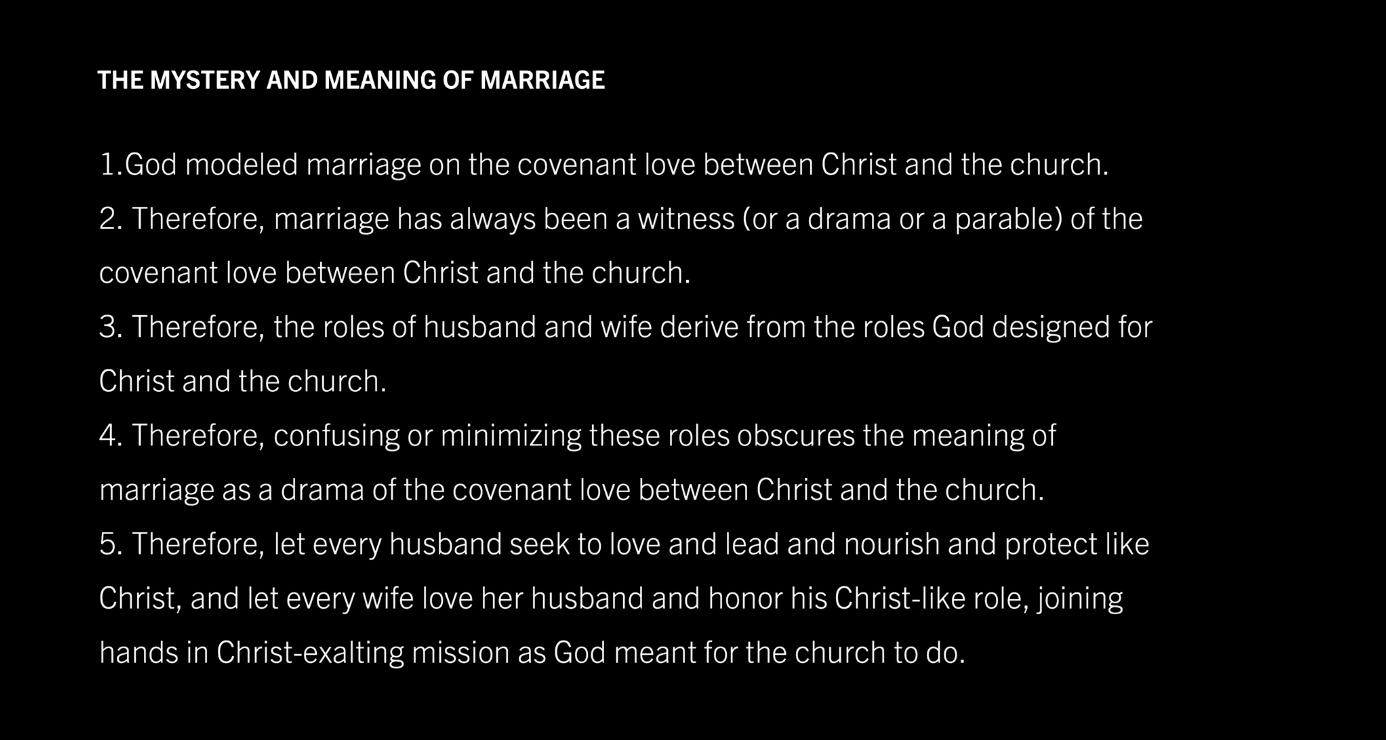
  1. God modeled marriage on the covenant love between Christ and the church.
  2. Therefore, marriage has always been a witness (or a drama or a parable) of covenant love between Christ and the church.
  3. Therefore, the roles of husband and wife derive from the roles God designed for Christ and the church.
  4. Therefore, confusing or minimizing these roles obscures the meaning of marriage as a drama of the covenant love between Christ and the church.
  5. Therefore, let every husband seek to love and lead and nourish and protect like Christ, and let every wife love her husband and honor his Christ-like role, joining hands in Christ-exalting mission as God meant for the church to do.

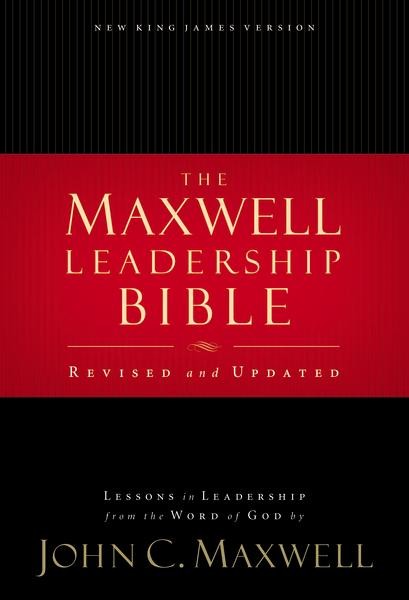
The Maxwell Leadership Bible (book review)

Hands-down the best book for any aspiring, developing, or seasoned leader is the Bible! John Maxwell is a mentor of leaders that I have come to greatly appreciate over the years of my leadership development. So having John Maxwell’s commentary accompany my daily Bible reading time has been a  huge blessing! You can find this complete leadership development package in The Maxwell Leadership Bible.

The Bible is filled with leadership principles given by God Himself. John Maxwell is helping me compile various principles throughout the entirety of the Bible into cohesive units of study.

The Bible also presents us with various people who followed or violated God’s leadership principles. We are able to see the struggles that come to those who either ignore God’s directives or don’t consistently follow through on them. And we’re able to see the legacy of success that follows those who make it a priority to consistently walk in God’s precepts. Once again, Maxwell is brilliant at identifying these leadership lessons.

Normally I post reviews after I have read an entire book, but given the fact that my Bible reading time is in-depth and time-consuming, I wanted to post a review now to encourage Christian leaders to take advantage of this wonderful resource. If you want to use the Bible to grow your leadership capacities, the commentaries and insights provided by John Maxwell will be a huge blessing to you.

P.S. I am reading The Maxwell Leadership Bible on the Kindle version. I find it very convenient to tap on the footnotes, character studies, and leadership lessons that John Maxwell has prepared, and then quickly tap back to the biblical passage right where I left off.

How Should Christians Handle Unfriendly Earthlings?

Christians are citizens of Heaven who are merely passing through Earth, so this isn’t a Christian’s final home. Because of this, it’s not unusual for Earthlings to mistreat, insult, and even persecute these “aliens and strangers.”

How are Christians supposed to respond to this?

First off, let’s make sure the persecution is for the right reason. Jesus said, “Blessed are you when people insult you, persecute you and falsely say all kinds of evil against you because of Me (Matthew 5:11).

Jesus also told us that this persecution has a blessing in it: we would be able to share our faith in Jesus Christ at the highest levels on Earth: On account of Me you will stand before governors and kings as witnesses to them” (Mark 13:9).

In 1 Peter 3:8, the apostle tells us how to live with everyone, Christian and Earthling alike:

  1. Harmoniously—keep The Main Thing the main thing; don’t get caught up in petty arguments
  2. Empathetically—put yourself in others’ shoes
  3. Kindly—treat everyone like a sibling that shares the same parents with you
  4. Compassionately—be strong enough to handle other people’s stuff
  5. Courteously—remember this: manners matter!

This list may be easy to live out when people are friendly to you, but what about when unfriendly Earthlings are downright mean to you? In the very next verse Peter gives us two Don’ts and one Do:

  1. Don’t repay evil with evil—Jesus is our example of this (see 1 Peter 2:21-23)
  2. Don’t insult the insulters—treat others as you want them to treat you (Luke 6:31)
  3. Do bless those who slander and persecute you—Jesus says we get absolutely no credit if we only treat kind people kindly (see Luke 6:32-33)

In Psalm 35 David is dealing with people who are fighting against him. They are saying mean things and trying to do even meaner things. This prayer shows both God’s part and our part

God’s part—defend me against the evildoers … remind me of Your salvation … pursue those who are falsely pursuing me … stay close to me.

My part—listen to God’s voice of assurance … live quietly … don’t give others cause to mistreat me … pray for those who persecute me … continually turn my thoughts and praise to God.

Peter wraps up this thought with these words—Who is going to harm you if you are eager to do good? But even it you should suffer for what is right, you are blessed (1 Peter 3:13-14).

Don’t give in to mistreatment and lash out in anger. Trust God to handle things. Keep on living a good life that is focused on bringing God all the glory due His name!

If you’ve missed any messages in this series, you may find the complete list by clicking here.

The Power That Comes After Delegation

I gave charge of Jerusalem to my brother Hanani, and Hananiah the leader of the citadel… (Nehemiah 7:2).

Good leaders delegate.

The project of rebuilding the walls around Jerusalem and hanging the doors had been completed, so it was time for Nehemiah to move to the next assignment God had for him.

To keep the momentum going which he had started, Nehemiah picked two trusted men:

  1. Hanani—his brother, who had previously visited Judah and brought back a faithful report about the condition of Jerusalem.
  2. Hananiah—a “man of integrity” and most importantly a man who “feared God more than most people do.”

These are good men that can carry on for Nehemiah. Nehemiah started the project, brought it to completion, and now new leaders are needed to keep the momentum going.

Notice that it is after completing the project and then delegating to new leaders that Nehemiah writes, “Then my God put it into my heart” to take on a new project (v. 5).

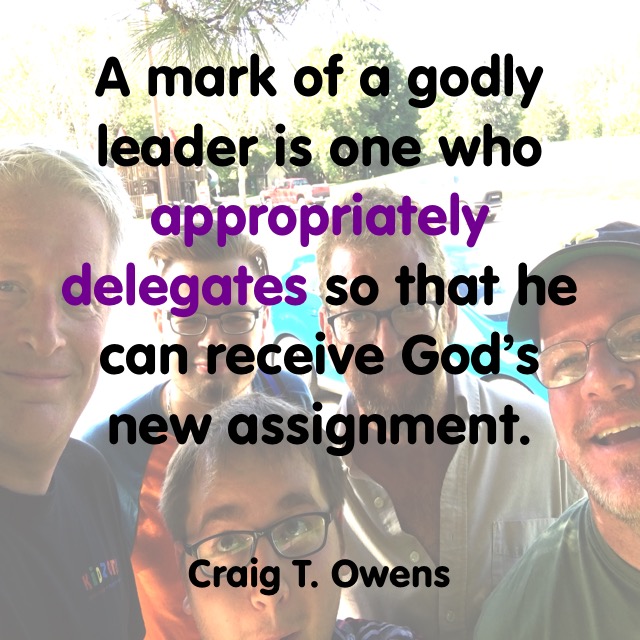
A mark of a godly leader is one who appropriately delegates so that he can receive God’s new assignment.

This is Part 9 in my series on godly leadership. To read my other posts, please click here.

What Is The Church Supposed To Be Doing?

Listen to the podcast of this post by clicking on the player below, and you can also subscribe on AppleSpotify, or Audible.

Before ascending back to Heaven, Jesus commissioned His followers. He gave them a mission that Christians often refer to as The Great Commission.

Jesus said, “All authority in heaven and on earth has been given to Me. Therefore go and make disciples of all nations, baptizing them in the name of the Father and of the Son and of the Holy Spirit, and teaching them to obey everything I have commanded you. And surely I am with you always to the very end of the age.”

There are several pictures in the New Testament of how the Church could live out this Great Commission, but one of the pictures that I find the most helpful is that of a Body.

The human body is an amazing creation! Just to accomplish the simple task of picking up something between our thumb and forefinger is a miracle in itself. The structure of bones and ligaments and tendons, the interaction of nerves in the fingers coordinating with the optical nerve, not to mention the enzymes and blood vessels that are all doing their part.

Yet if any part is not functioning properly, that simple action becomes more difficult. Maybe it even becomes impossible.

The Church is the same way. Every part of the Church Body has to be functioning in healthy order for the whole Body to be effective.

Here are four aspects of a healthy Church Body that the Apostle Paul lists in Ephesians 4:

  1. Caring for one another
  2. Mobilizing for evangelism
  3. Making disciple-makers
  4. Helping organize for more meaningful ministry

If every part of the Body is doing its part, we’re Living out the Great Commission.

If some parts are missing or unhealthy, we’re Wallowing in the Great Omission.

It’s not about your church (small “c”) or my church. It’s about all Christian disciples being a part of one Church—one Body—going into all the world and making disciples of all peoples. That’s what the Church is supposed to be doing!

►► Would you please prayerfully consider supporting this ministry? My Patreon supporters get behind-the-scenes access to exclusive materials. ◀︎◀︎

Are There Ghosts?

As a part of our annual Q Series, this was a question that was turned in: Are there ghosts?

Check out the video below…

The Scriptures I reference in this answer:

For other Q&As from this series, check out discussions about the Bible here, and questions about the mark of the beast here, and a question about a Christian losing his/her salvation here.

The Q Series—Parables, End Times, And Prayer

Our annual Q Series is where folks send their questions to me on a variety of subjects and we do our best to answer them. This week we tackled questions like:

  • What does Christ’s Parable of the Sower mean?
  • Can people lose their salvation?
  • Are micro-chips implanted in humans the start of “the mark of the beast”?
  • What does “666” stand for?
  • Why aren’t all of my prayers answered?

Here’s what we discussed, along with the time this discussion appears on the video:

  • The Parable of the Sower [1:27]
  • What is a parable? [2:19] **Be sure to check out What Was Jesus Teaching In The Parables? on Biblegateway
  • Who is the farmer in this parable? [4:30]
  • “The best commentary on Scripture is Scripture” [5:14]
  • Can someone lose their salvation? [7:42]
  • Keep sowing seed [11:51]
  • Eternal security? [13:50]
  • The Scripture has “a lot of faces” [17:20]
  • Are micro-chips “the mark of the beast”? [20:37]
  • What is gematria? How does this fit with 666? [22:58]
  • 666 falls short of God’s perfection [25:54]
  • The antichrist is a parody of Jesus Christ [26:08]
  • What is the significance of 666 on the right hand and forehead? [27:31]
  • To understand the future, look to an historic event [29:05]
  • A lesson from the socialism of the Nazis and Adolf Hitler [29:49]
  • A quote from Dr. Erwin Lutzer [31:15]
  • Why did Jesus talk about material possession so much? [32:48]
  • Why aren’t all my prayers answered? [36:36] **Be sure to check out Praying With Authority on Biblegateway.
  • How do we pray “in Jesus’ name”? [37:07]
  • How did Jesus speak to His Father in prayer? [39:10]
  • James on unanswered prayers [41:32]
  • Perseverance in prayer [43:30]

We will be answering your questions one more time next Sunday. Please click here to find all the ways you can submit your questions.

15 Quotes From “Run Today’s Race”

Oswald Chambers mastered the art of stimulating deep thinking and introspection with just a few short statements. Run Today’s Race is designed to be read each day for a full year. Trust me, the short seed thoughts you read each morning will keep you thinking all day long. Check out my full book review by clicking here.

“It is a great moment when we realize we have the power to trample on certain moods, a tremendous emancipation to get rid of every kind of self-consciousness and heed only one thing: the relationship between God and myself.”

“It is easy to turn our religious life into a cathedral for beautiful memories, but there are feet to be washed, hard flints to be walked over, people to be fed. Very few of us go there, but that is the way the Son of God went.”

“Prayer with most of us is turned into pious platitude, it is a matter of emotion, mystical communion with God. It is no use praying unless we are living as children of God. Then Jesus says—‘Every one that asketh receiveth.’”

“There is only one purpose for your life, and that is the satisfaction of the Lord Jesus Christ.”

“If there is the tiniest grudge in your mind against any one, from that second, your spiritual penetration into the knowledge of God stops.”

“We have judged our fellow men as sinners. If God should judge us like that we would be in hell. God judges us through the marvelous Atonement of Jesus Christ.”

“God delights to put me in a place where He can make me wealthy. ‘Follow Me, and thou shalt have treasure in heaven.’”

“The more complicated the actual conditions are, the more delightfully joyful it is to see God open up His way through.”

“When we try to reserve our strength it works out in weariness. Spend to the hilt all we have got and God’s recreating power is greater than all the expended power.”

“My personal life may be crowded with small, petty incidents altogether unnoticeable and mean [commonplace], but if I obey Jesus Christ in the haphazard circumstances, they become pinholes through which I see the face of God and when I stand and face to face with God I shall discover that through my obedience thousands were blessed.”

“Whenever the insistence is on the point that God answers prayer, we are off the track. The meaning of prayer is that we get hold of God, not of the answer.”

“One of the most amazing revelations of God comes when we learn that it is in the commonplace things that the Deity of Jesus Christ is realized.”

“As long as there is a human being who does not know Jesus Christ, I am his debtor until he does. The mainspring of [the Apostle] Paul’s service is not love for men but love for Jesus Christ.”

“As long as the devil can keep us terrified of thinking, he will always limit the work of God in our souls.”

“By prayer and Bible reading and meditation, the drab life (drab externally) has glorious holiday hours with God in which the soul is restored even in the valley of deep darkness.” 

More quotes coming soon, so stay tuned.

Godly Leaders Can Inspire Everyone To Pursue One Vision

And I told them of the hand of my God which had been good upon me, and also all of the king’s words that he had spoken to me. So they said, “Let us rise up and build.” Then they set their hands to this good work. (Nehemiah 2:18)

The mark of a godly leader is one who can inspire all sorts of people to pursue the same vision.

Nehemiah did such a good job casting the vision God had given him that people from all professions and persuasions immediately joined in. Although the vision was to rebuild the walls around Jerusalem, most of those who joined Nehemiah in pursuing this vision were anything but builders. They were…

  • Priests
  • Fathers and their sons
  • Fathers and their daughters
  • Natural-born Israelites
  • God-fearing foreigners
  • Goldsmiths
  • Perfume makers
  • Leaders
  • Laypeople
  • Those living within the city
  • Those who lived outside the city
  • Merchants

With one voice they cried out, “Let’s rise up and build!” and they got down to business.

All these different people buying-in to one godly leader’s vision!

This is Part 5 in my series on godly leadership. To read my other posts, please click here.

One-And-Done? Ongoing? Later?

If I were to ask five different Christians to give me a definition of sanctification, I just might get five different definitions!

Part of this comes from incorrect either-or thinking. However, Jesus seems to tell us that sanctification requires a both-and thinking.

In Christ’s prayer for His followers in John 17, He uses the word sanctified three times (see verses 17-19). Although He is using the same Greek word each time, He uses a different “flavor” of the word to make it really clear what He means.

First of all, the Greek word for sanctified means the process of being made into a saint. So sometimes I like to say the word this way: SAINT-ified.

Check out Christ’s prayer. First He says, “I sanctify Myself,” and then He says, “that they too may be truly sanctified.” Same Greek word, but each time is slightly tweaked.

Jesus uses a “flavor” of Greek which means sanctification is something that He has done completely and totally on His own once and for all. In other words, Christians are completely and totally sanctified at the very moment they surrender their life to Him.

But when He talks about His followers, the “flavor” of Greek means sanctification is something that is an ongoing process. In other words, we are being SAINT-ified.

So which is it? Sanctified once, or sanctified through an ongoing process?

It’s not either-or. It’s both-and!

Think about a married couple. From the moment the pastor says, “I now pronounce you husband and wife” they are married. It is done; fully completed. There is nothing the bride or groom can do to become more married.

However, the groom can begin to look at the marriage through his bride’s eyes. Then he can serve her in a way that helps her feel more joy, more satisfaction, and more fulfillment within the marriage. Neither of them becomes more married, but they can get more enjoyment within the marriage.

The same thing for Christians. At the moment we ask Jesus to be our Lord and Savior we are saved from the penalty of our sins. We can’t be more saved. But through the process of SANIT-ificiation we can experience more joy, more satisfaction, and more fulfillment within our relationship with Jesus.

My paraphrase of 1 Peter 1:15-16—But just as He who called you has paid for your once-for-all saint-ification, so keep on being saint-ified in all you do; for it is written: “Be holy, because I am holy.”

What about you? Are you satisfied with just being saved, or are you striving for a joy-filled, more fulfilling, increasingly satisfied relationship with Jesus Christ? It can truly be a wonderful both-and relationship!