The Q Series—Parables, End Times, And Prayer

Our annual Q Series is where folks send their questions to me on a variety of subjects and we do our best to answer them. This week we tackled questions like:

  • What does Christ’s Parable of the Sower mean?
  • Can people lose their salvation?
  • Are micro-chips implanted in humans the start of “the mark of the beast”?
  • What does “666” stand for?
  • Why aren’t all of my prayers answered?

Here’s what we discussed, along with the time this discussion appears on the video:

  • The Parable of the Sower [1:27]
  • What is a parable? [2:19] **Be sure to check out What Was Jesus Teaching In The Parables? on Biblegateway
  • Who is the farmer in this parable? [4:30]
  • “The best commentary on Scripture is Scripture” [5:14]
  • Can someone lose their salvation? [7:42]
  • Keep sowing seed [11:51]
  • Eternal security? [13:50]
  • The Scripture has “a lot of faces” [17:20]
  • Are micro-chips “the mark of the beast”? [20:37]
  • What is gematria? How does this fit with 666? [22:58]
  • 666 falls short of God’s perfection [25:54]
  • The antichrist is a parody of Jesus Christ [26:08]
  • What is the significance of 666 on the right hand and forehead? [27:31]
  • To understand the future, look to an historic event [29:05]
  • A lesson from the socialism of the Nazis and Adolf Hitler [29:49]
  • A quote from Dr. Erwin Lutzer [31:15]
  • Why did Jesus talk about material possession so much? [32:48]
  • Why aren’t all my prayers answered? [36:36] **Be sure to check out Praying With Authority on Biblegateway.
  • How do we pray “in Jesus’ name”? [37:07]
  • How did Jesus speak to His Father in prayer? [39:10]
  • James on unanswered prayers [41:32]
  • Perseverance in prayer [43:30]

We will be answering your questions one more time next Sunday. Please click here to find all the ways you can submit your questions.

15 Quotes From “Run Today’s Race”

Oswald Chambers mastered the art of stimulating deep thinking and introspection with just a few short statements. Run Today’s Race is designed to be read each day for a full year. Trust me, the short seed thoughts you read each morning will keep you thinking all day long. Check out my full book review by clicking here.

“It is a great moment when we realize we have the power to trample on certain moods, a tremendous emancipation to get rid of every kind of self-consciousness and heed only one thing: the relationship between God and myself.”

“It is easy to turn our religious life into a cathedral for beautiful memories, but there are feet to be washed, hard flints to be walked over, people to be fed. Very few of us go there, but that is the way the Son of God went.”

“Prayer with most of us is turned into pious platitude, it is a matter of emotion, mystical communion with God. It is no use praying unless we are living as children of God. Then Jesus says—‘Every one that asketh receiveth.’”

“There is only one purpose for your life, and that is the satisfaction of the Lord Jesus Christ.”

“If there is the tiniest grudge in your mind against any one, from that second, your spiritual penetration into the knowledge of God stops.”

“We have judged our fellow men as sinners. If God should judge us like that we would be in hell. God judges us through the marvelous Atonement of Jesus Christ.”

“God delights to put me in a place where He can make me wealthy. ‘Follow Me, and thou shalt have treasure in heaven.’”

“The more complicated the actual conditions are, the more delightfully joyful it is to see God open up His way through.”

“When we try to reserve our strength it works out in weariness. Spend to the hilt all we have got and God’s recreating power is greater than all the expended power.”

“My personal life may be crowded with small, petty incidents altogether unnoticeable and mean [commonplace], but if I obey Jesus Christ in the haphazard circumstances, they become pinholes through which I see the face of God and when I stand and face to face with God I shall discover that through my obedience thousands were blessed.”

“Whenever the insistence is on the point that God answers prayer, we are off the track. The meaning of prayer is that we get hold of God, not of the answer.”

“One of the most amazing revelations of God comes when we learn that it is in the commonplace things that the Deity of Jesus Christ is realized.”

“As long as there is a human being who does not know Jesus Christ, I am his debtor until he does. The mainspring of [the Apostle] Paul’s service is not love for men but love for Jesus Christ.”

“As long as the devil can keep us terrified of thinking, he will always limit the work of God in our souls.”

“By prayer and Bible reading and meditation, the drab life (drab externally) has glorious holiday hours with God in which the soul is restored even in the valley of deep darkness.” 

More quotes coming soon, so stay tuned.

Godly Leaders Can Inspire Everyone To Pursue One Vision

And I told them of the hand of my God which had been good upon me, and also all of the king’s words that he had spoken to me. So they said, “Let us rise up and build.” Then they set their hands to this good work. (Nehemiah 2:18)

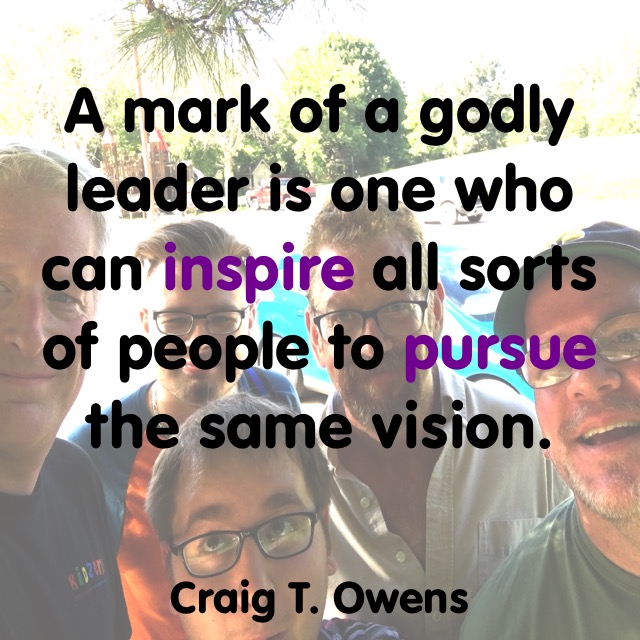
The mark of a godly leader is one who can inspire all sorts of people to pursue the same vision.

Nehemiah did such a good job casting the vision God had given him that people from all professions and persuasions immediately joined in. Although the vision was to rebuild the walls around Jerusalem, most of those who joined Nehemiah in pursuing this vision were anything but builders. They were…

  • Priests
  • Fathers and their sons
  • Fathers and their daughters
  • Natural-born Israelites
  • God-fearing foreigners
  • Goldsmiths
  • Perfume makers
  • Leaders
  • Laypeople
  • Those living within the city
  • Those who lived outside the city
  • Merchants

With one voice they cried out, “Let’s rise up and build!” and they got down to business.

All these different people buying-in to one godly leader’s vision!

This is Part 5 in my series on godly leadership. To read my other posts, please click here.

One-And-Done? Ongoing? Later?

If I were to ask five different Christians to give me a definition of sanctification, I just might get five different definitions!

Part of this comes from incorrect either-or thinking. However, Jesus seems to tell us that sanctification requires a both-and thinking.

In Christ’s prayer for His followers in John 17, He uses the word sanctified three times (see verses 17-19). Although He is using the same Greek word each time, He uses a different “flavor” of the word to make it really clear what He means.

First of all, the Greek word for sanctified means the process of being made into a saint. So sometimes I like to say the word this way: SAINT-ified.

Check out Christ’s prayer. First He says, “I sanctify Myself,” and then He says, “that they too may be truly sanctified.” Same Greek word, but each time is slightly tweaked.

Jesus uses a “flavor” of Greek which means sanctification is something that He has done completely and totally on His own once and for all. In other words, Christians are completely and totally sanctified at the very moment they surrender their life to Him.

But when He talks about His followers, the “flavor” of Greek means sanctification is something that is an ongoing process. In other words, we are being SAINT-ified.

So which is it? Sanctified once, or sanctified through an ongoing process?

It’s not either-or. It’s both-and!

Think about a married couple. From the moment the pastor says, “I now pronounce you husband and wife” they are married. It is done; fully completed. There is nothing the bride or groom can do to become more married.

However, the groom can begin to look at the marriage through his bride’s eyes. Then he can serve her in a way that helps her feel more joy, more satisfaction, and more fulfillment within the marriage. Neither of them becomes more married, but they can get more enjoyment within the marriage.

The same thing for Christians. At the moment we ask Jesus to be our Lord and Savior we are saved from the penalty of our sins. We can’t be more saved. But through the process of SANIT-ificiation we can experience more joy, more satisfaction, and more fulfillment within our relationship with Jesus.

My paraphrase of 1 Peter 1:15-16—But just as He who called you has paid for your once-for-all saint-ification, so keep on being saint-ified in all you do; for it is written: “Be holy, because I am holy.”

What about you? Are you satisfied with just being saved, or are you striving for a joy-filled, more fulfilling, increasingly satisfied relationship with Jesus Christ? It can truly be a wonderful both-and relationship!

10 Great Reasons To Go To Church Regularly

Without exception, all human beings have exactly 168 hours in a week. No one gets any bonus time and no one has any hours taken away. We’re supposed to get 8 hours of sleep a night, and most of us work about 40 hours each week. So let’s do the math…

168 hours per week
– 56 hours for sleeping
– 40 hours for work
=72 discretionary hours

In those 72 hours there must be time for eating and taking care of chores. But what about going to church? The problem for many people is looking at church attendance as just another “chore” or item on their “To Do” list.

But instead of thinking of going to church as “I have to,” how about if you looked at all of the “I get to” benefits?

Here are 10 great reasons for going to church regularly. I get to…

  1. …draw closer to my Heavenly Father, just like Jesus did (Luke 2:49)
  2. …be an example to others (1 Timothy 4:12)
  3. …hang out with some really great people (Hebrews 10:24)
  4. …get to know Jesus and my brothers and sisters better (1 John 1:3)
  5. …reaffirm the priority that God is first in my life (Matthew 6:33)
  6. …learn to better understand Scripture (2 Timothy 2:15)
  7. …join with a choir of God worshipers (John 4:23-24)
  8. …grow spiritually (1 Peter 2:2-5)
  9. …complete the Body of Chris (1 Corinthians 12:12)
  10. …avoid becoming isolated and possibly lost (Proverbs 18:1)

“Sometimes we make it sound like we’re making a sacrifice to go to church, but think about the very real sacrifice Jesus made so that we could meet together as brothers and sisters!” —Scott Troost

How about it? Do you think you could invest an hour or two of your 72 discretionary hours in a local church this week?

My thanks to my brother, Scott Troost, for sharing such a timely message!

8 Quotes From “Paths To Power” by A.W. Tozer

As I said in my book review, A.W. Tozer’s words frequently make me say both “Ouch!” and “Amen!” Maybe you’ll feel the same thing in these few quotes.

“Left to herself the Church must have perished as a thousand abortive sects had done before her, and have left nothing for a future generation to remember. That the Church did not so perish was due entirely to the miraculous element within her. That element was supplied by the Holy Spirit who came at Pentecost to empower her for her task. For the Church was not an organization merely, not a movement, but a walking incarnation of spiritual energy. …

“In short, the Church began in power, moved in power, and moved just as long as she had power. When she no longer had power she dug in for safety and sought to conserve her gains. But her blessings were like manna: when they tried to keep it overnight it bred worms and stank. So we have had monasticism, scholasticism, institutionalism; and they have all been indicative of the same thing: absence of spiritual power.” 

“The weakness in our message today is our overemphasis on faith with a corresponding underemphasis on obedience. This has been carried so far that ‘believe’ has been made to double for ‘obey’ in the minds of millions of religious persons.”

“In every denomination, missionary society, local church, or individual Christian this law operates. God works as long as His people live daringly; He ceases when they no longer need His aid.” 

“To any casual observer of the religious scene today, two things will at once be evident: one, that there is very little sense of sin among the unsaved, and two, that the average professed Christian lives a life so worldly and careless that it is difficult to distinguish him from the unconverted man.”

“It is always dangerous to isolate a truth and then press it to its limit without regard to other truth.”

“It may be stated as an axiom of the Christian system that whatever makes sin permissible is a foe of God and an enemy of the souls of men.”

“Some time after Pentecost a group of believers met to pray for strength and power to meet the emergency then facing them, and to enlist the help of God on their behalf. ‘And when they had prayed, the place was shaken where they were assembled together; and they were all filled with the Holy Ghost, and they spake the Word of God with boldness’ (Acts 4:31). Some of these were of the original number filled at Pentecost. It is hardly conceivable that God acted contrary to His own will in filling them again after Pentecost. Still other outpourings are recorded in Acts 8, 10 and 19. All these occurred some years after the original act.

“In brief, the teaching of the New Testament is that the outpouring at Pentecost was the historic beginning of an era which was to be characterized by a continuous outpouring of the Holy Spirit.”

“This anti-emotionalism, though it is sponsored by some good people and travels in pretty orthodox company, is nevertheless an unwarranted inference, not a scriptural doctrine, and is in violent opposition to psychology and common sense. Where in the Bible are feeling and faith said to be at odds? The fact is that faith engenders feeling as certainly as life engenders motion. We can have feeling without faith, it is true, we can never have faith without feeling. Faith as a cold, unemotional light is wholly unknown in the Scriptures.”

Paths To Power (book review)

As I read A.W. Tozer’s words I find myself saying two things: (1) “Ouch!” and (2) “Amen!” Tozer’s Paths To Power is a continuation in those responses as he outlines what robs the Church and individual Christians of the power God wants them to have.

Right at the outset, Tozer identifies a key element robbing the Church of power: a lack of obedience in the things God has commanded us. “A knowledge of the truth is not enough,” he writes. “The truth must be followed if we would realize in actual experience the blessedness which is here described.”

Another power-blocker is an unwillingness to let God confront us and help us change. We get stuck in a this-is-how-it’s-always-been rut and then shut our eyes to the times of refreshing God wants to send to us. Other blockers include poor doctrine, putting the Holy Spirit in a box, justifying our sin, and not unleashing our faith, to name just a few.

Thankfully, Tozer also points us to the straightforward cures for all of the blockages to power. If we are willing to open our eyes, ears, and hearts to God’s voice, His unlimited blessings could flow uninterrupted into our lives and churches.

Paths To Power contains only seven short chapters, but the digestion, contemplation, and implementation of Tozer’s cures will be something that will involve a lifetime commitment for those ready for God’s fresh power to be poured into their lives.

I am a Moody Publishers book reviewer.

Godly Leaders Raise Up Godly Leaders

“…as the hand of the Lord my God was upon me…I gathered leading men of Israel to go up with me” (Ezra 7:28).

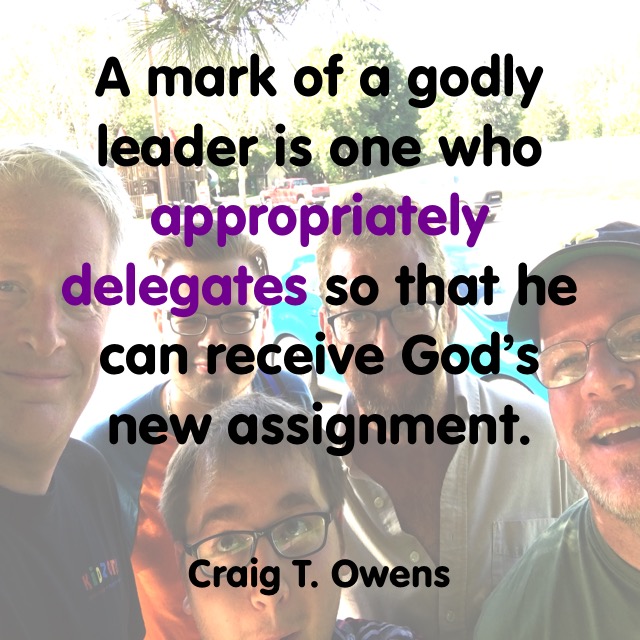
A mark of a godly leader is one who raises up other godly leaders. He doesn’t want to walk alone; he doesn’t want to keep God’s blessings to himself. He knows that there can never be too many God-fearing leaders.

How did Ezra raise up more godly leaders?

  1. Ezra made sure his team had everyone it needed to be successful. When he discovered his team had no Levites to oversee functions in the temple, he made an appeal for a Levite to join his team. “Then, by the good hand of our God upon us” God sent Ezra nearly 250 Levites (Ezra 8:18-20)!
  2. Ezra made sure his team would be adequately cared for. He prayed and fasted as he asked for God’s direction and protection for his team (vv. 21-23).
  3. Ezra trusted his teammates. He entrusted them with precious, irreplaceable treasures (vv. 24-34).

What Ezra did became contagious. The leading men that came to follow Ezra all brought other potential leaders with them as well.

Godly leaders are never content arriving at their destination alone—they want as many other godly leaders alongside them as possible.

My prayer—God, place Your good hand on me to empower me to raise up godly leaders.

This is the first part of my series on godly leadership. To check out all of the posts, please click here.

Where Preachers Are Powerless

To my dear pastor friends, please ponder carefully these wise words from Oswald Chambers:

“As preachers and teachers we are powerless to make saints. Our duty is to put the seed into the right place and leave the rest to God. …

“Modern evangelism makes the mistake of thinking that a worker must plough his field, sow the seed, and reap the harvest in half-an-hour. Our Lord was never in a hurry with the disciples, He kept on sowing the seed and paid no attention to whether they understood Him or not. He spoke the truth of God, and by His own life produced the right atmosphere for it to grow, and then left it alone, because He knew well that the seed had in it all the germinating power of God and would bring forth fruit after its kind once it was put in the right soil. …

“Sow the Word of God, and as sure as God is God, it will bring forth fruit. …

“Sow emotions, and the human heart will not get beyond you. There are men and women at work for God who steal hearts from God, not intentionally, but because they do not preach the Word of God. They say, ‘I don’t want anyone to think about me’; that should never need to be said. If the thought of ourselves is lurking anywhere as we preach, we are traitors to Jesus Christ. Our duty is to get people through to God. … See that you sow the real seed of the Word of God, and then leave it alone.” —Oswald Chambers, in The Servant As His Lord

These words prompt me to take a close look into God’s mirror to see if I’m preaching in a way that God can bless. How about you?

The Servant As His Lord (book review)

One of the most straight-talking, tell-it-like-it-is Christian speaker and author is Oswald Chambers. No one could ever accuse him of sugar-coating the Christian walk! In The Servant As His Lord, Chambers takes an unflinching look at the difficulty a Christian will have in living as his Lord, Jesus Christ, did.

As is the case with nearly all of Oswald Chambers’ books, The Servant As His Lord is a compilation of three sources: lectures, sermons, and essays for some small pamphlets. Biddy Chambers, his wife, often recorded Oswald’s sermons via shorthand and then put them into a book form at a later date.

The material in this book was all recorded during the height of The Great War (or what we now refer to as World War I). Many Christians were quite shaken in their faith during this time, questioning why God’s followers should have to go through such horrific things. Oswald Chambers, as he always did, never dodged the question nor made excuses, but simply stated: Jesus suffered pain, ridicule, and injustice while on earth, and His followers will too. The servant will be as his Lord.

Even though this book addresses some heavy topics, it’s not at all a “downer” for the reader. Quite the contrary! This book is actually very encouraging for the Christian going through any kind of difficulty or trial, knowing that Jesus not only went through the same thing, but that He is walking with us through our own trials.

This is definitely one of Chambers’ meatier books, but it is well worth the mature Christian’s time to study these wise and encouraging words.