T.M. Moore wrote, “The apostle Paul promised that, whenever we are faced with temptation, God will provide a way of escape, so that we can bear up and grow through temptation into greater maturity in the Lord (1 Corinthians 10:13). We are practicing self-control when we search for that way of escape and direct our steps toward it: ‘I thought about my ways, and turned my feet to Your testimonies. I made haste, I did not delay to keep Your commandments’ (Psalm 119:59, 60).” Read more about the necessity of self-control in this post.
“Character doesn’t make you a leader; it protects you as a leader.” —John Maxwell
“Hard words are an evidence of the weakness of the cause which they are used to support. Hard arguments softly put, are the really effective weapons, but it takes some of us a long time to learn this; and generally, in our younger days, we wear away our own strength by the violence with which we use it.” —Charles Spurgeon
One of the leaders in my school shared this: “Numerous researchers have studied the use of wait time by teachers. Pausing for just 3-5 seconds after a question has been shown to produce higher-level thinking and answering. This is true both of classroom questioning and individual conversation. Slow down during conversation today and see what happens!” Previously, I shared an important lesson I learned about slowing down.
Listen to the podcast of this post by clicking on the player below, and you can also subscribe on Apple, Spotify, or Audible. Check out the video content in this post by clicking here.
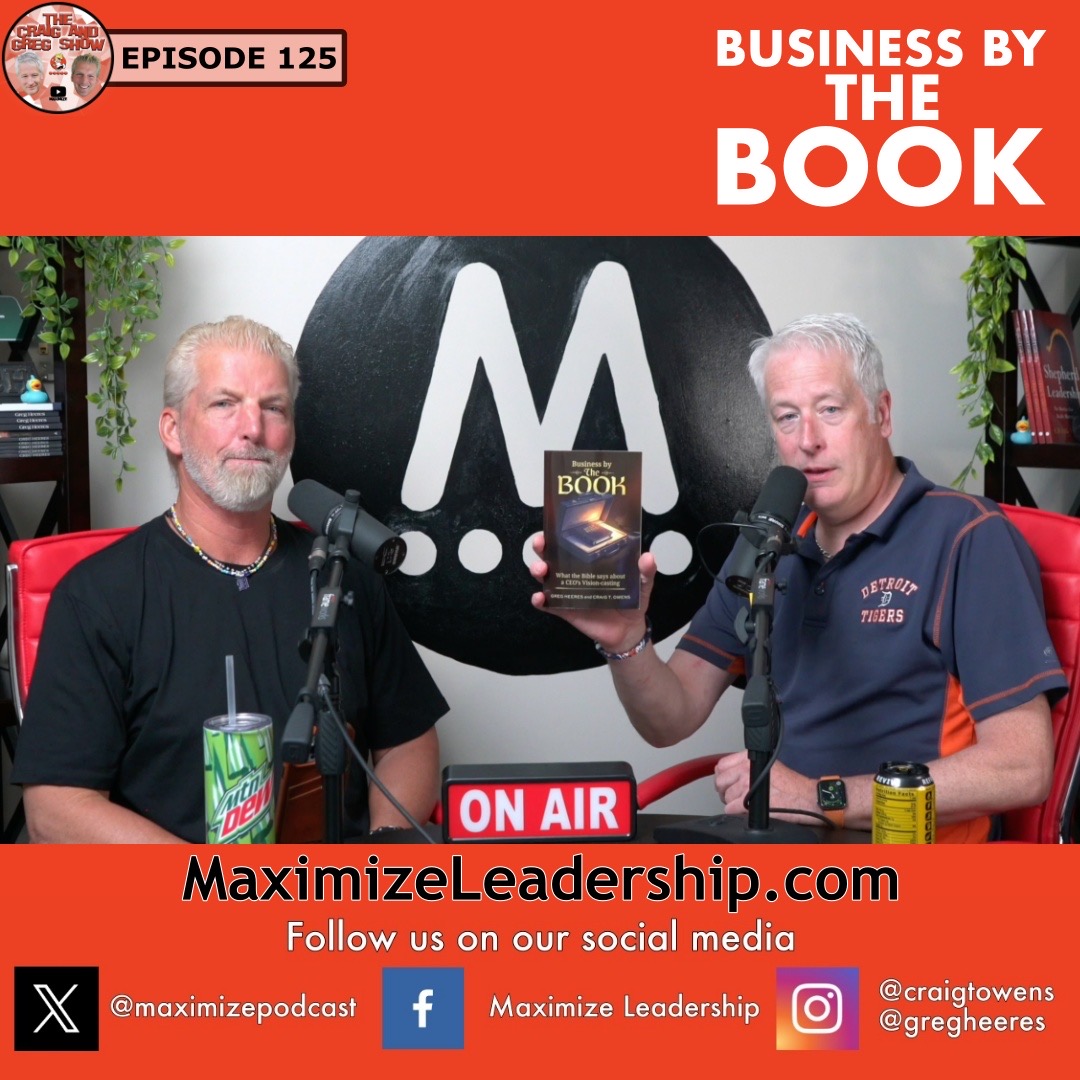
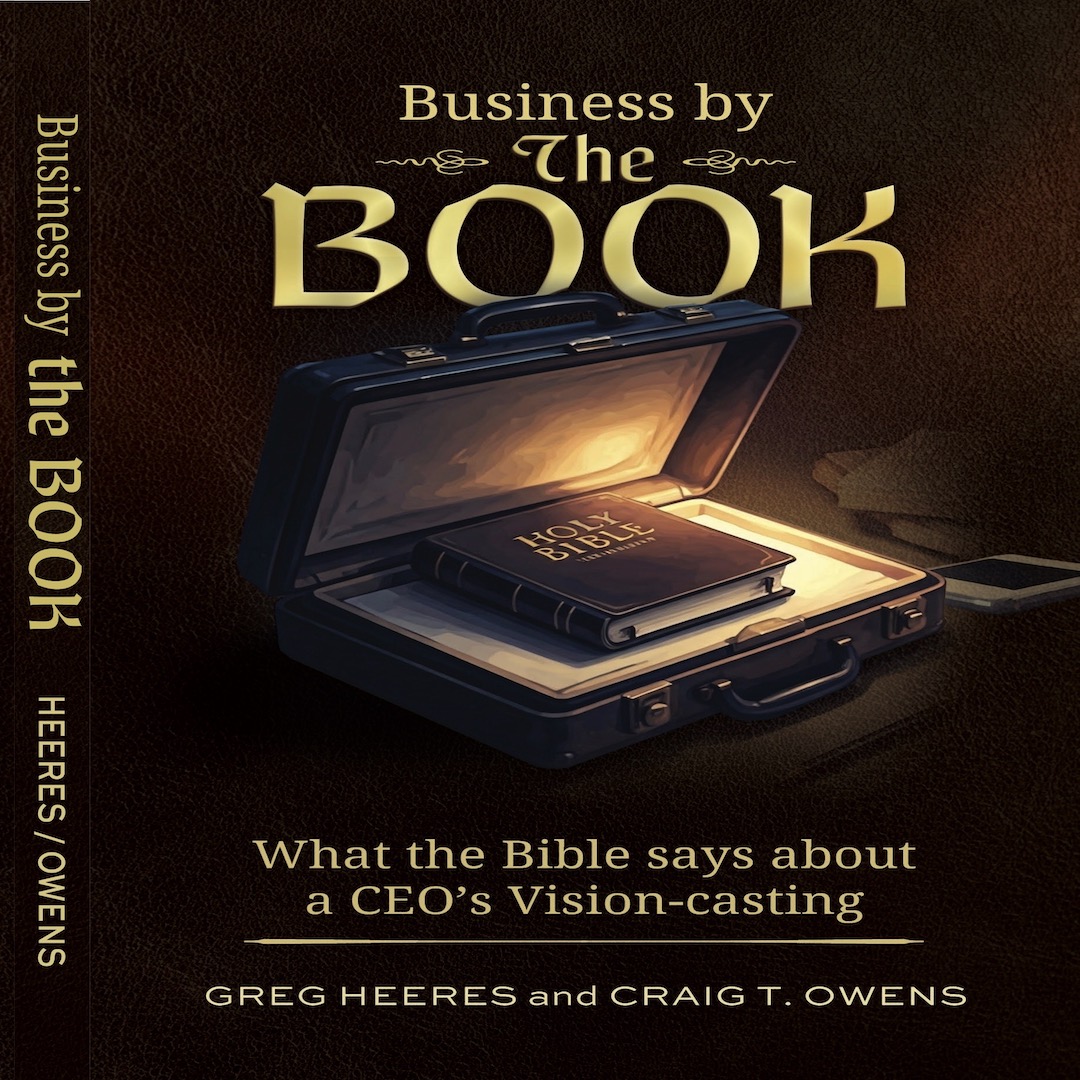
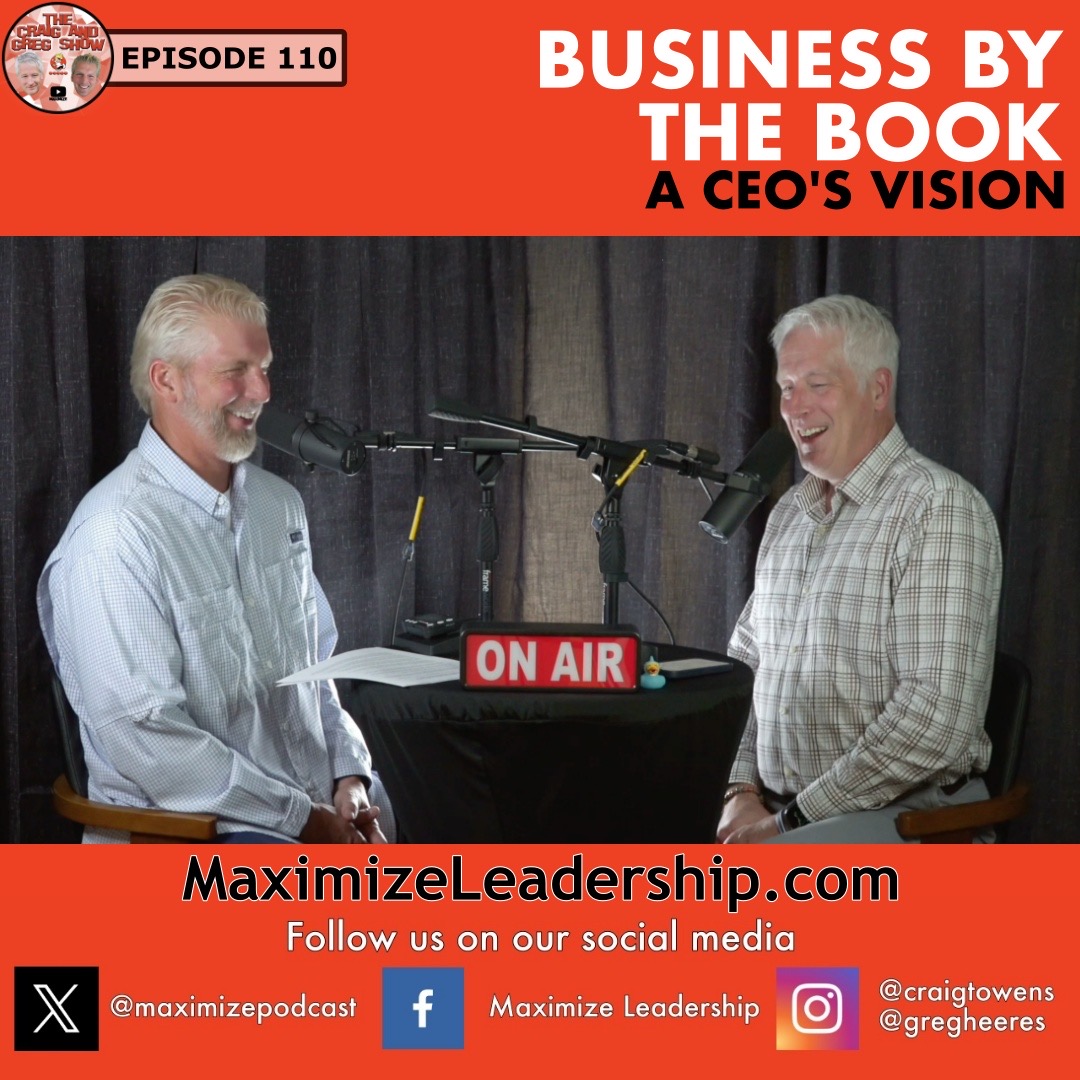
It seems like many people put business and faith in two separate boxes, considering them entirely different topics of discussion. Greg and I completely disagree—the Bible is a resource for all areas of our lives, from the board room to the living room. That’s why we wrote our Business By The Book series. This is a guide to help you apply biblical principles to the corporate world. In today’s episode we preview the first book in this series: Business by the Book: What the Bible says about a CEO’s vision-casting.
[0:00] Introduction
[2:10] What does it mean for the leader to cast vision for his or her organization?
[3:07] Here’s what you can expect from Business by the Book—What the Bible says about a CEO’s vision-casting
[4:13] After a leader has cast a vision, that leader then needs to empower his or her entire team to help them achieve the vision.
[6:46] Leaders must be self-aware of their strengths and weaknesses, and help their teammates learn about themselves as well.
[9:06] Organization chart maneuvering can help empower teammates to accomplish great things. And I also share a teaser about a new project on which Greg is working.
[10:26] Greg talks about two vastly different roles: Commander and Includer.
[12:27] I share an excerpt from a chapter that Greg wrote in this book, and then Greg elaborates on how this helps a team pursue the vision.
[16:37] Leaders can move from doing to facilitating, which will help others set up into new roles.
[18:21] Some counsel for leaders who are first time vision-casters.
[19:26] Greg shares a tip for facilitating meetings to get more people involved.
[21:44] “Leaders become great not because of their power, but because of their ability to empower others.”
[24:18] HERE’S HOW TO WIN A FREE COPY OF OUR NEW BOOK!
Listen to the podcast of this post by clicking on the player below, and you can also subscribe on Apple, Spotify, or Audible.
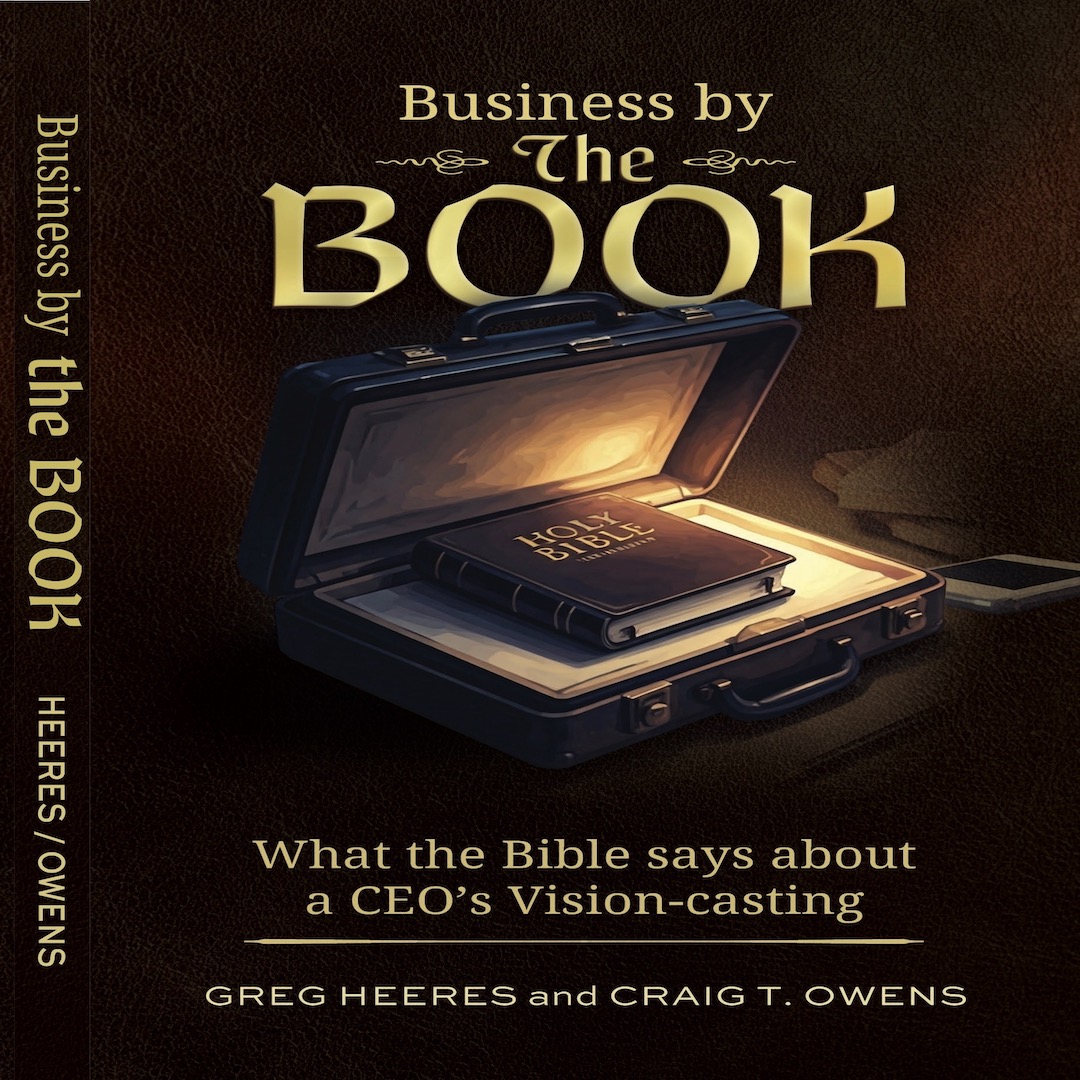
My podcast cohost, Greg Heeres, and I just finished our first co-authored book in our seriesBusiness by the Book. This book is both biblical wisdom and practical insight into how a CEO casts vision for themselves and the organization they lead.
We write about the God-honoring way to cast vision, but there is another way—the human way. In their book Spiritual Leadership, Henry and Richard Blackaby describe it like this:
“The Gospel of Luke provides a graphic contrast between peoples’ agendas and God’s [Luke 9:28-36]. Jesus took Peter, James, and John with Him up a mountain to experience a divine encounter. God the Father was unfolding His specific will for His Son. The Father brought Moses and Elijah to encourage Jesus for the enormous work of redemption He was about to accomplish. So sacred was that moment that Jesus radiated the glory of His divinity. Peter and his companions, however, had been sleeping. When they awoke and saw the magnificent scene unfolding, Peter spoke up: ‘Master, it’s good for us to be here! Let us make three tabernacles: one for You, one for Moses, and one for Elijah’ (v. 33). Peter’s first thought was to build something tangible to institutionalize the divine encounter. Peter, a natural leader, could already envision the ongoing ministry he and his friends would administer as a result of that encounter. However, the instant Peter began talking, the vision was removed, and only Jesus remained visible. Clearly Peter’s plan was not God’s agenda. The heavenly Father immediately rebuked Peter, saying, ‘This is My Son, the Chosen One; listen to Him!’ (v. 35). Peter, because he was human, instinctively thought in temporal terms. He envisioned something he could control and manage. He wanted to move Jesus, Moses, Elijah, James, and John on to his agenda instead of seeking to understand God’s will and adjusting his own life accordingly. Peter’s ignorance of spiritual ways is all too prevalent among today’s spiritual leaders. Too often people assume that along with their role of leader comes the responsibility of determining what should be done. They develop aggressive goals. They imagine grandiose dreams. They cast grand visions. Then they pray and ask God to join them in their agenda and bless their efforts. That’s not the spiritual leader’s role. Spiritual leaders seek God’s will, whether it is for their church, family, or corporation, and then they mobilize their people to pursue God’s plan. …
“We must emphasize that planning or goal setting is not wrong. Organizations must have direction and order. The key is the source of those plans. Spiritual leaders seek God’s guidance in discerning God’s purposes for their organization. Then they mobilize their organizations to effectively accomplish what God assigns.”
One final thought from the Blackabys: “God has the vision of what He wants to do. God does not ask leaders to dream big dreams for Him or to solve the problems confronting them with their own best thinking. He asks leaders to walk with Him so intimately that when He reveals His agenda they immediately adjust their lives and their organizations to His will and the results bring glory to God.”
Listen to the podcast of this post by clicking on the player below, and you can also subscribe on Apple, Spotify, or Audible.
Greg Heeres is my lifelong friend and co-host of The Craig and Greg Show leadership podcast. We have just released the first book in our series called Business by the Book. These books will help business leaders see how relevant the Bible is for the day-to-day wisdom they need to make impactful decisions for their organizations.
I write chapters one, three, and five with a biblical example of the book’s focal point, and then Greg writes a business application of those examples in chapters two, four, and six.
Our first book is about the CEO’s vital role of vision-casting.
We wanted to give you a taste of what these books are all about, so here is the first chapter in this book entitled “Eyes on the Prize”—
Where there is no vision, the people are unrestrained. (Proverbs 29:18)
It All Starts with You
It all starts with you as the leader of your organization. If you have a clear vision in mind for both your personal life as well as for your organization, your people will join you on this journey, no matter how long or difficult it may seem.
On the other hand, the number one cause of both personal and corporate failure is drifting away from the vision that brought success.
God gives vision. He doesn’t give a vision to a leader so that a leader can have a better life, but so that leader can help people get to a better place. Vision is always through the leader to the people. Solomon said, “Where there is no vision, the people are unrestrained” (Proverbs 29:18).
Another translation of this verse carries even more weight, “Where there is no vision, the people perish.”
Eye Discipline
In almost every sport that involves a ball, the tried-and-true maxim is, “The ball goes where your eyes go.”
Greg and I first met on a basketball court. There were a group of guys that got together to play basketball every day at lunchtime. Because Greg and I were about the same height, we were almost always placed on opposite teams and I had the unenviable assignment of guarding this exceptional athlete.
One of the things I noticed right away about Greg’s game was how good he was “in traffic.” He could exploit a small gap between defenders and dribble the ball through that opening to give himself a good look at the hoop. That good look usually meant success in scoring.
I did my best to match Greg shot for shot, but I usually came out on the losing side of these match-ups. There is something about competition that causes me to focus on my task—both in business and on the basketball court. So as I guarded Greg, I studied what made him so successful. Eventually I spotted one of the main differences between us: It was his eyes.
As Greg drove through traffic, he kept his eyes on the basketball rim, so when he was ready to shoot, the ball went where his eyes already were. I noticed about myself that when I tried to navigate through all the bodies on the court, my eyes went down to the basketball, and only when I thought I was in the clear did I move my eyes to the rim.
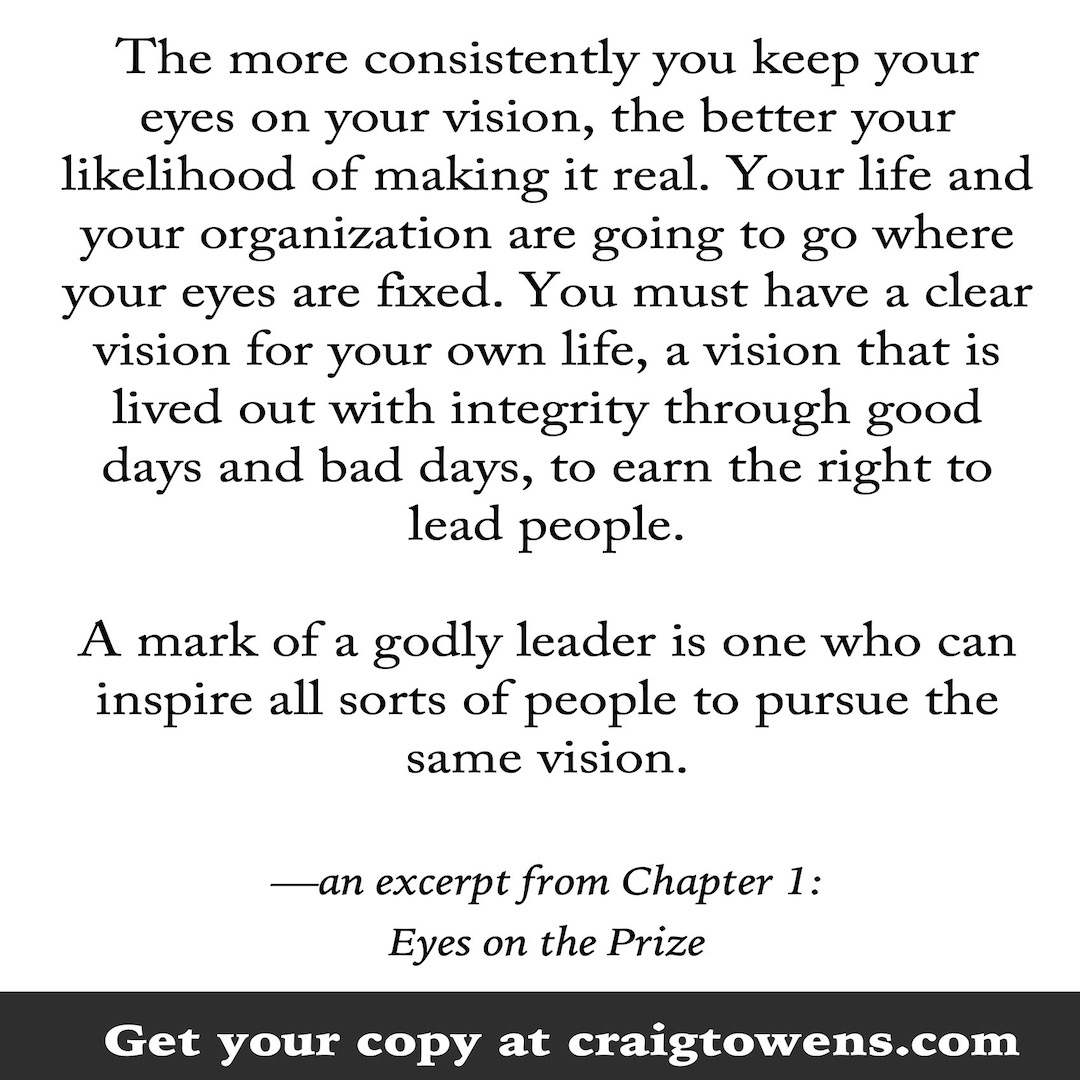
The more consistently you keep your eyes on your vision, the better your likelihood of making it real. Your life and your organization are going to go where your eyes are fixed. You must have a clear vision for your own life, a vision that is lived out with integrity through good days and bad days, to earn the right to lead people.
Nehemiah the Vision-caster
The nation of Israel was being allowed to return to their homeland after 70 years in exile. The capital city Jerusalem was in a shambles—the walls had been knocked down, the gates were burned, and their temple of worship had been demolished.
When Nehemiah arrived in Jerusalem, he made a careful inspection of the situation. He undertook his first assessment by himself at night; he didn’t share his findings with the people right away.
Nehemiah was a man of personal integrity. Throughout the historical account of his leadership, we see him handling his position of authority, the funds entrusted to him for the rebuilding project, his own personal finances, and even the “competitors” that wanted the Israelites to fail, with godly wisdom and impeccable character.
With his personal life in order, Nehemiah then approached the people of Israel. In his journal, recorded for us in the Book of Nehemiah in the Bible, he wrote—
Then I said to them, “You see the trouble we are in: Jerusalem lies in ruins, and its gates have been burned with fire. Come, let us rebuild the wall of Jerusalem, and we will no longer be in disgrace.” I also told them about the gracious hand of my God on me and what the king had said to me. (Nehemiah 2:17-18)
Because Nehemiah went first, the people readily accepted his vision of a rebuilt city: “So they said, ‘Let us rise up and build.’ Then they set their hands to this good work” (Nehemiah 2:18).
A mark of a godly leader is one who can inspire all sorts of people to pursue the same vision. Nehemiah did such a good job casting the vision God had given him that people from all professions and persuasions joined in.
Although the vision was to rebuild the walls around Jerusalem, most of those who joined Nehemiah in pursuing this vision were anything but builders. They were priests, goldsmiths, perfume makers, and merchants. They were young and old, men and women, native-born Israelites and God-fearing foreigners, those who lived in the city and those who lived in the countryside (see Nehemiah 3). With one voice they cried out, “Let’s rise up and build!” and they got down to business.
All these different people bought into one godly leader’s vision.
What’s Your Vision?
Do you have a clear vision for your own life? What about for your organization? You need to have your eyes on a prize that will stand the test of time and will have lasting—even eternal—significance.
If you cannot readily identify a compelling vision for either yourself or your organization, I would like to suggest three places you could start. You could say, “My/our vision is . . .
(1) . . . to do good. Peter summed up the entirety of Jesus’s public ministry by saying, “Jesus went around doing good and healing all who were oppressed by the devil” (Acts 10:38 NLT).
(2) . . . to do what is right, to love mercy, and to walk humbly with your God. This is an exact quotation of the vision statement God gave through the prophet Micah (Micah 6:8 NLT).
(3) . . . to bring life where there is death and to set captive people free. This was what Jesus stated as His personal vision for His public ministry (Luke 4:18-19).
Find your personal vision and keep your eyes on the prize. This will give you moral authority for the vision you will share with your team. Your vision as the leader is the key to unlocking your organization’s success.
“Oh! to be solid gold through and through. If so, you need not mind the trials of today, since they will only prepare you for the glories eternal at the appearing of Jesus Christ.” —Charles Spurgeon, commenting on 1 Peter 1:6-7
“The clearer and more compelling our vision, the more earnest, specific and devoted we will be in taking up the disciplines necessary to realize our vision.” —T.M. Moore
Dan Reiland writes that leaders under sustained pressure may “eventually face a breaking point where caving in no longer looks like a weakness and starts looking like the only option to survive.” He then shares some solid leadership practices to help us stand firm during these pressure-packed situations.
“The sign that the Holy Spirit is in us is that we realize, not that we are full, but that we are empty. There is a sense of absolute need. We come across people who try us, circumstances that are difficult, conditions that are perplexing, and all these things awaken a dumb sense of need, which is a sign that the Holy Spirit is there. If we are ever free from the sense of need, it is not because the Holy Spirit has satisfied us, but because we have been satisfied with as much as we have.” —Oswald Chambers, in If You Will Ask
How cool is this: “Another fascinating clue has been found pointing to Neanderthals belonging to the human population. In a Russian cave, researchers discovered what they believe to be a 60,000-year-old Neanderthal molar tooth with a hole in it. A LiveScience article has dubbed the discovery ‘the oldest evidence of intentional dentistry to date.’” Of course, this human isn’t 60,000 years old, but more like 4000 years old, and shows the intelligence that the Creator endowed in all humans.
Listen to the podcast of this post by clicking on the player below, and you can also subscribe on Apple, Spotify, or Audible.
One of a leader’s most important jobs is guiding the vision of their organization. Much has been said about getting others to follow that vision, and in our most recent episode Greg and I talked about being careful to stay true to the vision you have set.
You can watch this full episode of The Craig and Greg Show here.
The first book in our Business by the Book series is on a CEO’s vision casting. This will be available soon. In the meantime, check out some other leadership resources from Greg and me:
Listen to the podcast of this post by clicking on the player below, and you can also subscribe on Apple, Spotify, or Audible.
In a previous episode we brought you the exciting news that Greg and I are collaborating to write a series of books called Business By The Book. In today’s episode, we revisit the first book in this series—A CEO’s Vision—and discuss how once the vision has been cast the next vital step is to bring your team along with you.
[0:00] Introduction
[0:11] I welcome Greg to an exclusive club!
[0:49] We show why we think we are over-achievers.
[2:00] Leaders need to take others along with them, transitioning from “I” to “we.”
[4:39] How do leaders handle the frustration of a slow-moving team?
[6:51] How we wrote “Business by the Book” for a CEO who is casting vision.
Listen to the podcast of this post by clicking on the player below, and you can also subscribe on Apple, Spotify, or Audible.
Before a leader can cast a compelling vision for an organization, he or she has to be living a compelling personal vision. Greg and I explain why this is an indispensable first step.
This clip is from an episode of The Craig and Greg Show where we are discussing the first book in our new series of books called Business by the Book. The first book is What the Bible says about a CEO’s vision-casting.
Check out my other podcasts, my books, and so much more by clicking here.
Listen to the podcast of this post by clicking on the player below, and you can also subscribe on Apple, Spotify, or Audible.
One of the amazing things about the Bible is that it has practical application for every aspect of our lives—including the business world! Today Greg and I are excited to announce that for the first time in our long friendship we are writing collaborators on a new series of books entitled Business By The Book. In today’s episode we preview the first book in this series about a CEO’s vision.
[0:56] Some new and exciting news on a great new project—a book that we have co-written. The first book in our series called Business by the Book.
[2:20] Vision cannot be delegated to a committee, but the CEO must be the chief vision-caster.
[2:54] Greg and I first met on a basketball court, but there was an important lesson in that game that teaches CEOs about vision-casting.
[4:40] Why does a CEO need to have a personal vision statement before they lay out a vision for their organization?
[7:23] We layout how the book is organized and share insights on the first two chapters.
[9:17] CEOs would do well to show the way to the vision before they tell others the way to the vision.
[11:00] Greg uses a concept from “Alice in Wonderland” to talk about minimizing the things that distract leaders from pursuing their vision.
[16:45] Here’s what we hope you will takeaway from this series of books.
Listen to the podcast of this post by clicking on the player below, and you can also subscribe on Apple, Spotify, or Audible.
If the expected target metrics of today’s program are met, we expect significant workflow performance advancements from team lead positioned individuals.
Does that seem a little complicated? Jargon in the workplace can very quickly cause significant problems, leading to confusion and disengagement in your team. The solution is simple—clear, concise communication. So let’s try this again without the jargon: Greg and I hope that this episode inspires you to remove the jargon from your communication, and as a result you will see your leadership influence grows.
[0:41] Today we are returning to Leadership Builders and Killers with a topic inspired by a series of videos I saw online about business jargon.
[3:21] Greg asks, “Why all the jargon?”
[5:34] Jargon can take away from what you want to communicate, and can cause others to disengage from the conversation.
[8:26] Jargon is antithetical to a commitment to clarity.
[9:33] I share a story of a conversation with students that highlights wisdom we can take into the workplace.
[12:06] One of the lowest form of communication is assumption.
[14:03] It’s important to circle back with people after a meeting to maker sure they understood.
[15:13] Jargon frequently shows up when there’s bad news to share, and when leaders are trying to cast vision.
[16:50] Sometimes we use jargon to hide.
[19:30] I share a story from the life of John Wesley about how he became a better communicator.
[21:14] It’s important to communicate with everyone on an even playing field, and not use jargon to avoid being pinned down.
[22:39] Using jargon can negatively impact your influence as a leader. Conversely, clear communication will lift your influence.
[24:58] Jargon can creep into your communication without you being aware of it. A coach from outside your industry can help you notice these blind spots.
Check out this episode and subscribe on YouTube so you can watch all of the upcoming episodes. You can also listen to our podcast on Spotify and Apple.



 Here’s a good piece of advice for first-time vision-casters: Be prepared for a quiet initial response. Greg and I discuss this in a full length podcast AND in our book Business by the Book—What the Bible says about a CEO’s vision-casting.