


 Last week we explored the validity of the evidence for the accuracy of the biblical accounts for the life of Jesus (you can check that out here). You might be one who says, “Okay, I think Jesus was a good Man, but I think it’s a bit of a stretch to believe that anyone could be raised from the dead after three days.” I think that’s a reasonable thing to explore…
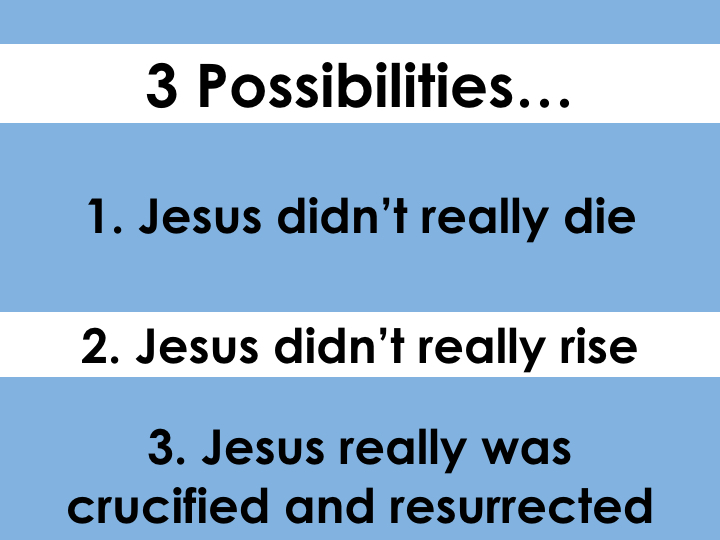
If the tomb where Jesus was placed is really empty, then there are only three possibilities for us to consider.
(1) Jesus didn’t really die.
- It’s hard to imagine anyone could go through the intense torture Jesus did prior to His crucifixion unscathed.
- The crucifixion process itself is one of the most gruesome forms of execution man has ever invented.
- As a result, forensic science shows that Jesus most likely died of a heart attack. The mention in John 19:34 of the blood and water that flowed from Christ’s body is an indication of the cardiac distress His body experienced.
- Men who were followers of Jesus handled His dead body, and undoubtedly would have checked for any signs life (John 19:38-40).
- A Roman centurion reported to the Roman governor Pilate that Jesus had in fact died (Mark 15:43-45).
- Extra-biblical historians, many of whom were unfriendly to Jews and Christians, reported Christ’s death as an historical fact.
(2) Jesus didn’t really rise.
- Some have claimed that Christ’s followers “saw” Jesus only in a grief-induced hallucination. The problem is, Jesus appeared to individuals, small groups, and large groups multiple times and in multiple settings over the course of 40 days (1 Corinthians 15:3-8).
- At least one of Christ’s closest followers said he wouldn’t be convinced by verbal testimony alone, but needed to touch Christ’s body for Himself (John 20:24-28).
- The disciples were afraid and lacked any military training that would have allowed them to get past the trained soldiers guarding the tomb (Matthew 27:62-66; 28:11-15).
(3) Jesus really did die on a Cross and was raised back to life.
Arthur Conan Doyle’s Sherlock Holmes rightly said, “When you have eliminated the impossible, whatever remains, however improbable, must be the truth.”
Real-life cold-case detective J. Warner Wallace explains how detectives use abductive reasoning to examine all of the evidence and infer to the most reasonable explanation from that. As a result, Detective Wallace says about this third explanation:
“The last explanation (although it is a miraculous, supernatural explanation) suffers from the least number of liabilities and deficiencies. If we simply enter into the investigation without a pre-existing bias against anything supernatural, the final explanation accounts for all of the evidence without any difficulty. The final explanation accounts for the evidence most simply and most exhaustively, and it is logically consistent…. The final explanation is also superior to all other accounts (given that it does not suffer from all the problems we see with the other explanations).” —J. Warner Wallace, Alive
The truth is Jesus loved you so much that He had to die for you. He had to pay the penalty for your sins. And God loved His Son so much, that He raised Him back to life. Jesus can live in you now, and you can live with Him forever, if you will simply believe what He did for you on Calvary.
Jesus left an empty tomb behind to show how powerful His love and life is!


![Light & Truth [Acts]](https://craigtowens.com/wp-content/uploads/2016/02/light-truth-acts.jpg)






 Craig T. Owens
6 More Quotes From “Light & Truth—Acts and the Larger Epistles”
February 17, 2016 — Craig T. Owens“We are described as feeble men, bearing on our shoulders a burden too heavy to be borne; the Holy Spirit comes up to us; not exactly to take away the burden; nor to strengthen us under it; but to put His own Almighty shoulder under it, in the room of, and along with ours; thus lightening the load, though not changing it; and bearing the heavier part of it with His own Almightiness. Thus it is that He ‘helps’ our infirmities; making us to feel both the burden and the infirmity all the while that He helps; nay, giving us such a kind and mode of help, as will keep us constantly sensible of both.” [Romans 8:26]
“How real, how true, how fast must that love have been. Here is its sincerity demonstrated. Here are its dimensions measured. What is its height? The answer is, ‘He spared not His Son.’ What is its depth? ‘He spared not His Son.’ What is its length? ‘He spared not His Son.’ What is its breadth? ‘He spared not His Son.’ Nay, He delivered Him up. Nay, He laid our sins upon Him; He made Him a curse for us. The more that we meditate on this one gift, the more does its greatness display itself. It passeth all measurement and all understanding.” [Romans 8:32]
“Prayer takes for granted that God is full, and we are empty; that He is infinitely full, and we unspeakably empty. … Prayer takes for granted that there is a connection between His fullness and our emptiness. The fullness is not inaccessible. It is not too high for us to reach, or for it to stoop. It is not too great for us, nor too distant, so as to be incommunicable. There is a connection, and it has been established by God Himself; it is a divine medium of communication: ‘Ask, and you shall receive.’ Prayer takes for granted that we are entitled to use this channel.” [Romans 12:12]
“If you are Christians then, be consistent. Be Christians out and out; Christians every hour, in every part, and in every matter. Beware of half-hearted discipleship, of compromise with evil, of conformity to the world, of trying to serve two masters. … Half-hearted Christianity will only dishonor God, while it makes you miserable. There is abundance of Christianity, so-called, in our day. Who does not call himself a Christian? But who cultivates the holiness, the blamelessness, the devotedness, the calm consistency of a follower of Christ? Who hates sin as it ought to be hated? Who separates from the world as he ought? Who follows Christ as He ought to be followed? Who walks in the footsteps of the holy Son of God?” [1 Corinthians 1:8]
“Let us walk worthy [of the blessings in Christ Jesus]; as men who really believe it; happy, holy, unworldly, zealous, generous, loving. Let us carry the consciousness of our calling into everything—great or small; into business, daily life, recreations, reading, education, everything; maintaining our true position before men; manifesting our proper character; letting the world know our prospects, and doing nothing inconsistent with what we profess to be now, and with what we shall be when the Lord comes.” [1 Corinthians 1:9]
“Thus, then, is our whole earthly life, in all its parts, to be regulated by the magnitude of the eternal. Things present must be subordinated to those which are to come, the seen to the unseen, the earthly to the heavenly. It is by the light of the coming glory that we must walk while here. It is from the clock of eternity that our time is to be always taken. Arrange your business, your recreations, your duties with reference to the invisible and unending future. Live, speak, work, move, as those who believe that the things which are seen are temporal, but the things which are not seen are eternal.” [1 Corinthians 7:29-31]
The first set of quotes I shared from this book can be read here. And my review of this book is posted here.
Share this: