3 Lessons From A Devoted Dad

If you were to pick a man that would have been desperately devoted to Jesus as his Savior, Cornelius wouldn’t make anyone’s “top 10” list! 

Just take a look at all the strikes against this man. He was a… 

  • Gentile—to Jews, Gentiles were just the fuel to stoke the fires of hell. 
  • resident of the city of Caesarea—since this was the headquarters of the Roman government for Palestine, not many Jews would venture there. 
  • Roman—historians say only 10% of Romans in this era were monotheistic. 
  • centurion—not just any centurion, but an extremely powerful centurion from the Italian Regiment (not just a local mercenary who was in it for the money). And he took his name from Cornelius Sulla, a Roman general known both for his mercy and his ruthlessness.

All of this makes Cornelius a fully self-sufficient and a well-to-do man who was not likely to look for help from God. Nor was he the type of person that a Christian missionary might seek out. 

But clearly, something was missing in Cornelius’ life because he was completely countercultural in his pursuit after God. Not just his pursuit of God, but his quick understanding of exactly who Jesus was. 

Luke the historian describes Cornelius as:

  • devout and God-fearing. The Greek word for devout literally means “a right worshipper.” It’s a word Luke only uses three times in Acts, and two of those times are describing Cornelius. 
  • prayerful. The word Luke uses for him means someone who makes prayer personal and ongoing. 
  • generous. Cornelius took care of people who couldn’t take care of themselves. 

All of this got God’s attention (see Psalm 141:2; Revelation 5:8; Proverbs 19:17), and He sent an angel to direct Cornelius to Peter. 

When Peter came to Cornelius’ house, twice he said “as you know” (vv. 36, 37), showing us that Cornelius was aware that there was not only one true God, but that a relationship with Jesus was the only way to be in right relationship with God. As Peter spoke with Cornelius, his family, his relatives, his close friends, and even his fellow soldiers, the Holy Spirit baptized them just as He had done with the disciples of Jesus on the day of Pentecost. 

So here are 3 vital lessons for all men to learn from the life of Cornelius the centurion—

  1. Your devotion to God is influential. People around you do notice your devoted pursuit of God.
  2. Your openness to all that God has puts your family, friends, and coworkers in a place to receive God’s blessings too.
  3. God’s blessings flowing through you have lasting and far-reaching results. The outpouring of the Holy Spirit on Cornelius may have opened the door for Christian evangelism to Gentiles unlike anything that had happened before.

Dads, be devoted to God. Desire all He has for you, and all He has for those around you. Pursue Him no matter how many “strikes” there may be against you. 

If you missed any of the messages in this series, you can access the full list of messages by clicking here.
Soul And Spirit

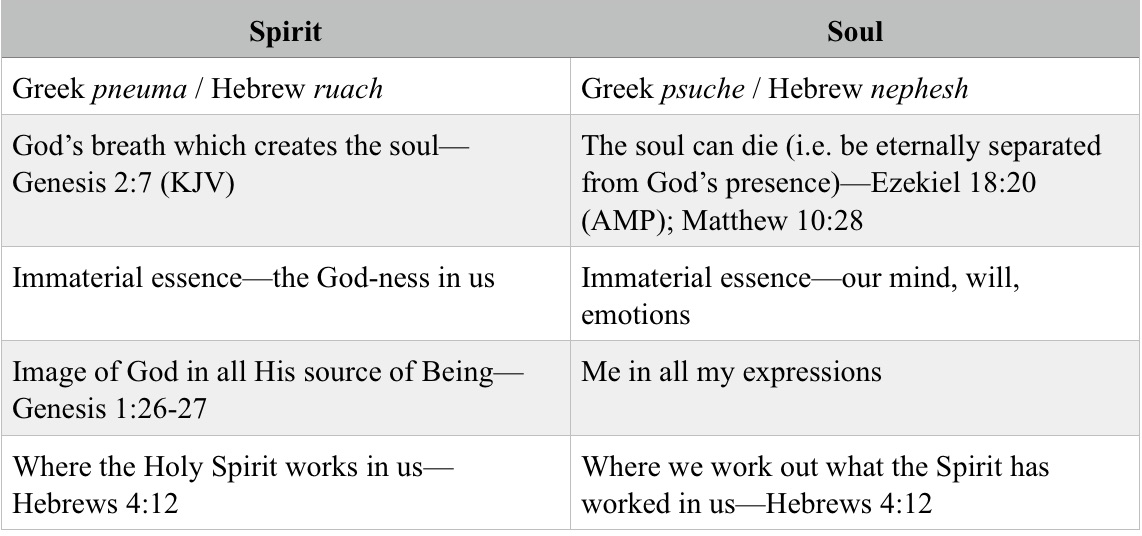
If I were to ask you to define the material/physical part of you versus the immaterial part of you, it probably wouldn’t be too difficult. Obviously, we can touch the physical part but we cannot touch the immaterial part. 

But human as a three-part being—we have a body, a soul, and a spirit. So if I were to now ask you to describe the “dividing line” between the two immaterial parts of us (the soul and the spirit), you would probably have a more difficult time coming up with a definition. 

Both terms are used throughout the Bible. Sometimes it seems the words soul and spirit are almost used interchangeably, but they are most assuredly two separate parts of what makes us us. 

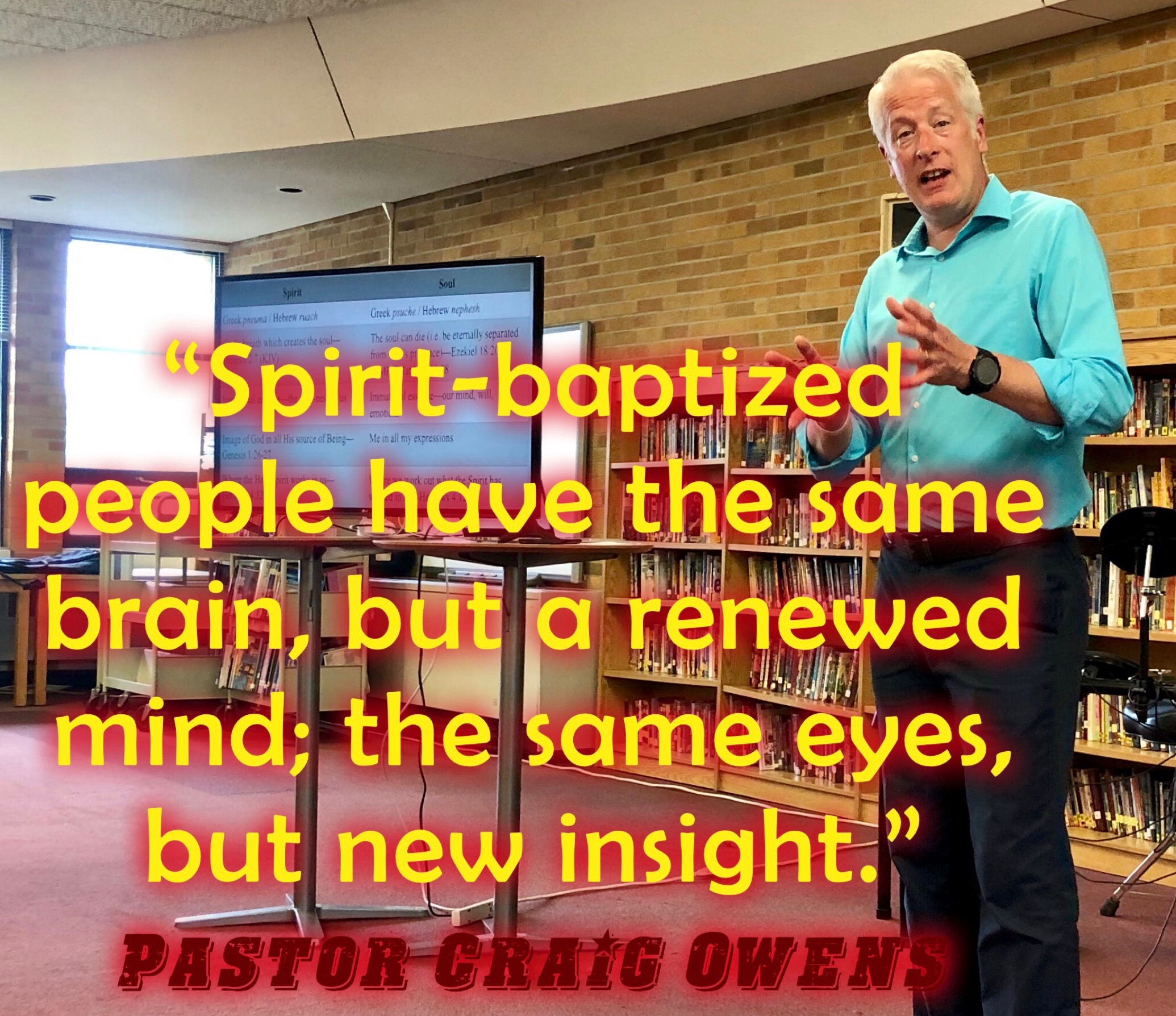
Please check out this chart that I shared with my friends at Calvary Assembly of God, and perhaps even take a few minutes to watch the video below. If you would like to download a PDF version of this chart, you may do so by clicking here → Soul and spirit side-by-side

Verses referenced—Genesis 1:26-27, 2:7; Ezekiel 18:20; Matthew 10:28; Hebrews 4:12

4 Holy Spirit-Enhanced Habits

According to Paul, there are only two ways people can live: in the flesh or in the Spirit. That is—(1) operating separate from God, or (2) with a soul/body that is operating with God’s full involvement. 

The trouble is: we’re always—as long as we’re alive—still in the flesh because we need these bodies to carry around our soul and spirit. But changes begin to occur first at salvation (when the connection of our spirit to God’s Spirit is reestablished), and even more so after being baptized in the Holy Spirit (when we are not trying to work out things on our own). 

As a result, we have the same brain, but a mind that is being renewed; the same eyes, but insight that is being expanded; the same ears, but learning new ways to hear what the Holy Spirit is saying. 

Remember that Jesus promised that the baptism in the Holy Spirit would empower us TO BE His witnesses (Acts 1:8). Not just to do things differently, but to have our spirit so enlivened by the Holy Spirit that we are living, breathing, walking, talking witnesses of a life transformed.

Have you noticed that there wasn’t a steep “learning curve” for the disciples of Jesus following Pentecost? Part of that is due to four key habits that the Holy Spirit helped form in their lives. 

  1. Correct biblical application—We immediately see people going from “They didn’t understand from the Scriptures” to quickly applying biblical texts to their current situations. This is exactly what Jesus promised would happen (John 20:6-9; Acts 2:16, 25, 34; John 14:26). 
  1. Intercessory prayer—To intercede is to take someone else’s needs to God on their behalf. The Holy Spirit can help us apply Scripture to our prayers, and can even help us without words at all (Acts 4:24-26; Romans 8:26-27). 
  1. Creative thinking—Christians should be the most creative thinkers in the world (Psalm 119:99; Jeremiah 33:3; 1 Corinthians 2:10). 
  1. Healthy conflict resolution—We’re all different, so not seeing eye-to-eye is bound to happen, but Spirit-empowered Christians will be able to resolve conflicts faster and with better results (Acts 6:1-8; Acts 15:1-31). 

“Your life as a Christian should make unbelievers question their disbelief in God.” —Dietrich Bonhoeffer

Amen! Your life as a Christian that is living out daily habits that have been empowered by the Spirit should make everyone around you want to go deeper and deeper into all that the Holy Spirit has in store for them too. 

If you missed any of the messages in this series, you can access the full list of messages by clicking here

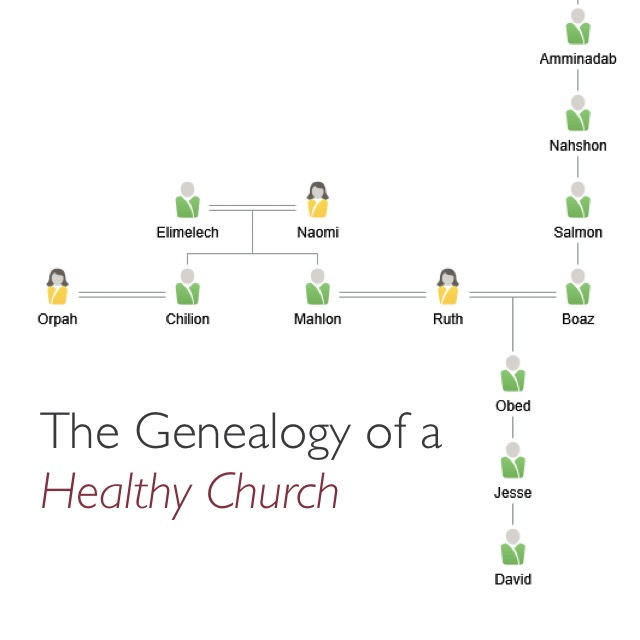
The Genealogy of a Healthy Church

And the things you have heard me say in the presence of many witnesses entrust to reliable people who will also be qualified to teach others. (2 Timothy 2:2)

Paul list four generations in this healthy church—Paul ➡️ Timothy ➡️ faithful Christians ➡️ others. 

We all have a role to play, and every role is vital in a healthy church. Are you a…

Paul: a first generation Christian that needs to start the ball rolling?

Timothy: one who needs to pass along what you have learned to the next generation?

faithful Christian: someone that is actively living out what has been taught to you?

member of the Body of Christ: one that needs to reach out to someone who isn’t a part of the Body yet?

Every single role is indispensable if the Church is going to remain healthy. If any part of this genealogy is lost, the whole Church suffers.

20 Helpful Thoughts On Criticism

“Criticism is something you can avoid easily—by saying nothing, doing nothing and being nothing.” —Aristotle 

“The Lord uses critics to show us our own hearts, even if what they say is not fully true, informed, or even fair. There is almost always a germ of truth in what our critics (in their own pain and disappointment) shout at us. The wise leader will humble himself and look for the truth embedded in every oppositional interaction.” —Dick Brogden [see 2 Samuel 16:5-12] 

“Feedback is the breakfast of champions.” —Ken Blanchard 

“Criticism can be received as a gift from God. It is an opportunity to pray, search Scripture, evaluate your own heart, and offer grace to others. The right response to criticism should not be retaliation or pride (which just perpetuates hurt), but rather humility.” —Jeremy Carr

“There is a growing trend to attack, criticize, and resent anyone who has talent or achievements that sets them apart from others. This tendency extends to those who resent the efforts of leaders who challenge the status quo. Opponents of change initiatives often attempt to marginalize leaders by attacking their character and questioning their motives. If the messenger is flawed, then the message and vision they offer cannot be trusted. As disappointing as it is, these challenges come with the territory of leadership.” —Dr. J. Lee Whittington

“If I were to attempt to answer all the criticisms and complaints I receive, I would have no time for any other business. From day to day I do the best I can and will continue to do so till the end. If in the end I come out all right, then the complaints and criticisms and what is said against me will make no difference. But, if the end brings me out wrong, then ten angels coming down from heaven to swear I was right would still make no difference.” —Abraham Lincoln

“If a ministry is God-anointed, it doesn’t matter who criticizes it. If it’s not anointed, it doesn’t matter who praises it.” —Rick Warren 

“Your critics have information that your friends are withholding.” —John Maxwell 

“God never gives us discernment so that we may criticize, but that we may intercede.” —Oswald Chambers 

“No leader is exempt from criticism and his humility will nowhere be seen more clearly than in the manner in which he accepts and reacts to it.” —J. Oswald Sanders 

“Criticism may not be agreeable, but it is necessary. It fulfills the same function as pain in the human body: It calls attention to an unhealthy state of things.” —Winston Churchill 

“Every man needs a blind eye and a deaf ear, so when people applaud, you’ll only hear half of it, and when people salute, you’ll only see part of it. Believe only half the praise and half the criticism.” —C.H. Spurgeon 

“Any fool can criticize, condemn and complain—and most fools do. But it takes character and self-control to be understanding and forgiving.” —Dale Carnegie

“A mark of a godly leader is one so focused on God’s plan that he pays no attention to his critics or enemies.” —Craig T. Owens

“Never be afraid of honest criticism. If the critic is wrong, you can help him; and if you’re wrong, he can help you. Either way, somebody’s helped.” —A.W. Tozer 

“It’s so much easier to teach correct principles than it is to know and love a person. It’s so much easier to give brilliant advice than to empathize and be open. It’s so much easier to live independently than to live interdependently. It’s so much easier to be a judge than to be a light. It’s so much easier to be a critic than to be a model.” —Stephen Covey

“When is it inappropriate to praise a critical person? One: When you are being criticized for outright sin, and the criticism is accurate. If what is said is true, the tension you feel will be relieved only one way: confession. Two: when you are falsely accused of sin. Sin is a serious charge, obviously more serious than those ‘against you’ realize or they would have done their homework.” —Blaine Allen

Don’t let an arrow of criticism pierce your heart unless it first passes through the filter of Scripture.” —Mark Batterson

“There is no better antidote for unjust criticism than a clear conscience before God.” —James Hernando

“It is not the critic who counts; nor the many who point out how the strong man stumbles, or where the doer of deeds could have done them better. The credit belongs to the man in the arena, whose face is marred by dust and sweat and blood, who strives valiantly… who knows the great enthusiasms, the great devotions, who spends himself in a worthy cause, who at the best knows in the end the triumph of high achievement, and who at the worst, if he fails, at least fails while daring greatly, so that his place shall never be with those cold and timid souls who have never known neither victory nor defeat.” —Teddy Roosevelt 

Everyday Evidence

Last week we learned that speaking in tongues was one of the most noticeable and consistent characteristics of those who were baptized in the Holy Spirit. 

Speaking in tongues as the Spirit enables you is the unmistakable, objective, outward, initial physical evidence. The Bible makes clear that continuing to pray in tongues has huge benefits for both our personal prayer lives and for the corporate church body. But don’t stop there! 

The initial, outward evidence is primarily for the individual Christian—it’s a way of knowing that you know that you have indeed been baptized in the Spirit. But there also needs to be some everyday evidence for others that testifies to them that something is different about your life. 

Consider the disciples of Jesus before and after being baptized in the Holy Spirit…

Their vocabulary

Before being baptized in the Spirit they said stupid things because they didn’t know what to say (Mark 9:5-6) But after being baptized in the Spirit there was no more foot-in-mouth disease. Just as the Holy Spirit enabled them to praise God in an unlearned tongue, He also empowered their natural dialect. The same Greek word is used in Acts 2:4 (enabled by the Holy Spirit), 2:14 (Peter addressed the crowd), and 26:25 (what I am saying is true and reasonable). 

Their spiritual power

Before it was limited, and often thwarted, but afterward, it was limitless and effortless (Mark 9:17-18; Acts 3:1-8; 5:15; 6:8).

Their understanding of servanthood

Before they argued about who was the greatest. Afterward, they gladly gave all that they had to others (Mark 9:33-34; Acts 2:44-45). 

Their boldness in the face of adversity

Before they abandoned Jesus, ran away, and hid in locked rooms. Afterward, there was no intimidating or silencing them (Acts 4:8, 13, 18-20). 

Their understanding of Scripture

Before they had virtually no understanding of Scripture’s application. Afterward, they understood how to apply God’s Word in almost every situation (Acts 2:16, 33-35; 4:24-26). 

Jesus promised that the baptism in the Holy Spirit would empower us TO BE His witnesses (Acts 1:8). Not just to do things for Him. There’s nothing wrong about doing Jesus-glorifying things, but in themselves, they are too short-sighted. Jesus doesn’t want us empowered to do things, but TO BE a living, breathing, walking, talking witness of a life transformed by His power. That’s the reason why I say to you again and again: Don’t stop at salvation. Press on and press in to be baptized in the Holy Spirit so that you can BE an empowered, transformed and transforming witness for Jesus!

If you missed any of the messages in this series, you can access the full list of messages by clicking here

Thursdays With Spurgeon—How satan Attacks

This is a weekly series with things I’m reading and pondering from Charles Spurgeon. You can read the original seed thought here, or type “Thursdays With Spurgeon” in the search box to read more entries.

How satan Attacks

     Our faith at times has to fight for its very existence. The old Adam within us rages mightily, and the new spirit within us, like a young lion, disdains to be vanquished; and so these two strong ones contend, till our spirit is full of agony. …

     Christ alone was tempted in all points as we are, though without sin. No one man is tempted in all points exactly like another man, and each one has certain trials in which he must stand alone amid the rage of war, with not even a book to help him, or a biography to assist him—no man ever having gone that way before except that one Man whose trail reveals a nail-pierced foot. He alone knows all of the devious paths of sorrow. Yet even in such byways, the Lord is with us, helping us, sustaining us, and giving us grace to conquer at the close. … 

     So satan, loath to leave a soul, pursues it hotfoot. He will have it back if he can; and often, soon after conversion, there comes a time of dreadful conflict, when the soul seems as if it could not live. … 

     Once, when the tempter had grievously assailed me, I went to see my dear old grandfather. I told him about my terrible experience, and then I wound up by saying, “Grandfather, I am sure I cannot be a child of God, or else I should never have such evil thoughts as these.”

     “Nonsense, Charles,” answered the good old man. “It is just because you are a Christian that you are thus tempted. These blasphemies are no children of yours; they are the devil’s brats, which he delights to lay at the door of a Christian. Don’t you own them as yours; give them neither house-room or heart-room.” 

From The Autobiography of Charles Spurgeon 

The spiritual attacks—especially on new Christians—can be intense. Even “veteran” Christians aren’t immune to such attacks. 

Although every Christian shares some commonality in the ways in which we are tempted, no one experiences an identical attack. The devil is a cunning schemer and he can tailor-make his attacks to each individual. Gratefully, there is One who knows every minute detail of our temptation. Jesus was tempted in every way that we are, and He overcame those temptations without sinning. Now our victorious Savior stands before God’s throne interceding on our behalf as we battle the tempter. 

Spurgeon’s grandfather was right—don’t own these satanic blasphemies as your own! Remind yourself that you are in a war. Then say with the apostle Paul, “Thanks be to God that Jesus Christ has rescued me from all these. There is now no condemnation for me because I am in Christ Jesus, and there is absolutely nothing that can separate me from that love!” (see Romans 7:25; 8:1, 31-39)

The Unmistakable Evidence

That Pentecost Sunday immediately following Christ’s resurrection forever changed what Pentecost stood for. From this point forward, Christians who have encountered the Holy Spirit as those 120 followers of Jesus did now call themselves Pentecostal. (Check out Acts 2:1-12, 16, 22-24, 37-39.)

If you had been present on that day, there were three pieces of evidence you would have noticed:

  1. Wind—this is the Greek word pneuma, which is the same as the Hebrew word ruach. This is the impartation of the Spirit that brings a true life connection to the Trinity (Genesis 2:7). This power was foretold by Jesus when He promised, “you will receive power when the Holy Spirit comes on you…” (Acts 1:8a). 
  1. Fire—this was foretold by John (Luke 3:16). This fire was to light up our witness to a dark world (Matthew 5:14-16). Again Jesus promised, “you will receive power to be My witnesses…” (Acts 1:8b). 
  1. Tongues—this fulfilled the promise of Jesus, “to be My witnesses…to the ends of the earth” (Acts 1:8c). 

Some have tried to call this speaking in tongues an “ecstatic utterance,” or just nonsensical gibberish. But notice the descriptions Luke gives: each one heard them speaking in his own language (v. 6), each of us hears them in his own native language (v. 8), and declaring the wonders of God in our own tongues (v. 11). Luke lists visitors from over 15 different places around the world that heard their native tongue being spoken by these native Galileans. Luke pointed out that these Spirit-baptized Christians spoke like this as the Spirit enabled them (v. 4b). 

Two types of vocabulary are happening here—language (vv. 6, 8), which is the Greek word dialektos, and tongues (vv. 4, 11), which is the Greek word glossa. 

Dialektos is a learned language. Glossa can also be learned, but it’s not something that one just casually picks up. The Greeks said glossa is “not a word of everyday speech but one belonging to dignified and elevated discourse.” The Greeks called glossa the language of prophets, wisemen, and philosophers.

“But,” you might say, “speaking in tongues sounds weird!” Yes, it does. As N.T. Wright said:

“God acts completely unexpectedly—as He always said He would.” 

Remember this—God is God. He is uncontainable, indefinable. If we can define Him, He is not God, but we are. He always does things “out of the box”—at least out of our box, not His! Like sending His Son born of a virgin, and empowering Jesus to restore sight to one born blind, and enabling Jesus to cure someone who contracted leprosy, and even reversing the laws of biology to bring Jesus back to life! 

So it’s not unexpected that the baptism of the Holy Spirit is accompanied by someone praising God in a dialect they have never learned. Speaking in tongues as the Spirit enables you is the unmistakable, objective, outward, initial physical evidence of the baptism in the Holy Spirit. 

Jesus wants us to have rivers of living water flowing—bursting!—out of us. This living water can flow out of anyone who has the Spirit IN them! Don’t wait another day: be baptized in the Holy Spirit.

If you missed any of the messages in this series, you can access the full list of messages by clicking here.
5 Lessons From An Amazing Mother

There is a Pentecostal Christian woman that we first meet in the Book of Acts, and then we see her name scattered throughout Paul’s letters. She may be the most prominent woman among all of the Apostle Paul’s companions and probably is responsible for spreading the Gospel more and farther than any other woman recorded in the Bible. 

Scripture doesn’t tell us if she had children of her own but she is certainly the spiritual mother of more Christians than we will ever be able to count!

Prisca is her birth name. She is a Jew, and most likely a freeborn Roman (just as Paul was). She is from the prominent Acilius family, so combined with Prisca her name is called Priscilla. She married Aquila and they both worked as leather makers (also known as tentmakers). 

Let’s take a look at Priscilla’s travel itinerary—

Pricilla left Rome because of Emperor Claudius’ decree in 49 AD and traveled to Corinth, where she met Paul (Acts 18:1-3, 11, 18-19). 

After spending almost 2 years with Paul in Corinth, they traveled to Ephesus with Paul, where she met and mentored Apollos (Acts 18:24-26). Apollos became a trusted friend to Paul; in fact, Paul calls him a synergos (where we get our English word for synergy). In other words, Paul thought his ministry was more effective because of his partnership with Apollos, but that is all thanks to Priscilla’s involvement! 

Priscilla returned to Rome sometime after Claudius’ death in 54 AD. She probably returned home to prepare the way for Paul’s visit there (Romans 1:10-11; 15:23-24; 16:3). 

And at some point she returned to Ephesus, probably to help Timothy as he pastored the church there (2 Timothy 4:19). 

Here are 5 lessons we can learn from Priscilla’s life—

  1. Be baptized in the Holy Spirit. This is what she taught to others, so it is undoubtedly how she lived as well. 
  1. Use the gifting God has given you. Except for one place, Priscilla is always listed first ahead of her husband. This is unprecedented anywhere else in the New Testament. That tells us that despite what the Greco-roman culture tried to enforce, Priscilla was the predominant teacher/preacher in her family.
  1. Work hard. Priscilla had to be fairly well-to-do to be able to travel to at least three major cities and to host churches in her home, and yet we see her working with her hands to provide for her family and for the church. 
  1. Be bold. Jesus said the baptism in the Holy Spirit would give us boldness, and Priscilla demonstrated that powerfully (Romans 16:4). 
  1. Be synergistic. Paul also called Priscilla a synergos. Paul used this word sparingly for people who had put everything on the line for the sake of the Gospel. He used synergos for people like Apollos, Timothy, Titus, and Luke. Priscilla is the only woman who gets this invaluable term.  

We don’t know if Priscilla was a biological mom, but she was definitely a spiritual mom. She was empowered by the Holy Spirit, and probably is responsible for spreading the Gospel more than any other woman recorded in the Bible. You can follow in her footsteps! 

If you missed any of the messages in this series, you can access the full list of messages by clicking here. 

The Empowerment Of Pentecost

The Feast of Pentecost was an annual celebration for Jewish people for a long time, with nothing really noteworthy happening. Until…

…on the Day of Pentecost that took place just 10 days after Jesus ascended into heaven, a new breed of Christian was unleashed on the world. Those followers of Jesus who were baptized in the Holy Spirit on that day begin living a lifestyle that we now refer to as Pentecostal. 

Most people were familiar with water baptism is an outward sign of an inward commitment. It’s not something that was new to Christianity: Greek philosophy teachers and Jewish rabbis baptized their followers. So did John the baptizer (or the Baptist). 

But John, as the forerunner of Jesus, promised that there would be something more—a baptism in the Holy Spirit that Jesus would bring. Jesus Himself said this baptism was so important that He didn’t want His followers to even attempt to begin to evangelize the world until they received this baptism (Luke 3:3, 16; 24:44-49; Acts 1:4-8). 

What is important about this Holy Spirit baptism? What are its origins? To answer these questions, we have to go back to the very beginning of Time itself. When God created humans, the Holy Spirit was breathed into us, giving us a living soul (Genesis 1:26, 2:7). This Spirit-breath set us apart from all other living creatures (Job 33:4, 32:8; Proverbs 20:27).

We were created to be intimately connected with God, but our sin severed that. Our hearts became sin-calloused and selfish and stone-hard toward God. 

The Cross of Jesus allowed us to be reconciled to God. By placing our faith in what Jesus did for us on the Cross, we could receive forgiveness of our sins. We were now saved from the penalty of our sins, but Jesus wanted more for us—He wanted us also to be saved to a new life that was as intimately connected to God’s heart as His life was. 

So Jesus told His followers to wait and pray for the promised baptism in the Holy Spirit. 

They prayed. And on that Day of Pentecost, they were indeed baptized in the Holy Spirit (Acts 2:1-4). Actually, the word filled literally means “fulfilled”—the baptism in the Holy Spirit fulfilled what Jesus had promised. 

From that day forward, those who are baptized in the Holy Spirit are called Pentecostal people. I know there are some who would argue that was only for “back then,” but let me tell you from personal experience that there is no other way that I would try to live the Christian life than by being an unashamed Pentecostal! 

Jesus wants us to not only be water baptized to announce our faith in Him for forgiveness of sins, but also to be baptized in the Holy Spirit to empower us to live holy, extraordinary, fulfilling lives. If you haven’t been baptized in the Holy Spirit, you can be simply by asking God (Luke 11:13).

Join me next Sunday as we continue to explore what it means to live the Pentecostal lifestyle.

If you missed any of the messages in this series, you can access the full list of messages by clicking here.