Thursdays With Spurgeon—Honey In My Mouth

This is a weekly series with things I’m reading and pondering from Charles Spurgeon. You can read the original seed thought here, or type “Thursdays With Spurgeon” in the search box to read more entries.

Honey In My Mouth

He will glorify Me, for He will take of what is Mine and declare it to you. All things that the Father has are Mine. Therefore I said that He will take of Mine and declare it to you. (John 16:14-15) 

     So we actually receive, through Jesus Christ, by the Spirit, what is in the Father!  

     Ralph Erskine, in the preface to a sermon upon the fifteenth verse, has a notable piece. He speaks of grace as honey for the cheering of the saints, for the sweetening of their mouths and hearts. But he says that in the Father, ‘The honey is in the flower….’ In the Son, ‘the honey is in the comb…. But then we have honey in the mouth. That is the Spirit taking all things and making application of them, by showing them to us and making us to eat and drink with Christ and share of these things….

From Honey In My Mouth

My grandfather had honeybees on his farm and I was fascinated by them. So much so that in my ecology class in college, I wrote my final research paper on the fascinating inner workings of the honeybee hive. My grandfather would often plant various crops so that the nectar from those flowers would give a distinct flavor to the honey. 

The nectar of a flower has everything in it to make honey except for one thing: a honeybee’s care. The nectar has to be transported back to the hive where it then undergoes the process of being transformed into honey—precise temperatures, storage, and evaporation processes are perfectly overseen by the bees until edible honey emerges. 

Ralph Erskine’s analogy of this nectar-to-honey process is very apropos to the things of God. Our Heavenly Father said that His thoughts are higher than our thoughts: they are inaccessible by our finite human minds (Isaiah 55:8-9). Jesus came as the revelation of all of the things of the Father, declaring to us all that God has for us. Jesus added, “I still have many things to say to you, but you cannot bear them now” (John 16:12), which is why the Holy Spirit illuminates the inspired Word of God.

Do you see the whole Trinity active in this process? The Father creates, the Son reveals, and the Spirit makes accessible (or, if you will, the Spirit makes edible). 

The Holy Spirit not only makes the things of God edible to us, but He gives us new tastebuds. No longer will the things of the world satisfy our tastes, no longer will we find any satisfaction in them, no longer will those earthly things nourish us. What the Father has created, and the Son has revealed, the Spirit will make real—and delicious!—to us.


Thursdays With Spurgeon—Poetic Groans

This is a weekly series with things I’m reading and pondering from Charles Spurgeon. You can read the original seed thought here, or type “Thursdays With Spurgeon” in the search box to read more entries.

Our Prayer Helper 

Likewise the Spirit also helps in our weaknesses. For we do not know what we should pray for as we ought, but the Spirit Himself makes intercession for us with groanings which cannot be uttered. (Romans 8:26) 

     A man’s heart is moved when he groans. A groan is a matter about which there is no hypocrisy. A groan comes not from the lips, but from the heart. A groan, then, is a part of prayer that we owe to the Holy Spirit, and the same is true of all the prayer that wells up from the deep fountains of our inner life. [see also Jeremiah 4:19; Isaiah 38:14; Psalm 77:4, 38:8-9] … 

     That which is thrown up from the depths of the soul, when it is stirred with a terrible tempest, is more precious than pearl or coral, for it is the intercession of the Holy Spirit! … 

     Beloved, what a different view of prayer God has from that which men think to be the correct one! You may have seen very beautiful prayers in print and you may have heard very charming compositions from the pulpit, but I trust you have not fallen in love with them. Judge these things rightly. I pray you never think well of fine prayers, for before the thrice-holy God it ill becomes a sinful supplicant to play the orator! … The tail feathers of pride should be pulled out of our prayers, for they need only the wing feathers of faith. The peacock feathers of poetical expression are out of place before the throne of God. … God looks at the heart. To Him fine language is as sounding brass or a tinkling cymbal, while a groan has music in it! 

From The Holy Spirit’s Intercession

God is not looking for well-polished prayers; He’s looking for real prayers. Let’s be honest: Not even the most educated person in the world has a vocabulary sufficient enough to accurately communicate with The Almighty God! 

Our Heavenly Father wants us to come to Him in simple, childlike anticipation. Notice I didn’t say childish anticipation—there is a huge difference. What Paul is telling us in Romans 8 is that the Holy Spirit can make the most eloquent, childlike, sincere prayer out of our deepest longings in our hearts. 

Jesus reminded us, “Your Father knows the things you have need of before you ask Him” (Matthew 6:8). Our Father wants to answer our prayers, and He has given us His Holy Spirit to help us pray in a way that He can answer. 

Don’t try to spruce up your vocabulary before you come to God in prayer. Just come to God in prayer, trusting that the Holy Spirit will make a beautiful prayer even out of your childlike groanings! The Holy Spirit turns our groans into prayerful poetry in our Heavenly Father’s ears!

Words To Winners Of Souls (book review)

Horatius Bonar has given us a collection of sermons preached to pastors, which have been collated in a book under the title Words To Winners Of Souls. 

Although these were words by a pastor to pastors, this shouldn’t be a book exclusively read by pastors. Anyone who wants to successfully share their Christian testimony with unsaved friends and loved ones can find much to digest in these sermons. That being said, this is still a must-read (and I don’t say that very often) for those in pastoral ministry. 

Bonar was a no-pulled-punches preacher! He spoke candidly and forcefully, but he also spoke out of a love for the Body of Christ and its ministers. Early on in this book he says, “We take for granted that the object of the Christian ministry is to convert sinners and to edify the body of Christ. No faithful minister can possibly rest short of this. Applause, fame, popularity, honor, wealth—all these are vain. If souls are not won, if saints are not matured, our ministry itself is vain.” Wow: “our ministry itself is vain”—you cannot get more gut-level honest than that! 

In this collection of messages, Bonar helps us diagnose what may be hindering our soul-winning practices, and he also proposes the remedy for those shortcomings. These words are honest and often hard to hear, but they are so needed for everyone who desires, as Jesus does, “that none should perish but all should come to repentance” (2 Peter 3:9). 

Pastors, please read this book! 

Parishioners, please get a copy of this book for your pastor and then offer to prayerfully read through it with him or her. I promise you: this book will pay eternal dividends. 

UPDATE: I have shared some quotes from this book here.

A Hideous Strength

“…Come, let us face each other in battle” (2 Kings 14:8). 

Based on Amaziah’s request and Jehoash’s unusual parable-based response, it appears that this is the chronology of what happened:

  • Amaziah requests that Jehoash give him one of his daughters in marriage
  • Jehoash refuses
  • Amaziah attacks and defeats Edom 
  • Amaziah, feeling very proud of himself, then repeats his request to Jehoash, who again refuses
  • Amaziah begins to muster his troops to attack Jehoash and Israel
  • Jehoash defeats in Amaziah battle

Jehoash correctly diagnosed Amaziah: “You have indeed defeated Edom and now you are arrogant. Glory in your victory, but stay at home” (v. 10). 

Pride makes us think we are better than we are. Pride leads us to believe that we are owed something more. Pride comes before a fall. 

Amaziah’s pride had an expensive price tag:

  • he lost the battle
  • the walls around Jerusalem were torn down
  • the temple at Jerusalem was plundered
  • he was assassinated by his own military leaders

Pride is a hideous strength because it is a deceptive and short-lived strength.

C.S. Lewis described pride so well: “Pride gets no pleasure out of having something, only out of having more of it than the next man. We say that people are proud of being richer, or cleverer, or better looking than others. If everyone else became equally rich, or clever, or good looking, there would be nothing to be proud about. It is the comparison that makes you proud: the pleasure of being above the rest. Once the element of competition has gone, pride has gone. That is why I say that Pride is essentially competitive in a way the other vices are not. … Nearly all those evils in the world which people put down to greed or selfishness are really far more the result of Pride. … Pride is ruthless, sleepless, unsmiling concentration on the self.” —C.S. Lewis 

Oh my! We must pray: “Holy Spirit, help me guard my heart against this propensity to pride. Yes, a victory can lead to pride and a false sense of strength, but it is a hideously deceptive strength. Please remind me that: 

  • victory makes me susceptible to pride 
  • pride makes me think I’m better (stronger, more impressive, more spiritual) than I really am 
  • this hideously deceptive vice makes me forget to remain dependent on God 
  • the dependence on myself makes me vulnerable to attack and defeat.” 

Don’t let Pride be your undoing, as it was for Amaziah. 

You Have A Choice

“While we may not be able to take every thought captive in every situation we face every day, we can learn to take one thought captive and, in doing so, affect every other thought to come. So what is the one thought that can successfully interrupt every negative thought pattern? It’s this: I have a choice. 

“When we’re spiraling in noise or distractedness, we have a choice to shift our minds back to God through stillness. When we’re spiraling in isolation, we have a choice to shift our minds back to God through community. When we’re spiraling in anxiety, we have a choice to shift our minds back to God through trust in His good and sovereign purposes. When we’re spiraling in cynicism, we have a choice to shift our minds back to God through worship. When we’re spiraling in self-importance, we have a choice to shift our minds back to God through humility. When we’re spiraling into victimhood, we have a choice to shift our minds back to God through gratitude. When we’re spiraling in complacency, we have a choice to shift our minds back to God through serving Him and others.

“If you have trusted in Jesus as your Savior, you have a God-given, God-empowered, God-redeemed ability to choose what you think about. You have a choice regarding where you focus your energy. You have a choice regarding what you live for. You are not subject to your behaviors, genes, or circumstances. You are not subject to your passions, lusts, or emotions. You are not subject to your thoughts.

“No fixation exists outside God’s long-armed reach. Because we are a ‘new creation,’ we have a choice.

“When we think new thoughts, we physically alter our brains. When we think new thoughts, we make healthier neural connections. When we think new thoughts, we blaze new trails. When we think new thoughts, everything changes.” —Jennie Allen, from the YouVersion reading plan Get Out Of Your Own Head

History Matters

The minor prophets cover a span of about 300 years, from 760-450 BC, and Jonah appears right in the middle of that. Jonah overlaps Amos and Hosea in northern Israel, and he finishes his ministry just before Isaiah’s ministry begins in southern Judah. 

Jonah is the only narrative in the minor prophets. He was a prophet during the reign of Jeroboam II when Israel was temporarily growing in strength. He is the first of Israel’s prophets to be sent to a non-Jewish population. 

Critics have raised questions about this book. Questions like: Did Jonah write this book himself or is it just a story about him? Is this book historical or allegorical? 

The five biggest objections that are raised to Jonah’s historicity are: 

  1. The hyper-nationalistic feel is more like when Ezra and Nehemiah led people back to Jerusalem after their captivity in Babylon, and not during the time of Jeroboam II. 
  2. Parts of Jonah appear copied from the prophet Joel. 
  3. There are no (or incorrect) details about the major city of Nineveh that Jonah visited. 
  4. There are no extra-biblical historical records of a revival in Nineveh. 
  5. Jonah was swallowed by a fish?! 

I think there are very good reasons to believe that Jonah was both autobiographical and historically accurate. 

First, there was a revival of sorts (although not religiously) in Israel during the time of Jeroboam II. This was a time that Israel felt like it could flex its muscles again, so Jonah would not be acting out of character to be so pro-Israel. 

Second, Jonah 3:9 and Joel 2:14 sound similar, but scholars cannot tell which was written first. Couldn’t God amplify a message? Consider how many parts of the Gospel of Mark are used in the Gospels of Matthew and Luke. And it’s a regular practice for authors even today to directly quote other sources. 

Third, regarding the lack of details about Nineveh, the biblical writers give very few details of any places outside of Israel or Judah. The only “incorrect” detail skeptics point to is Jonah 3:3 stating that the city was so big that it would take three days to walk around it. Nineveh was a city of about 120,000 inhabitants, so it could easily take three days of walking and preaching in order to get the message to everyone. 

Fourth, the revival in Nineveh was clearly short-lived. Jonah was probably in Nineveh around 760 BC. Assyria was rising politically and militarily during that time and defeated Israel just 40 years after Jonah’s preaching. Assyria itself was then defeated in 605 BC. 

Finally, Jonah was swallowed by a fish?! The root word for fish in Hebrew means something that has grown to such an enormous size that it overshadows everything else. But notice that what caused the sailors to be in awe of God was not the whale/fish swallowing Jonah, but the immediate calming of the ocean when Jonah was thrown overboard (Jonah 1:15-16). Miracles appear throughout this book. And throughout the entire Bible! 

Why should the appearance of miracles surprise us? Some people have a bias against the supernatural, where they wrongly believe that we can know everything through naturalistic means. C.S. Lewis pointed out, “I use the word Miracle to mean an interference with Nature by supernatural power. … Nature as a whole is herself one huge result of the Supernatural: God created her.” 

I don’t think this story is a parable or an allegory because nowhere else in the Bible are such details given in the form of a parable. 

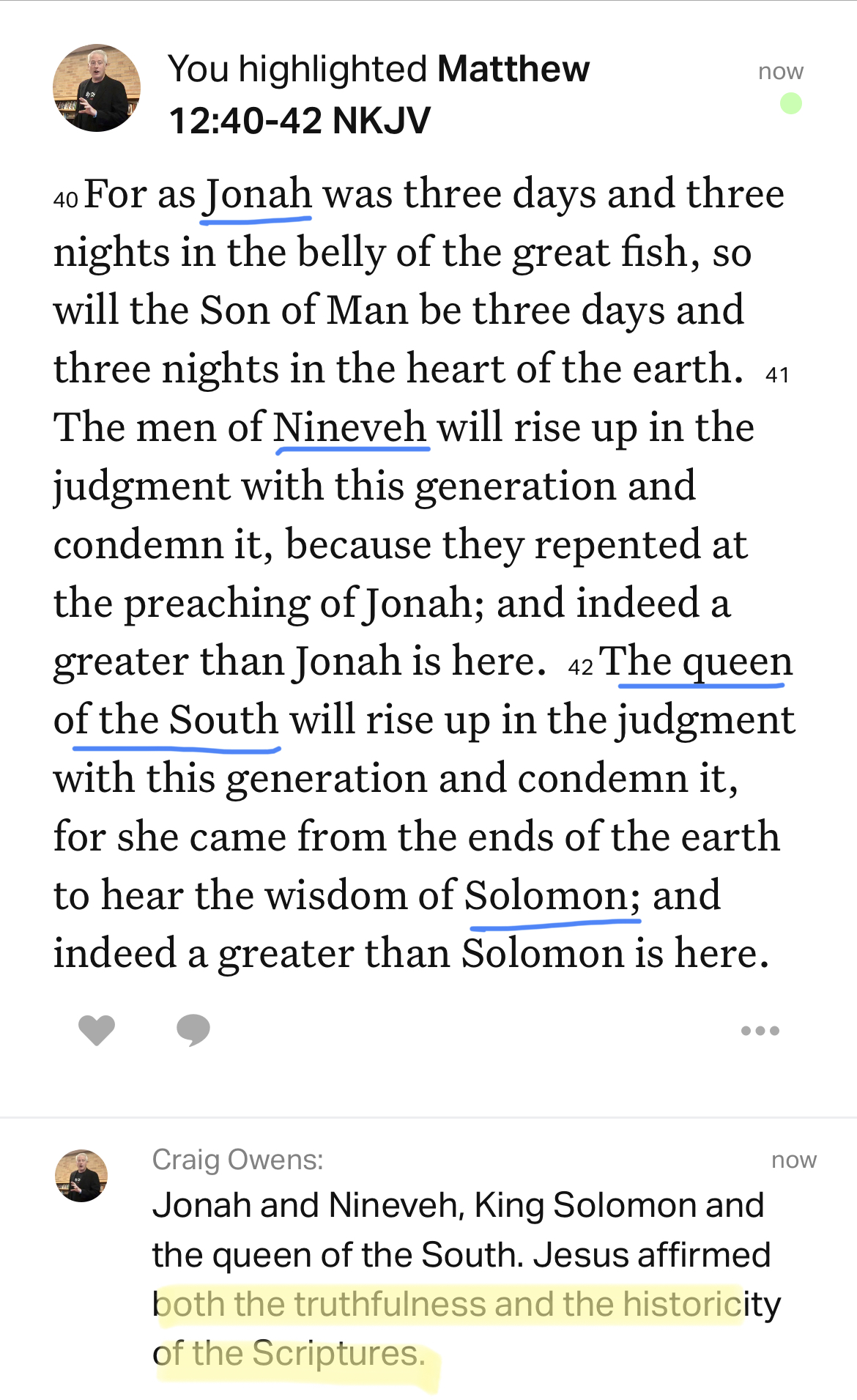
I believe this story is historical because Jesus talked about the historicity of Jonah in the same breath as He talked about other historical people: the Queen of the South and Solomon (Matthew 12:38-42). Jesus clearly viewed Jonah as historically reliable and accurate. To call Jonah into question is to call into question the truthfulness of Jesus Himself! 

History matters because all of History is God’s story! 

Our belief in the message of the Bible is not based upon “once upon a time” or “a long time ago in a galaxy far, far away.” It’s based upon real people in real places, especially the historicity of Jesus (notice all of the historical details Luke lists in the birth account of Jesus). 

Jonah was clearly one of those historical people, in an historic place, and at a precise moment in world history that tells the story of Jesus and our redemption which He purchased! 

If you want to check out all of the messages in our series on the major lessons from the minor prophets, you can find that list by clicking here.

Keep Up Your Spiritual Health

In Workmen Of God, we have a collection of lectures Oswald Chambers delivered to those “reliable men” and women (see 2 Timothy 2:2) who were either already working in pastoral ministry or preparing to do so. Chambers talks to pastors about their work among those entrenched in their unbelief, those who are skeptical, those who are backslidden, those who are hypocrites, and those who have sick souls. He especially challenges pastors on how to minister to themselves so that they are prepared to minister to any soul in which God brings them in contact.

It’s in that light that I think this passage is so vital for anyone involved in Christian ministry—

“So remember, it is absolutely necessary to be like the cedars of Lebanon. Do you know the characteristic of a Lebanon tree? The cedars of Lebanon have such extraordinary power of life that instead of nourishing the parasites it kills them, the life within is so strong and so robust that instead of feeding the parasites it chokes them off. God grant that we may be so filled with His life, may flourish as the cedars of Lebanon, so that He can trust us down in all the dark, difficult places amongst the souls of our brother men and be able to pour His tremendous health and power through us. … 

“Do you remember, then, that it is necessary for the worker to be healthy, and beware of this mistake, that by working for God amongst men, you develop your own Christian life; you do not unless your Christian life is there first. It is so obvious that it needs to be said over again—you cannot develop your own Christian life unless it is there. The advice given that if you work for God you develop your own life often means that if you work for God you get right yourself; you do not, you have to be right with God first.” 

Pastors and other Christian workers, remember that you cannot give to others what you do not have yourself. You MUST make regular time to abide with Jesus, not for sermon preparation, but for your own robust spiritual health. 

Although written over 100 years ago, this book is still a treasure-trove for anyone in church ministry today!

The Core Curriculum Of The Spirit

“The Law of God teaches us how to love Him and our neighbors (Matthew 22:34-40). The Law of God is critical for seeking the Kingdom of God (Matthew 5:17-19). The Law of God liberates us from the blinding and binding power of sin (James 2:8-13). The Law of God marks the path of love that Jesus walked, and that all must walk who would follow Him (1 John 2:1-6; 5:1-3). The Law of God provided the framework within which the apostles ordered their churches (cf. 1 Corinthians 5, 9; James 2:5; 1 John 5). The Law of God is the core curriculum of the Spirit, as He brings us into the presence of God’s glory and transforms us into the image of Jesus Christ (Ezekiel 36:26-27; 2 Corinthians 3:12-18). Neglecting the Law of God is a major cause for the decline of true and selfless love in the world; it licenses the progress of evil; and it threatens to render the prayers of Law-neglecting believers an ‘abomination’ or, we might say, ‘a dead and a useless thing’ (Matthew 24:12; Proverbs 28:4, 9). 

[all Scriptures from the above paragraph are here]

“It’s no wonder the psalmist, echoing Moses, insisted that the righteous person, the one who embodies the goodness of God in all his ways, meditates on the Law of God day and night, hides it in his heart and embodies it in all his ways (Psalm 119:9-11; Deuteronomy 6:1-9), keeps it diligently, delights in and loves it, and hastens to make sure his feet follow in its path (cf. Psalm 1; Psalm 119:4, 5, 35, 59, 60, 97). 

[all Scriptures from the above paragraph are here]

“If you are missing the Law of God in your relationship with Jesus, you are depriving yourself of a most important resource for bringing the goodness of God to light in the land of the living. The good works outlined in the Law of God are those ‘ordained of old’ which God intends us to do in all our ways (Ephesians 2:10). Yes, understanding the Law can be difficult. But we can learn from the prophets, Jesus, and the apostles how to read, study, and meditate in this most important corpus of Biblical literature, and thus we can discover the true freedom for goodness and love that God has prepared for us.” —T.M. Moore 

Two Great Lies

“By two great lies was man led away from God. By the same two lies has the estrangement been kept up. On these two lies the world has been feeding ever since the Fall. Their fruit has been woe and death—‘Ye shall not die’ and ‘Ye shall be as gods.’ …

“The world’s history is the same. Our race has been eating the fruit of lies [Hosea 10:13]; not simply of sin, but of lies. The sorrows, sighs, tears, pains of our race are the fruit of lies—the original lie of Paradise, and a thousand such since then. …

“The two original satanic lies are continually coming up, and along with them myriads of others, all leading us astray. Each day brings forth the lie, the fruit, the eating thereof. satan, or the world, or the flesh, or a friend, or a book, or a scene whispers the lie; it is fair and specious, we believe it; it brings forth fruit, we eat of it, and the end is bitterness and disappointment. We feed on lies. … We persuade ourselves that this world is good, and pleasant, and excellent, so we pursue it in preference to the world to come. …

“Jesus says, ‘Yes, ye shall not surely die, but that deliverance shall not be in the way you think. Death is the wages of sin, yet I bring life to the sinner, everlasting life, life through the belief of the Truth, even as death came through the belief of a lie. Yes, ye shall be as gods, but not in your way. I will make you partakers if the divine nature, not by eating the forbidden tree, but by eating of Me.’” —Horatius Bonar, in Light and Truth: The Old Testament

Loitering Words

These are the last words of David: “The inspired utterance of David son of Jesse, the utterance of the man exalted by the Most High, the man anointed by the God of Jacob, the hero of Israel’s songs. The Spirit of the Lord spoke through me; His word was on my tongue. The God of Israel spoke, the Rock of Israel said to me: ‘When one rules over people in righteousness, when he rules in the fear of God, he is like the light of morning at sunrise on a cloudless morning, like the brightness after rain that brings grass from the earth.’” (2 Samuel 23:1-4) 

Look how David describes himself: 

  • Inspired by God
  • Exalted by the Most High 
  • Anointed by God 

This statement by David reminds me of the words Moses spoke about himself: “Moses was a very humble man, more humble than anyone else on the face of the earth” (Numbers 12:3)! 

David also said that he was the hero of Israel’s songs. The King James Version says he was “the sweet psalmist of Israel.” However he is described, these are his last words. Literally, that means that his words loitered. They hung around. They continued to impact people’s lives long after he was gone.

Look how long his words loitered. When the Church prayed in Acts 4, they quote David’s prophetic words, stating that they were spoken through the Holy Spirit. David said that’s exactly how he was speaking—“the Spirit of the Lord spoke through me; His word was on my tongue” (v. 2), and God Himself is recorded as speaking through David in verse 3.

God’s words were on David’s lips because God’s Spirit was in David’s heart.

David was both confident of this and humbled by this.

  • Confidently he said he “rules over people in righteousness” and “my house [is] right with God” (v. 5). 
  • Humbly he said “he rules in the fear of God” and God was the One who “brought to fruition my salvation” (v. 5). 

God is still looking for people through whom He may speak loitering words.

May our prayer be—God, You are still looking for men and women through whom You can impart loitering words. You want to put Your words in the mouth of those who are righteous in Your sight and who walk in reverent fear of Your holiness, those who acknowledge Your love and Your sovereignty. O God, make me that person! I don’t want to speak idle words, but life-changing, God-glorifying, Spirit-empowered words that will loiter, and impart truth, and bring people to Jesus. Show me what I need to change to be the one through whom You will speak Your loitering words.