Refuge From The Shoving

Listen to the podcast of this post by clicking on the player below, and you can also subscribe on AppleSpotify, or Audible. 

I don’t know when the last was that you may have tried to get a dozen little kids lined up, but it’s quite an experience! Everyone is vying for their spot. Someone gets mad and yells out, “He cut!” And then the reply is yelled back, “No, I didn’t. She was saving my spot!” This usually results in lots of pushing and shoving as each person tries to reclaim their rightful place in line. 

This is the backdrop for Psalm 7. The introduction tells us that Cush is causing David grief. Maybe because Cush is from the tribe of Benjamin like King Saul, and he doesn’t want David cutting in line so he is shoving him back to his proper place. 

(Check out all of the Scriptures in this post by clicking here.)

There’s a musical term David uses, which isn’t used in any other psalm: shiggaion. This means a rhythm that isn’t normal—it’s a freewheeling, irregular, impassioned beat. This also helps set the atmosphere for what’s happening in David’s life. The root word for shiggaion implies a shakeup (or a shoving and pushing) that could lead to someone losing their way. 

David tries to do the right thing. He asks for God’s help (v. 1) so that he doesn’t get ripped to shreds (v. 2). He even takes time to ask himself if he has done anything that led to Cush’s shoving (vv. 3-5). But notice these are all David’s attempts to make things right. 

Remember that this is a Royal Psalm, but we haven’t heard anything about God as King yet. But now we come to the end of v. 5, which is also the end of David’s own striving. It’s marked by the word Selah. 

My little friends push and shove to try to get their place. But all of that stops when I say, “Johnny is my line leader, and this is the way the rest of you are going to line up behind him.” David’s Selah pause was a call to switch from doing things on his own to yielding to the King to sort things out. He was saying, “The King of kings is the Leader and He knows my place in line.” 

It’s only after the Selah that we see the royal terms for the Undisputed Leader:

  • He is the One who will decree justice (v. 6) 
  • He will rule…from on high (v. 7) 
  • He is the Supreme Judge (vv. 8, 11) so David yields his introspection to Him (vv. 3-4, 8-9) 
  • He is God Most High (vv. 10, 17) 

Our King has no rival. No one can shove Him. No one can contradict Him. No one can hide anything from Him (vv. 11-16). 

We must bow only to the King of kings (Philippians 2:10-11). 
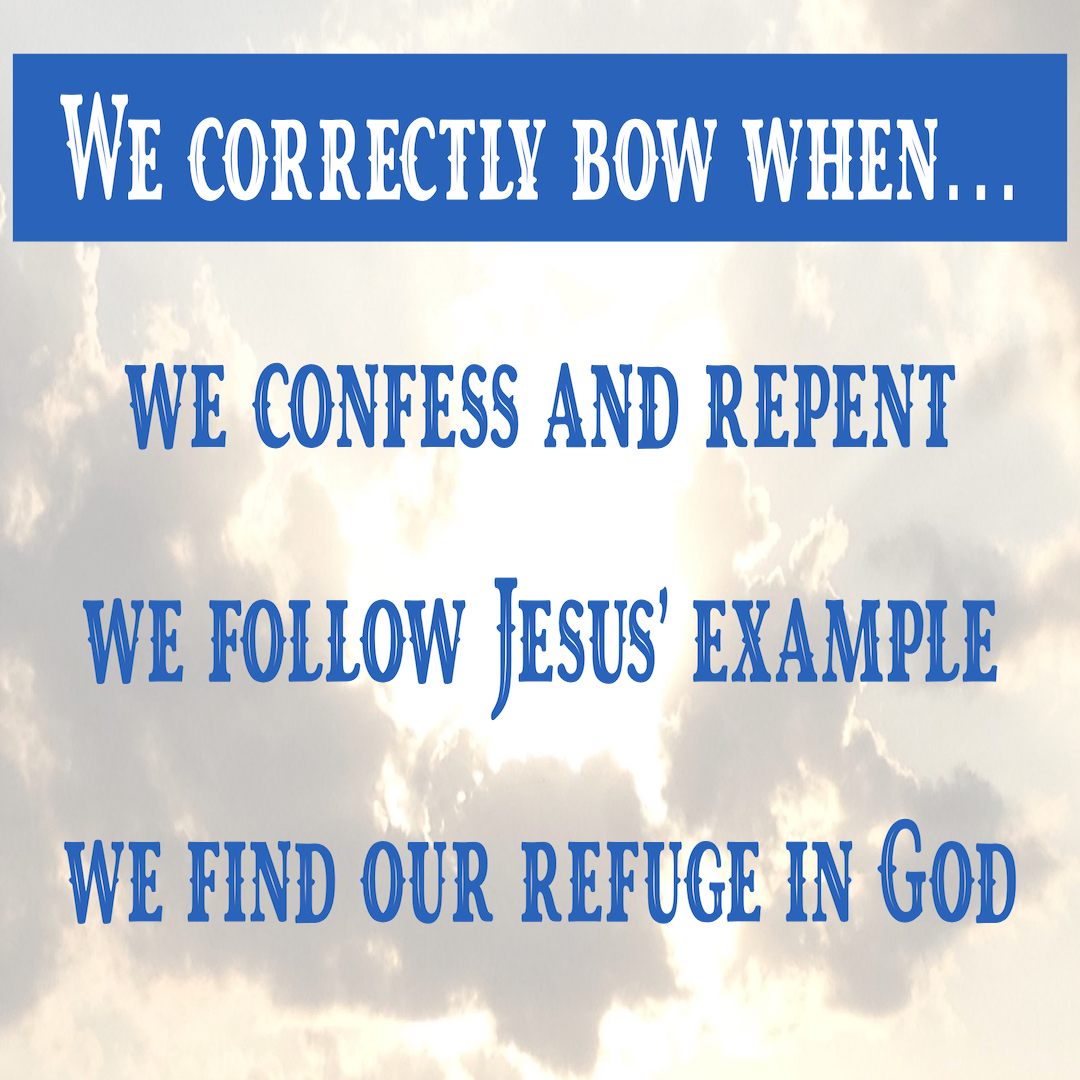
We mistakenly bow our knee to man when…

  • …we aren’t willing to own our mistakes 
  • …we try to administer our own “shove” of justice 
  • …we make our own refuge 

So we bow to the King when…

  • …we acknowledge, confess, and repent of our sins (vv. 3-5; Psalm 19:12, 69:5)
  • …we follow the example of Jesus when we’re shoved around (1 Peter 2:21-23)
  • …find our refuge solely in God (v. 1; c.f. 2:12; Ephesians 6:12; James 4:7)

Our best response in troublesome times—when you feel like you are being shoved around—is to fall to your knees in reverence to the King of kings (v. 17)! The beloved of the Lord shall dwell in safety by Him; He covers him all the day long, and makes His dwelling between his shoulders (Deuteronomy 33:12 AMPC). 

If you’ve missed any of the other messages in our series looking at the royal psalms, you can catch up by clicking here. 

►► Would you please prayerfully consider supporting this ministry? My Patreon supporters get behind-the-scenes access to exclusive materials. ◀︎◀︎

Links & Quotes

Even if the world’s legal system seems unjust, Jesus says by continuing to press our case with the public servants He has put in place, we are really trusting God to bring us His perfect justice. Check out my full sermon on how the Bible from Moses to Jesus explains how to define the legal term, “An eye for an eye, a tooth for a tooth.”

I have lots of new content every week, which you can check out on my YouTube channel.

“A significant amount of research and scholarship (both scientific and theological) indicates that a young Earth is the most straightforward, conservative way to interpret God’s Word. … The most unambiguous way to interpret the Bible is according to its grammatical-historical sense, or the intended meaning of the authors. A literal interpretation accounts for all figures of speech in the text, providing the most straightforward method of exegeting Scripture. To this point, when Jesus quoted the Old Testament, it was always clear that He considered its passages as factual and true.”  Check out the post Long Ages and the Bible—What’s the Problem? 

“Your brain is made up of neurons that communicate with each other through synapses. Delta-FosB is one of the chemicals that creates neural circuits—i.e., ‘pathways’—to help those neurons communicate more quickly and efficiently. … Basically, what you experience as getting better and better at something is your brain ‘rewiring’ itself to become faster and more efficient at sending the same messages between the same neurons.” This works for both healthy and unhealthy activities. In this article from Fight The New Drug, research shows how regular consumption of pornography is hampering your brain’s ability to have normal, healthy relationships.

Dr. Henry Halley, in his Halley’s Study Bible, observed, “Note, too, the unceasing emphasis on the resurrection throughout this book. It was the pivotal point in Peter’s sermon on Pentecost (2:24, 31-32), in his second sermon (3:15), and in his defense before the Sanhedrin (4:2, 10), It was the burden of the apostles’ preaching (4:33). It was Peter’s defense in his second arraignment (5:30). A vision of the risen Christ converted Paul (9:3-6). Peter preached the resurrection to Cornelius (10:40). Paul preached it in Antioch (13:30-37), Thessalonica (17:3), Athens (17:18, 31), and Jerusalem (22:6-11), to Felix (24:15, 21), and to Festus and Agrippa (26:8, 23).” You can check out all of the Scriptures he mentions in this quote here.

Stephen Witmer asks an important question: “Which is closer to the center of your life as a Christian: what you’re doing for God, or what God has already done for you through Jesus Christ? Which one grounds your identity more deeply, affects your mood more frequently, rouses your passions more highly? Your answer to these questions will deeply shape the stability, tenacity, happiness, boldness, and humility of your Christian experience. Jesus wants to provide you grounds for unshakable joy.” Check out this example Witmer shares from an exchange between Jesus and His followers. 

“Informing your opinion of the comparative merits of Christian men, never forget the old rule: ‘distinguish between times.’ Place yourself in each man’s position. Do not judge what was a right course of action in other times, by what seems a right course of action in your own.” —J.C. Ryle

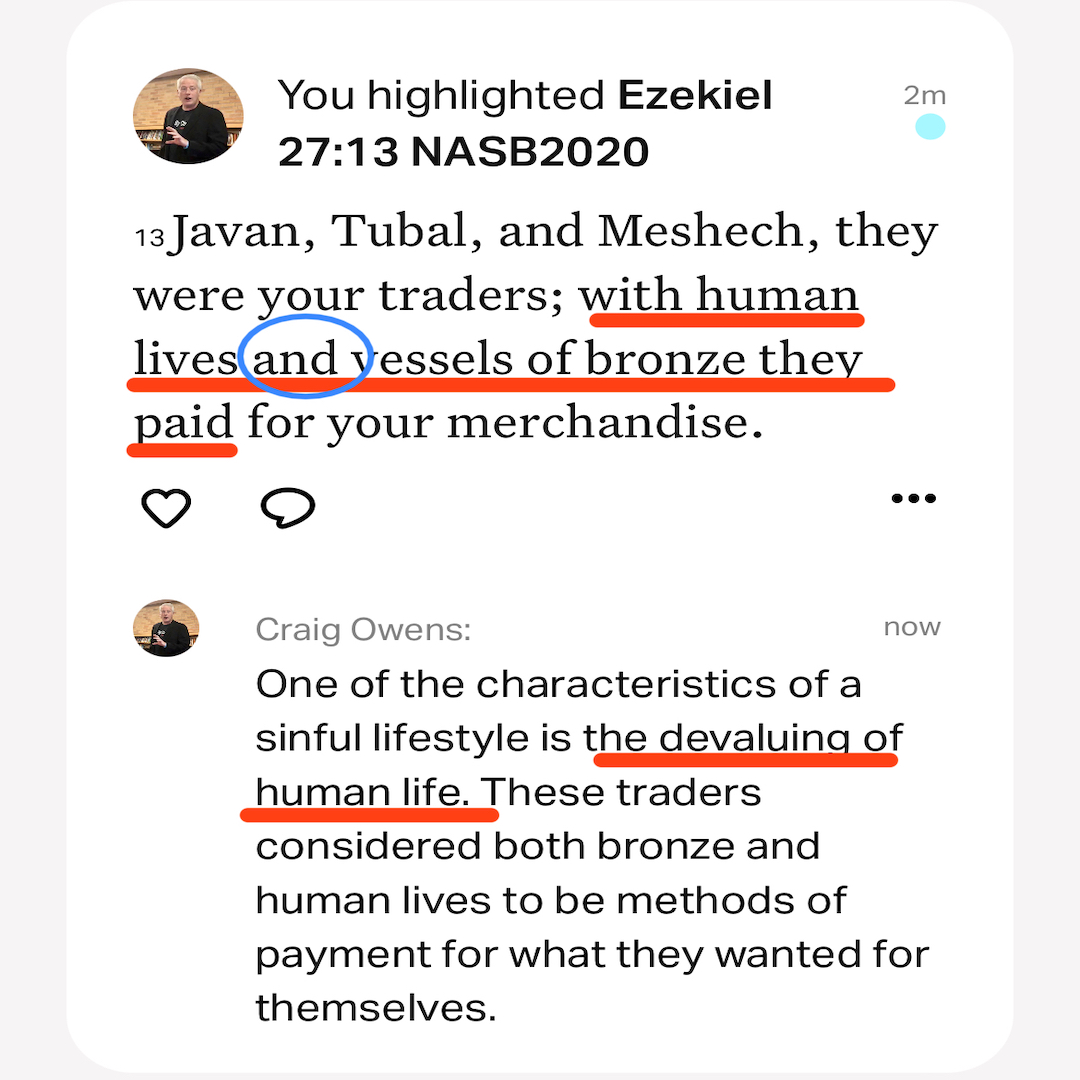
God holds human life as precious in His sight. Whenever anyone asks me why I support the sanctity of human life, my answer is simple, “Because God holds it sacred.” Consequently, God punishes those who devalue human life.

My friend, Pastor Tim Dilena, shares a thought about how God often uses people as the answer to our prayers.

Rules Can Be Overbearing—Love Never Is

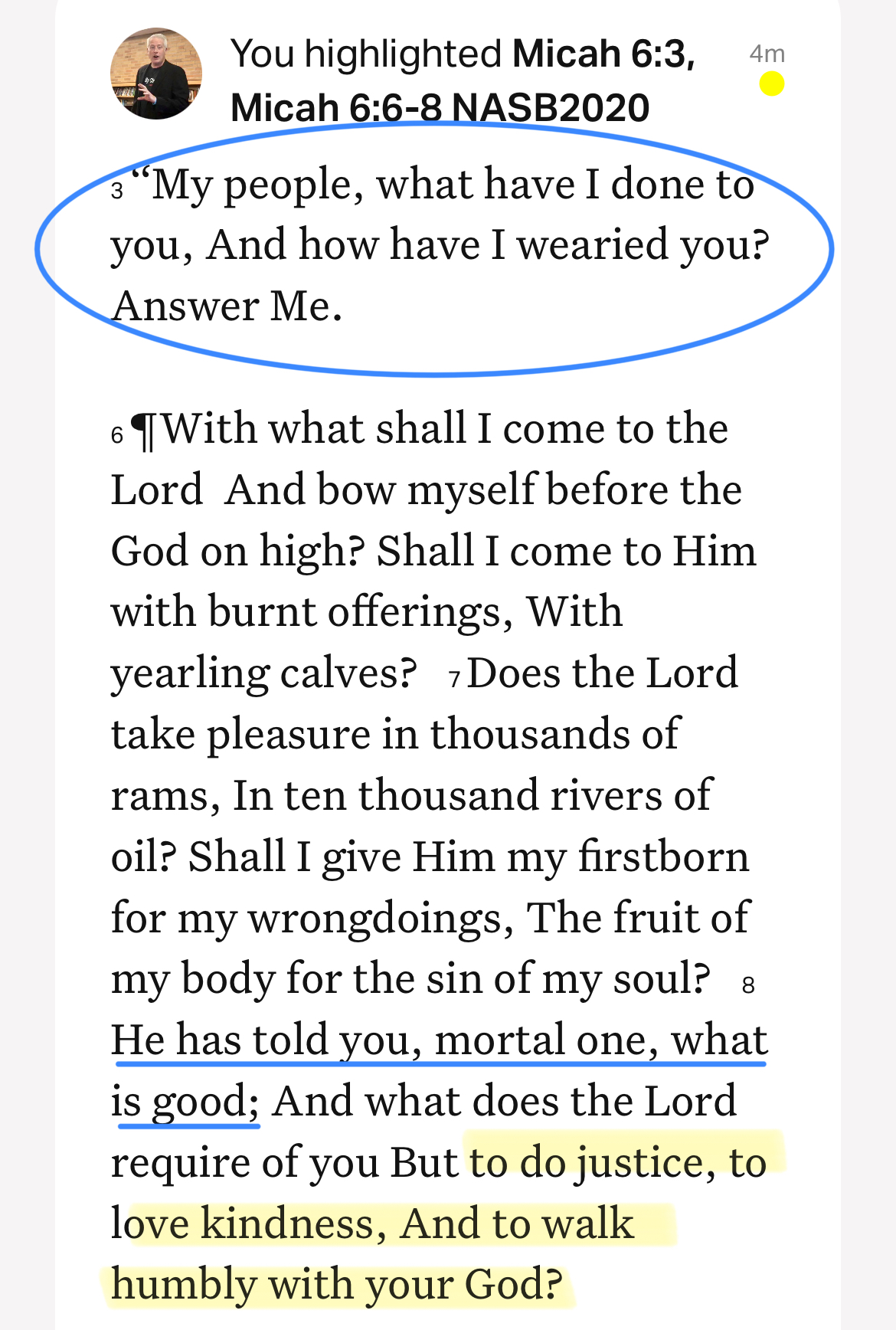
My people, what have I done to you, and how have I wearied you? Answer Me. … With what shall I come to the Lord and bow myself before the God on high? Shall I come to Him with burnt offerings, with yearling calves? Does the Lord take pleasure in thousands of rams, in ten thousand rivers of oil? Shall I give Him my firstborn for my wrongdoings, the fruit of my body for the sin of my soul? He has told you, mortal one, what is good; and what does the Lord require of you but to do justice, to love kindness, and to walk humbly with your God? (Micah 6:3, 6-8)

God doesn’t weary us with constantly changing or overbearing rules!

What God asks of us is that we give Him our heart (love the Lord your God with all your heart, soul, mind and strength), and then we live a life that shows His love to others (love your neighbor as yourself). 

That’s it: Love God, and then let justice, love, and humility flow out from that Source of love.

On a related note, check out these posts :

Links & Quotes

Healthy leaders look in the mirror first before they confront a teammate on something that needs to change. Check out the full conversation Greg and I had on The Craig and Greg Show about defeating the two-headed leadership killer of ignorance and arroganceI have lots of new content every week, which you can check out on my YouTube channel.

“I am often, I believe, praying for others when I should be doing things for them. It’s so much easier to pray for a bore than to go and see him.” —C.S. Lewis, Letters to Malcolm: Chiefly on Prayer

“The greatest weapon against stress is our ability to choose one thought over another.” —William James

The most empowered and empowering person is the one who remains in Jesus.

“Whereas three or more incidents of intense stress within a year (say, serious financial trouble, being fired, or a divorce) triple the death rate in socially isolated middle-aged men, they have no impact whatsoever on the death rate of men who cultivate many close relationships.” —Daniel Goleman, Richard Boyatzis & Annie McKee, Primal Leadership

T.M. Moore has an outstanding series of posts on how Christians should interact with the governments in the lands in which they live. I highly recommend this series to you. T.M. wrote, “We have seen that justice is a jewel of many facets. In its obligatory facet, justice requires that we love our neighbors simply because they are made in the image of God. We must regard them, and do with them, as we wish to be regarded and done with ourselves. In its preventive facet, justice demands that we use forethought in all our actions to make sure, as far as possible, that our neighbor or his property is not injured by what we do. Distributive justice encourages us to share generously with our neighbors and others in need. Restorative justice comes into play when the balance of neighbor love has become disturbed and the one guilty of disturbing it is required to set things right again. Each of these forms of justice, grounded in the Law of God, is very much a part of life in our society today. It is simply mindless or prejudicial to insist that we should have no input from Scripture or the Law of God, either in the public square or in the making of public policy. Our nation was founded on Biblical principles of justice, and to deny this is to rewrite history past and to put in jeopardy history to come.”

The Greek word translated as “consider” in Hebrews 3:1 means to observe closely, to consider attentively, to fix your eyes or mind upon it. In its context, this verb is usually directing us to the end result of being in awe, kindling a renewed faith, and being rejuvenated with a new resolve to move forward. This is what happens especially when we consider Jesus❣️

Don’t Try To Get Even

Listen to the podcast of this post by clicking on the player below, and you can also subscribe on AppleSpotify, or Audible. 

When I work with students I frequently find that conflicts between them are really one-upmanship. Here’s what I mean: one student intentionally or unintentionally tweaks another student, that student then responds with a decidedly intentional verbal or physical shove, which is responded to by the initial student with a louder and more intentional reprisal. And on and on it escalates until someone steps in to stop it.

I often ask these students who are upset with each other, “What did you think was going to happen when you treated the other person that way?” The quick response is almost always, “I don’t know.” And I believe that because most of us don’t think through the counter-reaction to our reaction. 

So I will ask a follow-up question: “Did you think that by shoving him in response to his insult that he was going to say, ‘Oops, my bad. I’m sorry for that and I won’t do it again’?” 

Usually, the student answers quite honestly, “No, I didn’t think that would happen.” They were just so upset that they wanted to let the other person know that they had been hurt.

This idea of getting even is the longing of so many of the psalms: How long until we see victory? (see Psalms 6, 13, 35, and 94 as examples). It’s the cry of the martyrs before God’s throne: How long until we see justice? It’s the desire of every Christian wrongly accused and condemned: God, how long until Your truth prevails? 

Matthew quotes a passage from Isaiah 42:1-4 that is fulfilled in the ministry of Jesus. Part of that description says, “A bruised read He will not break, and a smoldering wick He will not snuff out, till He leads justice to victory. In His name the nations will put their hope” (Matthew 12:20-21). Notice this key word: till HE leads justice to victory

Jesus is Justice and Truth, and He does ultimately triumph. But notice how Jesus accomplishes this because it is to be our model too: 

  • No quarreling 
  • No shoving back on those who have hurt us
  • No attacking those who have attacked me

Victory comes only through Jesus. I have to relent trying to balance the scales of justice—this is never my place. If I try to make things right on my own, my so-called justice only sets off a one-upmanship shoving match that continues to escalate in very ungodly ways. 

Vengeance is God’s. Justice is God’s. My hope—my immovable hope—is only in what Jesus has accomplished. Remember what Matthew quoted: “In His name the nations” [and all those who have been persecuted, wronged, and martyrd] “will put their hope”! 

Let’s all ask the Holy Spirit to remind us of this the next time we want to shove back the person who just shoved us. 

►► Would you please prayerfully consider supporting this ministry? My Patreon supporters get behind-the-scenes access to exclusive materials. ◀︎◀︎
It’s Just Not Fair

Listen to the podcast of this post by clicking on the player below, and you can also subscribe on AppleSpotify, or Audible. 

It’s not uncommon to hear children on the playground complaining, “That’s not fair!” Common but somewhat expected. 

Unfortunately, it still seems to be common among adults who feel they got the short end of the deal to grouse, “That’s not fair!” Common but immature. Sadly, I have to admit that there are times that I find myself complaining that I didn’t get a fair deal. 

If anyone could complain about not getting His “fair share” it would be God. He gives His all to people who easily forget His blessings, quickly chase after other things, and still grumble that they aren’t getting a fair deal. 

God never complains, but He does ask questions: “My people, what have I done for you? How have I burdened you? Answer Me” (Micah 6:3). In the next two verses, God twice calls on His people to “remember” all that He has done for them. 

We must answer God. But it seems to me that our obedience to Him is the only reasonable response to all of the blessings He has poured out on us. God doesn’t demand burdensome sacrifices from us, but He simply wants us to act justly, love mercy, and walk humbly before Him (v. 8). 

What God asks of me is out of all proportion with what He has given me, who He is for me today, and the future He has secured for me. 

Fair? No way, it’s completely unfair. God gives me everything and what He asks in return is so minor. Let’s make it our daily joy to act justly, to love mercy, and to walk humbly before our loving God! 

►► Would you please prayerfully consider supporting this ministry? My Patreon supporters get behind-the-scenes access to exclusive materials. ◀︎◀︎
The Key To God’s Treasure

Listen to the podcast of this post by clicking on the player below, and you can also subscribe on AppleSpotify, or Audible. 

…the fear of the Lord is the key to this treasure (Isaiah 33:6). 

What treasure is Isaiah referring to? There is an amazing list of blessings in this chapter! Things like…

  • God’s graciousness 
  • God’s strength
  • Salvation
  • God’s justice
  • God’s righteousness
  • A sure foundation
  • “A rich store of salvation and wisdom and knowledge” 
  • Eternally secure in God’s presence
  • Seeing God’s beauty 
  • Having evil people removed from my life 
  • Peace 

How do I get the key to this treasure? By placing my faith in Jesus. Jesus paid the price, so He could take the key from the devil and hold it securely. When I am in Him, I have access to this key to God’s riches! 

With all of this treasure accessible to me, how do I now live? In a word: Nobly. “But the noble make noble plans, and by noble deeds they stand” (Isaiah 32:8). I am a child of God, a joint-heir with Jesus. I lack no good thing, so I can live securely, gracefully, and nobly. I must live this way to bring glory to my Lord and my Master every single day! 

►► Would you please prayerfully consider supporting this ministry? My Patreon supporters get behind-the-scenes access to exclusive materials. ◀︎◀︎
Oy!

Listen to the podcast of this post by clicking on the player below, and you can also subscribe on AppleSpotify, or Audible. 

Woe is me!” said the prophet (Isaiah 6:5). 

The Hebrew word for “woe” here is the word “oy!” Although the word “woe” appears 20 times in the English translation of Isaiah, the Hebrew word “oy” is only used four times, and two of those times are Isaiah speaking of himself (6:5; 24:16). “Oy!” is a cry from a profound stab of pain from the realization that my sin has transgressed an All-Holy God. 

Isaiah saw his own sin (6:5) as well a the sin of his people (3:9, 11), and it took his breath away. He stood trembling before a holy God pleading for mercy and cleansing before he could answer the call to be God’s messenger to the people of Israel (6:5-8). 

The other Hebrew word that gets translated into the English word “woe” is “howy.” This is usually uttered from someone in pain because things aren’t going well. It’s a cry of, “Hey! Look! This is painful. This is not good at all.” But unlike “oy” which requires a profound heart change, “howy” can be said with the mouth without any change of the heart. 

Isaiah cried, “Oy!” because his sin deserved the punishment of the Righteous Judge, but his heart posture called on God’s mercy for forgiveness and restoration. Because of his cleansed heart, Isaiah could now call, “Howy!” to the people: “Hey, sinful Israel, look at your sin. Look at how you’ve transgressed against God. Feel that pain, then don’t delay, but cry out ‘Oy!’ to Him now, while mercy may still be found.” 

Isaiah’s “howy” had the impact of godly integrity because he had first cried “oy” in God’s presence. His “howy” was a call to others to do what he had done: see the holiness of God, see their sin, tremble in fear before an All-Holy God, and then cry “oy” to an All-Merciful God for forgiveness and restoration. 

We should do the same thing. When the Holy Spirit convicts you of sin, don’t merely say, “Hey (howy), that hurts!” But say, “Oy! I have sinned, but God is a merciful Forgiver of sin.” Let that stab of pain from the conviction of your sin bring a change in your heart as well as a cry from your lips. God is merciful, and He does forgive. 

►► Would you please prayerfully consider supporting this ministry? ◀︎◀︎

The Best Leadership Manual

Listen to the podcast of this post by clicking on the player below, and you can also subscribe on AppleSpotify, or Audible. 

When the righteous thrive, the people rejoice… (Proverbs 29:2). 

I have read hundreds of leadership books and biographies of history’s most influential leaders. But no book even comes close to the leadership principles I discover on an almost daily basis in my Bible. Without a doubt, my Bible is my go-to leadership Book! 

A great place to start mining leadership principles is the book of Proverbs. Take time to study just one of the 31 chapters each day, and you will be astounded at the leadership insights you will have gleaned by the end of the month. 

Take Proverbs 29 as an example. Reading through this chapter, I’m reminded that:

  • righteous leadership causes people to rejoice 
  • a leader builds stability through consistent justice, but bribes or showing favoritism undermines a leader’s foundation 
  • leaders who speak up for those without a voice of their own will continue to exert influence long after their tenure is over 
  • wise leaders energize people when they share a compelling vision 
  • justice comes through a righteous leader, but ultimate justice come from God

I even read an important warning for leaders who make it their goal to lead righteously: Bloodthirsty men hate a man of integrity and seek to kill the upright (v. 10). 

But even on the heels of that warning I read this assurance to continue to lead righteously: Fear of man will prove to be a snare, but whoever trusts in the Lord is kept safe (v. 25). 

A mark of a godly leader is one who is continually finding new leadership principles in the Bible. 

Try it for yourself and see how applying God’s wisdom will increase your influence as a leader. 

This is part 58 in my series on godly leadership. You can check out all of my posts in this series by clicking here.

►► Would you please prayerfully consider supporting this ministry? ◀︎◀︎

Godly Leaders Do God’s Justice

Listen to the podcast of this post by clicking on the player below, and you can also subscribe on AppleSpotify, or Audible. 

How long will you judge unjustly, and show partiality to the wicked? (Psalm 82:2)

It’s been said that those who attain a position of authority or leadership will make it their sole focus to retain that position of leadership, even to the point of judging unjustly or showing partiality to the wicked. 

In my book Shepherd Leadership: The Metrics That Really Matter, I wrote, “When God uses the word ‘Woe!’ we should definitely take that seriously. He uses that very word to warn shepherd leaders who were shirking their responsibility when He said, ‘Woe to those shepherds who only take care of themselves’ (Ezekiel 34:2).” 

God is the Ultimate Judge, yet while we are here on earth He chooses to allow men and women to be leaders and judges. We can do this in a God-honoring way only when we lead and judge like God. 

In this psalm, God Himself calls out the ungodly practices that self-serving leaders employ to keep themselves popular and in their positions of leadership: 

  • partiality = wickedness 
  • biases = wickedness 
  • apathy = wickedness 
  • injustice = wickedness 
  • ignoring = wickedness 
  • seeking earthly applause = wickedness 
  • taking advantage of others = wickedness 

Instead, God calls on leaders to lead according to the principles He both exhibits Himself and lists for us in the Bible. Things like…

  • defending the poor 
  • serving as a father to the fatherless
  • dispensing justice to the disempowered 
  • speaking up for the voiceless
  • standing up to the wicked 
  • and doing all of these things in a way that God is glorified 

I must always remember why I am in any position of leadership: God chose me for that position and placed me there to do His justice in the world. 

A mark of a godly leader is one who is doing God’s justice in God’s way.

This is part 57 in my series on godly leadership. You can check out all of my posts in this series by clicking here.

►► Would you please prayerfully consider supporting this ministry? ◀︎◀︎