Inspiration, Illumination, And Boldness

Listen to the podcast of this post by clicking on the player below, and you can also subscribe on AppleSpotify, or Audible. 

David declared that the Holy Spirit inspired the words he penned. “The Spirit of the Lord spoke in and by me, and His word was upon my tongue” (2 Samuel 23:2). 

Both Jesus and Peter affirm this in the New Testament as well when they make mention that David’s words were given to him by the Holy Spirit (Matthew 22:43; Mark 12:36; Acts 1:16, 4:25). 

It’s not just the words of David, but all Scripture is God-breathed (2 Timothy 3:16; 2 Peter 1:21)! This is why we would be wise to pray before reading our Bibles to ask the One Who inspired the Scripture to illuminate our minds to understand it and guide us into its daily application (John 14:26, 16:13). 

Jesus desired that we go even farther than this. His directive to His followers was for them to be baptized in the Holy Spirit. This initial baptism took place on the first Pentecost celebration after Jesus had ascended to Heaven. Luke records it this way—

And they were all filled (diffused throughout their souls) with the Holy Spirit and began to speak in other (different, foreign) languages (tongues), as the Spirit kept giving them clear and loud expression in each tongue in appropriate words. (Acts 2:4 AMPC) 

And in the subsequent verses Luke makes it clear that these were intelligible languages and intelligent words that served as a testimony to the worldwide visitors that were in Jerusalem—

And when this sound was heard, the multitude came together and they were astonished and bewildered, because each one heard them—the apostles—speaking in his own particular dialect. And they were beside themselves with amazement, saying, “Are not all these who are talking Galileans? Then how is it that we hear, each of us, in our own (particular) dialect to which we were born? Parthians and Medes and Elamites and inhabitants of Mesopotamia, Judea and Cappadocia, Pontus and the province of Asia, Phrygia and Pamphylia, Egypt and the parts of Libya about Cyrene, and the transient residents from Rome, both Jews and the proselytes to Judaism from other religions, Cretans and Arabians too—we all hear them speaking in our own native tongues and telling of the mighty works of God!” (vv. 6-11 AMPC) 

In his sermon that followed this event, Peter states that the baptism in the Holy Spirit—with the physical evidence of speaking in tongues—is an evidence of Christ’s resurrection. “Being therefore lifted high by and to the right hand of God, and having received from the Father the promised blessing which is the Holy Spirit, He has made this outpouring which you yourselves both see and hear” (v. 33). 

Later on, when the Christians were facing the threat of persecution from the Jewish leadership, they prayed. In their prayer, they noted again the Spirit-inspired words that David penned and the desire of Jesus for them to be His missionaries (see Acts 4:24-30). 

God answers their prayer powerfully! “And when they had prayed, the place in which they were assembled was shaken; and they were all filled with the Holy Spirit, and they continued to speak the word of God with freedom and boldness and courage” (v. 31). 

The Holy Spirit gave us the Scripture, and He illuminates the Scripture to us. 

The Holy Spirit assures us of our salvation, and He empowers us to share this Good News with others. 

The Holy Spirit gives us words to speak, and He gives us the boldness and courage to speak them. 

He speaks, He illuminates, He empowers, He emboldens! If your theology limits the work of the Holy Spirit to some obscure corner of your world, you are robbing yourself of the power to live a God-glorifying, Jesus-promoting life. 

You may be interested in some additional posts and sermons where I discuss more about the initial physical evidence of speaking in tongues as the Holy Spirit empowers Christians—

You may also be interested in an extensive series of messages I have shared called We Are: Pentecostal. 

►► Would you please prayerfully consider supporting this ministry? My Patreon supporters get behind-the-scenes access to exclusive materials. ◀︎◀︎

Links & Quotes

You and I will learn lessons in the hard times that we could learn no other way. Then God will use those lessons so we can help minister to others in their hard times. Check out my sermon about interceding for other saints.

I have a lot of new video content on my YouTube channel every week. Please check it out and subscribe so you don’t miss anything.

Because the Bible is God-breathed, it is as historically accurate as it is applicable to our daily lives. I love these archeological biographies that the Bible Archeology Report presents. This one is about Babylonian king Merodach-Baladan II. 

ICR’s Dr. Randy Guliuzza says, “Convergent evolution is the fabricated conjecture evolutionists invoke to explain very similar characteristics between creatures that could not have been inherited from a common ancestor and that evolutionists will never accept as having been produced by an intelligently designed internal programming that is specified for common purposes.” This particular article is about bats which have always had the ability to fly. Not one fossil record shows any flightless bats because God created them as flying mammals. 

In the early 1900s, Albert Norris was a missionary in India, observing firsthand the spiritual and physical hardships the people faced there. In an article in the Pentecostal Evangel, Norris wrote, “A Christianity that coldly sits down, and goes on its routine of formal work, and allows its fellowmen to starve, or to be obliged to go through all the hard sufferings and exposure connected with famine, without effort to help them, might as well quit its preaching.”

In answering a question about using AI to write a sermon, John Piper answers with an emphatic “no.” I agree! One of the reasons Piper shares: “One of the qualifications for being an elder-pastor-preacher in the Bible is the gift or the ability to teach, didaktikos (1 Timothy 3:2). That means you must have the ability, the gift, to read a passage of Scripture, understand the reality it deals with, feel the emotions it is meant to elicit, be able to explain it to others clearly, illustrate and apply it for their edification. That’s a gift you must have. It’s your number-one job. If you don’t have it, you should not be a pastor.”

“You don’t try to forget the mistake, but you don’t dwell on it. Don’t let it have any of your energy, or any of your time, or any of your space.” —Johnny Cash 

Links & Quotes

Christian parents often experience both a weight and a wait as they pray for their children. Biblical waiting is always active, calling us to continue to pray for our kids—not matter how old they are!

I have a lot of new video content on my YouTube channel every week. Please check it out and subscribe so you don’t miss anything.

The Institute for Creation Research reported: “Perhaps one of the top evidences for creation are the subcellular and incredibly efficient molecular protein machines that clearly function by known engineering principles. They are hardly simple. Determining just a part of their function requires the best science has in twenty-first-century technology: ‘While belonging to the nanoscale, protein machines are so complex that tracing even a small fraction of their cycle requires weeks of calculations on supercomputers.’”

Dr. Thaddeus Williams said, “What do you think is the most repeated phrase in the entire Bible? It’s, ‘Thus says the Lord…’ which clocks in at over 400 occurrences. The God of the Bible is not the stone-cold silent god of the ancient Greeks. Nor is He the stone-cold silent god of the ancient Stoics or Epicureans, too busy enjoying the amenities of divine bliss to bother with humanity. No. The God who exists is a God who speaks.” What does this mean for us? Dr. Williams talks about what happens to people who make time to regularly hear what God has to say to them through His Word.

“Work is the outcome of effort; fruit, of life. A bad man may do good work, but a bad tree cannot bear good fruit.” —Hudson Taylor 

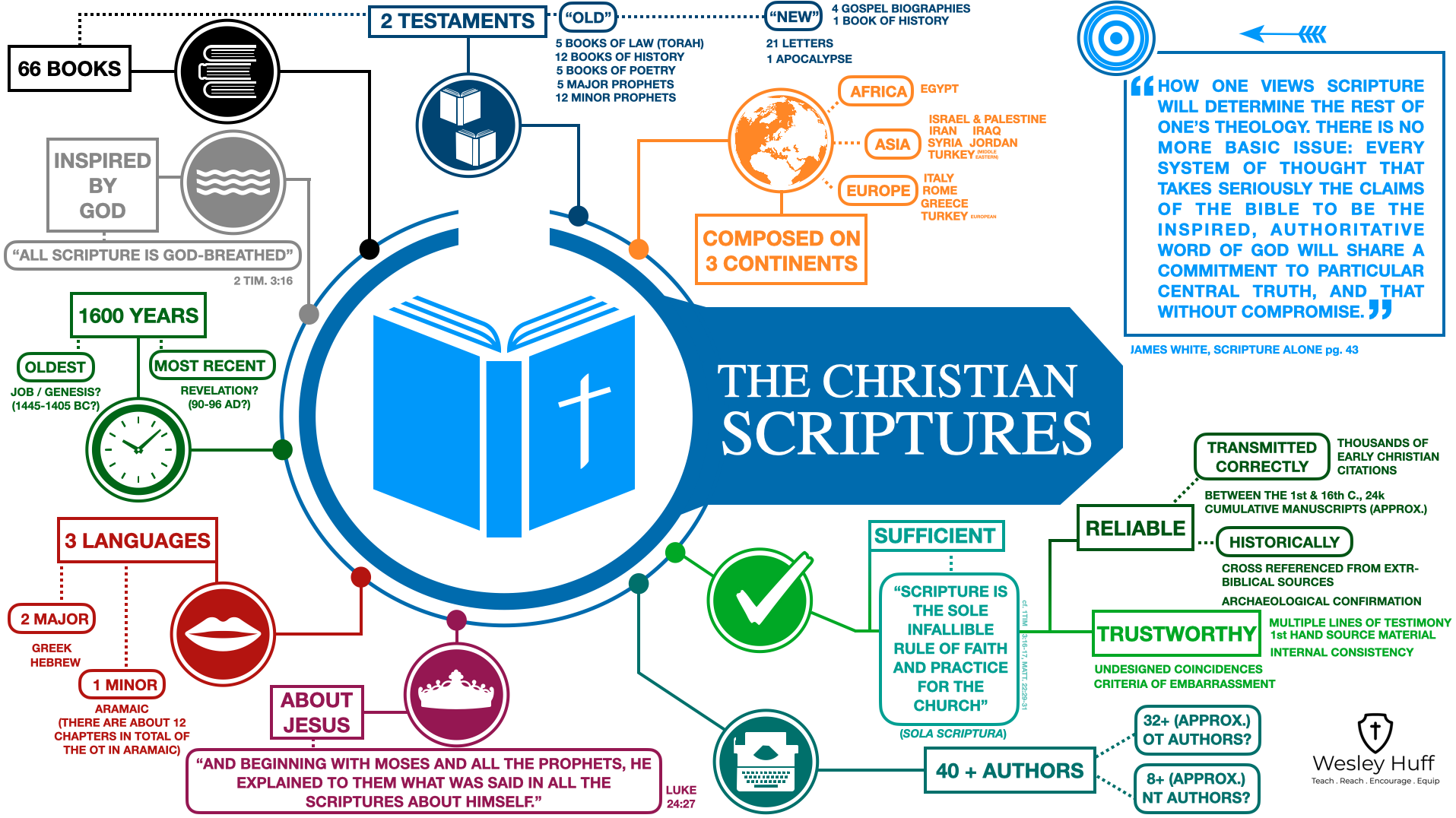
I love studying my Bible, and I also enjoy passing along things that encourage others to begin studying their own Bibles. This is a really cool infographic from Wesley Huff, giving a great overview of the Bible.

Dr. Steve Nichols has an interesting mini-biography of King Louis IX, whom some have called “the greatest king of the Middle Ages.”

J. Warner Wallace leads us all along “the fuse” that led up to the arrival of Jesus as the Messiah, the One to whom the Old Testament prophets predicted.

The Confirming Details

Listen to the podcast of this post by clicking on the player below, and you can also subscribe on AppleSpotify, or Audible. 

A couple of years ago I was in a car accident, but I never saw the car that hit me. Fortunately, the driver in the vehicle right behind me, a driver who was nearly hit by the car who hit me, and another driver waiting at the same intersection all shared their stories with the sheriff’s deputy. All of their stories had slightly different details, but putting all of their accounts together, they gave the deputy a complete story of what happened.

This is one of the features throughout the Bible that repeatedly convinces me that the events are both historically accurate and divinely inspired. I love reading the Old Testament prophecies that are fulfilled in the New Testament, the different perspectives the four Gospel writers give of the public ministry of Jesus, and the details in the epistles that correspond with the historical accounts found elsewhere (both inside and outside Scripture). 

Luke was one of the Gospel writers who also wrote a sequel called the Book of Acts. In this historical record of the early church, he documents many confirming details. For example, consider the story of Saul’s encounter with Jesus on the road to Damascus. Luke tells us the story in Acts 9, and then repeats the story as Paul is telling it to different audiences in chapters 22 and 26. Without the details that Luke records, skeptics could easily chalk up Saul’s experience to a hallucination or even madness, as Governor Festus claimed in Acts 26:24. 

(Check out all of these biblical passages by clicking here.)

For instance, the bright light that got Saul’s attention was seen by both Saul and his companions that were traveling with him. These were Jews who shared Saul’s hatred of Christianity, so they would have no desire to bolster Saul’s story after he himself became a Christian. The brilliance of this light knocked all of the travelers to the ground (9:3–8; 22:6–7, 11; 26:13–14). 

Everyone heard the voice of Jesus speaking to Saul, although Saul was the only one who could understand His words spoken to him in the Aramaic language (9:4–7; 22:7–9; 26:14). 

All of Saul’s companions and a Jewish Christian named Ananias could attest to Saul’s physical blindness after being exposed to this bright light (9:8, 17–18; 22:11–13). 

Ananias confirmed what Jesus had said to Saul, although he was in Damascus (and not on the road with him) when Jesus spoke to Saul. This was because Ananias had also been given a vision of what was happening with Saul, and what Jesus had said to him (9:10–17; 22:12–16). 

All of these confirming details assure us that Saul was not hallucinating, nor did he concoct some fantastic tale to thrill his audiences. This was an actual historical event that is attested to by many sources. 

This is the consistent evidence we find throughout all of Scripture. This means that we can trust both the divine inspiration and the historical reliability of everything we read in the Bible.

►► Would you please prayerfully consider supporting this ministry? My Patreon supporters get behind-the-scenes access to exclusive materials. ◀︎◀︎
Links & Quotes

Having too many items listed as “priorities” on your To Do list can actually paralyze you. You have keep your list manageable to keep your leadership effective. Check out the full conversation Greg and I had on setting goals and making changes. This is also an important aspect of maintaining good mental health.

I have lots of new content every week, which you can check out on my YouTube channel.

According to Leslie T. Lyall, the secret of Hudson Taylor’s life and ministry could be summed up in four simple propositions: “There is a living God. He has spoken in His Word. He means what he says. And He is willing and able to perform what He has promised.”

“Hard times create strong men. Strong men create good times. Good times create weak men. And, weak men create hard times.” —G. Michael Hopf

In lamenting the rise of worldliness in our churches, John Piper said, “About forty years ago, David Wells wrote a book called No Place for Truth, which made the case that in the American church, God rests far too lightly on the people of God. He doesn’t have weight. It was the same heart cry from Dr. Wells as from J.B. Phillips. God is marginal. God has little weight in our worship services and little weight in our lives. He’s taken lightly. He’s simply one among many factors rather than the all-consuming factor, and I have thought that if I were to write a book today with a similar burden, it might have this title: Your Christ Is Too Cheap, Your Heaven Is Too Distant, Your Earth Is Too Big.”

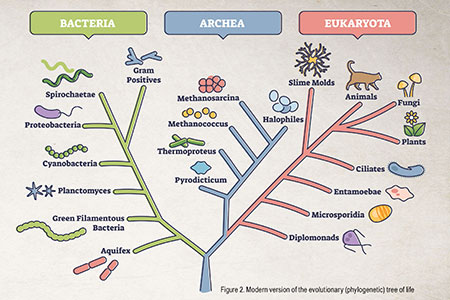
The Institute for Creation Research reported, “In July of 2024, Science magazine confidently reported, ‘The last ancestor shared by all living organisms was a microbe that lived 4.2 billion years ago, had a fairly large genome encoding some 2600 proteins, enjoyed a diet of hydrogen gas and carbon dioxide, and harbored a rudimentary immune system for fighting off viral invaders.’ That’s quite a statement that details an unknown creature living somewhere on this planet 4.2 billion years ago.” Of course, this is an unobservable, unprovable claim, but that’s part and parcel of the evolutionists’ claims. 

Fight The New Drug explains what sextortion is and how to protect yourself and your family from this insidious online threat.

“What we do on some great occasion will probably depend on what we already are; and what we are will be the result of previous years of self-discipline.” —H.P. Liddon, nineteenth-century theologian 

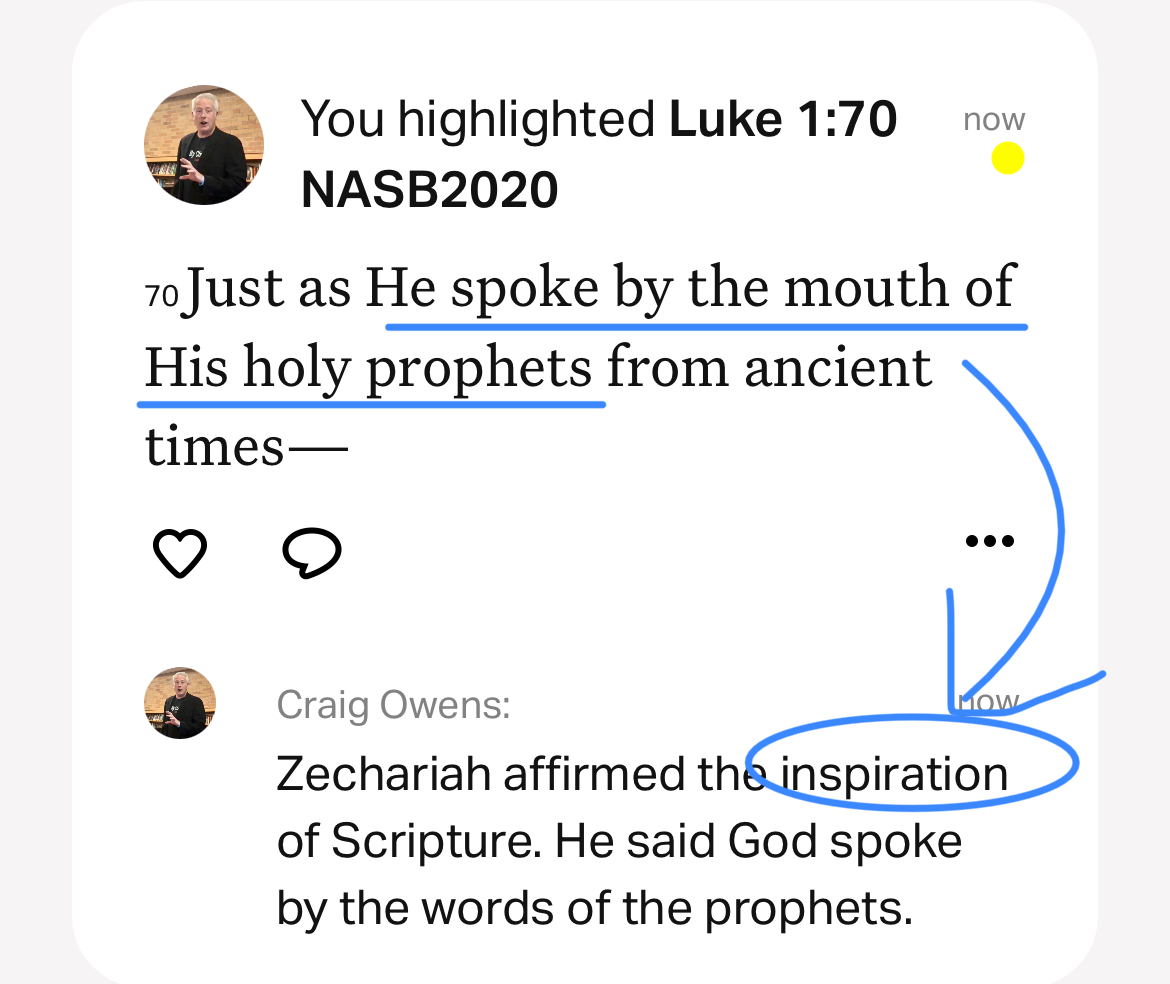
Lenny Esposito has a great podcast for Christian apologists called the Come Let Us Reason podcast. On a recent episode, Lenny used a passage in the Book of Jeremiah to talk about the inspiration of Scripture.

“God will work when He pleases, how He pleases, and by what means He pleases. He is not bound to keep our time, but He will perform His word, honor our faith, and reward them that diligently seek Him.” —Matthew Henry 

As the first Christian church dealt with a serious complaint that could have split the church internally, there are a number of leadership gifts that are in play to provide a wise solution. Most of these leadership gifts get overlooked by the casual observer, but they are all absolutely indispensable. This is new exclusive content I regularly share with my Patreon supporters. Would you prayerfully consider supporting this ministry?

Links & Quotes

A.W. Tozer said, “There’s an awesomeness about God which is missing in our day altogether; there’s little sense of admiring awe in the Church of Christ these days.” May we repent of little prayers and boldly pray to an awesome God who wants to do awesome things that will bring Him glory!

I have lots of new content every week, which you can check out on my YouTube channel.

I always smile at the archeological discoveries which confirm the historicity of the Bible! Discovery after discovery keeps reinforcing that the Bible is a reliable historical document—which is exactly what one would expect from the inspired Word of God. Here are two recent article: (1) An archeological biography of the Assyrian king Ashurbanipal, and (2) The excavation of a rare Roman prison in Corinth that “likely gives us a picture of those that held the apostles as recorded in the New Testament (e.g. Acts 5:18, 12:5, 16:23).”

This is a very informative Q&A session with cold case detective and Christian apologist J. Warner Wallace. But I especially like his answer to the first question: Do Christians have to investigate every other religion to be convinced that the Bible is true?

“Faith untried may be true faith, but it is sure to be little faith, and it is likely to remain dwarfish so long as it is without trials. Faith never prospers so well as when all things are against her: tempests are her trainers, and lightnings are her illuminators. … No flowers wear so lovely a blue as those which grow at the foot of the frozen glacier; no stars gleam so brightly as those which glisten in the polar sky; no water tastes so sweet as that which springs amid the desert sand; and no faith is so precious as that which lives and triumphs in adversity. … Faith increases in solidity, assurance, and intensity, the more it is exercised with tribulation. Faith is precious, and its trial is precious too.” —Charles Spurgeon 

“Mature Christians can be recognized by a variety of indicators. They feast on the Word of God (Hebrews 5:14), persevere in love and good works (Hebrews 6:9-10), bear the fruit of the Spirit rather than the marks of the flesh (Galatians 6:16-23), use their gifts to help build the church (1 Corinthians 12:7-11; Ephesians 4:12-16), teach the things of Jesus to others (Hebrews 5:12: Acts 1:8), and more. This, the New Testament insists, is the condition toward which every Christian strives.” —T.M. Moore (check out all of the Scriptures T.M. references here

“Now is the accepted time, not tomorrow, not some more convenient season. It is today that our best work can be done.” —W.E.B. Du Bois 

Jesus shows us that only secure people can serve others. Insecure people won’t ever make themselves vulnerable, and so they miss out on God’s blessing. I address this in more depth in my book Shepherd Leadership.

God In The Footnotes?

Listen to the podcast of this post by clicking on the player below, and you can also subscribe on AppleSpotify, or Audible. 

Can we trust our Bibles? There are some things that skeptics point to that we need to be able to defend—even in this model prayer that we have been studying. We come to the last verse of this prayer, which many of you probably learned or heard as, “For Yours is the kingdom and the power and the glory forever. Amen.” Yet some Bibles have a footnote here that notes that this doxology is not seen in all biblical manuscripts. 

How are we to handle this observation, and others like it in places like Mark 16:9-20 and John 7:53-8:11? 

Let’s start with how we got the Bibles we have today, because it is very instructive. 

We don’t have the autographs (original writings) but we have manuscripts (copied by a trained scribe from the autograph, and then copied from by yet another reliable scribe, and so forth). The oldest calfskin manuscript we have goes back to 1500 BC, and the oldest papyrus manuscript goes back to 2400 BC. 

The scribes were incredibly talented and disciplined men. They became a recognized group called the Sopherim (scribes) in about 500 BC. By AD 100, the Talmudic scribes eclipsed them, and then the Masoretic scribes—the most stringent scribes of all—dominated from AD 500-900. 

Let’s turn our attention first to the manuscripts that compromise what we call the Old Testament. What did Jesus—and others that lived in His time—call those 39 books of the Old Testament? They were called Scripture. Those books were not in doubt even before Jesus was on earth. 

Dr. Peter Flint notes, “The biblical Dead Sea Scrolls are up to 1,250 years older than the traditional Hebrew Bible, the Masoretic text. We have been using a one-thousand-year-old manuscript to make our Bibles. We’ve now got scrolls going back to 250 BC. … Our conclusion is simply this—the scrolls confirm the accuracy of the biblical text by 99 percent.” 

In the New Testament era, the disciples of Jesus went out in pairs. Their oral transmission of the news of Jesus and the quoting of Scripture was verified by their traveling partners. Even for those who happened to be by themselves (e.g. Philip in Samaria), there was always follow up by other church leaders. 

So the New Testament epistles were written to verify the spoken words—James was the earliest (probably AD 45). The number of manuscripts we have of these New Testament words are simply astounding! 

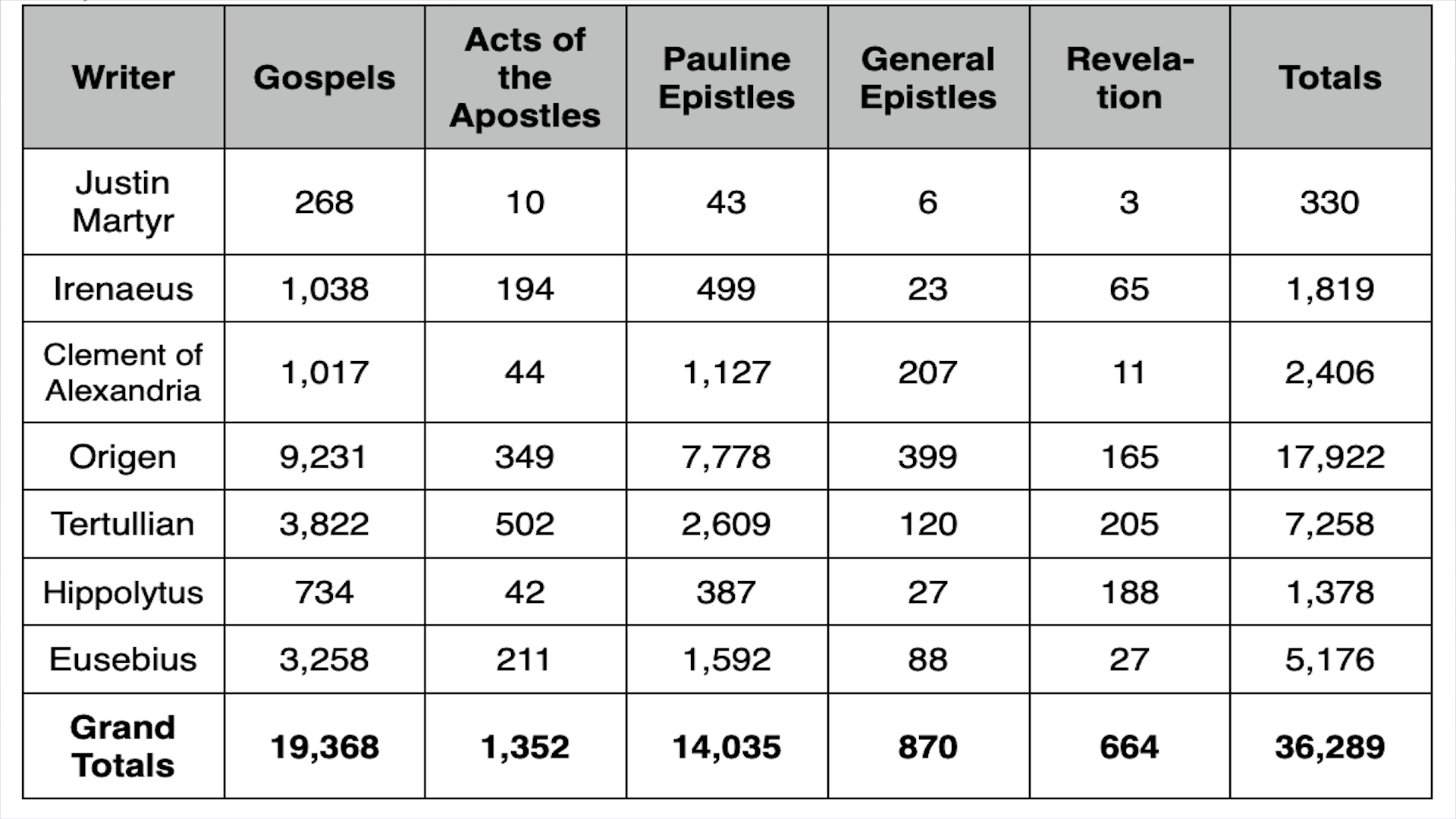
After the canon of the New Testament was completed, the church fathers quoted so much of the New Testament in their letters and books that we could completely reconstruct those 27 books just from their writings. 

With this many manuscripts in existence, is it likely that there would variations in manuscripts? Yes. But none of the variations ever discovered have been fundamental enough to change anything in the meaning. Josh McDowell states, “Compared with other ancient writings, the Bible has more manuscript evidence to support it than the top ten pieces of classical literature combined.” 

So how do we handle these places where scholarly footnotes tell us of a discrepancy in the existing manuscripts? 

  1. Get the context—does this fit with what is happening around it? 
  2. Is there corroboration—can we cross-reference it from elsewhere in the Bible? 

In the conclusion of the powerful model prayer Jesus has given us, the closing words appear to be a doxology. But I think we can trust this because for three main reasons: 

  1. This doxology seems to come full circle with how the prayer begins in: Our Father in heaven, hallowed be Your name, Your kingdom come, Your will be done, on earth as it is in heaven (vv. 9-10). 
  2. These words are found almost verbatim in the words of David: Yours, Lord, is the greatness and the power and the glory and the majesty and the splendor, for everything in heaven and earth is Yours. Yours, Lord, is the kingdom; You are exalted as head over all (1 Chronicles 29:11). 
  3. Finally, these words are similar (if not identical) to the words that John records he heard in Heaven—Revelation 4:11; 5:12-13; 7:12; 11:15-17 

As we have noted throughout this prayer series, the focus of this prayer is two-fold: It is both an acknowledgement of the awesome, praiseworthy glory of our God, and it is a petition for our lives to be empowered to help others see our glorious God and Savior for themselves. 

For these reasons, this doxology, I believe, is an indispensable part of this majestic prayer. 

If you missed any of the other messages in this series, you can check them all out here. 

►► Would you please prayerfully consider supporting this ministry? My Patreon supporters get behind-the-scenes access to exclusive materials. ◀︎◀︎

The Lens For Difficult Biblical Passages

Listen to the podcast of this post by clicking on the player below, and you can also subscribe on AppleSpotify, or Audible. 

If you’ve ever found sections of the Bible difficult to understand, I’ve got a few thoughts to help you out.

Check out this episode of The Podcast.

Resources mentioned in this video:

►► Would you please prayerfully consider supporting this ministry? My Patreon supporters get behind-the-scenes access to exclusive materials, like this recent video where I explain how God reveals previously-unknown truths to us. Become a supporter today and get instant access to everything I have already shared with my supporters. ◀︎◀︎

Links & Quotes

The Holy Spirit loves to give us those “lightbulb moments” when the Word of God almost leaps off the page! I have lots of new content every week, which you can check out on my YouTube channel.

It has long been believed that some migratory animals use the earth’s magnetic force to help them navigate. Some researchers discovered that moths can see both the magnetic fields and the stars to plot their course. The lead researcher wrote, “If you have this tiny insect with a brain a tenth the volume of a grain of rice and eyes smaller than a pinhead, that they can do this is surprising.” The protein in their eyes that allow them to do this is unevolved—it’s always been there, implant from the beginning by our awesome Creator!

In the God Speaks Science reading plan on YouVersion, John Von Sloten wrote, “Creation is God’s first book. To read it we need science. Science is not the enemy of the Christian faith; it’s an ally! … We need to read biblical creation references with the Author’s omniscience and original intent in mind. To do that, we need science. … What if you try to connect the next scientific truth you encounter to an attribute of our ever-near God? If everything comes from God’s mind, then everything has something to say about God’s nature.”

Competitive leaders need to keep both winning and losing in perspective. Check out the full conversation Greg and I had about competition on The Craig and Greg Show.

I love studying the archeological discoveries that confirm the historicity of the Bible. Check out this compilation of the kings of Judah and Israel from The Bible Archeology Report. You may also be interested in this side-by-side chart I created of the timelines of these kings.

“Men of peace must not think about retribution or recrimination. Courageous people do not fear forgiving.” —Nelson Mandela

“Leaders inspire others because they are inspired by others.” —John Maxwell

“The most important single ingredient in the formula of success is knowing how to get along with people.” —Teddy Roosevelt

Power-Packed Sermons

Listen to the podcast of this post by clicking on the player below, and you can also subscribe on AppleSpotify, or Audible. 

Jesus began to speak to them in parables… (Mark 12:1). 

What Jesus relates here in the 12th chapter of Mark’s Gospel is only the fourth parable that Mark records, and as the final parable that Jesus shares, it brings His public ministry to a close. 

Jesus concludes this parable by quoting from Psalm 118. This Psalm is the last of the “Hallel Psalms” that were sung at the conclusion of the Passover celebration. This song specifically looks eagerly forward to the arrival of the Messiah. It contains the words that the crowd used on Palm Sunday: “Lord, save us! Lord, grant us success! Blessed is He who comes in the name of the Lord” (Psalm 118:25-26). By quoting from the same Psalm—that was perhaps hundreds of years old, but had just been sung and shouted by the crowd—Jesus was claiming to be the Messiah longed for in that Hallel Psalm. 

As you may recall, these shouts from the crowd and the activities of Jesus as He cleansed the temple got the religious leaders riled up! They, in essence, asked Jesus, “Who do You think You are?!” His answer is contained in this parable of Mark 12. 

At the conclusion of this parable, the religious leaders “knew He had spoken this parable against them” (Mark 12:12).

Mark’s observation about the response of the religious leaders is, in a nutshell, the essence of a Holy Spirit-anointed sermon. The connection of Scripture to current events is powerful! The Holy Spirit is also the One who brings the application of Scripture to bear on the hearts of the audience.

Pastors, if you want to deliver soul-shaking, life-transforming, eye-opening, heart-melting sermons, you must follow this example of Jesus: Stick with the Scripture! 

We don’t need to try to be clever or witty or even memorable. We just need to speak the Word of God that is inspired by the Holy Spirit, and then allow the Holy Spirit to illuminate that inspired Word to each person’s needs. As Randy Pope noted, “Preaching is not talking to people about the Bible; it is talking to people about themselves from the Bible.” 

I don’t want to try to make my voice impress people, but I am desperate for God’s voice to impact people. Nearly every week as I prepare a sermon, I’ll pray this prayer from Oswald Chambers: “In my preaching, cause Thy glorious voice to be heard, Thy lovely face to be seen, Thy pervasive Spirit felt.” My dear pastor, I would encourage you to make this your prayer as well. 

►► Would you please prayerfully consider supporting this ministry? My Patreon supporters get behind-the-scenes access to exclusive materials. ◀︎◀︎