13 Introspective Questions From “Longing For A Changed World”

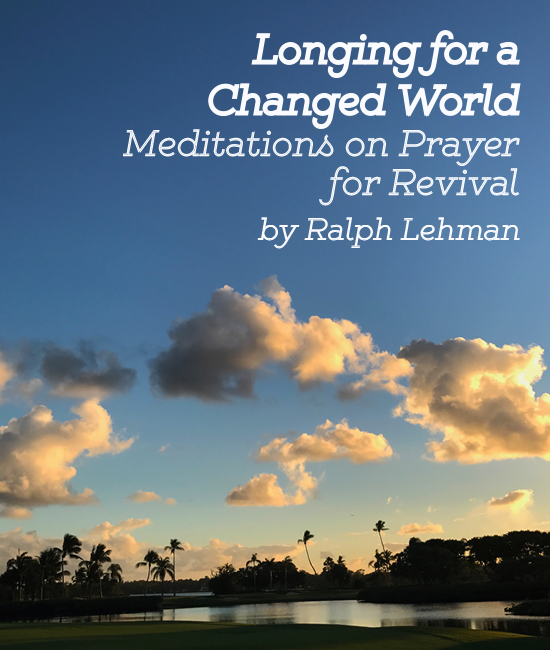
As Ralph Lehman made his case for Christian to (re)establish a prayer focus for revival in his book Longing For A Changed World, he asked several penetrating questions. Here are a few of them for you to consider.

“[Josiah’s revival] was one revival that began with the leaders of government. Are we praying for our leaders?”

“Our government has entered many areas that were once considered to be the Church’s sphere of ministry. How can we lead our churches back into these areas?”

“Have you considered that you are grieving the Spirit when you deprive Him of conversing with God by choosing not to pray?”

“As men of prayer, should we not strive to be like the great prayer warriors of the Bible?”

“Tertullian, a church father who lived in the Roman Empire around 200 A.D., stated that the Roman emperor and his armies benefited greatly from the prayers of the Christians who interceded on their behalf. Can we present the same argument to our political leaders today?”

“What would we be willing to leave or to set aside for the sake of more time in prayer, seeking the Kingdom and righteousness of God?”

“Do we seek the Lord of revival, or merely desire His blessings?”

“If we do not enjoy God’s presence, through His Word and prayer, we are missing the true blessing God intends for us—the blessing of Himself. If we will not seek the presence of God day by day, how can we expect Him to go with us in our daily lives?”

“If God was willing to take the Israelites into the Promised Land without His presence [Exodus 33:3-4], what does this say to the proponents of the ‘health and wealth’ gospel?”

“Even though we have been blessed immeasurably by living here in the United States, do our hearts long for God’s rule to be acknowledged in our land? Do we yearn to abide in His presence? Or are we idle in our contentment with the milk and honey?”

“Sometimes, our areas of giftedness become spheres where we fail to ask God for strength. Have you considered your strengths may be the very areas that satan exploits?”

“Are we praying for revival, are we also praying that we would conduct ourselves in such a way that the world would take notice, even if this meant for us to suffer?”

“Is the God of today’s church big enough to surprise us?”

You can check out some other quotes from Longing For A Changed World by clicking here, and my full book review is available here.

Thursdays With Oswald—A Biblical View Of Government

Oswald ChambersThis is a weekly series with things I’m reading and pondering from Oswald Chambers. You can read the original seed thought here, or type “Thursdays With Oswald” in the search box to read more entries.

A Biblical View Of Government

     The Bible point of view about government is that God compels men to govern man for Him, whether he likes it or not. The ordinance of government, whether it is a bad or good government, does not lie with men, but is entirely in God’s hands; the king or the government will have to answer to God (cf. 1 Peter 2:13-14). … 

     In politics also it is difficult to steer a course; there is a complication of forces to be dealt with which most of us know nothing about. We have no affinity for this kind of thing, and it is easy to ignore the condition of the men who have to live there, and to pass condemnation on them. … It is easy to condemn a state of things we know nothing about while we make excuses for the condition of the things we ourselves live in. … 

     We say, “Why does God allow these things? Why does He allow a despot to rule?” In this dispensation it is the patient long-suffering of God that is being manifested. God allows men to say what they like and do what they like (see 2 Peter 3:14). Peter says that God is long-suffering, and He is giving us ample opportunity to try whatever line we like both in individual and national life. If God were to end this dispensation now, the human race would have a right to say, “You should have waited, there is a type of thing You never let us try.”

     God is leaving us to prove to the hilt that it cannot be done in any other way than Jesus Christ’s way, or the human race would not be satisfied.” 

From Shade Of His Hand

Oswald Chambers wrote these words during The Great War (what we now call World War I), when everyone was questioning how governments could do such horrendous things.

I think Chambers sums up how a Christian should respond to earthly governments:

  1. Remember they are placed in their positions by God, so treat them with respect (Romans 13:6-7).
  2. Don’t condemn government officials, but pray for them  (1 Timothy 2:1-2).
  3. Clean up the areas where we can clean up, and let the politicians clean up their own areas.

Book Reviews From 2016

BookshelfHere are the books I read and reviewed in 2016. Click a title to read the review…

#struggles

Alive

An Angel’s Story

Answering Jihad

Archeological Study Bible

Chase The Lion

Churchill’s Trial

Culture

Hope … The Best Of All Things

How To Read A Book

I Stand At The Door And Knock

Jesus Always

Letters To A Birmingham Jail

Light & Truth—Acts & The Larger Epistles

Light & Truth—Revelation

Light & Truth—The Lesser Epistles

More Than A Carpenter

Of Antichrist And His Ruin

On This Day

One Of The Few

Our Iceberg Is Melting

Shaken

So, Anyway…

Streams In The Desert

The American Patriot’s Almanac

The Bad Habits Of Jesus

The Beauty Of Intolerance

The Blessing Of Humility

The Dawn Of Indestructible Joy

The Duty Of Pastors

The Gospels Side-By-Side

The Mathematical Proof For Christianity

The Philosophy Of Sin

The Place Of Help

The Porn Circuit

The Psychology Of Redemption

The Seven Laws Of Love

The Shadow Of An Agony

The Tabernacle Of Israel

Think On These Things

Today’s Moment Of Truth

Useful Maxims

Your Sorrow Will Turn To Joy

Here are my book reviews for 2011.

Here are my book reviews for 2012.

Here are my book reviews for 2013.

Here are my book reviews for 2014.

Here are my book reviews for 2015.

John Bunyan On The Relationship Between Church And State

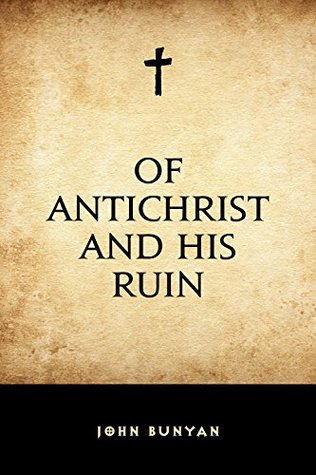
Of Antichrist And His RuinJohn Bunyan, as Charles Spurgeon said, was so steeped in Scripture, that he practically bled Bible! In his book Of Antichrist And His Ruin, Bunyan pointed out how God would use earthly governments to bring about the demise of Antichrist. In addition, Bunyan also shared these insights on how the Church should treat the governments of Earth.

“Take heed in laying the cause of your troubles in the badness of the temper of governors. … God is the chief, and has the hearts of all, even of the worst of men, in His hand. Good tempered men have sometimes brought trouble; and bad tempered man have sometimes brought enlargement to the churches of God: Saul brought enlargement (1 Samuel 14:28). David brought trouble (2 Samuel 12:10).) Ahab brought enlargement (1 Kings 21:29). Jehoshaphat and Hezekiah did both sometimes bring trouble (2 Chronicles 19:2; 20:35; 32:25). Therefore, the good or bad tempers of men sway nothing with God in this matter; they are the sins or repentances of His people, that make the church either happy or miserable upon earth.”

“The church therefore, as a church, must use such weapons as are proper to her as such; and the magistrate, as a magistrate, must use such weapons as are proper to him as such. … She [the church] may, and ought, with her faith and prayer, and holy life, to second this work of kings (Ezra 1:2, 3). When the king’s laws, and the law of their God, did at any time come in competition, they would indeed adhere to, and do the law of their God; yet with that tenderness to the king, his crown and dignity, that they could at all times appeal to the righteous God about it (Daniel 6:22). Nor did they lose by doing so; yea, they prospered; for by this means Mordecai was made a great man, and a savior of his people (Esther 2:21-23). By this means also was Daniel made a great man, and helpful to his brethren (Daniel 5:29).”

“Pray for kings to the God of heaven, Who has the hearts of kings in His hand: and do it ‘without wrath and doubting’; without wrath because thy self is not perfect; and without doubting because God governeth them, and has promised to bring down Antichrist by them. Pray for the long life of the king. Pray that God would always give wisdom and judgment to the king. Pray that God would discover all plots and conspiracies against his person and government. Pray also that God would make him able to drive away all evil and evil men from his presence….”

To read more quotes from this book, please click here. And to check out my review of this book, please click here.

Religious Liberty In School

free-to-speakAs our students are heading back to their schools, it is a great time to be reminded of the religious liberties they have while in school. With all of the talk of so-called “separation of church and state,” I think many parents and students are reluctant to say anything that sounds remotely Christian, for fear of getting in trouble with the powers-that-be.

But we don’t have to tread so carefully!

Gateways To Better Education has some great resources. I ordered a couple hundred of their “Free To Speak” pamphlets. I gave them to our school superintendent, and as many parents as as I could. This short pamphlet summarizes the US Department of Education’s guidelines on what is allowed in school. In short, the Seven Freedoms are:

  1. Students can pray, read their Bibles or other religious material, and talk about their faith at school.
  2. Students can organize prayer groups and religious clubs, and announce their meetings like any other club.
  3. Students can express their faith in their class work and homework.
  4. Teachers can organize prayer groups with other teachers.
  5. Students may be able to go off campus to have religious studies during school hours.
  6. Students can express their faith at a school event.
  7. Students can express their faith at a graduation ceremony.

Don’t be intimidated. Don’t be uninformed. Know your rights as a US citizen.

9 Quotes From “Of Antichrist And His Ruin”

Of Antichrist And His RuinJohn Bunyan’s works are steeped in Scripture. His thoughts about the Antichrist and other end times events are either directly taken from biblical passages, or else his line of reasoning fits perfectly with the intent of the Scriptures. You can read my full book review by clicking here. Below are some quotes I found enlightening.

“Coercion, in anything connected with religion, whether it imposes creeds, liturgies, or modes of worship, is Antichrist: whom to obey, is spiritual desolation, and if knowingly persevered in, leads to death.” —George Offor, editor

“As God therefore did put it into the hearts of the wicked kings of Babylon, to distress in His church and people for their sins; so He put it into the hearts of the kings of the Medes and Persians, who were to be, in a sense, their saviors; to ease them of those distresses, to take off the yoke, and let them go free.”

“This twenty years we have been degenerating, both as to principles, and as to practice; and have grown at last into an amazing likeness to the world, both as to religion and civil demeanor.” 

“Take heed in laying the cause of your troubles in the badness of the temper of governors. … God is the chief, and has the hearts of all, even of the worst of men, in His hand. Good tempered men have sometimes brought trouble; and bad tempered man have sometimes brought enlargement to the churches of God: Saul brought enlargement (1 Samuel 14:28). David brought trouble (2 Samuel 12:10).) Ahab brought enlargement (1 Kings 21:29). Jehoshaphat and Hezekiah did both sometimes bring trouble (2 Chronicles 19:2; 20:35; 32:25). Therefore, the good or bad tempers of men sway nothing with God in this matter; they are the sins or repentances of His people, that make the church either happy or miserable upon earth.”

“Antichrist is the adversary of Christ; an adversary really, a friend pretendedly. So then, Antichrist is one that is against Christ; one that is for Christ, and one that is contrary to Him (and this is that mystery of iniquity [2 Thessalonians 2:7]). Against Him in deed; for Him in word, and contrary to Him in practice. … Christ prefereth His Father’s will above heaven and earth: Antichrist prefereth himself and his traditions above all that is written, or that is called God, or worshiped.”

“Nor can all the fallen angels, with all the members and limbs of Antichrist, cause that their brat should abide so much as one day longer than our God’s prefixed time.”

“Now, by ordinances of Antichrist, I do not intend things that only respect matters of worship in Antichrist’s kingdom, but those civil laws that impose and enforce them also; yea, that enforce that worship with pains and penalties, as in the Spanish Inquisition. … What could the king of Babylon’s golden image have done, had it not been for the burning fiery furnace that stood within view of the worshipers (Daniel 3)? Yea, what could that horrible command, to pray for thirty days to neither God nor man, but to the king, have done, had it not been for the dark den and the roaring lions therein ready to devour those that disobeyed it (Daniel 6)? … For as the furnace would have been next to nothing, if void of fire; and the den as little frightful, if destitute of lions; so these laws will be as insignificant, when Christ has slain that spirit that is in them; that spirit that causes that as many as will not worship the image of the beast, should be killed.”

“What say ye now, ye sons of God! Will you learn to make a judgment of things according to the mystery of the wisdom of God, or will ye longer conclude according to sense and reason?”

“Cold blasts in November are not received with that gentleness as are colder in March and April; for that these last cold ones are but the farewell notes of a piercing winter; they also bring with them the signs and tokens of a comfortable summer. Why, the church is now at the rising of the year; let then the blasts at present, or to come, be what they will, Antichrist is assuredly drawing towards his downfall.”

20 Useful Maxims

Useful MaximsI thoroughly enjoyed reading Useful Maxims by Brian Ridolfi (check out my review of his book by clicking here). Here are 20 of Brian’s useful maxims that caught my highlighter.

  1. Going to church is good; going to God is better.
  2. Progress is not good if you are progressing in the wrong direction.
  3. Good demeanor does not validate bad behavior.
  4. Broken commandments break down integrity.
  5. The Bible’s meaning is not hidden from men; men hide from its meaning.
  6. Actions are better indicators of character than rhetoric.
  7. The indifferent make no difference.
  8. Remaining weak takes strength. It takes power not to use power.
  9. Great men step in when everyone else steps out.
  10. Moral arguments which are entirely material are entirely immaterial.
  11. Peacemakers and saltshakers dispense enrichment.
  12. A grudge will keep you deep in sludge. Points of contention are points of retention.
  13. Revenge is hard to reverse.
  14. Never put faith in people who have no faith.
  15. Everything goes when anything goes.
  16. Your sin is not just your problem.
  17. Parental neglect prompts government parenting.
  18. Where no one fears God, everyone fears man.
  19. The right battle is lost with the wrong weapon.
  20. Insecurity secures instability.

Watch for more maxims soon. Or follow me on Twitter and Tumblr to read some of Brian Ridolfi’s maxims.

9 Quotes On Socialism From “Churchill’s Trial”

Churchill's TrialWinston Churchill waged a lifelong battle against Socialism creeping into a democratic government. He felt it would ultimately undermine the freedoms of individual citizens. In Churchill’s Trial by Larry Arnn, significant space was given to this topic. Here are a few of the most noteworthy quotes on the evils of socialism.

“Human relations are not a contest in which the advantage of some requires the disadvantage of others. That means in turn that government need not have the authority to allocate resources, at least not comprehensively. A government with such power would be in one sense at war with any citizens who have more than others, effectively with all citizens but the few poorest.” —Larry Arnn

“I declare to you, from the bottom of my heart, that no Socialist system can be established without a political police. Many of those who are advocating Socialism or voting Socialist today will be horrified at this idea. That is because they are short-sighted, that is because they do not see where their theories are leading them. No Socialist Government conducting the entire life and industry of the country could afford to allow free, sharp, or violently-worded expressions of public discontent. They would have to fall back on some form of Gestapo, no doubt very humanely directed in the first instance.” —Winston Churchill

“The inherent vice of capitalism is the unequal sharing of blessings. The inherent virtue of socialism is the equal sharing of miseries.” —Winston Churchill

“Churchill’s differences with socialism proceed from this fundamental difference about nature. He thought that the equality for which socialism aimed was unnatural. He thought that it could not be achieved except by suppressing nature, including human nature, which would require the suppression of humans. He thought that because of this fundamental difference, socialism would result in impoverishment in economics, corruption in personal character, and despotism in politics. He thought that by nationalizing these areas of private life in which most human beings do their most urgent and fulfilling tasks, socialism would truncate the lives of ordinary people. For that reason he regarded socialism as dehumanizing.” —Larry Arnn

“A state that attempts to equalize things that are not inherently equal will be at war with human excellence. Some people are in fact wiser, braver, more generous, more skillful, more beautiful, stronger, and more active than others. This does not make them different in their rights, if those rights are defined as the right to employ their ability and gain or lose by their efforts. Both the equality of rights and the differences of human makeup are natural phenomena, and they must be accorded their sway. The attempt to equalize unequal things would, Churchill argued, produce resistance, which in turn would call forth from socialism more vigorous laws. This cycle will continue until all the rights of the people were gone.” —Larry Arnn

“Socialism knows that it can only operate through an agency of bureaucracy under the direction of an autocratic sect.” —Winston Churchill

“If you make 10,000 regulations you destroy all respect for the law.” —Winston Churchill 

“Property [means] every thing to which a man may attach a value and have a right; and which leaves to everyone else the like advantage.” —James Madison (emphasis in original)

“If evil systems corrupt good men, it is no less true that base men will dishonor any system, and while no bond of duty more exacting than that of material recompense regulates the relations of man and man, while no motion more lofty and that of self-interest animates the exertions of every class, and no hope beyond the limits of this fleeting world lights the struggle of humanity, the most admirable systems will merely succeed in transferring, under different forms and pretexts, the burden of toil, misery, and injustice from one set of human shoulders to another.” —Winston Churchill 

You can read my review of Churchill’s Trial by clicking here.

My first set of quotes from this book can be found by clicking here.

12 Quotes From “Churchill’s Trial”

Churchill's TrialIn Churchill’s Trial, Larry Arnn has given us a fascinating look at Winston Churchill’s battle to keep freedom alive, both in the moment of crisis and after the crisis has passed. You can read my full book review by clicking here. Below are a few of the quotes I highlighted as I read.

“Mankind has never been in this position before. Without having improved appreciably in virtue or enjoying wiser guidance, it has got into its hands for the first time the tools by which it can unfailingly accomplish its own extermination. That is the point in human destinies to which all the glories and toils of men have at last lead them. They would do well to pause and ponder upon their new responsibilities. Death stands at attention, obedient, expectant, ready to serve, ready to shear away the peoples en masse; ready, if called upon, to pulverize, without hope of repair, what is left of civilization. He awaits only the word of command. He awaits it from a frail, bewildered being, long his victim, now—for one occasion only—his master.” —Winston Churchill 

“Science is necessary, and also science is a master. As the human ability to make grows, the human ability to control the engines by which we make diminishes. The logical problem is relentless: we may stay as we are and lead shorter lives of pain and trouble, or we may use our capacity to make our lives easier and safer. If we do that we will gain power, and we can use that power against ourselves.” —Larry Arnn

“No material progress, even though it takes shapes we cannot now conceive, or however it may expand the faculties of man, can bring comfort to his soul.” —Winston Churchill 

“We must never cease to proclaim in fearless tones the great principles of freedom and the rights of man which are the joint inheritance of the English-speaking world and which through Magna Carta, the Bill of Rights, the Habeas Corpus, trial by jury, and the English common law find their most famous expression in the American Declaration of Independence. …

“All this means that the people of any country have the right, and should have the power by constitutional action, by free unfettered elections, with secret ballot, to choose or change the character or form of government under which they dwell; that freedom of speech and thought should reign; that courts of justice, independent of the executive, unbiased by any party, should administer laws which have received the broad ascent of large majorities or are consecrated by time and custom. Here are the title deeds of freedom what should lie in every cottage home. Here is the message of the British and American peoples to mankind. Let us preach what we practice—let us practice what we preach.” —Winston Churchill

“There is enough for all. The earth is a generous mother; she will provide in plentiful abundance food for all her children if they will but cultivate her soil in justice and in peace.” —Bourke Cockran

“Human relations are not a contest in which the advantage of some requires the disadvantage of others. That means in turn that government need not have the authority to allocate resources, at least not comprehensively. A government with such power would be in one sense at war with any citizens who have more than others, effectively with all citizens but the few poorest.” —Larry Arnn

“In republics, the greater danger is that the majority may not sufficiently respect the rights of the minority.” —James Madison

“He who molds public sentiment goes deeper than he who enacts statutes or pronounces decisions.” —Abraham Lincoln

“Democracy properly understood means the association of all through the leadership of the best.” —Winston Churchill

“Our hearts will ache…if we have not a vision above material things.” —Winston Churchill

“If men were angels, no government would be necessary. If angels were to govern men, neither external nor internal controls on government would be necessary.” —James Madison

“We now watch the workings of a written Constitution enforced by a Supreme Court according to the letter of the law, under which anyone may bring a test case challenging not merely the interpretation of the law, but the law itself, and if the Court decides for the appellant, be he only an owner of a few chickens, the whole action of the Legislature and the Executive becomes to that extent null and void.” —Winston Churchill 

More quotes coming soon…

Churchill’s Trial (book review)

Churchill's TrialI have read so much written by and about Winston Churchill, that it’s hard to imagine learning something new about this remarkable man. And yet, I was amazed at how much more I learned in reading Churchill’s Trial by Larry Arnn.

It’s easy to take for granted the freedoms people have in countries like England and the United States because of the foresight of the framers of our Constitutions. But there are trials which put these freedoms in a precarious place, and if it were not for strong and insightful men—like Winston Churchill—those freedoms could have disappeared.

Churchill played key roles in his country, and in world politics, through two world wars, a global depression, the coming of age of new military super-powers, the dawn of the era of atomic warfare, and the rise of Communism. In all of these intense events, the temptation was there to make radical changes to meet the challenge of the moment. Churchill had the wisdom and foresight to leverage the strength of his country’s Constitution, without undermining it nor setting a precedent which would erode future freedoms.

In what Churchill did for England, he also helped strength the resolve of key leaders in the United States, who faced similar challenges in a shifting geopolitical climate. Churchill not only saved the world from the spread of fascism and communism, but he did so in a way that would guarantee freedom for millions of people in generations to follow. The question before us now is: Will we learn from Churchill’s example, or will we fail the trial we now face?

For history buffs, political junkies, and fans of Winston Churchill, Churchill’s Trial is an excellent read.

I am a Thomas Nelson book reviewer.