Why Should Christians Sing?

Some things are fascinating by what isn’t said. For instance, in the Christmas carol It Came Upon A Midnight Clear there is something conspicuously missing. 

One thing that isn’t missing is singing. Every one of the stanzas ends with a phrase about the angels singing. But can you spot what IS missing? I didn’t see it at first until I read this quote from respected music professor Dr. C. Michael Hawn: “This may be the only commonly sung Christmas carol in our hymnals that does not mention the birth of Christ! 

This carol just sort of assumes that we know why the angels are singing. But do we know? 

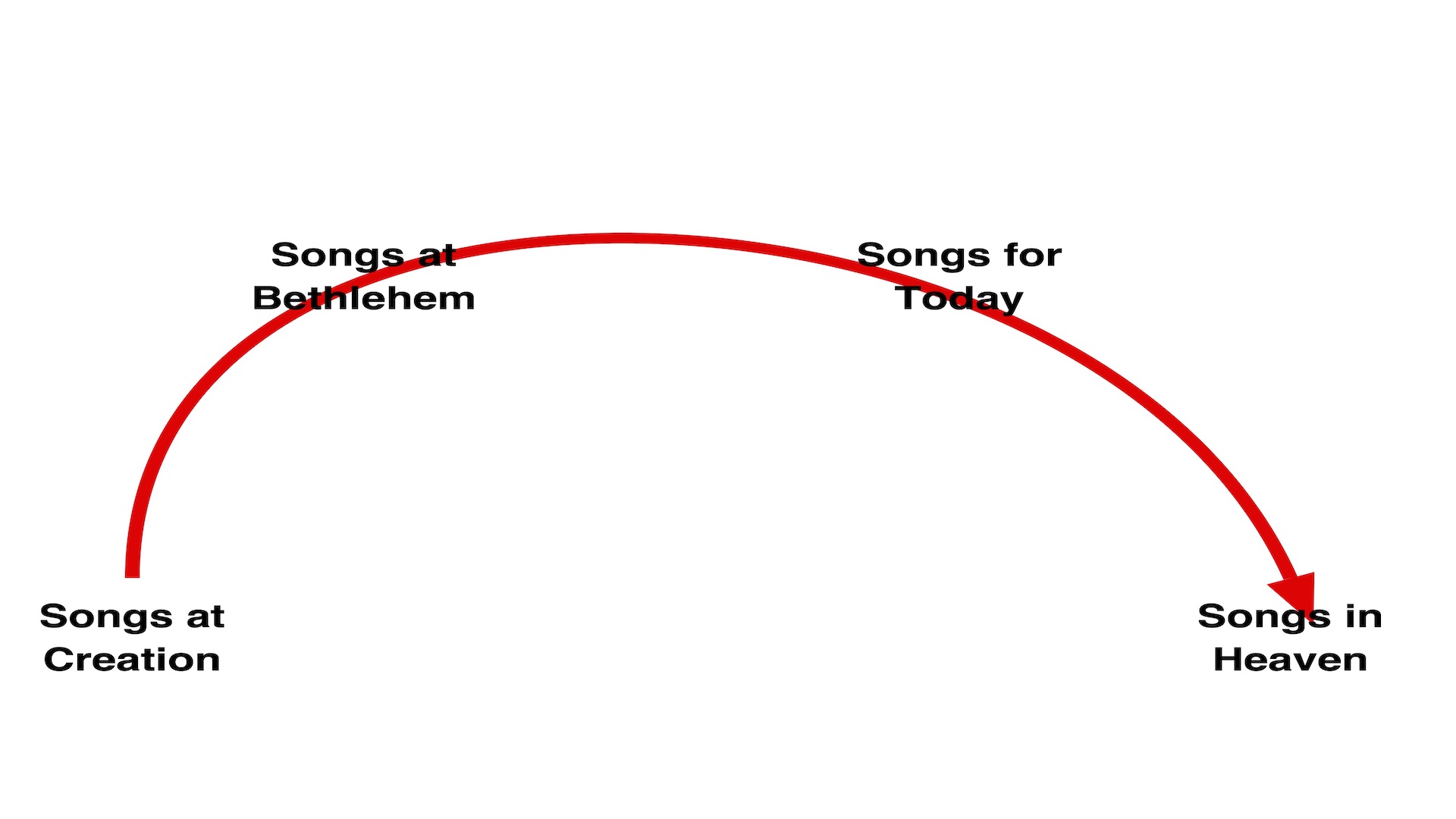
The Bible tells us that the angels were singing at Creation and that they are still singing in Heaven for all of eternity (Job 38:4-7; Revelation 5:9-13; 7:9-12; 15:2-4). Then we have this glimpse of the angels singing when Jesus was incarnated as a human baby in Bethlehem (Luke 2:14). Where did they get their song and their inspiration to sing it?

Their song comes from the Choir Leader who is the King of kings. Jesus is singing in Heaven, before the throne of His Father, about the salvation that He brought to mankind through His incarnation, sinless life, death on Calvary, and resurrection from the grave (see Hebrews 2:9-12). 

The song that Jesus sings tells the story of how He came to earth just like us—made a little lower than the angels—so that He might taste sin and death and conquer them for us. Now as our victorious Savior, He is not ashamed to call those who put their faith in Him His brothers and sisters.

Now perhaps you see why angels are also singing all the time! 

Even today there is a lot of singing around the Christmas season, but there is something missing in most of the songs: a focus on what Christmas really means. The world’s songs are about trees, and gifts, and Santa, and falling in love, but it’s a song that is out of tune with the angelic song. 

As Christians, we have a choice we can look around at this out-of-tune singing and lament what’s happening in our world, we can join in these meaningless songs, or we can look up at our Savior and sing the song He is singing. 

Christian, will you join with the angelic choir to let the world hear the unmistakable love song that Jesus is still singing today? 

If you’ve missed any of the message in this series, you can check them out by clicking here.

Humbug?!

In Longfellow’s classic I Heard The Bells On Christmas Day every stanza ends with the phrase “peace on earth, goodwill to men.” Unless you’ve been living someplace that doesn’t get the daily news, you might be saying, “Peace on earth? Really? I just don’t see it….” Or as Ebenezer Scrooge might say, “Peace on earth? Bah! Humbug!” 

A humbug is an imposter, or something empty of meaning. 

The third stanza of I Heard The Bells seems almost to slide into that Christmas humbug note: “And in despair I bowed my head: ‘There is no peace on earth,’ I said. ‘For hate is strong and mocks the song of peace on earth, goodwill to men.’” 

Indeed, even for those who call themselves a Christian, Christmas could become a humbug if…

  • … it’s all about busyness or just trying to “survive the holidays” 
  • … we get more excited about Santa Claus coming down the chimney to fill stockings than we do about Jesus coming down to Earth to be born in a manger 
  • … our main focus is on gifts—both what you’re giving and what you’re getting—and then we regret putting ourselves into debt 

Between Malachi (the last book of the Old Testament) and Matthew (the first book of the New Testament) is a time span of about 400 years that is called “the dark period.” God had promised through Jeremiah that He would restore the Israelites and rebuild Jerusalem. There were promises of the Messiah coming to set things right, but after 400 years of darkness, the mindset of most Israelites was probably, “Messiah? Peace? Bah! Humbug!!” 

What God really promised through Jeremiah was a peace that came about as a result of two things: (1) forgiveness of sins and (2) restoration of a perfect relationship with God. The Hebrew word for “peace” is shalom, which means one’s personal sense of wholeness and well-being, free from anxiety and fear, knowing that all is well between my soul and God. 

This is what God promises—I will cleanse them from ALL the sin they have committed against Me and will forgive ALL their sins of rebellion against Me (Jeremiah 33:8). 

This shalom is what comes through the First Advent of Jesus! As Longfellow observed, “Then pealed the bells more loud and deep: God is not dead nor doth He sleep; the wrong shall fail, the right prevail, with peace on earth, goodwill to men.” 

And this is what Jesus brought—

  • She will give birth to a Son, and you are to give Him the name Jesus, because He will save His people from their sins (Matthew 1:21 NIV). 
  • Now you have been united with Christ Jesus. Once you were far away from God, but now you have been brought near to Him through the blood of Christ. For Christ Himself has brought peace to us… (Ephesians 2:13-14 NLT) 
  • Therefore, since we are justified (acquitted, declared righteous, and given a right standing with God) through faith, let us grasp the fact that we have…peace with God through our Lord Jesus Christ (the Messiah, the Anointed One) (Romans 5:1 AMP). 

The bells and carols and remembrances of Christ’s First Advent should send our hearts soaring in anticipation of Christ’s Second Advent—when Christ shall return to take all of His own to be with Him forever, where He will wipe away every tear and where we live forever with Him in the New Jerusalem (see Jeremiah 33:9; John 14:3; Revelation 21:1-4). 

Let us guard against Christmas ever becoming a humbug—an imposter, something empty of meaning—but let’s make sure the rich meaning of Christ’s peace dwells richly in us! 

If you’ve missed any of the message in this series, you can check them out by clicking here.  

Don’t __________ One Another

Listen to the podcast of this post by clicking on the player below, and you can also subscribe on AppleSpotify, or Audible.

Check out James 4:11, “Brethren…

  • …do not speak evil of one another” (NKJV) 
  • …do not accuse or malign one another” (AMP)
  • …do not bad-mouth one another” (MSG)
  • …do not slander one another” (GW)
  • …do not criticize one another” (NLT)
  • …do not defame one another” (Greek definition for katalaleo) 

Why not? James gives us three good reasons:

  1. All humans are made in God’s image. So to defame another person is to defame God. 
  2. All humans are a part of my family. “One another” (Greek allelon) and “brethren” (Greek adelphos) includes me too! 
  3. It only set me up to be judged in the same way—“What right do you have to judge or criticize others?” (TLB) … “Who are you that you presume to pass judgment on your neighbor?” (AMP) … “Who do you think you are to meddle in the destiny of others?” (MSG). 

The bottom line—

If I don’t want someone to ___________ me, I shouldn’t ___________ them! 

(see Luke 6:31 and James 2:8)

►► Would you please prayerfully consider supporting this ministry? ◀︎◀︎

What Is The Church Supposed To Look Like?

If someone asked you what a church is supposed to look like, do you describe steeples and crosses, stained glass windows and big wooden pulpits?

Guess what? The first Church in Jerusalem had none of those things!

Luke the historian describes the church this way: “They studied and prayed together, they ate with each other, they fed the hungry, and they took care of the poor. God performed miracles through them, everyone thought well of them, and people were getting saved every single day” (see Acts 2:42-47). Other historians of the day noted that Christians started the first orphanages, the first feeding programs, the first homes/schools for the blind, and the first medical dispensaries. They described how the Christians changed the cultural understanding of marriage and family, and how they gave dignity to women, children, the elderly, and the sick. 

They did this by putting their faith into action, just as Jesus described (see Matthew 25:31-40). James reminds us that this required a deeply personal faith and a roll-up-your-sleeves attitude. In fact, James went so far as to say that faith in Jesus wasn’t enough. 

Faith without works is dead. Works without faith is useless. We must believe it and live it. We need both faith and works.

Everyone can do this… 

  • if a young kid is hungry, get involved with feeding them
  • if an elderly lady in your neighborhood needs a friend, stop by for coffee
  • if a neighbor is sick and can’t cover their usual tasks, mow their lawn 
  • if a high school student can’t go to homecoming because she can’t afford the dress, take her shopping and buy the dress for her
  • if someone has an extended hospital stay, collect their mail and water their plants
  • if no one is visiting them in the hospital, go sit with them for a while

Jesus said, “When you do this for others, you are really doing it for Me.” 

Luke didn’t say, “Every day the Christians were preaching.” He says, “Every day the Christians were serving. And then every day God was adding to their number people who were being saved.” 

Your faith in action speaks a sermon louder and more convincingly than any sermon ever could. 

How will you show your neighbors the love of Jesus this week?

Self-made Or Spirit-led?

“And behold, two men were conversing with Him—Moses and Elijah, who appeared in splendor and majesty and brightness and were speaking of His exit from life, which He was about to bring to realization at Jerusalem.” (Luke 9:30-31)

Jesus was constantly making decisions that kept Him on the path straight toward Calvary’s Cross. He would let nothing deter Him from God’s appointed mission. Even when His own friends and family urged Him to find another route. 

It was at a moment like this—when Jesus had yet another choice to make about what path He would follow—that Moses and Elijah talked to Him, reminding Him of the ultimate outcome of His obedient and correct choices. 

At every crossroads—at every decision point—Jesus chose correctly. He chose to do God’s will for His life. He could have decided to do things His own way, but He leaned into the unmistakable voice of the Holy Spirit pointing Him toward the right path.

What does that mean for us today?

I have failed to make the right choice.
That means that I could have chosen correctly.
Jesus was human just like me.
Which means He had choices too.
He always chose correctly, even though the other possibility was there.
So the question is: Will I try to be a self-made man or a Spirit-led man?
I cannot be both.

The Day Of The Lord

All we know about the prophet Joel is that he is the son of Pethuel, and his name means Jehovah is God. He appears to be addressing the southern part of Israel (Judah/Jerusalem). 

What is interesting to note about Joel’s writing is a recurring theme that goes something like this: 

Foreshadowing (or prophetic foretelling) → Calling for a godly response → God’s blessing on a right response or God’s punishment on a wrong response → An outcome which foreshadows or foretells another more dire event → repeat…

For instance, in Joel’s prophesy the massive invasion of locusts was intended to get the Israelites to pay attention to their sins. Joel calls for fasting and repentance and warns (foreshadows/foretells) that an invading army at a later date would do even greater damage (1:2-14). 

Likewise, the invading army—which would do more damage than the invading locusts—should also call the Israelites to repentance and imploring God for His help. 

Jesus, just like Joel, taught that whether it was an evil man, an accident, or even a natural disaster, painful things should cause us to consider the state of our eternal soul (see Luke 13:1-5). And Jesus and Joel both foretell of the Day of the Lord when there will be no more opportunities for repentance. 

To prepare God-fearing people for this dreadful day of the Lord, Joel foretells if the outpouring of the Holy Spirit. This is the same empowering Spirit that Jesus said would equip His followers to take the message of salvation to all four points of the compass (Acts 1:4-8). And just as Joel foretold 800 years earlier, on the first Pentecost Sunday after Christ’s ascension back into heaven, the Christians were baptized in the Holy Spirit, prompting Peter to quote an extension passage from Joel (compare Joel 2:28-32 with Acts 2:14-21).

Joel’s final chapter talks about Judgment Day, and about the multitudes, multitudes in the valley of decision. Peter confronted his audience as well about the decision they should make to turn to Jesus as their Savior and Lord. 

The Day of the Lord could come at any moment and millions around the world are still in the valley of decision. I find these words quite sobering—

“Someone asked, ‘Will the heathen who have never heard the Gospel be saved?’ It is more a question with me whether we—who have the Gospel and fail to give it to those who have not—can be saved.” —Charles Spurgeon 

We are even closer to the Day of the Lord today than we were yesterday. What will you do?

Please join me this Sunday as we continue our series learning the major lessons from the minor prophets.

It’s Time To Come Home

I already shared the bizarre but beautiful sermon illustration that Hosea lived out for the Israelites and for us. His wife had been unfaithful to him and had gotten herself so far in debt that she was a virtual slave. Hosea, in a clear picture of God’s amazing, unrelenting love, bought back his wife, paid off her debts, and completely restored her to himself. 

Sadly, the people of Israel—even after seeing this grace-filled living lesson—continue to push farther and farther away from God. This prompted God to announce the indictment against them… 

Hear the word of the Lord, you Israelites, because the Lord has a charge to bring against you who live in the land: “There is no faithfulness, no love, no acknowledgment of God in the land. There is only cursing, lying and murder, stealing and adultery; they break all bounds, and bloodshed follows bloodshed” (Hosea 4:1-2). 

It wasn’t the first time that someone preferred the things of the world to the things of God (like Adam and Eve), and it wasn’t the last time (like you and me). We mortals tend to be seduced by what we can see and hold right now, instead of trusting God for something far better. 

Jesus told a story about a son who enjoyed the full privilege and favor of his father, yet this son thought he could do better on his own. He asked his father for his share of the inheritance and left for a distant land, determined to live a life where he called all the shots. But with his money gone, he found himself in debt, starving, and working as a hired hand in a pigsty. 

It was then that Jesus said that young man came to his senses. He had nothing to bring to his father—no gift of restitution, no token of respect, nothing except his words. All he could say was, “Father, forgive me.” 

But that’s all that was needed. Hosea counseled the Israelites to do the same thing:

Return, Israel, to the Lord your God. Your sins have been your downfall! Take words with you and return to the Lord. Say to Him: “Forgive all our sins and receive us graciously, that we may offer the fruit of our lips” (Hosea 14:1-2). 

The wayward son had a rehearsed speech asking his father to simply hire him as a servant, as if he wasn’t worthy to be considered a son any longer. But the father—in words that reflect our Heavenly Father’s love—cut the son’s speech short. He let the son only say, “Forgive me,” but before the son could make the request to be a servant the father totally restored him. 

After Hosea calls the wayward people to return with their “forgive us,” he quotes God’s reply: “I will heal their waywardness and love them freely, for My anger has turned away from them” (14:4). 

How could this be? How could God’s full judgment not fall on His wayward people? How could it not fall on you and me?! Because it fell on Jesus (2 Corinthians 5:21)! So when we come back to God with our words of forgiveness, He restores us and clothes us in the robe of Jesus (Galatians 3:27). 

Absolutely amazing! 

God longingly speaks to His wayward people, “It’s time to come home. I’m waiting for you with open arms. I am ready to restore you completely. Just come home.”

Join me next week as we continue to learn about the major lessons we can discover in the minor prophets. 

Favorable Influence

Listen to the podcast of this post by clicking on the player below, and you can also subscribe on AppleSpotify, or Audible. 

Twice the 80th psalm declares—Restore us, O Lord God Almighty; make Your face shine upon us, that we may be saved (Psalm 80:19). 

But if we are already a Christian that has been saved from the penalty of our sin and saved to an eternal reward, then that also means that God’s face IS already shining on us, He HAS already restored us, and He HAS already given us His favor. 

I like how the Amplified Bible renders this verse: Restore us, O Lord God of hosts; cause Your face to shine in pleasure, approval, and favor on us, and we shall be saved! 

What we have received is too wonderful for us to keep to ourselves, so we must let His pleasure, approval, and favor now shine out of us! 

“If the result of our experience of God does not compel and propel us into global mission, it is doubtful whether we have really encountered the God of the Bible.” —Dick Brogden 

Jesus stated His mission simply and then sent us out on the exact same mission (Luke 4:18-19; John 20:21). We do this best by living closely among people so they can also see us shine with God’s favor.

Paul called us to shine as well: Live clean, innocent lives as children of God, shining like bright lights in a world full of crooked and perverse people (Philippians 2:15). I believe this is a perfect definition of the word influence. The origin of the word meant the supposed flowing of ethereal fluid from the stars thought to affect the actions of men. Christians that let their good deeds shine in the darkness can influence the entire culture around them!

“Radical Christianity is not going on a missions trip or a big conference. Radical Christianity is staying steady for decades.” —Mike Bickle 

Being a person that shines with favorable influence requires staying involved for the long haul so that you can build trustworthiness. It’s being in visible places not to get glory, but to let people see God’s glory. When they see His glory shine on you and out of you, they will want what you have too!

Solomon said, By the blessing of the influence of the upright and God’s favor—because of them the city is exalted (Proverbs 11:11). So, my fellow Christian, let me ask you: 

  • Has God shined on you?
  • Are you letting Him shine out of you? 
  • Are you living a noteworthy, trustworthy, visible life in your dark community? 

“It’s your choice: You can be a part of your city’s elevation or its deterioration.”

—Craig T. Owens

►► Would you please prayerfully consider supporting this ministry? My Patreon supporters get behind-the-scenes access to exclusive materials. ◀︎◀︎

Dressed For Victory

Finally, be strong in the Lord and in His mighty power (Ephesians 6:10).

Not…

  • be strong in my own ability
  • be strong in the company of another warrior

But…

  • be strong in the Lord
  • be strong in the power of His might

The armor I wear has been battle-tested by the undefeated Champion. It’s armor emblazoned with the crimson red blood of Calvary. It’s armor gleaming brightly with the glow of Resurrection victory.

I wear Christ’s armor! 

  • The belt of truth—it’s the righteousness of Jesus (Isaiah 11:1-5)
  • The breastplate of righteousness—worn by the Messiah who defeated evil (Isaiah 59:15-17)
  • The helmet of salvation—worn by Jesus as He won salvation for us (Isaiah 59:16-17)
  • The shoes of the gospel of peace—worn by our Lord as He defeated our enemies (Isaiah 52:5-7)
  • The shield of faith—God says, “I am your shield” (Genesis 15:1)
  • The sword of the Spirit—what Jesus used to strike down satan’s temptations (Isaiah 49:1-2; Luke 4:4, 8, 12)

I must continually clothe myself in God’s armor. Then I keep the armor bright by prayer—

Restraining prayer, we cease to fight 
Prayer makes the Christian’s armor bright 
And satan trembles when he sees 
The weakest saint upon his knees. (William Cowper)

Holy God, may I be dressed in YOU at every moment. May I daily use YOUR battle-tested armor and weapons to strike a blow against satan! 

(Check out all the Scripture references above by clicking here.)

Thursdays With Spurgeon—The Blessing Of A Promise-Keeping God

This is a weekly series with things I’m reading and pondering from Charles Spurgeon. You can read the original seed thought here, or type “Thursdays With Spurgeon” in the search box to read more entries.

The Blessing Of A Promise-Keeping God

     I do not believe we can preach the gospel if we do not preach justification by faith without works; or unless we preach the sovereignty of God in His dispensation of grace; or unless we exalt the electing, unchangeable, eternal, immutable, conquering love of Jehovah. … 

     All the purposes of man have been defeated, but not the purposes of God. The promises of man may be broken. Many of them are made to be broken. But the promises of God shall all be fulfilled. He is a promise-maker, but He never was a promise-breaker; He is a promise-keeping God, and every one of His people shall prove it to be so.  

From The Autobiography Of Charles Spurgeon

God is not a man, so He does not lie. He is not human, so He does not change His mind. Has He ever spoken and failed to act? Has He ever promised and not carried it through? (Number 23:19)

For the word of God will never fail. (Luke 1:37)

Now I am about to go the way of all the earth. You know with all your heart and soul that not one of all the good promises the Lord your God gave you has failed. Every promise has been fulfilled; not one has failed. (Joshua 23:14)

But joyful are those who have the God of Israel as their helper, whose hope is in the Lord their God. He made heaven and earth, the sea, and everything in them. He keeps every promise forever. (Psalm 146:5-6) 

For all of God’s promises have been fulfilled in Christ with a resounding “Yes!” And through Christ, our “Amen” (which means “Yes”) ascends to God for His glory. (2 Corinthians 1:20)

Our God is a promise-making, promise-keeping God!