Thursdays With Spurgeon—Present Communion With Jesus

This is a weekly series with things I’m reading and pondering from Charles Spurgeon. You can read the original seed thought here, or type “Thursdays With Spurgeon” in the search box to read more entries.

Listen to the podcast of this post by clicking on the player below, and you can also subscribe on iTunes or Spotify.

Present Communion With Jesus

     The desire of a renewed soul is to find Christ and to be with Him. … Past communion with Christ is very well: ‘Therefore I will remember Thee from the land of Jordan…’ (Psalm 42:6). But these are only stale meats, and a loving soul wants fresh food every day from the table of Christ. … 

     A true loving soul, then, wants present communion with Christ. So the question is, ‘Tell me where You feed. Where do You get Your comfort from, O Jesus? I will go there. … Where do You feed Your flock? In Your house? I will go there, if I may find You there. In private prayer? Then I will not be slack in that. In the Word? Then I will read it night and day. Tell me where You feed; wherever You stand as the Shepherd, there will I be, for I want You. I cannot be satisfied to be apart from You. My soul hungers and thirsts to be with You.’

From The Church’s Love To Her Loving Lord

There are so many pictures in the Bible about our continual reliance on God’s presence—from the manna that was only good for each day, to Jesus teaching us to pray for “our daily bread,” to the vivid example of Christians being as dependent on Jesus as a branch is dependent on the vine (see Exodus 16:4-5, 14-17; Matthew 6:11; John 15:1-8).  

All of these mean that we need to constantly abide with our Savior. 

In my book Shepherd Leadership: The Metrics That Really Matter, I spend two chapters talking to leaders about the need to rest—or sabbath. In fact, I call it sabbathing to give it the emphasis on the ongoing nature of this activity. I wrote—

“Without building in sabbath breaks, we run down emotionally, spiritually, mentally, and physically, which means loving God becomes a chore, not a delight (Mark 12:30). This then means loving your neighbor becomes nearly impossible (Mark 12:31). Ultimately, this means that we aren’t able to be the compassionate, wise, strong shepherds that the sheep under our care need us to be. … 

“The goal of sabbathing is to infuse more vitality into the shepherd leader for the purpose of pasturing the sheep under that leader’s care. You cannot give hope to others unless you are hope-filled; you cannot give health to others unless you are healthy; you cannot consistently speak wisdom to others unless you are growing in wisdom. All of this healthy growth for the shepherd leader takes place while sabbathing….” 

To reiterate what Pastor Spurgeon said: “A true loving soul, then, wants present communion with Christ.” I hope you will always seek that for yourself.

►► Would you please prayerfully consider supporting this ministry? ◀︎◀︎

Abiding In God’s Omnipresence

Listen to the podcast of this post by clicking on the player below, and you can also subscribe on Apple, Spotify, or Audible. 

Why do Christians say things like, “Let’s go to church” or “Let’s go meet with God”? 

Do we forget that Jesus said He would never leave us, or that He sent the Holy Spirit to be our constant Companion, or that our very heart is the temple of God’s presence (Matthew 28:20; John 14:16; 1 Corinthians 3:16)? We are naturally self-focused creatures. It takes discipline on our part to keep reminding and re-reminding ourselves that God is always with us. 

Psalm 84 and its two Selahs is one way of re-reminding ourselves of God’s abiding presence. The Selahs are reminders to pause and consider, “Where am I?” and to know that the answer can always be, “Surely I am in God’s presence!” 

This psalm is divided into three 4-verse stanzas. Stanzas 1 and 2 end with the call to Selah, and all three stanzas feature a powerful name for God: LORD Almighty. When we see LORD in all capital letters, that is God’s covenant name: Yahweh or Jehovah, which means that He is the “I AM that I AM.” Almighty signifies that He is the invincible, un-defeatable Captain of angel armies. 

In these two combined titles, we have the personal intimate God of love and the unstoppable God of limitless power! If He were just the God of love, we may not be able to trust His power. If He were just the God of power, we may not be able to approach Him. He is the All-Loving, Ever-Approachable Power. 

Another important recurring theme in Psalm 84 is the word blessed. It’s used three times in this psalm, more than in any other single psalm. This word means God’s unmerited favor, and the word either begins or ends each of the three stanzas.  

In stanza 1 (vv. 1-4), twice we have that combined title of LORD Almighty. But we must always remember that our God is not distant and unapproachable, but the sons of Korah call Him “my King” and “my God.” At the end of this first stanza, we are invited to Selah—a pause to praise our glorious King! 

Stanza 2 (vv. 5-8) begins with that reminder that we are blessed. The psalmists tell us that God’s blessings flow even in my Valley of Baca (or weeping). With God’s presence surrounding me, I can go from “strength to strength” because the LORD Almighty hears my prayer and responds to my prayer! So at the end of this stanza, we are again invited to Selah—this time it’s a pause to pray to our listening God. 

In stanza 3 (vv. 9-12), another important word is featured that reminds us that our God is not a stingy King, but One who delights in His children and wants to lavishes them with His blessings: the word is favor. We read, “look with favor on Your anointed one” and “the LORD bestows favor and honor; no good thing does He withhold from those whose walk is blameless.” God’s favorable blessings flow toward us as eternally as He exists! 

This psalm is circular: it begins as it ends, so it invites us to continue to praise, continue to pray, and continue to abide in His presence. We’re called not just to know about God’s presence, but to rejoice in His presence. 

It’s one thing to know about God’s omnipresence, but it’s an entirely different thing to abide in God’s omnipresence! 

This isn’t something that happens overnight. Brother Lawrence reminds us that this is a progressive revelation for Christians: “One does not become holy all at once. … The more one knows Him, the more one desires to know Him. And as knowledge is commonly the measure of love, the deeper and more extensive our knowledge shall be, the greater will be our love: and if our love of God were great we should love Him equally in pains and pleasures.” 

I encourage you to Selah frequently so that you can move from mere head knowledge of God’s presence to becoming intimately aware of His closeness! 

If you’ve missed any of the messages in our series looking at the Selahs in the Psalms, you may find the full list by clicking here. 

►► Would you please prayerfully consider supporting this ministry? ◀︎◀︎

Thursdays With Spurgeon—Active Love

This is a weekly series with things I’m reading and pondering from Charles Spurgeon. You can read the original seed thought here, or type “Thursdays With Spurgeon” in the search box to read more entries.

Listen to the podcast of this post by clicking on the player below, and you can also subscribe on iTunes or Spotify.

Active Love

     True love next shows itself in obedience. … ‘Tis love that makes our willing feet in swift obedience move.’ We can do anything for those we love, and if we love Jesus, no burden will be heavy, no difficulty will be great. We should rather wish to do more than He asks of us and only desire that He was a little more exacting that we might have a better opportunity of showing forth our affection. …

     The apostle says, ‘Let us not love in word or in tongue, but in deed and in truth’ (1 John 3:18). Actions speak louder than words, and we will always be anxious to tell our love in deeds as well as by our lips. The true disciple asks continually, ‘Lord, what do You want me to do?’ (Acts 9:6). He esteems it his highest honor to serve the Lord. …  

     I believe in an active love that has hands to labor and feet to run as well as a heart to feel, eyes to glance, and ears to listen.

From The Church’s Love To Her Loving Lord

Those who love Jesus obey Him (John 14:15). 

Those who love Jesus serve others out of that love (Matthew 25:31-40). 

Those who love Jesus put action to their faith in Him (James 2:14-18). 

Those who love Jesus continually ask Him, “Lord, what do You want me to do?” 

Love for Jesus isn’t just something we feel, it’s who we are and it’s how we act and speak and serve every single day.

►► Would you please prayerfully consider supporting this ministry? ◀︎◀︎
Perspective On Persecution

Listen to the podcast of this post by clicking on the player below, and you can also subscribe on Apple, Spotify, or Audible.

Around the world we hear of Christians being persecuted for their faith in Jesus: Afghanistan … N. Korea … China … even in the USA, Christians like Jack Phillips and Barronelle Stutzman are being persecuted for standing up for what they believe. 

Here’s an important principle to keep in mind: In times like these, we need to remember there have always been times like these. Especially because the psalmist Asaph, Jesus, and the apostle Paul all forewarned us about persecution (Psalm 83; Mark 13:9, 12-13; 2 Timothy 3:12-13). 

Jesus said that our persecution should only come “on account of Me.” And Asaph notices the same thing in his prayer, using phrases like “Your enemies,” “Your foes,” “they conspire against Your people,” and “they form an alliance against You.” 

Asaph also recognized that times like these call for a Selah pause—a pause to calmly consider. (You may also be interested in this flowchart on persecution.) 

I think the first thing we need to consider is our part in bringing on the persecution. I need to ask the Holy Spirit to reveal if I may have been the trigger to the anger of these wicked people. If I have done something, I need to repent, ask forgiveness, and see what I can do to make restitution. 

Next, we need to Selah to consider this: It might look desperate, but God has handled these kinds of evil people before. Asaph mentions several enemies of God’s people whom God decisively defeated in the past. Our Selah pause will help us recall that God is the same today as He was yesterday—He is more than able to handle these persecutors. 

With all of these bullies ganging up on Israel, you can understand why Asaph cries out for God’s strong action against them. But I want you to notice that the call for judgment is NOT vindictive but redemptive. Asaph asks for punishment “so that men will seek Your name, O LORD” and that they may “know that You, whose name is the LORD—that You alone are the Most High over all the earth.” 

In other words, this isn’t a “Get ‘em, God” prayer, but a “Save ‘em, God” prayer! 

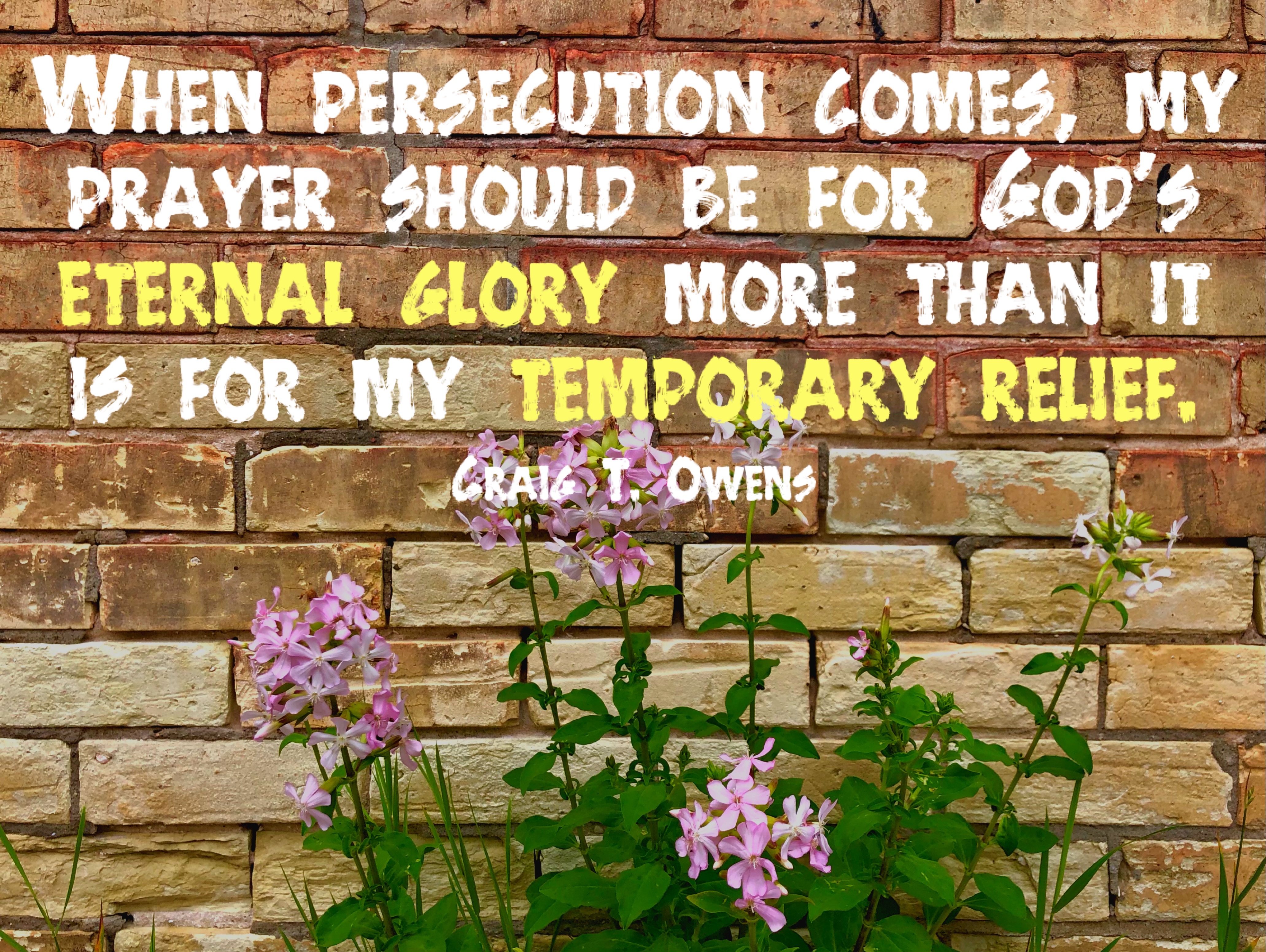
We’re not looking for relief for ourselves—that’s only temporary—but we’re looking for glory for God—that’s eternal!

Jesus and the apostle Peter both tell us that God’s desire is for no one to perish apart from a relationship with Him through Jesus Christ (John 3:16-17; 2 Peter 3:9). 

The reason we need to Selah and ask that introspective question about our words or actions triggering our persecutor’s anger is because God will use our righteous response to persecution as a testimony. 

Jesus said our persecution should be because of Him, but He also told us that there would be a blessing in it (Matthew 5:11-12; Mark 13:13; Luke 21:17-19). And Paul tells us that this reward isn’t just a silver lining to a dark cloud, but a reward beyond compare (Romans 8:18). 

Asaph went to prayer when Israel was attacked, and that should be our first response too. 

But let’s Selah in that prayer to make sure we’re not the trigger, and then may our prayer be more for God’s eternal glory than it is for our temporary relief. 

If you’ve missed any of the messages in our series looking at the Selahs in the Psalms, you can access the full list by clicking here.

►► Would you please prayerfully consider supporting this ministry? ◀︎◀︎
Three Pictures Of The Church

Listen to the podcast of this post by clicking on the player below, and you can also subscribe on Apple, Spotify, or Audible. 

When you’ve been at a church service have you ever asked yourself, “What are we doing here? What exactly is ‘church’? What are we supposed to be doing?”  

 Some people think church is saints going out to tell people about Jesus, and some people think church is saints coming together to hear about Jesus (see Matthew 28:19-20; 1 Corinthians 11:18). I think this is an either-or trap. 

I think a better way of looking at this is “both-and” and “so that”: BOTH coming to a gathering of believers so that we can be equipped to go out AND going out to tell people about Jesus so that we can bring new disciples into the church. 

Our foundational truth statement says: The Church is the Body of Christ, the habitation of God through the Spirit, with divine appointments for the fulfillment of her great commission. Each believer, born of the Spirit, is an integral part of the General Assembly and Church of the Firstborn, which are written in heaven. 

To help us see where we play a vital role in all of this, the Bible gives us three pictures of the church:

  1. A Body
  2. A Building
  3. A Bride

(see Ephesians 1:22-23; 1 Corinthians 12:12-26; Ephesians 2:19-22; John 3:29; 2 Corinthians 11:2; Ephesians 5:21-33)

All of these pictures speak of multiple parts making up one unified, healthy whole. Remove any part or any function, and the whole thing is diminished. All of these pictures also speak of intentionality. No one becomes healthy by accident, or builds a sound structure by accident, or enjoys a fulfilling marriage by accident. Health, soundness, and fulfillment all result from being intentional about our choices and interactions. 

I believe these three pictures also help us see what the church isn’t and is. 

  • A healthy church isn’t about numbers  
  • A healthy church isn’t about the day of the week that we meet
  • A healthy church isn’t about an “order of service” (there is no such thing listed in the New Testament!)
  • A healthy church is about Jesus being the focal point. As Jesus said, “I will build My Church.”   
  • A healthy church is about being intentional in everything we do 
  • A healthy church is about doing everything we can to glorify Jesus, both when we come together and when we go out into the world

(see Matthew 18:20; Romans 14:5; Matthew 16:18; Acts 10:38; 1 Corinthians 10:31; Hebrews 10:23-25) 

The first Church in the New Testament showed us how they followed the example of Jesus. Before trying to fulfill the Great Commission of going into all the world, they first obeyed the directive from Jesus to stay in Jerusalem until they were empowered by the Holy Spirit. Then we see an intentionality, and an empowerment, and a complete reliance on the Holy Spirit in everything they undertook from that point on. 

(see Acts 1:8; 2:42-47; 4:29-35; 6:1-7; 8:4, 26; 10:19-20; 13:1-3; 15:1-29)  

It’s not about going to “my church” or going to “your church.” It’s about being the Church (with a capital “C”)—the Body of of Christ, the Building of Christ, the Bride of Christ. 

Bottom line:

Christians are being the Church when they are intentionally living in a way that makes Jesus known. 

This is a part of our ongoing series looking at our foundational truths. If you’ve missed any of the messages in this series, you can find the full list by clicking here.

►► Would you please prayerfully consider supporting this ministry? ◀︎◀︎
Ordinances Of The Church

Listen to the podcast of this post by clicking on the player below, and you can also subscribe on Apple, Spotify, or Audible. 

Many churches recognize a various numbers of ordinances within their worship services. The dictionary gives two definitions of the word ordinance that are helpful for us: (1) a rule to be followed, and (2) something believed to be ordained (or made holy). 

There are two ordinances that we celebrate: baptism in water and holy communion. 

Water Baptism

This wasn’t a practice invented by Christians, but teachers had been baptizing their students for years as an outward sign of followership. Not only did various members of the Israelite community come to John to be baptized, but even Jesus desired to be water baptized (Matthew 3:5-6, 13-17). 

Why would Jesus need to be baptized? Look at how Jesus replied to John, “It should be done, for we must carry out all that God requires” (Matthew 3:15 NLT), or in the NIV: “to fulfill all righteousness.” 

Jesus came to be our High Priest. One of the requirements for the priest was “he must bathe himself in water before he puts” on the ceremonial robes that were to be worn in the tabernacle (Leviticus 16:4). Jesus also came to be our perfect sacrifice, so He needed to be like us in every single way. If Jesus wasn’t water baptized, not “all righteousness” would have been fulfilled. 

Jesus was also baptized as an example for us. We, too, are priests in God’s Kingdom that need to be washed for our priestly service (1 Peter 2:9; 3:20-21). 

Our foundational truth statement on this is: “The ordinance of baptism by immersion is commanded by the Scriptures. All who repent and believe on Christ as Savior and Lord are to be baptized. Thus they declare to the world that they have died with Christ and that they also have been raised with Him to walk in newness of life.” 

Jesus gave us this rule to follow for new Christians: “baptizing them in the name of the Father and of the Son and of the Holy Spirit” (Matthew 28:19). This is also what Peter announced to the new believers on the Day of Pentecost: “Repent and be baptized, every one of you, in the name of Jesus Christ for the forgiveness of your sins” (Acts 2:38).  

Communion

Sometimes called The Last Supper or The Lord’s Supper, the Israelites had continued to celebrate the Passover (Exodus 12) with unleavened bread and wine—symbolizing the body and the blood of the sacrificial lamb which saved them from death. 

Our foundational truth statement on this is: “The Lord’s Supper, consisting of the elements—bread and the fruit of the vine—is the symbol expressing our sharing the divine nature of our Lord Jesus Christ, a memorial of his suffering and death, and a prophecy of His second coming, and is enjoined on all believers ‘till He come!’” 

Jesus, while celebrating Passover with His disciples, showed how Passover had been pointing to His First and Second Advents (Luke 22:13-20; 1 Corinthians 11:23-26). 

Both of these ordinances have reminders in them of our new life in Christ:

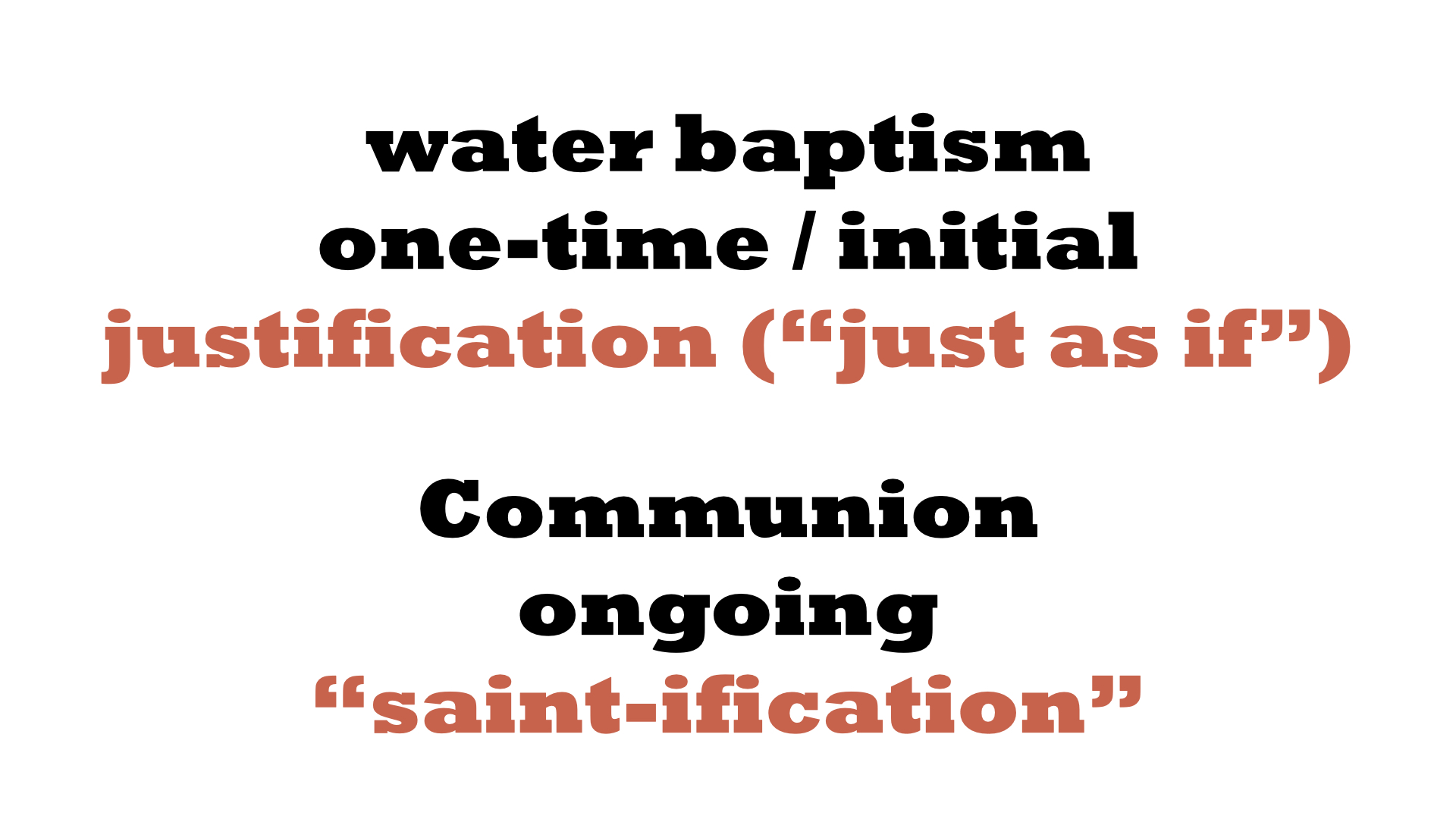
  1. Water baptism is a one-time event, just as our justification (“just as if I’d never sinned”) is a one-time event. This looks back to what Jesus did on the Cross. 
  2. Communion is an ongoing celebration “until He comes,” just as our sanctification (“saint-ification”) is an ongoing process. This looks ahead to what Jesus will complete when we are glorified in Heaven. 

If you’ve missed any of the other messages in our series exploring our foundational beliefs, you can find the complete list by clicking here.

►► Would you please prayerfully consider supporting this ministry? ◀︎◀︎

Thursdays With Spurgeon—Unity Not Uniformity

This is a weekly series with things I’m reading and pondering from Charles Spurgeon. You can read the original seed thought here, or type “Thursdays With Spurgeon” in the search box to read more entries.

Listen to the podcast of this post by clicking on the player below, and you can also subscribe on iTunes or Spotify.

Unity Not Uniformity

And the glory that You gave Me I have given them, that they may be one just as We are One: I in them, and You in Me; that they may be made perfect in one, and that the world may know that You have sent Me, and have loved them as You have loved Me. (Jesus, in John 17:22-23)

     Beloved, those in whom Christ lives are not uniform, but one. …  

     As I have remarked, it is not uniformity. Of this our Lord says nothing. Though we are one body in Him, yet all the members have not the same office. The eye is very different from the ear, and the foot has not the same form as the hand. Neither does He speak of any formal organization by which unity is to be secured. How many have tried to create a mechanical union and have made confusion worse confusion! Their eagerness for unity has threatened to dash everything to shivers! The very first step toward a visible unity of the church is, with most men, that they will fix a standard of what the church ought to be and cut off everybody who will not conform to their idea! …  

     Christ lives in His people, and we are to act so, in the power of the Holy Spirit, that onlookers will say, ‘Surely Christ lives again in that man, for he acts out the precepts of Jesus. Did you notice how he bore the insult? Did you notice how he laid himself out to oblige and to serve? Did you observe how, without introducing religious talk, he gradually steered the conversation toward that which is to edification?’ …

     Brothers and sisters, if you and I are living for the same design that our Lord lived for, and if the very life that quickens us is the life of Jesus, then, since Jesus lives always for the same thing that God proposes and works out, surely there is a grand unity, the likes of which are not found in the universe! … 

     ‘That the world may know that You have sent Me.’ How will they know it? Why, when they see such characters as I have so feebly tried to paint! When they see men who are no longer selfish, hard, and ungenerous—when they see men no longer governed by their passions, no longer earthbound—when they see loving men, men who desire that which is holy, just, and good! When they see men living for God, the world will say, ‘Their Master must have been sent of God.’

From The Glory, Unity, And Triumph Of The Church

Several years ago I was meeting with a group of pastors from various denominations. Although the meeting was friendly, I still sensed some “walls” between us. At one point I asked, “By a quick show of a raised hand, how many of us believe that salvation from the penalty of our sin comes only through the work that Jesus did for us on the Cross?” Every pastor in the room raised a hand. “Great,” I said, “let’s just focus on that!” 

Some Christians are Calvinist, and some are Arminian; some take Communion one way, and some another way; some are charismatic, and some more liturgical; some baptize one way, and some baptize differently. Jesus wasn’t looking for uniformity, but He did pray for unity. 

We can all be unified around the love of Christ, and the unity of the family of Christ. 

If we will set aside the petty denominational differences and simply love each other as brothers and sisters in Christ, we will present a witness for Him that is unmistakable and irrefutable! We need each other to bring out the saintliness in all of us. When the world sees this vibrant saintliness—regardless of which church those saints attend on Sundays—it will capture their attention and draw them to Jesus. 

Charles Spurgeon concluded the sermon I just quoted from with a prayer, to which I sincerely hope all of us Christians can add our own Amen: “Oh, for grace so to live to God in Christ Jesus that the world will never be able to answer the argument of our lives! Help us, O Spirit of the Lord! Amen.”

►► Would you please prayerfully consider supporting this ministry? ◀︎◀︎
Thursdays With Spurgeon—Sent To Show Jesus To The World

This is a weekly series with things I’m reading and pondering from Charles Spurgeon. You can read the original seed thought here, or type “Thursdays With Spurgeon” in the search box to read more entries.

Listen to the podcast of this post by clicking on the player below, and you can also subscribe on iTunes or Spotify.

Sent To Show Jesus To The World

And the glory that You gave Me I have given them, that they may be one just as We are One: I in them, and You in Me; that they may be made perfect in one, and that the world may know that You have sent Me, and have loved them as You have loved Me. (Jesus, in John 17:22-23)

     The essence and cause of the glory that the Father gave the Son was, first of all, that He endowed Him with the Holy Spirit. ‘God does not give the Spirit by measure. The Father loves the Son, and has given all things into His hand’ (John 3:34-35). The Holy Spirit descended upon our Lord in His baptism and abode upon Him so that in the power of the indwelling Spirit He lived, spoke, acted, and in all that He did, the Spirit of God was manifest. …  

     Now this glory, our Lord has given to all His disciples. Upon each true disciple, the Spirit of God rests according to his measure. If we have not the anointing to the fullest, it is either from lack of capacity or by reason of our own sin, for the Spirit of God is given to the saints—He dwells with us and will be in us always. My brothers and sisters, I would to God we realized this, that the glory of the Holy Spirit that was given to Christ is also given to us, so that it is ours to think, to feel, to speak, to act under His guiding influence and supernatural power! What are we apart from the Holy Spirit? How can we hope to convince even one man, much less the world, that God has sent His Son unless the Holy Spirit is with us? …  

     If men would see God, let them look at Jesus, for there is He to be seen! And with bated breath we add—let them look at Christ’s people, for there also is God revealed! It is the glory of the saints that they are the mirror of the divine character! … 

     Christ Jesus was sent to reveal the Father, sent to reclaim the wandering souls of men, sent to seek and to save the lost. And this is exactly what every true Christian is sent into the world to do. He is commissioned to reveal God in his every act and word. He is commissioned to win back rebellious hearts. He is commissioned to save the sons of men and bring them up out of the horrible pit into which their sins have cast them. …

     Jesus was the Son of God, and He overcame the world in the power of His Sonship. Now, this glory that the Father gave Him, He has given us, that we, too, may be accepted; that we, too, may have access; that we, too, may have prevalence in prayer; that we, too, may have the Spirit of Adoption; and that we, too, may trample upon sin and overcome the hosts of darkness. This is the glory that rests upon all the faithful!

From The Glory, Unity, And Triumph Of The Church

Jesus commissioned His followers to go into all the world as His witnesses, but He never intended for us to go in our own strength. As Spurgeon asked, “How can we hope to convince even one man, much less the world, that God has sent His Son unless the Holy Spirit is with us?” 

That’s why I always stress that Christians not be content with merely having received the salvation that comes with the forgiveness of their sins, but that they press on to be baptized in the Holy Spirit. It’s this empowerment that will allow us to be effective witnesses for Jesus.

Thursdays With Spurgeon—Context Is King

This is a weekly series with things I’m reading and pondering from Charles Spurgeon. You can read the original seed thought here, or type “Thursdays With Spurgeon” in the search box to read more entries.

Listen to the podcast of this post by clicking on the player below, and you can also subscribe on iTunes or Spotify.

Context Is King

And the glory that You gave Me I have given them, that they may be one just as We are One: I in them, and You in Me; that they may be made perfect in one, and that the world may know that You have sent Me, and have loved them as You have loved Me. (Jesus in John 17:22-23)

     Some words serve many uses and have many meanings. We are very apt to make mistakes if we give the same sense in all places to the same word. The word world throughout Scripture is used with a very remarkable variety of meaning, and one had need to have his wits about him and to read carefully in order to know what is the precise source of the term in each place where it occurs. …  

     I say again, the word world, therefore, has many shades of meaning ranging from that jet black meaning in which the world lies in the wicked one—‘Love not the world, neither the things that are in the world’ (1 John 2:15)—upward to the milder sense in John 1:10, ‘He was in the world, and the world was made through Him, and the world did not know Him.’ And yet higher to the bright meaning, ‘The kingdoms of this world have become the kingdoms of our Lord and of His Christ’ (Revelation 11:15). It is not in the worst sense that our text speaks of the world, but in the same manner as we find it used in such passages as these: ‘The Lamb of God who takes away the sin of the world!’ (John 1:29). ‘God was in Christ reconciling the world to Himself, not imputing their trespasses to them’ (2 Corinthians 5:19). And again in 1 John 2:2, ‘And He Himself is the propitiation for our sins, and not for ours only but also for the whole world.’ 

     It is certain that ‘God so loved the world that He gave His only begotten Son, that whoever believes in Him should not perish but have everlasting life’ (John 3:16), and we cannot suppose that the great Redeemer would refuse to pray for those whom He was given. I understand in this particular place by the word world the whole mass of mankind upon the face of the earth who are not as yet converted. … 

     For the sake of the world, He would have the church in a high state of holy beauty and strength. May His gracious prayer be answered in all of us by the working of the Holy Spirit! … Our wish is to bring multitudes to the Savior and to conquer province after province of this revolted world for King Jesus. ‘Let the whole earth be filled with His glory’ (Psalm 72:19) is a prayer that we cannot, we dare not, we would not fail to pray! 

From The Glory, Unity, And Triumph Of The Church

When we are studying our Bibles, we must remember that context is so vital. We have to read each inspired word in its proper context so that we know how to believe, think, live, and pray. I urge you to slow down in your Bible reading—aim for better and richer comprehension than to just try to read a lot in one sitting. Sometimes in my own personal Bible study time, I may spend several minutes just thinking about one phrase, and that may be the only part that I read on that particular morning. 

I would also counsel you to use some trustworthy Bible study tools. I have a list here of 8 must-have Bible study tools, and you can find some new ways to use these tools in this post about three types of Bible studies you may not have considered before. 

However you read your Bible, make sure you are reading each part in its proper context. Pray before you begin reading and ask the Holy Spirit—Who inspired the Scriptures—to illuminate them to your heart and mind. These thoughtful Bible studies will do more to grow your spiritual maturity than simply rushing through your reading time.

Two Perfect Prayers

Friends, I recently shared a message in which I talked about how the Holy Spirit helps us in our prayer life, specifically how the Spirit reminds Christians that we have been adopted into God’s family. 

In this clip from that sermon, I talk about the only two times that we can pray perfect prayers, and I make reference to two passages of Scripture: John 14:26 and Romans 8:26-27. Take a listen… 

The Spirit of Truth reminds us of everything God has said to us in His Word, and He helps us turn those promises into prayers (see John 14:26). 

The Spirit of Intercession gives us a prayer language unknown to our logical mind, whereby we pray in a language in which we have no control over the words being spoken (see Romans 8:26-27; 1 Corinthians 12:4-10). 

Only when we pray God’s Words directly back to Him, or when we pray in tongues as the Holy Spirit enables us, are we praying a perfect, unselfish, God-glorifying prayer.

►► Would you please prayerfully consider supporting this ministry? ◀︎◀︎