Jesus told us that we could pray in His name and expect amazing things (see John 14:13-14, 15:16, 16:23-24). This does not mean that simply adding the phrase “in Jesus’ name, Amen” to the end of a prayer unlocks a secret code. Rather, it means that the more we understand just how awesome our Savior is, and that He is the Key to God’s storeroom, the more we will being to align our prayers with the will of God.
Jesus desires for His Father’s glory to be seen on earth through the answers to our prayers. The writer of Hebrews opens his letter by reminding us that Jesus is “the radiance of God’s glory and the exact representation of His being, sustaining all things by His powerful word” (Hebrews 1:3).
We will be working our way through the Book of Hebrews to learn just how awesome the name of Jesus truly is. As we do so, my prayer is that your prayer life will flourish into something far greater than it has ever been before!
Join us beginning this Sunday for our series on prayer called Awesome: Learning to pray in the awesome name of Jesus.
If you have missed any of the messages in this series, check them out here:
This is a weekly series with things I’m reading and pondering from Charles Spurgeon. You can read the original seed thought here, or type “Thursdays With Spurgeon” in the search box to read more entries.
Listen to the podcast of this post by clicking on the player below, and you can also subscribe on Apple, Spotify, or Audible.
When God Seems Distant
You may possibly be in such a condition that every promise scowls at you as though it were transformed into a threat. When you turn over the pages of the Book once so full of comfort to you, it seems withered into a howling wilderness. …
Even those promises that you have been accustomed to offer to others in their time of need appear to shut their doors against you. ‘No admittance here,’ says one promise. Unbelief puts its burning finger right across another. Past sin accuses you and cries, ‘You cannot claim this word, for your transgression has forfeited it.’ So you may look through the whole Bible and find nothing upon which your souls may rest. … The fault is not in the promise but in us. …
Why does our gracious God permit this? Perhaps it is because you have been living without Him, and now He is going to take away everything upon which you have been in the habit of depending. Another reason may be that He wishes to drive you to Himself. … The prodigal was never safer than when he was driven to his father’s bosom, because he could find sustenance nowhere else. And, brothers and sisters, I think our Lord favors us with a famine in the land that it may make us seek after the Savior more. …
When everything goes well with us, we frequently run a long way from God, but as soon as we are overtaken by trouble or see a lion in the way, we fly to our heavenly Father. I bless God for the mire and for my sinking in it, when it makes me cry out, ‘Deliver me, O my God, out of the deep mire, and let me not sink.’
From The Believer Sinking In The Mire
David said, “I keep my eyes always on the Lord. With Him at my right hand, I will not be shaken” (Psalm 16:8). And in another psalm he elaborated on this by saying,
Yes, my soul, find rest in God; my hope comes from Him. Truly He is my rock and my salvation; He is my fortress, I will not be shaken. My salvation and my honor depend on God; He is my mighty rock, my refuge. Trust in Him at all times, you people; pour out your hearts to Him, for God is our refuge. (Psalm 62:6-8)
God allows shaking so that we will recognize that He is the only sure foundation. The only things that shake and prove themselves to be untrustworthy are those things not standing on God. So if God seems distant, ask the Holy Spirit to show you if there are any idols in your heart. If there are, repent from trusting those and return to God alone.
After this, the next step is to silence the voice of the enemy. Jesus said satan’s native language is lies and slander. As Spurgeon said, the enemy of your soul would love to tell you that God’s promises aren’t for you—that somehow you are disqualified from claiming them.
Listen to the podcast of this post by clicking on the player below, and you can also subscribe on Apple, Spotify, or Audible.
What people were saying about Jesus from His birth—before He preached a sermon, performed a miracle, or stepped on the toes of religious or political leaders—was revealing the truth. I’ve already discussed the words of the Magi and King Herod the Great, but all of these men also interact with another group (Matthew 2:1-6). Matthew calls them “all the people’s chief priests and teachers of the law.”
This group was commonly called the Sanhedrin. It was an influential body of 70 + 1 leaders (Numbers 11:16), whose influence was felt in the temple in Jerusalem, in the synagogues in small villages, in King Herod’s throne room, and in the palace of the Roman governors.
Notice that Matthew says “chief priests” in the plural. At the time of the birth of Jesus, Caiaphas was high priest and Annas his father-in-law was the former high priest. In the time of the early church, Annas is again called the high priest (Luke 3:2; John 18:13; Acts 4:6)
Even under the Roman government the Sanhedrin held tremendous power…
they were experts in the Mosaic law and its application (Matthew 22:35)
Jesus said, “the teachers of religious law and the Pharisees are the official interpreters of the law of Moses” (Matthew 23:2 NLT)
Jesus also said they had storehouses of helpful knowledge (Matthew 13:52)
they decided who would get to use their authority (Mark 11:27-28; 1:22)
they were keepers of the traditions and became “indignant” when those traditions weren’t followed (Mark 7:5; Matthew 21:15)
they were exorcists (Mark 9:14-17; Acts 19:13-14)
Jesus said these leaders would be instrumental in His death (Matthew 16:21)
they had their own armed guards and prisons (Mark 14:43; Acts 4:1; 5:18)
yet they were afraid of the opinions of the people (Luke 22:1-2; Mark 11:31-32)
Jesus said they were “the official interpreters of the law,” yet they oftentimes interpreted the law to benefit themselves.
When Herod asks them where the Messiah is to be born, they quote Micah 5:2 as saying, “a Ruler who will be the Shepherd of My people Israel.” But the word they use for “Ruler” means a leader with authority, or a governor (the same word is used for Joseph in Acts 7:10). Remember Herod’s violent temper and his insane suspicion? The word these religious leaders used gave them an “out.” They were almost saying to Herod, “When the Messiah does come, He will be a governor, which means there’s a good chance that He would report to you.” This “tame” interpretation was an attempt to keep them in the good graces of King Herod the Great
But Micah himself uses the word for “Ruler” that means one with absolute dominion. Jesus will be THE Sovereign King.
After hearing that this long awaited Messiah had finally been born in fulfillment of the prophecies, take a look at their response—
they said .
they did . (even though Bethlehem was only 6 miles away!)
How sad!
But I think this is because they believed themselves to be “in” with Jehovah because they so carefully kept the rules. They didn’t need a Messiah to save them because—in their minds—they believed they were already saved from God’s punishment.
Keeping religious rules doesn’t save anyone.
Honoring age-old traditions doesn’t save anyone.
Only coming to Jesus saves anyone!
A key prophecy about Jesus in Isaiah 9:2 says that the Messiah will save us from darkness and shadows. What exactly are these?
The writer of Hebrews tells us that the law and rules are merely shadows of the True Substance. God said through Isaiah that relying on the rules keeps us trapped in meaningless religious traditions. But Jesus came as the Light and as the Substance that set us free. His death and resurrection made it possible for our sins to be forgiven (see Hebrews 10:1-7; Isaiah 1:11-14, 18).
Rules don’t take us into God’s presence, but Jesus does. Not just talking about Jesus, but coming to Jesus as our Savior and Lord.
People will talk about Jesus—even you may talk about Him. That doesn’t do anything. But when we do more than talk—when we come to Him to follow Him as our Ruler and Shepherd—then we find forgiveness and freedom.
Let’s not just talk about Jesus, but let’s be actively obedient!
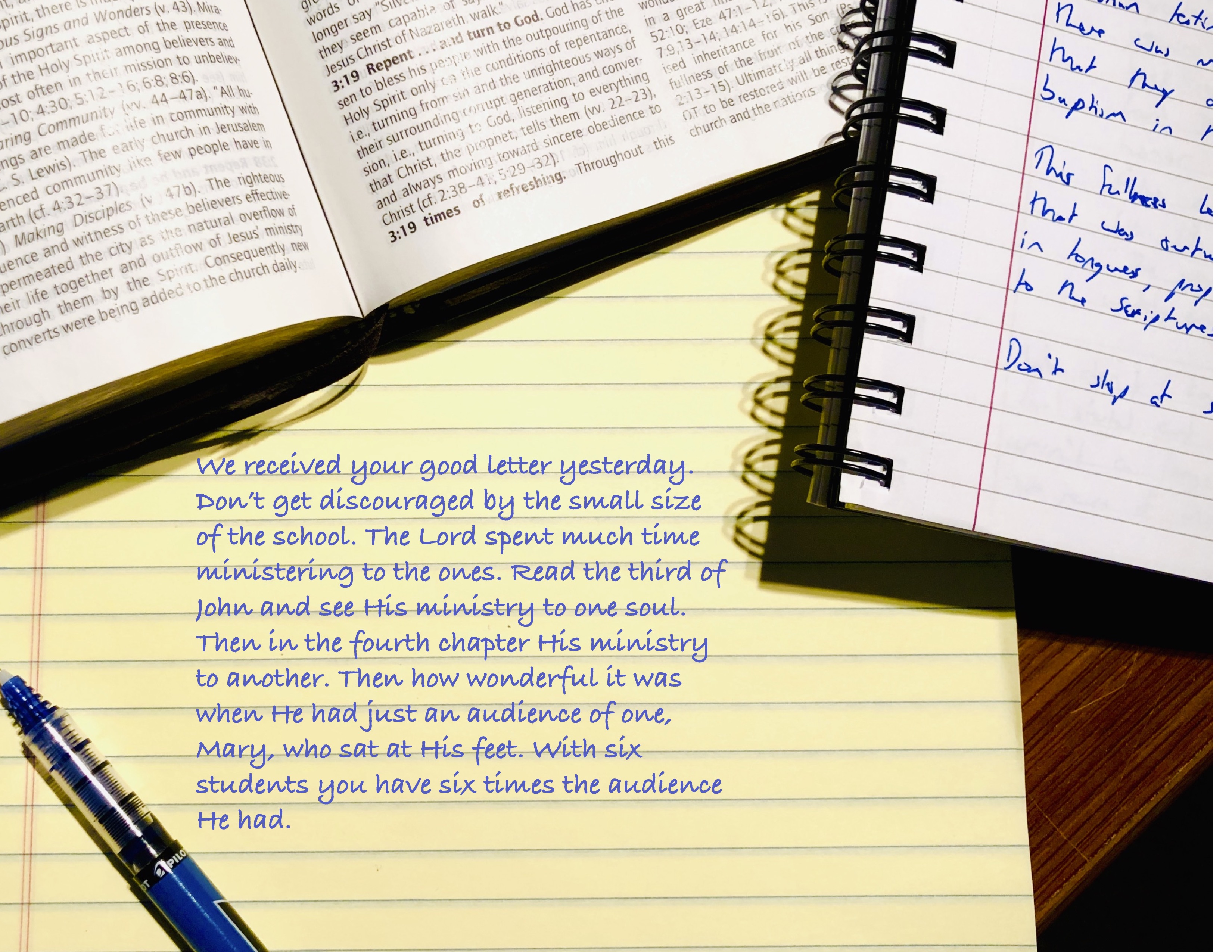
When Faith Frodsham was teaching at the Peniel Bible Institute, she wrote home to tell her father Stanley about her frustration over the small size of her class. She wondered if she was really being successful with such a small class.
“We received your good letter yesterday. Don’t get discouraged by the small size of the school. The Lord spent much time ministering to the ones. Read the third of John and see His ministry to one soul. Then in the fourth chapter His ministry to another. Then how wonderful it was when He had just an audience of one, Mary, who sat at His feet. With six students you have six times the audience He had.”
Success is not about big numbers, but about quality time invested faithfully and for God’s glory.
I wrote my book Shepherd Leadership: The Metrics That Really Matterto address this misconception which discourages so many pastors and other ministry leaders. If you are involved in ministry, I truly believe this book will give you a new encouraging perspective.
But let’s look at this from another angle: Before there was an Old Testament and a New Testament, what did those who lived in the days of Jesus call what we now refer to as “the Old Testament”? They called it Scripture.
Here’s a clip from a recent sermon where I discuss more in-depth why our New Testament is really the best commentary we have on the Old Testament:
I invite you to check out a couple of other resources:
Listen to the podcast of this post by clicking on the player below, and you can also subscribe on Apple, Spotify, or Audible.
“Anxiety disorders are the most common mental illness in the U.S., affecting 40 million adults in the United States age 18 and older, or 18.1% of the population every year.” —Anxiety & Depression Association of America
A multitude of factors go into someone’s anxiety: genetics, temperament, brain chemistry, life experiences. In addition to those factors, we have to keep in mind that humans are a three-part being—with a body, mind, and spirit—and a disease in one area does affect the other two areas.
All of this means that there is no one-size-fits-all solution for anxiety. But there is one Healer:
He may supernaturally heal your body, mind, or spirit
He may direct you to a medical doctor, a mental health professional, or a spiritual counselor
But always, He will walk through the challenges with you, strengthening you, and preparing you to minister to others going through a similar struggle (Psalm 23:1-6; 2 Corinthians 1:3-4)
David wrote, “When I am afraid, I put my trust in You” (Psalm 56:3). Notice that he said “when” not “if.” David knows what you probably know too: we can be easily consumed by our anxiety, doubts, and fears. But David also knows (and I hope you do too) that at those moments, we can go to God as our trustworthy First Source.
One of the dictionary definitions of anxiety is a feeling of disquiet. All of the conflicting thoughts make it hard to concentrate, the abundance of noise makes it difficult to talk to yourself, let alone talk to God.
I’d like you to consider another psalmist’s words. Look at the first half of Psalm 94:19—
When anxiety was great within me… (NIV)
In the multitude of my anxious thoughts… (AMP)
When doubts filled my mind… (NLT)
The setting of this psalm is one of lots of disquieting voices: a desire to see the wrongdoers punished, listening to arrogant words, getting fed up with boasting words, seeing good people being trampled, hearing foolish words uttered about God (vv. 1-8).
Experiencing anxiety is not sinful, but I do think that we grieve God’s heart when we immediately run to other sources for relief instead of going to our loving Heavenly Father first. After dealing with the disquiet in the opening verses of Psalm 94, the psalmist says, “My anxiety level was sky high!” But then notice how that verse concludes—
…Your consolation brought me joy (NIV)
…Your comforts cheer and and delight my soul (AMP)
…Your comfort gave me renewed hope and cheer (NLT)
Jesus told us about our Comforter who would always be with us (John 14:1, 16-17). A little further on in these same remarks Jesus also said, “These things I have spoken to you, that in Me you may have peace. In the world you will have tribulation; but be of good cheer, I have overcome the world” (John 16:33 NKJV).
I like that phrase, “Be of good cheer.” That phrase is just one word in Greek, and sometimes it’s translated “be of good courage.” In every single instance, it’s only used by Jesus and it’s only used when He comes close to anxious people (Matthew 9:2, 9:22, 14:27; Mark 6:50, 10:49; Luke 8:48; John 16:33; Acts 23:11).
A furious squall battered the boat, almost swamping it. The disciples were—to say the least—disquieted! In their anxious state they notice Jesus peacefully sleeping. They wake Him up with, “Don’t You care that we’re drowning?!” Jesus stands up and says to the storm, “Quiet. Be still.”
Recall that one of the descriptions of anxiety was being disquieted. That prefix dis- means to be separated: our anxiety would seek to distance us from God’s presence, to make us feel like His help is too far away. But when we go to Jesus, He alone can say, “Quiet” to our disquieting thoughts. He can remove the “dis-” and bring us close to Him. Only His peace can X-out the noise of the storm and bring you to a place of quiet rest.
After Jesus said, “Quiet. Be still,” notice this: “…THEN the wind died down and it was completely calm” (Mark 4:39). And the great thing is this: Even if another storm begins disquieting us just a few minutes after the calm, we can go to Him again. There is no limit: We can continually go to the Eternal Source of peace, to the only One who can speak, “Quiet” to our anxious thoughts.
Listen to the podcast of this post by clicking on the player below, and you can also subscribe on Apple, Spotify, or Audible.
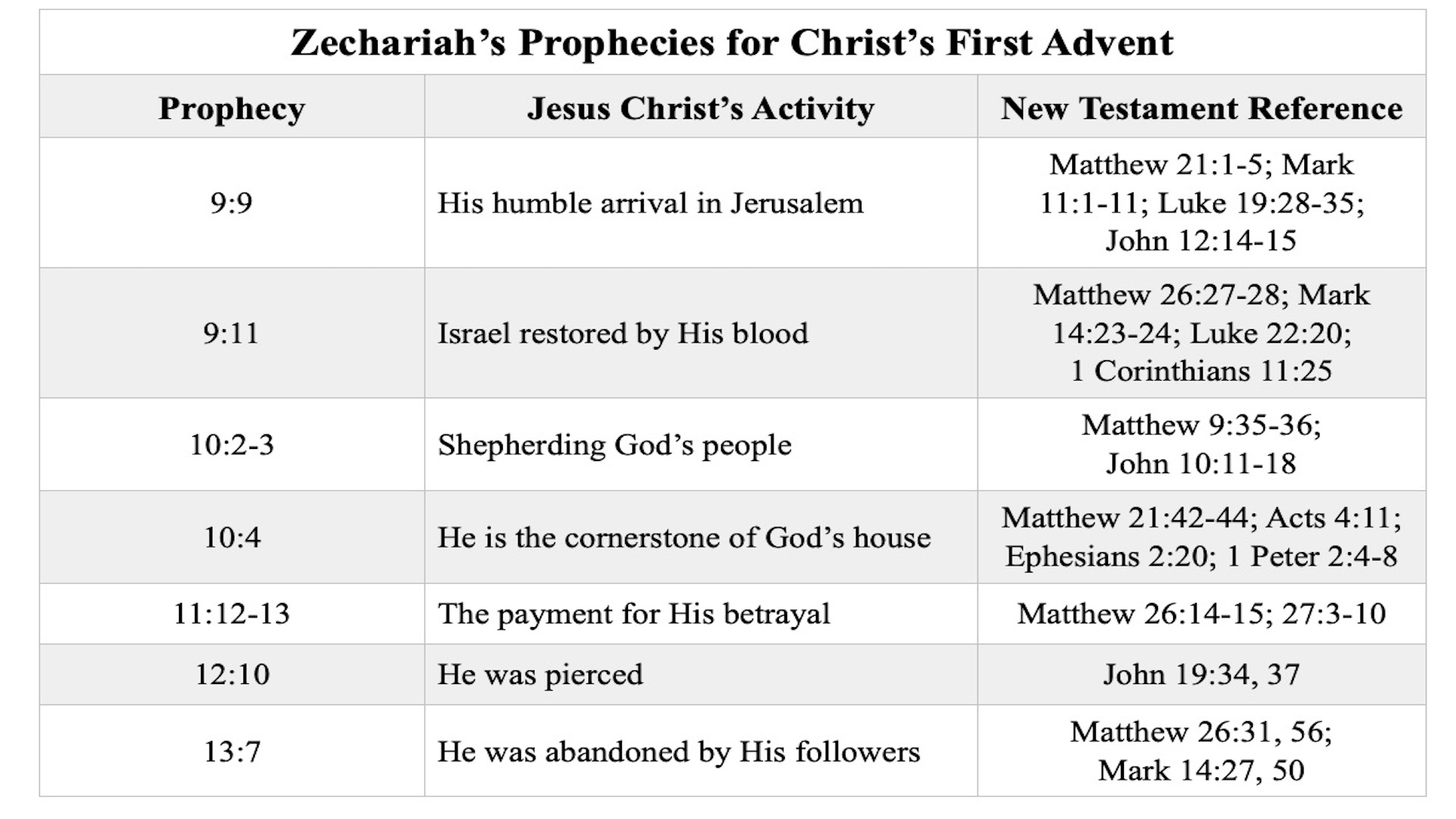
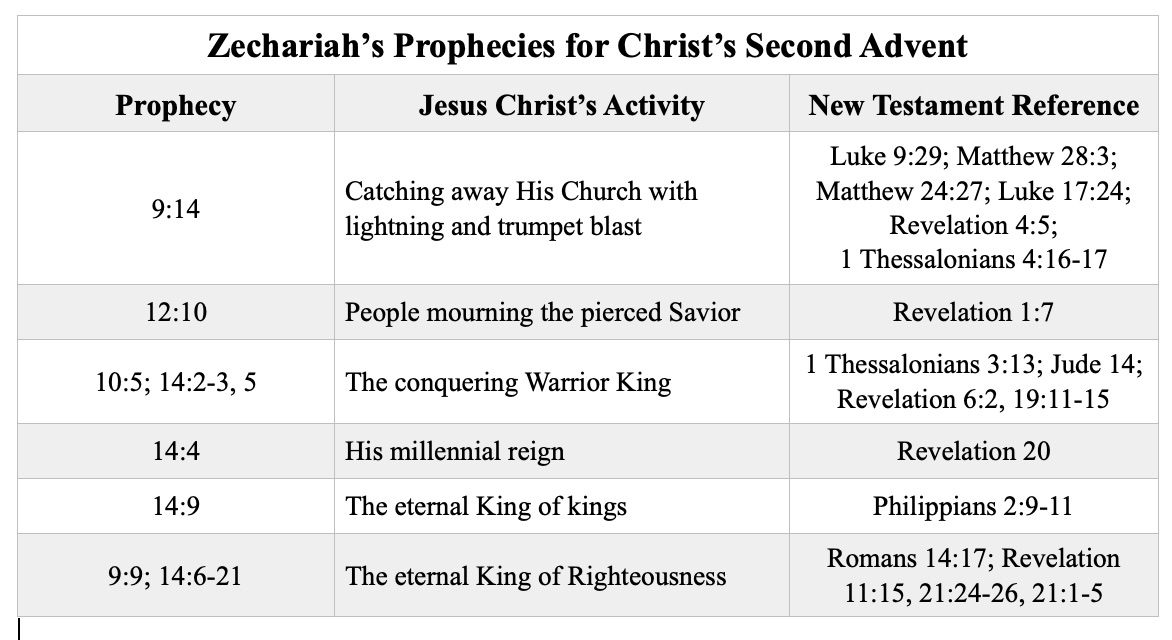
Zechariah pronounces more messianic prophecies than any other biblical writer, with the exception of Isaiah (and he wrote 66 chapters!). These prophecies are fulfilled in Christ’s First Advent, and promised for His Second Advent. Check these out for yourself…
(All of the biblical references for the above chart can be viewed by clicking here.)
(All of the biblical references for the above chart can be viewed by clicking here.)
Why is it so vital that Jesus fulfilled these prophecies?
(1) The historicity of these fulfilled prophecies gives us a confidence for the future.
These fulfilled prophecies assure us that God is sovereign over all history. There are no accidents, and God needs no help from anyone else in fulfilling what He has promised. As a result, no world event—no matter how big it may seem—should be able to rattle us!
(2) The authenticity of what God has done gives us boldness for today.
When God does the miraculous, He authenticates His Word. This authenticity has always made God’s people stand out (see Genesis 41:39). It’s also why people recognized Jesus as the divine Son of God (John 3:2; 9:30-33). So we can live with the boldness to know that what God says He will do, He will do!
(3) The exclusivity of God’s promises and fulfillment of those promises gives us joy for our testimony.
Only Jesus could have done all of this (Luke 24:26-27, 44), so only Jesus can fulfill what is still remaining to be fulfilled! We can have supreme joy in knowing that only Jesus is our hope of salvation (John 14:6; Acts 4:12).
It’s vital that we know this is true so that we can live confident, bold, and joyful!Our confident boldness and our bold joy both glorify God and attract seekers to Him.
Listen to the podcast of this post by clicking on the player below, and you can also subscribe on Apple, Spotify, or Audible.
Have you ever heard this truism: The person with an experience is never at the mercy of the person with an argument?
There are, sadly, many who deny the reality of God’s divine healing for today. They may say God healed in the past, but that age has passed, or they may simply deny all supernatural activity. I have the best reply to these skeptics or deniers—and you may have this same reply: God does heal today; I know this is true because He has healed me!
Our truth statement about this says: “Divine healing is an integral part of the gospel. Deliverance from sickness is provided for in the atonement, and is the privilege of all believers.” Let me break this down into three parts.
(1) “Divine healing is an integral part of the gospel.” After that word “integral” I’d like to insert the word “indisputable.” When God does the miraculous, it is an undeniable proof of His love and power. A great story to prove this point is when Jesus healed a paralytic after He forgave him of his sins (Luke 5:17-26).
Notice how the people responded: Everyone was amazed and gave praise to God. This glory to God has always been the reason God performs miracles (see Mark 6:7-13; Acts 2:43; Acts 3:9-12).
(2) “Deliverance from sickness is provided for in the atonement.” I like to remember that the word atonement means “at-onement” and stands opposed to disease which I like to say as “dis-ease.” Sin is our ultimate dis-ease—the ultimate separator—so Jesus took care of both our spiritual dis-ease and our physical dis-ease when He died on the Cross for us, just as Isaiah prophesied. That’s why the New Testament also shows us salvation and healing frequently being linked together (Acts 10:38; 8:4-8).
(3) “And is the privilege of all believers.”ALL believers, not just a select few and not just those who lived at the time of the first apostles.
Divine healing has been—and always will be—an integral and indisputable part of the gospel precisely because it exalts God as THE Healer.
Many people today still believe what the disciples of Jesus believed: Disease is a consequence of personal sin. In addressing this misunderstanding, Jesus said that disease was “so that the work of God might be displayed” in the life of the one about to be healed. He said something similar while at the graveside of Lazarus, before he raised that dead man back to life (John 9:1-38; 11:4-45).
Sometimes God heals us now, but ALWAYS He heals us in our glorified bodies (2 Corinthians 12:9-10; 5:1-9; Revelation 21:4). Our patience and hope in our future, ultimate healing glorifies God in the present.
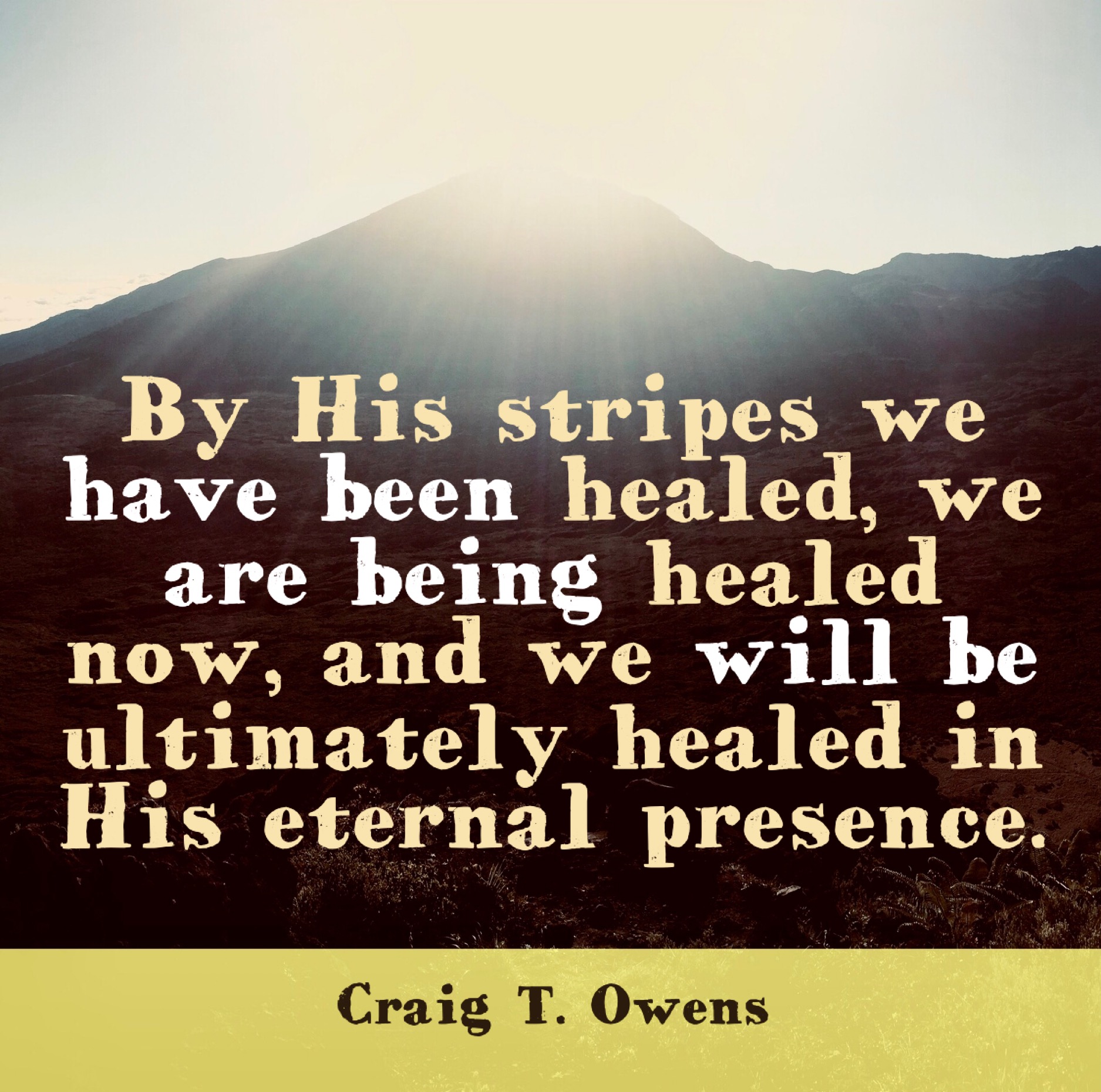
By faith in Jesus we can claim that “by His stripes we have been healed” (1 Peter 2:24). The verb tense Peter uses means we have been healed, we are being healed now, and we will be ultimately healed in Christ’s eternal presence. Whether we are healed here or not, we can live knowing that His healing power always brings Him glory and always draws people to Him, so don’t hesitate to keep on asking Him for His healing touch on your body and soul.
Listen to the podcast of this post by clicking on the player below, and you can also subscribe on Apple, Spotify, or Audible.
I had a great time on the Thriving In Ministry podcast with Kyle Willis and Dace Clifton.
Kyle asked me if I had a life verse that was working on me. Two verses—John 13:3-4—quickly sprang to mind from the actions of Jesus on the night He was betrayed. Here’s how I answered that question on the podcast…
In John 13, Jesus prepared to share a final meal with His disciples. John recorded these words: “Jesus knew that God had put all things under His power” (v. 3). ALL things—not some limited power, but all power. At that moment, Jesus was, without question, the most powerful Person standing on planet earth. By modern-day standards, we could say Jesus had reached the top of the ladder!
What would you do with that much power? How would you respond to having God’s full approval?
Here’s what Jesus did: He took on the role of the lowest of servants and washed His disciples’ feet. Then after doing this, He said something He had never said to His disciples before: “I have set you an example that you should do as I have done for you” (v. 14).
Jesus used His unlimited power to serve.
Our Good Shepherd’s plan all along was to serve people. He said, “The Son of Man did not come to be served, but to serve and to give His life as a ransom for many” (Mark 10:45).
Quite simply stated: Shepherd leaders serve.
I’ll be sharing more clips from this interview soon, so please stay tuned. In the meantime, Shepherd Leadership is now available in print, ebook, and audiobook.
Listen to the podcast of this post by clicking on the player below, and you can also subscribe on Apple, Spotify, or Audible.
In the Foreword to my book Shepherd Leadership: The Metrics That Really Matter, Dick Brogden observes, “God plucked David from the sheepfold. God chose a sheep to be a shepherd. And though we all are stupid sheep, when God plucks us out of obscurity to serve others, we can have the humble confidence for as long as we are asked to lead that God has chosen us. That confidence both faithfully drives us to our knees and fearlessly propels us against our giants. It is good to be a sheep; it is good to be an under-shepherd. Just remember you are stupid, chosen by the Wise One, and as long as you serve as a shepherd, you and your flock will be safe.”
How true it is that all of us are sheep. The role of the shepherd is to care for the sheep and create a healthy environment for them. The role of healthy sheep is to reproduce more sheep. In this, both shepherds and sheep are ministers—we all minister to those God has placed around us.
God calls all Christians to be ministers. The Church is the sheepfold that equips us, but then we must go out to minister in a way that will bring lost sheep to a personal relationship with Jesus.
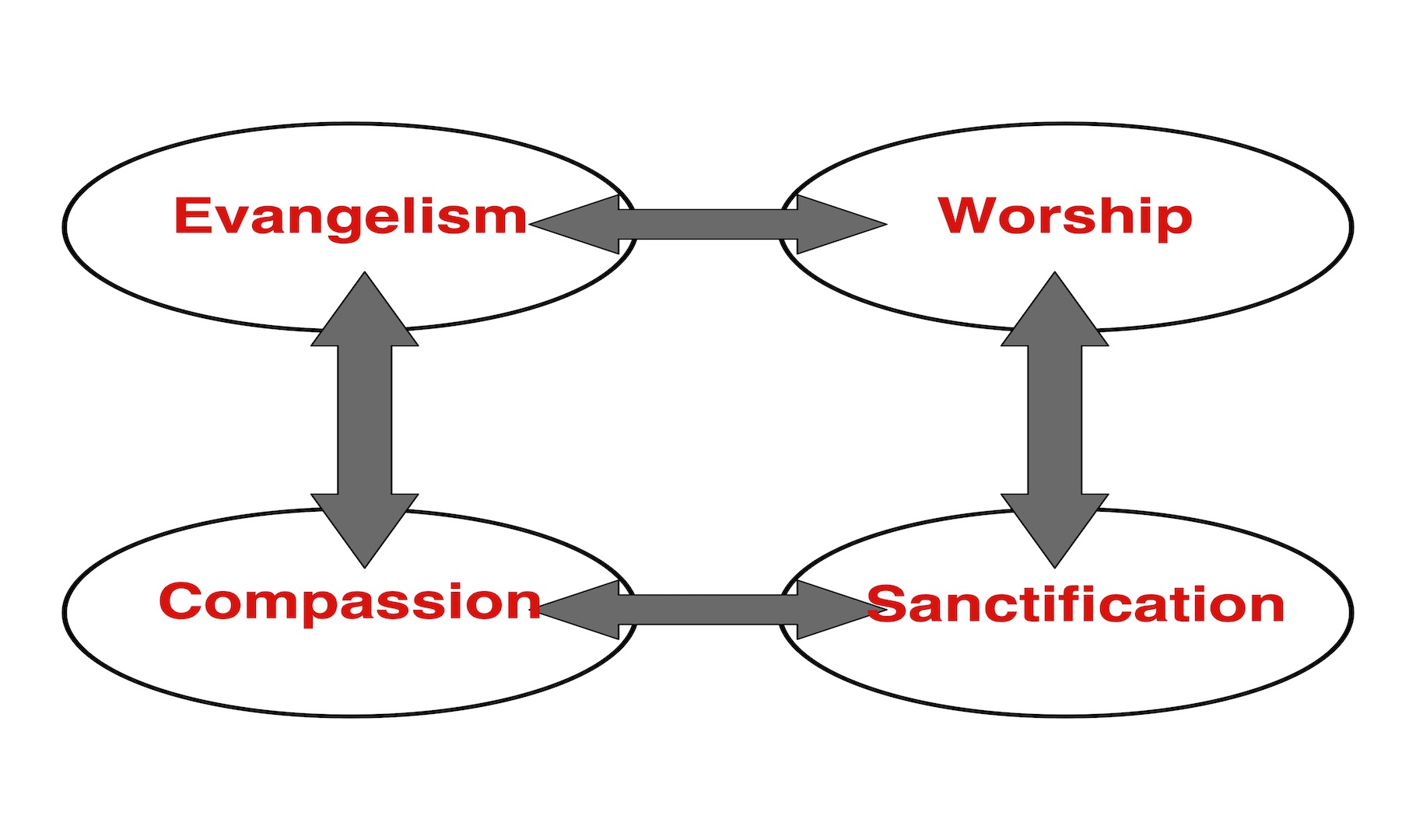
Our foundational truth statement about church ministry says: A divinely called and scripturally ordained ministry has been provided by our Lord for the fourfold purpose of leading the Church in evangelism, worship, sanctification, and compassion.
(1) Evangelism. When we looked at the foundational belief about the Church, we noted that it’s not either-or—evangelism or discipleship—but it’s both-and. Christians are being the Church when they are intentionally living in a way that makes Jesus known (Matthew 10:1, 7-8; 28:18-20).
(3) Sanctification. Remember that we are all in-process of becoming saints (I like to remember this by calling it saint-ification). We need each other to do this, which is why God gives gifts to bring out Christ-like maturity in us (Ephesians 4:1-7, 11-16).
So here are two important questions we need to ask ourselves: (1) Am I doing quality work? (2) Am I faithfully doing my work?
To help answer those questions, I like this thought from Leonard Sweet’s book I Am A Follower: “The most important metrics we must rely on, the crucial ‘deliverables’ we can present, must focus on the newly formed lives of the disciples we are making, the followers who are following Christ into a place of serving Him by serving others. The most important measure of our faithfulness to Christ must be the extent of transformation into the living image of Christ Himself. … The quantifiable fruit of our church is not found in the number of people we can gather on a weekly basis. What counts is what is happening in the lives of those who have gathered.”
These are questions we should all ask the Holy Spirit to reveal to us:
What is happening in my life?
Am I telling others about Jesus?
Am I worshipping God so consistently that everyone can see it?
Am I maturating as a saint and am I helping other saints mature?
Is my faith seen in my compassionate actions?
Our individual answers to those questions will determine the success of our individual churches, which will ultimately determine the effectiveness of the global Church of Jesus Christ. I hope you will take some time to consider these questions for yourself.



 Jesus told us that we could pray in His name and expect amazing things (see John 14:13-14, 15:16, 16:23-24). This does not mean that simply adding the phrase “in Jesus’ name, Amen” to the end of a prayer unlocks a secret code. Rather, it means that the more we understand just how awesome our Savior is, and that He is the Key to God’s storeroom, the more we will being to align our prayers with the will of God.








The Best Commentary On The Old Testament
December 8, 2021 — Craig T. OwensListen to the podcast of this post by clicking on the player below, and you can also subscribe on Apple, Spotify, or Audible.
But let’s look at this from another angle: Before there was an Old Testament and a New Testament, what did those who lived in the days of Jesus call what we now refer to as “the Old Testament”? They called it Scripture.
Here’s a clip from a recent sermon where I discuss more in-depth why our New Testament is really the best commentary we have on the Old Testament:
I invite you to check out a couple of other resources:
►► Would you please prayerfully consider supporting this ministry? ◀︎◀︎
Share this: