10 Quotes From “Our Portrait In Genesis”

The Complete Works Of Oswald ChambersOswald Chambers has given us another valuable resource in Our Portrait In Genesis, as he walks through the first book of the Bible with us. You can read my full book review here. As usual, there are just way too many good quotes to share all at once, so here is the first batch of quotes from this book.

“It is not my faith laying hold of the Word, but the life in the Word laying hold on me.”

“We transgress a law of God and expect an experience akin to death, but exactly the opposite happens, we feel enlarged, more broad-minded, more tolerant of evil, but we are more powerless; knowledge which comes from eating of the tree of the knowledge of good and evil, instead of instigating to action, paralyzes.”

“No man can murder his brother who has not first murdered God in himself.” 

“It is ingrained in our thinking that competition and rivalry are essential to the carrying on of civilized life; that is why Jesus Christ’s statements seem wild and ridiculous. They are the statements either of a man or of God Incarnate. To carry out the Sermon on the Mount is frankly impossible to anyone but a fool, and who is the fool? The man who has been born again and who dares to carry out in his individual life the teaching of Jesus. And what will happen? The inevitable result, not the success he would otherwise have. A hard saying, but true.”

“Grace is the overflowing immeasurable favor of God; God cannot withhold, the only thing that keeps back His grace and favor is our sin and perversity.” 

“Faith un-tried has no character value for the individual. … Spiritual character is only made by standing loyal to God’s character no matter what distress the trial of faith brings.”

“We must be careful never to compromise over any promise of God when by reason of human limitation there has been only a partial fulfillment. Such a compromise is easily detected whenever you feel, ‘Oh well, I suppose that is all God meant.’ Every word God has spoken will be absolutely fulfilled; to climb down from that confidence is to be disloyal to God.”

“There is always the danger of becoming a fanatical adherent to what God has said instead of adhering to God who said it.”

“The only way to wait for the Second Coming is to watch that you do what you should do so that when He comes is a matter of indifference.” 

“It is a question of faith in God, the rarest thing, we have faith only in our feelings. I don’t believe God unless He will give me something in my hand whereby I may know I have it, then I say, ‘Now I believe.’ There is no faith there.”

Our Portrait In Genesis (book review)

The Complete Works Of Oswald ChambersI love having Oswald Chambers walk alongside me as I study the Bible. He is like a wise, insightful friend pointing out, “Did you see that? Did you notice what God is doing here? What do you think that means for you?” In Our Portrait In Genesis, Chambers walks with us through the first book of the Bible.

Previously I reviewed Not Knowing Where by Oswald Chambers, which looks specifically at the life of Abraham in Genesis 12-25. In Our Portrait, Chambers turns his attention to the other notable people in Genesis.

As he looks at Adam, Eve, Cain, Able, Noah, and the other patriarchs, Chambers is constantly pointing out the lessons we can learn from their lives and apply to our lives. Because of his training in psychology, Chambers is so skilled at knowing what was going on in the minds of these biblical examples, and then helping us examine our own thinking along the same lines.

Our Portrait and Not Knowing Where are tremendously helpful commentaries to read as you work your way through the book of Genesis. As always, you can’t go wrong picking up an Oswald Chambers book!

Are You Irritated? Good!

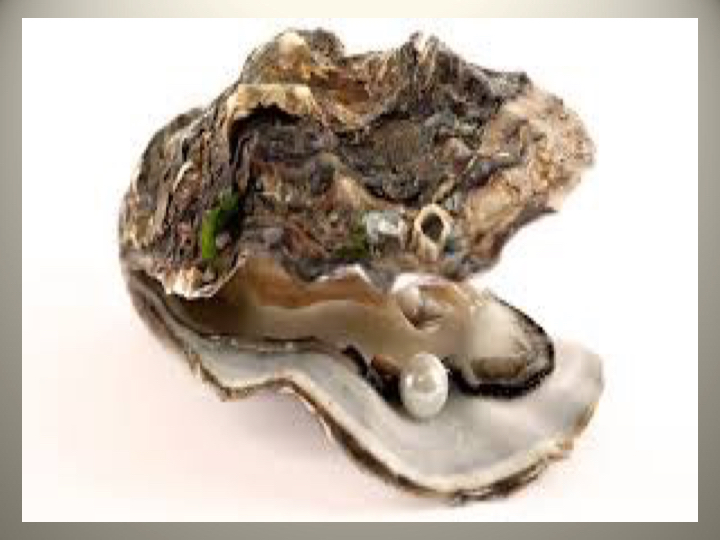
Pearl oysterPastor Tom Kaastra shared a whole new way of looking at the irritations we sometimes have, by pointing us to an example in nature. God reveals Himself to us in the Bible and through nature. That’s why Francis DeSales said, “God has signed all created things. We can trace His footsteps through the natural world.”

So take a look at the oyster. God designed it with a heart, a mouth, a digestive system, a reproductive system, a nervous system, and all other things that allow it to survive. But He also gave it a way to thrive.

The oyster can be irritated by a foreign invasion. But… God has put within the oyster the power to turn an irritation into a valuable pearl!

It is the same for Christians. The same power that raised Christ from the dead dwells in us (see Romans 8:11). That power allows us to see that all things are working together for the good of those who love God (see Romans 8:28-29). As Pastor Tom said it, “God wants to Jesus-size us.”

Carl Jung said, “Everything that irritates us about others can lead us to an understanding of ourselves.” So God designs irritations on purpose to develop a valuable pearl in our lives that will bring Him glory.

Look at Joseph. His brothers sold him into slavery in Egypt (which ranks in my book as a major irritation!). But look how Joseph saw the pearl God developed—

And now, do not be distressed and do not be angry with yourselves for selling me here, because it was to save lives that God sent me ahead of you. For two years now there has been famine in the land, and for the next five years there will not to be plowing and reaping. But God sent me ahead of you to preserve for you a remnant on earth and to save your lives by a great deliverance. So then, it was not you who sent me here, but God. (Genesis 45:4-8, emphasis added)

So the next time you’re irritated, remind yourself, “Great! God is making a valuable pearl in my life!”

You can watch the video of Pastor Tom’s message below, and be sure to check out his website for other valuable lessons like this one.

Live Blessed And Peaceful

SpockI think most people are familiar with Spock’s famous Vulcan hand signal that means “Live long and prosper.” But long before Star Trek, the origins of this idea were displayed in the pages of Scripture.

The Hebrew word for grace or favor is first used in relation to Noah: “BUT Noah found favor in the eyes of the Lord” (Genesis 6:8). The conjunction BUT at the beginning of this verse tells us that the favor Noah experienced is being contrasted to something exactly the opposite. Here’s what we read two verses earlier, “The Lord was grieved that He had made man on the earth, and His heart was filled with pain” (v. 6).

Noah had to make a choice: would he fear God, or would he fear man. It’s a choice we all have to make today. We have to weigh and decide:

  • Fear of God vs. fear of man
  • Pleasing God vs. pleasing myself or someone “important” to me
  • Humble reliance on God vs. self-reliance
  • Objective obedience to God vs. subjective agreement when it feels okay

In the section of Psalm 119 called shin (vv. 161-168), the psalmist wrestled with this as well. He decided that he wasn’t going to be afraid of government officials that could persecute him, BUT “my heart trembles at Your Word.” He decided that he wouldn’t look for worldly treasures, BUT he would “rejoice in Your promise” (v. 162). That he wouldn’t praise temporary things, BUT “I praise You for Your righteous laws” (v. 164). That he wouldn’t try to find satisfaction in the temporary, BUT he would bask in the “great peace [for them] who love Your law” (v. 165). On and on it goes…

  • …I wait for YOUR salvation
  • …I follow YOUR commands
  • …I obey YOUR statutes
  • …I obey YOUR precepts (vv. 166-168)

People that live this way experience the same favor and grace that Noah experienced.

The Lord BLESS you and keep you; the Lord make His face SHINE upon you and be GRACIOUS to you; the Lord turn His face toward you and give you PEACE. (Numbers 6:24-26)

You can live blessed and peaceful by choosing God above all else!

Next Sunday we wrap up our series on the 119th Psalm, and I would love it if you can join us!

Here is the video from yesterday’s message—

If you have missed any of the messages in our P119 series, you can access them all by clicking here.

8 Quotes From Horatius Bonar

Horatius BonarThere is a series of book by Horatius Bonar called Light And Truth. I am currently reading one of the books in the series as I read through the New Testament in my personal devotional time. Typically I post a book review after I’ve finished a book (which I will do with Light And Truth [update: the review is posted here]), and then I share some quotes from that book. In this case I’m mixing things up a bit: I’m sharing some quotes from the first half of this book today, and then I’ll post a review and more quotes after I finish the book. Enjoy!

(Note: Scripture references appearing in brackets following the quote reflects the passage or verse on which Bonar was commenting.)

“What is at the bottom of all the persecutions of various ages? It is Christ troubling the world. If He would let it alone, it would let Him alone. What means the outcry, and alarm, and misrepresentation, and anger, in days of revival? It is Christ troubling the world. What means the resistance to a fully preached gospel? It is Christ troubling the world. A fettered gospel, a circuitous gospel, a conditional gospel—a gospel that does not truly represent Christ—troubles no man; for in such cases it is another Christ that is announced, and not the Christ, the King of the Jews, that troubled Jerusalem. But a large, free, happy, unconditional gospel, that fully represents Jesus and His grace, Jesus and His completeness, does trouble men. It troubles all to whom it comes, in some measure. Some it troubles and then converts; some it only troubles. … The world’s only hope is to be ‘troubled’ by Christ. … Yet all this troubling is in love. He sounds His trumpet to awake the sleepers.” [Matthew 2:3]

“The Lord ends speaking and begins working; He comes down from the pulpit and enters the hospital. Such is His whole life: words and deeds intermingled; words of health and deeds of health. His lips breathe fragrance, and in His hand is the balm of Gilead. … [The leper] wants to be made clean, and he casts himself on Christ for this. He is the hyssop, the water, the blood, the ashes, the priest, the physician, all in one. Thus we still come, doubting neither the willingness nor the power, yet casting ourselves on the will of the Lord; not presuming to dictate, yet appealing to His sovereign Grace. As the needy, the sick, the unclean, we come; for the whole need not a physician, but they that are sick.” [Matthew 8:1-3]

“It is the voice of authority. It reminds us of Genesis 1:2-3. He speaks as one who knew that He could cure. Not hesitatingly. Nor are the words a prayer, but a command. He speaks, and it is done. … Thus love, authority, and power are all conjoined. It is the voice of Omnipotence. … He is the same Christ still; with the same love, and authority, and power. He is still a Healer, and the worst of diseases fly from His touch and voice. Let us go to Him with all that afflicts us. He calls and He will heal us of all. … Be persuaded to present thyself to Him, just as thou art give this divine Healer thy simple confidence. Take Him for what He is, and He will take thee for what thou art. Thus shalt thou meet in love; thou to be healed, and He to heal; thou to have the joy of being healed, and He to have the joy of healing thee, and to announce to heaven, in the presence of the angels of God, that another leper has been healed!” [Matthew 8:1-3]

“And is not this oftentimes the very point of the difficulty we experience in believing? We cling to the visible, the palpable prop—the human rope which we hold in our hand, unwilling to let go. We speak of our inability to believe; but what is this save our tenacity in holding on to the very things which God asks us to quit? We say that we ‘cannot lay hold’; should we not rather say that we ‘cannot let go’? We complain that we have no power to cling and grasp; whereas it should be that we have no will to let go.”

“As iniquity increases, faith decreases. … As iniquity increases, truth decreases. … As iniquity increases, righteousness and holiness decrease. … As iniquity increases, religion decreases. … As iniquity increases, delight in the things of God decreases. … But the special thing of which Our Lord predicts the decrease is love—love to God, love to himself, love to one another.” [Matthew 24:12]

“Our Lord will come! This is one of the great certainties of the unknown future. He may tarry, but He will come at last. Many obstacles made seem to rise up, but He will come. Men may not desire Him, but He will come. The Church may be cold, but He will come. Earth may think she has no need of Him, but He will come! The scoffer may say, where is the promise of His coming? but He will come. satan may do His utmost to oppose; but He will come. This is the great future certainty which Christ and His apostles have proclaimed to us. Our Lord will come! … The hour is, no doubt, fixed in God’s purpose, but the knowledge of that time is kept from us. They do wrong, then, who try to fix the hour, thus seeking to extract a secret from God. They do wrong who neglect the whole subject because this secret is connected with it. They do wrong who scoff at the whole subject because of the rash attempts or wretched failures of some pretended interpreters of prophecy. Thus, ‘we know,’ and ‘we know not’: we know that He will come, we do not when. … Beware of falling under any influences that would make you indifferent to the Lord’s appearing. Beware of worldly arguments; beware of pretended spiritual arguments; beware of confounding death and Christ’s coming; beware of the errors and seductions of the age.” [Matthew 22:42, 44]

“Ah, does not our faith often thus fail just at this point? We can go to Him for a little thing; we cannot go to Him for a great thing. We count it presumption to expect much. Instead of feeling that the worse the case, the greater the glory to His power and love, we stop short, and cease to expect anything from Him at all. I need not trouble the Master, we say, my case is so desperate; instead of saying, because my case is so desperate, I will trouble Him, I will give Him this opportunity of magnifying His skill and grace.” [Mark 5:36]

“Understand what is passing day by day; interpret events; connect them with the coming of the Son of Man. You see false Christs; you hear a Babel of opinions; you mark the new forms of immorality and infidelity; you are startled with the bold assaults made on Scripture, and on the Christ of God, on His blood, and Cross, and righteousness—connect all these with the coming of the Lord; interpret them as signs of the last days; do not treat them as common things; do not close your eyes upon them; do not be indifferent to them; do not admire them as tokens of intellectual development and human progress. Understand them all according to God’s purpose and mind. Examine them in the light of apostolic teachings and warnings. Be not deceived concerning them. Beware of the strong delusion. … Pray, then, for a needy church, that in all these respects God would visit her; raising her up; reviving her; rekindling her light; reinvigorating her strength; re-adorning her with all gifts and graces; reclothing her in apostolic raiment, and sending her forth to do His work with the old power and success of primitive days. Pray for a needy world. It is blind, and knows it not; poor, and thinks itself rich; foolish, and thinks itself wise. It is doubly needy. It is not aware of the extent of its ruin, and alienation, and depravity; not alive to its danger and hopeless prospects; not anticipating its doom. There is a hardening, and searing, and blinding process going on in connection with ‘modern progress.’” [Mark 13:33]

17 Final Quotes From “Not Knowing Where”

Not Knowing WhereI’ve been sharing some of the amazing quotes from Oswald Chambers’ book Not Knowing Where. Here is the last set of quotes from this book.

“The natural life is not spiritual, it can only be made spiritual by deliberately casting it out and making it the slave instead of the ruler. … Jesus Christ cannot give me a meek and quiet spirit, I have to take His yoke upon me; that is, I have to deliberately discipline myself. … If we do not resolutely cast out the natural, the supernatural can never become natural in us.”

“Remember, Abraham had to offer up Ishmael before he offered up Isaac. Some of us are trying to offer spiritual sacrifices before we have sacrificed the natural. The only way we can offer a spiritual sacrifice to God is to do what He tells us to do, discipline what He tells us to discipline.”

“Common sense is not faith and faith is not common sense; they stand in the relation of Ishmael and Isaac, of the natural and spiritual, of individuality and personality, of impulse and inspiration. Faith in antagonism to common sense is fanaticism, and common sense in antagonism to faith is rationalism. The life of faith brings the two into right relationship.”

“We have the idea that the body, individuality, and the natural life are altogether of the devil; they are not, they are all of God, designed by God, and it is in the human body and in the natural order of things that we have to exhibit our worship of God. The danger is to mistake the natural for the spiritual, and instead of worshiping God in my natural life to make my natural life God.”

“How am I going to find out what the will of God is? In one way only, by not trying to find out. If you are born again of the Spirit of God, you are the will of God, and your ordinary common sense decisions are God’s will for you unless He gives an inner check. When He does, call a halt immediately and wait on Him. Be renewed in the spirit of your mind that you may make out His will, not in your mind, but in practical living. God’s will in my common sense life is not for me to accept conditions and say—‘Oh well, it is the will of God,’ but to apprehend them for Him, and that means conflict, and it is of God that we conflict. Doing the will of God is an active thing in my common sense life.”

“As Abimelech rebuked Abraham when he was in the wrong (see Genesis 20), and Abraham in his turn rebuked Abimelech, so in the same way the children of men from time to time rebuke the children of God, and the children of God rebuke the politics of natural men. Compromise with each other or unity between them is immoral. Arbitration until He comes Whose right it is to reign is the God-ordained program.”

“The very nature of faith is that it must be tried; faith untried is only ideally real, not actually real. Faith is not rational, therefore it cannot be worked out on the basis of logical reason; it can only be worked out on the implicit line of living obedience.”

“God does not further our spiritual life in spite of our circumstances, but in and by our circumstances.”

“To say ‘Here I am’ when God speaks, is only possible if we are in His presence, in the place where we can obey.” 

“God never fits His Word to suit me; He fits me to suit His Word.”

“True faith does not so much take God at His Word as take the Word of God as it is, in the face of all difficulties, and act upon it, with no attempt to explain or expounded.”

“The path to God is never the same as the path of God. When I am going on with God in His path, I do not understand, but God does; therefore I understand God, not His path.”

“Christ died in the stead of me. I, a guilty sinner, can never get right with God, it is impossible. I can only be brought into union with God by identification with the One Who died in my stead. No sinner can get right with God on any other ground than the ground that Christ died in his stead, not instead of him.” 

“The maturity of character before God is the personal channel through which He can bless others. If it takes all our lifetime before God can put us right, then others are going to be impoverished.”

“The genius of the Spirit of God is to make us pilgrims, consequently there is the continual un-at-home-ness in this world (cf. Philippians 3:20).”

“It is impossible for a saint, no matter what his experience, to keep right with God if he will not take the trouble to spend time with God. In order to keep the mind and heart awake to God’s high ideals you have to keep coming back again and again to the primal source.”

“Bitterness and cynicism are born of broken gods; bitterness is an indication that somewhere in my life I have belittled the true God and made a god of human perfection.”

You can read other quotes I’ve shared from Not Knowing Where by clicking here, here, and here.

And my book review of Not Knowing Where is here.

Not Knowing Where (book review)

Not Knowing WhereNot Knowing Where by Oswald Chambers was the first book from Chambers that I ever read, and I was instantly hooked on this wise, godly man’s writing. I just finished reading this amazing book again, and found even more to love!

Not Knowing Where is a study on the life of Abraham from the book of Genesis. Chambers takes us slowly through Abraham’s life, with entire chapters in the book sometimes just looking at a handful of verse from the biblical account of Abraham. Not only do we get to know Abraham so much better, but Chambers also makes timeless applications that every Christian can live by.

These chapters are a series of lectures Chambers gave at the Bible Training College, so they have a very conversational feel to them, making them easily readable. We also get to see Chambers’ love of poetry, as in nearly every chapter he shares with us a verse or two from poets which so beautifully capture the scene Chambers is trying to paint.

I know many people say that My Utmost For His Highest is a good starter book for those wanting to discover the genius of Oswald Chambers, but for me there is no better starting point than Not Knowing Where.

Links & Quotes

link quote

Are you subscribed to The Overview Bible Project’s summary of each book of the Bible? Check out this summary of Genesis and then subscribe.

“On this planet, there are about 7,000 living languages. 1,860 of them do not have a single word of Scripture. 4,500 languages do not have a full Bible. That’s more than 1 billion Bibleless people.” Read more in There Is No Good Bible For Over A Billion People.

My friend Jeff Bonzelaar has a thoughtful post called To Drink Or Not To Drink.

“Worry is anti-trust. If you’re worried, you don’t trust something: your kids, their friends, strangers, the church, even God. Can He take care of your children? Certainly. Jesus says, ‘I tell you, stop being anxious and worried about your life.’ Pretty blunt. Stop it! Easier said than done, huh? Worry tests your trust, so hand your children to God and let Him babysit your babies when you’re not around. He’s pretty good at it!” —Max Lucado

Planned Parenthood continues to disgust me. Read 5 Little Known Facts About Planned Parenthood and tell me why we taxpayers are helping subsidize their operations.

DON’T SEE THIS MOVIE! Why Fifty Shades Of Grey sends the wrong message.

“Hell is at stake here, not just the loss of a few extra rewards. … So we warn each other: Don’t drift away. Don’t love the world. Don’t start thinking nothing huge is at stake. Fear the terrible prospect of not cherishing the promises of God above the promises of sin. But mainly we must focus on the preciousness of the promises and help each other value above all things how great the reward is that Christ has purchased for us.” —John Piper

[VIDEO] President Obama is finally making Pastor Saeed Abedini’s captivity in Iran more of a public issue. Check out this video, and go here to sign this petition.

Links & Quotes

link quote

Some good reading from today…

“The book of Romans in a sentence: Because you were condemned (1:1 – 3:20) and God justified you (3:21-5:21), empowered you to be distinct (6-8), and explained His plan to keep His promises to Abraham (9-11), it is right for you to submit your life for Divine inspection (12:1-2), and live the life of a real believer (12:2-16:27).” —Dr. Randall D. Smith

[INFOGRAPHIC] I love the Bible study tools from The Overview Bible Project! Check out this one on the main characters in Genesis.

A great story about a marathon runner who intentionally loses the race.

The co-founder of The Weather Channel blasts the “global warming” crowd.

“It is too bad that anything so obvious should need to be said at this late date, but from all appearances, we Christians have about forgotten the lesson so carefully taught by Paul: God’s servants are not to be competitors, but co-workers.” —A.W. Tozer

“The truth is that evil is not a real thing at all, like God. It is simply good spoiled. That is why I say there can be good without evil, but no evil without good. You know what the biologists mean by a parasite—an animal that lives on another animal. Evil is a parasite. It is there only because good is there for it to spoil and confuse.” —C.S. Lewis

“Love, in the Christian sense, does not mean an emotion. It is a state not of the feelings but of the will; that state of the will which we have naturally about ourselves, and must learn to have about other people.” —C.S. Lewis

“In our time we have all kinds of status symbols in the Christian church—membership, attendance, pastoral staff, missionary offerings. But there is only one status symbol that should make a Christian congregation genuinely glad. That is to know that our Lord is present, walking in our midst!” —A.W. Tozer

Links & Quotes

link quote

Some good reading from today…

“Let no one grieve at his poverty, for the universal Kingdom has been revealed. Let no one mourn that he has fallen again; for forgiveness has risen from the grave. Let no one fear death, for the death of our Savior has set us free.” —John Chrysostom

[VIDEO] This is sad and a bit scary. Americans don’t know what Memorial Day means.

Tim Elmore answers the question, “What’s the bid deal about Memorial Day?”

“Our great need is to be people whose delights are the very delights of God.” —John Piper

Unbelievable! The U.S. State Department promoted a Muslim cleric who condoned killing U.S. soldiers!

Those who boast of their knowledge betray their ignorance. Knowledge is not a possession to be proud of….” Read more of the quote from Charles Spurgeon in It Matters What You Do With Your Knowledge.

[VIDEO] Cool look at the overview of Genesis 1-11 from The Bible Project.