Answer me when I call, God of my righteousness! You have relieved me in my distress; be gracious to me and hear my prayer. … But know that the Lord has set apart the godly person for Himself; the Lord hears when I call to Him. (Psalm 4:1, 3)
I can’t come into God’s presence in my own strength. But when I am clothed in the righteousness of Jesus, the distress of my sin is relieved and I am joyfully welcomed into the awesome presence of my Heavenly Father! He longs to hear my voice, and He loves to be gracious to me!
In the fourth year of King Hezekiah, which was the seventh year of Hoshea son of Elah, king of Israel, Shalmaneser king of Assyria came up against Samaria and besieged it (2 Kings 18:9). The Bible Archeology Report puts together wonderful biographies of biblical characters based on archeological discoveries that corroborate the account in Scripture. Here is the biography of Assyrian King Shalmaneser V.
Meteorologist Dr. Roy Spencer writes, “Atmospheric CO2 levels will start to fall even with modest reductions in anthropogenic CO2 emissions. Why is that? The reason is due to something called the CO2 ‘sink rate.’ It has been observed that the more CO2 there is in the atmosphere, the more quickly nature removes the excess.” Imagine that! It’s almost as if the Creator of the Universe knew exactly what He was doing.
J. Warner Wallace makes the case that the origin of the universe points to a Creator—but he does so without using Scripture.
“You will not be able to extemporize good thinking unless you have been in the habit of thinking and feeding your mind with abundant and nourishing food.” —Charles Spurgeon
We need to be careful of overlooking details we think might be insignificant because we can easily think that our small lives are somehow insignificant. They are not! As Tom Kaastra reminded us last week, we are here on purpose and for a purpose; our lives are eternally significant.
Immediately after His resurrection, the followers of Jesus struggled to wrap their minds around what they had just experienced. Just before His ascension, Jesus explained to them both what had happened already, and what was about to happen (Luke 24:44-49).
Jesus said He had already fulfilled the promised about His crucifixion and resurrection. Luke writes that Jesus “opened their minds so they could understand” (v. 45).
Notice two important things:
The Spirit of Jesus—the Holy Spirit—opens minds
He opens minds to grasp the truth in Scripture
Jesus also says that we are still fulfilling the “what is written” (v. 46) in the the proclamation of the death and resurrection of Jesus. We are fulfilling the prophecy that says the message of Jesus will be preached everywhere to all peoples, so that they also can receive the forgiveness Jesus paid for and repent of their Godless ways.
Who opens minds? The Holy Spirit.
What does the Spirit use as a catalyst to open minds? Our witness.
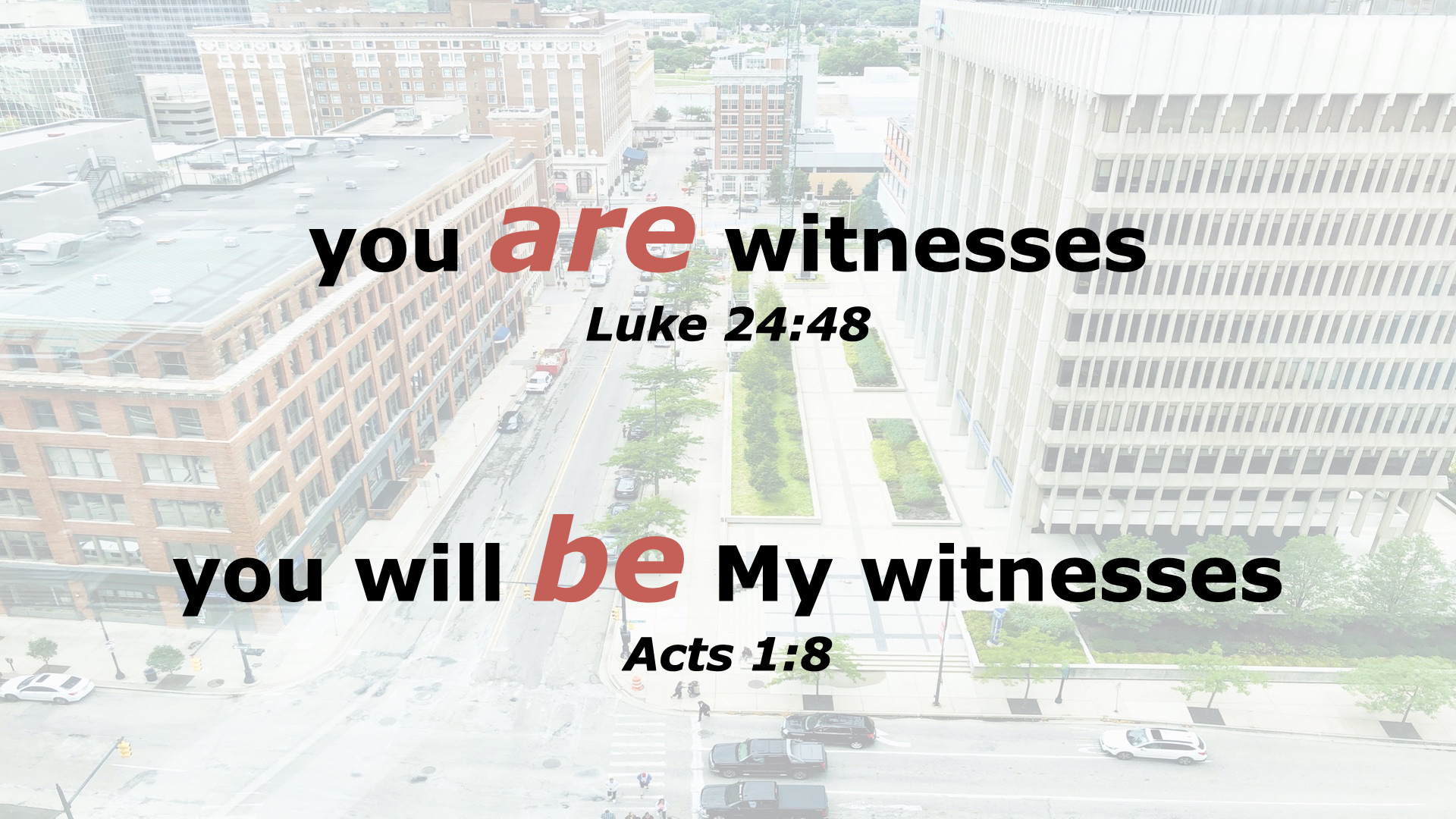
A witness is a truth-teller, who tells their firsthand story and who amplifies their verbal testimony by their Christ-honoring lifestyle. Jesus used two phrases to remind us that witnessing is not something we do, but it is who we are:
you ARE witnesses (Luke 24:48)
you will BE My witnesses (Acts 1:8)
Holy Spirit-baptized Christians are empowered to take Jesus to every street. God has strategically and purposefully placed us on our “streets” to proclaim our witness. From Easy Street to Skid Row, and everywhere in between, we are to fulfill the prophecy of proclaiming this good news to all nations (see 1 Corinthians 9:20-22).
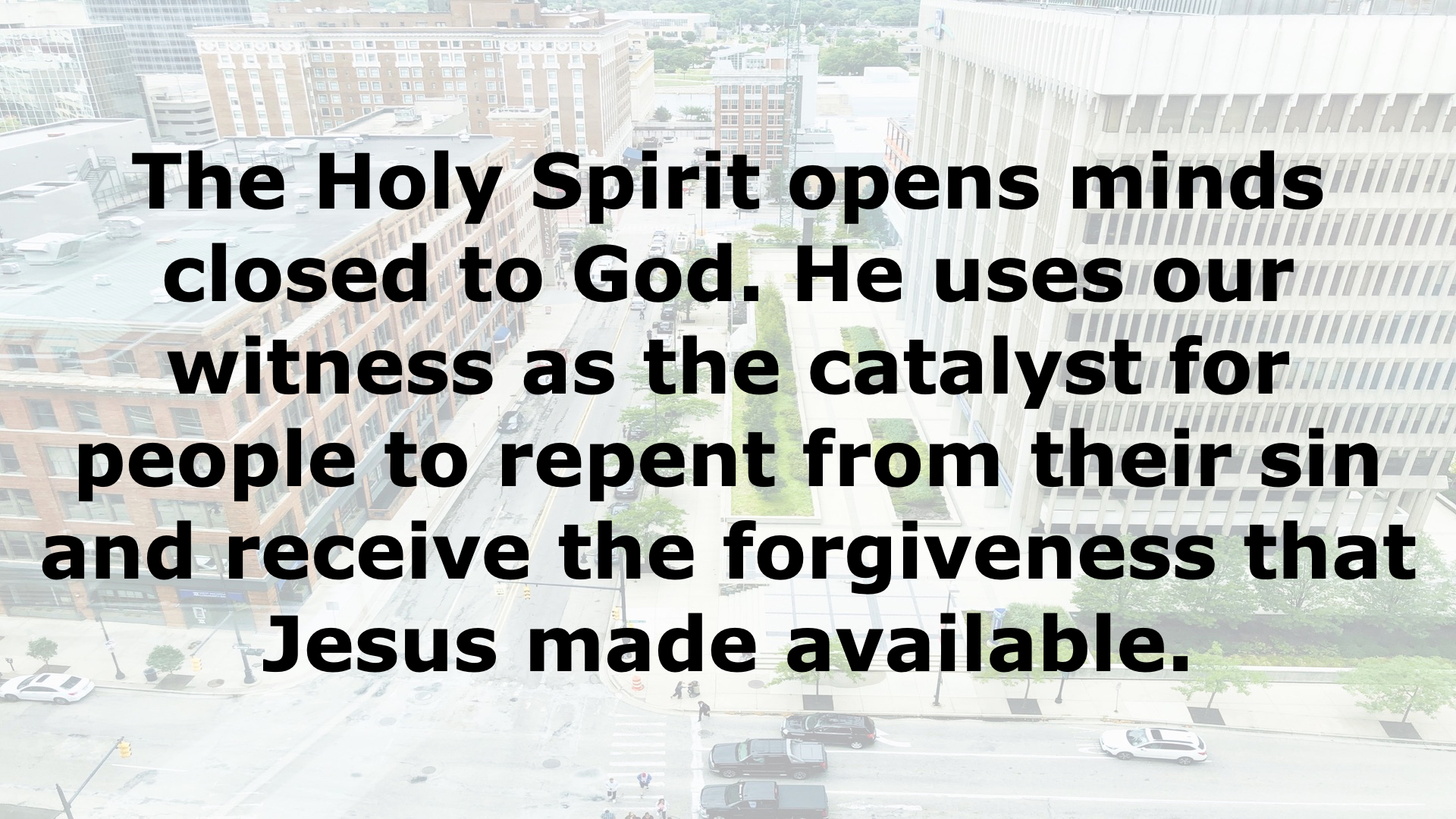
The Holy Spirit opens minds closed to God. He uses our witness as the catalyst for people to repent from their sin and receive the forgiveness that Jesus made available.
The devil wants us to remember what we’ve done or what we still need to do, but Jesus wants us to remember what He has already done. There is a huge difference! Check out this whole message here. I have lots of new content every week, which you can check out on my YouTube channel.
“The most likely man to go to hell is the man who has nothing to do on earth. Idle people tempt the devil to tempt them.” —Charles Spurgeon
“What were we made for? To know God. What aim should we have in life? To know God. What is the eternal life that Jesus gives? To know God. What is the best thing in life? To know God. What in humans gives God most pleasure? Knowledge of Himself.” —J.I. Packer
We can learn childlike faith by simply watching and listening to how young children interact with their loving parents. This video is a clip from one of the message in our series called Kingdom Praying.
Technological advancements abound all around us. How are Christians supposed to interact with technology: embrace it? ignore it? This is a thoughtful message to give us a biblical paradigm for our daily use of technology.
“We must quit bending the Word to suit our situation. It is we who must be bent to that Word, our necks that must bow under the yoke.” —Elizabeth Elliot
“The things you pray about are the things you trust God to handle. The things you neglect to pray about are the things you trust you can handle on your own.” —H.B. Charles
“Learning to pray doesn’t offer us a less busy life; it offers us a less busy heart.” —Paul Miller
He turned to God and the people put away their idols <or>
He turned from God and the people turned to their idols
It’s true: As goes the leader, so go the people.
In my life, I’ve experienced that the good things that I do over-the-top are only moderately emulated by those around me. But the unhealthy things that I even slightly indulge in are adopted quickly by everyone else.
Godly leaders must be so aware of how their example impacts everyone around them, and they must fight to maintain biblical standards. When we miss the mark, we must be quick to admit our shortcoming, repent, and get back on track.
In Hosea 4:9, God warns that the people will follow the ungodly example of their leaders, which is why God’s punishment is often more severe for those leaders.
On the positive side, in Leviticus 9, Moses and Aaron demonstrate the leadership example of spending time in God’s presence and fully obeying everything God had revealed to them there. Then verse 23 it says that after they came out of His presence, God’s glory appeared to all the people. The positive example of the leaders led to huge blessings for all the people!
A mark of a godly leader is one who increasingly aware of the power of his example.
Leaders, let’s be first to go first in…
…being in God’s presence
…obeying God’s commands
…repenting when we fall short
…asking forgiveness of those who have seen our poor example
…asking God to bless His people because of our good example
This is part 77 in my series on godly leadership. You can check out all of my posts in this series by clicking here.
Unforgiveness keeps our eyes on our offenders and off our God. Free yourself by forgiving those who have hurt you. You can check out this full sermon here. I have lots of new content every week, which you can check out on my YouTube channel.
“At the moment of truth, there are either reasons or results.” —Chuck Yeager
As I have shared before, I am so impressed with the He Gets Us social media campaign! Some people are still trying to figure out exactly what this campaign is. Sean McDowell and his podcast partner Scott Ray had a great conversation with Ed Stetzer about this. Check out the video!
Some people have been critical of the He Gets Us commercials that aired during the Super Bowl, but I thought they were outstanding! This is a social media outreach designed and funded by some of the most biblically-grounded, evangelistically-minded people I know. It is a social media campaign. It is not designed as a sermon (which is why there are no Bible verses shown in the commercial). The idea is to get past the barriers and misconceptions skeptics have come to believe about Jesus, and then be enticed to go to the hegetsus.com website. It is at this site that the Gospel message is introduced and visitors are given Bible verses and other materials to go deeper.
John Stonestreet wrote, “Before it was the corporate creation of greeting card companies, it was a day to remember third-century Christian martyr Valentinus of Rome.” This post is a good reminder of what Christians really should be remembering on Valentine’s Day, as well as the higher definition of love.
“The important thing is to learn a lesson every time you lose.” —John McEnroe
In January 1647, Oliver Cromwell captured King Charles I during the British Revolution. Within just a few months, Charles escaped and was able to raise another army. A year later, in August 1648, Cromwell’s forces once again defeated the army Charles had raised, and once again Charles was taken prisoner.
Oliver Cromwell put Charles on trial for his crimes, and after the guilty verdict was pronounced, Charles I was executed. A total of 59 people signed the former king’s death warrant.
Fast forward eleven years and Oliver Cromwell had died and his son Richard had taken his place as Lord Protector of England. Unlike his father, there was great discontent with Richard’s leadership. As a result, the Loyalists were able to sweep Charles II into power.
After assuming the throne of England, Charles II wanted the 59 death warrant signers put on trial, but fifteen of them had already died. That little fact didn’t stop King Charles II. He ordered that their bodies be exhumed, placed on trial, convicted of their crimes, and then hung.
I’m no psychologist, but I think it’s safe to say that Charles II might have had a slight problem with unforgiveness!
This is from a chapter I entitled “The ties that no longer bind.” The insidious nature of unforgiveness is that it ties us to the one who injured or offended us.
Jesus taught us to pray, “Forgive us our debts, as we also have forgiven our debtors” (Matthew 6:12). The word He uses for “debts” means something justly or legally due, or an offense or sin that has been committed. So a debtor is one who morally or legally owes another for the wrong committed.
So for these debts, we are taught to ask for forgiveness of God and to give that same forgiveness to others. Jesus uses the same root word for both “forgive” and “forgiven,” but there are nuances that make the picture quite clear.
When we ask God to forgive our debts, it is the active voice (I have to ask for it) and it is stated in the second person (I have to receive it). When I ask my Heavenly Father for this, my offense has been paid-in-full because the legal and moral requirements aren’t due any longer. I couldn’t pay this debt on my own, but Jesus paid it for me (2 Corinthians 5:21).
When I forgive someone who has wronged me, it is again the active voice (I have to give it), but it is now in the first person (I don’t wait around for the other person to ask for forgiveness). I let it go. I don’t hinder the other person or myself with waiting for the penalty to be paid any longer.
This is the only part of this model prayer for which Jesus gives a commentary afterwards (in Matthew 6:14-15). With this, Jesus is teaching us that to say, “I’m forgiven” is also to say, “I’m forgiving.”
Unlike Charles II, when we are forgiven and forgiving, the inevitable result is freedom for both ourselves and our offenders.
If we practice this relentlessly, we are both freed ourselves and freeing others!
When we pray, “Forgive as we also have forgiven,” we are both acknowledging His power to forgive us and requesting the faith need to be forgiving people. As C.S. Lewis noted, “To be a Christian means to forgive the inexcusable, because God has forgiven the inexcusable in you.”
The Bible describes satan’s activity as stealing, killing, and destroying. He’s called the father of lies, so he uses slander to try to steal, kill, and destroy. His slander is: “God can’t forgive that” and “You shouldn’t let them off the hook for what they did to you.”
These two thoughts are linked, just as “I’m forgiven” and “I’m forgiving” are linked. If I begin tothink that what someone did to me was too big for me to forgive, then I can also believe that there is a sin I have committed that is too big for God to forgive. But when I live both receiving and giving forgiveness, I can tune out this lie from hell.
Listen to the podcast of this post by clicking on the player below, and you can also subscribe on Apple, Spotify, or Audible.
I did a series of Advent messages a few years ago called “The Carols of Christmas” with the premise that many of our old familiar carols had become too familiar and we had lost the true meaning in those beautiful songs.
I think the same is true with the sentiment of wanting to experience the glory of God. Sometimes you will hear people say, “We just want to see God’s glory!” but I’m not sure they really mean this or really want it.
Throughout the Bible, “glory” comes from the Hebrew word which means weightiness. When God appears—or even one of His angels glowing with His glorious presence—people collapse under the weight of His glory. Look at the examples of Moses, Isaiah, Daniel, and even John the beloved disciple of Jesus (Exodus 3:6; Isaiah 6:3-5; Daniel 8:15-17; Revelation 1:12-17).
In the light of Christ’s glory everything is exposed. We have no excuses for our sin. We are seen exactly as we are, and the fear of God’s judgment causes us to collapse under that weight.
But the First Advent story is filled with the phrase “Fear not.” Let me show you two examples. First, notice the strong emotions when the angels appear to the shepherds—
An angel of the Lord appeared to them, and the glory of the Lord shone around them, and they were terrified. But the angel said to them, “Do not be afraid. I bring you good news that will cause great joy for all the people.” (Luke 2:9-10)
What was this good news that would turn their fear into joy? Listen to the angelic message to Joseph—
Joseph son of David, do not be afraid to take Mary home as your wife, because what is conceived in her is from the Holy Spirit. She will give birth to a Son, and you are to give Him the name Jesus, because He will save His people from their sins. (Matthew 1:20-21)
Notice the phrase, “HE will save His people from their sins.” Part of what contributes to our fear of God’s glorious presence is knowing that we are helpless to remove our sins. The fact that Jesus would do this for us was foretold in prophecies like Isaiah 25:7-9 and 59:15-16.
How will Jesus do this? In 1 Corinthians 15:53, Paul says that in order to enter into God’s presence our perishable, mortal lives have to be exchanged for something imperishable and immortal. We are unable to do this, but in the Incarnation, the immortal God put on mortal flesh!
Paul goes on in 1 Corinthians 15 to say, “When the perishable has been clothed with the imperishable, and the mortal with immortality, then the saying that is written will come true: “Death has been swallowed up in victory.” Where, O death, is your victory? Where, O death, is your sting?” (1 Corinthians 15:54-55)!
If our sins were still clinging to us, spending eternity in the presence of the King of Glory would be torturous! Our fear of His weighty glory is only changed into joy when we accept that He has saved us from the penalty of our sins. Now our fear of His glory isn’t a crippling fear, but as we worship Him for His salvation our fear becomes reverential worship.
Or we could say it this way—When we fear the King of Glory we fear nothing else!
Charitie Lees Bancroft captures that idea in these stanzas of her poem:
When satan tempts me to despair
And tells me of the guilt within,
Upward I look and see Him there
Who made an end of all my sin.
Because the sinless Savior died,
My sinful soul is counted free;
For God the Just is satisfied
To look on Him and pardon me.
Behold Him there! The risen Lamb,
My perfect, spotless righteousness;
The great unchangeable “I AM,”
The King of glory and of grace!
One with Himself I cannot die,
My soul is purchased by His blood;
My life is hid with Christ on high,
With Christ, my Savior and my God.
With our sins forgiven by our faith in Jesus, we can now enjoy an eternity in the weighty, awesome presence of the King of Glory!
The Holy Spirit loves to give us those “lightbulb moments” when the Word of God almost leaps off the page! I have lots of new content every week, which you can check out on my YouTube channel.
It has long been believed that some migratory animals use the earth’s magnetic force to help them navigate. Some researchers discovered that moths can see both the magnetic fields and the stars to plot their course. The lead researcher wrote, “If you have this tiny insect with a brain a tenth the volume of a grain of rice and eyes smaller than a pinhead, that they can do this is surprising.” The protein in their eyes that allow them to do this is unevolved—it’s always been there, implant from the beginning by our awesome Creator!
In the God Speaks Science reading plan on YouVersion, John Von Sloten wrote, “Creation is God’s first book. To read it we need science. Science is not the enemy of the Christian faith; it’s an ally! … We need to read biblical creation references with the Author’s omniscience and original intent in mind. To do that, we need science. … What if you try to connect the next scientific truth you encounter to an attribute of our ever-near God? If everything comes from God’s mind, then everything has something to say about God’s nature.”
Competitive leaders need to keep both winning and losing in perspective. Check out the full conversation Greg and I had about competition on The Craig and Greg Show.
Put the good stuff from the Bible in your heart and mind regularly. When you do, the Holy Spirit can remind you of what you’ve studied and help you apply it to your daily situations. I have lots of new content every week, which you can check out on my YouTube channel.
“It pays to know the enemy—not least because at some time you may have the opportunity to turn him into a friend.” —Margaret Thatcher
John Stonestreet and Dr. Glenn Sunshine shared this, “The despicable and horrendous attacks by Hamas against civilians last week, including beheading children and kidnapping the elderly, seems a throwback to some distant, barbaric past of human history. We may have thought the world had long ago outgrown such barbarity, but it hasn’t. In fact, as shocking as it is, the kinds of atrocities carried out by the Hamas terrorists are the norms of warfare, at least throughout most of human history.” What changed this? Quite simply: a Christian worldview of just warfare.
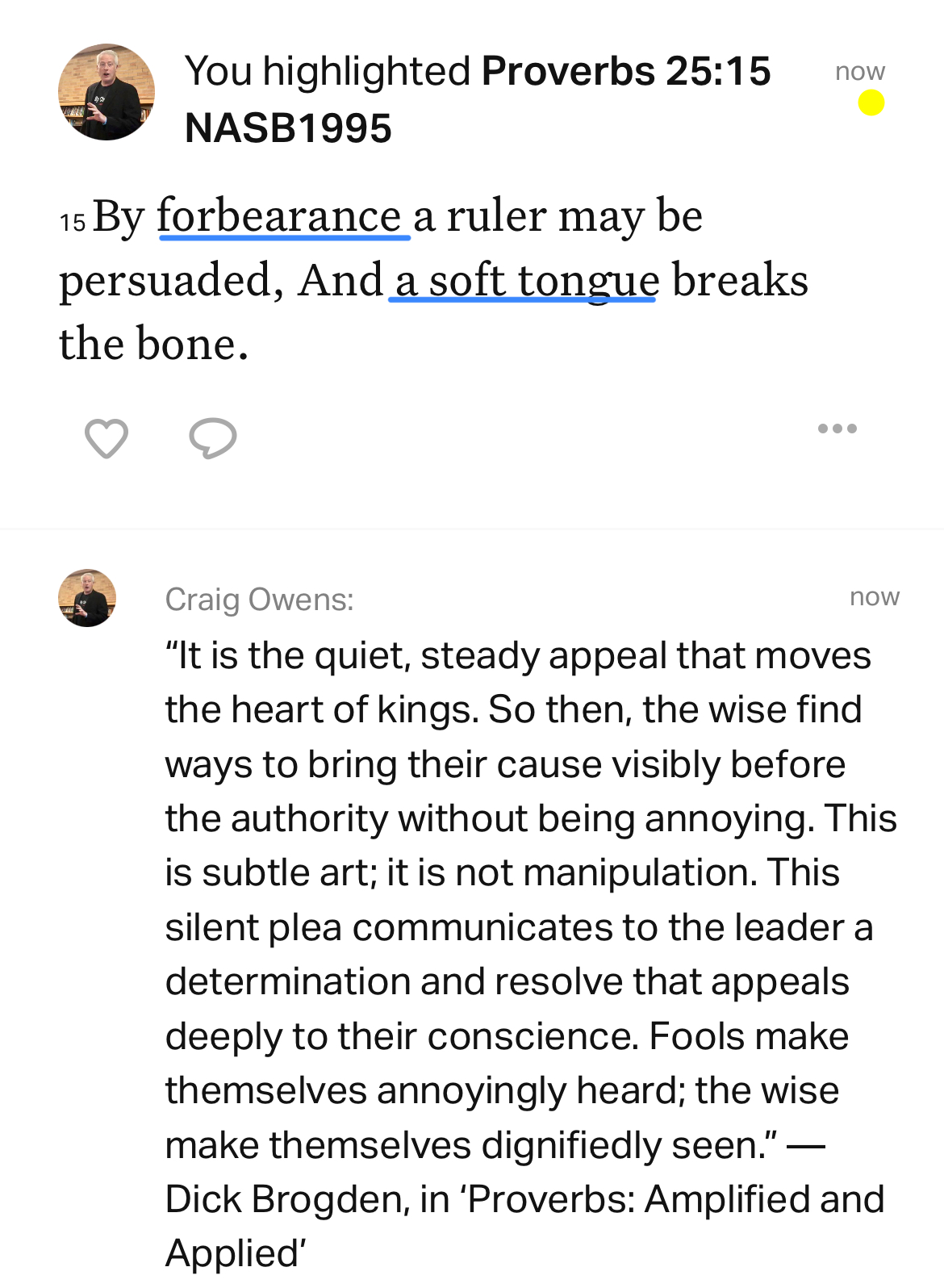
“It is the quiet, steady appeal that moves the heart of kings. So then, the wise find ways to bring their cause visibly before the authority without being annoying. This is subtle art; it is not manipulation. This silent plea communicates to the leader a determination and resolve that appeals deeply to their conscience. Fools make themselves annoyingly heard; the wise make themselves dignifiedly seen.” —Dick Brogden, in Proverbs: Amplified and Applied



 Answer me when I call, God of my righteousness! You have relieved me in my distress; be gracious to me and hear my prayer. … But know that the Lord has set apart the godly person for Himself; the Lord hears when I call to Him. (Psalm 4:1, 3)








Links & Quotes
February 17, 2024 — Craig T. OwensUnforgiveness keeps our eyes on our offenders and off our God. Free yourself by forgiving those who have hurt you. You can check out this full sermon here. I have lots of new content every week, which you can check out on my YouTube channel.
“At the moment of truth, there are either reasons or results.” —Chuck Yeager
As I have shared before, I am so impressed with the He Gets Us social media campaign! Some people are still trying to figure out exactly what this campaign is. Sean McDowell and his podcast partner Scott Ray had a great conversation with Ed Stetzer about this. Check out the video!
Some people have been critical of the He Gets Us commercials that aired during the Super Bowl, but I thought they were outstanding! This is a social media outreach designed and funded by some of the most biblically-grounded, evangelistically-minded people I know. It is a social media campaign. It is not designed as a sermon (which is why there are no Bible verses shown in the commercial). The idea is to get past the barriers and misconceptions skeptics have come to believe about Jesus, and then be enticed to go to the hegetsus.com website. It is at this site that the Gospel message is introduced and visitors are given Bible verses and other materials to go deeper.
“The important thing is to learn a lesson every time you lose.” —John McEnroe
Share this: