Easter Stories (book review)

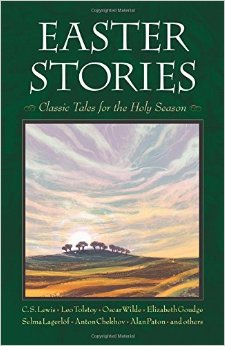
Easter StoriesMiriam LeBlanc has compiled a lovely collection of stories in Easter Stories: Classic Tales for the Holy Season. The stories themselves are not always classics (in the sense of being well known), but the authors are certainly a Who’s Who list.

Some of the better known authors include André Trocmé, Anton Chekhov, C.S. Lewis, The Brothers Grimm, and Oscar Wilde. The stories were collected in this book because they talk about sacrifice, new birth, new beginnings, and new life: all the themes echoed in the biblical story of Christ’s sacrificial death and resurrection.

These are great stories to introduce others to the story of Easter without turning to the passages in the Bible. These stories can introduce the themes of salvation, reconciliation, and new life, which will then allow Christians to lead their family and friends to the foundational stories in Scripture.

This is not only an excellent way to introduce the Easter themes to others, but also to introduce them to some of the more meaningful authors.

I am a Plough Publishing House book reviewer.

The Cross Of Jesus (book review)

The Cross Of JesusWarren Wiersbe writes early on in The Cross Of Jesus, “Unless we go back to the Cross, we can’t go forward in our Christian life.” How true this is, and what a wonderful job Rev. Wiersbe does in taking us back to the Cross!

This book is divided into four sections: What Jesus saw in the Cross, why Jesus died on the Cross, what Jesus said from the Cross, and how believers should live by the Cross. In essence we go back to the beginning to learn how we should now live because of the work Christ completed on the Cross.

Wiersbe quotes Charles Spurgeon as saying, “On whatever subjects I may be called to preach, I feel it to be a duty which I dare not neglect to be continually going back to the doctrine of the Cross—the fundamental truth of justification by faith which is in Christ Jesus.”

Whether you are wondering what significance Christ’s death at Calvary has for anything, or if you have been a believer in Christ’s atoning death for decades, or you are anywhere in between, going back for a fresh look at the old rugged Cross―and the Savior Who was sacrificed there―is always beneficial. And The Cross Of Jesus is an excellent book to guide you through your journey.

Links & Quotes

link quote

Some great reading I found today.

God has sought us out: let us have good hope for those who are laid upon our hearts in prayer, for He will find them out also. … It is a point of honor with Jesus to seek and to save all the flock, without a single exception. What a promise to plead!” —Charles Spurgeon

Where is the outrage?! Christian Girls Abducted & Raped In Egypt.

[INFOGRAPHI] Right on the heels of Easter, Bible Overview has a great infographic of everyone in the Bible who was raised from the dead.

The apostles had this instinct: When in trouble, pray. When intimidated, pray. When challenged, pray. When persecuted, pray!” —Jim Cymbala. Read more from Pastor Cymbala’s great post on prayer.

“Throughout our history Americans have put their faith in God and no one can doubt that we have been blessed for it. The earliest settlers of this land came in search of religious freedom. Landing on a desolate shoreline, they established a spiritual foundation that has served us ever since.” —Ronald Reagan

“Nobody ever got anything from God on the grounds that he deserved it. Having fallen, man deserves only punishment and death. So if God answers prayer it’s because God is good.” —A.W. Tozer

Sacrifice is not giving up things, but giving to God with joy the best we have.” —Oswald Chambers

Do You Smell Like Jesus?

Christ's aromaScientists tell us that the sense of smell contributes to more vivid and clear memory recall than any of the other human senses. Have you ever thought about the things Jesus smelled? Or about the memories others recalled about Jesus because of the way He smelled?

Less than a week before His crucifixion, Mary anointed Jesus with a highly-scented spice called spikenard (see John 12:1-8; Mark 14:3-9; and Matthew 26:6-13). Let me rephrase that: Mary didn’t just “anoint” Jesus as we think about that word today, she doused Him in a lifetime supply of this fragrance. Some people complained, but Jesus told those sour people that it was absolutely beautiful what she had done, as Jesus carried this aroma with Him to the Cross.

After He died on the Cross, Joseph and Nicodemus prepared Jesus for burial with 75 pounds of myrrh and aloes (see John 19:38-40). Think about that: seventy-five pounds! In doing so they actually fulfilled a prophesy from the Old Testament about King Jesus’ triumphal return to life—

Your throne, O God, will last for ever and ever; a scepter of justice will be the scepter of Your kingdom. You love righteousness and hate wickedness; therefore God, Your God, has set You above Your companions by anointing You with the oil of joy. All Your robes are fragrant with myrrh and aloes and cassia… (Psalm 45:6-8).

Jesus carried a powerful aroma with Him all the way to the Cross, into the tomb, and when He burst forth alive from the tomb! 

Without Christ, our lives carry the stench of death. We cannot come into our Heavenly Father’s presence because of that putrid smell clinging to us. But when God forgives us of our sins as we place our faith in Jesus, we are wrapped in the robes of Christ: we smell like Him and are welcomed into the Father’s presence.

Easter is a reminder of how a forgiven Christian should now live—

Live a life filled with love, following the example of Christ. He loved us and offered Himself as a sacrifice for us, a pleasing aroma to God (Ephesians 5:2).

…Now [God] uses us to spread the knowledge of Christ everywhere, like a sweet perfume. Our lives are a Christ-like fragrance rising up to God (2 Corinthians 2:14-15).

How do you smell? Do you smell like Jesus? Are others attracted to the aroma of Christ because of what they smell in you? Smelling good honors the work Jesus did on the Cross and in overcoming the grave.

Passion Week Infographic

Passion week infographicJosh Byers produced a great resource for the Passion Week. It lists chronologically all of the events recorded in the Gospels for the week from Palm Sunday to Resurrection Day, along with each of the Scripture references for those events. This would be meaningful way to read your Bible this week.

You can click the image to the left to view it magnified on your screen, or you can download a PDF version by clicking here → Passion week infographic.

If you really love Josh’s work, click here to go to his site to purchase a physical print.

But whatever you do, let’s observe this Passion Week with Bible reading and prayer.

Links & Quotes

link quote

Some great reading from today.

“What satan put into the heads of our remote ancestors was the idea that they could ‘be like gods’—could set up on their own as if they had created themselves—be their own masters—invent some sort of happiness for themselves outside God, apart from God. And out of that hopeless attempt has come nearly all that we call human history—money, poverty, ambition, war, prostitution, classes, empires, slavery—the long terrible story of man trying to find something other than God which will make him happy.” —C.S. Lewis

“Leadership requires vision, and whence will vision come except from hours spent in the presence of God in humble and fervent prayer?” —A.W. Tozer

[INFOGRAPHIC] Christ’s activities during the Passion Week.

I am proud of my heritage in the Assemblies of God, which is celebrating its centennial this year. Read the history of the fellowship’s creation here and here.

[VIDEO] Logan finds out he’s going to be a big brother.

Astronomers may have found some dark matter at the center of our galaxy. That’s cool, but if we can accept this science by faith, why can’t we accept the biblical version by faith?

Research says forgiving yourself makes you healthier physically.

“When should a Christian, then, be like Jesus Christ? Is there a time when he may strip off his regimentals—when the warrior may unbuckle his armor, and become like other men? Oh! no; at all times, and in every place let the Christian be what he professes to be.” —Charles Spurgeon

Book Reviews From 2013

BookshelfHere are the books I read and reviewed in 2013. Click a title to read the review…

10 People Every Christian Should Know

A Harmony Of The Gospels

Alive To Wonder

All In

Alone

Altar Ego

Andrew Murray Daily Reader

Dear Abba

Decision Points

Did The Resurrection Happen … Really?

Draw The Circle

Fight

Firsthand

Francis

God’s Favorite Place On Earth

God’s Workmanship

Habitudes

He Shall Glorify Me

I Never Thought I’d See The Day

If Thou Wilt Be Perfect

If Ye Shall Ask

It Is Finished

Jesus Is _____.

Jesus: A Theography

Knocking At God’s Door

Love To The Uttermost

One Year Book Of Personal Prayer

Outliers

Plastic Donuts

Pouring Holy Water On Strange Fire

Promotion

Raising Your Child To Love God

Seven Men

Smith Wigglesworth On Healing

Sometimes You Win, Sometimes You Learn

Stopping Words That Hurt

The 13th Resolution

The Baptism With The Holy Spirit

The Bare Facts

The Five Levels Of Leadership

The Highest Good

The Hobbit

The Man Who Knew Too Much

The Purpose Of Christmas

The Ragamuffin Gospel

The Reagan Diaries

The Secrets Of Intercessory Prayer

Things We Couldn’t Say

Understanding Sexting

Unfinished

Unstoppable

Visioneering

Who Do You Think You Are?

You Don’t Need A Title To Be A Leader

For my book reviews of 2011 click here, and for 2012’s list click here.

13 Quotes From “Dear Abba”

Dear AbbaDear Abba is an intimate book of prayer and personal reflection; it’s thought-provoking and emotionally-moving. You can read my full book review by clicking here. Below are some of the quotes and prayers I found especially meaningful.

“Dear Abba, I’ve come to the place where I’m letting You love me more each day, but I still struggle with letting You like me.” 

“It would be comical if it wasn’t so sad: all of our desires to make ourselves worthy of this world but unfit for the world to come.”

“Peace and joy go a-begging when the heart of a Christian pants for one sign after another of God’s merciful love. Nothing is taken for granted, and nothing is received with gratitude.”

“I feel like the psalmist tonight—downcast. I was upcast, bright, enjoying the warmth of the day and then suddenly my joy was pickpocketed. It was a small thing, a minor misunderstanding that I could have let roll off like water, but I held on to it and nursed it awhile, and like sin always does, it grew. Now I find my mind completely disturbed, anxious, angry, and my imagination is conjuring up all sorts of somebody-done-me-wrong songs. Why do I not trust You? After so many demonstrations of Your infinitely tender hand, why do I not trust You?”

“Sin does not magnify the suffering of man’s plight; instead, it mitigates it. When I sin, I seek an escape from my humanity. I used to say to myself, ‘Well, you’re only human!’ But sin does not make me human; it compromises my humanity. The philandering husband with his mistress on business trips, the chemically addicted, the thieves who build ivory towers out of stolen money, the sensation-seekers and power brokers who seek substitutes. They do not drink the poverty of the human situation down to the last drop. They dare not stare it full in the face.” 

Yet. Those three letters stop me in my rutted tracks of besetting sins. For You were tempted as I am, yet You did not sin. The humbling point is that on a scale from 1 to 10, I usually give in when the heat reaches 3 or 4, yet You experienced the 10—the full-in-the-face of temptation—and did not give in. You are the friend of sinners, yet You are also the Great High Priest who invites us to come with confidence to Your throne and receive both our daily bread and extra rations for emergencies.”

“To practice poverty of spirit calls us not to take offense or be supersensitive to criticism.

“When the gift of a humble heart is granted, we are more accepting of ourselves and less critical of others. … For the humble person there is a constant awareness of his or her own weakness, insufficiency, and desperate need for God.”

“My friends in Christ, the simple truth is that the Christian Church in America is divided by doctrine, history, and day-to-day living. We have come a long sad journey from the first century, when pagans exclaimed with awe and wonder, ‘See how these Christians love one another!’” 

“Christ’s breakthrough into new life on Easter morning unfettered Him from the space-time limitations of existence in the flesh and empowered Him to touch not only Nepal, but New Orleans, not only Matthew and Magdalene, but me. The Lion of Judah in His present risenness pursues, tracks, and stalks us here and now.”

“I realized today that there is a third character who goes up to the temple to pray: the pharisaic tax collector—a ragamuffin who knows she’s a ragamuffin and wants to make sure everyone else knows she’s a ragamuffin. So she ends up using her sinner status not to cry out for mercy to You, but rather to seek out the attention of others as one who is real and authentic, when in reality she is nothing more than hubris in thrift-shop fashions. I realized this today because I looked in the mirror. God, be merciful to me.” 

“The tendency to continually berate ourselves for real or imaginary failures, to belittle ourselves and underestimate our worth, to dwell exclusively on our dishonesty, self-centeredness, and lack of personal discipline, is the influence of our negative self-esteem. Reinforced by the critical feedback of our peers and the reproofs and humiliations of our community, we seem radically incapable of accepting, forgiving, or loving ourselves.”

“If nobody remembers my name or the works of my hands, if everything that I’ve worked so hard to build over the years crumbles into insignificance, if I lose my health and my wits and even, heaven forbid, my memory, You are still my refuge and strength.” 

No Conspiracies Here

Listen to the podcast of this post by clicking on the player below, and you can also subscribe on AppleSpotify, or Audible. 

Could it really be this simple? Could it be that Jesus died and rose again just like the Bible says? Or does it need to be more complicated than that? Are there other theories that seem to fit the facts?

At the feast of Pentecost where Jewish people from all over the world convened in Jerusalem just 50 days after the resurrection of Jesus, Peter stood up to address them:

  • He began, “Fellow Jews and all of you who live in Jerusalem…” (Acts 2:14). He addressed both local residents and guests from faraway lands.
  • Peter began by saying, “Jesus of Nazareth was a Man accredited by God to you by miracles, wonders and signs, which God did among you, as you yourselves know” (v. 22). No one shouted Peter down or disputed this claim. Quite possibly because there were those in this audience who had personally seen or experienced one of Jesus’ miracles.
  • The he announced, “God has raised this Jesus to life, and we are all witnesses of the fact” (v. 32). Anyone could have easily refuted this claim because the tomb of Jesus was within walking distance of where they were standing, and yet no one disputed this claim.

(Check out all of the Scripture references in this post by clicking here.)

A short time later, after healing a lame man outside of the temple, Peter and John were hauled before the Sanhedrin (the rulers and elders of the people [Acts 4:8]). This was the very group who had convinced the Roman governor Pontius Pilate to have Jesus crucified.

  • They addresses this group by saying, “It is by the name of Jesus Christ of Nazareth, Whom you crucified but Whom God raised from the dead, that this man stands before you healed” (v. 10). Once again, they didn’t dispute this, but they just told them to stop preaching in this name of Jesus (v. 17).

Paul was a devout member of this Jewish religious leadership until he had a personal encounter with Jesus. It became awfully difficult for Paul to argue that Jesus was dead, when he had personally seen Him and talked with Him!

Paul’s former colleagues had him arrested to stand trial before the Romans. The Roman governor Festus noted that the claims of the Jews against Paul were “about a dead man named Jesus Who Paul claimed was alive” (Acts 25:19). This is nearly 30 years after the resurrection of Jesus occurred. King Agrippa didn’t scoff this off. In fact, Paul said he was glad to talk to the king since “the king is familiar with these things…. I am convinced that none of this has escaped his notice, because it was not done in a corner” (Acts 26:26). Again, Agrippa didn’t dispute the claim of Jesus’ resurrection, but simply accused Paul of trying to convert him to Christianity.

There is something in our hearts that wants the resurrection to be true.

  • We don’t want to work all our lives for nothing.
  • We don’t want to invest in a relationship, only to have that end when the other person dies.
  • We want there to be something more. We want there to be something that makes sense of the world.
  • Only the resurrection of Jesus the Christ helps us make sense of life. Only His resurrection gives us lasting hope. 

An old song by the band Kansas says:

Deep within the hardest heart

There is something there that knows

There’s a hunger life can never fill

Til you face the One Who rose

There were two followers of Jesus who were out for a walk on the evening of the day of the resurrection. They, too, were trying to figure out if the news reports they heard about Jesus’ resurrection was fact or fiction. Jesus met them on the road (although they didn’t recognize Him) and He walked and talked with them. He explained how all of the things in the Bible pointed to these facts: a Savior would come, a Savior would die, and a Savior would be raised to life again. As Jesus sat down to eat with them, they recognized Who He was, and then He disappeared from their sight. As they hurried back to tell the other disciples, they said, “Didn’t our hearts burn within us as He talked” (Luke 24:32).

Does it take faith to believe the biblical resurrection story? Yes!

Does it take faith to believe the conspiracy theories? Yes!

But I believe that not only is the resurrection account more plausible, but it’s more satisfying too. The resurrection of Jesus rings true because IT IS TRUE, and because you were created by God to believe this truth so you could be in a relationship with Him forever.

►► Would you please prayerfully consider supporting this ministry? My Patreon supporters get behind-the-scenes access to exclusive materials. ◀︎◀︎

So Blessed

To think this is my “job”!

On Friday I had the privilege of sharing the message at our combined Good Friday service, where all the churches in Cedar Springs came together. I talked about the contrast Jesus presents to us from John 16:33. Quite simple it goes like this:

  • In the world = trouble
  • In Jesus = peace

This morning our Easter breakfast drama confronted (sometimes comically) the various conspiracy theories about the death and resurrection of Jesus. Then I shared how the biblical account of Jesus’ resurrection is not only the most plausible, reasonable and logical of accounts, but it is also the only option which gives us lasting hope.

It’s amazing to think that my “job” allows me to speak the words of life, the hope of freedom, the promise of eternal life, the beauty of a relationship with Christ. I am truly blessed and humbled to do what God has called me to do.