Winning Souls, Not Arguments

Listen to the podcast of this post by clicking on the player below, and you can also subscribe on AppleSpotify, or Audible. 

The men who were guarding Jesus mocked Him and beat Him. They blindfolded Him and hit Him again and then demanded, “Prophesy! Who hit You?” And it wasn’t just the physical abuse, but they heaped mocking insult upon mocking insult upon Jesus (Luke 22:64-65). 

All four of the Gospel writers recount how Jesus responded to both the physical and verbal abuse: 

  • To the false charges before the Sanhedrin, Jesus remained silent (Matthew 26:57-63) 
  • To the spitting and hitting by the members of the Sanhedrin, Jesus remained silent (Matthew 26:67-68) 
  • To the physical abuse of the guards, along with their mocking insults, Jesus remained silent (Mark 14:65; Luke 22:64-65) 
  • To the mocking He endured before King Herod, Jesus remained silent (Luke 23:9-11) 
  • To the false charges announced to Governor Pilate, Jesus remained silent (Matthew 27:12-14) 
  • To the insults and mocking thrown His way as He hung on the Cross, Jesus remained silent (Matthew 27:38-44; Mark 15:29-32; Luke 23:35-36) 

His only verbal response was after being slapped in the face by one of the officials in the Sanhedrin. Jesus said, “If I said something wrong, testify as to what is wrong. But if I spoke the truth, why did you strike Me?” (John 18:22-23). 

These are what we call an ad hominem attack. That is attacking the person, instead of confronting the ideas or arguments the person is presenting. 

The self-control of Jesus here is absolutely astounding! Peter records, “When they held their insults [and their fists and their spit] at Him, He did not retaliate; when He suffered, He made no threats. Instead, He entrusted Himself to Him who judges justly” (1 Peter 2:23). 

Even as His trial got underway, Luke records, “the council of the elders of the people…met together, and Jesus was led before them” (Luke 22:66).

Dr. Henry Halley points out that extra-biblical sources have told us that this trial violated at least four of the Sanhedrin’s own rules:

  1. Meeting on the morning of a festival 
  2. Meeting in Caiaphas’ personal residence 
  3. Trying a defendant without defense 
  4. Passing the verdict of a death sentence in one day instead of two days 

I would add a fifth rule which is found in Scripture: At least two witnesses need to be in agreement with their testimony for there to be a death sentence (Deuteronomy 17:6, 19:5; Mark 14:55-59). 

When the Sanhedrin then hauled Jesus before Pontius Pilate, even their charges made before the governor in Luke 23:1-2 were flimsy at best: 

  1. Subversion—there is no proof for this 
  2. Opposing taxes to Rome—this was false (see Luke 20:20-25) 
  3. Jesus was a rival to the Roman throne—not true 

And still Jesus remained almost completely silent! He only spoke when asked a direct question, but He remained silent throughout the false accusations, the verbal taunts, and the physical abuse. 

When I am treated unfairly, when the rules are bent against me, when false charges are lodged against me, I get angry! I want to defend myself! I want to put my accusers or abusers in their place! 

Could Jesus have prevented His arrest? Yes (Matthew 26:53)! 

Could Jesus have defended Himself before the Sanhedrin, Pilate, and King Herod? Yes! 

Could Jesus have come down from the Cross to prove His power? Yes! 

But Jesus wasn’t trying to win a momentary argument; He was winning souls for eternity! 

Jesus came not to be served, but to serve, and to give His life as a ransom for many (Mark 10:45). So, “for the joy set before Him He endured the Cross, scorning its shame, and sat down at the right hand of the throne of God.” 

When anger boils up because of the mistreatment we are enduring, we must “consider Him who endured such opposition from sinners, so that you will not grow weary and lose heart” (Hebrews 12:2-3). 

Like Jesus, let’s not try to win just a momentary argument that may result in the loss of a soul for all of eternity. There is a time to speak and there is a time for silence. As we keep our eyes on Jesus, we will know what time it is. 

(You can check out all of the Scriptures I referenced in this post by clicking here.)

P.S. You may also be interested in a previous blog post Winning the Argument or the Battle or my short video How Should Leaders Handle Pushback. 

►► Would you please prayerfully consider supporting this ministry? My Patreon supporters get behind-the-scenes access to exclusive materials. ◀︎◀︎

I Only Have Eyes For You

Listen to the podcast of this post by clicking on the player below, and you can also subscribe on AppleSpotify, or Audible. 

Love should be blind. That is, we should be so enamored with the one we love that we are blind to all others. There are some sweet lyrics to a 1932 song called “I only have eyes for you”—

My love must be a kind of blind love
I can’t see anyone but you
and, dear, I wonder if you’ll find
love an optical illusion too

Are the stars out tonight?
I don’t know if it’s cloudy or bright
‘cause I only have eyes for you, dear
The moon may be high
But I can’t see a thing in the sky
‘cause I only have eyes for you

I don’t know if we’re in a garden
or on a crowded avenue
you are here and so am I
maybe millions of people go by
but they all disappear from view
‘cause I only have eyes for you

Instead of having dedicated eyes, what would you think of someone who was constantly “checking out” those other than their sweetheart? That’s what the song of ascent in Psalm 123 calls on us to contemplate. 

Notice the use of the word “eyes” four times in just the opening two verses. The psalmist is asking us, “Do you only have eyes for God, or are you glancing elsewhere?” 

The call throughout the Bible, from beginning to end, has always been for a steadfast, loving eye for our loving God. From Moses to Jesus, the call is to love God above all else—to only have eyes for Him (Deuteronomy 6:5; Mark 12:30). I think this is why Jesus taught us to pray for a daily look to our Father’s hand for each moment’s provision (Matthew 6:11). 

This is not a begrudging “have to look” but an “I cannot help but continually look.” David said it this way, “Blessed be the Lord, Who daily loads us with benefits” (Psalm 68:19)!  

When we continually keep our eyes on our loving Heavenly Father, we see more and more of His graceful favor toward us. It’s the proud and arrogant (in verses 3-4) that think they have to take care of themselves, or that they have to keep their eyes open to other possibilities. 

God loves to shower His favor on those who only have eyes for Him: “Out of His fullness we have all received grace in place of grace already given” (John 1:16). This reminds me of the waves on the shore, where one wave of grace continually follows the previous wave of grace, which is quickly followed by yet another wave of grace. In fact, this idea is beautifully captured in the Amplified Bible’s rendering of this verse—

For out of His fullness (abundance) we have all received—all had a share and we were all supplied with—one grace after another and spiritual blessing upon spiritual blessing and even favor upon favor and gift heaped upon gift. 

God’s grace is unearned by our efforts, undeserved despite our sins, and unending for all of eternity!  

This song of ascent assures us that the humble servant who only has eyes for God is:

  • grateful for past blessings 
  • unashamed of his total dependence on God’s provision 
  • confidant in God’s favorable reply for every single request (Matthew 6:8; Luke 12:32)

So the questions we need to ask ourselves are simply, “Where are my eyes? Do I only have eyes for my God, or do I keep my options open? Do I humbly and confidently bring my petitions to God, or do I take matters into my own hands?” 

Since this is a song of ascent, let’s make sure that our song to God is always, “I only have eyes for You!” 

If you’ve missed any of the other messages in our series looking at these Psalms of Ascent, you can find them all by clicking here. 

►► Would you please prayerfully consider supporting this ministry? My Patreon supporters get behind-the-scenes access to exclusive materials. ◀︎◀︎

Kept To Keep

Listen to the podcast of this post by clicking on the player below, and you can also subscribe on AppleSpotify, or Audible. 

Last week I reminded you that the main point in Hebrew literature is usually found in the middle. In Psalm 121 that would be the first phrase of verse 5: The Lord watches over you. 

But I notice something that seems contradictory in the New Testament. Whereas the message here is, “God watches over you,” the message in some New Testament verses seems to be, “You watch over yourself” (see for example Matthew 26:41; 1 Thessalonians 5:6; 1 Timothy 4:16). Paul even said to the Christians at Corinth, “I worked harder than all of them” (1 Corinthians 15:10). 

So which is it: Is God watching over us or are we to watch over ourselves? It’s actually both, but something important has to come first. We cannot watch over ourselves unless we are assured that the Lord is watching over us to sustain us. 

Okay, I was being a bit sarcastic when I said those verses seemed contradictory, as I clearly quoted them out of their context. For instance, in that statement from Paul in 1 Corinthians, check out the full verse, “But by the grace of God I am what I am, and His grace to me was not without effect. No, I worked harder than all of them—yet not I, but the grace of God that was with me.” Paul is clearly saying that he could only work hard because he was empowered by God’s grace. Notice that it is decidedly not the other way around: Paul doesn’t say, “I worked hard to earn the grace of God.” 

Remember that these psalms of ascent remind us of our upward look and our upward journey. We need to keep our eyes on the prize, which is God Himself (Psalm 121:1-2). Using the apostle Paul’s life as an example again, he said something very similar—

Not that I have already obtained all this, or have already arrived at my goal, but I press on to take hold of that for which Christ Jesus took hold of me. Brothers and sisters, I do not consider myself yet to have taken hold of it. But one thing I do: Forgetting what is behind and straining toward what is ahead, I press on toward the goal to win the prize for which God has called me heavenward in Christ Jesus. (Philippians 3:12-14) 

The middle verse of Psalm 121 foretells what appears six times in just eight verses: the Hebrew word samar. Depending on the translation of the Bible, this word is either “watch over” or “kept.” In either case, the meaning is a concentrated focus, not turning aside to the left or the right, not distracted, eyes on the ultimate prize. And all six of these instances are God’s unwavering, loving focus on us. In this song, we are told: 

  • God never slumbers or is even momentarily distracted (vv. 3-4) as opposed to other deities that were thought to sometimes be unavailable to their worshippers (see 1 Kings 18:27). Instead, our God watches us so closely that He notices if even a single hair falls from our head (Matthew 10:30-31). 
  • God stands beside us to protect our places of vulnerability (vv. 5-6). The Amplified Bible says, “The Lord is your shade on your right hand—the side not carrying a shield.”
  • God keeps us from the entrapment of evil (v. 7). Jesus told us that He was praying this way for us so we can have confidence to pray this for ourselves (Luke 22:32; Matthew 6:13).  
  • God protects us as His most precious treasure. David uses this same word samar in Psalm 17:8, “Keep me as the apple of Your eye; hide me in the shadow of Your wings.” 
  • God is our eternal Protector. The last phrase of this psalm says He watches over us “both now and forevermore” (v. 8).  

The other places the word samar is used in the Bible is a call for us to keep God’s commands. But just as we saw with Paul that he was committed to running his race well because he was assured of the prize Jesus had secured for him, so for us, we can only keep God’s commands because we are kept secure by God. 

Because we are kept by God we can keep His commands. In Deuteronomy 4, Moses applies the word samar to God’s people. We are to..

  • keep the commands of the Lord (v. 4) 
  • watch ourselves closely so we don’t forget what God has done for us (v. 9) 
  • be careful not to forget the covenant God paid for us (v. 23)
  • keep God’s decrees and commands as way a way to pass on God’s blessing to future generations (v. 40)

If God is not the One keeping and preserving me, it will be impossible for me to keep His commands on my own. The promise of His watchful keeping and preserving should fuel our prayer to watch over ourselves with all diligence. Read His promises, pray His promises, be assured of His ever-present help so that you can use His help to look out for yourself. 

If you’ve missed any of the others messages in our look at the Psalms of Ascent, you can find them all here.

►► Would you please prayerfully consider supporting this ministry? My Patreon supporters get behind-the-scenes access to exclusive materials. ◀︎◀︎

Come To God And Keep Walking With Him

Listen to the podcast of this post by clicking on the player below, and you can also subscribe on AppleSpotify, or Audible. 

I have been so grateful for the insights of Dr. Gary Chapman in his book The Five Love Languages. I have found this book to be of immense value in helping couple prepares for marriage, and in helping married couples get beyond a place where intimacy has become stuck. 

In short, the five love languages are words of affirmation, quality time, gifts, acts of service, and physical touch. The goal of learning the other person’s love language—and learning to speak it consistently and fluently—is an increased level of intimacy. In the book of Amos, God asks, “Can two people walk together without agreeing on the direction?” (Amos 3:3 NLT), and speaking the right love language definitely helps people agree! 

The whole reason we come to God in prayer as a Father, as a Brother, and as a Counselor is so that we can hear Him speaking our love language and we can continue to walk in deeper intimacy with Him. 

When my then-girlfriend Betsy and I first met, we spent hours and hours getting to know each other. We would ask questions, share stories, and tell things we did and didn’t enjoy. This is the epitome of intimate conversation: getting to know the other person’s heart as you open up your heart to them as well.

I’ve shared this analogy before, but intimacy grows stale and can eventually disappear altogether if those in a relationship are no longer walking together. It doesn’t work if I say, “Betsy, I’m looking forward to spending an hour with you each week,” or even if I say, “I’ll give you 15 minutes each morning.” Instead, our relationship needs to be one of continual walking. 

It’s the same thing for us as Christians: we cannot only give God an hour at a church service on Sunday mornings, nor is intimacy going to increase if I only walk and talk with my Savior for a few minutes in my morning devotions. 

Walking closely with Him is what God has desired right from the beginning. He walked with Adam and Eve each evening. This phrase “walking with God” is used consistently throughout the Bible of those who had an intimate relationship with their Father, Brother, and Counselor—Noah, Abraham, Isaac, the people of Israel (Genesis 3:8, 6:9, 17:1, 48:15; Leviticus 26:12). And even as the New Testament era dawns, we read, “And they [Zechariah and Elizabeth] were both righteous before God, walking in all the commandments and ordinances of the Lord blameless” (Luke 1:6 NKJV). 

But I’m especially intrigued by the story of Enoch in Genesis 5:21-24. Twice in four short verses, we read “Enoch walked with God.” Remember that verse in Amos—“Can two people walk together without agreeing on the direction?”—so Enoch and God had to be in agreement. In fact, that’s exactly what we read about Enoch in the Book of Hebrews: 

By faith Enoch was taken from this life, so that he did not experience death: “He could not be found, because God had taken him away.” For before he was taken, he was commended as one who pleased God. And without faith it is impossible to please God, because anyone who comes to Him must believe that He exists and that He rewards those who earnestly seek Him. (Hebrews 11:5-6)

If you’ve taken Dr. Chapman’s love language assessment, you probably found that you were pretty lopsided: maybe you scored very highly in one love language and then barely registered in another. We may be lopsided in our love language skill, but God speaks every language perfectly! 

  • Words of affirmation—Hosea 2:14; Isaiah 40:2 
  • Quality time—Deuteronomy 31:6; Psalm 23:3-4
  • Gifts—James 1:17; 2 Peter 1:3
  • Acts of service—Philippians 2:13; Romans 8:28
  • Physical touch—Psalm 139:13-15; Luke 24:39 

(Click here to check out all of those verses.) 

Dr. Chapman noted that when our love language is being spoken to us sincerely and consistently, our love tank is filled, and all of the love languages begin to become more meaningful. 

Just as God walked with Enoch until the day He brought him Home, so He wants to walk with us. 

  • Walk in obedience to all that the Lord your God has commanded you, so that you may live and prosper. (Deuteronomy 5:33) 
  • The Lord will establish you as His holy people, as He promised you on oath, if you keep the commands of the Lord your God and walk in obedience to Him. (Deuteronomy 28:9) 
  • May He turn our hearts to Him, to walk in obedience to Him and keep the commands. (1 Kings 8:58) 
  • Blessed are all who fear the Lord, who walk in obedience to Him. (Psalm 128:1) 
  • And this is love: that we walk in obedience to His commands. As you have heard from the beginning, His command is that you walk in love. (2 John 6) 

When we walk in loving intimacy with Him, our intimacy grows deeper and more mature. Sometimes they will say of couples who have been married for a long time and walk in increasingly deeper intimacy with each other, “They seem to know each other’s thoughts.” That’s because they know each other’s hearts—and that’s what God wants to do with us. He did it with Enoch, and He will do that with us too (Jude 14; Jeremiah 33:3; Habakkuk 3:19). 

Enoch walked intimately with God for 365 years. Let us walk intimately with God for 365 days a year, for as many years as He gives us until God takes us away with Him forever! 

If you’ve missed any of the messages in our prayer series called Intimate Conversation, you can find all of the messages by clicking here. 

►► Would you please prayerfully consider supporting this ministry? My Patreon supporters get behind-the-scenes access to exclusive materials. ◀︎◀︎

The Rewarding Exchange

Listen to the podcast of this post by clicking on the player below, and you can also subscribe on AppleSpotify, or Audible. 

In Romans 3:23 we read, “For all have sinned and fall short of the glory of God.”  What does it mean to “fall short” of God’s standard? John Piper describes it this way: “It means that none of us has trusted and treasured God the way we should. We have not been satisfied with His greatness and walked in His ways. We have sought our satisfaction in other things, and treated them as more valuable than God.” 

A couple of chapters earlier in Romans, Paul tells us about an exchange that people make. They exchange a relationship with the eternal God for things which they can grab immediately. Sadly, these immediate things are only temporal things that fall short of God’s awesome glory and leave us perpetually unsatisfied (Romans 1:21-25). 

We were created by God to crave. Craving is what gives us staying power and brings fulfillment. Think of it this way: Would you rather…

  • …go to a job that is mundane, boring, and only focused on making money OR go to a job that is fascinating, using our talents, and trying to make a difference in the world? 
  • …eat food that tastes like cardboard OR eat savory food? 
  • …serve a god that is temporary, fickle, and unreliable OR serve a God that is eternal, faithful, strong, and loving? 

Or think of it another way: Which of those jobs would you want to go to? Which job would call out your best effort? Which food would you want to eat? Which food would make you want to praise the chef? And which God would you want to spend eternity with? Which God would want to invite others to worship? 

God gives us cravings that can only be satisfied in Him. The devil perverts these cravings to get us to go for quick, easy, self-made pleasures. Just think about how he tempted Adam and Eve (Genesis 3:1-6). 

Both the Old Testament and New Testament tell us of the joys of eternal cravings being satisfied and the consequences of giving in to temporal cravings. For example: 

  • God gives a craving for future meat, but satisfies us with manna while we wait. The devil temps us to have our meat now (Deuteronomy 12:20; Psalm 106:12-14; Numbers 11:34). 
  • God gives a craving for satisfying relationships. The devil tempts us to indulge our passions now by grabbing the most alluring relationship (Proverbs 5:18-19; Deuteronomy 5:21; Romans 1:24, 26). 
  • God gives a craving for success and significance in His timeframe. The devil tempts us to get ahead now (1 Kings 11:37-38; Genesis 3:6). 

(Check out all of these passages by clicking here.)

It’s a terrible exchange when we give up the glorious eternal for the fading temporal! Romans 1 describes the results as sinful, degrading, shameful, unnatural. That’s because the things of earth are temporary; only God is eternal. 

For all that is in the world—the lust of the flesh—craving for sensual gratification—and the lust of the eyes—greedy longings of the mind—and the pride of life—assurance in one’s own resources or in the stability of earthly things—these do not come from the Father but are from the world itself. And the world passes away and disappears, and with it the forbidden cravings (the passionate desires, the lust) of it; but he who does the will of God and carries out His purposes in his life abides (remains) forever. (1 John 2:16-17 AMP) 

We have to trust the One who gave us His unshakable promises—Be delighted with the Lord. Then He will give you all your heart’s desires (Psalm 37:4 TLB). Be delighted with Him and He will—not “may” or “hopefully He will” but He will—give you ALL your heart’s desires! 

There is an ultimate reward in Heaven but there are incredibly satisfying rewards along the journey to Heaven as well. Rewards like happiness, security, insight, and divine counsel from the Holy Spirit (2 Timothy 4:8; Psalm 119:2, 10, 16, 18, 24).

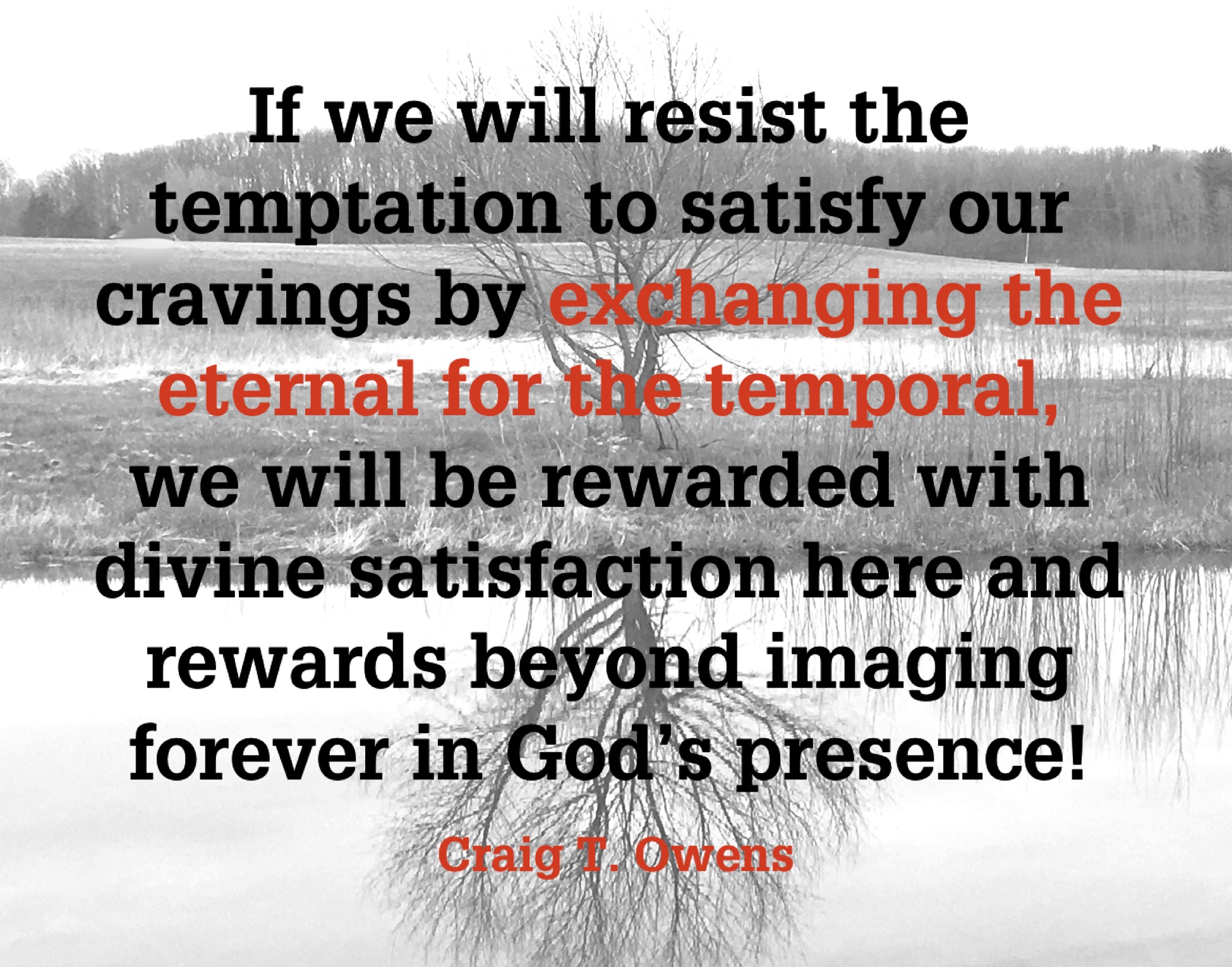
If we will resist the temptation to satisfy our cravings by exchanging the eternal for the temporal, we will be rewarded with divine satisfaction here and rewards beyond imaging forever in God’s presence! 

If you’ve missed any of the message in our series called Craving, you can find all of them by clicking here. 

►► Would you please prayerfully consider supporting this ministry? My Patreon supporters get behind-the-scenes access to exclusive materials. ◀︎◀︎
Unexpected Response

Listen to the podcast of this post by clicking on the player below, and you can also subscribe on AppleSpotify, or Audible. 

I’m a bit of a nut about the exactness of words, so one of my pet peeves is the incorrect use of imply and infer. “Imply” is something I do as the speaker; “infer” is something you do as the listener. Or you might say implying is like throwing and inferring is like catching. 

A big problem arises when I infer something that you didn’t imply. Or even worse, when I infer something based on something you didn’t say. People will often say something like this, “Since Jesus didn’t specifically talk about ________ then it must be okay.” In logic, this would be called an argument from ignorance: concluding that an action must be acceptable because it has not been specifically stated to be unacceptable. 

Statement #10 in our series asking “Is that in the Bible?” is—Love your neighbor. Is that in the Bible? Yes!  

Remember Jesus called “Scripture” all of the words we would now call “Old Testament.” So in Matthew 5:43 Jesus quoted Scripture: Do not seek revenge or bear a grudge against anyone among your people, but love your neighbor as yourself. I am the Lord (Leviticus 19:18). 

Later on, Jesus would add to this Deuteronomy 6:5—Love the Lord your God with all your heart and with all your soul and with all your strength—to answer the question about the greatest commandment of all. 

In Leviticus 19, the Hebrew word for love means love in the broadest sense of the word, and neighbor means a friend or a fellow citizen. Unfortunately, the rabbis inferred that someone not a Jew was therefore an enemy and therefore not worthy of love. They further inferred that the opposite of love was hate. 

Matthew Henry commented, “They were willing to infer what God never designed.” 

Statement #11 is—Hate your enemy. Is that in the Bible? Yes, in the fact that it appears in print in Matthew 5:43, but it doesn’t appear in the Scripture that Jesus knew. It had become so ingrained in the thinking of people that they now assumed it was in the Bible. 

In many ways, the Old Testament laws were easier to live out because they were all external and easy to measure, like don’t murder or don’t sleep with someone who isn’t your spouse. But Jesus made it a heart issue—He said lust is the same as adultery and hate is the same as murder. 

Jesus also made love for enemies a heart issue. The word He used for love in the Greek is agape—the same word describing God’s love for His enemies in John 3:16—For God so LOVED the world, that He gave His one and only Son, that whoever believes in Him would not perish but would have everlasting life. 

Jesus said our enemies were really our neighbors and were worthy of sacrificial love because they, too, were loved by God. 

Matthew 5:44 is shortened in the NIV and has a footnote explaining that the longer verse was not seen in the earlier manuscripts. But given the fact that Jesus demonstrated everything found in the longer version of this verse, I think we are safe in using it. So let’s look at the response Jesus calls us to from the NKJV: But I say to you, love your enemies, bless those who curse you, do good to those who hate you, and pray for those who spitefully use you and persecute you. 

Here’s what Jesus says it means for us to love our enemies:

(1) Bless the cursers. We’ve all been “cursed out” with nasty, hateful words. When that happens, Jesus wants to bless that neighbor. The word He used for bless literally means to say good words. 

(2) Help the haters. Jesus said we are to do those things that are beautiful and excellent—like the Good Samaritan did for his enemy-turned-neighbor (see Luke 10:25-37).  

(3) Pray for the persecutors. Talk to God about them; don’t talk to others about them. 

This response from Christians toward people whom others would call an enemy is totally unexpected by the world. This unexpected response will begin to draw enemies toward Jesus (1 Peter 2:12). If we will treat enemies and neighbors, they may soon become brothers and sisters in the family of God! 

When the world hits us Christians out of hate, let’s respond with unexpected love: blessing those who curse us, helping those who hurt us, and praying for those who persecute us. 

If you’ve missed any of the other messages in our Is That In The Bible? series, you can find the full list by clicking here. 

►► Would you please prayerfully consider supporting this ministry? My Patreon supporters get behind-the-scenes access to exclusive materials. ◀︎◀︎

Sure And Secure

Listen to the podcast of this post by clicking on the player below, and you can also subscribe on AppleSpotify, or Audible. 

We have looked at all of the psalms with a Selah pause, but there is one bonus message that we need to consider, and I think it’s a perfect wrap up to this series. 

Outside the book that bears his name, there is no other mention of Habakkuk anywhere else in the Bible. The author himself gives us no biographic information, nor does he give us dates as most of the other prophets do. However, there is enough information inside his short book that allows us to make some solid inferences:

  • based on his instructions in 3:19 we can infer he is a Levite and a worship leader—notice that he says “my instruments” 
  • we know for certain he is a song writer and a prophet (1:1; 3:1) 
  • he is a prophet with a heavy message—the word oracle in in the opening verse is probably better translated a “burden” 
  • he is a contemporary of Jeremiah, who spoke to backsliders, but Habakkuk speaks to the godly remnant to help them make sense of what’s happening in their crumbling culture 

Habakkuk does something that isn’t seen anywhere in the Bible except in the Psalms: he calls godly people to Selah—not once, but three times! 

In our look at the Selahs of Psalm 55 we noted how David’s Selahs almost came as an interruption of his anxious thoughts. Habakkuk’s Selahs follow this same theme. That’s because Habakkuk’s culture (like ours today) was increasingly unrighteous, unstable, and unsure. This prophetic worship leader wants righteous people trying to stand strong in their unrighteous culture to know that our surety and stability must come from our unshakable relationship with our righteous God. 

We’ve said that one of the definitions for Selah is “pause and calmly think of that,” but for Habakkuk’s Selahs I want to modify it slightly: Pause to interrupt your doubtful thoughts and consider this…. What he wants us to consider, I believe, comes from the opening words of his song in chapter 3—

Lord, I have heard of Your fame; I stand in awe of Your deeds, O Lord. Renew them in our day, in our time make them known; in wrath remember mercy (v. 2). 

We are to pause to consider that God has already shown His unrivaled power in the past, and then we stand firm to see Him move again “in our day, in our time” so that the unrighteous will have an opportunity to repent and turn to Him. 

The first Selah is after v. 3 in which Habakkuk references Mount Paran. How did God show His fame there? Moses recorded it this way: 

The Lord came from Sinai and beamed upon us from Seir; He flashed forth from Mount Paran, from among ten thousands of holy ones, a flaming fire, a law, at His right hand. (Deuteronomy 33:2)  

Selah—pause to interrupt your doubtful thoughts and consider this: God did this before and He can do it again. His glory will cover the heavens, His praise will fill the earth, His power will be so evident that the earth will quake and nations will tremble (vv. 4-6). All of this to reassure the righteous and arrest the attention of the wayward unrighteous.  

The second Selah is after v. 9 where Habakkuk is still describing all that God will do personally to rescue His righteous ones. Selah—pause to interrupt your doubtful thoughts and consider this: God did this before—see the almost identical language David uses in Psalm 18:3-17—and He can do it again. All of this to reassure the righteous and arrest the attention of the wayward unrighteous. 

The final Selah is at the end of v. 13 where Habakkuk describes what God will do to the enemies of His people. He uses words of decisive victory—crushed, stripped, pierced, trampled. 

Once again, Selah—pause to interrupt your doubtful thoughts and consider this: God did this before and He can do it again. More specifically, Jesus is the Decisive and Ultimate Victor over sin and death! Check this out: 

Then the end will come, when [Jesus] hands over the kingdom to God the Father after He has destroyed all dominion, authority and power. For He must reign until He has put all His enemies under His feet. The last enemy to be destroyed is death. (1 Corinthians 15:24-26) 

And having disarmed the powers and authorities, He made a public spectacle of them, triumphing over them by the Cross. (Colossians 2:15) 

Do not be afraid. I [Jesus] am the First and the Last. I am the Living One; I was dead, and now look, I am alive for ever and ever! And I hold the keys of death and Hades. (Revelation 1:17-18)

When our culture is becoming increasingly unrighteous, unstable, and unsure, what an unshakable surety and security we have standing on Christ the Solid Rock. As the old hymn reminds us—when all around my soul gives way, He then is all my hope and stay!

If you’ve missed any of the messages in our lengthy Selah series, you can find all of the messages by clicking here. 

►► Would you please prayerfully consider supporting this ministry? My Patreon supporters get behind-the-scenes access to exclusive materials. ◀︎◀︎

A Leader’s Daily Guide

Listen to the podcast of this post by clicking on the player below, and you can also subscribe on AppleSpotify, or Audible. 

Sometimes it’s best just to let the Bible speak for itself. 

As Moses was preparing the Israelites for life in the land God has promised them, he had these words for them about their leaders—

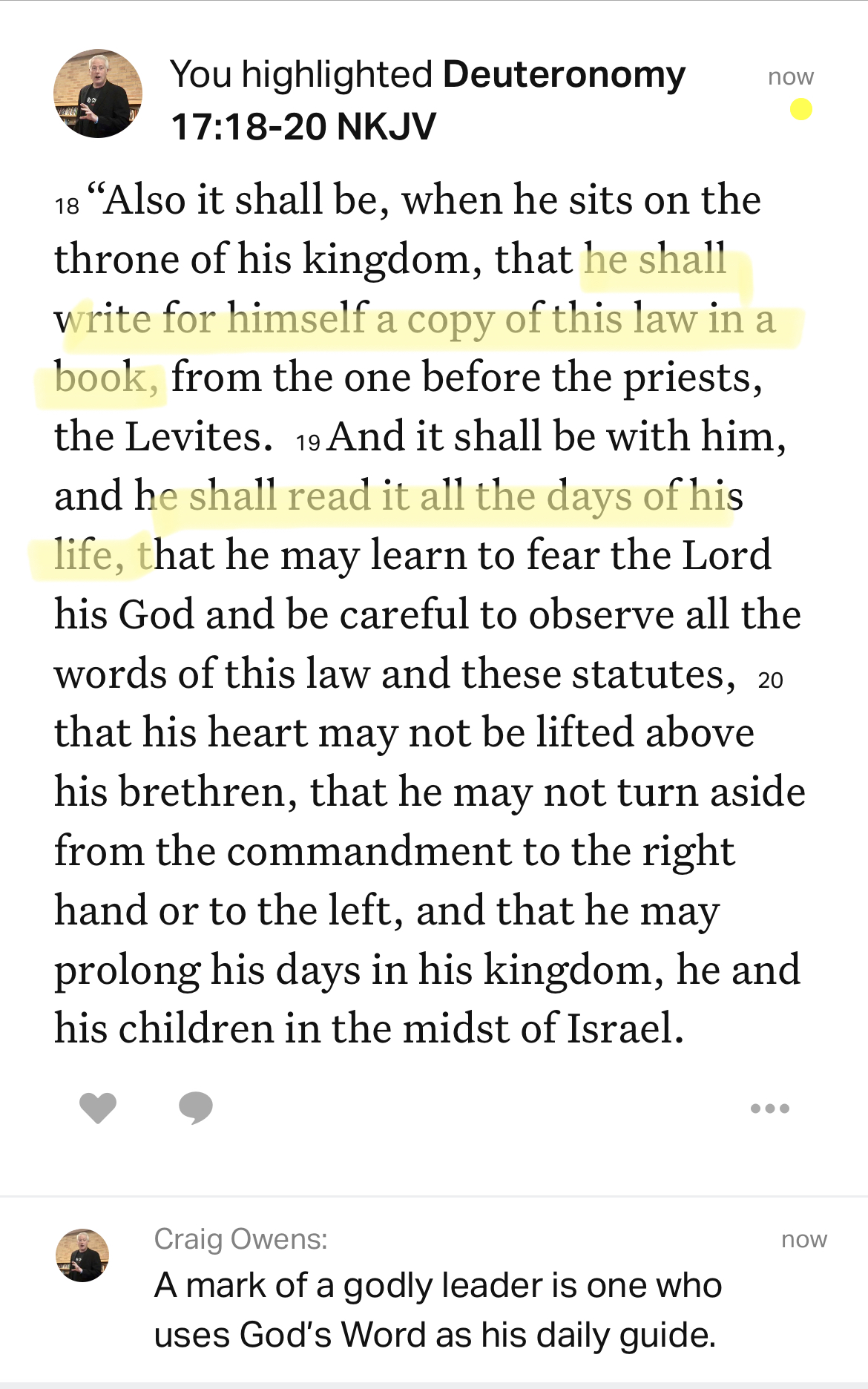
When you enter the land the Lord your God is giving you and have taken possession of it and settled in it, and you say, “Let us set a king over us like all the nations around us,” be sure to appoint over you a king the Lord your God chooses. … When he takes the throne of his kingdom, he is to write for himself on a scroll a copy of this law, taken from that of the Levitical priests. It is to be with him, and he is to read it all the days of his life so that he may learn to revere the Lord his God and follow carefully all the words of this law and these decrees and not consider himself better than his fellow Israelites and turn from the law to the right or to the left…. (Deuteronomy 17:14-15, 18-20) 

A mark of a godly leader is one who uses God’s Word as his daily guide.

This is part 64 in my series on godly leadership. You can check out all of my posts in this series by clicking here. 

►► Would you please prayerfully consider supporting this ministry? My Patreon supporters get behind-the-scenes access to exclusive materials. ◀︎◀︎

Links & Quotes

One of the last pictures I took with my Mom ♥

“Love of the Word appears preeminently in our Lord and Savior Jesus Christ. He read it publicly. He quoted it continually. He expounded it frequently. He advised the Jews to search it. He used it as His weapon to resist the devil. He repeatedly said, ‘The Scripture must be fulfilled.’ Almost the last thing He did was to ‘open their minds so they could understand the Scriptures’ (Luke 24:45). I am afraid that man cannot be a true servant of Christ, who has not something of his Master’s mind and feeling towards the Bible.” —J.C. Ryle, Bible Reading 

“The character of our praying will determine the character of our preaching. Light praying will make light preaching. …The preacher must be preeminently a man of prayer. His heart must graduate in the school of prayer. In the school of prayer only can the heart learn to preach.” —E.M. Bounds, Power Through Prayer 

I have blogged several thoughts about the historicity of the Bible. Here’s a post on Breakpoint about yet another archeological discovery that once again vindicates the Bible’s trustworthiness.

“Some pastors and preachers are lazy and no good. They do not pray; they do not read; they do not search the Scripture. … The call is: watch, study, attend to reading. In truth you cannot read too much in Scripture; and what you read you cannot read too carefully, and what you read carefully you cannot understand too well, and what you understand well you cannot teach too well, and what you teach well you cannot live too well. … The devil … the world … and our flesh are raging and raving against us. Therefore, dear sirs and brothers, pastors and preachers, pray, read, study, be diligent.” —Martin Luther

Looking at God’s awesomeness brings a peace that nothing else can.

A very thought-provoking Q&A with Sean McDowell and Dr. Stephen Meyer: Does Science Point to God?

Clinging To Jesus

Listen to the podcast of this post by clicking on the player below, and you can also subscribe on AppleSpotify, or Audible. 

Previously I shared with you that according to the Anxiety & Depression Association of America, nearly 1-of-5 adults in the United States age 18 and older battle some form of anxiety disorder. That means there’s a good chance that either you or someone close to you will be in this battle sometime during their life. 

We also learned from David that being anxious or afraid is not a sin. He said, “When [not ‘if’] I am afraid, I put my trust in You” (Psalm 56:3). But we can grieve God’s heart if we don’t train ourselves to turn to Him as our trustworthy First Source of help. 

We also saw in Mark 4:35-39 how the disciples of Jesus were caught in a raging storm, trying everything in their own power to rescue themselves, and yet Jesus was right there with them. He arose and said, “Quiet. Be still,” and “THEN the wind died down and it was completely calm.” From this we learned that only His peace can X-out the noise of the storm and bring us to a place of quiet rest. 

We see another aspect of anxiety here: “Anxiety weighs down the heart” (Proverbs 12:25). That word for “anxiety” means carefulness, but not in the idea of being cautious. It literally means someone who is full of cares. This state leads to a heaviness of heart, as the KJV of that same verse says, “Heaviness in the heart of a man maketh it stoop.”  

I don’t think anyone wakes up one day and says, “I’m going to take all of the cares of the world on my shoulders today.” Instead, we pick up just one thing. “This is just a small thing,” we tell ourselves. Then we wake up the next morning with just that one little thing, and we pick up one more little thing. And then we do it again the next day, and the next day, and the next day. Until before we know it we are bowed down because we are full of cares. This heaviness makes us stoop, makes us unsteady on our feet, and magnifies even the smallest of concerns into a huge crisis. 

We are clinging to our load of cares—our care-fullness—but our loving Heavenly Father desires us to cling to something else. He wants us to cling to Him!

  • Moses told the Israelites: Serve only the Lord your God and fear Him alone. Obey His commands, listen to His voice, and cling to Him. (Deuteronomy 13:4 NLT) 
  • David declared: I cling to You; Your right hand upholds me. (Psalm 63:8) 

We see a beautiful example of Paul clinging to the promises of God during his multiple trials in and around Jerusalem and then during his journey to Rome to stand trial yet again. While he was still in prison in Jerusalem, Jesus appeared to him and said, “Take courage! As you have testified about Me in Jerusalem, so you must also testify in Rome” (Acts 23:11). 

Paul knew he was going to arrive in Rome. But during the horrendous storm at sea on his way there, Paul received an added assurance. He told his shipmates—

“But now I urge you to keep up your courage, because not one of you will be lost; only the ship will be destroyed. Last night an angel of the God to whom I belong and whom I serve stood beside me and said, ‘Do not be afraid, Paul. You must stand trial before Caesar; and God has graciously given you the lives of all who sail with you.’ So keep up your courage, men, for I have faith in God that it will happen just as He told me.” (Acts 27:22-25) 

Jesus tells all of us to cling to Him and His secure promises (Matthew 11:28-30). When we cling to Him, we no longer cling to the cares of this world. We move from from full-of-cares to care-less. We go from insecurity over our future to the security that only Jesus can give us! 

Paul clung to those promises of Jesus: I will rescue you … You must testify about Me in Rome … I have given you all who sail with you. Likewise, we need to arm ourselves with the promises of God and tenaciously cling to them. I’ve shared just a few promises in the comments below, but feel free to reach out to me if I can help you find a promise in the Bible that you can cling to through your stormy times. 

If you’ve missed any message in our series about X-ing our anxieties, please click here to find the full list. 

►► Would you please prayerfully consider supporting this ministry? ◀︎◀︎