Integrity And Godly Sincerity

Listen to the podcast of this post by clicking on the player below, and you can also subscribe on AppleSpotify, or Audible. 

The apostle Paul had spent 18 months living and teaching in Corinth, he had likely visited them at least a couple of times, he had written two letters to them, and his associates had visited Corinth on his behalf. Bottom line: The Corinthians knew Paul well. 

With that in mind, Paul boldly states, “Now this is our boast: Our conscience testifies that we have conducted ourselves in the world, and especially in our relations with you, with integrity and godly sincerity” (2 Corinthians 1:12). 

Integrity means “the virtue of one who is free from pretense and hypocrisy.” Some biblical translations use the word holiness here. Indeed, for Christians integrity and holiness should be synonymous. The conclusion of this verse goes on to state that Paul could live this way “not according to worldly wisdom but according to God’s grace.” Paul knew that even more than the Corinthians, God knew Paul’s holy integrity. 

Paul also says that his conduct was with godly sincerity. You might think that the idea of sincerity or mental honesty is implied in the word integrity, but godly sincerity is a pureness that stands up to intense scrutiny. It’s not just a public act, but it is a consistently God-honoring way of living both publicly and privately. 

These two qualities give a godly leader moral authority like nothing else can. It’s authority that is felt as well as seen—it’s the “It Factor” that marks the Holy Spirit’s anointing on a leader. 

Paul is aware that his lifestyle could cause people to think well or to think poorly of the Gospel of Jesus. Just a few verses later, Paul uses the phrase “yes and no” twice (vv. 18-19). 

First, Paul reminds the Corinthians that he doesn’t “in the same breath say both ‘Yes, yes’ and ‘No, no.’” This means he doesn’t want his lifestyle to negate his preaching. 

Second, Paul wants to assure them that all of the promises of God are “‘Yes’ in Christ” (v. 20). He knows that a preacher who lives contrary to his preaching—whose walk doesn’t align with his talk—is not only a hypocrite before God, but a stumbling block to all who have put their faith in Jesus as a result of that preacher’s message. 

Integrity and godly sincerity are absolutely essential for those who proclaim the Gospel. 

Godly leaders must be vigilant. They must be ruthless with themselves so there isn’t even the slightest lapse of integrity. Any infractions in a leader’s integrity and godly sincerity could cause others to doubt that Christ’s “Yes” is truly a trustworthy “Yes.” 

May we all live in such a way that we, like Paul, can stand before those who know us best and assuredly say, “I have lived with all integrity and godly sincerity before both God and you!” 

►► Would you please prayerfully consider supporting this ministry? My Patreon supporters get behind-the-scenes access to exclusive materials. ◀︎◀︎

Thursdays With Spurgeon—Judging By First Appearances

This is a weekly series with things I’m reading and pondering from Charles Spurgeon. You can read the original seed thought here, or type “Thursdays With Spurgeon” in the search box to read more entries.

Listen to the podcast of this post by clicking on the player below, and you can also subscribe on AppleSpotify, or Audible. 

Judging By First Appearances 

     A good horse cannot be a bad color, and a really good preacher can wear what he likes, and none will care much about it; but though you cannot know wine by the barrel, a good appearance is a letter of recommendation even to a plowman. Wise men neither fall in love or take a dislike at first sight, but still the first impression is always a great thing even with them; and as to those weaker brethren who are not wise, a good appearance is half the battle.

     What is a good appearance? Well, it’s not being pompous and starchy and making oneself high and mighty among the people, for proud looks lose hearts, and gentle words win them. … When a man is as proud as a peacock, all strut and show, he needs converting himself before he sets up to preach to others. The preacher who measures himself by his mirror may please a few silly girls, but neither God nor man will long put up with him. The man who owes his greatness to his tailor will find that needle and thread cannot long hold a fool in a pulpit. …  

     At the same time, the preacher should endeavor, according to his means, to dress himself respectably; and, as to neatness, he should be without spot, for kings should not have dirty footmen to wait at their table, and they who teach godliness should practice cleanliness. … A worn coat is no discredit, but the poorest may be neat, and the men should be scholars rather than teachers till they are so.

From John Ploughman’s Talks of Plain Advice For Plain People

Like it or not, people do form first impressions on external appearances, and all leaders (and especially pastors) would do well to measure these words from Charles Spurgeon. 

I think Spurgeon is talking about honesty here. I need to be honest with who I am, while at the same time being honest about the office that I hold. I’m not playing dress-up, but I also need to be aware that I am representing the King of kings so an appropriate dress and lifestyle are required. 

I also need to be honest that people are forming first impressions the moment they see me, but also that I cannot try to dress or act in a way to please or attract people. 

I remember meeting a group of “seasoned saints” who all showed up at our church one morning. When I engaged them in conversation, they told me that their new pastor appeared to be too young for their style. They formed an opinion about him before ever giving him a chance. I told them that I knew their pastor and that I liked him a lot. I directed them to return to their home church and give their best support to their pastor for at least six months before they made any decisions. Thankfully, during that time they got to know this pastor and remained in that church with him. 

I am in the position I am in because God placed me there. I am working to hear Him say, “Well done, good and faithful servant.” I don’t want my appearance to get in the way of people hearing the message. I don’t want to try to be someone I’m not. I need to remain sensitive to the Holy Spirit’s direction in how I should dress, talk, and live. If my conscience is clear before God, then I won’t have to pay attention to the opinions of others.

►► Would you please prayerfully consider supporting this ministry? My Patreon supporters get behind-the-scenes access to exclusive materials. ◀︎◀︎
Poetry Saturday—Eternal Spirit

Listen to the podcast of this post by clicking on the player below, and you can also subscribe on Apple or Spotify.

Eternal Spirit, we confess
And sing the wonders of Your grace!
Your power conveys our blessings down
From God the Father and the Son.
Enlightened by Your heavenly ray,
Our shades and darkness turn to day.
Your inward teachings make us know
Our danger and our refuge, too.
Your power and glory work within,
And break the chains of reigning sin,
Does our imperious lusts subdue,
And forms our wretched hearts anew.
The troubled conscience knows Your voice,
Your cheering words awake our joys;
Your words allay the stormy wind,
And calm the surges of the mind.

*Spurgeon used this poem as a conclusion to his sermon entitled Human Depravity and Divine Mercy. I was unable to find this poem attributed to anyone else, so I am assuming it was written by Spurgeon himself. 

►► Would you please prayerfully consider supporting this ministry? ◀︎◀︎

8 Quotes From “Words To Winners Of Souls”

I don’t say this very often, but Words To Winners Of Souls by Horatius Bonar is a must-read for those in pastoral ministry. You can check out my full book review by clicking here. 

“The question, therefore, which each of us has to answer to his own conscience is, ‘Has it been the end of my ministry, has it been the desire of my heart to save the lost and guide the saved? Is this my aim in every sermon I preach, in every visit I pay? Is it under the influence of this feeling that I continually live and walk and speak? Is it for this I pray and toil and fast and weep? Is it for this I spend and am spent, counting it, next to the salvation of my own soul, my chiefest joy to be the instrument of saving others? Is it for this that I exist?’” 

“It is not opinions that man needs: it is truth. It is not theology: it is God. It is not religion: it is Christ. It is not literature and science; but the knowledge of the free love of God in the gift of His only-begotten Son.” 

“Our power in drawing men to Christ springs chiefly from the fullness of our personal joy in Him, and the nearness of our personal communion with Him.” 

“Why so many meetings with our fellow men, yet so few meetings with God?” 

“Our life has not been a lying-in-wait for the voice of God. ‘Speak, Lord; for Thy servant heareth,’ has not been the attitude of our souls, the guiding principle of our lives. Nearness to God, fellowship with God, waiting upon God, resting in God, have been too little the characteristic either of our private or our ministerial walk. Hence our example has been so powerless, our labors so unsuccessful, our sermons so meager, our whole ministry so fruitless and feeble.” 

“It is easier to speak or write about revival than to set about it. There is so much rubbish to be swept out, so many self-raised hindrances to be dealt with, so many old habits to be overcome, so much sloth and easy-mindedness to be contended with, so much of ministerial routine to be broken through, and so much crucifixion, both of self and of the world, to be undergone. As Christ said of the unclean spirit which the disciples could not cast out, so we may say of these: ‘This kind goeth not out but by prayer and fasting.’” 

“These must be days of strenuous, ceaseless, persevering, and, if God bless us, successful toil. We shall labor till we are worn out and laid to rest.” 

“It is unbelief that makes ministers handle eternal realities with such irreverence. It is unbelief that makes them ascend with so light a step ‘that awful place the pulpit,’ to deal with immortal beings about heaven and hell.” 

The Christian Leadership Cycle

…an apostle of Jesus Christ by the will of God… (2 Timothy 1:1). 

Paul tells his protegé Timothy that he didn’t choose apostleship, but that God chose him for it. The same should be true for all Christian leaders. To use a personal example: I didn’t choose to be a pastor, but God chose me for the pastorate. 

A mark of a godly leader is one who knows that God chose him to be a leader.

Knowing that, there are now choices that all leaders can—and should—make to steward their calling in a way that glorifies God. 

Paul tells Timothy that a pure conscience and a genuine faith allowed him to maximally use the gift of apostleship that God gave him. With these, Paul could use God’s gift without fear, but lovingly and with a sound mind (see vv. 3-7). 

This clear direction allows all Christian leaders to never be ashamed of their calling or of the fruits that come as a result of their leadership. This clear direction and sincere belief that I am doing what God has called me to do keeps me committed to an utter reliance on God’s supply all the way until the end (vv. 8-12). 

Finally, my commitment to effectively stewarding my God-ordained leadership is reinforced by holding fast to sound doctrine and remaining sensitive to the promptings of the Holy Spirit (vv. 13, 14). 

It looks something like this—

This is part 41 in my series on godly leadership. You can check out all of my posts in this series by clicking here.

Soul And Spirit

If I were to ask you to define the material/physical part of you versus the immaterial part of you, it probably wouldn’t be too difficult. Obviously, we can touch the physical part but we cannot touch the immaterial part. 

But human as a three-part being—we have a body, a soul, and a spirit. So if I were to now ask you to describe the “dividing line” between the two immaterial parts of us (the soul and the spirit), you would probably have a more difficult time coming up with a definition. 

Both terms are used throughout the Bible. Sometimes it seems the words soul and spirit are almost used interchangeably, but they are most assuredly two separate parts of what makes us us. 

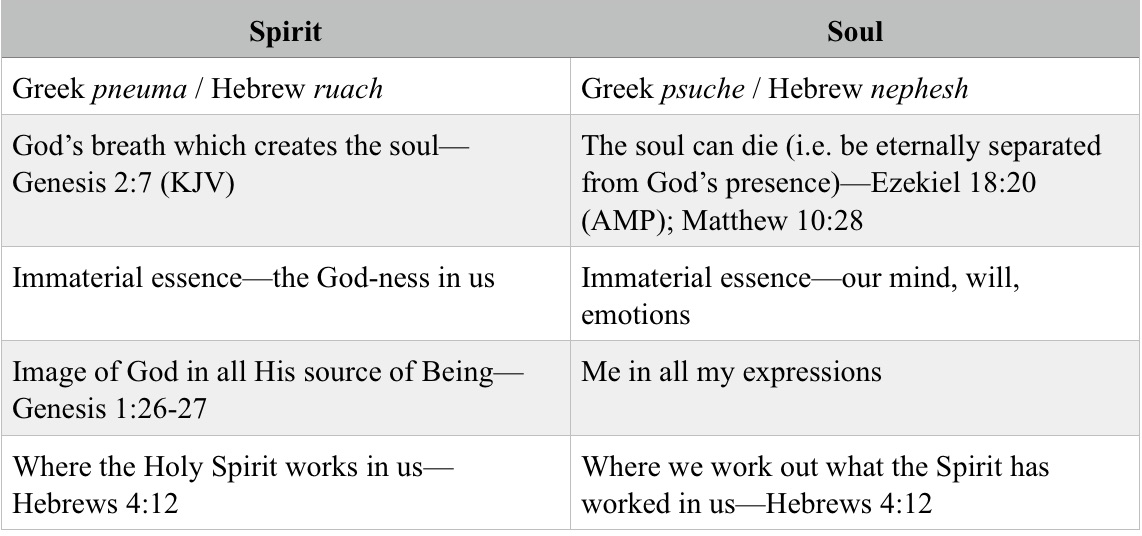
Please check out this chart that I shared with my friends at Calvary Assembly of God, and perhaps even take a few minutes to watch the video below. If you would like to download a PDF version of this chart, you may do so by clicking here → Soul and spirit side-by-side

Verses referenced—Genesis 1:26-27, 2:7; Ezekiel 18:20; Matthew 10:28; Hebrews 4:12

My Conscience

…my conscience also bearing me witness in the Holy Spirit (Romans 9:1). 

Conscience is that God-implanted part of a human soul that can distinguish between…

  • …the morally good and the morally bad 
  • …the things that attract God’s presence and the things that repel God’s presence
  • …commending things and condemning things
  • …the things that please the Holy Spirit and the things that grieve the Holy Spirit

Sin corrupts a conscience. Sin tries to blur the lines between good and evil. Sin looks for loopholes. 

Paul said his conscience was aligned with the Holy Spirit—my conscience bearing me witness in the Holy Spirit. 

The word for witness is the Greek word martyreo. Martyreo helps me distinguish because of personal experience OR divine revelation. In the case of a Holy Spirit-baptized Christian, it isn’t OR, it’s AND. Jesus used the same word when He said the baptism in the Spirit would empower His followers to be martyreo (Acts 1:8). 

The Holy Spirit aligns my conscience with God’s righteousness. The Spirit grieves when I fall short, and He rejoices when I obey. 

Following the other uses of martyreo in the New Testament, we can see that a Spirit-aligned conscience…

Can you say with Paul, “My conscience is aligned with the Holy Spirit”? You can if you make it a daily habit to listen for the Spirit’s voice and then obey His promptings. 

Don’t let sin corrupt your conscience, but let the Holy Spirit align your conscience with God’s righteousness. 

Thursdays With Spurgeon—Blessed Assurance

This is a weekly series with things I’m reading and pondering from Charles Spurgeon. You can read the original seed thought here, or type “Thursdays With Spurgeon” in the search box to read more entries.

Blessed Assurance

     The Holy Spirit, who enabled me to believe, gave me peace through believing. I felt as sure that I was forgiven as before I felt sure of condemnation. I had been certain of my condemnation because the Word of God declared it, and my conscience bore witness to it; but when the Lord Jesus justified me, the same witnesses made me equally certain. The Word of the Lord in the Scripture says, “He who believes in Him is not condemned” (John 3:18), and my conscience bore witness that I believed, and that God in pardoning me was just. Thus I had the witness of the Holy Spirit and also of my own conscience, and these two agreed in one. …  

     I find the apostle Paul speaking by the Holy Spirit and saying, “Having been justified by faith, we have peace with God” (Romans 5:1). If I know that my trust is fixed on Jesus only, and that I have faith in Him, were it not ten thousand times more absurd for me not to be at peace than for me to be filled with joy unspeakable? It is but taking God at His Word, when the soul knows as a necessary consequence of its faith that it is saved. …  

     Has Jesus saved me? I dare not speak with any hesitation here; I know He has. His word is true; therefore I am saved. My evidence that I am saved does not lie in the fact that I preach, or that I do this or that. All my hope lies in this, that Jesus Christ came to save sinners. I am a sinner, I trust Him, then He came to save me, and I am saved. I live habitually in the enjoyment of this blessed fact, and it is long since I have doubted the truth of it, for I have His own Word to sustain my faith.

From The Autobiography Of Charles Spurgeon

The joy that Spurgeon recounts in his conversion is the same joy that is available to all who call on Jesus in faith. As Spurgeon was prone to quoting passages of hymns in his sermons and books, these words of his remind me of a favorite hymn as well—

Blessed assurance, Jesus is mine;
Oh, what a foretaste of glory divine! 
Heir of salvation, purchase of God,
Born of His Spirit, washed in His blood. 
This is my story, this is my song,
Praising my Savior all the day long!

A Leader’s Sincere Apology

…I’m sorry, brothers… (Acts 23:5). 

It started off innocently enough. Paul was addressing the Jewish high counsel and simply said, “Brothers, I have always lived before God with a clear conscience!” 

That doesn’t seem too controversial nor insensitive, but the next move does—Instantly Ananias the high priest commanded those close to Paul to slap him on the mouth. What?! That seems like a bit of an over-reaction on the part of the high priest, or maybe a bit of show of force to let Paul know who was really in charge here. 

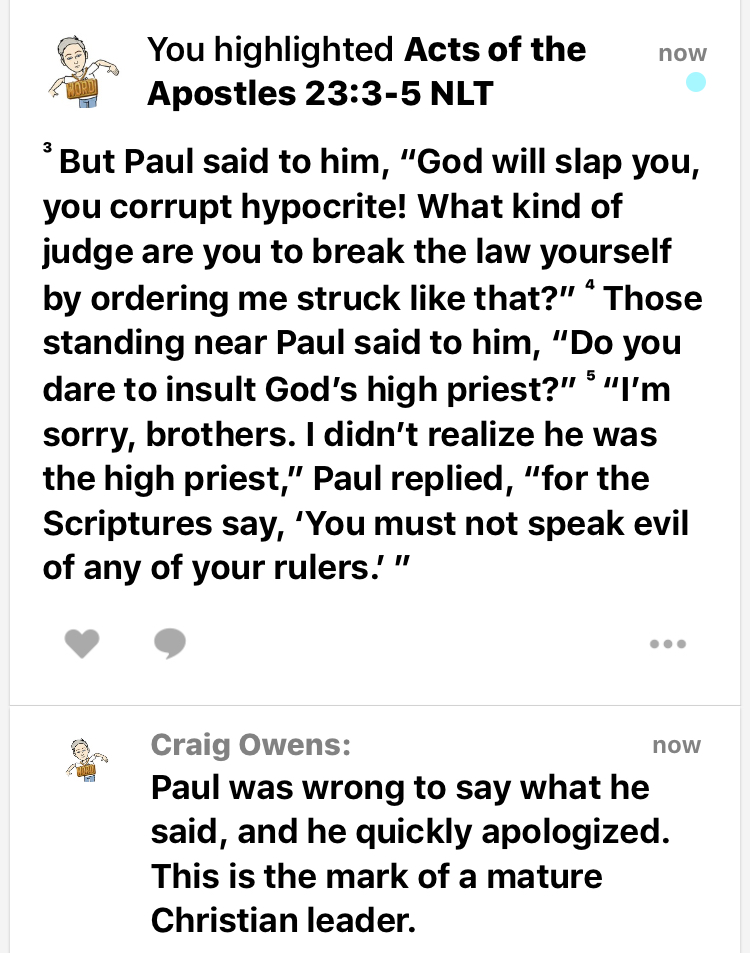
If you were Paul and got slapped in the face for a pretty simple and true statement, how would you respond? Paul responded like I think I may have, with a little verbal “slap” of his own: “God will slap you, you corrupt hypocrite! What kind of judge are you to break the law yourself by ordering me struck like that?” 

Yeah, take that, you big meanie! 

Those standing closest to Paul must have gasped in horror as they said, “Do you realize who you’re talking to?” 

Paul is an old man by this time. He’s been through shipwrecks, beatings, imprisonments, without food, traveled more miles than he can count, preached more sermons than he can remember. His body was giving out on him, and his eyesight was especially weak. Clearly, Paul didn’t realize to whom we was addressing his remarks. 

But Paul immediately owned up to his mistake. “I’m sorry, brothers. I didn’t realize he was the high priest, for the Scriptures say, ‘You must not speak evil of any of your rulers.’” 

A mark of a godly leader is one who is quick to apologize.

Paul could have made excuses. He could have justified what he said by explaining, “He deserved it because of how he spoke to me!” or “He started it!” 

But Paul offered no excuses or justifications, just a quick, simple, sincere apology. 

Oh, that all Christian leaders were as sensitive as Paul and as quick to apologize!

This is part 26 in my series on godly leadership. You can check out all of my posts in this series by clicking here.

Saturday In The Proverbs—God Is Sovereign (Proverbs 16)

[Each chapter in the Book of Proverbs contains thoughts that fit into a theme; they are not just random thoughts gathered together. In this “Saturday In The Proverbs” series, I will share a theme that I see in each chapter. But the cool thing about God’s Word is that you may see an entirely different theme. That’s great! If you do, I would love for you to share it in the comments below.]

…from the Lord (Proverbs 16:1).

God is Sovereign, which means He has supreme authority. 

The sooner—and more consistently—I acknowledge this, the more joy I can experience! According to Proverbs 16, acknowledging God as Lord and Master means: 

  • having the right answers (vv. 1, 24)
  • living with a clear conscience (v. 2)
  • thinking better thoughts (v. 3)
  • not getting swept away in judgment (vv. 4, 5)
  • experiencing mercy, truth, and atonement (v. 6)
  • peaceful living (v. 7)
  • contentment (vv. 8, 16)
  • divine direction (v. 9)
  • righteous living (vv. 10-12, 31)
  • favor among kings (vv. 13-15)
  • avoiding stumbling (v. 17)
  • avoiding pride (vv. 18-19)
  • happiness (v. 20)
  • having prudence (v. 21)
  • getting better understanding (vv. 22-23)
  • eternal life (v. 25)
  • satisfaction in my work (v. 26)
  • avoiding evil people (vv. 27-30)
  • self-control (v. 32)
  • seeing God’s providence at work (v. 33)

Not a bad list!