Out Of The Silent Planet (book review)

Listen to the podcast of this post by clicking on the player below, and you can also subscribe on Apple or Spotify.

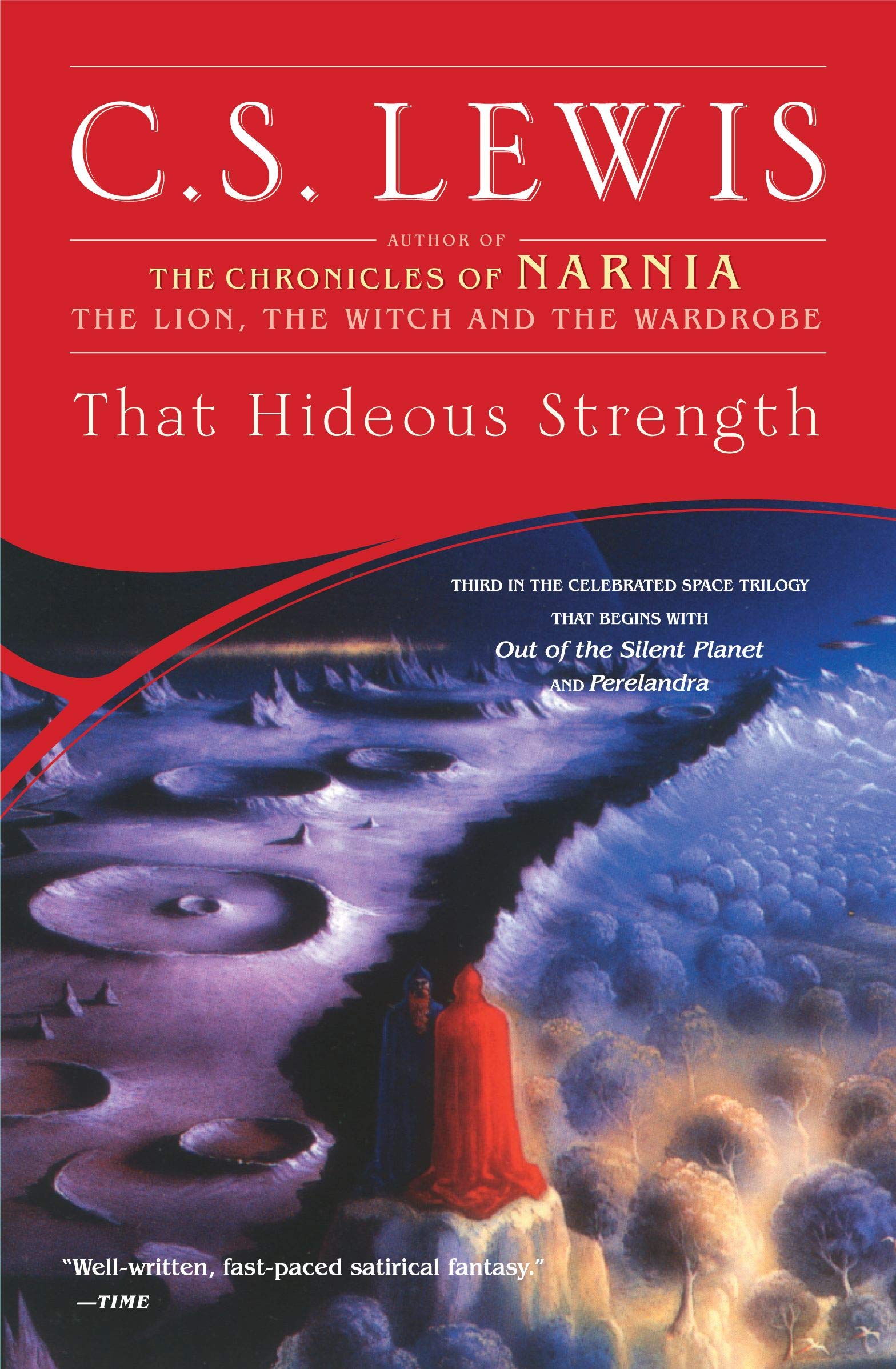
I truly believe that leaders are readers. But leaders need to also be discerning in the books they choose. I almost exclusively read non-fiction, but I make an exception when a fictional piece of literature is a mind-expanding book. As I am re-reading C.S. Lewis’ space trilogy, I’m reminded again how this master storyteller can pack so much into a few pages. Book one in this trilogy is Out Of The Silent Planet. 

In its simplest form, this book is about a trip to Malacandra (or Mars), but as with any fantasy work written by Lewis, the story tells a far deeper and more substantial Story. In this book, we go behind the scenes to witness the aftermath of the battle in heaven when Lucifer and his fallen angels attempted to usurp God’s throne. In the Malacandrian language, Lucifer is “the bent one,” having deviated away from God’s loving design, so those who have allowed themselves to be influenced by him are also called “bent.” The three Earthlings who have arrived on Malacandra show their level of straightness or bentness as this story unfolds. 

Another fascinating part of this book is the subtle change in language. The main protagonist is a philologist named Dr. Elwin Ransom. Watching how Lewis shows Dr. Ransom progressively learning the language of the inhabitants of Malacandra, contrasted with the way the bent men continue to speak it in “baby talk” is amazing. Ransom slowly learns more of the planet’s culture and the nuance of the language becomes more precise as he does so. And Lewis keeps pace by showing us the evolving vocabulary as the story moves along. 

If you are already a C.S. Lewis fan, this is a great book to continue your journey into his vast mind. But if you haven’t been exposed to much of Lewis’ writings yet, I would suggest holding off on this book until you have a better grasp of his more accessible works. 

►► Would you please prayerfully consider supporting this ministry? ◀︎◀︎

Seeing Beauty And Saying Beautifully (book review)

Listen to the podcast of this post by clicking on the player below, and you can also subscribe on Apple or Spotify.

Seeing Beauty And Saying Beautifully is, in my mind, a grand slam! It features one of my favorite poets (George Herbert), possibly the most prolific evangelist of history (George Whitefield), my all-time favorite author (C.S. Lewis), all tied together by my go-to theologian (John Piper). Seeing Beauty And Saying Beautifully is part 6 in Piper’s series called “The Swans Are Not Silent.” 

George Herbert was a pastor of a small country church and a prolific poet who wrote almost all of his poems uniquely. “Of the 167 poems in The Temple, 116 are written with meters that are not repeated,” which even modern poets find astounding. George Whitefield spent more hours of his life preaching than he did sleeping, and he spoke with such a captivating style that he was quite possibly the first celebrity of the American colonies. C.S. Lewis wrote everything from history to fantasy, autobiography to poetry, theology to children’s novels. Peter Kreeft says of him, he “was not a man: he was a world.” 

John Piper finds in all three of these men a common thread: They all were able to not only see the beauty of God in everything, but they were able to express it in a beautiful way that drew in others to see the beauty of God for themselves. Pastor John calls this “poetic effort.” 

Pastor John also wrestles with how the profound creativity and eloquence of his three subjects meshes with the apostle Paul’s admonition that human eloquence could drain the Cross of Jesus of its power (see 1 Corinthians 1:17-2:5). He concludes that poetic effort for the sake of exalting the speaker or poet does turn people’s eyes to man and away from God. But that poet, evangelist, or author that uses the beauty in God’s creation to point people to the Creator is doing so in a way in which God is supremely exalted. This, Pastor John says, is exactly what Herbert, Whitefield, and Lewis have done, and done so well that their poetic efforts are still fruitful and God-glorifying long after their deaths. 

Seeing Beauty And Saying Beautifully is a wonderful book for those who enjoy biographies, theology, or the craft of skilled artisans. If you don’t know about the poems of George Herbert, the preaching of George Whitefield, or the vast library of literature of C.S. Lewis, let this book be your doorway to a rich new world of discovery, enjoyment, and God-glorification. 

►► Would you please prayerfully consider supporting this ministry? ◀︎◀︎

“Dear Woman”

Listen to the podcast of this post by clicking on the player below, and you can also subscribe on Apple or Spotify.

The crucifixion of Jesus lasted about six hours. This was mercifully short compared to what typically happened to crucifixion victims. It was hard enough for Jesus to get enough air just to breathe, let alone enough air to talk, so His words are few but precious! From 9:00 until about noon, He speaks three times; from noon until about 3:00, He has no recorded words; at 3:00 there are four final statements that come pretty close together. 

As Jesus speaks His final declaration before wordlessly suffering for the next three hours, let’s take a look at who was there. They were people who deeply cared about Jesus, and people about whom Jesus deeply cared: His mother, His aunt, the mother of one of His disciples, Mary Magdalene, and His beloved disciple John. 

Also notable was who wasn’t present on Golgotha: none of Christ’s siblings or other close relatives. 

This last word from Jesus before His long silence was an incredibly loving word. As the oldest of His siblings, and with His earthly father Joseph dead, Jesus had head-of-the-household responsibilities, especially the care of His mother Mary. 

When Jesus speaks to her, He says, “Dear woman.” This is a term of kindness, respect, and endearment. To both His mother and to John, there is a Greek word that is omitted in some English translations of the Bible: Behold. Since Christ’s words were at a premium, this word was Jesus saying, “Listen very closely. Pay careful attention to this important word I’m about to speak.” 

To His mother, Jesus says, “Dear woman, behold your son.” Jesus was saying, here is one on whom you can depend. And to His dear friend Jesus says, “Behold your mother.” Literally, Jesus was asking John to care for Mary as though she were his own biological mother. 

Think about the dying declarations we’ve already heard. To those who treated Him so horribly, Jesus said, Father, forgive them.” This was a word of forgiveness that required agape love. To the hardened criminal crucified next to Him, Jesus said, “Today you will be with Me in paradise.” This was a word of salvation that also required agape love. 

Agape love is only possible in a regenerated heart. It’s an utterly selfless love that Jesus described this way: “Greater love has no one than this: to lay down one’s life for one’s friends” (John 15:13). To forgive the unforgivable, to grant salvation to a lifelong criminal, takes the other-worldly agape love. We expect this from Jesus. 

But there are two other loves in this scene. When Jesus says, “Dear woman,” He is expressing this natural love of son to mother. This Greek love is labeled storgé. C.S. Lewis calls this “the most natural, emotive, and widely diffused of loves.” To His dear friend John, Jesus speaks a word of philos love. C.S. Lewis says philos is “the love between friends as close as siblings in strength and duration [and] the least natural of loves.” 

Jesus cared deeply for His mother and He deeply trusted His friend John. This tells me an important truth: Jesus doesn’t just care about spiritual things. 

In fact, there isn’t anything that you care about that Jesus doesn’t feel too: “He had to be made like [us] fully human in every way” (Hebrews 2:17). 

Sadly, I think we frequently hold on to some cares because we think they are too small or too insignificant—or maybe “unspiritual”—so we think they are unworthy of Christ’s attention. Let me say it again: There isn’t anything that you care about that Jesus doesn’t feel too! 

Jesus intercedes before the Father’s throne of grace on our behalf. He knows exactly what to ask for because He experienced all of our earthly pains Himself. Then the Father and Son send the Holy Spirit into our hearts to give us the love and strength we need (see Hebrews 4:14-16; Romans 5:5). 

When Jesus showed us His full love—storgé, philos, and agape—He made it possible for us to fulfill His command: “A new command I give you: Love one another. As I have loved you, so you must love one another. By this everyone will know that you are My disciples, if you love one another” (John 13:34-35). 

Jesus showed every kind of love so that we can live every kind of love! As we live as love-filled people, we show others the path to Christ’s love for their own love-starved hearts. 

Jesus spoke this loving declaration from the Cross to show us that His love covers any need that we have to encounter. Let me repeat it again so that you don’t forget it: There isn’t anything that you care about that Jesus doesn’t feel too!

If you’ve missed any of the other messages in our series on the dying declarations of Jesus from the Cross, you can access the full list by clicking here.

►► Would you please prayerfully consider supporting this ministry? ◀︎◀︎

The Art Of Writing And The Gift Of Writers (book review)

Listen to the podcast of this post by clicking on the player below, and you can also subscribe on iTunes or Spotify.

I am eternally grateful to my high school English teachers who not only taught me the fundamentals of reading literature and writing in different styles, but who immensely sharpened my skills. But can you imagine having C.S. Lewis as a writing mentor? That’s what you are getting when you read The Art Of Writing And The Gift Of Writers. 

This book is compromised of essays and book reviews written by Lewis, interviews that Lewis gave, and even a transcript of an extemporaneous conversation with other authors who had congregated in Lewis’ rooms at Magdalen College. 

Learning how a gifted writer like Lewis crafted his own books was insightful, as well as how he interpreted the writing process of other authors. He even talked about how he choose to handle literary critics. But most energizing of all for me was the freedom he gave me to be myself in the writing process. He made it abundantly clear that other authors shouldn’t try to emulate his literary style—nor any other author’s style either—but to use their unique talents to write their unique works of literature. 

Since Lewis has been one of my favorite authors for most of my life, I found the journey into his mind to be absolutely fascinating. I would recommend this book for any author, aspiring author, or fellow fan of C.S. Lewis’ books and essays. 

Book Reviews From 2020

Poetry Saturday—The Nativity

Among the oxen (like an ox I’m slow)
I see a glory in the stable grow
Which, with the ox’s dullness might at length
   Give me an ox’s strength.

Among the asses (stubborn I as they)
I see my Savior where I looked for hay;
So may my beastlike folly learn at least
   The patience of a beast.

Among the sheep (I like a sheep have strayed)
I watch the manger where my Lord is laid;
Oh that my baa-ing nature would win thence
   Some wooly innocence! —C.S. Lewis

10 Quotes From “The Screwtape Letters”

C.S. Lewis gives us fantastic insight into the temptations the devil tries to use against Christians. You can read my full book review here. Just as a reminder: When Screwtape talks about “the Enemy” he is referring to God and when he says “our Father” he is talking about satan. 

“Prosperity knits a man to the World. He feels that he is ‘finding his place in it,’ while really it is finding its place in him.” 

“Music and silence—how I detest them both! How thankful we should be that ever since our Father entered Hell—though longer ago than humans, reckoning in light years, could express—no square inch of infernal space and no moment of infernal time has been surrendered to either of those abominable forces, but all has been occupied by Noise—Noise, the grand dynamism, the audible expression of all that is exultant, ruthless, and virile—Noise which alone defends us from silly qualms, despairing scruples, and impossible desires. We will make the whole universe a noise in the end.” 

“Let his inner resolve be to bear whatever comes to him, but to bear it ‘for a reasonable period’—and let the reasonable period be shorter than the trial is likely to last. It need not be much shorter…. The fun is to make the man yield just when (had he but known it) relief was almost in sight.”

“Surely you know that if a man can’t be cured of churchgoing, the next best thing is to send him all over the neighborhood looking for the church that ‘suits’ him until he becomes a taster or connoisseur of churches.” 

“Our Enemy is a hedonist at heart. All those fasts and vigils and stakes and crosses are only a facade. Or only like foam on the seashore. Out at sea, out in His sea, there is pleasure, and more pleasure. He makes no secret of it; at His right hand are ‘pleasures forevermore.’ Ugh! … He has filled His world full of pleasures. There are things for humans to do all day long without His minding in the least—sleeping, washing, eating, drinking, making love, playing, praying, working. Everything has to be twisted before it’s any use to us.” 

“You will say that these are very small sins; and doubtless, like all young tempters, you are anxious to be able to report spectacular wickedness. But do remember, the only thing that matters is the extent to which you separate the man from the Enemy. It does not matter how small the sins are provided that their cumulative effect is to edge the man away from the Light and out into the Nothing. Murder is no better than cards if cards can do the trick. Indeed the safest road to Hell is the gradual one—the gentle slope, soft underfoot, without sudden turnings, without milestones, without signposts.” 

“Your patient has become humble; have you drawn his attention to the fact? All virtues are less formidable to us once the man is aware that he has them, but this is specially true of humility. Catch him at the moment when he is really poor in spirit and smuggle into his mind the gratifying reflection, ‘By Jove! I’m being humble,’ and almost immediately pride—pride at his own humility—will appear. If he awakes to the danger and tries to smother this new form of pride, make him proud of his attempt. … You must therefore conceal from the patient the true end of Humility. Let him think of it not as self-forgetfulness but as a certain kind of opinion (namely, a low opinion) of his own talents and character.” 

“There are two equal and opposite errors into which our race can fall about the devils. One it to disbelieve in their existence. The other is to believe, and to feel an excessive and unhealthy interest in them.” 

“Even of his sins the Enemy does not want him to think too much: once they are repented, the sooner the man turns his attention outward, the better the Enemy is pleased.” 

“Whenever they are attending to the Enemy Himself we are defeated, but there are ways of preventing them from doing so. The simplest is to turn their gaze away from Him towards themselves. Keep them watching their own minds and trying to produce feelings there by the action of their own wills. When they meant to ask Him for charity, let them, instead, start trying to manufacture charitable feelings for themselves and not notice that this is what they are doing. When they meant to pray for courage, let them really be trying to feel brave. When they say they are praying for forgiveness, let them be trying to feel forgiven. Teach them to estimate the value of each prayer by their success in producing the desired feeling; and never let them suspect how much success or failure of that kind depends on whether they are well or ill, fresh or tired, at the moment.” 

The Screwtape Letters (book review)

Sun Tzu taught, “If you know the enemy and know yourself, you need not fear the result of a hundred battles.” With that maxim in mind, if you read The Screwtape Letters by C.S. Lewis, you will gain insight into the enemy’s tactics, unlike perhaps any other source. 

Lewis said this book was an easy book for him to write, but it gave him no joy to write it. Exposing the dark strategies of satan and his ugly cohort is indeed a joyless business. But even the apostle Paul tells us that we shouldn’t be unaware of the devil’s schemes. 

If you are a Christian and you read this book, you need to reverse your thinking. This book is a series of letters from Screwtape, a more experienced demon, to his nephew Wormwood who has just been given his first “patient” to seduce into hell. Whereas Christians call God their Father, in this book Screwtape refers to satan as “our Father” and God as “the Enemy.” 

Perhaps the most insightful part to me of this amazing book is the subtlety of the temptations which are employed to trip up Christians and keep seekers away from the truth. In fact, at several points Screwtape warns Wormwood that he is trying too hard to use something huge to bring down his patient when only the smallest of things will do the trick. 

I would encourage newer Christians to wait a while to read this book. In the meantime, read the Bible as much as you can—get to know the Real before you read about the counterfeit. For more mature Christians, however, this is an important book to read. 

(As a brief aside, in reading The Screwtape Letters this time through, I listened to the audiobook narrated by Joss Ackland and he delivered a phenomenal performance!) 

Praising God In The Troughs

Some people mistakenly think that the maturity of a Christian is a steady climb, and anything short of that is not God-honoring. They feel the graph has to always be moving up and to the right. In reality—if we zoom in—we will see lots of peaks and troughs that are in the climb. 

For instance, we read the worship leader of Psalm 42 saying, “By day the Lord directs His love, at night His song is with me—a prayer to the God of my life,” and we think, “Yeah, that’s what I expect from a saintly psalmist!” 

But let’s get the context. In the opening verses, this same worship leader talks about his profound thirst, his tears, and the taunts of his enemies. Twice in this psalm, he laments, “Why are you so downcast, O my soul? Why so disturbed within me?” 

Many people have gone through what has been called “the dark night of the soul.” I doubt anyone has ever given thanks because of those dark times, but they have learned to give thanks during those dark times.

Consider David’s beautiful words in Psalm 23. He points out that the Good Shepherd leads us into green pastures AND into dark valleys, beside quiet waters AND into the presence of enemies. 

But notice this: the Shepherd of our soul provides what we need in both daytime AND nighttime. He pours out blessings in the presence of our enemies, and as my grandfather wrote in the margin of his Bible next to verse 4, “Where there is shadow there must be light.” 

Consider the example of Paul who wrote to the Philippians, “Rejoice in the Lord always. I will say it again: Rejoice!” (4:4). He wrote this to the church that was birthed by Paul’s miraculous deliverance from prison, while Paul and Silas were doing just that: Praying and singing hymns to God! 

In The Screwtape Letters, C.S. Lewis gives us insight into how the demons view the temptation of Christians. Uncle Screwtape wrote to his nephew, “It may surprise you to learn that in God’s efforts to get permanent possession of a soul, He relies on the troughs even more than on the peaks; some of His special favorites have gone through longer and deeper troughs than anyone else. … It is during such trough periods, much more than during the peak periods, that the human is growing into the sort of creature He wants it to be. Hence the prayers offered in the state of dryness are those which please Him best.” 

A mark of a maturing saint is one who when he realizes he is in a trough begins to praise God in anticipation of the blessings which are coming! 

Don’t feel like you need to praise God FOR your troughs, but you can and should praise Him BECAUSE of His presence even in your driest, darkest trough. God is doing something in this trough time that He could accomplish in no other way. As David said, our Good Shepherd leads us in both sunlit and dark paths “for His name’s sake”—He will be glorified and you will be rewarded! 

Be sure to follow along on this series Thankful In The Night.

What Christians Believe (book review)

C.S. Lewis remains my all-time favorite author. His ability to explain concepts of theology is unparalleled in both his own time and into modern times. What Christians Believe is a classic case in point. 

During World War II, the BBC was looking for something both inspirational and educational to carry on their airwaves to the British troops abroad and the war-weary British citizens on the home front. They discovered a little-known professor of literature that presented something so fresh and revitalizing that his notoriety immediately skyrocketed throughout England! Part of what he presented as a series of audio essays for the BBC is captured in this book What Christians Believe

One of the things I enjoy about Lewis is his ability to simplify complex topics without feeling like he is “talking down” to you. What theologians had made so complex and out-of-reach to many of the uneducated, Lewis made accessible to a vast audience.

If you have a friend or family member that has asked you about your Christian faith, but doesn’t see to “get it” when you explain it, the short essays in this book may be just the thing to get the conversation started again. Better yet: read the chapters along with them and then get together for a time of discussion. I think you will be pleased with the doors that C.S. Lewis may open for deeper understanding and more productive conversations about your Christian faith.