7 Quotes For Leaders Who Love The Church

Catalyst devotionsI recently completed an excellent reading plan on YouVersion called Catalyst: Devotions For Leaders Who Love The Church. Here are some quotes I especially liked…

“Too often we view leadership as purely outward, thinking only of how we will climb the next mountain, or overcome the next obstacle without considering who we will be when we do. But true leadership, great leadership, starts within.” 

“Your capacity for life changing leadership is directly related to your willingness to be led, not your eagerness to perform. Lean in to the promises of God, allow Him to mature you in goodness, knowledge, self-control, perseverance, and love; true hallmarks of a leader worth following.”

“The more we look, act, love, and lead like Jesus, the more impactful our leadership will be to the world around us.” 

“There is no choosing to lead through the Spirit of God without choosing to be changed by the Spirit. … What is not cultivated in secret cannot be called upon in public. We have to pray for the transformative power of the Spirit to work His way in our hearts and minds, changing us forever, so our leadership is not a facade, but a reflection of His power at work within us.”

“Jesus calls us further, calls us to more, and through His power we have to change the landscape of leadership in our world. We must demonstrate that leadership through Christ speaks life and value into people’s hearts. That the way we treat the Father’s children matters, and is our greatest end.” 

“Father, help me to see Your children the way You do. Give me eyes to look beyond what my flesh sees, and to focus on how to affirm, love, and care for those You’ve entrusted me to lead. Create in me a compassionate heart, one that turns first to You in worship and then towards Your children with love.”

“God, this world is Yours, everything in it is Yours. I am Yours, do with my life what You will. Help me to release the things of my flesh, so that I may be transformed according to Your Spirit. Give me a heart for those around me, a burden for my community that compels me to fulfill the mission You have may give me. Teach me to clothe myself in You, to speak Your words and offer Your hands. May my leadership radiate You, and draw people towards Jesus.”

Overcoming Anxiety

God's answersI remember visiting Denver, Colorado. The scenery was so breathtaking, so I decided to go for an early morning hike. Quickly I discovered that my hike became breathtaking in more than one way! Even though I was in good shape, I had a hard time getting my breath because of the mile-high atmosphere.

I learned later that this is why many top athletes train in high elevation: it increases their lung capacity and endurance so that they now have an advantage when they compete against others.

God trains us on His mountains, but He made us to live and minister in the valleys. Our ascent into God’s mountaintop presence is so important for godly maturity!

In the first song of ascent, I noticed something unusual in the very first verse. Some Bibles translate the verbs in the present tense (I call on the Lord and He answers me), but some translations use the past tense (I called on the Lord and He answered me). Which is correct? Actually both of them are correct!

The verbs are written in the perfect tense—something done at a specific point in the past, but still relevant and powerful in the present. In other words, we can say it like this, “I called on the Lord in the past and He most definitely answered me. That gives me confidence to call on the Lord today, knowing that He will answer me again.”

Past answers lead to present power and future hope.

But—oh wow!!—check out how God answers us! The word literally means that God answers us in song. God so loves it when you trust Him enough to bring all your cares to Him, that He sings His answer to you. For the Lord your God is living among you. He is a mighty Savior. He will take delight in you with gladness. With His love, He will calm all your fears. He will rejoice over you with joyful songs (Zephaniah 3:17).

If we don’t continue to recall how God has answered us in the past, we’re missing out on the blessing of hearing Him sing His answers over us again today. As a result, we begin to live in the world’s valley-level turmoil and anxiety.

Peace is longed for in verses 6 and 7. The Christian wants to live in peace, but the world loves turmoil. Want proof? Just look at what makes the headlines today! The solution is to keep going back to God again and again and again—

Do not be anxious about anything, but in everything, by prayer and petition, with thanksgiving, present your requests to God. And the peace of God, which transcends understanding, will guard your hearts and minds in Christ Jesus. (Philippians 4:6-7)

Check out the full message to find the peace you are longing for!

If you don’t have a home church, please join us this Sunday as we continue our look at the psalms of ascent, or you can tune in to our live Periscope broadcast from wherever you are.

If you’ve missed any of the messages in this series, you can access the complete list by clicking here.

Psalms Of Ascent

The Psalms Of AscentEvery year, Jews from around the world made four pilgrimages to Jerusalem for various feasts and sacrifices. These journeys reminded them of God’s goodness as they went to the Temple to worship, and they helped refocus on God’s ways as they returned to their regular routines.

Jerusalem is over 2500 feet above sea level, so the pilgrimage there was a physical workout as well as a spiritual workout. So these times climbing up into God’s presence were beneficial for God’s people, preparing them to minister in their cities in the following months.

The Book of Psalms contains 15 songs that these pilgrims would sing to and with each other as they traveled up to Jerusalem. These Psalms of Ascent are still instructive for Christians today.

Please join me this Sunday as we begin a look at the life-changing truths these pilgrimage songs can still teach today to all of God’s people.

Here are the psalms we looked at:

11 Ways To Be A Good Minister

© Lori Oxford Photography

Here are 11 ways to “be a good minister of Christ Jesus” (1 Timothy 4:6)—

  1. Know the Scripture well enough to point out false doctrines (vv. 1-6a)
  2. Be a good teacher (v. 6b)
  3. Train myself to be godly (v. 7)
  4. Take care of my physical health (v. 8)
  5. Put my hope solidly in God (vv. 9, 10)
  6. Set an example worth following (vv. 11, 12)
  7. Use the Scriptures in everything I preach (v. 13)
  8. Turn my God-given gifts into strengths (v. 14)
  9. Have a good work ethic (v. 15a)
  10. Be consistently growing (v. 15b)
  11. Carefully and prayerfully evaluate my doctrine (v. 16)

4 Ways To Share The Good News With Everyone

Everybody EveryoneJesus told His followers that their ministry assignment was to take His message of salvation throughout the entire world. One requirement to do this, is to be able to communicate with lots of people. Actually to be able to communicate with everyone.

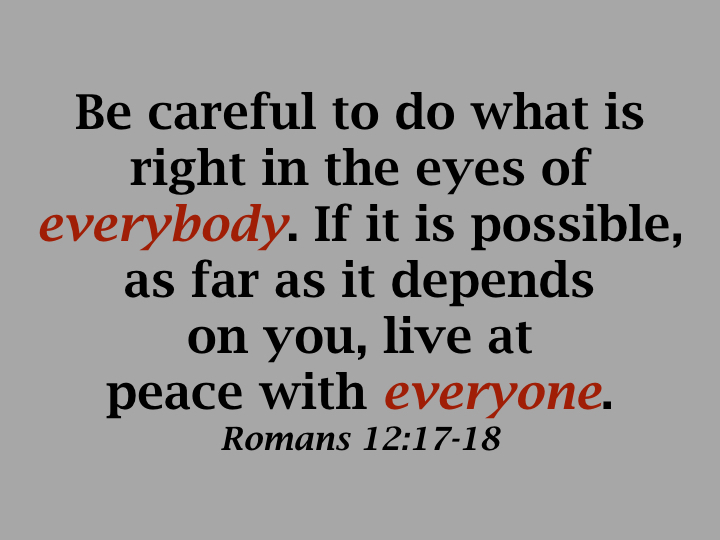
Be careful to do what is right in the eyes of everybody. If it is possible, as far as it depends on you, live at peace with everyone. (Romans 12:17-18)

Really? Everybody and everyone?!

Yes!

Jesus said our Helper would be the Holy Spirit. He would come to empower us to be witnesses to everyone, everybody, everywhere (Acts 1:8).

We have been learning how to communicate with others better, but noticing their communication style “accent.” Check out this post to get some more insight into this. In a nutshell…

  • Doers are action-oriented
  • Planners like to work out all the details
  • People want to make sure everyone is connected
  • Visions are imagining a better future

So if you are a Doer, and you’re trying to share the Good News about Jesus with a Planner, you can probably see a potential problem. The Doer is speaking in bullet points, but the Planner is wanting a lot more facts and figures.

This is where the Holy Spirit can help us. He has the insight that we don’t, and He can direct our words, just as He directed Christ’s words (see John 12:49-50).

Here’s how to talk their talk when you’re sharing the Good News:

(1) Doer

  • Keep it brief
  • Share more facts than stories
  • Stress now/today
  • Rely on the Gospel of Mark (action oriented)

(2) Planner

  • Tell them the who, what, where, when, why, and how
  • Be ready for lots of questions
  • Give them time to process your information
  • Rely on the Gospel of Matthew (lots of background, lots of Old Testament references to answer the who, what, where, when, why and how)

(3) People

  • Develop a friendship first
  • Share more stories than facts
  • Don’t tell them, show them your personal life
  • Rely on the Gospel of Luke (lots of personal stories about changed lives)

(4) Vision

  • Share both the facts and the stories
  • Encourage them to “Imagine what would happen …”
  • Give them time to ask questions
  • Rely on the Gospel of John (very poetic and image-rich)

You can connect with everyone, everybody, everywhere and share the Gospel with them in an effective way. Allow the Holy Spirit to give you the insight you need.

Check out how I describe this in more detail here…

Don’t Try To Change Your Bad Behavior

Thoughts to beahviorsAs I wrote previously, I believe Christians should be the best at getting along with others. First of all, Christians have been empowered by the Holy Spirit with the skills necessary to live at peace with everyone, IF we will only allow the Spirit to do the necessary work in us. And second, the way Christians treat others goes a long way toward either attracting or repelling others from a relationship with Jesus.

But here’s an important thing: If you don’t get along well with others now, don’t try to change your behavior!

Stephen Covey wrote, “To try to change outward behaviors does very little good in the long run if I fail to examine the basic paradigms from which those attitudes and behaviors flow.”

You see, behavior is the fruit. If we want to change the fruit, we need to back up a few steps.

The Apostle Paul used the life of Jesus as an example for Christians on how we can get along with others. But notice this: most of what Paul discusses is the “inside stuff.”

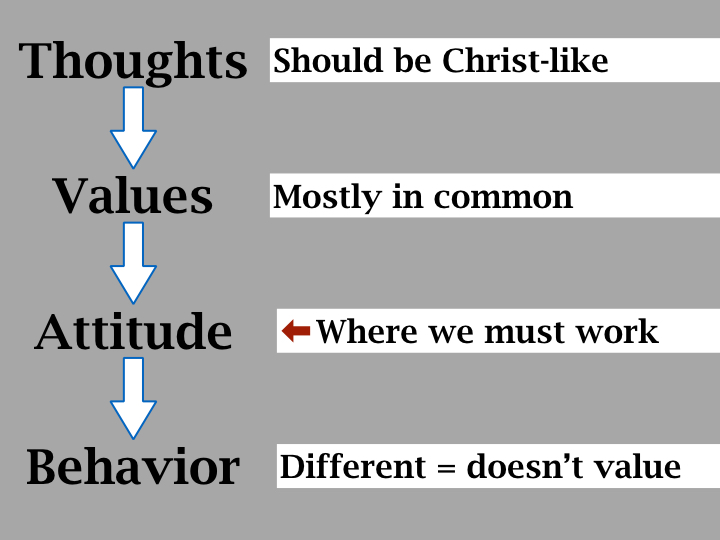
The progression goes like this (see Philippians 2:1-13)—

Thoughts → Values → Attitudes → Behaviors

(1) Thoughts—These need to be humble thoughts about God’s love toward us (v. 1).

(2) Values—Paul tells us to be “one in spirit and purpose” with others (v. 2). The definition of the Greek words here mean valuing the well-being of everyone. Paul then explains how our humility can lead to these win-win relationships (vv. 3, 4).

(3) Attitudes—“Your attitude should be the same as Christ Jesus” (v. 5). Jesus showed us what it was to have an attitude related toward obedience to God’s will.

(4) Behavior—If our thoughts, values and attitudes are rightly aligned to God, then our behavior will naturally be Christ-like as well. We see the example of Jesus in verses 6-8, and God’s reward for that behavior in verses 9-11. Then Paul calls on Christians to follow that pattern in our own lives (vv. 12, 13).

Most decent, reasonably-thinking human beings share the same values. Harry Truman said, “When we understand the other fellow’s viewpoint—understand what he is trying to do—nine times out of ten he is trying to do right.”

The problem is this: When the other person behaves differently from me, my natural tendency is to assume he doesn’t value what I value. In other words, I’m judging his value system on the way I normally behave.

The break-down is in my attitude. That’s the area I need to address. That’s the attribute of Jesus that Paul told us to copy.

So if I want to get along better with others, I shouldn’t try to change my behavior, but my attitude. My prayer should be: “I want this same attitude to be in me which was also in Christ Jesus. He served God and others, so I too want to follow His example of obedience, and I want to demonstrate my appreciation for all that Jesus has done for me by working hard to better get along with others. Help me change my attitude!”

Check out this video of the full message…

I hope you can join us next Sunday as we continue learning how to get along with others. Please join us in person or on Periscope.

12 More Quotes From “The Place Of Help”

The Place Of HelpAs always, there are more quotes from Oswald Chambers’ books than I have space to share them. So here are a few more from The Place Of Help.

“If we are going to be used by God, He will take us through a multitude of experiences that are not meant for us at all, but meant to make us useful in His hands. There are things we go through which are unexplainable on any other line, and the nearer we get to God the more inexplicable the way seems. It is only on looking back and by getting an explanation from God’s Word that we understand His dealings with us.”

“The essence of Christianity is that we give the Son of God a chance to live and move and have His being in us, and the meaning of all spiritual growth is that He has an increasing opportunity to manifest Himself in our mortal flesh.”

“Temptation is a short cut to what is good, not to what is bad. satan came to our Lord as an angel of light, and all his temptations center around this point—‘You are the Son of God, then do God’s work in Your own way; put men’s needs first, feed them, heal their sicknesses, and they will crown You King.’ Our Lord would not become King on that line; He deliberately rejected the suggested short cut, and choose the long trail, evading none of the suffering involved (cf. John 6:15).”

“God expects His children to be so confident in Him that in a crisis they are the ones upon whom He can rely. … God expects of us the one thing that glorifies Him—and that is to remain absolutely confident in Him, remembering what He has said beforehand, and sure that His purposes will be fulfilled.”

“God has never promised to keep us immune from trouble; He says ‘I will be with him in trouble,’ which is a very different thing.”

“The Bible characters never fell under weak points but on their strong ones; unguarded strength is double weakness.”

“Do we trust in our wits or do we worship God? If we trust in our wits, God will have to repeat the same lesson until we learn it.”

“The coming of Jesus Christ is not a peaceful thing, it is a disturbing thing, because it means the destruction of every peace that is not based on a personal relationship to Himself.” [Matthew 10:34]

“The peace that Jesus gives is never engineered by circumstances on the outside; it is a peace based on a personal relationship that holds all through. ‘In the world ye shall have tribulation: … in Me … peace.’”

“God is a holy God, and the marvel of the Redemption is that God the Holy One puts into me, the unholy one, a new disposition, the disposition of His Son.”

“In the Sermon on the Mount our Lord teaches us not to look for justice, but never to cease to give it. That is not commonsense, it is either madness or Christianity.”

“When the love of God is in me I must learn how to let it express itself; I must educate myself in the matter; it takes time. Acquire your soul with patients, says Jesus [Luke 21:19]. Never give way to this spirit—‘Oh well, I have fallen again, I will stay down now.’ Have patience with yourself, and remember that this is salvation not for the hereafter, but for the here and now.”

You can read the first set of quotes from The Place Of Help by clicking here.

My review of The Place Of Help is here.

And be sure to look for “Thursdays With Oswald” to read quotes and thoughts from the current Chambers’ book I am reading.

Is Christ Real To Me?

John WesleyJohn Wesley was deeply introspective about his faith in Jesus Christ. He once wrote—

“I did go thus far for many years…using diligence to eschew all evil, and to have a conscience void of offense; redeeming the time; buying up every opportunity of doing all good to all men; constantly and carefully using all the public and all the private means of grace; endeavoring after a steady seriousness of behavior, at all times, and in all places; and, God is my record, before Whom I stand, doing all this in sincerity; having a real design to serve God; a hearty desire to do His will in all things; to please Him who had called me to ‘fight the good fight,’ and to ‘lay hold of eternal life.’ Yet my own conscience beareth me witness in the Holy Ghost, that all this time I was but almost a Christian.”

To help keep himself on the right path, Wesley came up with this list of questions he regularly asked himself. This is a list any Christian would do well to read through regularly—

  1. Am I consciously or unconsciously creating the impression that I am better than I am? In other words, am I a hypocrite?
  2. Am I honest in all my acts and words, or do I exaggerate?
  3. Do I confidentially pass onto another what was told me in confidence?
  4. Am I a slave to dress, friends, work, or habits?
  5. Am I self-conscious, self-pitying, or self-justifying?
  6. Did the Bible live in me today?
  7. Do I give it time to speak to me everyday?
  8. Am I enjoying prayer?
  9. When did I last speak to someone about my faith?
  10. Do I pray about the money I spend?
  11. Do I get to bed on time and get up on time?
  12. Do I disobey God in anything?
  13. Do I insist upon doing something about which my conscience is uneasy?
  14. Am I defeated in any part of my life?
  15. Am I jealous, impure, critical, irritable, touchy or distrustful?
  16. How do I spend my spare time?
  17. Am I proud?
  18. Do I thank God that I am not as other people, especially as the Pharisee who despised the publican?
  19. Is there anyone whom I fear, dislike, disown, criticize, hold resentment toward or disregard? If so, what am I going to do about it?
  20. Do I grumble and complain constantly?
  21. Is Christ real to me?

Rewards And Consequences

Rewards and ConsequencesThe Bible consistently gives us—right up front—the rewards for right living, and the consequences for wrong living. No one ever has to be surprised. 

For example, take this message from Jesus in Luke 6.

  1. If you don’t want others to judge you, don’t be judgmental (v. 37).
  2. If you don’t want to be condemned by others, don’t condemn others (v. 37).
  3. If you want to be forgiven, forgive others first (v. 37).
  4. If you want to receive, be the first to give to others (v. 38).
  5. If you want to teach, find a good teacher and then be a good learner first (vv. 39-40).
  6. If you want to help others with their problems, first look in the mirror at yourself (vv. 41-42).
  7. If you want to speak good words, put good words inside yourself (vv. 43-45).
  8. If you want to stand strong through adversity, build on the right foundation (vv. 46-49).

God doesn’t miss a thing! He told us how to stay in the place where He can bless us, and how we can avoid life’s negative consequences.

We would all do well to hear these words and put them into practice (v. 47)!

How Do We Read Bible Stories?

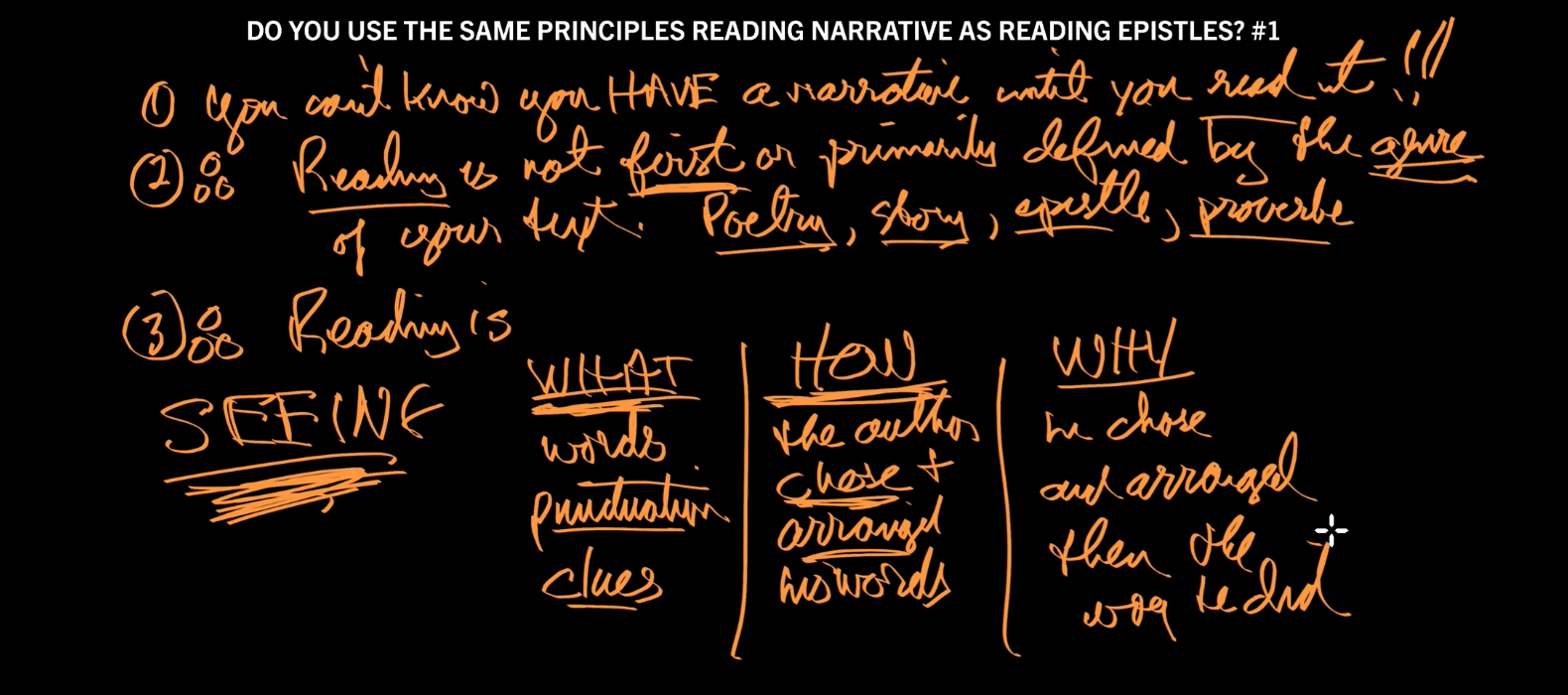
How do we read Bible storiesAt Calvary Assembly of God, we have been going through a series on how to study our Bibles. I love this insight from John Piper on how to read Bible stories—

Pastor Bobby Conway from the One Minute Apologist has a great series of videos that give us an oversight of each book of the Bible. In this video, he talks about the different genres of Scripture (much like Piper did in the above video)—