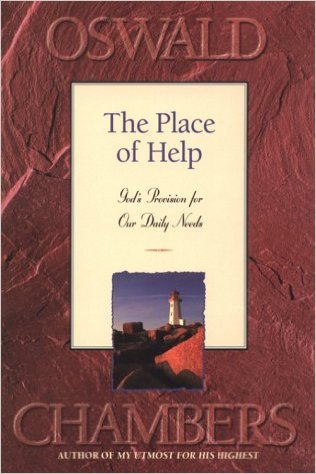
12 More Quotes From “The Place Of Help”

The Place Of HelpAs always, there are more quotes from Oswald Chambers’ books than I have space to share them. So here are a few more from The Place Of Help.

“If we are going to be used by God, He will take us through a multitude of experiences that are not meant for us at all, but meant to make us useful in His hands. There are things we go through which are unexplainable on any other line, and the nearer we get to God the more inexplicable the way seems. It is only on looking back and by getting an explanation from God’s Word that we understand His dealings with us.”

“The essence of Christianity is that we give the Son of God a chance to live and move and have His being in us, and the meaning of all spiritual growth is that He has an increasing opportunity to manifest Himself in our mortal flesh.”

“Temptation is a short cut to what is good, not to what is bad. satan came to our Lord as an angel of light, and all his temptations center around this point—‘You are the Son of God, then do God’s work in Your own way; put men’s needs first, feed them, heal their sicknesses, and they will crown You King.’ Our Lord would not become King on that line; He deliberately rejected the suggested short cut, and choose the long trail, evading none of the suffering involved (cf. John 6:15).”

“God expects His children to be so confident in Him that in a crisis they are the ones upon whom He can rely. … God expects of us the one thing that glorifies Him—and that is to remain absolutely confident in Him, remembering what He has said beforehand, and sure that His purposes will be fulfilled.”

“God has never promised to keep us immune from trouble; He says ‘I will be with him in trouble,’ which is a very different thing.”

“The Bible characters never fell under weak points but on their strong ones; unguarded strength is double weakness.”

“Do we trust in our wits or do we worship God? If we trust in our wits, God will have to repeat the same lesson until we learn it.”

“The coming of Jesus Christ is not a peaceful thing, it is a disturbing thing, because it means the destruction of every peace that is not based on a personal relationship to Himself.” [Matthew 10:34]

“The peace that Jesus gives is never engineered by circumstances on the outside; it is a peace based on a personal relationship that holds all through. ‘In the world ye shall have tribulation: … in Me … peace.’”

“God is a holy God, and the marvel of the Redemption is that God the Holy One puts into me, the unholy one, a new disposition, the disposition of His Son.”

“In the Sermon on the Mount our Lord teaches us not to look for justice, but never to cease to give it. That is not commonsense, it is either madness or Christianity.”

“When the love of God is in me I must learn how to let it express itself; I must educate myself in the matter; it takes time. Acquire your soul with patients, says Jesus [Luke 21:19]. Never give way to this spirit—‘Oh well, I have fallen again, I will stay down now.’ Have patience with yourself, and remember that this is salvation not for the hereafter, but for the here and now.”

You can read the first set of quotes from The Place Of Help by clicking here.

My review of The Place Of Help is here.

And be sure to look for “Thursdays With Oswald” to read quotes and thoughts from the current Chambers’ book I am reading.
12 Quotes From “The Place Of Help”

The Place Of HelpAs always, any Oswald Chambers book I read is thoroughly highlighted. There is always so much great content! On this blog, I have a weekly series called “Thursdays With Oswald” where I share quotes and thoughts from his book I’m currently reading. Be sure to check that out. Below are just a few of the quotes I noted from The Place Of Help. (By the way, you can read my review of this book by clicking here.)

“This is the age when education is placed on the very highest pinnacle. In every civilized country we are told that if we will educate the people and give them better surroundings, we shall produce better characters. Such talk and such theories stir aspirations, but they do not work out well in reality. The kingdom within must be adjusted first before education can have its true use. To educate an unregenerate man is but to increase the possibility of cultured degradation.”

“Not what the disciple says in public prayer, not what he preaches from pulpit or platform, not what he writes on paper or in letters, but what he is in his heart which God alone knows, determines God’s revelation of Himself to him. Character determines revelation (see Psalm 18:24-26).”

“Our Lord never gives private illuminations to special favorites. His way is ever twofold: the development of character, and the descent of Divine illumination through the Word of God.”

“The voice of the Lord listened to in darkness is so entrancing that the finest of earth’s voices are never afterwords mistaken for the voice of the Lord.”

“Jesus Christ distinctly stated that He came to do the will of His Father. ‘I must work the works of Him that sent Me.’ His first obedience was not to the needs of men, but to the will of God. He nowhere chose the altar of His sacrifice, God chose it for Him. He chose to make His life a willing and obedient sacrifice that His Father’s purpose might be fulfilled. … ’For we preach not ourselves, but Christ Jesus as Lord, and ourselves as your servants for Jesus’s sake,’ as Paul says in 2 Corinthians 4:5. We are the servants of men, says Paul, not primarily because their needs have arrested us, but because Jesus Christ is our Lord.” 

“If you become a necessity to a soul you have got out of God’s order, your great need as a worker is to be a friend of the Bridegroom. Your goodness and purity ought never to attract attention to itself, it ought simply to be a magnet to draw others to Jesus.”

“Suppose you talk about depending on God and how wonderful it is, and then others see that in your own immediate concerns you do not depend on Him a bit, but on your own wits, it makes them say, ‘Well, after all, it’s a big pretense, there is no Almighty Christ to depend on anywhere, it is all mere sentiment.’ The impression left is that Jesus Christ is not real to you.” 

“The highest Divine love is not only exhibited in the extreme amazement of the tragedy of Calvary, but in the laying down of the Divine life through the thirty years at Nazareth, through the three years of popularity, scandal, and hatred, and furthermore in the long pre-incarnate years (cf. Revelation 13:8).”

“The Cross is the supreme moment in Time and Eternity, and it is the concentrated essence of the very nature of the Divine love. … The Self-expenditure of God for His enemies in the life and death of our Lord Jesus Christ, becomes the great bridge over the gulf of sin whereby human love may cross over and be embraced by the Divine love, the love that never fails.” 

“Christian experience does not mean we have thought through the way God works in human lives by His grace, or that we are able to state theologically that God gives the Holy Ghost to them that ask Him—that may be Christian thinking, but it is not Christian experience. Christian experience is living through all this by the marvelous power of the Holy Ghost. The Holy Ghost working in me does not produce wonderful experiences that make people say ‘What a wonderful life that man lives’; the Holy Ghost working in me makes me a passionate, devoted, absorbed lover of the Lord Jesus Christ.”

“It is not the baptism of the Holy Ghost that changes men, but the power of the Ascended Christ coming into men’s lives by the Holy Ghost that changes men. The baptism of the Holy Ghost is the evidence of the Ascended Christ.” 

“There is only one Lover of the Lord Jesus and that is the Holy Ghost; when we receive the Holy Ghost He turns us into passionate human lovers of Jesus Christ. Then out of our lives will flow those rivers of living water that heal and bless, and we spend and suffer and endure in patience all because of One and One only.”

More quotes from this book coming soon…

O Holy Night & O Holy Day

O Holy NightIn 1847 an unnamed parish priest sent an unusual request to Placide Cappeau, the commissioner of wines in a small French town: “You are well known for your poems. Would you consider writing a poem for our Christmas mass?” Cappeau was both intrigued and honored, and he soon penned an essay called Cantique de Noel.

Cappeau felt that his poem was more worthy of a song, than just merely a poem, so he turned to his friend Adolphe Adams. Adams was a classically trained musician, but he was also a Jew. Adams said to Cappeau, “You’re asking me to write a melody for a poem that celebrates a Man I do not view as the Son of God, and a poem that celebrates a day I do not celebrate?” But because his friend Cappeau had requested it, he gave it his best effort. Three weeks later, Cantique de Noel was first heard at the Christmas Eve midnight mass.

Cantique de Noel quickly became popular throughout France. But when it was discovered that the lyricist Cappeau had left the church to become a socialist and that the musical composer Adams was a Jew, the Catholic Church banned the song from being sung in any of its churches. Still, the song grew in popularity.

During the build-up to the American Civil War, an abolitionist named John Dwight was especially moved by a line in Cantique de Noel: “Chains shall He break, for the slave is our brother, and in His name all oppression shall cease.” Dwight published his version of Cantique de Noel in his abolitionist magazine with the new title O Holy Night. The song quickly caught on in America.

The opening words of O Holy Night speak to our hearts today, as much as they did to those present at the First Advent—long lay the world in sin and error pining, till He appeared and the soul felt its worth. To pine for something means to long painfully for something just out of our reach. It’s what the psalmist in ancient Israel captured too when he wrote, My soul yearns, even faints, for the courts of the Lord; my heart and my flesh cry out for the living God (Psalm 84:2). There is a longing in all of us to know the Lord!

That’s why Christ’s First Advent is such a blessed, joyous event! In the second stanza we sing—In all our trials born to be our Friend; He knows our need, to our weakness is no stranger. Indeed the writer of Hebrews tells us why Jesus was born as a human (Hebrews 2:14-18), and why we can approach Him confidently (4:15-16).

Christ’s Incarnation allows us to put our faith in Him. When we do, we experience the Atonement. I like to remember this word by saying it at-onement. In other words, the Heavenly Father now sees me at-onement with His Son—when He looks at me, He sees Jesus. That’s why God forgets our forgiven sins (Hebrews 8:12)!

Then the third stanza of O Holy Night begins to tell us how we live out the at-onement every day by loving one another, enjoying His peace, living free and helping others get free too, singing joyfully to God day after night after day after night!

The First Advent was a holy night because Christ’s Atonement it makes us holy. So now all our nights are O holy nights, and all our days are O holy days, and all our work is O holy work, and all our relationships are O holy relationships!

Christ’s First Advent changes EVERYTHING for those who put their faith in Him. Is that you? Are you living in Christ’s at-onement? If not, you can be today by simply asking Him to come into your life.

You can check out some of the other Christmas carols we have looked at here. And check out the video of this message too—

If you have missed any of the messages in our series The Carols Of Christmas, you can find the full list by clicking here.

11 More Quotes From “Our Portrait In Genesis”

The Complete Works Of Oswald ChambersOswald Chambers’ book Our Portrait In Genesis is an excellent companion book when you read the book of Genesis from the Bible. I’ve already shared a few quotes from this book here, and here. Below are a few more I found highlighter-worthy.

“Degeneration and backsliding are by no means one and the same. Degeneration begins in almost imperceptible ways; backsliding in the Scriptural use of the term is a distinct forsaking of what I know of God and a deliberate substitution of something other (cf. Jeremiah 2:13). … If I maintain my right to my natural self I will begin to degenerate and get out of God’s purpose. … If I refuse to sacrifice the natural, the God-life in me is killed.”

“To experience conviction of sin is not a cause for misgiving, but an occasion for understanding the impossible things God has done in the Redemption.”

“All through, a personal crisis ought to serve as an occasion for revealing the fact that God reigns, as well as compelling us to know our own character.”

“We have the notion that it is only when we are pure and holy that God will appear to us; that God’s blessing is a sign that we are right with Him. Neither notion is true. Our Lord took care to say that God makes His sun to rise on the evil and on the good, and sends His rain on the just and on the unjust. God’s blessings are not to be taken as an indication of the integrity of the character blessed, yet on the other hand the discernment of God’s character is determined entirely by the individual character of the person estimating God. ‘With the merciful You will show Yourself merciful’ (Psalm 18:25). The way I discern God’s character is determined by my own character. God remains true to His character, and as I grow in integrity I discern Him. Jacob’s undeservedness, and the fact that God continually blesses him, are brought out very clearly all through his life.”

“‘I can’t understand why I have no confidence in God’; the reason may be a matter of digestion, not enough fresh air, or sleep, too much tea—something slight. It is the shallow things that put us wrong much more quickly than the big things. The great object of the enemy of our souls is to make us fling away our confidence in God; to do this is nothing less than spiritual suicide. When we experience misgiving because we have sinned there is never any ambiguity as to its clause, the Holy Spirit brings conviction home like a lightning flash.”

“Prayer in distress dredges the soul (cf. Psalm 107). It is a good thing to keep note of the things you prayed about when you were in distress. We remain ignorant of ourselves because we do not keep a spiritual autobiography.”

“That is always the test of the reality of sanctification, not so much that I have received something, but that I have ceased to be my old self.”

“The warrior of God is not the man of muscle and a strong jaw, but the man of un-utterable weakness, the man who knows he has not any power; Jacob is no longer strong in himself, he is strong only in God, his life is no longer marked by striving, but by reliance on God. You cannot imitate reliance on God.”

“Authority never comes from you, but from God through you, therefore let God introduce or withhold as He chooses.”

“Beware of saying, ‘Oh well, it doesn’t matter much what I think about in secret’; it does, for the opportunity will come when what you think about in secret will find expression and spurt out in an act. The Bible always speaks of sin as it appears in its final analysis. Jesus does not say, ‘You must not covet because it will lead to stealing’; He says, ‘You must not covet because it is stealing.’ He does not say, ‘You must not be angry with your brother because it will lead to murder’; He says, ‘You must not be angry with your brother because it is murder.’”

“Four times over in this chapter [Genesis 39] is this statement made, ‘the Lord was with Joseph.’ It is the presence of God that is the secret of victory always. The fear of the Lord creates an atmosphere in which impure thoughts and unholy desires die a natural death.”

You can also read my review of this book by clicking here.

Thursdays With Oswald—The Memory Of Sin

This is a periodic series with things I’m reading and pondering from Oswald Chambers. You can read the original seed thought here, or type “Thursdays With Oswald” in the search box to read more entries.

The Memory Of Sin

     No aspect of Christian life and service is in more need of revision than our attitude to the memory of sin in the saint. When the Apostle Paul said “forgetting those things which are behind,” he was talking not about sin, but about his spiritual attainment. Paul never forgot what he had been; it comes out repeatedly in the Epistles—“For I am the least of the apostles, that am not meet to be called an apostle” (1 Corinthians 15:9); “unto me who am less than the least of all saints, is this grace given” (Ephesians 3:8); “…sinners, of whom I am chief” (1 Timothy 1:15). …

     If one wants a touchstone for the depth of true spiritual Christianity, one will surely find it in this matter of the memory of sin. There are those who exhibit a Pharisaic holiness, they thank God with an arrogant offensiveness that they are “not as other men are”; they have forgotten the horrible pit and miry clay from whence they were taken, and their feet set upon a rock through the might of the Atonement. … 

     May the conviction of God come with swift and stern rebuke upon any one who is remembering the past of another, and deliberately choosing to forget their restoration through God’s grace. When a servant of God meets these sins in others, let him be reverent with what he does not understand and leave God to deal with them. 

From Conformed To His Image (emphasis added)

These are good questions for Christians to ask themselves regularly: (1) Am I remembering the sins of others the way I would want others to remember my sins? (2) Am I remembering my forgiven sins the way that God remembers them (Psalm 103:10-12)?

Links & Quotes

link quote

“It has pleased God to give each one of us the same amount of time each day, week, month, and year. Time is a gift of God, and He expects us to use it wisely, in ways that overcome the foolishness of living apart from God and glorify Him in all the details of our lives (Psalm 90:12; Ephesians 5:15-17; 1 Corinthians 10:31). … The challenge of the spiritual life is to claim all our time and construct all our activities in order to pursue what we desire as the life of following Jesus. Anything that doesn’t contribute to that objective distracts from it. … What do the time and activities of your life reveal about what you desire in life and what you’re depending on to give your life purpose and joy?” —T.M. Moore

If you haven’t checked out The Bible Project videos lately, please visit their YouTube channel. They have some really cool stuff that give you an overview of a book of the Bible, and some of the major themes in the Bible. Each video is only 5-7 minutes long, but there is a ton of good insight packed into that time.

“If God did not love us unconditionally, He would not penetrate our unattractive lives, bring us to faith, unite us to Christ, give us His Spirit, and make us progressively like Jesus.” —John Piper

“The Word of God is an expansive Word; ever widening its dimensions; growing upon us; never old, ever new; in which we make continual discoveries; the same tree, but ever putting forth new branches and leaves; the same river, but ever swelling and widening; losing none of its old water, yet ever receiving accessions.” —Horatius Bonar

Planned Parenthood’s love/hate relationship with science.

The Federalist shares 10 reasons it makes zero sense to support abortion.

Parents & teachers, check out what Tim Elmore says we often forget when we are helping our students solve problems.

Links & Quotes

link quote

“Parents! I do hope you are all endeavoring to bring your children to Christ by teaching them the things of God. Let them not be strangers to the plan of salvation. Never let it be said that a child of yours reached years in which his conscience could act, and he could judge between good and evil, without knowing the doctrine of the atonement, without understanding the great substitutionary work of Christ. Set before your child life and death, hell and heaven, judgment and mercy, his own sin, and Christ’s most precious blood; and as you set these before him, labor with him, persuade him, as the apostle did his congregation, with tears and weeping, to turn unto the Lord.” —Charles Spurgeon

“The role of God’s Word is to feed faith’s appetite for God. And, in doing this, it weans my heart away from the deceptive taste of lust. … As I pray for my faith to be satisfied with God’s life and peace, the sword of the Spirit carves the sugar coating off the poison of lust. I see it for what it is. And by the grace of God, its alluring power is broken.” —John Piper

“This triangle of truisms, of father, mother and child, cannot be destroyed; it can only destroy those civilizations which disregard it.” —G.K. Chesterton

“Have you realized that most of your unhappiness in life is due to the fact that you are listening to yourself instead of talking to yourself? Take those thoughts that come to you the moment you wake up in the morning. You have not originated them, but they start talking to you, they bring back the problems of yesterday, etc. Somebody is talking … yourself is talking to you!” —Martyn Lloyd-Jones

Planned Parenthood updates:

Ultrasounds = good for saving babies, bad for Planned Parenthood’s business.

Earlier this week I shared a list of companies who support Planned Parenthood (at least PP had listed them as supporters on its website). Here’s what these companies said when they were contacted by The Daily Signal. Good news: It appears that many of them are not supporting PP financially.

PP cartoonHopefully this cartoon doesn’t describe you… (click the link or the picture to see the rest of it).

Salty Disciples

The hope of gloryWho are Christ’s disciples? Is it only the people who walked Earth at the same time and place as Jesus? Was it an exclusive club of the 12 men Jesus selected as His apostles? Can anyone be a disciple of Jesus Christ?

Great questions!

First of all we must know that discipleship is not something we DO; it’s who we ARE. We have to start thinking of discipleship like a job search, where we need to have the right education and experiences that will build up our spiritual resume, and then Jesus will “hire” us to be one of His disciples.

We do the being, and Jesus does the preparingAnd Jesus said to them, Come after Me and BE My disciples, and I will MAKE you to become fishers of men (Mark 1:17, AMP). We are to just BE with Jesus, and being with Him will prepare us to be made into something else.

We don’t negotiate with Jesus on how much time we can give Him. We don’t say, “As soon as I get through this busy time in my life I’ll follow you” or “After the kids are grown, then I’ll have more time for you” or “As soon as I get my business situation taken care of.” Jesus wants us to come to Him just as we are right now—Simply put, if you’re not willing to take what is dearest to you, whether plans or people, and kiss it good-bye, you can’t be My disciple. (Luke 14:33, MSG)

As a disciple of Jesus we don’t try to act a certain way, we simply AREYou ARE the salt of the earth… (Matthew 5:13). We can do this because of the Atonement (or as Oswald Chambers says, the “at-onement”). You are in Christ, and He is in you—when God sees you, He sees Jesus; when others see you, they see Jesus. 

Here’s the amazing thing: God wants to use you to show Jesus to others. God has chosen to make known among the Gentiles the glorious riches of this mystery, which is Christ IN you, the hope of glory (Colossians 1:27).

Make it your goal to simply be with Christ, and then be prepared for His God’s glory to be on display in you. You will then BE salt and light to a needy world!

Thursdays With Oswald—Christ’s Perfection In You

Oswald ChambersThis is a periodic series with things I’m reading and pondering from Oswald Chambers. You can read the original seed thought here, or type “Thursdays With Oswald” in the search box to read more entries.

Christ’s Perfection In You

     Paul does not say, nor does the Spirit of God say anywhere, that after we are born again of the Spirit of God, Jesus Christ is put before us as an Example and we make ourselves holy by drawing from Him. Never! Sanctification is Christ formed in us; not the Christ-life, but Christ Himself. In Jesus Christ is the perfection of everything, and the mystery of sanctification is that we may have in Jesus Christ, not the start of holiness, but the holiness of Jesus Christ. …  

     Those of you who are hungering and thirsting after holiness, think what it would mean to you to go out tonight knowing that you may step boldly into the heritage that is yours if you are born of the Spirit, and realize that the perfections of Jesus are yours by His sovereign gift in such a way that you can prove it experimentally!

From Our Brilliant Heritage (emphasis added)

Oswald Chambers says there are three Mysteries that are impossible for us to fully grasp with our natural minds: (1) The Triune God—Father, Son and Spirit all equally God; (2) The Incarnation of Jesus—fully Man and fully God; and (3) Christ in us.

Yes, it’s a mystery, but it’s true! Jesus doesn’t want to be your Example. He wants to be in you, and wants you to be in Him. His desire is that you are at-onement (that’s what the word atonement means) with Him, so that when people look at you they see Jesus.

You don’t have to earn this, or try to work it up in your life. If you have invited Jesus into your life, He truly is IN you—all of His perfection is IN you! Ask the Holy Spirit to make this real to you today.

17 Final Quotes From “Not Knowing Where”

Not Knowing WhereI’ve been sharing some of the amazing quotes from Oswald Chambers’ book Not Knowing Where. Here is the last set of quotes from this book.

“The natural life is not spiritual, it can only be made spiritual by deliberately casting it out and making it the slave instead of the ruler. … Jesus Christ cannot give me a meek and quiet spirit, I have to take His yoke upon me; that is, I have to deliberately discipline myself. … If we do not resolutely cast out the natural, the supernatural can never become natural in us.”

“Remember, Abraham had to offer up Ishmael before he offered up Isaac. Some of us are trying to offer spiritual sacrifices before we have sacrificed the natural. The only way we can offer a spiritual sacrifice to God is to do what He tells us to do, discipline what He tells us to discipline.”

“Common sense is not faith and faith is not common sense; they stand in the relation of Ishmael and Isaac, of the natural and spiritual, of individuality and personality, of impulse and inspiration. Faith in antagonism to common sense is fanaticism, and common sense in antagonism to faith is rationalism. The life of faith brings the two into right relationship.”

“We have the idea that the body, individuality, and the natural life are altogether of the devil; they are not, they are all of God, designed by God, and it is in the human body and in the natural order of things that we have to exhibit our worship of God. The danger is to mistake the natural for the spiritual, and instead of worshiping God in my natural life to make my natural life God.”

“How am I going to find out what the will of God is? In one way only, by not trying to find out. If you are born again of the Spirit of God, you are the will of God, and your ordinary common sense decisions are God’s will for you unless He gives an inner check. When He does, call a halt immediately and wait on Him. Be renewed in the spirit of your mind that you may make out His will, not in your mind, but in practical living. God’s will in my common sense life is not for me to accept conditions and say—‘Oh well, it is the will of God,’ but to apprehend them for Him, and that means conflict, and it is of God that we conflict. Doing the will of God is an active thing in my common sense life.”

“As Abimelech rebuked Abraham when he was in the wrong (see Genesis 20), and Abraham in his turn rebuked Abimelech, so in the same way the children of men from time to time rebuke the children of God, and the children of God rebuke the politics of natural men. Compromise with each other or unity between them is immoral. Arbitration until He comes Whose right it is to reign is the God-ordained program.”

“The very nature of faith is that it must be tried; faith untried is only ideally real, not actually real. Faith is not rational, therefore it cannot be worked out on the basis of logical reason; it can only be worked out on the implicit line of living obedience.”

“God does not further our spiritual life in spite of our circumstances, but in and by our circumstances.”

“To say ‘Here I am’ when God speaks, is only possible if we are in His presence, in the place where we can obey.” 

“God never fits His Word to suit me; He fits me to suit His Word.”

“True faith does not so much take God at His Word as take the Word of God as it is, in the face of all difficulties, and act upon it, with no attempt to explain or expounded.”

“The path to God is never the same as the path of God. When I am going on with God in His path, I do not understand, but God does; therefore I understand God, not His path.”

“Christ died in the stead of me. I, a guilty sinner, can never get right with God, it is impossible. I can only be brought into union with God by identification with the One Who died in my stead. No sinner can get right with God on any other ground than the ground that Christ died in his stead, not instead of him.” 

“The maturity of character before God is the personal channel through which He can bless others. If it takes all our lifetime before God can put us right, then others are going to be impoverished.”

“The genius of the Spirit of God is to make us pilgrims, consequently there is the continual un-at-home-ness in this world (cf. Philippians 3:20).”

“It is impossible for a saint, no matter what his experience, to keep right with God if he will not take the trouble to spend time with God. In order to keep the mind and heart awake to God’s high ideals you have to keep coming back again and again to the primal source.”

“Bitterness and cynicism are born of broken gods; bitterness is an indication that somewhere in my life I have belittled the true God and made a god of human perfection.”

You can read other quotes I’ve shared from Not Knowing Where by clicking here, here, and here.

And my book review of Not Knowing Where is here.