4 Ways To Evaluate Biblical Evidence

Reliability of the GospelsTo be honest, if someone hasn’t heard the biblical account of the life of Jesus Christ before, it can sound quite fantastic! Jesus was born of a virgin, lived a sinless life, performed miracles no one had seen before, died a horrific martyr’s death, was raised back to life three days later, and then ascended back into heaven until He returns to Earth again.

But as fantastic as this sounds, there is still enough evidence to reasonably believe it’s all true. An unreasonable faith believes in something in spite of the evidence; a blind faith believes in something without any evidence; and reasonable faith believes in something because of the evidence.

The Bible gives us eyewitness testimony about the life of Jesus which we can matter-of-factly evaluate. 

In a modern-day court of law, eyewitness testimony is evaluated on…

  • …the determination that the witnesses were actually present.
  • …the ability to corroborate their testimony.
  • …the consistency of their testimony over time.
  • …any biases they have that would cause them to exaggerate or misrepresent their testimony.

Let’s consider the testimony of the four Gospel writers: Matthew, Mark, Luke and John.

(1) Were The Eyewitnesses Present?

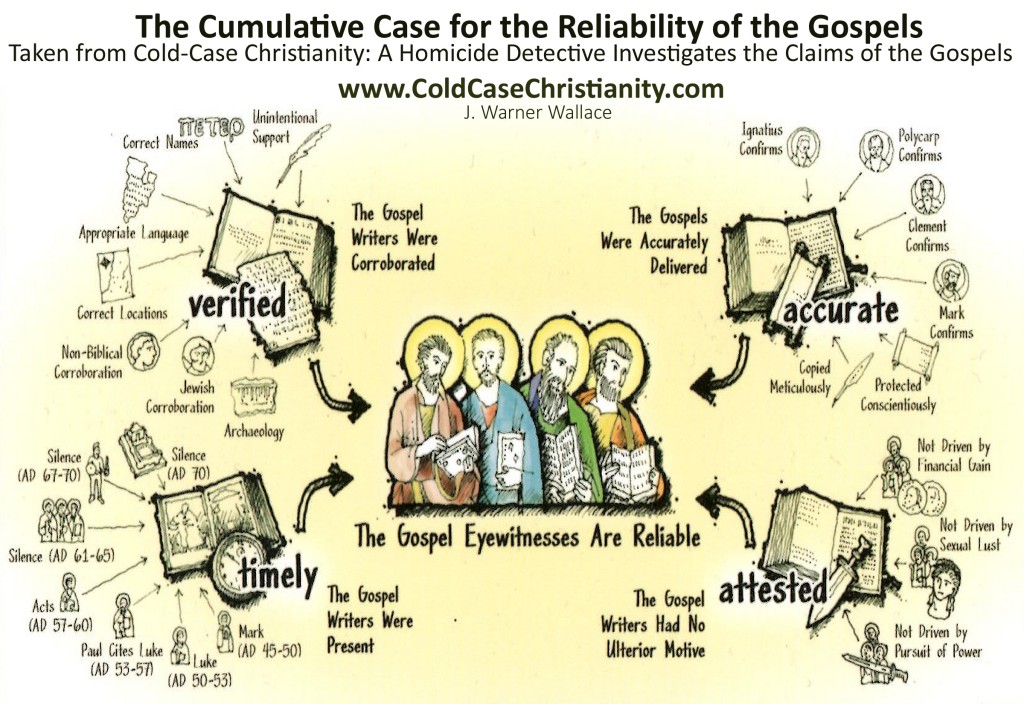
  • Luke is considered a credible historian, even by modern standards. He wrote the book of Acts following the ascension of Jesus into Heaven. Because he did not mention three major events in Jewish history (the Jewish uprising, the Roman siege of Jerusalem in response to that uprising, and the Roman destruction of the temple), we can determine that Acts was written before 61 AD.
  • Luke wrote the Gospel that bears his name before he wrote Acts. The Apostle Paul referenced portions of Luke’s Gospel in letters we can date by Paul’s Roman imprisonment, which means Luke was written prior to 53-57 AD.
  • Luke uses the Gospel of Mark as one of his references, which means Mark was probably written in 45-50 AD, just 10-15 years after the events of Christ’s life.
  • Mark was closely associated with the Apostle Peter, who was most assuredly Mark’s “source” in writing his Gospel, and Peter was one of the original twelve apostles called by Jesus.
  • Matthew and John were both apostles of Jesus, living and working closely with Jesus for over three years.

(2) Is Their Testimony Corroborated?

  • Archeological finds continually demonstrate the accuracy of the people, titles, places and details the Gospel writers mention.
  • Outside—or extra-biblical—sources like Josephus (a Jewish historian who wanted to preserve the purity of Judaism), Tacitus (a Roman historian), and Mara Bar-Serapion (a Syrian historian)—all who wrote between 40-70 AD—affirm things like where Jesus lived, the miracles He performed, the manner of His death, His resurrection, and the changed lives of people who believed in Jesus Christ.
  • In addition, Paul wrote of the “five hundred of the brothers” who were also eyewitnesses to the resurrected Christ (1 Corinthians 15:3-8).

(3) Has Their Testimony Remain Unchanged Over Time?

  • The history and accuracy of the scribes had already been demonstrated in the preservation and transmission of the Old Testament over a period of 1400 years.
  • These same scribal techniques were not only used in the transmission of the New Testament, but in subsequent years the Masoretic scribes became even more meticulous in the techniques they used.
  • The “chain of custody” of evidence can be absolutely traced from the Gospel authors, to their students, and to the writings of the Church Fathers.
  • In fact into the third-century AD, the writings of the Church Fathers contain so many direct quotations from the New Testament, that we can almost completely reconstruct the New Testament from their writings.

(4) Is Their Testimony Unbiased?

  • These eyewitnesses didn’t gain anything financially by their testimony. In fact, many of them lost or gave up all their possessions to tell others about Jesus.
  • They didn’t gain political power or influence that could save their own lives. All of the original apostles (except John) died a gruesome martyrs’ death.
  • In short, they had nothing to gain by making up and reporting a false story about Jesus.

All of these points make it reasonable to believe the evidence presented in the Bible about Jesus Christ is true. Check out this video where I elaborate a little more on each of these points—

If you live in the Cedar Springs area and don’t have a home church, I would love for you to visit with us Easter Sunday morning at 10:30am. We’ll be examining the evidence for Christ’s resurrection from the dead. Click here to get more details.

3 Bible Studies For You To Try

Book by book studyLast week I spoke and wrote about some tools you might use to study your Bible. Now I’d like to share some Bible study projects you might try with those new tools. As always, I recommend that beginning Bible studies go verse by verse through the Bible. I believe you will lay a strong foundation for your faith when you systematically put God’s Word into your heart.

Book By Book

I’ll use the book of Ephesians as an example. Using my Bible atlas I find that the city of Ephesus is located along an important trade route, and it is the Roman capital of the province of Asia. My Full Life Study Bible tells me that because so much trade passed through this city, this letter was probably intended to be a circular letter for all of the communities near Ephesus. As a result, Paul is not addressing any specific problems in this church, but writes theological ideas for a broad spectrum of people.

As I begin reading, I paused in the first verse when I came to the phrase “the faithful in Christ.” I asked myself, “What does it mean to be faithful IN Christ? Can I be faithful outside of Him?” By the time I got to verse 3, I saw a similar phrase: “every spiritual blessing in Christ.” Now I went back and used a blue highlighter (there’s nothing special about blue, it just happened to be the first highlighter I grabbed), and marked those two “in Christ” phrases. I see two more in verse 4: “He chose us in Him” and “holy and blameless in His sight.” Going through the whole book I discovered 36 times the phrases “in Christ” or “in Him.” This is helpful to me to know the kind of security I have in Jesus.

Another thing that stood out to me were Paul’s prayers for the church. I see His very moving prayers in passages like 1:15-19 and in 3:14-21. I also see in 6:18 that he tells us to pray all kinds of prayers for ourselves and for others. And I see in 6:19 that Paul asked the church to pray for him too.

And always look for “therefore” phrases. For example in 4:24-25 or 4:32-5:1. The “therefore” phrases tell us how to live or think in light of the ideas that were just shared.

Chapter By Chapter

A good place to do this is in the Psalms or Proverbs. These are usually stand-alone chapters. When reading the chapters in these two books, I love reading them in parallel with other translations. For example, check out this from Psalm 1.

In Psalm 59, notice the superscript (or introduction). This gives us some background information to the psalm. Using my concordance, I found that this psalm was written this time in David’s life.

There is usually a theme to each chapter of the Proverbs, so try to discover that. In Proverbs 2, I noticed the “if … then” statements. In the first four verses I see things like “IF you will seek wisdom like this,” and then in verses 5-22 I see a whole bunch of blessings that follow the “then” that starts verse 5.

Word By Word

Sometimes I like to go really deep in a passage, so I slow down and look at it word by word. Here you need to use a Strong’s Concordance of the Bible. I like the one available on Blue Letter Bible. For example, next to 2 Peter 1:5, you can hover over the word “Tools” and select “Interlinear.” Clicking on “Interlinear” you will see all of the Greek words that make up this verse. By clicking on the Strong’s number, you can see the definition of that Greek word. Scrolling down a bit, you can see all of the other verses where that Greek word is used in the New Testament.

None of these tools are meant to take the place of the Holy Spirit. He is called the Spirit of Truth, and since He is the One who inspired all of the Scripture, ask His help before you begin any Bible study.

Here are two more Bible studies for you to try.

In this video I go into more detail on how I undertake all of these Bible studies. And be sure to join us next week as we take another look at different types of Bible studies.

4 Thoughts To Help Prayer Become A Daily Habit

ImportunityI have shared several strategies about prayer throughout this series (you can read them here, here, here, and here). One danger in putting these steps into practice in our life is what I would call one-and-done. We do it once and think we’ve done all we need to do.

Scientists tell us at a minimum it takes 21 days in a row to make a habit. Jesus went even farther than that in talking about prayer in Matthew 7:7. When we look at the three aspects of the verbs ask, seek, and knock in this verse, it would be better stated like this—

You need to keep on asking, and keep on seeking, and keep on knocking. This is not good advice or a helpful suggestion, but it is vital for your spiritual life. So after you have asked, sought, and knocked, then do it again, and again, and AGAIN.

Matthew Henry said it this way: “Here is a precept in three words to the same purport, Ask, Seek, Knock; that is, in one word, ‘Pray; pray often; pray with sincerity and seriousness; pray, and pray again; make conscience of prayer, and be constant in it; make a business of prayer, and be earnest in it.’”

In the English language the dictionary has a word for this: importunity. This means being urgent and persistent, sometimes annoyingly so!

I believe importunity requires these four characteristics:

  1. Trust. Remember Jesus taught us to begin our prayer with, “Our Father.” We have to come to Him again and again and again trusting that He loves us, that He alone is the Source of our help, and that He wants to help us. We also have to trust that our Father wants to give us the very best (Matthew 6:8, 7:7-11).
  2. Perseverance. I love the story of the persistent widow in Luke 18:1-5. This determined lady kept coming back again and again. Henry Ward Beecher said, “The difference between perseverance and obstinacy is, that one often comes from a strong will, and the other from a strong won’t.”
  3. Creativity. One of my favorite New Testament stories is about a mother who is not only as persistent as the widow in Luke 18, but she is creative in her prayer as well (Mark 7:24-30). This lady bantered with Jesus in a way that I believe caused Christ to throw back His head and laugh! This is not bargaining with God, as Oswald Chambers wrote, “Repetition in intercessory importunity is not bargaining, but the joyous insistence of prayer.”
  4. Action. Paul was looking for an open door to preach the Gospel, but he didn’t sit still while he waited for God to say “yes” (Acts 16:6-10).

Keep these in mind as you make importunity a key part of your prayer life. And check out the full video of my message on importunity in prayer.

New Year, New Attitude

Listen to the podcast of this post by clicking on the player below, and you can also subscribe on AppleSpotify, or Audible.

If you’re looking to challenge yourself to be a better person in the New Year, you couldn’t go wrong with this list—

  1. Hate what is evil
  2. Cling to what is good
  3. Love others with real compassion
  4. Honor others above yourselves
  5. Work hard
  6. Keep growing spiritually
  7. Find new ways to serve the Lord
  8. Be joyful in hope
  9. Be patient in hard times
  10. Be faithful in prayer
  11. Share with others who are in need
  12. Practice hospitality
  13. Bless those who persecute you
  14. Laugh with your friends when they’re happy
  15. Cry with your friends when they’re sad
  16. Live in harmony with everyone
  17. Make friends with those others call “nobodies”
  18. Don’t try to be somebody you’re not
  19. Don’t respond to insults with insults, but with love
  20. Try to do what is right in the eyes of everyone
  21. Live at peace with everyone
  22. Don’t take revenge, but let God handle it
  23. Don’t let evil get the best of you, but get the best of evil by doing good

(Hat tip to the apostle Paul for this list taken from Romans 12:9-21)

►► Would you please prayerfully consider supporting this ministry? ◀︎◀︎

Links & Quotes

link quote

“The busyness of duties will knock us out of relationship to God more quickly than the devil.” —Oswald Chambers

“The moment I come into possession of something which my neighbor or my fellow man has not, I become a debtor to that fellow man! … It is to God, then, that in the first place Paul feels himself an infinite debtor in the fullest sense [Romans 1:14]. To God Himself he cannot pay this debt directly, but he can indirectly, by pouring out the God-given treasure upon others.” —Horatius Bonar

“To lose temper, and call names, is a common sign of a defeated cause. … The true Christian in the present day must never be surprised to find that he has constant trials to endure from this quarter. Sinful human nature never changes. So long as he serves the world, and walks in the broad way, little perhaps will be said against him. Once let him take up the cross and follow Christ, and there is no lie too monstrous, and no story too absurd, for some to tell against him, and for others to believe. But let him take comfort in the thought that he is only drinking the cup which his blessed Master drank before him. The lies of his enemies do him no injury in heaven, whatever they may on earth. Let him bear them patiently, and not fret, or lose his temper. When Christ was reviled, ‘He reviled not again’ (1 Peter 2:23). Let the Christian do likewise.” —J.C. Ryle

I like hearing this: Senator Ted Cruz points out how Congress can end abortion without the Supreme Court.

Rev. Tim Dilena shares a video message of how to finish well: Fighting The Reprehensible Thing.

Are you infringing on someone’s copyright? Check out this infographic from ChurchMag.

6 Ways To Make Sure Everything You Do Is Sacred

It's all sacredAround 1300 AD, the Church began propagating a myth. It showed up in two words that were created around that time: clergy and laity.

Simply stated, clergy is from a root word that means “the learned men … the ones enlighten for ministry.” And laity is anyone not in that inner circle.

Insecure leaders did this to maintain control. They continued to read the Scriptures in Latin, which few could read, so they made sure that the clergy alone had a Bible, and they alone became the expounders of how the Bible told us to live.

In the clergy-laity divide, they also created a sacred-secular divide.

When Paul addresses the Colossians he does so with anything but a clergy-laity divide in mind. He calls them the holy and faithful brothers in Christ (Colossians 1:2). The KJV translates holy as saints, for that’s how Paul indeed sees them. And he sees them as his very own faith-filled brothers.

Paul also has anything but a sacred-secular divide in mind as he instructs then—whatever you do, whether in word or deed.

He makes it clear that everything we do as faith-filled, holy saints is to be sacred and God-honoring.

How do we do whatever we do in a sacred, God-honoring way? We ask these six questions:

[1] Can it be done with a clear conscience? (Acts 23:1; 24:16)

  • “It is not WHAT a man does that determines whether his work is sacred or secular, it is WHY he does it.” —A.W. Tozer

[2] Will it promote the Gospel? (Philippians 1:27)

[3] Is it a good deed? (Acts 10:38; James 3:13)

[4] Does it point people to God? (1 Peter 2:12; 1 Corinthians 10:31)

[5] Can I do it in the name of Jesus? (Colossians 3:17do it ALL in the name of Jesus)

[6] Does it cause others to be thank-full? (Colossians 3:17giving THANKS to God the Father).

Live according to your high calling, for all you do is sacred!

(To check out more thoughts on Colossians 3:15-17, click here and here.)

You Are God’s Lavish Gift To Others

GratefulI have noticed a couple of things about thank-full people (people who are full of thanks). In a single word the difference is ABUNDANCE.

  • Thank-full people have an abundance mentality—they believe there’s plenty for everyone; that God’s grace overflows and is boundless.
  • Thank-full people want others to find this abundant life too. As Charles Spurgeon prayed, “I would then that the quickening Spirit would come down upon me, and upon you, upon every one of us in abundance, to create men valiant for truth and mighty for the Lord.”

This abundance mentality is what Paul is referring to when he writes, “Let the word of Christ dwell in you richly” (Colossians 3:16). Both words dwell and richly convey someone who is so saturated in the abundance of God, that they cannot help wanting to share it with everyone!

So how do Christians lavish their thank-fullness and peace-fullness on others? The rest of that verse in Colossians tells us:

  1. We teach.
  2. We admonish with all wisdom.
  3. We sing.

Teaching others is always rooted in love, and is for the benefit of the other person (Ephesians 4:15, 25, 29).

Wisdom is the Greek word sophia. It means heavenly insight that is extremely practical. That’s what we need when we admonish those we love. This word means to warn people if they are on a wrong path. We love them enough to speak a loving word of warning (Proverbs 27:5-6).

And we sing out of our abundant overflow. The word of Christ dwells in us so richly that it literally bursts out of us in song! Have you ever been around someone so full of God’s presence that their words almost seem to be a song?

But don’t miss out on this. The lavish gift God wants to pour out on people is YOU! Notice how many times the pronoun you is used in Colossians 3:15-17. YOU are God’s gift to your family, your friends, your co-workers, your community!

Don’t rob others of this amazing gift by becoming ungrateful.

Grateful is graceful. 
Graceful is thankful. 
Thankful is worshipful.
Worshipful is God-full.

“The essence of Christianity is that we give the Son of God a chance to live and move and have His being in us, and the meaning of all spiritual growth is that He has an increasing opportunity to manifest Himself in our mortal flesh.” —Oswald Chambers

What will you do to remain thank-full, and remain God’s lavish gift to others?

Part three of our 3-part series on gratitude is coming up this Sunday. If you don’t have a home church in the Cedar Springs area, I would be so thank-full to have you come join us!

10 Ways To Pastor Like Paul

Apostle PaulI don’t think anyone who has studied the New Testament would argue that Paul was a premier pastor, evangelist and missionary. In his farewell address to the elders from Ephesus, Paul used his life as an example—“you know how I lived the whole time I was with you” (Acts 20:18).

Here are 10 things Paul demonstrated as a pastor:

  1. Great humility (v. 19)
  2. Preached the “hard messages” they needed to hear (v. 20a)
  3. Preached publicly and house to house (v. 20b)
  4. Made our Lord Jesus the central message of his sermons (v. 21)
  5. In constant contact with the Holy Spirit (vv. 22-23)
  6. Desired to finish the race and complete the task God had given him (v. 24)
  7. Lived innocently (v. 26)
  8. Always proclaimed the whole will of God, not just select topics (v. 27)
  9. Didn’t covet a luxurious lifestyle, but supplied my own needs by working as a tentmaker (vv. 33-34)
  10. Worked hard to be charitable to everyone (v. 35)

Because Paul lived like this, he had the moral authority to call these elders to live a similar lifestyle. He challenged the Ephesian pastors to:

  • Keep watch over yourselves
  • Keep watch over the flock
  • Stay in tune with the Holy Spirit’s oversight
  • Shepherd the Church
  • Remember the Church is the Bride of Christ (v. 28)
  • Be on your guard! (v. 31)

If you are a pastor, pay attention to these words!

If you love your pastor, help him or her stay true to these words!

Thursdays With Oswald—Your Thought Life DOES Matter

Oswald ChambersThis is a periodic series with things I’m reading and pondering from Oswald Chambers. You can read the original seed thought here, or type “Thursdays With Oswald” in the search box to read more entries.

Your Thought Life DOES Matter

“Beware of saying, ‘Oh well, it doesn’t matter much what I think about in secret’; it does, for the opportunity will come when what you think about in secret will find expression and spurt out in an act. The Bible always speaks of sin as it appears in its final analysis. Jesus does not say, ‘You must not covet because it will lead to stealing’; He says, ‘You must not covet because it is stealing.’ He does not say, ‘You must not be angry with your brother because it will lead to murder’; He says, ‘You must not be angry with your brother because it is murder.’”

From Our Portrait In Genesis

This is why the Apostle Paul tells us to take all of our thoughts captive (2 Corinthians 10:5). What you are thinking about IS determining who you will become in the future. Capture those negative, unbiblical thoughts and replace them with the truth found in God’s Word.

Thursdays With Oswald—The Memory Of Sin

This is a periodic series with things I’m reading and pondering from Oswald Chambers. You can read the original seed thought here, or type “Thursdays With Oswald” in the search box to read more entries.

The Memory Of Sin

     No aspect of Christian life and service is in more need of revision than our attitude to the memory of sin in the saint. When the Apostle Paul said “forgetting those things which are behind,” he was talking not about sin, but about his spiritual attainment. Paul never forgot what he had been; it comes out repeatedly in the Epistles—“For I am the least of the apostles, that am not meet to be called an apostle” (1 Corinthians 15:9); “unto me who am less than the least of all saints, is this grace given” (Ephesians 3:8); “…sinners, of whom I am chief” (1 Timothy 1:15). …

     If one wants a touchstone for the depth of true spiritual Christianity, one will surely find it in this matter of the memory of sin. There are those who exhibit a Pharisaic holiness, they thank God with an arrogant offensiveness that they are “not as other men are”; they have forgotten the horrible pit and miry clay from whence they were taken, and their feet set upon a rock through the might of the Atonement. … 

     May the conviction of God come with swift and stern rebuke upon any one who is remembering the past of another, and deliberately choosing to forget their restoration through God’s grace. When a servant of God meets these sins in others, let him be reverent with what he does not understand and leave God to deal with them. 

From Conformed To His Image (emphasis added)

These are good questions for Christians to ask themselves regularly: (1) Am I remembering the sins of others the way I would want others to remember my sins? (2) Am I remembering my forgiven sins the way that God remembers them (Psalm 103:10-12)?