Listen to the podcast of this post by clicking on the player below, and you can also subscribe on Apple, Spotify, or Audible.
I had a great time on the Thriving In Ministrypodcast with Kyle Willis and Dace Clifton.
Kyle asked me a question about how I recharge myself mentally. A key verse in the Bible for me is 2 Corinthians 10:5 where the the apostle Paul counsels us to capture our thoughts. This is extremely hard to do when we are physically or mentally drained.
In my younger years, I used to try to “do nothing” as my recovery time. As I matured, I realized that top athletes had a different way to help their body recover, and I began to adapt those practices to my time of mental recovery. Dace also shares a very helpful tip for his mental recovery time.
In my book Shepherd Leadership: The Metrics That Really Matter I make the case that in order for the sheep to be healthy, the shepherd has to get healthy first. The principle is simple: You cannot give to others what you do not possess yourself. I hope you will pick up a copy of my book to learn how Jesus taught us to be wholly healthy leaders.
I’ll be sharing more clips from this Thriving In Ministry interview soon, so please stay tuned. Shepherd Leadership: The Metrics That Really Matter is available in print or ebook, and in audiobook through either Audible or Apple.
Listen to the podcast of this post by clicking on the player below, and you can also subscribe on Apple, Spotify, or Audible.
Let’s get on the same page with a few facts:
Nearly 1-of-5 adults in the United States age 18 and older battle some form of anxiety disorder.
Being anxious is not a sin but we can grieve God’s heart if we don’t train ourselves to turn to Him as our First Source. Notice that David said, “When[not “if”] I am afraid, I put my trust in You” (Psalm 56:3).
A third definition of anxiety is found here: “Cast your cares on the Lord and He will sustain you; He will never let the righteous be shaken” (Psalm 55:22). This word for cares or anxieties is the only time this Hebrew word is used in the Bible. The idea is a heavy burden, which the Amplified Bible captures like this: “Cast your burden on the Lord—releasing the weight of it—and He will sustain you….”
We can be burdened because we pick up and carry things on our own. But the word for cares or burdens in Psalm 55:22 can mean not only things we pick up, but things given to us by God or allowed by God. You might ask, “Why would God give me a burden?”
Sometimes it’s allowed—God allowed satan to afflict Job within limits, and He allowed Joseph’s brothers to ambush him (Job 1:8-12; 2:3-7; Genesis 50:20).
Sometimes it’s given—God gave Jesus a bitter cup to drink, and He gave Paul a “thorn in the flesh” (Matthew 26:39-42; 2 Corinthians 12:7).
In every instance, the limits are perfectly measured to accomplish what God wants to do. The way we respond glorifies Him and keeps us dependent on Him (Job 1:20; 2:10; Genesis 50:20; 2 Corinthians 12:8-10; Hebrews 10:10).
Still in the middle of this, the burdens can seem overwhelming and anxiety-inducing. That’s why God tells us what to do with these burdens: Cast them off!
In Psalm 55:22, David gives us the word “cast” in the imperative mood, which means it’s a command. Literally, the word means to throw away or shed the burden.
How often do we do this? David said he prayed “evening, morning, and noon” for God’s help (Psalm 55:16-17).
What does God do when we cast off these burdens? He sustains and supports us—“He will sustain you; He will never let the righteous be shaken.”
The apostle Peter quotes the opening words of this verse when he writes, “Cast all your anxiety on Him,” and then he tells us why we can do this: “Because He cares for you” (1 Peter 5:7). Just like David said he prayed for his burdens to be released “evening, morning, and noon,” the verb tense Peter uses implies the same thing. We don’t just release our burdens once, but we continue to do it again and again and again!
The word Peter uses for “cast” is only used twice in all the New Testament. The word means not just to drop our burdens at our feet—where we may trip over them or be tempted to pick them up again—but to throw our burdens on someone else. The only other place this word is used is when on the day Jesus rode into Jerusalem the disciples “threw their cloaks on the colt and put Jesus on it” (Luke 19:35).
Peter tells us that this casting off of our burdens requires us to humble ourselves before God. Pride makes us think we can handle it on our own, and that same pride robs God of the glory He would receive when He provides relief from our heavy load. We cast these burdens onto Jesus so that we can be alert to the enemy’s sneaky tactics, and help others who are also being attacked. And just as David said God supported and sustained him, Peter said the same thing (1 Peter 5:6-10). I especially like the wording from the King James Version—
But the God of all grace, Who hath called us unto His eternal glory by Christ Jesus, after that ye have suffered a while, make you perfect, stablish, strengthen, settle you. (1 Peter 5:10 KJV)
Jesus can X-out the instability that comes with carrying heavy burdens and make us stablished, strengthened, and settled in Him.
Don’t try to carry these anxiety-inducing burdens on your own, but cast them on Jesus every evening, morning, and noon. Let Him carry those burdens so you can live in a way that glorifies Him every single day.
Listen to the podcast of this post by clicking on the player below, and you can also subscribe on Apple, Spotify, or Audible.
“Anxiety disorders are the most common mental illness in the U.S., affecting 40 million adults in the United States age 18 and older, or 18.1% of the population every year.” —Anxiety & Depression Association of America
A multitude of factors go into someone’s anxiety: genetics, temperament, brain chemistry, life experiences. In addition to those factors, we have to keep in mind that humans are a three-part being—with a body, mind, and spirit—and a disease in one area does affect the other two areas.
All of this means that there is no one-size-fits-all solution for anxiety. But there is one Healer:
He may supernaturally heal your body, mind, or spirit
He may direct you to a medical doctor, a mental health professional, or a spiritual counselor
But always, He will walk through the challenges with you, strengthening you, and preparing you to minister to others going through a similar struggle (Psalm 23:1-6; 2 Corinthians 1:3-4)
David wrote, “When I am afraid, I put my trust in You” (Psalm 56:3). Notice that he said “when” not “if.” David knows what you probably know too: we can be easily consumed by our anxiety, doubts, and fears. But David also knows (and I hope you do too) that at those moments, we can go to God as our trustworthy First Source.
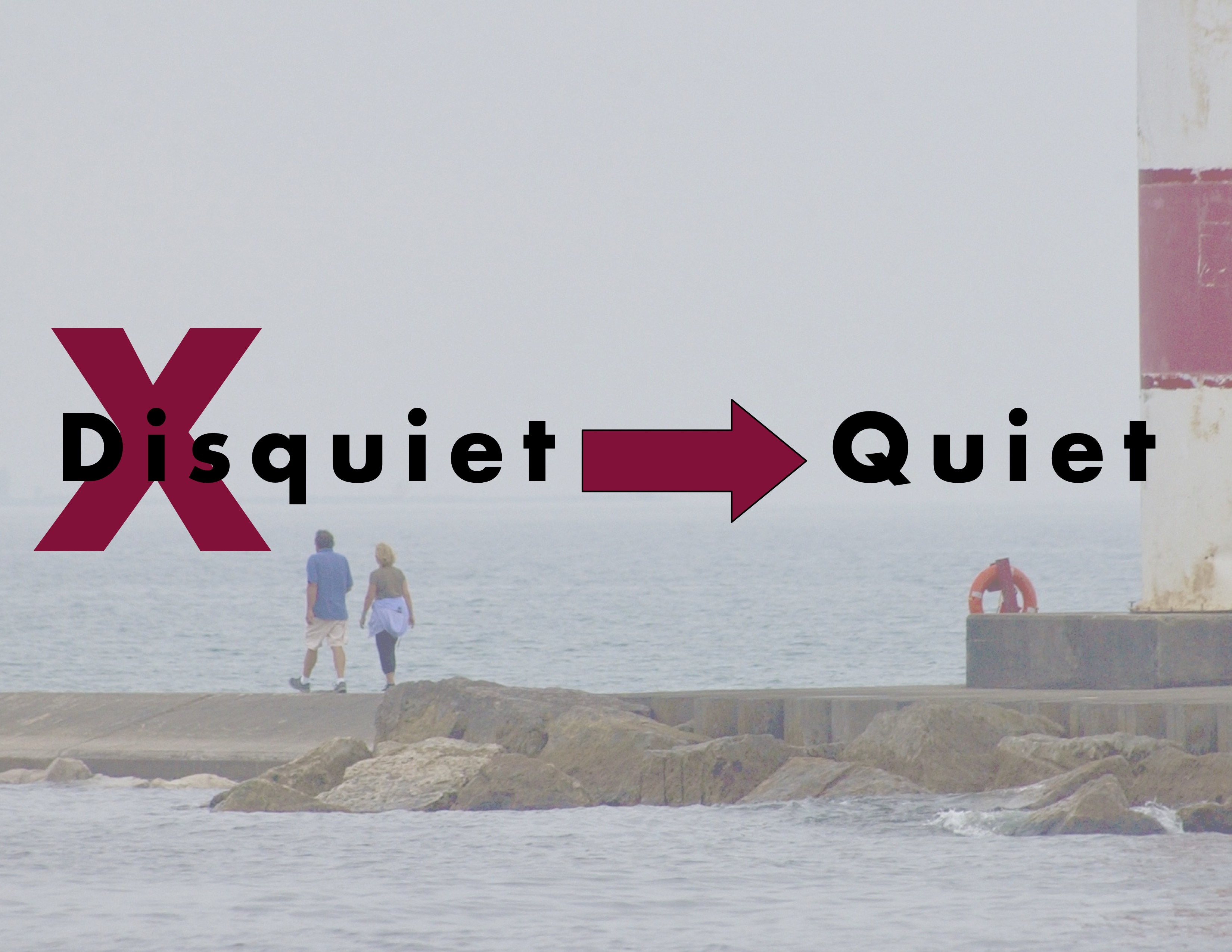
One of the dictionary definitions of anxiety is a feeling of disquiet. All of the conflicting thoughts make it hard to concentrate, the abundance of noise makes it difficult to talk to yourself, let alone talk to God.
I’d like you to consider another psalmist’s words. Look at the first half of Psalm 94:19—
When anxiety was great within me… (NIV)
In the multitude of my anxious thoughts… (AMP)
When doubts filled my mind… (NLT)
The setting of this psalm is one of lots of disquieting voices: a desire to see the wrongdoers punished, listening to arrogant words, getting fed up with boasting words, seeing good people being trampled, hearing foolish words uttered about God (vv. 1-8).
Experiencing anxiety is not sinful, but I do think that we grieve God’s heart when we immediately run to other sources for relief instead of going to our loving Heavenly Father first. After dealing with the disquiet in the opening verses of Psalm 94, the psalmist says, “My anxiety level was sky high!” But then notice how that verse concludes—
…Your consolation brought me joy (NIV)
…Your comforts cheer and and delight my soul (AMP)
…Your comfort gave me renewed hope and cheer (NLT)
Jesus told us about our Comforter who would always be with us (John 14:1, 16-17). A little further on in these same remarks Jesus also said, “These things I have spoken to you, that in Me you may have peace. In the world you will have tribulation; but be of good cheer, I have overcome the world” (John 16:33 NKJV).
I like that phrase, “Be of good cheer.” That phrase is just one word in Greek, and sometimes it’s translated “be of good courage.” In every single instance, it’s only used by Jesus and it’s only used when He comes close to anxious people (Matthew 9:2, 9:22, 14:27; Mark 6:50, 10:49; Luke 8:48; John 16:33; Acts 23:11).
A furious squall battered the boat, almost swamping it. The disciples were—to say the least—disquieted! In their anxious state they notice Jesus peacefully sleeping. They wake Him up with, “Don’t You care that we’re drowning?!” Jesus stands up and says to the storm, “Quiet. Be still.”
Recall that one of the descriptions of anxiety was being disquieted. That prefix dis- means to be separated: our anxiety would seek to distance us from God’s presence, to make us feel like His help is too far away. But when we go to Jesus, He alone can say, “Quiet” to our disquieting thoughts. He can remove the “dis-” and bring us close to Him. Only His peace can X-out the noise of the storm and bring you to a place of quiet rest.
After Jesus said, “Quiet. Be still,” notice this: “…THEN the wind died down and it was completely calm” (Mark 4:39). And the great thing is this: Even if another storm begins disquieting us just a few minutes after the calm, we can go to Him again. There is no limit: We can continually go to the Eternal Source of peace, to the only One who can speak, “Quiet” to our anxious thoughts.
Listen to the podcast of this post by clicking on the player below, and you can also subscribe on Apple, Spotify, or Audible.
I get a little leery when people are advocating for a government that is friendly to Christianity. In biblical history and world history, Christians tend to backslide when things are going smoothly for them.
As the Jews returned from their exile in Babylon, things were going fairly easily for them. And as they had done so many times before, they began to backslide. The Archeological Study Bible noted, “This generation was not guilty of the gross idolatry of its forefathers. Rather, these Israelites embraced a kind of dead orthodoxy, in which they tried to get by with the minimum that their faith required.”
Onto this scene comes a prophet named Malachi. Malachi means “My messenger,” and we don’t know if this was actually the prophet’s name or not, but he took it on as his nature, delivering the heavy words of God. In fact, he held the words of God with such respect that when he says this is “an oracle,” he literally is saying, “This is a heavy burden to bear!”
Malachi uses the phrase “LORD Almighty” (or LORD of Hosts in the KJV, and Lord of Heaven’s Armies in the NLT) twenty-four times. By contrast with the other minor prophets…
Hosea, Joel, Amos, Obadiah, and Jonah use this phrase zero times
Micah and Habakkuk each use it once
Nahum and Zephaniah each use it twice
Haggai uses it 12 times (or 32 percent of the total verses in his book)
Zechariahuses the phrase 46 times (which 22 percent of his total verses)
But Malachi’s 24 times is 44 percent of his total verses! In other words, he wanted his audience to be crystal clear that it wasn’t him who was speaking, but the King of kings was speaking to us through Malachi!
God is still speaking through Malachi to us today! Just like Israel in Malachi’s day, I think Christians today run the very real risk of backsliding. Just like Israel, when we forget the weightiness of the glory of the LORD ALMIGHTY we can begin to slip into an it’s-no-big-deal attitude.
By contrast, when we’re honoring the LORD of Hosts, and reverencing Him, and desirous of His glory being seen, it’s a very big deal that we listen to His voice and closely follow His commands.
So Malachi’s six warnings to the Israelites of his day should still be heeded by Christians today. We should examine ourselves very closely to see if we have the same it’s-no-big-deal attitude. We should ask ourselves, “Are we…
(1) …offering less-than-our-best sacrifices? Are we just giving God the leftovers?”
(2) …listening to church leaders that don’t reverence God’s name?”
(3) …honoring the sanctity of marriage?”
(4) …self-seeking instead of neighbor-loving?”
(5) …withholding the full tithe from our local church?”
(6) …following God only for personal gain?”
(Check out all of the verses for these questions by clicking here.)
If this study of the minor prophets—especially these last three—has told us anything, it’s that God keeps His word. When He says He is coming back as the righteous Judge, that will happen. In fact, it could happen at any moment!
We must be ready! We must guard our hearts against the it’s-no-big-deal attitude. We must reverence our awesome God. The things of God are a very big deal indeed (see Hebrews 10:37-39; Revelation 22:12-16).
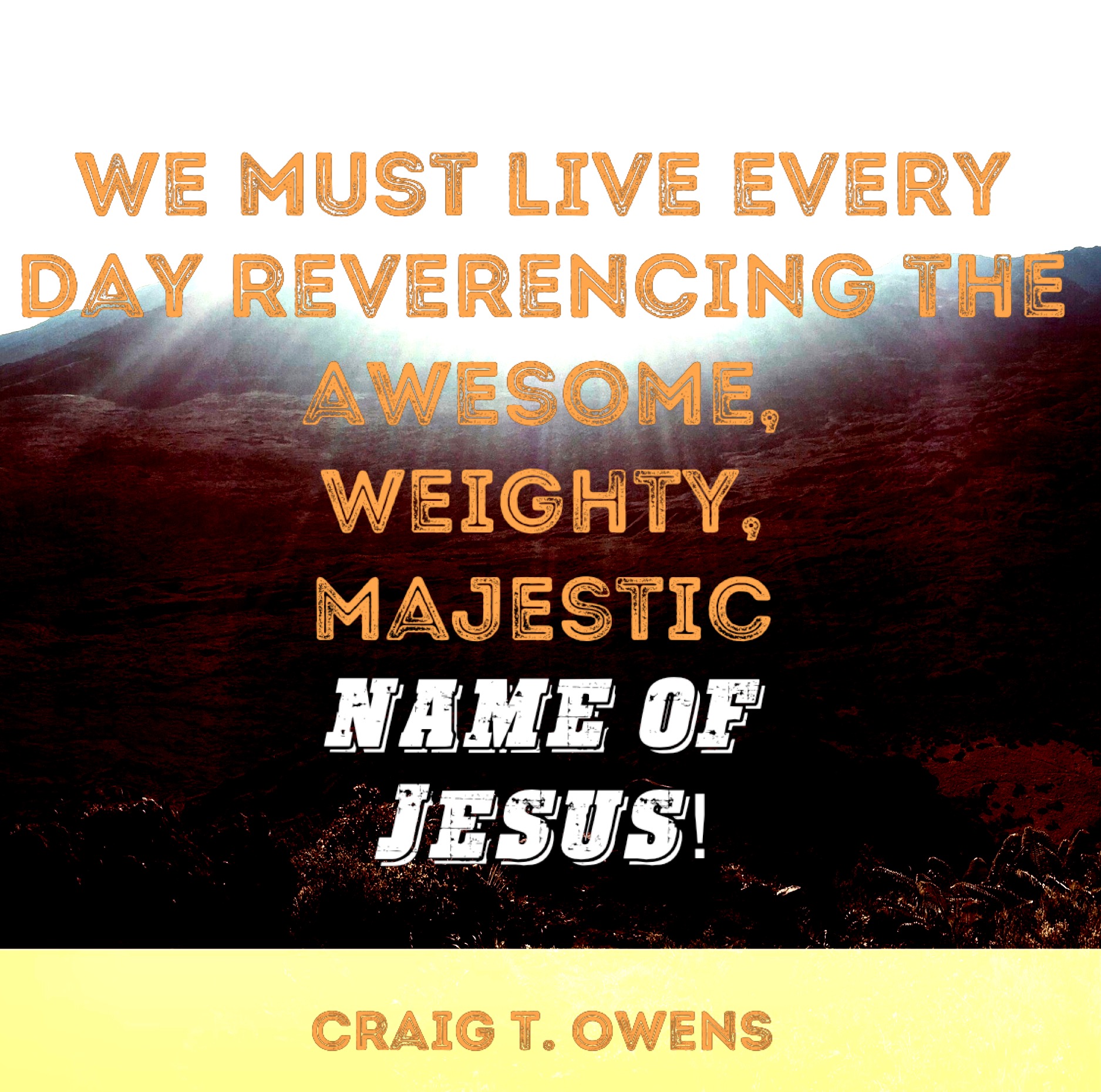
To guard ourselves against this backsliding attitude, we must live every day reverencing the awesome, weighty, majestic name of Jesus!
This is a weekly series with things I’m reading and pondering from Charles Spurgeon. You can read the original seed thought here, or type “Thursdays With Spurgeon” in the search box to read more entries.
Listen to the podcast of this post by clicking on the player below, and you can also subscribe on iTunes or Spotify.
Faith Sees Better Than Sight Does
For we walk by faith, not by sight. (2 Corinthians 5:7)
There is walking by faith, and there is walking by sight. The most of men, all men indeed, naturally walk by sight. They have a proverb that says, ‘Seeing is believing,’ and they are wise men, for they trust people as far as they can see them, and no further. … Self-reliance is the name of the principle, and according to the world, the best and grandest thing that a man can do is have faith in himself. …
I think the world must be pretty well ashamed of itself if it still considers this poor earth to be all that a soul has to live for. I feel as if I could not talk upon the matter. Solomon tried everything there was in this world—riches, power, pleasure—every sort of delicacy and delight he had, beyond the point of satisfaction. And what was his verdict upon at all? ‘Vanity of vanities, all is vanity’ (Ecclesiastes 1:2). …
If there is not another world to live for, I must say that this life is a most unutterably empty kind of thing! It is not worthy of a man! But oh, to believe what God tells me: that there is a God; that God became flesh to bear me up to Himself! To believe that I am God’s son, that I have an immortality within myself that will outlast the stars, that I will one day see His face and sing His praise forever with cherubim and seraphim! Why, there is something here! …
If you walk only by sight and believe only what you see, what do you believe? You believe that while you are living here, it is a good thing to make the best you can of it. And then you will die and be buried, and that will be the end of you! What a poor, miserable, ignorant belief this is! … But when you believe in what God reveals and come to walk by faith, how your information expands! Now riddles are all solved, and the inexplicable is understood! …
The principle of faith does best in the dark. He who walks by faith can walk in the sunlight as well as you can, for he walks with God. He has enlightened eyes, but he can walk in the dark as you cannot, for his light is still shining upon him. He trusts in the unseen and in the invisible, and his soul rejoices when present things are passing away.
The devil’s strategy hasn’t changed. He will try to get you to say, “Woe is me! Look at all of the bad things happening around me!”
But we walk by faith, not by sight. “Faith is the assurance—the confirmation, the title deed—of the things we hope for, being the proof of things we do not see and the conviction of their reality—faith perceiving as real fact what is not revealed to the senses” (Hebrews 11:1 AMP).
Don’t give in to the temptation to believe only what you see. There is so much more waiting for you. It’s all yours by faith in Jesus Christ!
This is a weekly series with things I’m reading and pondering from Charles Spurgeon. You can read the original seed thought here, or type “Thursdays With Spurgeon” in the search box to read more entries.
Listen to the podcast of this post by clicking on the player below, and you can also subscribe on iTunes or Spotify.
Keep Moving Forward
For we walk by faith, not by sight. (2 Corinthians 5:7)
God does not say to us, ‘This is the way,’ and then stop. He says, ‘This is the way, walk in it.’ We are always to be making advances. We are to be going from faith in its beginnings to faith in its perfections, from faith to assurance, from assurance to full assurance. And from there, we are to go to the full assurance of hope to the full assurance of understanding, always forward, waxing stronger and stronger. …
The Christian’s motto is ‘Upward and onward.’ Not as though he has already obtained, either is already perfect, he presses forward to the mark for the prize of his high calling in Christ Jesus. …
Can you perform the common activities of the household and the daily duties that fall to your lot in the spirit of faith? This is what the apostle means. He does not speak about running or jumping or fighting, but about walking—and he means to tell you that the ordinary life of a Christian is different from the life of another man—that he has learned to introduce faith into everything he does.
From Faith Versus Sight
I have a t-shirt that says on the front, “Keep moving forward.” But the back of the t-shirt has the real-life challenge: “Crawling is acceptable. Falling is acceptable. Puking is acceptable. Crying is acceptable. Pain is acceptable. Quitting is not!”
How true!
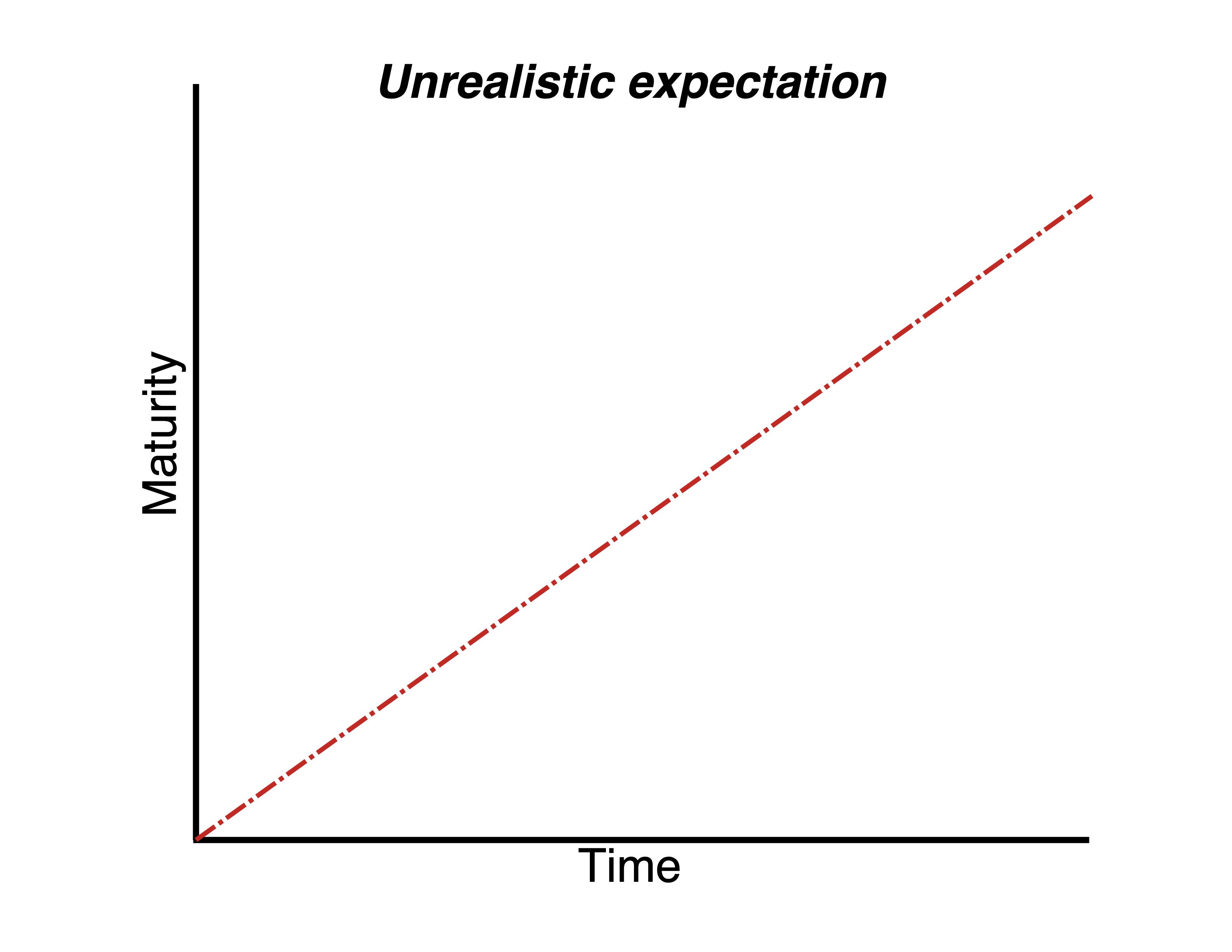
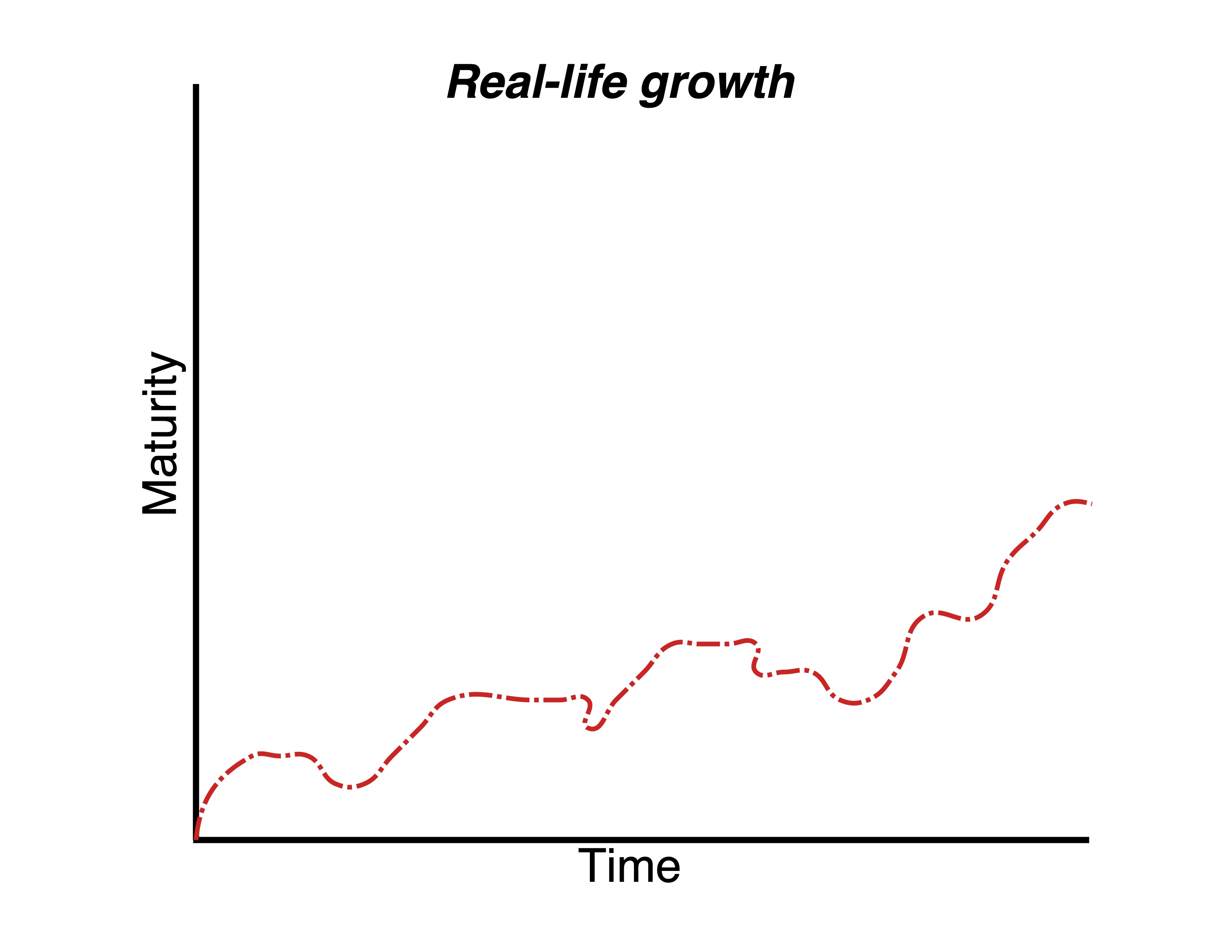
I think the problem for many Christians is that they have an unrealistic expectation of growth. Somehow we’ve come to believe that our Christian growth is a constant upward trajectory to maturity, and that if there are ever any stumbles along the way, that means we’ve blown it. (By the way, Oswald Chambers has some helpful thoughts on our stair-step growth.)
But Paul tells us, “We walk”: We keep moving forward. That doesn’t mean there aren’t times of stumbling, or a plateau, or even a pause to catch our breath. Paul tells us that an important aspect of our walk is that we forget what’s behind us and we keep moving forward—keep walking—keep going.
Every single day, let us say along with Paul, “I don’t mean to say that I have already achieved these things or that I have already reached perfection. But I press on to possess that perfection for which Christ Jesus first possessed me. No, dear brothers and sisters, I have not achieved it, but I focus on this one thing: Forgetting the past and looking forward to what lies ahead, I press on to reach the end of the race and receive the heavenly prize for which God, through Christ Jesus, is calling us” (Philippians 3:12-14 NLT).
My friend, keep moving forward in faith, believing that the Holy Spirit is with you—maturing you, strengthening you—on every single step on your Christian walk.
A recent article called “Soul Watchers” really caught my attention. Here are a few excerpts to whet your appetite…
Elders are called “overseers” and “shepherds” in their relationship to the congregations of the Lord (1 Peter 5:1-3). … Elders were charged with the responsibility of watching over the flocks of the Lord (Acts 20:28), preserving sound doctrine and right practice in the churches (Acts 15:1-6; Titus 1), and, in particular, keeping watch over the souls of God’s people (2 Corinthians 12:15; Hebrews 13:17). …
The elders appointed to serve the churches of the New Testament were called to be shepherds, leading the Lord’s flocks into fuller realization of His Kingdom and promises. In fact, so vital were elders to the churches of the New Testament that Paul insisted that any church that didn’t have elders was to that extent not “in order” (Titus 1:3).
(Check out the bible verses T.M. references in this piece by clicking here.)
This is a weekly series with things I’m reading and pondering from Charles Spurgeon. You can read the original seed thought here, or type “Thursdays With Spurgeon” in the search box to read more entries.
Listen to the podcast of this post by clicking on the player below, and you can also subscribe on iTunes or Spotify.
Walking Preachers
For we walk by faith, not by sight. (2 Corinthians 5:7)
Walking is a position that…signifies activity. You would suppose from the way some Christians deport themselves, that their whole life was spent in meditation. It is a blessed thing to sit ‘with Mary at the Master’s feet.’ But we walk as well as sit. We do not merely learn, but we practice what we know. We are not simply scholars, but, having been taught as scholars, we go on to show our scholarship by working in the vineyard or wherever else the Master may be pleased to place us. …
You would gather indeed from what others say, that the whole life of a Christian is to be spent in prayer. Prayer, it is true, is the vitality of the secret parts of Christian life, but we are not always on our knees! We are not constantly engaged in seeking blessings from heaven. We do continue in prayer, but we are also engaged and showing forth to others the blessings that we have received and in exhibiting in our daily actions the fruits that we have gathered on the mountaintop of communion with God. We walk, and this implies activity. …
‘We walk.’ This is more than some can say. They can affirm, ‘We talk. We think. We experience. We feel.’ But true Christians can say with the apostle Paul, ‘We walk.’ Oh, that we may ever be able to say it too! Here, then, is the activity of the Christian life.
From Faith Versus Sight
Edgar A. Guest captured this idea well in his poem “Sermons We See.” The first stanza says,
I’d rather see a sermon than hear one any day;
I’d rather one should walk with me than merely show the way.
The eye’s a better pupil and more willing than the ear;
Fine counsel is confusing, but example’s always clear.
And the best of all preachers are the men who live their creeds.
For to see the good in action is what everybody needs.
Or as Francis of Assisi noted, “It is no use walking anywhere to preach unless our walking is our preaching.”
So a fantastic question for every Christian to ask themselves is this: Do people know that I’m walking with Jesus even if I never open my mouth to tell them?
Listen to the podcast of this post by clicking on the player below, and you can also subscribe on Apple, Spotify, or Audible.
Have you ever heard this truism: The person with an experience is never at the mercy of the person with an argument?
There are, sadly, many who deny the reality of God’s divine healing for today. They may say God healed in the past, but that age has passed, or they may simply deny all supernatural activity. I have the best reply to these skeptics or deniers—and you may have this same reply: God does heal today; I know this is true because He has healed me!
Our truth statement about this says: “Divine healing is an integral part of the gospel. Deliverance from sickness is provided for in the atonement, and is the privilege of all believers.” Let me break this down into three parts.
(1) “Divine healing is an integral part of the gospel.” After that word “integral” I’d like to insert the word “indisputable.” When God does the miraculous, it is an undeniable proof of His love and power. A great story to prove this point is when Jesus healed a paralytic after He forgave him of his sins (Luke 5:17-26).
Notice how the people responded: Everyone was amazed and gave praise to God. This glory to God has always been the reason God performs miracles (see Mark 6:7-13; Acts 2:43; Acts 3:9-12).
(2) “Deliverance from sickness is provided for in the atonement.” I like to remember that the word atonement means “at-onement” and stands opposed to disease which I like to say as “dis-ease.” Sin is our ultimate dis-ease—the ultimate separator—so Jesus took care of both our spiritual dis-ease and our physical dis-ease when He died on the Cross for us, just as Isaiah prophesied. That’s why the New Testament also shows us salvation and healing frequently being linked together (Acts 10:38; 8:4-8).
(3) “And is the privilege of all believers.”ALL believers, not just a select few and not just those who lived at the time of the first apostles.
Divine healing has been—and always will be—an integral and indisputable part of the gospel precisely because it exalts God as THE Healer.
Many people today still believe what the disciples of Jesus believed: Disease is a consequence of personal sin. In addressing this misunderstanding, Jesus said that disease was “so that the work of God might be displayed” in the life of the one about to be healed. He said something similar while at the graveside of Lazarus, before he raised that dead man back to life (John 9:1-38; 11:4-45).
Sometimes God heals us now, but ALWAYS He heals us in our glorified bodies (2 Corinthians 12:9-10; 5:1-9; Revelation 21:4). Our patience and hope in our future, ultimate healing glorifies God in the present.
By faith in Jesus we can claim that “by His stripes we have been healed” (1 Peter 2:24). The verb tense Peter uses means we have been healed, we are being healed now, and we will be ultimately healed in Christ’s eternal presence. Whether we are healed here or not, we can live knowing that His healing power always brings Him glory and always draws people to Him, so don’t hesitate to keep on asking Him for His healing touch on your body and soul.
Listen to the podcast of this post by clicking on the player below, and you can also subscribe on Apple, Spotify, or Audible.
Haggai appears on the historical scene for just five months, but what a bright light he shines! He is the first of three post-exilic prophets to encourage the Israelites who have returned to Jerusalem.
Before we talk about Haggai’s ministry, we need a brief grammar lesson. Specifically, let’s look at two prefixes: un- and non-. Both of them ultimately mean “not,” but there is a distinction that we need to consider when it comes to the Bible:
unbiblical would mean something contrary to the teaching of the Bible
non-biblical is something that may or may not be correct, but it’s not specifically mentioned in the Bible
Let me give you an example from my book Shepherd Leadership: The Metrics That Really Matter. Chris asked me whether I preferred the title senior pastor or lead pastor. This is a non-biblical issue; that is, it doesn’t really matter to me because neither of those titles are found in the Bible. Technically, the word pastor isn’t in the Bible either. The word that is usually translated “pastor” is really a herdsman or a shepherd.
The problem is that if we put too much focus on non-biblical things, those things can end up becoming unbiblical pursuits. Like when Jesus took the Pharisees to task for their focus on traditions over Scripture (see Matthew 15:1-6). I wrote Shepherd Leadership mainly to get pastors and church leaders to spot non-biblical metrics which may have sneakily turned into unbiblical pursuits, so that they could return to pure biblical principles. In the Preface of my book, I wrote—
“My larger concern is that churches, parachurch organizations, and nonprofit ministries that are largely founded to fulfill a biblical mandate are straying from the simple, freeing truths found in the Bible. Or maybe I should say that they are adding things to their ministries that aren’t in the pages of Scripture. Whichever way you want to say it, the result is the same: We are using the wrong metrics to define ‘success’ for our ministries. I fear that in our focus on unbiblical practices, we are missing the joy of really doing ministry.”
Haggai calls God’s people to return to God’s Word. This is the second-shortest book in the Old Testament (at just 38 verses long), yet Haggai says something like “this is what God says” 28 times in these 38 verses!
Haggai also records five times that God says, “Give careful thought to your ways.” This phrase literally means to take a strong hold on each thought and examine it intensely. This idea is always connected to a phrase like, “This is what the Lord Almighty says” (1:5, 7; 2:14-15, 17-18). In other words, we are to thoughtfully examine our lifestyle with God’s Word being THE standard of measurement.
Paul made a similar connection in the New Testament: We demolish arguments and every pretension that sets itself up against the knowledge of God, and we take captive every thought to make it obedient to Christ (2 Corinthians 10:5).
Jesus did this too. When speaking to the religious leaders, He said, “You are wrong because you know neither the Scriptures nor God’s power” (Matthew 22:29). And even with His own disciples, He had to open their minds to see how the Scriptures pointed to Him and were fulfilled in Him (Luke 24:25-27, 44-45).
Indeed, the phrase “it is written” is used 75 times in the New Testament!
That’s why Haggai’s words still ring true to us today: “Give careful thought” to how you live in light of how God says you should be living. Christians need to…
We must become people of the Word of God or else we run the very real risk of letting our non-biblical decisions spiral downward into a sinful, unbiblical lifestyle that grieves the heart of God.