Does Self-Help Get God’s Help?

This is part 1 in our series looking at phrases that sound biblical and then asking, “Is that in the Bible? 

Statement #1—God helps those who help themselves. Is that in the Bible? No, it is not! 

The reason why I think people have accepted this as biblical is an incorrect view of God. 

  1. Humanism says God is us, which makes us believe, “If it’s going to be, it’s up to me.” 
  2. Fatalism says there is no God and therefore no meaning to life, which makes us believe, “The outcome is what it is and no one has any say in the matter.” 
  3. Deism says there is a God, but it’s hard to get His attention, which makes us believe “He is either disinterested in me or unapproachable. He’s only available for the ‘big’ things.” 

The Bible flat-out rejects all three of these isms. 

Instead, we see a loving, approachable God. One who is both all-powerful and all-loving. He says things like…

  • I made you and know everything about you, and I remain infinitely interested and intimately involved in your life 
  • Come to Me and I will give you rest
  • I want you to cast all your anxieties on Me
  • Don’t be anxious about anything, but tell Me about everything that troubles you (Psalm 139:1-18; Matthew 11:28-29; 1 Peter 5:7; Philippians 4:6)

Not only is “God helps those who help themselves” untrue, but the exact opposite is also true—God helps those who cannot help themselves! 

In Isaiah 40:28-29, we read that God gives strength to the weary and increases the power of the weak. 

“Yes, it is our strength, not our weakness, that is our hindrance and stumbling block.” —Horatius Bonar 

God gives power to the weak. He gives strength to those with no might of their own. God does NOT help those who think they can help themselves! God helps those who cannot help themselves! This is what Jesus came to do, and why we should rejoice in the fact that He does indeed help those who could never rescue themselves (Isaiah 53:4-5; 2 Corinthians 12:9)!

It is our can’ts that God uses as His opportunities to show how limitless He is. Our limitations magnify His love and His power. 

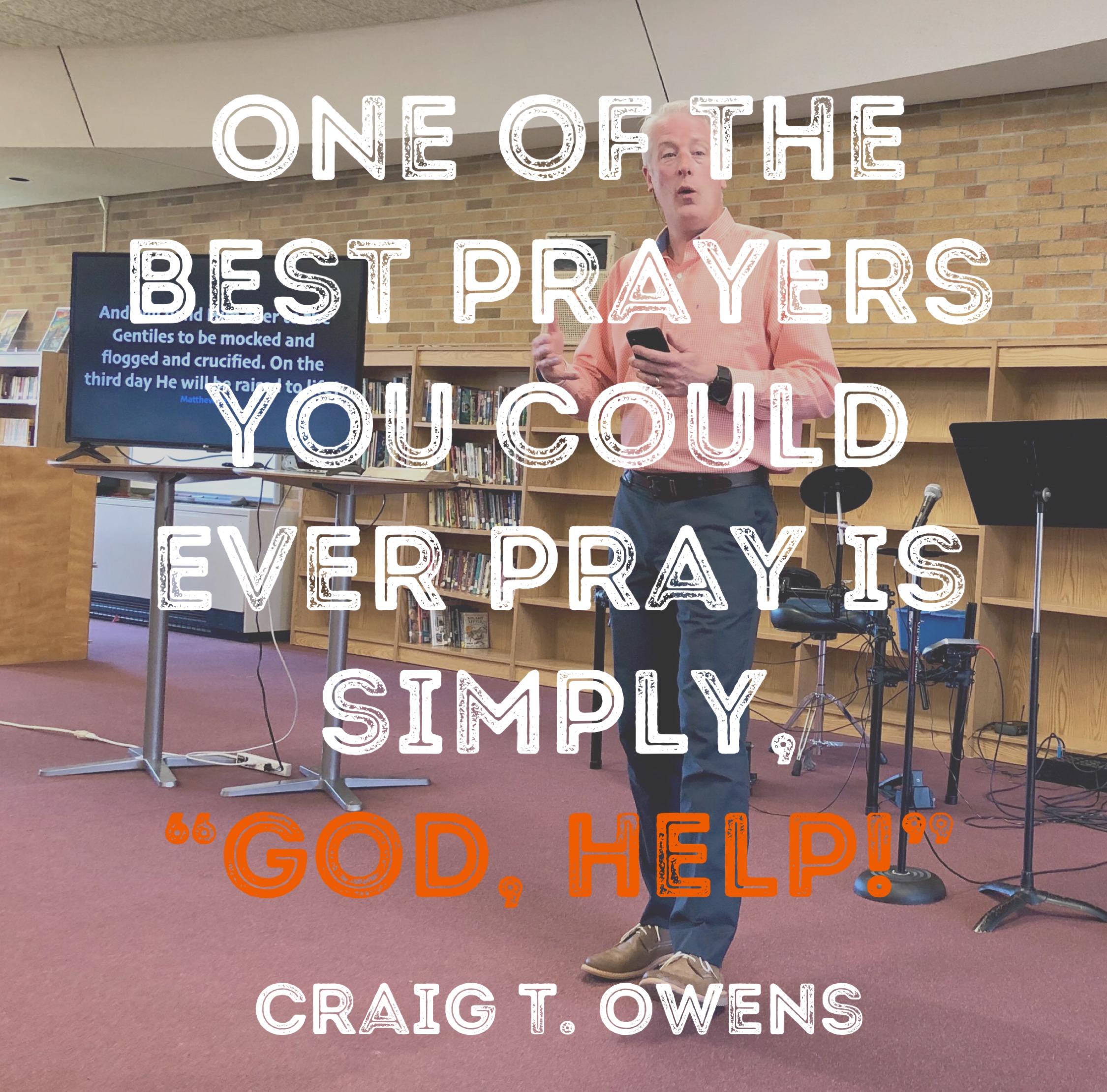
One of the best prayers you could ever pray is simply, “God, help!” This simple prayer acknowledges in just two words that you can’t but He most assuredly can! 

But those who wait for the Lord—who expect, look for, and hope in Him—shall change and renew their strength and power; they shall lift their wings and mount up close to God as eagles mount up to the sun; they shall run and not be weary, they shall walk and not faint or become tired. (Isaiah 40:31 AMP) 

Join me next week as we continue to explore various statements and ask, “Is that in the Bible? 

The Devil’s “Likes”

But you said in your heart, “I will ascend to heaven; I will raise my throne above the stars of God, and I will sit on the mount of assembly In the recesses of the north. I will ascend above the heights of the clouds; I will make myself like the Most High.” —what God said about satan (Isaiah 14:13-14)

“For God knows that in the day you eat from it your eyes will be opened, and you will be like God, knowing good and evil.” —satan (Genesis 3:5)

No wonder, for even satan disguises himself like an angel of light. —what the Apostle Paul said about satan (2 Corinthians 11:14)

Be of sober spirit, be on the alert. Your adversary, the devil, prowls around like a roaring lion, seeking someone to devour. —what the Apostle Peter said about satan (1 Peter 5:8)

Jesus is all reality. He is the All-Sufficient I AM. He knew the end from before the beginning. He is THE King of kings. The devil is only like a king, or like an angel, or like a lion.

The devil can only pretend to have answers. Everything he produces is a counterfeit. No wonder Jesus called him the “father of lies,” since lies are all he has to offer. 

The devil tries to look like God, he tries to lure us to disobey God, he pretends to be what he’s not. So don’t fear his pretend roar. Instead, give yourself completely to God’s care, then you can stand firm against the devil’s attempts to seduce you, and he will be forced to flee from you (James 4:7)!

Thursdays With Spurgeon—Our Fight For Faith

This is a weekly series with things I’m reading and pondering from Charles Spurgeon. You can read the original seed thought here, or type “Thursdays With Spurgeon” in the search box to read more entries.

Our Fight For Faith

     Our faith at times has to fight for its very existence. The old Adam within us rages mightily, and the new spirit within us, like a young lion, disdains to be vanquished; and so these two strong ones contend, till our spirit is full of agony. …

     Christ alone was tempted in all points as we are, though without sin. No one man is tempted in all points exactly like another man, and each one has certain trials in which he must stand alone amid the rage of war, with not even a book to help him, or a biography to assist him—no man ever having gone that way before except that one Man whose trail reveals a nail-pierced foot. He alone knows all of the devious paths of sorrow. Yet even in such byways, the Lord is with us, helping us, sustaining us, and giving us grace to conquer at the close. … 

     So satan, loath to leave a soul, pursues it hotfoot. He will have it back if he can; and often, soon after conversion, there comes a time of dreadful conflict, when the soul seems as if it could not live. … 

     Once, when the tempter had grievously assailed me, I went to see my dear old grandfather. I told him about my terrible experience, and then I wound up by saying, “Grandfather, I am sure I cannot be a child of God, or else I should never have such evil thoughts as these.” 

     “Nonsense, Charles,” answered the good old man. “It is just because you are a Christian that you are thus tempted. These blasphemies are no children of yours; they are the devil’s brats, which he delights to lay at the door of a Christian. Don’t you own them as yours; give them neither house-room or heart-room.” 

From The Autobiography Of Charles Spurgeon

The apostle Peter says our adversary the devil continually prowls around looking for a follower of Jesus that he can devour. This shouldn’t be surprising to us since Jesus said that the devil’s agenda was to steal, kill, and destroy. (See 1 Peter 5:8-9; John 10:10.)

But the apostle Paul also tells us that we aren’t supposed to be unaware of the devil’s schemes. Instead, we are to capture every thought and make them obedient to Jesus (2 Corinthians 10:5). That means, as Spurgeon’s grandfather counseled him, we recognize those evil thoughts as the devil’s brats and don’t allow them to take up room in our house nor our heart. 

Stand firm—those who are in Christ are more than conquerors! 

On Full Display

In the same way, let your good deeds shine out for all to see, so that everyone will praise your heavenly Father. (Matthew 5:16)

Jesus wants Christians to be leaders, to be pacesetting examples. That means that Christian leaders must be comfortable with others carefully watching their lives. 

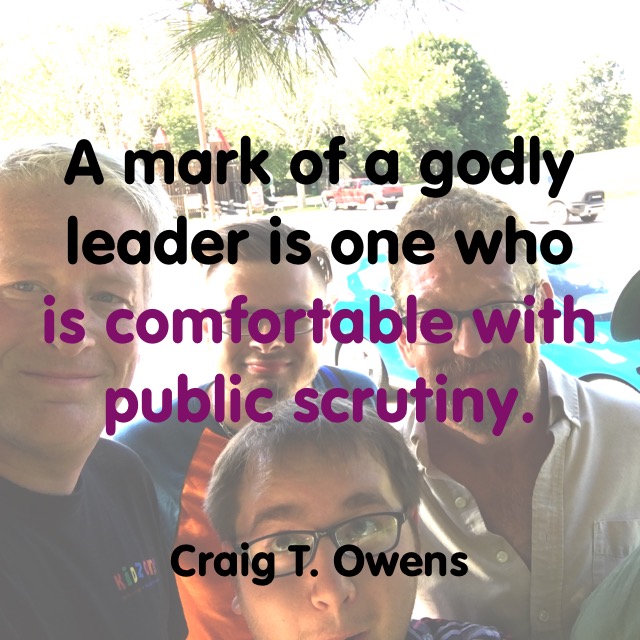
A mark of a godly leader is one who is comfortable with public scrutiny.

“It is bad enough to be blind ourselves. It is a thousand times worse to be a blind guide.” —J.C. Ryle 

“Live an exemplary life among the natives so that your actions will refute their prejudices. Then they’ll be won over to God’s side and be there to join in the celebration when he arrives.” —1 Peter 2:12 MSG 

Sermons must be practiced as well as preached…. If a man teach uprightly and walk crookedly, more will fall down in the night of his life than he built in the day of his doctrine.” —John Owen 

Be a walking, talking, living example of what you preach, in every silent moment of your life, known and unknown; bear the scrutiny of God, until you can prove that you are indeed an example of what He can do.” —Oswald Chambers 

“Behave yourselves wisely—living prudently and with discretion—in your relations with those of the outside world (the non-Christians)…” —Colossians 4:5 AMP

“We hear that some people in your group refuse to work [or are behaving irresponsibly; are living/walking in idleness/disorder]. They do nothing but busy themselves [meddle; interfere] in other people’s lives. We command those [such] people and beg [urge; encourage; exhort] them in the Lord Jesus Christ to work quietly [or settle down] and earn [eat] their own food.” —2 Thessalonians 3:11-12 EXB)

“We should make less excuses for the weaknesses of a Christian than for any other man. A Christian has God’s honor at stake. When a man is regenerated and bears the Name of Christ the Spirit of God will see to it that he is scrutinized by the world, and the more we are able to meet that scrutiny the healthier will we be as Christians.” —Oswald Chambers 

This is part 37 in my series on godly leadership. You can check out all of my posts in this series by clicking here.

My Conscience

…my conscience also bearing me witness in the Holy Spirit (Romans 9:1). 

Conscience is that God-implanted part of a human soul that can distinguish between…

  • …the morally good and the morally bad 
  • …the things that attract God’s presence and the things that repel God’s presence
  • …commending things and condemning things
  • …the things that please the Holy Spirit and the things that grieve the Holy Spirit

Sin corrupts a conscience. Sin tries to blur the lines between good and evil. Sin looks for loopholes. 

Paul said his conscience was aligned with the Holy Spirit—my conscience bearing me witness in the Holy Spirit. 

The word for witness is the Greek word martyreo. Martyreo helps me distinguish because of personal experience OR divine revelation. In the case of a Holy Spirit-baptized Christian, it isn’t OR, it’s AND. Jesus used the same word when He said the baptism in the Spirit would empower His followers to be martyreo (Acts 1:8). 

The Holy Spirit aligns my conscience with God’s righteousness. The Spirit grieves when I fall short, and He rejoices when I obey. 

Following the other uses of martyreo in the New Testament, we can see that a Spirit-aligned conscience…

Can you say with Paul, “My conscience is aligned with the Holy Spirit”? You can if you make it a daily habit to listen for the Spirit’s voice and then obey His promptings. 

Don’t let sin corrupt your conscience, but let the Holy Spirit align your conscience with God’s righteousness. 

Make A Big To-Do Out Of God

“God endows us with gifts so we can make Him known. Period. God endues the Olympian with speed, the salesman with savvy, the surgeon with skill. Why? For gold medals, closed sales, or healed bodies? Only partially.

“The big answer is to make a big to-do out of God. Brandish Him. Herald Him. ‘God has given gifts to each of you from His great variety of spiritual gifts. Manage them well. … Then God will be given glory’ (1 Peter 4:10-11 NLT). 

“Live so that ‘He’ll get all the credit as the One mighty in everything—encores to the end of time. Oh, yes!’ (1 Peter 4:11 MSG). Exhibit God with your uniqueness. When you magnify your Maker with your strengths, when your contribution enriches God’s reputation, your days grow suddenly sweet.” —Max Lucado, in You!

Alien Friendships

As Peter wraps up his letter, he reminds us of his purpose in writing to us aliens and strangers

  • encouraging you = speaking encouraging words to your heart.  
  • testifying that this is the truth = speaking thoughtful words to your head. 

But Peter also says that he wrote this letter “with the help of Silas”—some translations even say “by Silas”—indicating that Peter needed someone to come alongside him with words of encouragement and strength, as much as he needed to deliver those words to fellow Christians. 

Peter mentions three people that were alongside him. These folks are instructive for us too:

  1. Silas 

Peter called Silas a faithful brother. The Greek word he uses for brother is adelphos, a word which usually meant someone who shared the same parents. But Peter modifies this to mean a Christian brother whose heartbeat with the love of Jesus the way his did; someone who shared the same Heavenly Father.  

Silas was a recognized church leader and a companion of Paul (Act 15:22, 30-32, 40). He had quite an extensive and impressive resume, and he also had the full endorsement for such notable people as James, Paul, and Peter. 

  1. She who is in Babylon

Babylon is a code word almost universally agreed to be Rome, but there is some debate as to whom the “she” is. Some think this is the church-in-exile in Rome, and some think this is Peter’s wife (Matthew 8:14; 1 Corinthians 9:5). 

Whether the church or Peter’s wife, they/she are anonymous servants of God, but never for a moment forgotten by God, nor is their reward going to be lacking (Matthew 6:1, 4). 

  1. Mark

Peter calls Mark my son. Again, he takes a word that originally meant “my offspring” and changes it to mean Mark was his protegé. 

Mark had traveled with Paul, then left Paul mid-journey, and was eventually reconciled to Paul (Acts 13:5, 13; 15:36-41; Colossians 4:10; 2 Timothy 4:11). 

Mark listened to and recorded Peter’s accounts of Christ’s earthly ministry and wrote the first Gospel that was produced. His Gospel became one of the main reference documents that Matthew and Luke referred to in writing their Gospels. 

Here’s the point—There are no dispensable people in the Church! 

You may be like Silas with many talents and an impressive resume and references. Or you may be like the “she” who is an anonymous helper to others. Or you may even by like Mark who made mistakes but was given a second chance to make good on your commitment. 

You need a Silas, a she, and a Mark in your life. And you just may need to be one of those to someone else. 

“You can deceive yourself with beautiful thoughts about loving God. You must prove your love to God by your love to your brother; that is the one standard by which God will judge your love to Him. If the love of God is in your heart you will love your brother.” —Andrew Murray 

So let me ask you to consider something vital: Are you remaining faithful to your Christian family? 

If you’ve missed any messages in this series, you may find the complete list by clicking here.

Fight Or Flee?

But you, man of God, flee from all this, and pursue righteousness, godliness, faith, love, endurance and gentleness. Fight the good fight of the faith… (1 Timothy 6:11-12). 

Psychologists tell us that when faced with certain situations our bodies instinctively prepared to fight or flight. Knowing which situations to fight and which to run from are crucial for living a long and productive life. 

It’s no different in the spiritual realm. 

Christian leaders must know which things are worth the fight, and which things they simply must flee. To flee from things we should fight shows a lack of courage. But to try to fight the things we should run from shows a lack of wisdom. 

A mark of a godly leader is one who knows what to fight and what to flee.

Three things you must FIGHT for…

  1. …the purity of the true faith (1 Timothy 6:12; Jude 1:3)
  2. …the disempowered (Proverbs 31:8-9; Matthew 21:12-13)
  3. …the devil (1 Peter 5:9; James 4:7; Ephesians 6:11) 

Three things you must FLEE from…

  1. …idolatry (1 Corinthians 10:14)
  2. …sexual sin (1 Corinthians 6:18; Genesis 39:12)
  3. …earthly riches (1 Timothy 6:9-11)

Don’t try to fight the things you must flee from, and don’t run away from the things you must fight for. Pray for God’s wisdom to know which is which. 

This is part 29 in my series on godly leadership. You can check out all of my posts in this series by clicking here.

Battle Ready

The Bible says that satan prowls around like a lion, looking for an opening to devour Christians. Are you battle ready? The Apostle Peter gives us all of the battle preparation that we will need to be victorious!

One of the most important things we need to do is prepare ourselves before the battle even begins. Peter lists two key components: (1) self-control and (2) alertness (1 Peter 5:8-11). 

This Greek word for self-control is only used six times in all of the New Testament. Peter uses it three times in his first epistle, and the Apostle Paul also uses the word three times. It’s amazing to see the similarity in uses between the two of them. 

Both apostles use self-control in the context of the value of prayer (1 Thessalonians 5:6, 8; 1 Peter 4:7). In other words, Christians don’t wear armor to fight; they wear armor to pray. We have to be self-controlled enough to stick to the business of prayer. 

Restraining prayer, we cease to fight 
Prayer makes the Christian’s armor bright 
And satan trembles when he sees 
The weakest saint upon his knees. —William Cowper

Then both apostles use the Greek word for self-control in the context of using God’s Word as a spiritual weapon (2 Timothy 4:1-5; 1 Peter 1:10-13). Jesus used this same strategy in his battle in the desert against satan (Matthew 4:1-10)—Jesus was praying before the devil came to tempt Him, and then He defeated the devil’s temptations by quoting Scripture. 

Peter says the devil “prowls around like a roaring lion.” Notice that important word: like. The devil has always been an imitator—trying to be like God, he was expelled from Heaven, and then he deceived Adam and Eve by telling them they could be like God too. He’s using the same strategy now. 

Augustine pointed out, “Christ is called a Lion because of His courage; the devil because of his ferocity. The Lion comes to conquer, the other to hurt.” 

So Peter encourages us to “resist him, standing firm in the faith.” You resist the devil when you… 

  • …stay submitted to God 
  • …remember the blood of the Jesus—THE Lion of Judah—that won your victory 
  • …stay self-controlled in prayer
  • …remain alert in the Scriptures

Ask the Holy Spirit to keep you battle ready by helping you to develop the self-control and alertness you need. 

If you’ve missed any messages in this series, you may find the complete list by clicking here.

Alien Anxiety

“A recent survey of primary care physicians in the United States revealed that at least one-third of office visits were prompted by some form of anxiety.” —Lanny Hunter & Victor Hunter 

The Greek word for anxiety means to be pulled in different directions. In the context of “Aliens and Strangers,” it means being pulled between Earth’s way and Heaven’s way. Other biblical definitions for anxiety that the Amplified Bible brings out include—

  • being perpetually uneasy…about your life (Matthew 6:25) 
  • a troubled mind unsettled, excited, worried, and in suspense (Luke 12:29) 
  • drawn in diverging directions, his interests are divided and he is distracted from his devotion to God (1 Corinthians 7:34) 

Unchecked anxiety can negatively impact our physical, emotional, mental, and even spiritual health, so it’s imperative—if we are going to live differently than Earthlings—that Christians handle their anxiety in an alien way. 

Peter gives us an alien response to our feelings of worry and anxiety—

Cast all your anxiety on [Jesus] because He cares for you. (1 Peter 5:7)

Notice that Peter doesn’t say, “Don’t be anxious,” but he does say, “Here’s what to do with your anxiety.” Being anxious is not a sin, but hanging on to your anxiety may cause you to behave in a sinful way. 

So what do we do with our anxiety? In a word cast it off—throw it somewhere else! The verse tense here means it’s something we must keep on doing, so Peter is really saying keep on casting your anxiety on Jesus. 

Why can we keep on casting our anxieties on Jesus? Because He cares for you. Jesus has taken charge of your care; He’s made it His goal that you aren’t missing out on the abundant life He paid for! This verb is in what’s called the indicative mood. That means it is something that has happened in the past, and it is happening now, and it will continue to happen forever and ever! 

Even if you cast an anxiety on Jesus 30 seconds earlier, you can do it again right now because that’s how much He cares for you! 

At the risk of oversimplifying it, here is the prescription for anxiety in four steps: 

  1. Recognize that you are anxious—admit it to yourself and to God. 
  2. Remind yourself that Jesus cares for you. 
  3. Reject your anxieties by counteracting your worry with God’s truth—I like to read something like Psalm 23.
  4. Repeat steps 1-3. 

“Your natural tendency when you’re feeling anxious is to focus on yourself and your problems. The more you do this, the more you forget about Me and all the help I can supply. This worldly focus only increases your anxiety! Let the discomfort you feel at such times alert you to your neglect of Me. Whisper My Name, and invite Me into your difficulties. … A problem-preoccupation makes you anxious. So I urge you to cast all your anxiety on Me—trusting that I care for you. You may have to do this thousands of times daily, but don’t give up! Each time you cast your worries and concerns on Me, you are redirecting your attention from problems to My loving presence.” —Sarah Young, in Jesus Always 

Join me next week as we continue our series called Aliens and Strangers. If you’ve missed any messages in this series, you may find the complete list by clicking here.