This is a weekly series with things I’m reading and pondering from Charles Spurgeon. You can read the original seed thought here, or type “Thursdays With Spurgeon” in the search box to read more entries.
Listen to the podcast of this post by clicking on the player below, and you can also subscribe on iTunes or Spotify.
Our Daily Doctrine Of Experience
[God] alone is my rock and my salvation (Psalm 62:2).
Doctrine is nothing unless it is proved in our experience. Most of God’s doctrines are only to be learned by practice—by taking them out into the world and letting them bear the wear and tear of life. …
Think how many enemies you have. How many rivers you have to cross, how many mountains to climb, how many dragons to fight, how many lions’ teeth to escape, how many fires to pass through, how many floods to wade. … Can your salvation be of anything except God? …
I beseech you, remember this. I hope you know it by experience in the past, but try to remember it in the future—wherever you go, ‘Salvation is of the Lord.’ Do not get to looking at your heart; do not get to examining to see whether you have anything to recommend you; just remember, salvation is of the Lord. ‘He alone is my rock and my salvation.’ …
I say, Christian, your highest and noblest experience is not to be groaning about your corruption, is not to be crying about your wanderings, but is to say, ‘With all my sin and care and woe, His Spirit will not let me go.’ ‘Lord, I believe; help my unbelief!’ (Mark 9:24). …
Now we must have the great duty. The great duty is this: If God only is our rock and we know it, are we not bound to put all our trust in God, to give all our love to God, to set all our hope upon God, to spend all our life for God, and to devote our whole being to God? … Trace your mercies to God and say perpetually, ‘He alone is my rock and my salvation.’
From God Alone The Salvation Of His People
If you will look through the pages of the Bible, you will see that people struggled when they forgot what God had done for them and therefore they began to take matters into their own hands. In the Old Testament, the prophets called this idolatry and adultery; in the New Testament, Jesus called this a lack of faith.
An old hymn reminds us:
Oh, to grace how great a debtor
Daily I’m constrained to be!
Let Thy goodness, like a fetter
Bind my wandering heart to Thee
Prone to wander, Lord, I feel it
Prone to leave the God I love
Here’s my heart, Oh, take and seal it
Seal it for Thy courts above (Robert Robinson, Come Thou Fount)
I think this is the reason why Jesus taught us to pray, “Give us today our daily bread.” We need to be perpetually reliant on God’s grace—a perpetual debtor. This posture reminds us, “He alone is my rock and my salvation,” and guards us against the spirit of self-reliance that would lead us astray.
Let our doctrine be proven in our daily experience of coming to God as our one and only Source again and again and again.
In our justice system, rarely will a judge allow hearsay testimony to be introduced in court. But there is one notable exception: a dying declaration.
A dying declaration is the statement of a mortally injured person who is aware he or she is about to die. This statement is admissible testimony in court on the theory that a dying person has no reason not to tell the truth.
Jesus was nailed to a Cross. Mortally injured, unable to escape, He had no reason to lie. In His dying moments, struggling to get enough air in His lungs to be able to speak, Jesus choked out seven statements that still have a profound impact on us today.
Here are the confessions of Jesus we have discussed:
Listen to the podcast of this post by clicking on the player below, and you can also subscribe on Apple or Spotify.
To some who were confident of their own righteousness and looked down on everybody else, Jesus told this parable: “Two men went up to the temple to pray, one a Pharisee and the other a tax collector. The Pharisee stood up and prayed about himself: ‘God, I thank You that I am not like other men—robbers, evildoers, adulterers—or even like this tax collector. I fast twice a week and give a tenth of all I get.’
“But the tax collector stood at a distance. He would not even look up to heaven, but beat his breast and said, ‘God, have mercy on me, a sinner.’
“I tell you that this man, rather than the other, went home justified before God. For everyone who exalts himself will be humbled, and he who humbles himself will be exalted.” (Luke 18:9-14)
I think the NIV footnote on verse 11 is the most accurate rendering of “the Pharisee stood up and prayed about himself.” The footnote says, “He prayed TO himself.” He made himself God, which, if you will recall, is exactly how satan tempted Adam and Eve—you will be like God (Genesis 3:5).
In a portion of William Cowper’s poem Truth, he addresses the pride of the Pharisee, and warns us that this could be our pride too if we aren’t carefully guarding our hearts.
Who judged the Pharisee? What odious cause
Exposed him to the vengeance of the laws?
Had he seduced a virgin, wrong’d a friend,
Or stabb’d a man to serve some private end?
Was blasphemy his sin? Or did he stray
From the strict duties of the sacred day?
Sit long and late at the carousing board?
(Such were the sins with which he charged his Lord.)
No—the man’s morals were exact. What then?
‘Twas his ambition to be seen of men;
His virtues were his pride; and that one vice
Made all his virtues gewgaws [gyoo-gaws] of no price;
He wore them as fine trappings for a show,
A praying, synagogue-frequenting beau.
The self-applauding bird, the peacock, see—
Mark what a sumptuous Pharisee is he!
Meridian sunbeams tempt him to unfold
His radiant glories, azure, green, and gold:
He treads as if, some solemn music near,
His measured step were govern’d by his ear;
And seems to say—“Ye meaner fowl give place;
I am all splendour, dignity, and grace!”
Not so the pheasant on his charms presumes,
Though he, too, has a glory in his plumes.
He, Christian-like, retreats with modest mien
To the close copse or far sequester’d green,
And shines without desiring to be seen.
The plea of works, as arrogant and vain,
Heaven turns from with abhorrence and disdain;
Not more affronted by avow’d neglect,
Than by the mere dissembler’s feign’d respect.
What is all righteousness that men devise?
What—but a sordid bargain for the skies!
But Christ as soon would abdicate His own,
As stoop from heaven to sell the proud a throne.
When the writer of Hebrews says that we can approach the throne of grace boldly, it is clear that it is not because of our righteous deeds, even if they are as exacting and as perfect as a Pharisee. We can only come boldly into God’s presence because we come in the name and the righteousness of Jesus. “I tell you that this man, rather than the other, went home justified before God.”
Adding “in Jesus name” to the end of our prayers isn’t a password that opens the storeroom of Heaven, but it is a reminder that we have nothing in ourselves to commend us to God. We come boldly only in Jesus.
Listen to the podcast of this post by clicking on the player below, and you can also subscribe on Apple or Spotify.
In The Problem of Pain, C.S. Lewis writes, “Suffering is not good in itself. What is good in any painful experience is, for the sufferer, her submission to the will of God, and, for the spectators, the compassion aroused and the acts of mercy to which it leads.” This sentiment was never more fully displayed than in the lives of the ten Boom family. Corrie ten Boom relates her story in The Hiding Place.
The ten Boom family had lived in Holland for a couple of generations at the time the Germans occupied their country during World War II. Immediately, their family home and watch repair shop became a hub for underground resistance activity. But the start of this war was not the start of their compassionate activity in their city. The ten Booms lived out their Christian faith in tangible, compassionate ways every single day, and their neighbors reaped the benefits.
The entire ten Boom family was actively involved in the efforts to protect at-risk people during the Nazi oppression of their country, including the elderly and sick, their Jewish neighbors, the mentally disabled, and the young men that were being pressed into duties to support the German war effort. As The Hiding Place progresses, the story begins to zoom-in on two sisters: Betsie and Corrie, especially their activities inside the German prisons and concentration camps in which they were imprisoned.
The miracles that God performed for these women are too many to recount here, but it seems like hardly a page in the story passes before another miracle is seen. These Christian women took full advantage of each miracle and used them to continue to bring light and love into one of the most dark and hateful times in human history. Even after the war has ended and Corrie has returned to her Holland home, the ministry of healing, forgiveness, and reconciliation continued unabated through her tirelessly loving activities.
The Hiding Place is truly a heroic tale! I highly recommend parents and grandparents reading it aloud to their children and grandchildren. May all Christians follow the example of the ten Boom family in finding ways to daily share the love of Jesus to their neighbors-in-need.
Listen to the podcast of this post by clicking on the player below, and you can also subscribe on Apple or Spotify.
Some really silly guys did a series of videos called “Neature Walk” because they wanted to share how neat is nature! In episode one Vic sees a tree that he really likes and says, “Score! This is an aspen tree. You can that it’s an aspen tree because of the way it is.” This is either circular reasoning or an obvious statement. “Just look at this thing. You can tell it’s this thing because it looks and acts like this thing.”
I feel a lot like this when I look at the first part of our third foundational truth statement: “We believe in the Deity of the Lord Jesus Christ.” (As a side note, I covered the second part of this statement—“As God’s Son, Jesus was both human and divine”—in another post, which you may find here.)
Check this out: the definition for Deity is the divine character of God, and the definition for divine means things relating to the Deity. In saying we believe Jesus is God we are really saying, “You can tell that Jesus is God because of the way He is.”
In order to make this definition work, we need evidence for both the divinity and the deity of Jesus. That being said, let me remind you of J. Warner Wallace’s instruction on faith. There is:
Blind faith—believing in something without evidence
Unreasonable faith—believing in something in spite of the evidence
Reasonable faith—believing in something because of the evidence
Here is some evidence that I think makes it reasonable to believe that Jesus is divine:
Virgin birth—Isaiah 7:14; Luke 1:34-35; Matthew 1:22-23
Sinless life—Isaiah 53:4-6, 9; Hebrews 7:26-27; 1 Peter 2:22
I think the best evidence for the Deity of Jesus is the connection He Himself made between the “Jehovah” titles of the First Testament and His “I AM” statements in the Second Testament:
Jehovah Jireh (I Am Your Provider) → I am the Bread of Life (John 6:35)
Jehovah Rapha (I Am Your Healing) → I am the Resurrection and the Life (John 11:25-26)
Jehovah Nissi (I Am Your Source) → I am the Vine (John 15:5)
Jehovah Shalom (I Am Your Peace) → I am the Light of the world (John 8:12)
Jehovah Raah (I Am Your Shepherd) → I am the Good Shepherd (John 10:11)
Jehovah Sabaoth (I Am Your Wall Of Protection) → I am the Gate (John 10:9)
Jehovah Tsid-kenu (I Am Your Righteousness) → I am the Way, Truth, and Life (John 14:6)
Jehovah Shammah (I Am Here) → I am the Alpha and Omega (Revelation 1:8; 22:13).
We cannot claim that Jesus was born of a virgin, or lived a sinless life, or did miracles, or died and rose again and then not believe He is God. We cannot pick and choose the parts of Jesus we want.
The apostle Paul reminded us that someday “at the name of Jesus every knee should bow, in heaven and on earth and under the earth, and every tongue acknowledge that Jesus Christ is Lord, to the glory of God the Father” (Philippians 2:11-12).
Every knee will bow to Him one day: Either in worship of Jesus their Savior, or in abject terror of Jesus their Judge.
I pray that you believe in Jesus as your Lord and Savior today… don’t wait another moment!
This is a weekly series with things I’m reading and pondering from Charles Spurgeon. You can read the original seed thought here, or type “Thursdays With Spurgeon” in the search box to read more entries.
Listen to the podcast of this post by clicking on the player below, and you can also subscribe on iTunes or Spotify.
Security
[God] alone is my rock and my salvation (Psalm 62:2).
I do not reckon that is salvation that regenerates me and then puts me in such a position that I may fall out of the covenant and be lost. I cannot call that a bridge that only goes halfway over the stream. I cannot call that salvation that does not carry me all the way to heaven, wash me perfectly clean, and put me among the glorified who sing constant hosannas around the throne. …
Do I live to God a holy life? It is not I, but Christ who lives in me. Am I sanctified? I did not sanctify myself. God’s Holy Spirit sanctifies me. Am I weaned from the world? I am weaned by God’s chastisements. Do I grow in knowledge? The great Instructor teaches me.
From God Alone The Salvation Of His People
A few months ago I began designing a series of graphics under the heading, “Says who?” I took some of the lies of satan and put them side-by-side with the truth from God’s Word.
When God is our Savior, we are secure. The devil would love to make us think that our salvation is hanging by a thread, that we have to work harder to make sure we don’t miss out, that a single sin can disqualify us from God’s favor, and a hundred other lies. But they are all just that: lies!
We have to learn to capture each of these thoughts, and if they are thoughts that don’t align with God’s Word, then we need to confront them with the truth. I have found it very helpful to speak these truths out loud. To see some of the ways I suggested thinking differently about the devil’s lies, check out this post on reversing your thinking.
As the old hymn says, “Jesus paid it all, all to Him I owe.” You don’t have to earn your salvation or make your position secure—your salvation has been paid-in-full and you are perfectly secure! Now what you owe to Jesus is to allow Him to take you safely home.
Listen to the podcast of this post by clicking on the player below, and you can also subscribe on Apple or Spotify.
Amaziah did what was right in the eyes of the Lord, but not wholeheartedly (2 Chronicles 25:2).
Notice the contradictions in Amaziah’s life and leadership:
✅obeyed God’s law (v. 4)
🚫disobeyed God’s law (v. 14)
✅trusted that God would give success to the army of Judah (v. 5)
🚫supplemented his army with mercenaries from Israel (v. 6)
✅listened to the prophet God sent to him (vv. 7-10)
🚫ignored the prophet God sent to him (vv. 15-16)
✅trusted God (vv. 9-10)
🚫turned to idols (v. 14)
Sadly, the “not wholeheartedly” leader usually ends up just like other leaders that God calls “evil” (vv. 22-24, 27).
Bottom line: there is no such thing as a halfway leader in God’s eyes. There is only following God or rebelling against God—all leaders must choose one or the other.
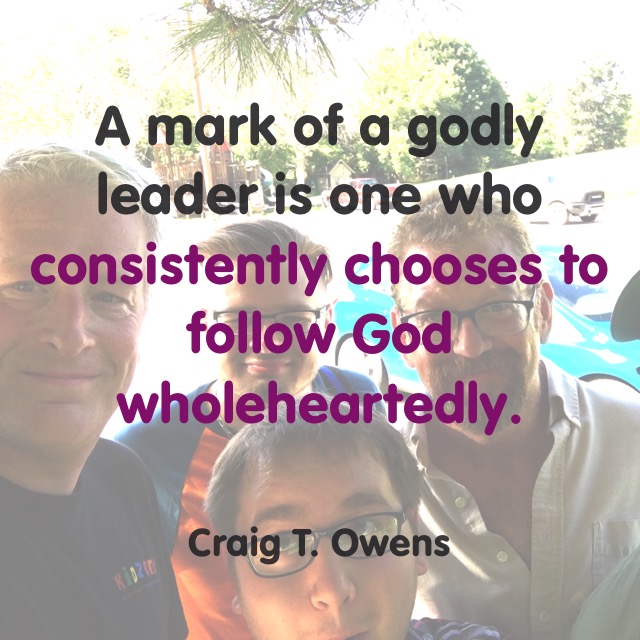
A mark of a godly leader is one who consistently chooses to follow God wholeheartedly.
This is part 55 in my series on godly leadership. You can check out all of my posts in this series by clicking here.
Check out this episode and subscribe on YouTube so you can watch all of the upcoming episodes. You can also listen to our podcast on Spotify and Apple.



 I will not be dissuaded from my view









 Craig T. Owens