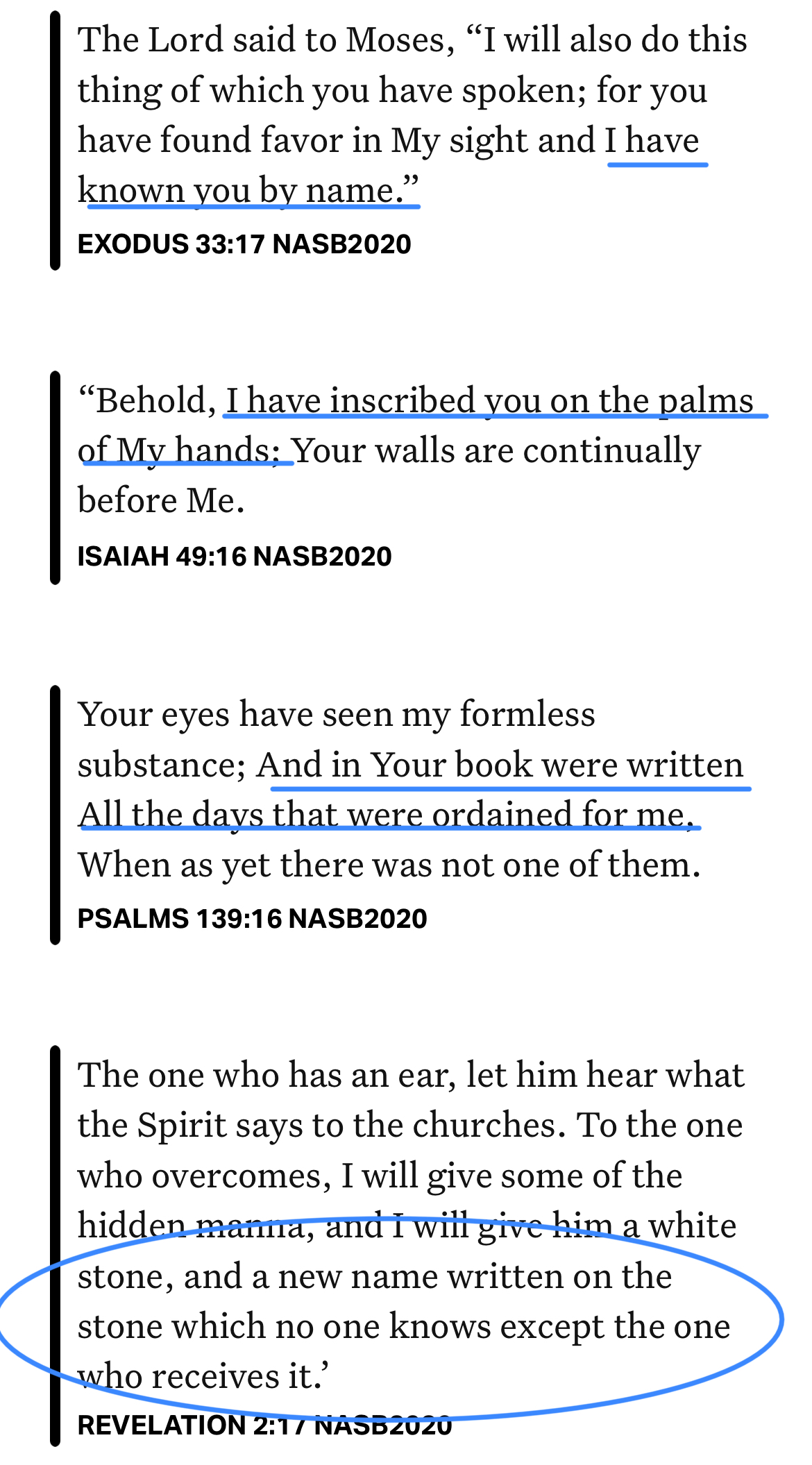
Names convey character traits, honoring of the past, and hopes for the future. God knows all of our days and how our name will be remembered at each pivotal moment of our lives (Psalm 139:16). Our names are lovingly tattooed on His hands so He always sees them (Isaiah 49:16).
God not only knows and uses the name our parents have given us, but He has a name for each of us that only He knows. When we get to Heaven, He will reveal to each of us the unique name He has for us (Revelation 2:17).
Listen to the podcast of this post by clicking on the player below, and you can also subscribe on Apple, Spotify, or Audible.
We’ve made it to the top step after a long climb. We’ve arrived! But arrived for what? Not for taking it easy, but for serving.
Jesus was at the top, and consider what He did with that position:
He laid aside His prerogatives as God to serve us—Philippians 2:6-8
He demonstrated this by becoming a servant of the servants—John 13:3-5
He said, “For who is greater, the one who is at the table or the one who serves? Is it not the one who is at the table? But I am among you as One who serves.” (Luke 22:27)
We strive for the top not to be served, but to serve. This is why the final Song of Ascent addresses those at the top as “servants of the Lord” (Psalm 134:1).
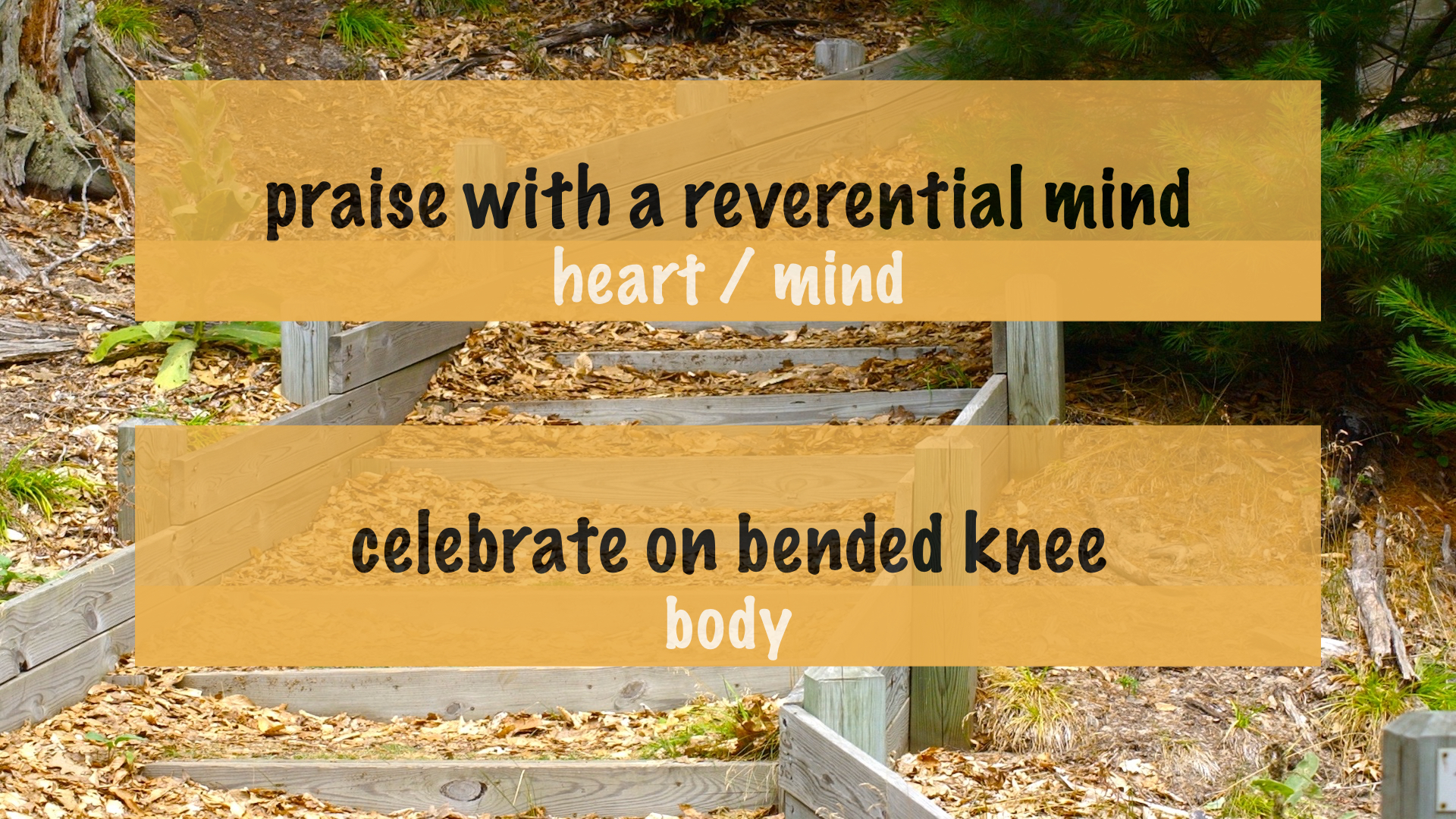
The first duty of the servants is to praise (2x in vv. 1, 2). The KJV actually renders this word “bless,” which I believe is a good way for us to think about this. The word means:
praise God with a reverential mind and
celebrate God on bended knee
In other words, both our heart and our body need to be in a posture of a praising servant. In the Septuagint, the word used for praise / bless is eulogeo, which means to say good words. In putting the two parts of the definition together, it mean we aren’t grumbling about our service (like “I have to do this”), but we are thankfully and worshipfully serving (as in “I get to do this!”).
These servants are called to “minister…in the house of the Lord [and] in the sanctuary” (134:1-2), just as the priests in the tabernacle (1 Chronicles 9:33; Leviticus 6:13; 24:2, 4).
This blessing and serving is itself a blessing which unlocks even more blessing. The final words of the final Song of Ascent is a prayer request (notice the word “may” in v. 3).
The word bless in this final is the same word translated praise in vv. 1-2, except here the form of the verb means “to be shown divine favor”!
We don’t get blessed by God because we have blessed God, but we bless God because He has already blessed us. I don’t command His blessing, but I bless Him in recognition of the blessing that continually flows from Him to me.
To word minister as in v. 1 means to:
endure all hardships
continue until the task is done
cause or help others to stand too
God loves to bless people who love to bless people!
As long as we’re here, keep blessing and serving others as your act of worship to God. Say good words to people about God and say good words to God about people. Lift up your hands, fall on your knees, sing out loud, or worship quietly in your heart. But keep on serving like Jesus. All of this blesses God.
Your final and eternal reward in the Heavenly Zion is coming and it is beyond compare—
It will be good for those servants whose Master finds them watching when He comes. Truly I tell you, He will dress Himself to serve, will have them recline at the table and will come and wait on them. It will be good for those servants whose Master finds them ready, even if He comes in the middle of the night or toward daybreak. (Luke 12:37-38)
In blessing others, we are blessing the God who has already blessed us and who longs to bless us for all of eternity!
If you’ve missed any of the messages looking at the fifteen Songs of Ascent, you can find them all here.
I have lots of new content every week, which you can check out on my YouTube channel.
“Dad always said you could fall off the same ladder you climbed up.” —Hank Aaron
Paleontologists have noted that what Creationists would call pre-Flood mammals lived longer than similar mammals today. “This research should be of interest to Bible-believing Christians because, as chronicled in Genesis 5, humans in the pre-Flood world were experiencing much greater lifespans. Moreover, the advanced ages of the Genesis 5 patriarchs at the births of their sons strongly suggest delayed sexual maturation and possible delayed skeletal maturation, too. The Bible gives no hint that this amazing longevity was in any way supernatural.”
“If we leave our failure, we don’t learn from our failure. If we learn from our failure, we seldom have to leave because of our failure.” —John Maxwell
Dr. Steve Nichols hosts a great podcast called 5 Minutes In Church History. In the episode this week, he talked about the church politics Jonathan Edwards had to confront when he first arrived in Stockbridge. It came to a head in a letter Edwards received: “All it did was go into, again, politics, accusing Edwards of mis-running the school, which wasn’t true, and deflecting the blame and the focus away from the Williams family. And now Edwards needs to vindicate himself. Well, all that to say, we think of these church history figures, and we see their portraits, we sometimes forget that they’re actually people, and they had to deal with challenges too.” These types of faultfinding accusations are what I address in my book When Sheep Bite.
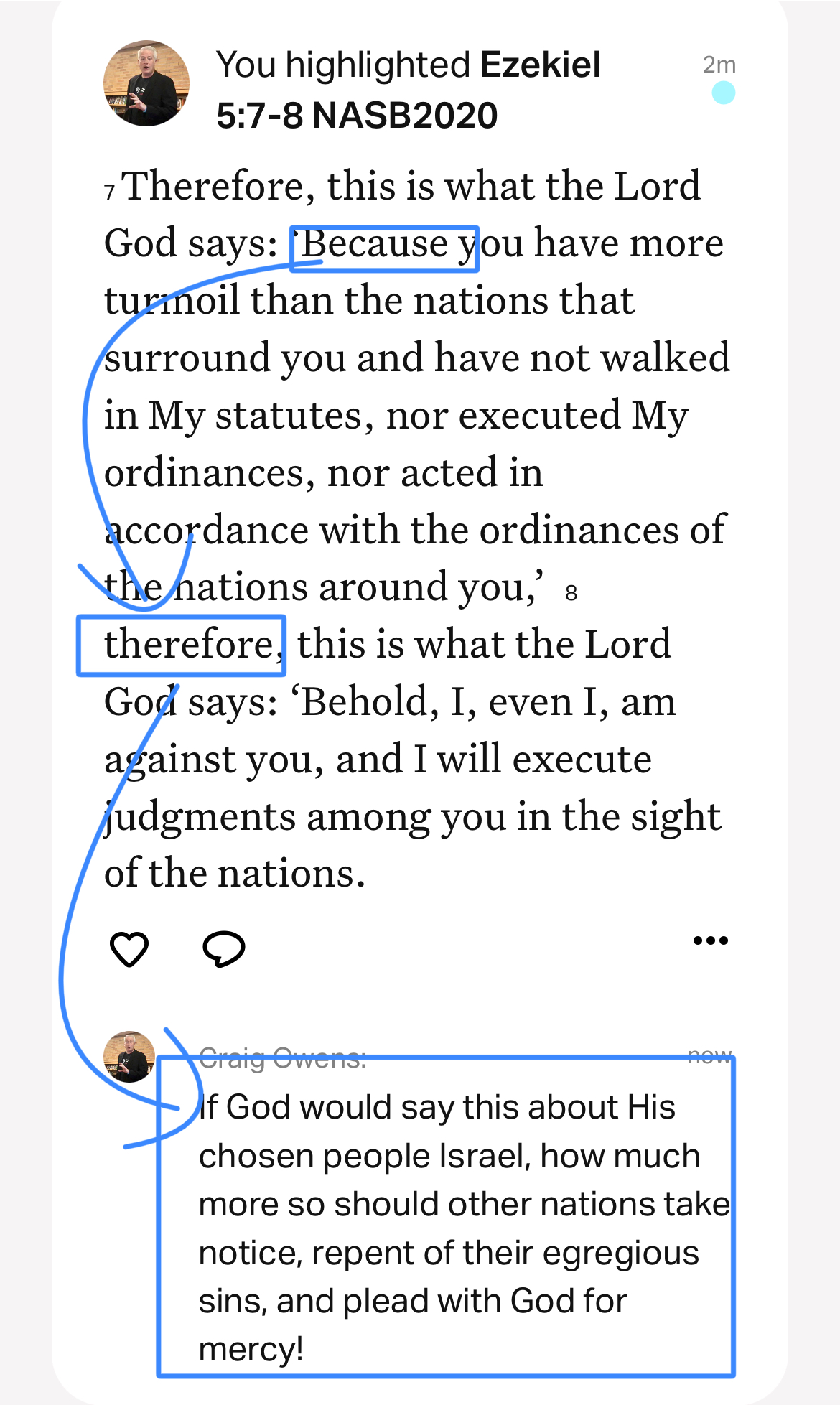
If God would say this (Ezekiel 5:7-9) about His chosen people Israel, how much more so should other nations take notice, repent of their egregious sins, and plead with God for mercy!
Listen to the podcast of this post by clicking on the player below, and you can also subscribe on Apple, Spotify, or Audible.
God wants us to progress to the next level in our Christian walk, but we need to know what we’re ready for that. Just as a teacher in school prepares us for a test, administers the test, and then gives us the result of the test in order to promote us to the next level, so does our loving Heavenly Father.
Listen to the podcast of this post by clicking on the player below, and you can also subscribe on Apple, Spotify, or Audible.
Like it or not, your example as a leader is making an impact on all the people around you—including the next generation of leaders who will take their positions after you have passed away.
So I have a simple question for you: Are you setting them up for success or failure?
Hezekiah had been sick and God miraculously healed him. When Merodach-baladan, king of Babylon, heard about this, he sent envoys to see King Hezekiah. Instead of bragging on God, Hezekiah bragged about all of his riches.
“Behold, the days are coming when everything that is in your house, and what your fathers have stored up to this day, will be carried to Babylon; nothing will be left,” says the Lord. “And some of your sons who will come from you, whom you will father, will be taken away, and they will become eunuchs in the palace of the king of Babylon.” (Isaiah 39:6-7)
Sadly, Hezekiah responded, “At least it won’t impact me.”
A mark of a godly leader is one who desires to set up future leaders for success.
His son Manasseh became one of the most evil, godless kings that Judah had ever known. And as a result, he experienced the punishment that Isaiah had prophesied.
Thankfully, Manasseh eventually humbled himself, repented of his sin, and got to experience God’s restoration to a small degree—
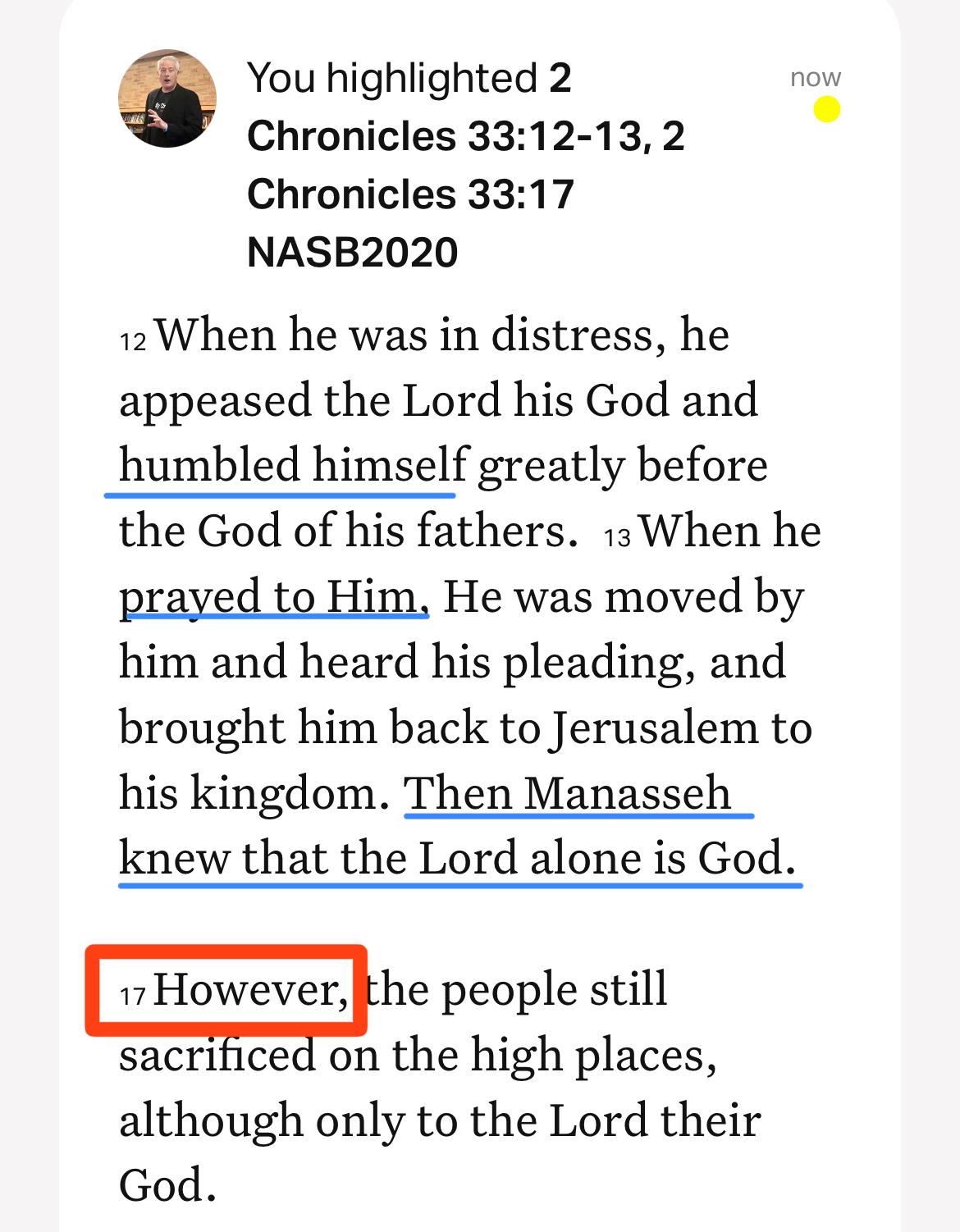
When he was in distress, he appeased the Lord his God and humbled himself greatly before the God of his fathers. When he prayed to Him, He was moved by him and heard his pleading, and brought him back to Jerusalem to his kingdom. Then Manasseh knew that the Lord alone is God. (2 Chronicles 33:12-13)
But there is a sad “however” for Manasseh’s son Amon: However, the people still sacrificed on the high places (2 Chronicles 33:17). This mixing of the worship of God with the worship of pagan idols always pulls people away from God. It certainly did that for Amon because “he did evil in the sight of the Lord, just as his father Manasseh had done. For he walked entirely in the way that his father had walked, and served the idols that his father had served, and worshiped them” (2 Kings 21:20-21). “Furthermore, he did not humble himself before the Lord as his father Manasseh had done, but Amon multiplied his guilt” (2 Chronicles 33:23).
Godly leaders should be just as concerned about the people that come after them as they are about the people around them now. Godly leaders strive to set up future generations for success—so they can receive God’s continued and increased blessings.
This is part 78 in my series on godly leadership. You can check out all of my posts in this series by clicking here.
Listen to the podcast of this post by clicking on the player below, and you can also subscribe on Apple, Spotify, or Audible.
Here’s how God describes a wicked nation:
Woe to her who is rebellious and defiled, the oppressive city! She obeyed no voice, she accepted no discipline. She did not trust in the Lord, she did not approach her God. Her leaders within her are roaring lions, her judges are wolves at evening; they have no bones to gnaw in the morning. Her prophets are insolent, treacherous men; her priests have profaned the sanctuary. They have done violence to the Law. (Zephaniah 3:1-4)
These are people who were once so passionate for God and are hurtling toward His judgment on their sinful lifestyle—
thumbing their noses at their own civil laws
calling their own justice system into question
governed by leaders who are focused on flexing their power for themselves
afflicted by judges ruling by the desires of those who give them “bones to gnaw”
subject to preachers who twist and distort Scripture to suit their own desires
These things can come from nothing but pride that says, “We know best. We don’t need some out-of-date, behind-the-times god telling us what to do!”
These prideful people are hellbent on pursuing their sinful lifestyle—rejecting God’s warning of impending and certain judgment—because they have fooled themselves into believing there is no God!
Our history books are filled with stories of other proud nations that thought this same way, but God both announced and carried out His righteous judgment on them. And still, we foolishly believe we are better than them, that we can avoid the inscrutable eyes of God.
God is looking for one righteous man or woman who will hold to His righteous standard, and who will stand in the gap to intercede for rebellious, hellbent people (Ezekiel 22:30).
Listen to the podcast of this post by clicking on the player below, and you can also subscribe on Apple, Spotify, or Audible.
The 12th Song of Ascent (Psalm 131) was written by David to remind us to rely on God’s help even more as we progress on the journey (or mature in our faith). In the 13th Song (Psalm 132), the psalmist says, “Remember David” and his passion for God’s people to experience God’s righteousness and joy. In order for us to know that, we have to remember Jesus.
Those who put this collection of Songs of Ascent together now include David’s fourth song (Psalm 133) in this collection which expresses his desire for unity among God’s people.
Can you imagine the pilgrims starting out from their individual villages? Maybe there’s not very many of them to begin with and traveling is pretty easy, but they do have to be vigilant against dangers on the road.
As they progress, they begin to join with pilgrims from other villages. Maybe these are from the same tribe, perhaps even distant relatives. The journey may go a bit slower now that there are more people to keep track of, and some complications of personality may start to arise. But the level of safety and assistance also increases.
Soon the group is getting larger as they now join with pilgrims from other tribes. These aren’t near relatives at this point, so there may be more complications, but there is even greater encouragement, safety, and potential.
Aha! Potential.
We’ve gone singing with a small ensemble to singing in a choir. And David is anticipating us singing in an even larger, majestic choir! There will undoubtedly be more problems, but there is also assuredly so much more potential, beauty, and strength in their combined worship.
My friend Dan Chastain has over 20 years of experience in the United States Army. He points out that the Army did the same things in his day as we read in the Old Testament.
The unity of a fighting force, Dan said, is a blessing. David was a professional soldier. Many people today join the military because of this professional, unity, and camaraderie. Maintaining this unity is the responsibility of everyone, because disunity leads to mistrust, chaos, and defeat.
David says this choir paints a picture—“it is like” (v. 2) and “it is as if” (v. 3). He is saying that God desires overflowing blessings on His people (v. 2), and that God desires saturating blessings on His people (v. 3). Why? Because God wants to give us more than enough for our needs so that there is plenty left for those who aren’t brothers and sisters yet. He longs for our choir to include people from every tribe, race, and nation.
Just as we said last week that a Christian’s joy is a testimony, a choir of Christians is an even more compelling testimony!
David calls this unity “good” which really means so much better than the alternative. And he calls this unity “pleasant.” The Hebrew word literally means singing a sweet sound!
The Hebrew word for “unity” here is also instructive. It means to be together in the same place—not just in spirit and desire—but in physical proximity. This is exactly the picture we see in the first Church (Acts 2:44, 46-47), as well as the picture of the choir from every nation, tribe, people, and language singing around God’s throne in Heaven (Revelation 7:9-10).
In order to navigate all of the differences of personality that could keep us from this unity, we have to work at. We need the attitude of Jesus (Philippians 2:1-5). This requires a daily transformation of our minds (Romans 12:1-3), and this transformed mind is what helps us move from a small ensemble to a majestic choir (Romans 12:4-5, 16-18).
No one wants what the gloomy person has. Joy is a Christian’s testimony—it’s what attracts others to Jesus! Check out this full message from my series on the Songs of Ascent.
I have lots of new content every week, which you can check out on my YouTube channel.
“At first glance, people may not see how these different forms of sexual violence connect to each other. But, in fact, experts are increasingly recognizing that they may all stem from one common source—sexual objectification. Sexual objectification occurs when people perceive others as sex objects rather than complex human beings deserving of dignity and respect.” Pornography is a major contributor to the sexual objectification which leads to sexual violence.
Dr. Brian Thomas describes why fossils are found where they are and why land animals may even be found near marine animals: “This fossil discovery [a bone from a South American megaraptor found near Cape Otway, Australia] fits well with a biblical history, which goes something like this: Around 2348 BC, a worldwide flood crushed and reshaped the earth’s surface, breaking up a single landmass (Pangaea) into continents and fossilizing countless living things. Prior to the Flood megaraptors roamed Pangaea, during the Flood they were fossilized, and in the late Flood stages the boundaries of new continents (along with their fossils) were roughly shaped. Unlike the standard story, the outlines of this history have been testified to by reliable eyewitnesses, and this testimony has been faithfully preserved in Genesis.”
“The more we let God take over us, the more truly ourselves we become—because He made us.” —C.S. Lewis
J. Warner Wallace shares two trends in American society that are contributing to the decline of religious adherence in America.
“There is no way around hard work. Embrace it.” —Roger Federer
Shame on my thoughts, how they stray from me!
During the Psalms, they wander on a path that is not right; they run, they distract…
One moment they follow the ways of loveliness, and the next the ways of riotous shame…
Swiftly they leap in one bound from earth to heaven…
O beloved Christ… may the grace of the sevenfold Spirit come to keep them in check!
Rule this heart of mine, O swift God of the elements, that You may be my love, and I may do Your will! —Anonymous, On the Flightiness of Thought, Irish, 8th-9th century
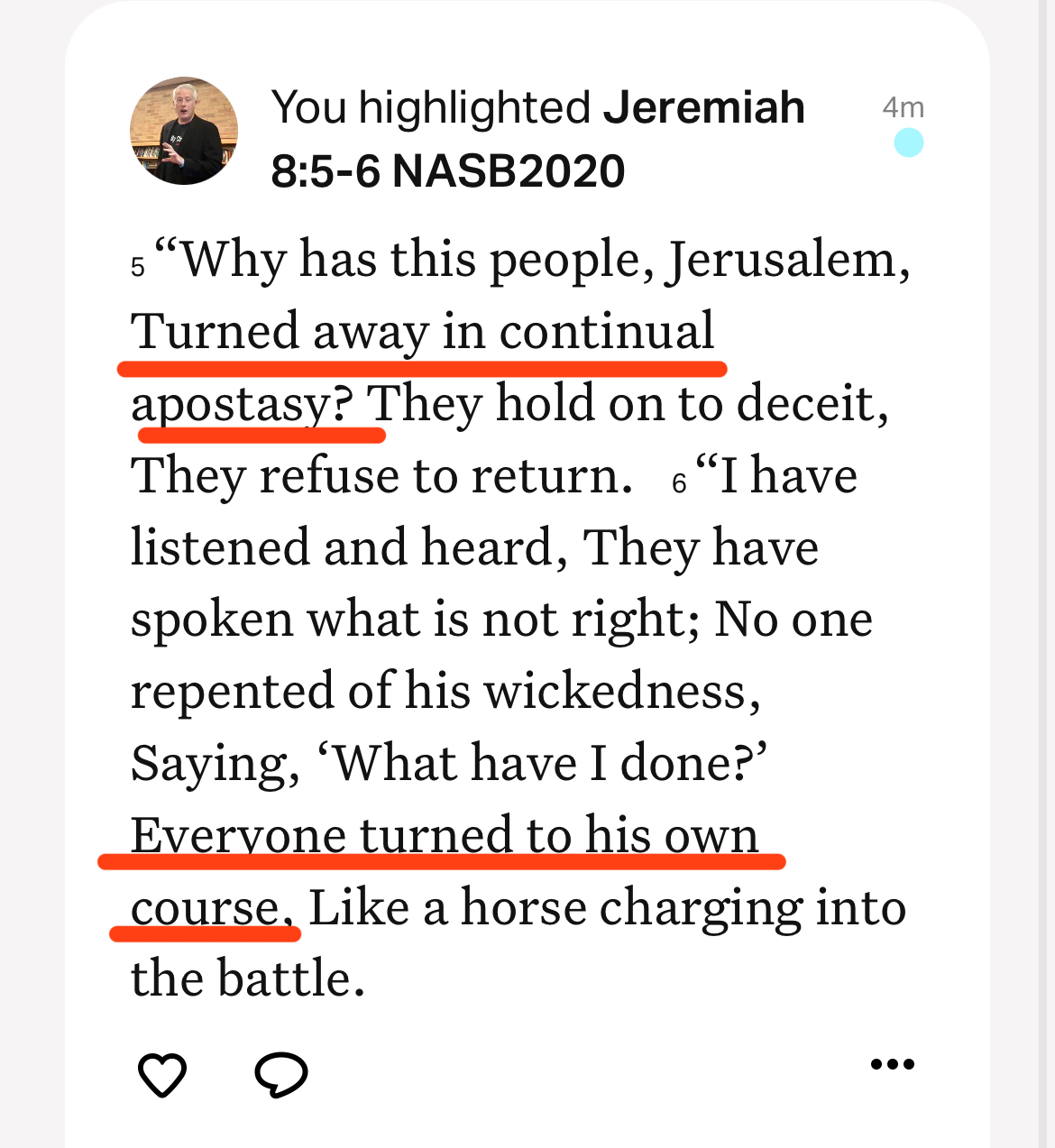
Why has this people, Jerusalem, turned away in continual apostasy? They hold on to deceit, they refuse to return. I have listened and heard, they have spoken what is not right; no one repented of his wickedness, saying, “What have I done?” Everyone turned to his own course, like a horse charging into the battle. (Jeremiah 8:5-6)
“Everyone turned to his own course” is the description of our culture today.











 Craig T. Owens