Listen to the podcast of this post by clicking on the player below, and you can also subscribe on Apple or Spotify.
I have always been mindful of Your unfailing love…. (Psalm 26:3).
The dictionary defines “mindful” as simply being aware. Unfortunately, many psychologists today have constricted this term to mean simply being aware of the present moment, especially one’s own emotions in the present moment.
In the New Living Translation, this verse has David saying to God, “I am alwaysaware of Your unfailing love.” God’s unfailing love is an eternal attribute of God, and David says he is perpetually contemplating this attribute. But notice how David applies mindfulness not just to his present moment, but to his past and future as well. In fact, David invites God to examine his heart and mind to verify that David is always properly mindful of God’s love.
Notice the past, present, and future tenses David uses—
Past (v. 1):
I have led a blameless life
I have trusted in the Lord without wavering
Present (vv. 3, 7, 11):
Your love is ever before me
I walk continually in Your truth
I proclaim aloud your praise
I lead a blameless life
Future (v. 12):
In the great assembly I will praise the Lord
Notice that between David’s claim that he has led a blameless life and that he isstill leading a blameless life, we read his request for God to, “Test me, O Lord, and try me, examine my heart and my mind.” David was perpetually mindful of God’s awareness of both his thoughts and his lifestyle.
Being mindful of God’s love means looking back in gratitude to recall God’s past provision, looking around in worship to see God’s ongoing involvement, and looking ahead in hope to anticipate God’s unending grace.
Unlike modern-day psychology which tells us mindfulness is a narrowing of our thoughts, biblical mindfulness is an expanding of our thoughts. Biblical mindfulness sees God’s past work and His future grace, and brings those to bear on our present circumstances.
Check out this episode and subscribe on YouTube so you can watch all of the upcoming episodes. You can also listen to our podcast on Spotify and Apple.
Listen to the podcast of this post by clicking on the player below, and you can also subscribe on Apple or Spotify.
I’m a student of leadership, so I love to learn about what makes leaders “tick,” how they overcome obstacles and deal with adversity, and watch how they prepare themselves to be the best they can be. Broadcaster Jim Gray has had a front-row seat (literally!) to some of the most outstanding athletes in recent history, and he unpacks his stories about these leaders in his book Talking To GOATs.
For those of you wondering, GOAT stands for “greatest of all time.” We’re talking about people who stand out from their peers over a long period of time, those who set the standard for everyone else, those who have so excelled that their sport has had to change things up to try to accommodate them! Superstars like Muhammad Ali, Tom Brady, Michael Jordan, Tiger Woods, Mike Tyson, Hank Aaron, and Michael Phelps.
Jim Gray’s book is a behind-the-scenes look at not only the hard work he put in to produce and present interviews with these GOATs, but also insights rarely seen of the intense work these athletes put in to become the GOATs of their particular sport. Jim shows us how both he and these athletes deal with setbacks, criticism, the challenges that come with success, and their own internal drive to keep being the best.
This book isn’t all about athletes, but it’s a bit of a memoir of Jim’s life too. I really enjoyed learning about the role that Jim’s parents, and especially his dad, played in helping Jim get into these “front row seats” to cover these amazing athletes. Jim is also very candid about how he has processed the inevitable criticism that comes from interviewing a certain athlete in a way that not every fan appreciated. It was a very enjoyable read.
The sports fans in your life will almost certainly know who Jim Gray is, and they will love hearing what went into some of the more memorable moments in sports broadcasting. My son gave me this book as a gift and I thoroughly enjoyed it, so I know that the sports fans that you love will also give you kudos if you send Talking To GOATs their way.
DON’T #1: Don’t be a hypocrite. That word literally means a play-actor. More than anyone else ever will, God sees who we really are. We cannot fool Him so there is no reason to fake it. For proof, check out some of the gut-level-honest prayers David records in the psalms!
DON’T #2: Don’t babble. The Greek word here is unique: It’s made up of the name of a poet named Battus who was needlessly wordy, and the Greek word for word. In Greek, the word battologeō is an onomatopoeic word (like our English words that sound like what they really are describing: words like whoosh, buzz, or smack). It means rambling with our mouth, but our hearts and heads simply aren’t engaged as well.
“When prayer has become secondary, or incidental, it has lost its power. Those who are conspicuously men of prayer are those who use prayer as they use food, or air, or light, or money.” —M.E. Andross
My friend’s trainer recently told him, “You cannot out-exercise a bad diet.” I think this is just as true in the realm of prayer: You cannot out-________ a bad prayer diet. You cannot…
…out-religion a bad prayer diet, as though your religious exercises can make up for a lack of prayerful food.
…out-talk a bad prayer diet, or “babble,” as Jesus said.
…out-strategize a bad prayer diet, as one successful man attempted to do (see Luke 12:16-20).
Jesus said our heavenly Father is just waiting for us to ask Him for what we need. In Psalm 5, David explained how attentive God is, even understanding our cries, our sighs, and our groans. So David’s conclusion was: “Lord, every morning You hear my voice. Every morning, I tell You what I need, and I wait for Your answer.”
Friends, we need to be first responders in prayer. Make it a habit every morning to let God hear your voice before anyone else does. DON’T make a show out of it or babble some words you don’t really feel, but DO talk with your loving heavenly Father about what you need for this upcoming day. He has already prepared a good, healthy diet for you, so ask Him to give you this day what you need, and then be expectant all day long in the ways your Father will answer you.
This is a weekly series with things I’m reading and pondering from Charles Spurgeon. You can read the original seed thought here, or type “Thursdays With Spurgeon” in the search box to read more entries.
Listen to the podcast of this post by clicking on the player below, and you can also subscribe on iTunes or Spotify.
Talking Back To Your Old Family
When a man is adopted into a family and comes thereby under the regime of his new father, he has nothing whatever to do with the old family he has left behind and he is released from subjection to those whom he has left. And so, the moment I am taken out of the family of satan, the prince of this world has nothing to do with me as my father and he is no more my father. I am not a son of satan; I am not a child of wrath.
…When the law comes to a Christian with all its terrible threats and horrible denunciations, the Christian says, ‘Law! Why do you threaten me? I have nothing to do with you. I follow you as my rule, but I will not have you to be my ruler. I take you to be my pattern and mold, because I cannot find a better code of morality and of life, but I am not under you as my condemning curse.’ …
If one man adopts another child into his family, he cannot give it his own nature as his own child would have had. And if that child whom he will adopt should have been a fool, it may still remain so. He cannot make it a child worthy of him. But our heavenly Father, when He comes to carry out adoption, gives us not only the name of children, but the nature of children, too. He gives us a nature like His well-beloved Son, Jesus Christ.
From Adoption
Charles Spurgeon was called “the prince of preachers” for good reason! His word pictures are so biblically-accurate and so easy to recall, that anyone can grasp the concepts he shares from the Scripture. I have two takeaways from this portion of his sermon:
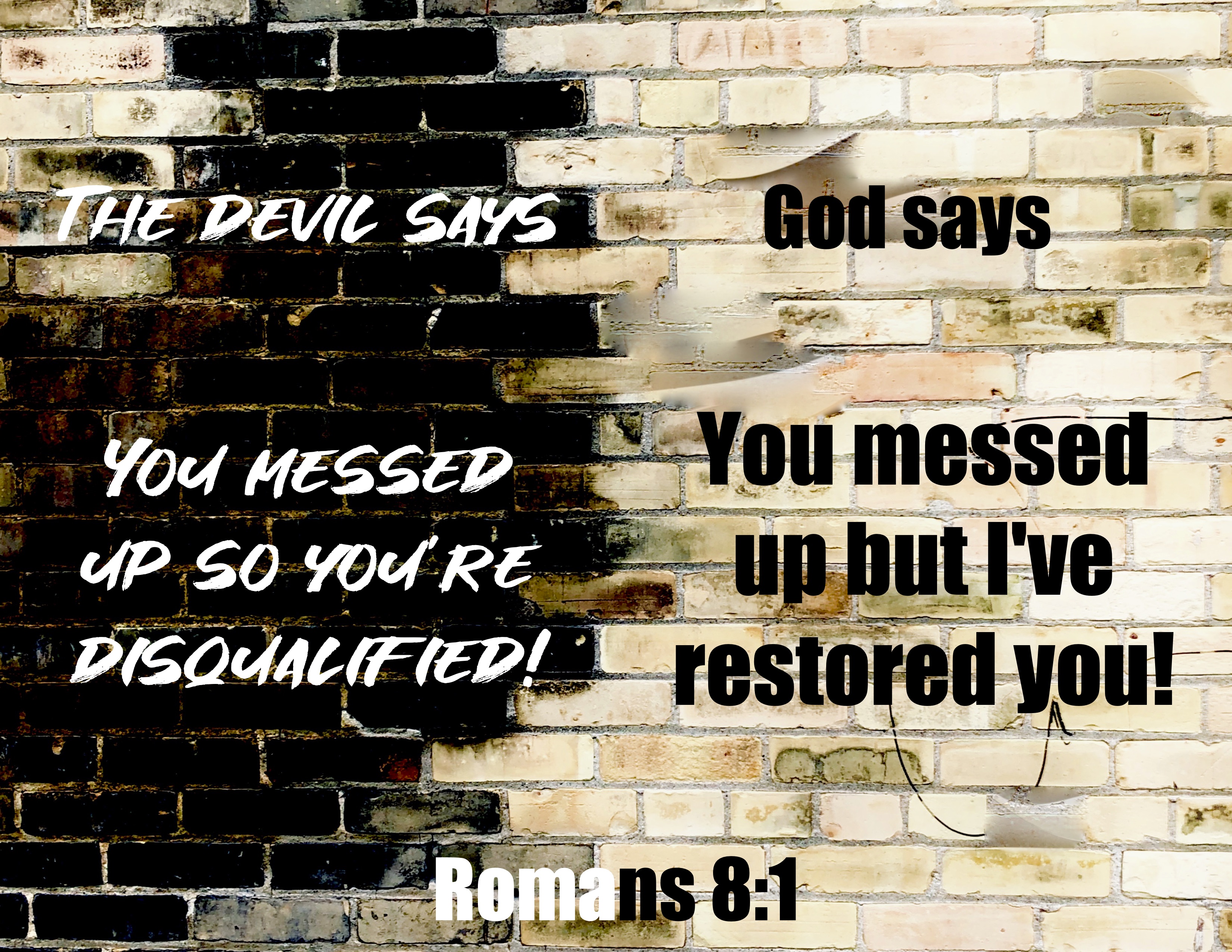
First, we need to talk back to our old family. The name “satan” means accuser: he accuses, condemns, slanders, and does his best to separate. When a Christian has been adopted into God’s family, there is no condemnation for the one who now calls God, “Abba Father” (see Romans 8:1-17).
This is where we need to call out satan’s lies. I mean literally call them out. We need to talk back to the devil and tell him the truth, just as Spurgeon said in his example of talking back to the Law. Let me say it again: literally speak the truth out loud. The devil needs to hear it and your own ears need to hear it too: “I am no longer subject to your jurisdiction. You have no say over me any longer. I am a child of God. My sins have been forgiven and forgotten; therefore, there are no grounds left for any condemnation!”
Second, we need to talk back to our old nature. After being adopted into God’s family, the Holy Spirit undertakes a process to conform us to the image of Jesus. This process is called sanctification, but I like to call it saint-ification.
This is where we call out what we used to be. And, again, I challenge to literally speak these words out loud. Don’t say, “I’m so impatient,” but tell yourself (out loud!), “I am becoming the patient saint Jesus wants me to be.” Don’t say, “I’ll never get this right,” but tell yourself, “I am learning more and more about Christ’s nature with each attempt.” Talk back to these old habits from your old family, and tell them about the new saintly habits the Holy Spirit is developing in you.
The book of Revelation tells us that the saints overcame the slanderous devil by the blood of Jesus and by the words of their testimony. Speak out those life-affirming words every time that slanderer tries to make you forget into whose family you have been adopted!
Listen to the podcast of this post by clicking on the player below, and you can also subscribe on Apple or Spotify.
…whoever does these things will never be shaken (Psalm 15:5).
David says “these things” are what allow us to come into God’s presence, but we cannot consistently nor completely do “these things” without the help that can only come from being in God’s presence. So I have to already be doing “these things” in order to get into His presence in order to get empowered to do “these things”?!
That seems like a classic, no-win, Catch-22!
So… how do I get into God’s presence in the first place?
Simple: I can’t.
Only Jesus can.
Thankfully, He made it possible for me to come in: He became the Door!
Only by Jesus can I come in. Only in Jesus can I be empowered. Only with Jesus can I consistently do “these things.”
What are “these things” that David listed that both allow me to come into God’s presence and then keep me in God’s presence? David said we must…
…speak truthfully: from the heart, no slander on my tongue, no unkind words in my mouth, no gossip on my lips.
…live courageously: honoring what is good and opposing what is evil.
…keep my oaths: making my yes mean yes, not making any excuses, helping others to do the same.
“These things” both glorify God and keep me in God’s presence. And “these things” attract others to His presence too. But I don’t try to do “these things” in my own strength—that would make me God—nor just as a religious To-Do List—that would make me a Pharisee. But I take a cue from the apostle Paul—
But whatever I am now, it is all because God poured out His special favor on me—and not without results. For I have worked harder than any of the other apostles; yet it was not I but God who was working through me by His grace (1 Corinthians 15:10).
It is grace—a free gift of God—that enables me to do “these things” not in my own strength, but in His strength!
I don’t try harder to do “these things” that keep me secure in God’s presence, but I trust more profoundly in His grace that continually empowers me to successfully do “these things” every single day.
Listen to the podcast of this post by clicking on the player below, and you can also subscribe on iTunes or Spotify.
I am eternally grateful to my high school English teachers who not only taught me the fundamentals of reading literature and writing in different styles, but who immensely sharpened my skills. But can you imagine having C.S. Lewis as a writing mentor? That’s what you are getting when you read The Art Of Writing And The Gift Of Writers.
This book is compromised of essays and book reviews written by Lewis, interviews that Lewis gave, and even a transcript of an extemporaneous conversation with other authors who had congregated in Lewis’ rooms at Magdalen College.
Learning how a gifted writer like Lewis crafted his own books was insightful, as well as how he interpreted the writing process of other authors. He even talked about how he choose to handle literary critics. But most energizing of all for me was the freedom he gave me to be myself in the writing process. He made it abundantly clear that other authors shouldn’t try to emulate his literary style—nor any other author’s style either—but to use their unique talents to write their unique works of literature.
Since Lewis has been one of my favorite authors for most of my life, I found the journey into his mind to be absolutely fascinating. I would recommend this book for any author, aspiring author, or fellow fan of C.S. Lewis’ books and essays.
Listen to the podcast of this post by clicking on the player below, and you can also subscribe on Apple or Spotify.
There is a common characteristic among every human civilization: they all have had a pantheon of gods. It seems that no one god could capture all of the attributes each civilization thought were important, so they created multiple gods to help fill in the gaps.
Onto the world scene comes the account recorded for us in the Bible of a God who creates the universe. The Hebrew word for this God is elohiym which means “a divine one.” This name is used throughout the Creation story in Genesis 1.
Then in Genesis 2:4, a new name appears, one that is used over 6500 times in the Bible. It is the unpronounceable name YHWH: often pronounced Yahweh or substituted with the word Jehovah. In most Bible translations this name is designated by all capital letters: LORD. Yahweh or Jehovah means “the existing One.”
The first part of our second foundational truth states, “The one true God has revealed Himself as the eternally self-existent ‘I AM,’ the Creator of heaven and earth and the Redeemer of mankind.” This Creator is uncreated: He sustains the universe without needing to be replenished Himself. He is utterly complete in Himself; hence, His name means I AM (see Exodus 3:13-15).
The second part of this foundational truth statement says, “He has further revealed Himself as embodying the principles of relationship and association as Father, Son and Holy Spirit.”
The I AM is One (see Deuteronomy 6:4), but He reveals Himself in three Persons—Father, Son, Spirit—that we call the Trinity (although this is not a word found in the Bible).
Sometimes Christians have done a disservice to the I AM by making it appear He is divided. For instance, we might say, “The Father is the Creator, the Son is the Redeemer, and the Spirit is the Regenerator.” But remember that our One God is not a pantheon of gods; He is One. We see the fullness of the Trinity operating in every area. Here’s just a short sampling:
The creation of the universe—Genesis 1:1; Colossians 1:15-16; Psalm 104:30
The creation of man—Genesis 1:26-27
A prophecy about Jesus’ advent—Isaiah 9:6
The incarnation of Jesus—Luke 1:35
The baptism of Jesus—Matthew 3:16-17
The resurrection of Jesus—Acts 2:32; John 10:18; Romans 1:4
Our atonement—Hebrews 9:14
A Christian’s baptism in the Holy Spirit—John 14:16
A good question for us to ponder is: Why would this I AM God create humans? If He needs nothing to complete Himself or sustain Himself, why make us?
The apostle John captures the essence of the Trinity in three words: God is love.
God created us out of an overflow of His love so that we too could enjoy the intimate, eternal pleasure of being at-onement with Him forever. God then wants our love to overflow to everyone around us, so that they will also be drawn into this at-oneness with the I AM.
When Jesus was asked to state the greatest commandment, He first quoted from Deuteronomy 6: “Hear, O Israel: The LORD [Yahweh] our God, the LORD [Yahweh] is one.” Christ’s conclusion was for us to love this All-Loving God with all our heart, soul, mind, and strength. And then Jesus added an obvious overflow of that love: “And love your neighbor as yourself” (see Mark 12:29-31).
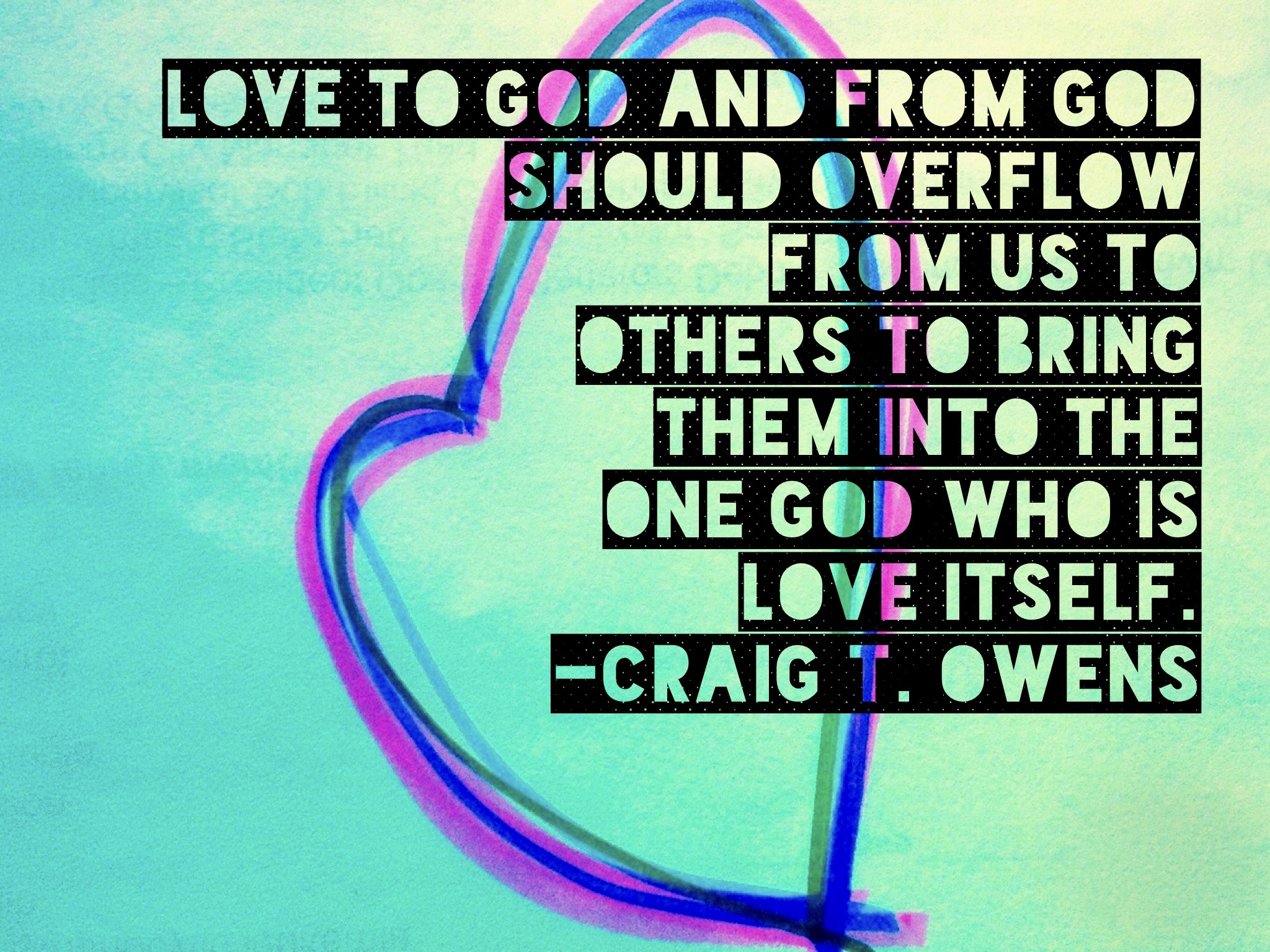
Love to God and from God should overflow from us to others to bring them into the One God who is love itself.
The more we understand this love that the I AM has for us: (1) the better able we will be to love and worship Him, (2) the more we will love others out of this overflow of love, and (3) the more glory our awesome GOD will receive. Which is exactly what the apostle Paul prayed for us in Ephesians 3:14-19.
This idea of an I AM God who reveals Himself as Father, Son, and Spirit has been described by the Latin phrase mysterium tremendum. It is indeed a mystery: not one that frightens and confuses, but one that energizes and enlivens. Pray Paul’s prayer for yourself, so that you can see more dimensions of this awesome love that God has for you!



 I have always been mindful of Your unfailing love…. (Psalm 26:3).








 Craig T. Owens