Greg cautions that either we address change or we avoid change, but if we avoid changing, our group may move on without us
just because we are changing doesn’t mean we are growing
Greg offers counsel on what leaders need to evaluate when considering changes
“unhealthy leaders change things to gain more control; healthy leaders change things to help the whole team get better,” Greg says
we don’t grow in areas of comfort: we learn most of our lessons moving forward, but we learn very few lessons sitting still
good leaders reassure other leaders to make thoughtful changes
the right way for leaders to partner with their team to effect positive changes
Check out this episode and subscribe on YouTube so you can watch all of the upcoming episodes. You can also listen to our podcast on Spotify and Apple.
Listen to the podcast of this post by clicking on the player below, and you can also subscribe on Apple or Spotify.
In our system of law, special attention is given to someone’s dying declaration. If our legal system gives such weight to the last words of an imperfect man, it seems to me that we should take special note of the dying declarations of the only truly innocent Man who ever walked this earth: Jesus Christ.
After being nailed to the Cross, the first dying declaration from Jesus was: Father, forgive them, for they do not know what they are doing (Luke 23:34).
Let’s say that Billy is dying on a hospital bed after being fatally shot, and all he can muster the strength to do is point at Johnny and whisper, “He… shot… me….” We would know who the “he” was in that situation, but who exactly is the “them” in this declaration of Jesus?
Who offended Jesus? Who mortally wounded Him? Who caused Him such anguish? Maybe it was…
His disciples who couldn’t stay awake to pray with Him
Judas who betrayed Him with a kiss
the nine disciples who ran away
Peter who denied three times that he knew Jesus
the false witnesses in Caiaphas’ house
the members of the Sanhedrin who hit Him and spit on Him
the members of the Sanhedrin who were silent
the temple guards who mocked Him
those who spewed lies when Jesus stood before Pilate
those who lied about Jesus when He stood before Herod
Herod and his soldiers who mocked Him
the Roman soldiers who abused Him
the Roman soldiers who stripped Him naked and crucified Him
Listen to how Peter described the response of Jesus to all of this: When they hurled their insults at Him, He did not retaliate; when He suffered, He made no threats… (1 Peter 2:23). That word for insults means to heap abuse on Him or to pile on. This was a fulfillment of a 700-year-old prophecy: He was oppressed and afflicted… (Isaiah 53:7). Isaiah uses similar words, where oppressed means tyrannized, and afflicted means a humiliating, painful loss of dignity.
Christ’s own disciples afflicted Him, and so did the temple guards, and Pilate, and King Herod, and the Roman soldiers… and you and me. All of this mistreatment and humiliation and tyrannizing was handed out by us too (see Isaiah 53:6; 1 Peter 2:24-25). That’s why His arms were spread so wide when He said, “Father, forgive them,” because there were so many that needed forgiveness!
When Jesus said forgive, He was asking His Father to take away our guilt that kept us out of God’s presence. Think of a courtroom scene where God the Father is the Judge, satan is the prosecutor, Jesus is the victim, and I am the defendant. The evidence is overwhelming and incontrovertible, and I am pronounced guilty. My punishment is a death sentence. When Jesus says, “Father, forgive him,” He is taking the death penalty in my place!
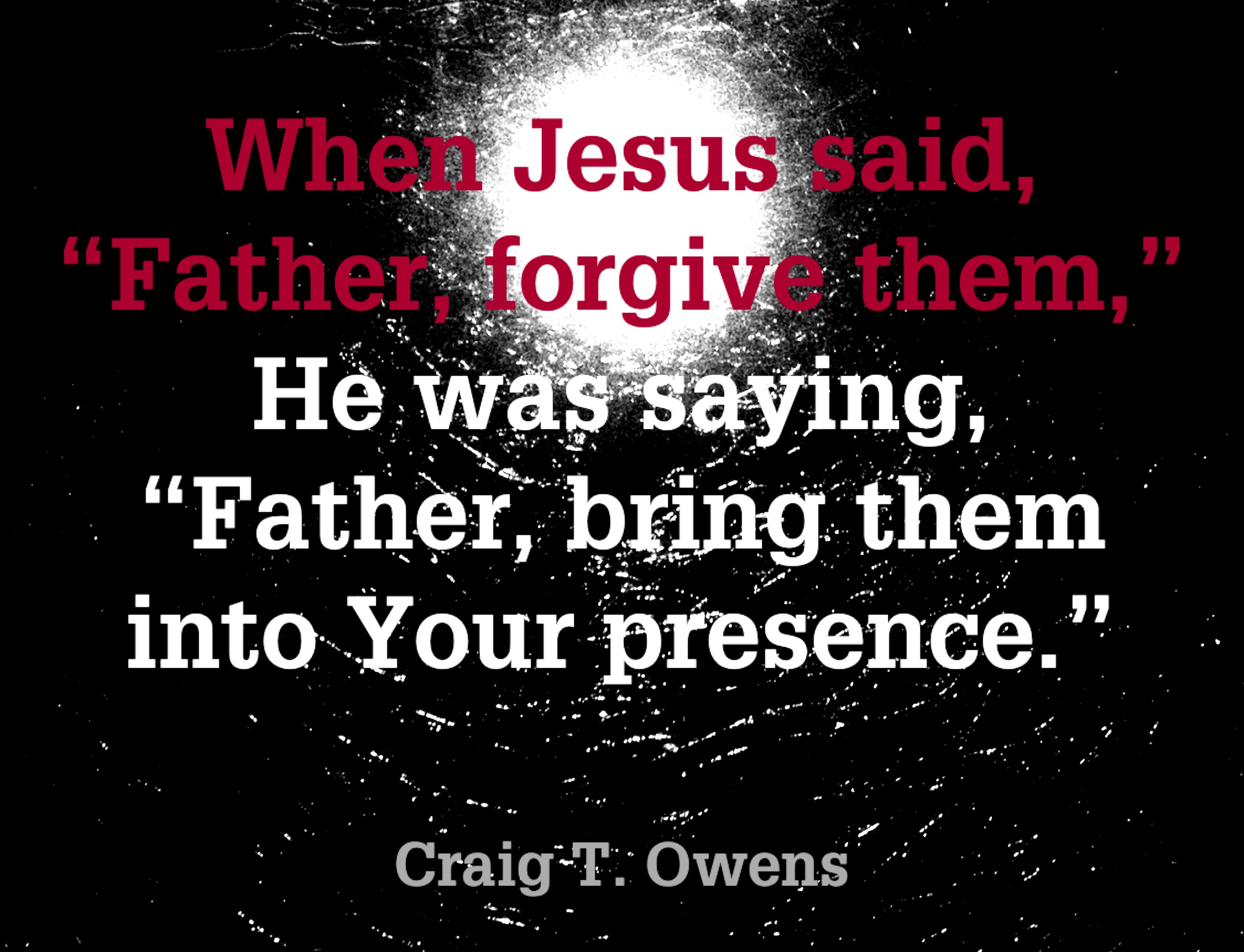
When Jesus said, “Father, forgive them,” He was saying, “Father, bring them into Your presence!”
You and I need to accept by faith the atoning work done on the Cross, the forgiveness of sins that was purchased for us. Jesus didn’t come to condemn us, but to lovingly restore us, and for that we are eternally and humbly grateful.
Listen to the podcast of this post by clicking on the player below, and you can also subscribe on Apple or Spotify.
Some really silly guys did a series of videos called “Neature Walk” because they wanted to share how neat is nature! In episode one Vic sees a tree that he really likes and says, “Score! This is an aspen tree. You can that it’s an aspen tree because of the way it is.” This is either circular reasoning or an obvious statement. “Just look at this thing. You can tell it’s this thing because it looks and acts like this thing.”
I feel a lot like this when I look at the first part of our third foundational truth statement: “We believe in the Deity of the Lord Jesus Christ.” (As a side note, I covered the second part of this statement—“As God’s Son, Jesus was both human and divine”—in another post, which you may find here.)
Check this out: the definition for Deity is the divine character of God, and the definition for divine means things relating to the Deity. In saying we believe Jesus is God we are really saying, “You can tell that Jesus is God because of the way He is.”
In order to make this definition work, we need evidence for both the divinity and the deity of Jesus. That being said, let me remind you of J. Warner Wallace’s instruction on faith. There is:
Blind faith—believing in something without evidence
Unreasonable faith—believing in something in spite of the evidence
Reasonable faith—believing in something because of the evidence
Here is some evidence that I think makes it reasonable to believe that Jesus is divine:
Virgin birth—Isaiah 7:14; Luke 1:34-35; Matthew 1:22-23
Sinless life—Isaiah 53:4-6, 9; Hebrews 7:26-27; 1 Peter 2:22
I think the best evidence for the Deity of Jesus is the connection He Himself made between the “Jehovah” titles of the First Testament and His “I AM” statements in the Second Testament:
Jehovah Jireh (I Am Your Provider) → I am the Bread of Life (John 6:35)
Jehovah Rapha (I Am Your Healing) → I am the Resurrection and the Life (John 11:25-26)
Jehovah Nissi (I Am Your Source) → I am the Vine (John 15:5)
Jehovah Shalom (I Am Your Peace) → I am the Light of the world (John 8:12)
Jehovah Raah (I Am Your Shepherd) → I am the Good Shepherd (John 10:11)
Jehovah Sabaoth (I Am Your Wall Of Protection) → I am the Gate (John 10:9)
Jehovah Tsid-kenu (I Am Your Righteousness) → I am the Way, Truth, and Life (John 14:6)
Jehovah Shammah (I Am Here) → I am the Alpha and Omega (Revelation 1:8; 22:13).
We cannot claim that Jesus was born of a virgin, or lived a sinless life, or did miracles, or died and rose again and then not believe He is God. We cannot pick and choose the parts of Jesus we want.
The apostle Paul reminded us that someday “at the name of Jesus every knee should bow, in heaven and on earth and under the earth, and every tongue acknowledge that Jesus Christ is Lord, to the glory of God the Father” (Philippians 2:11-12).
Every knee will bow to Him one day: Either in worship of Jesus their Savior, or in abject terror of Jesus their Judge.
I pray that you believe in Jesus as your Lord and Savior today… don’t wait another moment!
Check out this episode and subscribe on YouTube so you can watch all of the upcoming episodes. You can also listen to our podcast on Spotify and Apple.
Listen to the podcast of this post by clicking on the player below, and you can also subscribe on Apple or Spotify.
When I first began this series on prayer, I challenged all of us to make prayer a habit. I suggested putting up “Have I prayed about it?” Post-It Notes all over the place to get us thinking about prayer continually.
“Have I prayed about it?” is a great start. But then I need to ask, “How long have I prayed about it?” or maybe even, “How long am I willing to pray about it?”
Thomas Merton wrote, “What is the use of praying if at the very moment of prayer we have so little confidence in God that we are busy planning our own kind of answer to our prayer?” In other words, why do we go through the motions of praying and then strike out on our own? Or why do we pray for a little bit and then think, “Oh, perhaps God isn’t interested in this prayer”?
In Romans 12:12, the apostle Paul challenged us to never stop praying:
faithful in prayer (NIV)
constant in prayer (AMP)
prayerful always (TLB)
continuing steadfastly (NKJV)
This verb emphasizes the –ing part. Even though this is a verb, it’s what is known as a “verbal noun”: the noun pray is the same thing as the verb praying.
This Greek word is defined as: devoted, giving unremitting care to something, being courageous in perseverance, and staying at constant readiness. I would sum it up this way—
Prayer that is both persistent and insistent!
When Jesus teaches us that the motive for our prayer is, “Your kingdom come, Your will be done,” He is also implying that this requires continuous—persistent and insistent—involvement. With every prayer, we are persistently and insistently advancing God’s Kingdom and God’s glory.
I’m also moved by the insistent and persistent prayer of Nehemiah. He prayed, “Give Your servant success today by granting him favor in the presence of [King Artaxerxes].” He prayed this every day for over 4 months. The king finally noticed Nehemiah’s downcast face, asked him what was wrong, and then “because the gracious hand of my God was upon me, the king granted my requests.”
Nehemiah kept praying for 120 days or more, believing every day God would open the door of favor. In the meantime, God was moving things into place so that when Artaxerxes finally noticed Nehemiah’s downcast face, and Nehemiah shared what was on his heart, the king grantedevery single request!
Friends, don’t be timid in your prayers and don’t give up praying. P.U.S.H.—Pray Until Something Happens. Pray for God’s glory to be seen, for His kingdom to advance on earth, and for His will to be done.
Listen to the podcast of this post by clicking on the player below, and you can also subscribe on Apple or Spotify.
The Lord is my light and my salvation—whom shall I fear? The Lord is the stronghold of my life—of whom shall I be afraid? (Psalm 27:1)
How many of my daily choices are affected by fear?
whether to try something new or to stick with what’s familiar?
should I confront a friend on a bad choice or let him figure it out on his own?
to spend money or to invest it for later? what do I buy? where do I invest?
what if people don’t like what I do or say? what if they talk behind my back?
David begins this psalm with the same kinds of questions, as he battles enemies surrounding him, the possibility of his family rejecting him, false witnesses speaking lies against him, and foes closing in from every side.
In the middle of all of these swirling issues, David exhibits a confidence that starkly stands out:
whom shall I fear?
of whom shall I be afraid?
my heart will not fear
I will be confident
I am still confident
How can David respond this way? He kept turning his thoughts from the temporal to the eternal—
It may seem dark now, but God is light.
People may be fickle, but God is unchanging.
Foes may be strong, but God is the strongest.
People are mean, but God is good.
Both David’s opening and closing thoughts in this psalm are really a conversation with himself: The Lord is my light and my salvation—whom shall I fear? The Lord is the stronghold of my life—of whom shall I be afraid? … I am still confident of this: I will see the goodness of the Lord in the land of the living. Wait for the Lord; be strong and take heart and wait for the Lord. (vv. 1, 13, 14)
My friends, don’t let fear drive your decisions. Let confidence in God drive your decisions. Talk back to your fearful thoughts like David did and remind them of the great and loving God that cares for you. Don’t take matters into your own hand, but wait for the Lord; be strong and take heart and wait for the Lord.
I used Psalm 27 as a teaching example of how to turn passages from the Bible into our own personalized prayers. Check out this 5-minute video here:
There is another thing both David and Jesus agree upon. They both tell us that there is one thing that can block our prayer: unconfessed, unrepented sin.
David wrote, “If I regard iniquity in my heart, the Lord will not hear.” The Hebrew word translated “regard” means to be aware of something. David teaches us that we have to be made aware of our sin in order to confess our sin and ask forgiveness. We become aware of our sin through prayer and reading the Bible (Psalm 139:23; James 1:25; Romans 7:7-12).
The NIV translates the same Hebrew word in Psalm 66:18 as “cherished.” After becoming aware of our sin, we have to be careful not to make excuses or justifications for it. And then the NLT translates the same word “not confessed.” After becoming aware of our sin and accepting responsibility for it, then we can confess it to God.
In teaching us to pray, Jesus said our forgiveness of others had a direct correlation to the forgiveness we would receive from our Heavenly Father (Matthew 6:12, 14-15). Jesus further expounds this thought when He tells Peter to forgive others “seventy times seven times”; in other words: countless times.
Think of it this way: Have you asked God’s forgiveness more than seven times? How about more than seven times for the same sin? I have! So Jesus is really asking Peter, “Do you want God to put a limit on how many times He will forgive you? If not, then don’t you put a limit on how many times you will forgive others.”
The Amplified Bible has a great definition of forgiveness in Matthew 6:12—left, remitted, let go of the debts, and have given up resentment against. The Hebrew word David uses in Psalm 32:1 has a similar feel—lifted up, taken away, carried off.
Our forgiven sins are forgotten sins. Every time we come to God for forgiveness, it’s like it is the first time. And Jesus says this is the same way we need to treat others.
Let’s all strive to be first responders in confessing our own debts to God so we can be forgiven, AND then let’s also be first responders in forgiving the debts others have incurred against us.
As I’ve said before: A mark of a maturing saint is one who is closing the gap between awareness of his sin and making his confession of that sin.
But this is just as true:
A mark of a maturing saint is one who is closing the gap between being injured and forgiving the offender.
We do this again and again and again—countless times!—because that’s how often our Heavenly Father forgives us.
Be a first responder in both asking for forgiveness and giving forgiveness.
Don’t let your debts block your prayers.
Don’t let your unreceived forgiveness weigh you down.
Don’t let your ungiven forgiveness weigh others down.
Check out this episode and subscribe on YouTube so you can watch all of the upcoming episodes. You can also listen to our podcast on Spotify and Apple.
DON’T #1: Don’t be a hypocrite. That word literally means a play-actor. More than anyone else ever will, God sees who we really are. We cannot fool Him so there is no reason to fake it. For proof, check out some of the gut-level-honest prayers David records in the psalms!
DON’T #2: Don’t babble. The Greek word here is unique: It’s made up of the name of a poet named Battus who was needlessly wordy, and the Greek word for word. In Greek, the word battologeō is an onomatopoeic word (like our English words that sound like what they really are describing: words like whoosh, buzz, or smack). It means rambling with our mouth, but our hearts and heads simply aren’t engaged as well.
“When prayer has become secondary, or incidental, it has lost its power. Those who are conspicuously men of prayer are those who use prayer as they use food, or air, or light, or money.” —M.E. Andross
My friend’s trainer recently told him, “You cannot out-exercise a bad diet.” I think this is just as true in the realm of prayer: You cannot out-________ a bad prayer diet. You cannot…
…out-religion a bad prayer diet, as though your religious exercises can make up for a lack of prayerful food.
…out-talk a bad prayer diet, or “babble,” as Jesus said.
…out-strategize a bad prayer diet, as one successful man attempted to do (see Luke 12:16-20).
Jesus said our heavenly Father is just waiting for us to ask Him for what we need. In Psalm 5, David explained how attentive God is, even understanding our cries, our sighs, and our groans. So David’s conclusion was: “Lord, every morning You hear my voice. Every morning, I tell You what I need, and I wait for Your answer.”
Friends, we need to be first responders in prayer. Make it a habit every morning to let God hear your voice before anyone else does. DON’T make a show out of it or babble some words you don’t really feel, but DO talk with your loving heavenly Father about what you need for this upcoming day. He has already prepared a good, healthy diet for you, so ask Him to give you this day what you need, and then be expectant all day long in the ways your Father will answer you.
This is a weekly series with things I’m reading and pondering from Charles Spurgeon. You can read the original seed thought here, or type “Thursdays With Spurgeon” in the search box to read more entries.
Listen to the podcast of this post by clicking on the player below, and you can also subscribe on iTunes or Spotify.
Talking Back To Your Old Family
When a man is adopted into a family and comes thereby under the regime of his new father, he has nothing whatever to do with the old family he has left behind and he is released from subjection to those whom he has left. And so, the moment I am taken out of the family of satan, the prince of this world has nothing to do with me as my father and he is no more my father. I am not a son of satan; I am not a child of wrath.
…When the law comes to a Christian with all its terrible threats and horrible denunciations, the Christian says, ‘Law! Why do you threaten me? I have nothing to do with you. I follow you as my rule, but I will not have you to be my ruler. I take you to be my pattern and mold, because I cannot find a better code of morality and of life, but I am not under you as my condemning curse.’ …
If one man adopts another child into his family, he cannot give it his own nature as his own child would have had. And if that child whom he will adopt should have been a fool, it may still remain so. He cannot make it a child worthy of him. But our heavenly Father, when He comes to carry out adoption, gives us not only the name of children, but the nature of children, too. He gives us a nature like His well-beloved Son, Jesus Christ.
From Adoption
Charles Spurgeon was called “the prince of preachers” for good reason! His word pictures are so biblically-accurate and so easy to recall, that anyone can grasp the concepts he shares from the Scripture. I have two takeaways from this portion of his sermon:
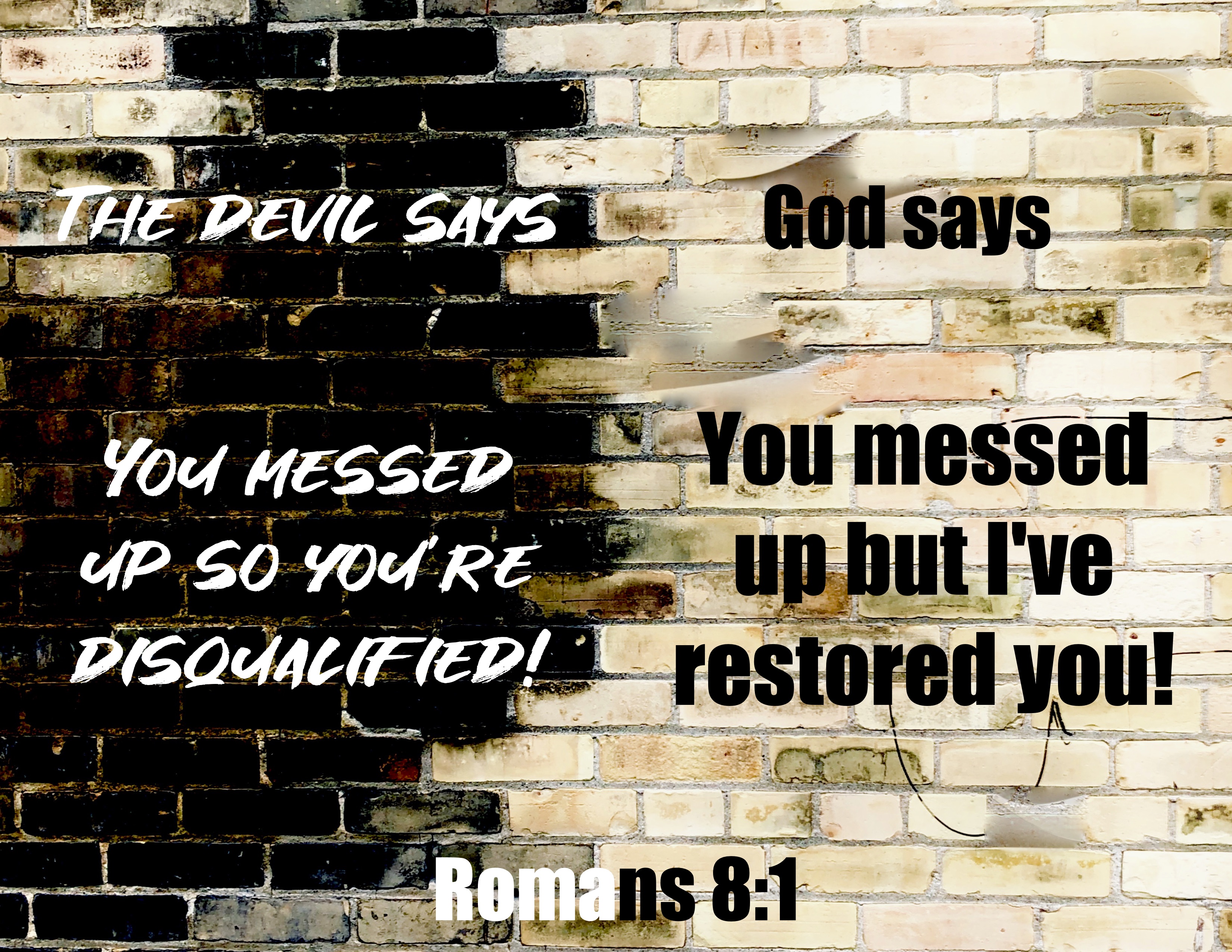
First, we need to talk back to our old family. The name “satan” means accuser: he accuses, condemns, slanders, and does his best to separate. When a Christian has been adopted into God’s family, there is no condemnation for the one who now calls God, “Abba Father” (see Romans 8:1-17).
This is where we need to call out satan’s lies. I mean literally call them out. We need to talk back to the devil and tell him the truth, just as Spurgeon said in his example of talking back to the Law. Let me say it again: literally speak the truth out loud. The devil needs to hear it and your own ears need to hear it too: “I am no longer subject to your jurisdiction. You have no say over me any longer. I am a child of God. My sins have been forgiven and forgotten; therefore, there are no grounds left for any condemnation!”
Second, we need to talk back to our old nature. After being adopted into God’s family, the Holy Spirit undertakes a process to conform us to the image of Jesus. This process is called sanctification, but I like to call it saint-ification.
This is where we call out what we used to be. And, again, I challenge to literally speak these words out loud. Don’t say, “I’m so impatient,” but tell yourself (out loud!), “I am becoming the patient saint Jesus wants me to be.” Don’t say, “I’ll never get this right,” but tell yourself, “I am learning more and more about Christ’s nature with each attempt.” Talk back to these old habits from your old family, and tell them about the new saintly habits the Holy Spirit is developing in you.
The book of Revelation tells us that the saints overcame the slanderous devil by the blood of Jesus and by the words of their testimony. Speak out those life-affirming words every time that slanderer tries to make you forget into whose family you have been adopted!



 the challenge for leaders when things are changing