Fight Like Jesus

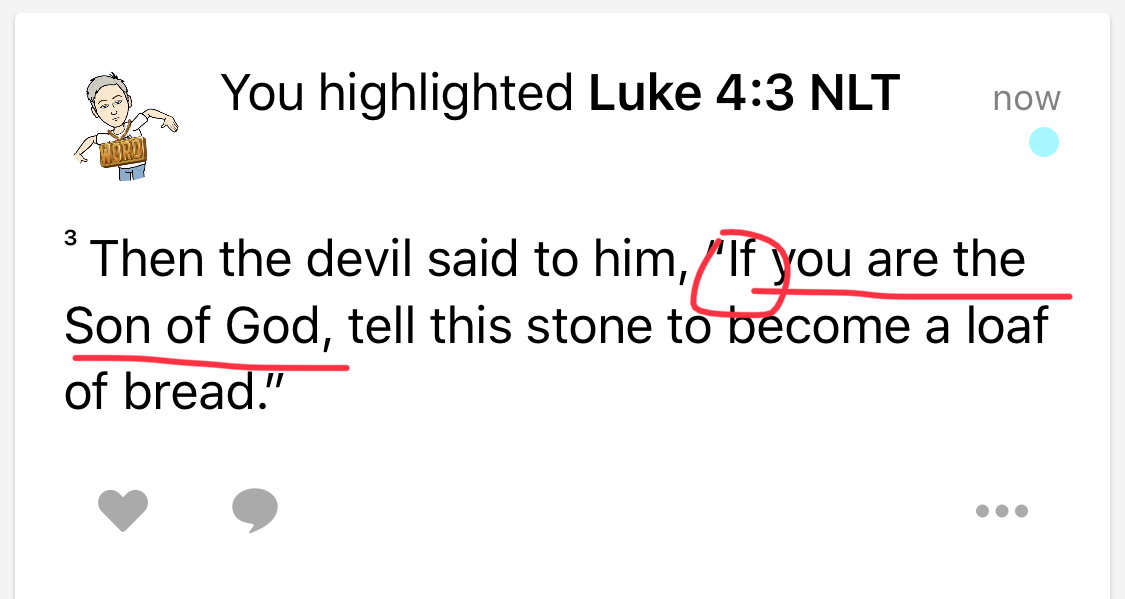
God announces to the world that Jesus is His Son, but as soon as the devil has an opportunity to tempt Jesus he begins with, “IF You are the Son of God….

“This is the bedrock of EVERY temptation. If satan can cause us to reject, doubt, or forget our original identity as beloved sons and daughters of the King, he can get us to fall for any number of tricks and non-satisfying pleasures.” —Honoring Christ In Human Rights (a YouVersion reading plan)

The devil has always been a slanderer and a prosecutor—always leveling charges against God’s children, trying to get them to feel unworthy of God’s love. He still does this today. 

Don’t let him. It’s time to fight back!

How?

We read in Revelation: “For the accuser of our brothers and sisters, who accuses them before our God day and night, has been hurled down. They triumphed over him by the blood of the Lamb and by the word of their testimony” (Revelation 12:10-11).

Jesus—the Lamb of God—shed His blood for you. You have been purchased with an amount that is incalculable. You have so much worth to your Heavenly Father! You did nothing to earn this payment of blood, you just receive it by faith. 

But we also need “the Word.” Notice that every time the devil attacked Jesus, He responded by saying, “It is written,” and then He quoted the Word (see Luke 4:1-12). We must do the same. 

When the devil says you’re unworthy of God’s love, you say, “It is written, ‘There is no condemnation for me because I am covered by the blood of Jesus’” (Romans 8:1).

When the devil says God can’t or won’t help you, you say, “It is written, ‘If God did not spare His own Son, but gave Him up for me—how will He not also graciously give me everything I need?’” (Romans 8:32). 

When the devil says you can’t resist his temptations for very much longer, you say, “It is written, ‘Greater is He that is in me than anything you’ve got. I have submitted myself to God and I will not give in to you, so you must flee from me!’” (1 John 4:4; James 4:7).

When the devil says you’re all alone in this world, you say, “It is written, ‘God said He would never leave me, and His Spirit is inside me right now and forever’” (Hebrews 13:5; John 14:16-18).

Dear friend, the blood of the Lamb covers you. Now use His Word to refute every single charge the devil tries to use to slander you. 

9 Prayers From “Praying The Promises”

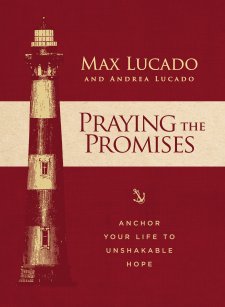
In Praying The Promises, Max Lucado gives us valuable instruction on how to turn Scriptural promises into powerful prayers. Here are a few of those prayers (the biblical reference in brackets is the passage that helped form the prayer). 

Thank you for being a God who wants me to know You.… Your wisdom surpasses all wisdom on this earth. Your ways are so much higher than mine. I could study You and Your Word for the rest of my life and still only scratched the surface of the depths of who You are. You are at once knowable and unknowable.… Deepen my knowledge of You, God. [Psalm 19:1-2; Isaiah 55:8-9; Romans 1:19-20]

Help me rely on Your promise of grace because I have been found righteous through Jesus. When trouble comes, use those troubles to increase my faith and draw me nearer to You. [Hebrews 7:25]

Father, sometimes I convince myself that I need to earn Your salvation. I feel like I should do more, be more, and achieve more. But You simply want my faith. Help me let go of my striving and this need to perform for You and for others. [Romans 4:5; Philippians 3:4-7] 

Guide me during the difficult times. Give me hope as I pray and wait. Remind me of Your power and authority so that I will trust Your ways, even when I can’t see where the path before me is going. [Genesis 50:20-21; Ephesians 1:11-12; Romans 5:3] 

Forgive me when I look for guidance outside of Your Word. When I ask friends what to do before I open my Bible. When I am resistant to reading Your Word because I want to guide myself rather than be guided by You. Renew my desire and passion for reading the Bible. … May I learn something new about You and Your character each time I read it. [Psalm 32:8; 2 Timothy 3:16-17] 

When a worry arises, remind me of Your presence so I will turn to You and not fear. [Psalm 23:1, 4]

Gracious Father, nobody is beyond Your redemption. Because of Your love and mercy, You provided a Redeemer for us in Christ, who graciously stopped us while we were on the path of sin, gave us refuge, and pointed us toward the road of redemption. [Galatians 4:4-5]

Forgive me when I try to fight my own battles. … If I try to fight for myself, I end up feeling exhausted and defeated by my own efforts. You have said You are fighting for me. Help me believe that truth even when I am so tempted to fight for myself. Go before me this week as I face temptation. Go before me as I face anxiety, fear, and uncertainty. Protect me in every spiritual battle. Fight for me and help me surrender each battle to You. [Exodus 14:14; Deuteronomy 1:30; Psalm 20:7-8]

As concerns and questions come up, remind me to turn each of them over to You in prayer. I lift up my family to You. I lift up my work to You. I lift up my to-do list to You. Cover each worry with Your peace. Prioritize my day so that it aligns with Your will and not mine. [1 John 5:14]

You can check out my review of Praying The Promises by clicking here, and you can read some other quotes from this book by clicking here.

The Power Of Praying Scripture

I have always been a huge proponent of allowing the Scriptures to help form my prayers. I think there is great value in speaking God’s Word back to Him. 

“Knowing God’s Word helps us pray, and praying helps us know God’s Word.” —Craig T. Owens

I am currently reading Max Lucado’s book Praying The Promises in which he makes the same case. For instance, consider the following passages—

The rain and snow come down from the heavens and stay on the ground to water the earth. They cause the grain to grow, producing seed for the farmer and bread for the hungry. It is the same with My word. I send it out, and it always produces fruit. It will accomplish all I want it to, and it will prosper everywhere I send it. (Isaiah 55:10-11) 

[Abraham] was fully convinced that God is able to do whatever He promises. (Romans 4:21) 

For no matter how many promises God has made, they are “Yes” in Christ. And so through Him the “Amen” is spoken by us to the glory of God. (1 Corinthians 1:20) 

Here’s how Max Lucado turned those passages into a prayer—

Lord, You are the Maker and Keeper of promises. Your Word does not return void. When You say You will do something, You do it. You are able to do whatever You promise. So many years ago You made a covenant with Your people, and You have been faithful to the covenant.

Sometimes it is easier to put my faith in my circumstances rather than in Your promises. I want to rely on myself, my earthly possessions, and the people in my life, but these so often fail me. But Your promises will never fail me!

As I read through Your promises, give me a new passion for them. Show me what promises I have forgotten over the years and need to cling to again. Reveal Your true character to me. Remind me of the power of Your love and Your grace. Strengthen my faith, and teach me to lean on Your Word rather than on myself.

Thank You for keeping Your promises. I’m grateful for the ultimate promise I have in Your Son, Jesus. Amen.

Why don’t you start making this a regular habit yourself.

Christian Citizenship = Stewardship

“For the Christian, citizenship is about stewardship. That’s especially true in a country where our most important governing document begins with ‘We the People.’ That means we have a lot of responsibility. …  

“God has ordained a government as one way that He shows grace to all people. Government should recognize the God-given duty of human beings and respect the roles and responsibilities of family and church. Government is to keep the peace through the rule of law and to use force to punish those who break it. The role of government is to maintain justice and peace in society so other institutions, especially the family in the church, can do what they are designed to do. …

“Christians should enter the public square with a biblically shaped perspective. To apply a Christian worldview to questions of public policy is not exercising self-interest. It is simply serving our neighbor by testifying to the way God has made the world.” —Jennifer A. Marshall 

For the Christian, citizenship is about stewarding the responsibilities God has given us to the countries in which we live. Those include things like:

  1. Showing proper respect to those in leadership positions (Romans 13:1-6)
  2. Submitting like we’re servants of the King of kings (1 Peter 2:13-17)
  3. Praying for our leaders (1 Timothy 2:1-4)
  4. Voting for those people who uphold biblical principles

“All the opportunity for self-government through the rule of the people depends upon one single factor. That is the ballot box. . . . The people of our country are sovereign. If they do not vote they abdicate that sovereignty, and they may be entirely sure that if they relinquish it other forces will seize it, and if they fail to govern themselves some other power will rise up to govern them.” —President Calvin Coolidge

The Selah That Keeps Us From Sinning

There is a very natural emotion that we humans have when someone has hurt us, but if we don’t pause (Selah), that natural emotion can lead us into sin. David has good counsel for angry people in Psalm 4. 

Many scholars think that Psalm 4 is a continuation—or a part 2—of Psalm 3. As you will notice in the preface of Psalm 3, David is on the run from his son Absalom, who is trying to steal the kingdom of Israel from him. 

Look at the swing of David’s emotions:

  • Troubled/sad (v. 1) 
  • Anger (v. 4)
  • Contentment (v. 7)
  • Peace (v. 8)

The first time David tells his readers to Selah pause is between verses 2 and 3. The change is almost an about-face: 

Look at this: look who got picked by God! He listens the split second I call to Him. Complain if you must, but don’t lash out. Keep your mouth shut, and let your heart do the talking. Build your case before God and wait for His verdict (vv. 3-5 in The Message). 

My friend Josh Schram shared these truths: 

  1. Don’t sin by letting anger control you. 
  2. It’s right to be angry, but it’s not right to sin. 
  3. When someone hurts us, it’s tempting to break God’s law. We can almost justify it, but it is a sin to give in to anger. 

“Search your heart and be silent”Selah. This pause gives us hope that we can “build your case before God and wait for His verdict.” 

In Romans 12:17-21, Paul gives similar counsel when dealing with enemies:  As far as it depends on you…

  • Don’t repay evil for evil. 
  • Do repay evil with doing what’s right. 
  • Don’t take revenge. 
  • Do let God handle it. 
  • Don’t mistreat your enemies. 
  • Do bless your enemies. 
  • Don’t be overcome by evil. 
  • Do overcome evil by doing good. 

Since David let his anger go, that also means he didn’t sin! His clear conscience meant he could lie down and sleep in peace. 

You cannot hold a grudge and peace in the same heart. 

Please join me next week as we continue our look at the Selahs in the Book of Psalms. 

God’s Gift To The World

You are a gift. You are God’s grace gift to the world. 

Max Lucado said it this way: “You are you-nique. 

God made you on purpose and for a purpose.

God implanted unique abilities in you from conception (see Psalm 139:13). And check out what God said to Jeremiah, “Before I formed you in the womb I knew and approved of you…” (Jeremiah 1:5). Before you were even conceived, God already knew all about you AND He approved of you! 

Why did God implant these unique abilities in you? Because He knew of the unique opportunities you would face during your lifetime (see Psalm 139:16). Because God is for you, He gave you all that you would need to successfully face every opportunity that came your way. 

Every one of us has been given these grace gifts of unique talents and opportunities. The Bible says, “to each one of us grace has been given as Christ apportioned it” (Ephesians 4:7). If God is for you, and God is for me, then that means that you have been gifted to be a blessing to me and I have been gifted to be a blessing to you (Romans 12:3-6; 1 Corinthians 12:4-7).

Let me state it again: every one of us has been entrusted by God with unique talents in order to successfully face the unique opportunities that He knew we would face. Jon Bloom reminds us, “Some are given more, some are given less, but all are given much.” 

So what do we do with what we’ve been entrusted? There are two possibilities: (1) We can invest our talents and abilities in a way that glorifies God, or (2) We can squander the talents God has given us. 

How do you squander the grace gift of your life? 

  1. Not discovering it—I have a gift?
  2. Devaluing it—I’m nothing special.
  3. Overvaluing it—I’m super-important. I don’t need anyone else.
  4. Laziness—I don’t want to mess it up, so there’s no need for me to invest my gift.
  5. Short-sightedness—My gift is just for me, so it doesn’t matter what I do with it.

I hope we can all say what Erma Bombeck wrote: “When I stand before God at the end of my life, I would hope that I would not have a single bit of talent left but could say, ‘I used everything You gave me.’”

How do you honor God with your you-niqueness? I can tell you in just three simple words—You be you! 

If you will just be who God made you—not downplaying your talents, not wishing you had someone else’s talents—that’s when you will feel fulfilled, and God will be glorified, and the rest of the world will be blessed! So…

YOU BE YOU! 

Is It Really The 11th Hour?

When we’re down to the last minutes before a crucial deadline, we often refer to it as “the eleventh hour.” 

Have you been there? You’re sweating it out, wondering if God is going to come through for you. Or perhaps thinking about what you might need to handle yourself in order to meet the deadline. And then God comes through for us, and we let out a deep sigh of relief and gratitude. 

But why a sigh? Were we worried that God wouldn’t come through? Did we think God’s supply was limited? And what made us think that it was “the eleventh hour” anyhow? 

What we often think is the eleventh hour is really God’s first hour! God is never late. He’s never scrambling to come up with what we need. We might be the ones “scrambling,” but God never is. He always has the perfect resources at the perfect moment. 

We should know this because the Bible tells us: God who did not spare His own Son, but gave Him up for us all—how will He not also, along with Him, graciously give us all things? (Romans 8:32) 

Jesus tells a story about an eleventh-hour situation in Matthew’s Gospel. Men were waiting around to work for the day when a landowner came along to hire them. He hired some guys first thing in the morning and agreed to pay them a full day’s pay. He hired some other workers at 9:00 AM and promised to pay them fairly, and then he hired even more workers at noon and at 3:00 PM, also promising to pay them what was fair. Finally, he hired some workers at 5:00 PM—literally at the eleventh hour—without any mention of pay. 

At the end of the day, every single worker was paid a full day’s wage. Every single one of them. Jerry Bridges notes why this is significant: 

“Each worker, regardless of how long he had worked, received a day’s wages. He received not what he had earned on an hourly basis, but what he needed to sustain his family for a day. … Those eleventh-hour workers were hired because they needed to receive a day’s wages. They had been standing all day waiting for someone to hire them so they could earn money to support their families. They needed to work more than the landowner needed their work. He hired them, not because of his need, but because of their need.” (emphasis added)

You see, God knows what you NEED and He generously supplies that NEED right on time.

Jesus taught us to pray, “Give us this day our daily bread.” The problem comes when we start looking down the road wondering what’s going to happen tomorrow, and the next day, and the next day (see Matthew 6:11, 31-34). 

God’s favor toward us is out of all proportion to our work or sacrifice. He gives exactly what we need, exactly when we need it. 

If you’re feeling anxious—like the clock is ticking down to the eleventh hour—perhaps you should recall how God has provided for you in the past. Then discipline your thoughts from running ahead to tomorrow as you pray, “Give me this day what I need.” 

Here’s a prayer I’m praying—

“God, I remember the wonderful deeds You have done for me. They are constantly in my thoughts. I cannot stop thinking about Your mighty works in the past. Therefore, I ask you today for my daily bread. Let my heart be on guard against scrambling as though I were in an eleventh-hour situation. You are my all-loving, all-gracious Father. You know what I have need of even before I ask. May my attitude be one of assured contentment in your abundant, right-on-time supply. May you be glorified as others see this confidence in my attitude.”

God Is For You!

I’m going to make a statement that might shock some people. 

Some of you who have been around Christianity might have heard this before, and you may even mentally agree with it. But even people who mentally agree with it want to add a “Yeah, but…” to it. Or they mentally agree with it but don’t live like it’s true. 

Ready? Here it is … 

God is for you.

Far too many people mistakenly think God is looking for an opportunity to punish them; He’s trying to catch them doing something wrong; He’s perched on the edge of heaven with lightning bolts of judgment in His hand. God doesn’t want to blast you; He wants to bless you! 

Although the word favor appears quite frequently in Scripture, God’s favor is also implied in the word grace, which means God’s unmerited favor. 

It’s unmerited because none of us is worthy of God’s favor; it’s not something anyone can earn. We have all sinned, and therefore we’re all worthy of the death penalty. Every single one of us! 

I have worshipped idols, I have blasphemed God’s name, I have broken the Sabbath, I have dishonored my parents, I have coveted, I have lied, I have committed adultery, and I have murdered. And so have you (see James 2:10).

Do you understand what Jesus did for us on the Cross? HE SWITCHED PLACES WITH US!

Jesus became my sin, and He made it possible for me to become His righteousness (2 Corinthians 5:21). Check this out: 

For God took the sinless Christ and poured into Him our sins. Then, in exchange, He poured God’s goodness into us!

“It was because of His grace that God the Father sent His only Son to die in our place. To say it another way, Christ’s death was the result of God’s grace; grace is not the result of Christ’s death.” —Jerry Bridges

Don’t allow the devil’s lies of your unworthiness keep you from missing out on this truth. All of us are unworthy of God’s favor. But God demonstrated that He was for us when Jesus died on the Cross in our place. Now there is no more guilt, no more condemnation, absolutely nothing standing in the way of all of God’s unmerited favor because 

GOD IS FOR YOU! 

Join me next Sunday as we continue with our series called God’s Favor. You can either join me in person or on Facebook Live.

God’s Favor

What if I were to tell you that God is for you? 

What if I were to tell you that God wants to bless you? 

What if I were to tell you that God’s favor is constantly pursuing you? 

Well, here’s me telling you that it’s all true! 

“Since God did not spare even His own Son but gave Him up for us all, won’t He also give us everything else?” (Romans 8:32). 

Why would God do this? Because if you feel distant from Him, how can you glorify Him? If you feel disconnected from His love, how will you draw others to Him? If you feel like your relationship with Him is hanging by a thread, how can you happily abide in His presence? 

Knowing God’s favor is the key to living the abundant life Jesus purchased for you on the Cross! 

Join me this Sunday as we begin a new series exploring the wonderful depths of God’s favor. You can join me in person at Calvary Assembly of God, or tune in on Facebook Live at 10:30am Sunday morning.

If you missed any of the messages in this series, you can catch up here:

A.L.I.V.E.—The “E” Is For Engagement Of Christ’s Followers

Let’s get some insight into the Greco-Roman and Jewish mindsets of the first century AD. Specifically, the mindset of men. 

There is a well-known letter written June 17, 1 BC, from a man named Hilarion, who was gone off to Alexandria, to his wife Alis, whom he has left at home. He writes to her: “If—good luck to you—you bear a child, if it is a boy, let it live; if it is a girl, throw it out.” This letter captures the male-dominated mindset in the Roman world concerning women and children. In a word: inferior or even disposable. 

This mindset wasn’t limited to the world the Jews called “pagan,” but it was prevalent in Judaism too. Every day Jewish men began their morning prayer time with, “God, I thank You that You did not make me a Gentile, a slave, or a woman.” 

With this background, it makes it startling that a Jewish man (who prayed that prayer thousands of times) writing to people in Rome (who undoubtedly had the same mindset as Hilarion), begins his list of thank you notes with gratitude to two women! Paul goes on to list no less than 8 women, even giving preferential treatment to a wife (Priscilla) over her husband (Aquila) when he mentions her name first! (see Romans 16:1-4, 6, 12).

William Barclay wrote, “Anyone who asks the question: ‘What has Christianity done for the world?’ has delivered himself into a Christian debater’s hands. There is nothing in history so unanswerably demonstrable as the transforming power of Christianity and of Christ on the individual life and on the life of society.”

Indeed Christians changed the lives of at least four groups:

  1. Women (especially in the role of marriage)—divorce was so common that it was neither unusual nor particularly blameworthy for a woman to have a new husband every year. Yet Christians taught men to esteem their wives and for marriage to be honored by everyone (Ephesians 5:28; Hebrews 13:4). 
  2. Children—who weren’t even considered a part of the family until they had grown up and proven their worth to the father. Yet Christians taught fathers to nurture their children (Ephesians 6:4).
  3. Senior citizens—the pragmatic Romans had little to do with those they considered less valuable. But the first blind asylum was founded by Thalasius, a Christian monk; the first free medical dispensary was founded by Apollonius, a Christian merchant; the first hospital of which there is any record was founded by Fabiola, a Christian lady.
  4. The weak and sick—when a plague hit Rome, all the young, healthy people left the sick and elderly behind. They ran away, but the Christians stayed to help. The Christians taught that everyone (regardless of age, sex, or wealth) was valuable (1 Timothy 5:1-2). 

That was just the start of Christianity. Men like William Wilberforce and Abraham Lincoln were Christians who opposed slavery; Clara Barton was nicknamed “the angel of the battlefield” and founded the Red Cross; Paul Brand was a doctor who ran to leprosy patients when everyone else shunned them; Mother Teresa loved those poor, dying souls whom others ignored. 

So what’s your conclusion? Throughout history Christians have been martyred for their faith, but not only are they willing to die for their belief that Jesus is alive, but they continue to do good to those who persecute them. Would people do this to perpetuate a hoax? Or does this sound more like the real deal?

Please check out the other evidence I have presented for the resurrection of Jesus: