Refined By The Fire

Where is God in our trials? When we call, Jesus runs to our cry. He is able to help us because He knows exactly what our cries sound like. Aren’t you glad He does?! 

While we are in these difficult times, you might find yourself asking a question I have asked, “Okay, God, I believe You are doing something, but what exactly are You doing?” 

I can’t tell you specifically what God is doing in your life, because your story is unique and special. But I can tell you that during the hard, painful chapters of our lives, God is accomplishing at least five things in all of us.

  1. God is opening our eyes to new paradigms

We will learn lessons in these fiery trials that we couldn’t possibly learn any other way. 

  1. God is building empathy in us which we didn’t have before

One dictionary defines empathy as “the power of understanding and imaginatively entering into another person’s feelings.” It’s only because of our trials that we no longer have to imagine what someone else is feeling, but instead we know exactly what they’re feeling and how we can help. 

  1. God is growing our patience 

It’s been said that patience is the “mother of all other virtues.” Paul said that “these troubles produce patience” (Romans 5:3). As God grows your patience, He will also help you to grow all of the other Christlike virtues. 

  1. God is refining His character in us 

Paul went on to add that not only does trouble produce patience, but “patience produces character” (Romans 5:4). During the times of difficulty and uncertainty, we become more aware of deficiencies in our character. 

  1. God is building in us an unshakable hope in His future grace 

Hope is not wishful thinking; it’s well-founded believing! 

I want to circle back to that word refining because I think that best sums up what God is doing in our painful times. Romans 8 tells us—The Spirit Himself thus testifies together with our own spirit, assuring us that we are children of God. And if we are His children, then we are His heirs also: heirs of God and fellow heirs with Christ—sharing His inheritance with Him; only we must share His suffering if we are to share His glory. But what of that? For I consider that the sufferings of this present time—this present life—are not worth being compared with the glory that is about to be revealed to us and in us and for us and conferred on us! (Romans 8:15-18) 

So where’s God in this time of fire? He is overseeing our trial as a Perfect Refiner. Do you know how the silversmith knows he has purified the impurities from the silver ore? The silver is pure when he can see his own reflection in the silver! 

In the heat of your trial, God is close to you. He knows the perfect temperature and the precise time that it will take to allow His face to be seen in you! 

Sometimes you will see what God is doing through your furnace time, sometimes you won’t. But don’t ever bail out! God IS working! He is giving you a new perspective, a deeper empathy, more patience, an unshakable hope, and most of all—He is removing the impurities that will allow His face to be seen more clearly in you! 

Join me this Sunday as we continue to learn where God is in our darkest times. And if you didn’t catch the previous messages in this series, please check out The God That Runs To You and How Long Will This Last?

On Living In A [COVID-19] Age

In 1948, World War II had come to a close and the nuclear age had dawned. The Cold War was beginning to ratchet up and the fear of nuclear annihilation was gripping people’s hearts. 

In this environment, C.S. Lewis wrote an essay entitled On Living In An Atomic Age. I have changed the word “atomic” for “COVID-19,” and I think you will see the relevance. 

In one way we think a great deal too much of the COVID-19 virus. “How are we to live in a COVID-19 age?” I am tempted to reply: “Why, as you would have lived in the sixteenth century when the plague visited London almost every year, or as you would have lived in a Viking age when raiders from Scandinavia might land and cut your throat any night; or indeed, as you are already living in an age of cancer, an age of syphilis, an age of paralysis, an age of air raids, an age of railway accidents, an age of motor accidents.”

In other words, do not let us begin by exaggerating the novelty of our situation. Believe me, dear sir or madam, you and all whom you love were already sentenced to death before the COVID-19 virus was invented: and quite a high percentage of us were going to die in unpleasant ways. We had, indeed, one very great advantage over our ancestors—anesthetics; but we have that still. It is perfectly ridiculous to go about whimpering and drawing long faces because the scientists have added one more chance of painful and premature death to a world which already bristled with such chances and in which death itself was not a chance at all, but a certainty.

This is the first point to be made: and the first action to be taken is to pull ourselves together. If we are all going to be destroyed by the COVID-19 virus, let that virus when it comes find us doing sensible and human things—praying, working, teaching, reading, listening to music, bathing the children, playing tennis, chatting to our friends over a pint and a game of darts—not huddled together like frightened sheep and thinking about viruses. They may break our bodies (a microbe can do that) but they need not dominate our minds.

For Christians, I would urge you to think in ways in which I am certain C.S. Lewis would agree: 

Set your minds on things above, not on earthly things. (Colossians 3:2) 

Finally, brothers and sisters, whatever is true, whatever is noble, whatever is right, whatever is pure, whatever is lovely, whatever is admirable—if anything is excellent or praiseworthy—think about such things. (Philippians 4:8) 

Be joyful because you have hope. Be patient when trouble comes, and pray at all times. (Romans 12:12)

Acceptable And Pleasing

…acceptable to the Lord … an aroma pleasing to the Lord… (Leviticus 1:3, 9). 

Whether it’s a sacrifice or a lifestyle, these two phrases sum up the goal of obeying all of God’s directives: acceptable and pleasing. 

“But,” you might say, “there is a lot of law to obey—a lot! 

And I would agree with you. Beginning with the Ten Commandments in Exodus 20 and going all the way through Numbers 9, there are 56(!) chapters of regulations.

“And I’m supposed to follow all of those?!” 

Yes! Every single one of them. And not just those, but also the innumerable man-made rules that were added on top of all of those laws. 

In the opening words of Leviticus, two key words emerge:

  • Acceptable to the Lord 
  • An aroma pleasing to the Lord

“How can I ever get there?” 

YOU can’t! 

For EVERYONE has sinned; we ALL fall short of God’s righteous standard (Romans 3:23 NLT). 

For NO PERSON will be justified—made righteous, acquitted, and judged acceptable—in God’s sight by observing the works prescribed by the Law… (Romans 3:20 AMP). 

But here is our hope—Blessed be the God and Father of our Lord Jesus Christ, Who has blessed us with every spiritual blessing the heavenly places in Christ…to the praise and of the glory of His grace, by which HE MADE US ACCEPTABLE in the Beloved (Ephesians 1:3, 6 NKJV). 

And when we are in Christ, we also become an aroma pleasing to God—Our lives are a Christ-like FRAGRANCE rising up to God (2 Corinthians 2:14-17 NLT). 

On our own, we cannot accomplish any of this. But in Christ we are both ACCEPTABLE to the Lord … and an aroma PLEASING to the Lord…. 

What’s In A Name?

Leah became pregnant and gave birth to a son… (Genesis 29:32). 

Jesus said that ALL the Scripture pointed to Him (John 5:39). That means even the various names of people in the Scripture give us some insight into the nature of Jesus. 

Consider Jacob and his sons, who become the fathers of the tribes of the nation of Israel. Jacob the deceiver is transformed into Israel the guileless, and the names of his sons point to what Jesus does to transform all of us into His righteous brothers and sisters. 

[Check out the links posted below to read all the Scripture references.]

Reuben—God sees my misery and sends His Son (Genesis 29:32; John 3:16). 

Simeon—God sent His Son when I was unlovable (Genesis 29:33; Romans 5:6-8). 

Levi—after I am saved from my sins, I am joined to God (Genesis 29:34; Ephesians 2:1-5).

Judah—my salvation brings praise to God (Genesis 29:35; John 15:8).

Dan—God has vindicated me in Jesus (Genesis 30:6; John 8:11).

Naphtali—Christ’s righteousness has given me victory over my struggles (Genesis 30:8; Romans 8:1; 1 Corinthians 15:54-56). 

Gad—God’s favor now advances toward me like an unstoppable troop (Genesis 30:11; Romans 8:31-39). 

Asher—I am now able to enjoy God’s happiness (Genesis 30:13; Matthew 25:21, 34). 

Issachar—God IS my reward (Genesis 30:18; Revelation 3:20-21).

Zebulun—my Husband (Jesus) honors me (Genesis 30:20; Ephesians 5:22-23; Hebrews 2:11).

Joseph—God has taken away my disgrace and added His blessing (Genesis 30:24; Romans 8:1, 32).

Manasseh—God has made me forget my past (Genesis 41:51; Psalm 103:12).

Ephraim—God has made me abundantly fruitful (Genesis 41:52; 1 Peter 2:9-10).

Benjamin—I am God’s son (Genesis 35:18; Ephesians 2:6)! 

God has done ALL this—and more!—through Jesus! 

When you read the Bible, don’t rush through it. Slow down. Meditate on it. Soak in it. And then see how the Holy Spirit will illuminate truth to you. 

[Please check out the Bible references I’ve listed above for yourself. All of the Genesis references are here, and all of the other references are here.]

God Keeps His Word

…as He had said… (Genesis 21:1-7).

This thought—and even the phrase itself—permeates the Bible. From the very beginning of Time itself, whatever God says—happens!

His word is His bond: What He had promised (v. 1b). There are no loopholes, no equivocations. When God says it, it is signed, sealed, delivered!

When is His word accomplished? From the moment He says it. His word cannot be altered nor delayed. We simply wait for its fulfillment: At the very time God had promised (v. 2).

This also means that I must obey what God says. If His word is immutable, my faith and obedience must be just as steadfast. Just like Abraham: Abraham circumcised him, as God commanded him (v. 4).

Jesus said that the Holy Spirit would help remind us of everything God has said. The same Word that tells us God’s promises is also the same Word that sparks the faith to believe His Word (Romans 10:17). 

Get God’s Word.
Believe He will fulfill it in His timing. 
Obey everything He says.
Laugh in joy when you see His word accomplished: God has brought me laughter (v. 6)! 

A Praying Family

Not one word in Scripture is wasted: not one word is redundant or replaceable. When Jesus taught us to pray to a Heavenly Father, He taught us to say, “OUR Father.” That means we are all His children, with His Holy Spirit helping us to grasp this—The Spirit Himself testifies with our spirit that WE are God’s children. Now if WE are children, then WE are heirs—heirs of God and co-heirs with Christ… (Romans 8:16-17). 

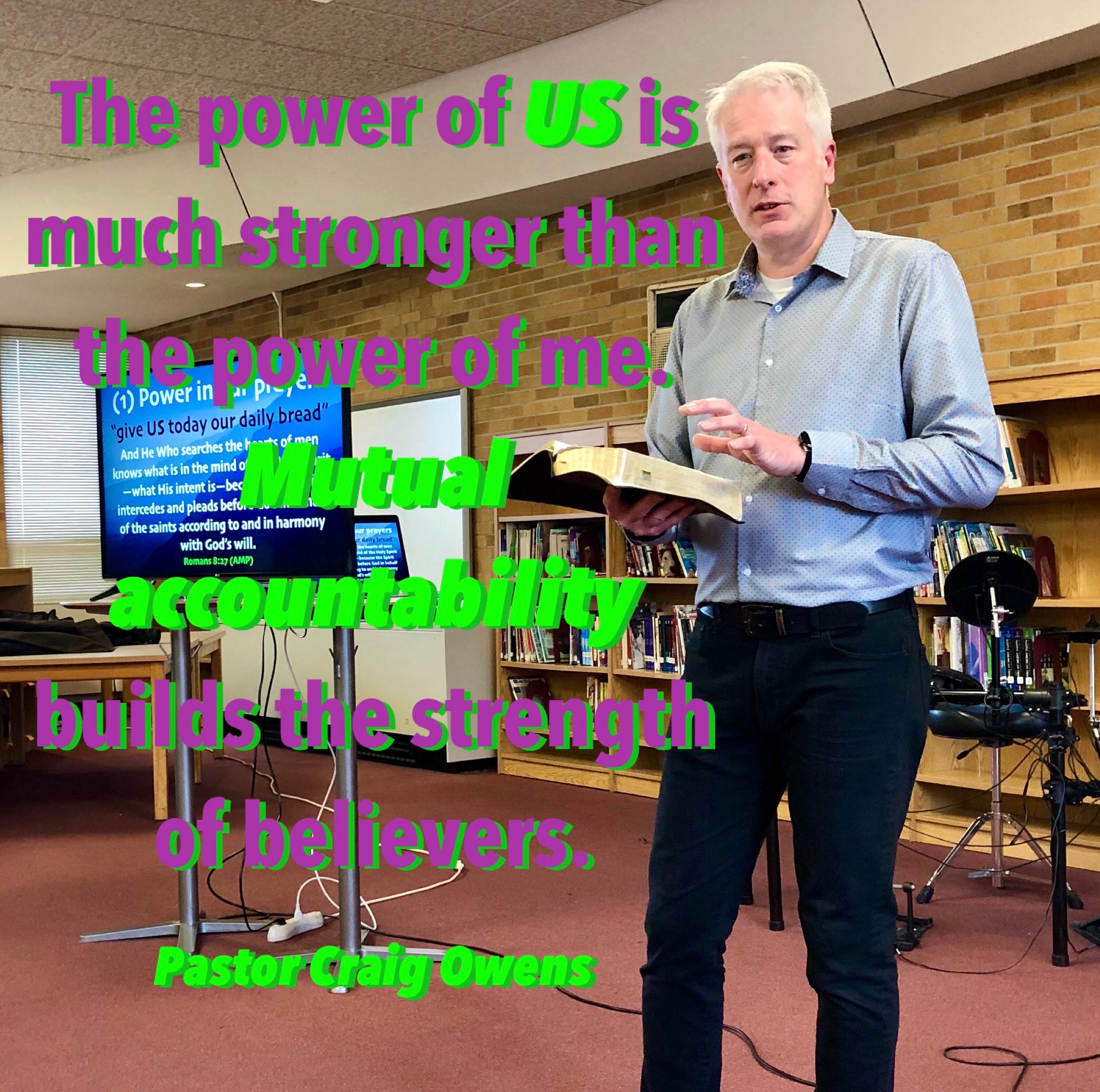
Did you know that the word saints never appears in the singular in Scripture? No one person is singled out for his or her saintliness. Because we are saintS, praying together to OUR Father, this means accountability. For some people, accountability is a bad word. It seems to them to feel like someone is looking over their shoulder or checking up on them. But Christians should never feel this way! I like how Ken Blanchard defines this: “Accountability means: We owe each other for something we’ve agreed upon.” 

What have the saints of God agreed upon? That God is our Father, that Jesus is His Son and our Brother, and that the Holy Spirit is our Helper. We’ve agreed that if we are brothers and sisters in God’s family, we are mutually accountable to one another. 

In the context of the prayer Jesus taught us to pray, being mutually accountable means: 

  1. Power in our prayersgive US today our daily bread. Jesus talks about the power in agreement, and the apostle Paul emphasizes how the Holy Spirit helps believers harmonize in prayer with each other and with God’s will (Matthew 18:19-20; Romans 8:27). 
  1. Strengthening of our characterforgive US our debts, as WE also have forgiven our debtors. Jack Hayford points out that, “The believer’s best defense against self-deception is through mutual accountability to one another.” In order for our character to be strengthened, we have to allow others to speak into our lives—even the lovingly painful words (Proverbs 27:17, 6). 
  1. Protection from falling to temptationlead US not into temptation, but deliver US from the evil one. Samson became entangled with a prostitute when he was all by himself; Elijah became depressed when he sent his servant away; David fell into sin when he was alone; Peter denied Christ when all of the other disciples had run away. That’s why the writer of Hebrews counsels us to stick close to our Christian family members (Hebrews 10:21-25). 

In an earlier post, I noted that how we view God is going to determine what we pray and what we expect after we pray. Coming together and praying together will help us see God better. Just as the angels around the throne are always crying out to each other “Holy! Holy! Holy!”, when we come together we can show our fellow saints what we’ve learned about our holy Father’s love and power. This is both an encouragement to others and allows others to be an encouragement to us too. Then together we can pray more boldly and expect great things in response to our prayer. 

Being mutually accountable to the saints in prayer…

  • hallows God as our Father

  • glorifies Jesus as our Brother

  • honors the Spirit as our Helper

God never intended that you would have to walk through life alone. He wants us to share the journey with fellow saints—His family made up of our brothers and sisters. This praying family truly honors God’s name! 

Join me on Sunday as we continue to learn more about prayer. 

Prayer Expectations

Many of our prayers could be much bolder and much more specific than they are. Why is that? Because how we view God is going to determine what we pray and what we expect after we pray.

When we pray, we approach an All-Loving Father, and we approach an All-Powerful God. I have found that typically people get warmed by the idea of Father and get scared by the idea of God. They say things like: “What if my prayers don’t hallow God’s name? What if He’s mad at me? What if I pray an improper prayer?” 

God wants us to come to Him in prayer, so He makes Himself very accessible! The Father is both Father and God; the Son is both Friend and King; the Spirit is both Comforter and Convictor. We get ALL of this in One God. 

Charles Spurgeon had this word of encouragement: “If You are my Father, then You love me. If I am Your child, then You will regard me, and poor though my language is, You will not despise it.” Jesus came to earth fully God and fully man, making Him our perfect intermediary (see Job 9:32-35; 1 Timothy 2:5; Hebrews 7:25). And the Holy Spirit helps interpret our groaning prayers (Romans 8:26-27). 

Have you ever noticed that neither the prophets of the Old Testament, nor Jesus in the Gospels, nor the apostles in the New Testament ever prayed, “God, if this is Your will please do such-and-such”? They simply prayed. Or more accurately, they prayed so boldly and specifically it almost sounded like a command: “Stand up” or “Be clean” or “Go, your prayer has been answered.” 

When you and I are praying to an All-Loving and All-Powerful Father, with Jesus interceding for us, and the Spirit helping us, we too can pray these bold and highly specific prayers. 

After all, if you don’t pray specifically and expectantly, how will you know when your prayer is answered? 

I find John Piper’s acrostic very helpful in praying these bold and expectant prayers. He calls it APTAT: 

  • A—Admit I can’t do anything without Christ. This hallows His Name. 
  • P—Pray for help to do it. 
  • T—Trust a specific promise of God to help me (two general promises are found in Isaiah 41:10 and Romans 8:32). 
  • A—Act. Do the things I need to do: apply for the job, ask forgiveness, schedule a meeting. 
  • T—Thank Him when I’m done. 

Two final thoughts—

  1. Make prayer more of a listening relationship than a talking relationship. 
  2. Give yourself some grace as you are maturing; don’t expect immediate perfection. Start praying and then let the Father, the Son, and the Spirit help you mature in your prayer life. 

I hope you can join me this Sunday as we continue to work on our plans to pray.

Hallowed Be Your Name

Jesus was once asked, “What is the greatest commandment?” He responded by saying, “The Lord our God, the Lord is One,” and then saying we should love God with all our heart, soul, mind, and strength (which fulfills the first four of the Ten Commandments), and then love our neighbor as ourselves (which fulfills the next six of the Commandments).

To live this way, we need to pray this way too! That’s why Jesus taught us a model prayer—which we typically call “The Lord’s Prayer”—in which the first three petitions are for God’s glory (hallowed be Your name; Your kingdom come; Your will be done), and the next three petitions are for man’s help (daily bread, forgiveness, victory over temptation). 

Jesus says we can pray to our Heavenly Father, but we still need to remember that He is also the God of the Hallowed Name. The Greek word for hallowed is made up of two other Greek words: 

  • hagnos is something totally immaculate, blindingly pure, and unapproachable. The apostle Paul said this about God: Our Master, Jesus Christ, is on His way. He’ll show up right on time, His arrival guaranteed by the Blessed and Undisputed Ruler, High King, High God. He’s the only one death can’t touch, His light so bright no one can get close. He’s never been seen by human eyes—human eyes can’t take Him in! Honor to Him, and eternal rule! (1 Timothy 6:15-16) 
  • thalpo means cherished. The same apostle Paul also said that God has given us the right to approach Him as “Abba, Father” or “Daddy, God” (Romans 8:15). 

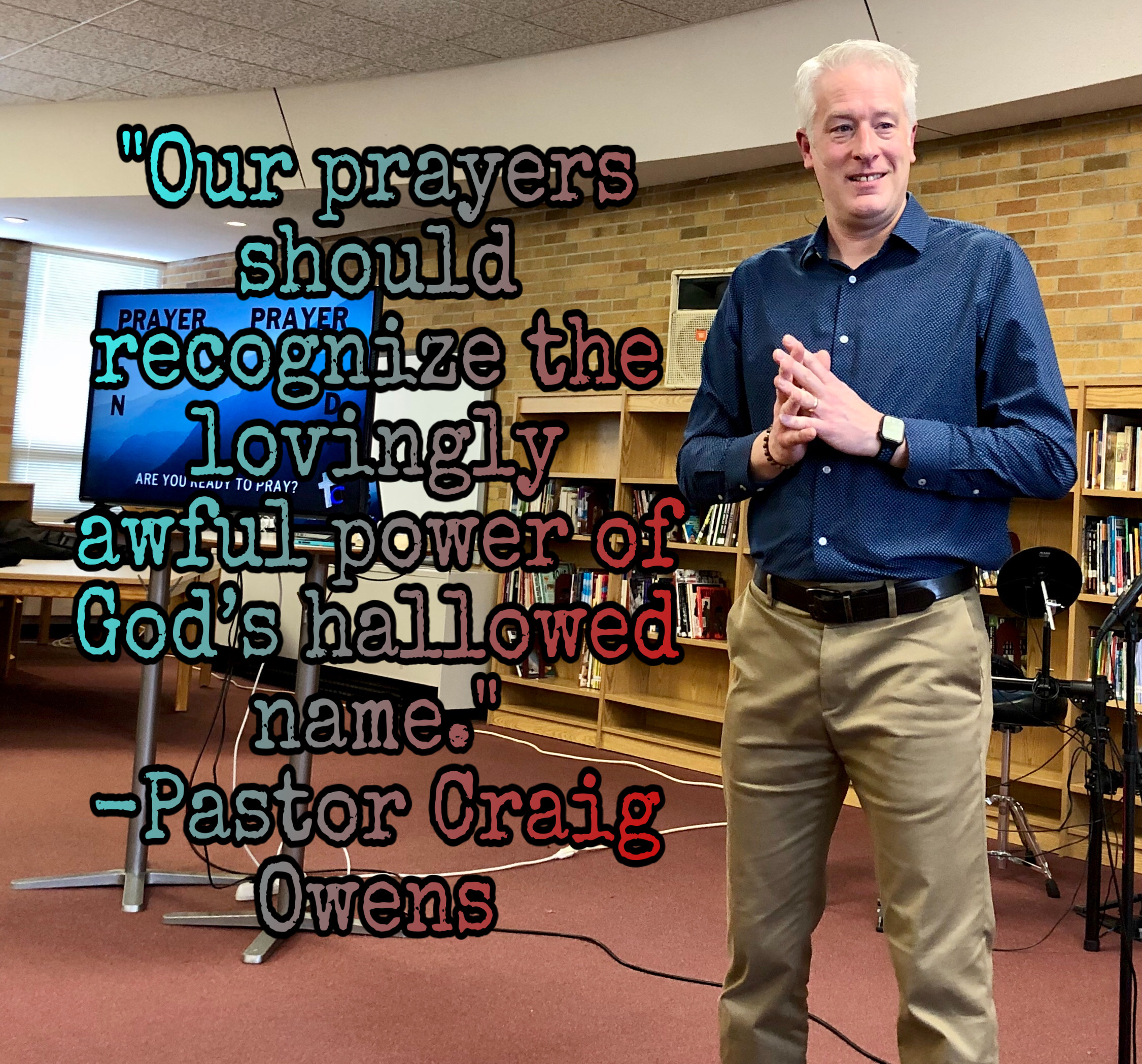
He is both unapproachable and approachable. He is both awful and lovable. He is both Supreme power and Supreme love. He is both Hallowed and Father. He is unique. Since He is unique, we must approach Him uniquely in holy prayer. But we must always approach first and foremost to reverence His holy Name. As Matthew Henry said, “Let Him have the praise of His perfections, and then let us have the benefit of them.” 

Think of His glory in every request you make of Him. Father, may Your holy, righteous name be hallowed and exalted and made famous as You…

  • … provide my daily bread
  • … forgive me and help me forgive others
  • … give me victory over temptations

Let’s not pray prayers that rob God of His glory. Prayers like:

  • Selfish prayers that are all about me, me, me
  • Doubtful prayers that aren’t really sure God can help
  • Little prayers that insult God’s power and His love
  • Unexpectant prayers that ask God to do something, but we don’t really expect that He will

Let’s be known as people who pray confidently humble prayers. Let’s come to a Father Who is All-Love and to a God Who is All-Powerful—a God Whose power is perfectly balanced by His love, and Whose love is perfectly balanced by His power. May our prayers HALLOW His name! 

Join me this Sunday as we continue to learn more about prayer. 

Thursdays With Spurgeon—The Joy Of Saying, “My God”

This is a weekly series with things I’m reading and pondering from Charles Spurgeon. You can read the original seed thought here, or type “Thursdays With Spurgeon” in the search box to read more entries.

The Joy Of Saying, “My God”

     We commence then by the first thing, which is enough to startle us by its immense value. In fact, unless it had been written in God’s Word, we never could have dreamed that such a blessing could have been ours. God Himself, by the covenant, becomes the believer’s own portion and inheritance. “I will be their God” [Jeremiah 31:33]. … 

     Stop just one moment and think it over before we start. In the covenant of grace, God Himself conveys Himself to you and becomes yours. Understand it. God and all that is meant by that word—eternity, infinity, omnipotence, omniscience, perfect justice, infallible rectitude, and immutable love; all that is meant by God as Creator, Guardian, Preserver, Governor, Judge. All that that great word God can mean of goodness and of love, of bounty and of grace. All that this covenant gives you to be your absolute property as much as anything you can call your own: “I will be their God.” … 

     While He is Judge of all, He especially is their judge because He is the Judge whom they love to reverence, the Judge whom they long to approach because they know His lips will confirm that which their hearts have already felt, which is the sentence of their full acquittal through the merits of the glorious Savior. Our loving God is the Judge who will acquit our souls, and in that respect we can say He is our God whether as Sovereign, as Governor enforcing law, or as Judge punishing sin. Although God is in some sense the God of all men, yet in this matter there is something special toward His people so that they can say, “He is our God, even in those relationships.” … 

     Furthermore, the Christian can call God his God from the fact of his justification. A sinner can call God, God, but he must always put in an adjective and speak of God as an angry God, an incensed God, or an offended God. But the Christian can say “my God” without putting in any adjective except it be a sweet one wherewith to extol Him, so now we who were sometime afar off are made near by the blood of Christ. We who were enemies to God by wicked works are His friends, and looking up to Him, we can say “my God,” for He is my Friend, and I am His friend.

From God In The Covenant 

What an incredible assurance in those two words: my God! Therefore, there is now no condemnation for those who are in Christ Jesus (Romans 8:1). 

It makes me want to sing along with Fanny Crosby:

Blessed assurance, Jesus is mine!
O what a foretaste of glory divine!
Heir of salvation, purchase of God,
Born of His Spirit, washed in His blood.
This is my story, this is my song
praising my Savior all the day long!


Poetry Saturday—Like A River Glorious

Like a river, glorious
Is God’s perfect peace,
Over all victorious
In its bright increase;
Perfect, yet it floweth
Fuller every day,
Perfect, yet it groweth
Deeper all the way.

Stayed upon Jehovah,
Hearts are fully blest;
Finding, as He promised,
Perfect peace and rest.

Hidden in the hollow
Of His blessed hand,
Never foe can follow,
Never traitor stand;
Not a surge of worry,
Not a shade of care,
Not a blast of hurry
Touch the spirit there.

Stayed upon Jehovah,
Hearts are fully blest;
Finding, as He promised,
Perfect peace and rest.

Every joy or trial
Falleth from above,
Traced upon our dial
By the sun of love;
We may trust Him fully
All for us to do—
They who trust Him wholly
Find Him wholly true.

Stayed upon Jehovah,
Hearts are fully blest;
Finding, as He promised,
Perfect peace and rest. —Frances Ridley Havergal