No Exceptions

Listen to the podcast of this post by clicking on the player below, and you can also subscribe on AppleSpotify, or Audible. 

King David wrote a coronation psalm for his son Solomon as he ascended the throne in Jerusalem. The opening words say, “Endow the king with Your justice, O God, the royal son with Your righteousness. He will judge Your people in righteousness, Your afflicted ones with justice” (Psalm 72:1-2).

David was calling on God’s blessing on his son, but He was also reminding Solomon that he couldn’t rule without God’s help. David’s singular focus was for God to receive all the glory. He closes the coronation psalm like this: “Praise be to the Lord, the God of Israel, Who alone does marvelous deeds. Praise be to His glorious name forever; may the whole earth be filled with His glory. Amen and Amen” (vv. 18-19).

Solomon started out well. “Solomon son of David established himself firmly over his kingdom, for the Lord his God was with him and made him exceedingly great” (2 Chronicles 1:1). Even when God gave Solomon the option to ask for anything, he choose wisdom “to govern this great people of Yours (1 Kings 3:7-9).

David strongly impressed on Solomon that obedience to God was the key to God’s blessing on Solomon and on the nation of Israel. “So be strong, act like a man, and observe what the Lord your God requires: Walk in obedience to Him, and keep His decrees and commands, His laws and regulations, as written in the Law of Moses. Do this so that you may prosper in all you do and wherever you go” (1 Kings 2:2-3).

But there is an ominous word that creeps in very early on in Solomon’s reign. Just one word that foreshadows the downfall that is to come—

Solomon showed his love for the Lord by walking according to the instructions given him by his father David, EXCEPT (1 Kings 3:3).

As you’ve probably heard, Solomon’s many foreign wives began to lead him astray from “observing what the Lord your God requires” and eventually became his downfall. But it began right here with the EXCEPT.

It’s all or nothing.

I cannot pick and choose which words from God I’m going to follow and which I’m going to “except.” If God says I must do it, then I must do it!

The EXCEPT will lead to my downfall just as surely as it did for Solomon.

Heavenly Father, may I be so sensitive to the prompting of Your Holy Spirit if I’ve let any EXCEPTs creep into my life. Reveal them to me so that I may repent, show myself a man, and follow You wholeheartedly.

►► Would you please prayerfully consider supporting this ministry? My Patreon supporters get behind-the-scenes access to exclusive materials. ◀︎◀︎

The Incense Of Prayer

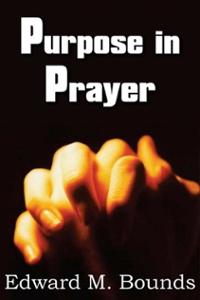
E.M. Bounds has challenged and inspired my prayer life probably more than any other author. Check out these words from his book Purpose In Prayer

Purpose In Prayer“God shapes the world by prayer. Prayers are deathless. The lips that utter them may be closed in death, the heart that felt them may have ceased to beat, but the prayers live before God, and God’s heart is set on them and prayers outlive the lives of those who uttered them; outlive a generation, outlive an age, outlive a world.

“That man is the most immortal who has done the most and the best praying. They are God’s heroes, God’s saints, God’s servants, God’s deputies. A man can pray better because of the prayers of the past; a man can live holier because of the prayers of the past, the man of many and acceptable prayers has done the truest and greatest service to the incoming generation. The prayers of God’s saints strengthen the unborn generation against the desolating waves of sin and evil. Woe to the generation of sons who find their censors empty of the rich incense of prayer; whose fathers have been too busy or too unbelieving to pray, and perils inexpressible and consequences untold are their unhappy heritage. Fortunate are they whose fathers and mothers have left them a wealthy patrimony of prayer.” (emphasis added)

When God gave Moses instructions for building the tabernacle, the altar of incense was placed before the curtain that separated the Holy Place from the Holy of Holies. The Bible does not tell us how the high priest passed through or by the curtain, so many believe that as he worshiped God, his prayers mingled with the incense, and God translated him through the curtain and into His presence.

There are other verses to support this:

  • Let my prayer be set forth as incense before You, the lifting up of my hands as the evening sacrifice. (Psalm 141:2)
  • The book of Revelation gives us a glimpse into Heaven, and twice we see the prayers of the saints being linked with the incense of worship (see Revelation 5:8 and 8:3-4).

Notice what E.M. Bounds says … our prayers TODAY are providing the incense the NEXT GENERATION will need! If we fail to pray now, we’re not only hurting ourselves, but we’re putting our children and grandchildren on a path toward “perils inexpressible and consequences untold.”

Instead, let’s leave them “a wealthy patrimony of prayer”! Will you pray? Today?

Listen, O My Soul

Listen O my soulDavid wraps up the 35th Psalm with a thought that is familiar to him—

My tongue will speak of Your righteousness and of Your praises all day long. (Psalm 35:28)

Praise is good for the soul! But in the midst of enemies gloating over David, hating him without reason, devising false accusations against him, and making plans to do him in (see verses 19-21), where could David get the strength to sing about God’s goodness?

As I said, it’s the last verse where David declares his unending praise. This verse is the result of seeing God move. But much earlier in this psalm David says, “Say to my soul, ‘I am your salvation’” (v. 3).

Before David could speak it, he had to hear it! He had to quiet himself in the midst of all the assaults on him to hear God say, “I AM your salvation!”

Not “my ears,” but “my soul”: the very center of my being, my mind, my emotions. I need the I AM to reassure the soul He created that He is still there. Unless I hear that assurance at the core of my being, I can only go through the motions. True worship comes from a real, personal encounter with the I AM.

O, listen my soul! Hear your Savior speak the assurance of His salvation. Only then can I open my lips in endless praises all day long.

Forethought Or After-Thought?

What is man that You are mindful of him, the son of man that You care for him? You made him ruler over the works of Your hands; You put everything under his feet. (Psalm 8:4-5)

forethoughtafterIn mythology, humans are an after-thought, a nuisance, slaves and servants of the gods, and usually pawns in the gods’ scheming against each other.

But Jehovah God created man as a part of His creation. He created mankind in His own image and breathed His own life into him. After the first five days of creation, God said, “It is good.” But on the sixth day, after creating man, He said, “It is very good!”

Jehovah God has man at the forefront of His mind. He not only calls us into a relationship with Him, but the Trinity works in divine cooperation to make it possible for us to come to Him.

He doesn’t see a mass of humanity, but He sees each one of us individually and uniquely. And He is attentive to us—“For the Lord has heard my cry for mercy; the Lord accepts my prayer” (Psalm 6:9).

As David burst into praise with this realization of God’s forethought of us, let us echo this praise (Psalm 8:9)—

O Lord, our Lord, how majestic is Your name in all the earth!

The North Star

The North StarIn our series called The Star Of CHRISTmas, Pastor Josh reminded us that Jesus is the North Star.

The North Star never wavers, never moves; it’s always constant.

But as Josh reminded us, light pollution sometimes makes it hard to see the North Star. The bright lights of the city, airplane lights, and even street lights make it difficult to know for sure we are following the North Star.

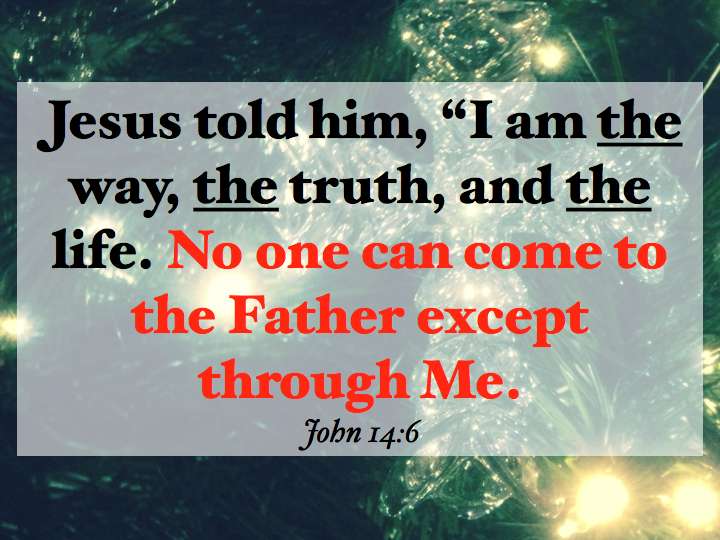
Jesus is the North Star—“I am the way, the truth, and the light” (John 14:6). But there are so many things that bring light pollution to His bright, unwavering, unchanging light. Lights that say, “This is important,” or “This light will get you where you need to go,” or even “All lights are equal.”

In this busy time of year, it’s important for us to take the time to filter out light pollution, and make sure that we are truly following Jesus. David prayed a great prayer, “Search me, O God, see if there is any offensive ways in me” (Psalm 139:23-24). It’s a great prayer for us to pray too.

Check out the other ways Jesus shined brightly at His Advent in our series The Star Of CHRISTmas.

See God Bigger

See God BiggerGlorify the Lord with me; let us exalt His name together. (Psalm 34:3)

“I am positively sure after many years of observation and prayer that the basis of all of our trouble today, in religious circles, is that our God is too small. When David says magnify the Lord, he doesn’t mean that you are to make God big, but you are to see Him big. When we take a telescope and look at a star, we don’t make the star bigger, we only see it big. Likewise you cannot make God bigger, but you are only to see Him bigger. … My brethren, God calls us to magnify Him, to see Him big. A meeting is not big because a lot of people are present. A meeting is big because a number of people see a big God in the meeting. And the bigger God is seen, the greater the meeting. A friend of mine has a little saying, ‘I would rather have a big, little meeting than a little, big meeting.’ There are a lot of big meetings that are little because the God in them is a small God. And there are a lot of little meetings that are big because God is big in the midst of them. … That is the first thing—magnify God. Your ministry will be little, and you will live and die little unless you have a bigger God.” —A.W. Tozer

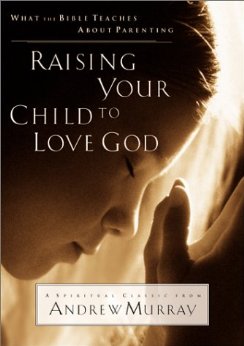
30 Quotes From “Raising Your Child To Love God”

Raising Your ChildIt’s a book I called a “must read for all parents” (you can read my full book review by clicking here). After typing up my notes of all the quotes I highlighted in this book, I ended up with 18 pages of notes, so these quotes from Andrew Murray’s book are, in my opinion, the cream of the crop. Tomorrow I will share some of the prayers Murray offered in his book.

“Example is better than precept. … Love that draws is more important than law that demands. … Let parents be what they want their children to be.”

“How terrible is the curse and power of sin! Through the father the child becomes a partaker of the sinful nature, and the father so often feels himself too sinful to be a blessing to his child; thus the home becomes a path to destruction rather than to eternal life. But—blessed by God!—what sin destroyed, grace restores. … Let God’s Father-heart and His Father-love be your confidence. As you know and trust Him the assurance will grow that He is fitting you for making your home, in ever-increasing measure, the bright reflection of His own.”

“God seeks a people on earth to do His will. The family is the great institution for this object; a believing and God-devoted father is one of the mightiest means of grace.” 

“What God says of Abraham gives us further insight into the true character of this grace: ‘For I have chosen him, so that he will direct his children and his household after him to keep the way of the Lord.’ The spirit of modern so-called liberty has penetrated even into our family life; and there are parents, who some from a mistaken view of responsibility, some from lack of thought as their sacred calling, somer from love of ease, have no place for such a word as ‘command.’ They have not seen the heavenly harmony between authority and love, between obedience and liberty. Parents are more than friends and advisers; God has clothed them with a holy authority to be exercised in leading their children in the way of the Lord.”

“Oh that Christian parents would realize, just as Judah did, what it means to stand in that place for their child! How often—when our children are in danger because of the prince of this world, when the temptations of the flesh or the world threatened to make them prisoners and slaves, holding them back from ever reaching the Father’s home—are we found careless or unwilling to sacrifice our ease and comfort in order to rescue them!” 

“Oh, that the eyes of God’s people might be opened to the danger that threatens the church! It is not infidelity or superstition, it is the spirit of worldliness in the homes of Christian families, sacrificing the children to the ambitions of society, to the riches or the friendship of the world—that is the greatest danger of Christ’s church. If every home once won for Christ were a training school for His service, we would find in this a secret of spiritual strength no less than all that ordinary preaching can accomplish.”

“With a parent’s love comes a parent’s influence. … The character of a child is formed and molded by impressions; continual communion with the parent can render these impressions deep and permanent. The child’s love for a parent rises to meet the parent’s love.” 

“The first four commandments have reference to God, the last five to our neighbor. In between stands the fifth. It is linked to the first four because to the young child the parent represents God; from him the child must learn to trust and obey God. And this command is the transition to the last five because the family is the foundation of society, and there the first experience comes of all the greater duties and difficulties with humankind at large.”

“The child can only honor what he sees to be ‘worthy of honor.’ And this is the parent’s high calling: always so to speak and act, so to live in the child’s presence, that honor may be spontaneously and unconsciously rendered. … Above all, let parents remember that honor comes from God. Let them honor Him in the eyes of their children, and He will honor them there too.”

“There is nothing that drive home the word of instruction as powerfully as a consistent and holy life. … The entrance of divine truth into the mind and heart, the formation of habits and the training of character—these are not attained by sudden and isolated efforts, but by regular and unceasing repetition.”

“Love knows no sacrifice, counts nothing a burden; love does not rest until it has triumphed.”

“We don’t want to be just another family with whom God dwells and is pleased. Ours must be wholly consecrated to God. And do not be afraid that strength will not be given to keep the vow. It is with the Father in heaven, calling and helping and tenderly working both to will and to do in us, that we are working.”

“We need renewed wisdom directly from above for the individual needs of each child. Daily prayer is the secret of training our children for God. … Those who have already communicated with God and received divine teaching about their children will be those who desire still more and pray earnestly for it.”

“Nothing open the fountains of divine love and renewed love for each other more than the prayerful desire to know how to raise our children to love God.”

“Not to restrain a child is to dishonor God and the child.”

“My duty is never measured by what I feel is within my power to do but by what God’s grace enables me to do.”

“Every thoughtful parent knows that there are times and places when the temptations of sin will be more apt to surprise even the most well-behaved child. Such are the times, both before and after the child goes into a situation or circumstance where he may be tempted, that a praying father and mother should do what Job did, bring the children before God in repentance and faith and where possible to confront them with questions concerning their behavior.”

“Let us ask God to make us very watchful and very wise in availing ourselves of opportunities to admonish our children and to pray audibly with them.”

“In our family’s life, the first thing of importance must not be our earthly happiness, or even the supply of our daily needs, nor seeing to the child’s education for a life of prosperity and usefulness, but rather the yielding of ourselves to God in order to be conveyors of His grace and blessing to our children. Let us live for God’s purpose: deliverance from sin. Thus our family life will forever be brightened with God’s presence and with the joy of our heavenly home to come, of which our earthly one is by the nursery and the image.”

“‘The children of Your servants will live in Your presence; their descendants will be established before You’ (Psalm 102:25-28). Death may separate one generation from another, but God’s mercy connects them as it passes on from one to another; His righteousness, which is everlasting, reveals itself as salvation from generation to generation. … It is God’s will that His salvation should be known from generation to generation in your family too, that your children should hear from you and pass on to their children the praises of the Lord.”

“God’s purpose is that the Holy Spirit should take possession of our sons and daughters for His service; that they should be filled with the Holy Spirit, consecrated for service. They belong to Him and He to them.” 

“Jesus desires that we rise above the experiences of fatherhood on earth to know more deeply the Father in heaven.”

“The earthly father must not only make the Father in heaven his model and guide, but he must so reflect Him that his child will naturally desire to emulate the One whom he so aptly represents. … In a Christian father a child ought to have a better picture than the best of sermons can give of the love and care of the heavenly Father and all the blessing and joy He wants to bestow.”

“If we are to watch over the heavenly quality of our children, we must ourselves be childlike and heavenly-minded. … Children lose their childlikeness all too soon because parents have so little of it.”

“Fathers, you have sons whom you would fain bring to Jesus to be saved, come and hear the lessons the Lord would teach you. Let these children first send you to Jesus in confession, prayer, and trust; your faith can bring them in.”

“Your motherhood is in God’s sight holier and more blessed than you realize.”

“The effect of the good advice parents give is more than neutralized by their own behavior.” 

“A child should never be allowed to feel that his immaturity is not taken into account, that his young reasoning is not regarded, that he has not received empathy, or help, or justice that he expects. This will take a kind of love and thoughtfulness that parents are all too short of.”

“If you feel that you do not know how to teach the Word to them, to make it interesting or exciting for them, take heart—God will make it come alive to them if you are faithful to read it and live it.”

“I am the giver of their physical life, the framer of their character, the keeper of their souls, the trustee of their eternal destiny. I was first blessed that I may bless them, first taught how my Jesus loved me and gave Himself for me that I may know how to love and how to give myself for them. … And the more tenderly my love to them is stirred up, the more I feel the need to be wholly and only the Lord’s, entirely given up to the love that loves and makes itself one with me. This will fill me with a love from which selfishness shall be banished, giving itself in a divine strength to live for the children that God has given me.”

Mouth-To-Mouth

Mouth to mouthI’ve notice that when someone feels physically tired, mentally unengaged, spiritually embattled, emotionally dry, or just plain worn out, they have an audible physical sign that is almost universal.

Those people sigh.

A sigh is an involuntary response that signifies frustration and a call for help. It should also be a reminder of the best place to find that help.

In Psalm 119, the chapter is organized in 8-verse segments. I like to look at the “bookend” verses of each section, as it usually gives a good idea of what that section is focusing on. The section called kaph has this bookended statement—

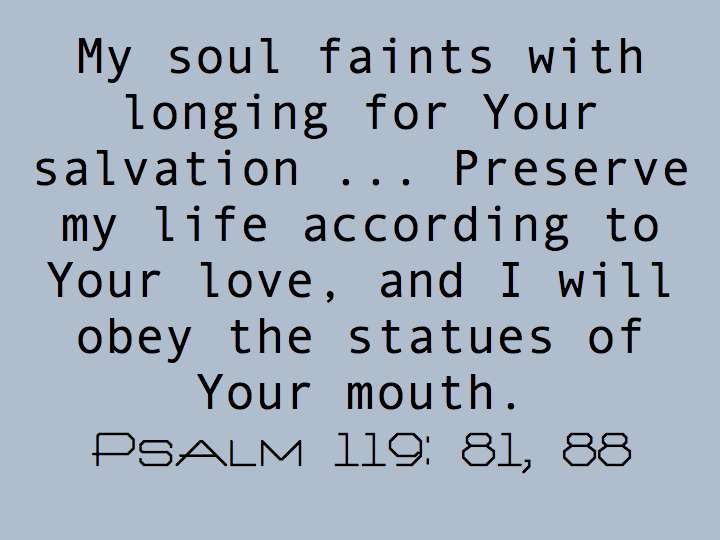
My soul faints with longing for Your salvation … Preserve my life according to Your love, and I will obey the statues of Your mouth (Psalm 119:81, 88).

Follow this progression:

  • When God created man, He breathed a soul into him. So we are created by His breath.
  • Jesus said that man does not live by bread alone, but by every word that comes from the mouth of God. God’s Word is inspired, which means it is literally God-breathed. So our soul is sustained by the breath of God.

The psalmist says his soul is sighing and wasting away, but he recognizes that his God-breathed soul can be restored through the God-breathed word. So in verse 88 he is asking God to give him mouth-to-mouth (or perhaps mouth-to-soul) resuscitation! 

The psalmist talks about clinging tenaciously to God’s Word as if it were his only lifeline … because it is! So whenever you find yourself sighing, let that be a reminder that you can get your spiritual resuscitation from the breath of God: His Word. Hold on to it as if your very life depended on it … because it does!

If you have missed any of the messages in our P119 series, you can access them all by clicking here.

At Last!

Jesus is our atonementThe Day of Atonement was a very special day for the Jewish people. It was called by some the Sabbath’s Sabbath, as it was the most holy day of the year. It was the day everyone looked forward to, because finally they could have forgiveness for their sins.

The word atonement in the Hebrew meant that a payment was made that was equivalent to the offense that was committed. The offense was huge: Sin was open rebellion against Almighty God, it was to spit in the face of our Heavenly Father, it was to slap away His hands that were reaching out to embrace us. Nothing short of a death could atone for that sort of offense!

So the high priest would go through an elaborate ceremony of washing himself and putting on special garments that were only to be worn on this Day of Atonement. Because the high priest was also a sinner himself, his first sacrifice was a bull. The blood from this sacrifice was taken by the high priest into the Most Holy Place of the temple to cover his own sins, before he could even approach God to ask for the forgiveness of the sins of anyone else.

After having completed this step, the high priest could then proceed. He would sacrifice a goat as a sin offering for the people. As he did with the bull’s blood, he would take the goat’s blood back into the Most Holy Place to ask God to show mercy toward people who had sinned, to turn away His holy wrath against their rebellion. Then the priest would lay his hands on a second goat, one that was still alive, and confess all of the sins of the people. This goat (called the scapegoat) was then taken out into the desert. This symbolized the removal of the people’s guilt, making it possible for them to be in relationship with God once again.

This was repeated year after year after year. It was repeated because the people continued to sin. It was repeated because these rituals were only a shadow of what God really wanted to accomplish. David wrote about the futility of these sacrifices—

Sacrifice and offering You did not desire—but a body You have given me—burnt offerings and sin offerings You did not require. Then I said, “Here I am, I have come—it is written about me in the scroll. I desire to do Your will, my God; Your law is within my heart.” (Psalm 40:6-8)

A beautiful thing happened through the ministry of Jesus on earth. Jesus came to be both the perfect high priest (one without sin, who did not need to purify Himself), and the perfect sacrifice. Jesus is called the once for all sacrifice of atonement for us, as He embodied the cry David made nearly 1000 years earlier. Hebrews 10:5-7 says that the words uttered by David prophetically were repeated by Jesus: “Here I am, I have come—it is written about me in the scroll. I desire to do Your will, my God; Your law is within my heart. I will be the once for all sacrifice.”

When Jesus told us the the new covenant was in His shed blood on Calvary’s Cross, He was saying that no longer would we have to wait until the Day of Atonement to find forgiveness; no longer would we have to wait upon an imperfect earthly priest to offer a sacrifice for us; no longer would we have to carry around the guilt of our sin and feel separated from God’s presence while waiting for a special ceremony. AT LAST! We can have immediate forgiveness, eternal redemption, and an everlasting relationship with God because of what Jesus did for us once for all!

As you celebrate Holy Week, be thrilled with the truth that Jesus’ death on the Cross makes it possible for you to have complete atonement. Our Savior has redeemed us AT LAST!

If you have missed any of the messages in this series called Who Is Jesus?, you can find them all here.

Thursdays With Oswald—Venting In Prayer

This is a weekly series with things I’m reading and pondering from Oswald Chambers. You can read the original seed thought here, or type “Thursdays With Oswald” in the search box to read more entries.

Venting In Prayer 

     When you are worked up to a pitch emotionally, read some of the Psalms, and the Spirit of God will gradually teach you how to form a spiritual nous*, a mind whereby you will not only understand but will slowly and surely get to the place where you can express your spirit, you will have a totally new language. 

* To read what Chambers means by the Greek word nous, click here. 

From Biblical Psychology 

Sometimes we’re too timid in our prayers. We think we need to hold back, or not really say what’s on our mind. We probably think that some of the language we use might be too offensive for God’s ears.

Have you ever read some of the Psalms? As Oswald Chambers suggests, this is a great place to form your prayer vocabulary. David really “lets loose” in some of his prayers, calling his enemies all sorts of names, and basically saying, “Get ‘em, God!”

So you don’t want to say those kinds of things to God? Don’t you think He already knows what you’re thinking? Wouldn’t it be much more effective to “vent” in prayer—in the safe presence of your loving Heavenly Father? It’s really only after you “get it out” that the Holy Spirit can help you work it out.

Express yourself—vent in God’s presence instead of the presence of those who are troubling you—and then listen to how God’s Spirit will help you slowly and surely get a brand new perspective on your situation.

UPDATE: I have a whole chapter called ‘Your Emergency Release Valve’ about these types of prayers in my book When Sheep Bite.