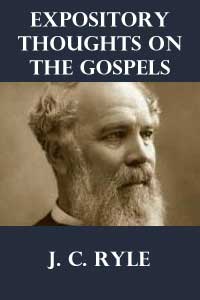
 In my current Bible reading time, I am reading J.C. Ryle’s Expository Thoughts On The Gospels as a read-along companion with my Bible. Bishop Ryle correctly feels the weight and effectiveness of prayer in the life of a Christian. Here are some of his quotes regarding prayer.
“If afflictions drive us nearer to Christ, the Bible, and prayer, they are positive blessings.”
“It is not for us to prescribe either the time or the way in which our requests are to be answered.… Let us rather ‘continue in prayer,’ ‘watch unto prayer,’ ‘pray always and not faint.’”
“Why is it that there is so much apparent religious working and yet so little result in positive conversions to God—so many sermons, and so few souls saved—so much machinery, and so little effect produced—so much running here and there and yet so few brought to Christ? Why is all this? The reply is short and simple: there is not enough private prayer. The cause of Christ does not need less working, but it does need among the workers more praying. … The most successful workmen in the Lord’s vineyard are those who are, like their Master, often and much upon their knees.”
“If we would have good ministers we must remember our Lord’s example and pray for them. Their work is heavy. Their responsibility is enormous. Their strength is small. Let us see that we support them and hold up their hands by our prayers.”
“Let us bear these rules in mind every Sunday morning before we go to hear the Word of God preached. Let us not rush into God’s presence careless, reckless, and unprepared, as if it mattered not in what way such work was done. Let us carry with us faith, reverence, and prayer. If these three are our companions, we shall hear with profit and return with praise.”
“Let a petition for more faith form a part of all our daily prayers. As ever we would have peace, and calmness, and quietness of spirit, let us often say, ‘Lord, increase our faith.’”
“Let us strive and pray that the same mind may be in us which was in our blessed Master. Like Him, let us be willing to go anywhere, do anything, suffer anything when the path of duty is clear and the voice of God calls. Let us set our faces steadfastly to our work when our work is plainly marked out, and drink our bitter cups patiently when they come from a Father’s hand.”
“We must seek to have knowledge as well as zeal. Zeal without knowledge is an army without a general, and a ship without a rudder. We must pray that we may understand how to make a right application of Scripture.”
“Prayer is one of the best and most powerful means of helping forward the cause of Christ in the world. … Not all believers have money to give to missions. Very few have great intellectual gifts or extensive influence among men. But all believers can pray for the success of the Gospel—and they ought to pray for it daily.”
“Prayer is one of the principal weapons which the minister of the Gospel ought to use. To be a true successor of the apostles, he must give himself to prayer as well as to the ministry of the Word (Acts 6:4). He must not only use the sword of the Spirit, but pray always, with all prayer and supplication (Ephesians 6:17, 18). This is the way to win a blessing on his own ministry. This, above all, is the way to procure helpers to carry on Christ’s work.”
“Daily bread and daily mercy are by far the first and principal things that mortal man needs. He is the rich man who possesses them. He is the wise man who is not ashamed to pray for them every day.”
“Nothing that concerns God’s people is too little for Him to manage or for them to bring before Him in prayer.”
“‘He spoke a parable to this end: that men ought always to pray, and not to give up.’ These words, be it remembered, are closely connected with the solemn doctrine of the second advent, with which the preceding chapter concludes. It is prayer without fainting during the long weary intervals between the first and second advents which Jesus is urging His disciples to keep up.”
“Let us often pray that we may have wisdom from above in order to answer rightly when perplexing questions are put to us. The servant of Christ must expect a portion like his Master. He must count it no strange thing if the wicked and worldly-minded endeavor to entangle him in his talk, and to provoke him to speak unadvisedly with his lips.”
“Whatever other means of relief we use, let us pray. The first Friend we should turn to ought to be God. The first message we should send ought to be to the throne of grace.”



 This is a weekly series with things I’m reading and pondering from Charles Spurgeon. You can read the original seed thought here, or type “Thursdays With Spurgeon” in the search box to read more entries.




 Craig T. Owens
11 Quotes On The Gospel Of Matthew
November 14, 2018 — Craig T. Owens“The rulers of this world have often call themselves Great, Conqueror, Bold, Magnificent, and the like. The Son of God is content to call Himself Savior. These souls which desire salvation may draw near to the Father with boldness, and have access with confidence through Christ. It is His office and His delight to show mercy. ‘For God didn’t send His Son into the world to judge the world, but that the world should be saved through Him’ (John 3:17).”
“Trust Him at all times with all your sorrows. He will not despise you. Pour out all your heart before Him in prayer, and keep nothing back. He can sympathize with His people.”
“Let us beware of resting satisfied with head-knowledge. It is an excellent thing, when rightly used. But a man may have much of it, and yet perish everlastingly. What is the state of our hearts? This is the great question. A little grace is better than many gifts. Gifts alone save no one. Grace leads on to glory.”
“Here is one among many reasons why we ought to be diligent readers of our Bibles. The Word is the sword of the Spirit. We shall never fight a good fight, if we do not use it as our principal weapon. The Word is the lamp for our feet. We shall never keep the King’s highway to heaven, if we do not journey by its light. … Knowledge of the Bible never comes by intuition, it can only be obtained by diligent, regular, daily, attentive, wakeful reading.”
“Aim at letting men see that we find Christianity makes us happy. Never let us forget that there is no religion in looking melancholy and gloomy. Are we dissatisfied with Christ’s wages and Christ’s service? Surely not! Then let us not look as if we were.”
“Let the prayer ‘Lord, increase our faith,’ always form part of our daily petitions. We never perhaps know the weakness of our faith until we are placed in the furnace of trial and anxiety. Blessed and happy is that person who finds by experience that his faith can stand the fire, and that he can say with Job, ‘though He slays me yet will I trust in Him’ (Job 13:15).”
“The more clearly we see Christ’s power, the more likely we are to realize Gospel peace. Our position may be trying. Our hearts may be weak. The world may be difficult to journey through. Our faith may seem too small to carry us home. But let us take courage when we think on Jesus, and not be cast down. Greater is He that is for us than all those who are against us. Our Savior can raise the dead. Our Savior is Almighty.”
“Great grace and common sense are perhaps one of the rarest combinations. … Our Lord Jesus Christ Himself is our most perfect example. None were ever so faithful as He. But none were ever so truly wise. Let us make Him our pattern, and walk in His steps.”
“Let us not be ashamed to say that we expect a literal fulfillment of unfulfilled prophecy. Let us frankly allow that there are many things we do not understand, but still hold our ground tenaciously, believe much, wait long, and not doubt that all will one day be made clear.”
“Are we ever mocked and persecuted and thought foolish because of our religion? Let us bear it patiently and pray for those who persecute us. They know not what they are doing. They will certainly alter their minds one day. We may yet hear them confessing that we were wise and they were foolish. The whole world shall one day acknowledge that the saints of God made a wise choice.”
“We can never attach too much importance to the atoning death of Christ. It is the leading factor in the Word of God, on which the eyes of our soul are to be ever fixed. Without the shedding of His blood, there is no remission of sin. It is the cardinal truth on which the whole system of Christianity hinges. Without it the Gospel is an arch without a key stone, a fair building without a foundation, a solar system without a sun.”
Quotes from Ryle’s comments on the Gospels of Mark, Luke, and John coming soon.
Share this: