Peace On Earth! Really?

Craig T. OwensFor some people, “peace on earth” is just a wish. Perhaps all of this talk of peace and goodwill during the buildup to Christmas is doing just the opposite, and you’re feeling a bit stressed out.

How do you think Joseph felt on the night of his first son’s birth? Do you think he was peaceful, or do you think things weren’t going as he had planned, and his stress level was through the roof? We can learn a very valuable lesson from his life.

Please gather your family and friends around to watch this short 10-minute video before you begin your Christmas celebration. This encouraging word may be just what you need to have a peaceful and joyous Christmas.

(If you have any trouble with the above video, here’s another link to try.)

I encourage you to read the Scriptures I mention in this video. They are:

And the quote from Max Lucado I shared:

“You’ve stood where Joseph stood. Caught between what God says and what makes sense. You’ve done what He told you to do only to wonder if it was Him speaking in the first place. You stared into a sky blackened with doubt. And you’ve asked what Joseph asked. You’ve asked if you’re still on the right road. You’ve asked if you were supposed to turn left when you turned right. And you’ve asked if there is a plan behind the scheme. Things haven’t turned out like you thought they would. Each of us knows what it’s like to search the night for light. Not outside a stable, but perhaps outside an emergency room. On the gravel of a roadside. On the manicured grass of the cemetery. We’ve asked our questions. We’ve questioned God’s plan. And we’ve wondered why God does what He does. The Bethlehem sky is not the first to hear the pleading of a confused pilgrim. If you are asking what Joseph asked, let me urge you to do what Joseph did. Obey.”

Merry Christmas!

Holiday To Do List

Christmas To Do listThis is a pretty good list!

  1. Buy Be presents
  2. Wrap gifts someone in a hug
  3. Send gifts peace
  4. Shop for Donate food
  5. Make cookies love
  6. See Be the lights

May we all keep in mind that Jesus is the reason for the season—

  1. He came as Emmanuel to be God with us
  2. His blessings envelope us
  3. He came to bring peace on earth
  4. He provides our daily bread
  5. He is love
  6. And He calls us to be His light to the world

(I found this picture online but cannot find out who created it. If someone knows, please tell me, as I would love to give them proper credit.)

4 Powerful Truths About Peacefulness

PeacefulnessHave you ever noticed the importance the Apostle Paul gives to “peace”? Not just any kind of peace, but the peace that is linked with God’s grace.

Paul always puts grace and peace together. Every one of his letters opens with “grace and peace. The only exceptions are his two personal letters to Timothy where he says “grace, mercy and peace.

In his letter to the Colossians we get a clue to why this is, when he writes, “Let the peace of Christ rule in your hearts, since as members of one body you were called to peace. And be thankful” (Colossians 3:15).

Let me start at the end of the verse. The word “thankful” is the Greek word euchristos. It’s where we get our word Eucharist (or Communion). The root word (charizomai) means to (a) live gracefully, (b) forgive gracefully, (c) rescue gracefully, (d) restore gracefully. That’s just how Jesus—the Prince of Peace—lived on earth, and that’s what His broken body and spilled blood purchased for us: peace with God.

So a thankful Christian is a peaceful Christian. Or another way of saying this: a Christian’s peace-fullness comes from thank-fullness.

When we “let the peace of Christ rule” in our heats, it’s because we understand what His grace has purchased for us. And we want others to know this grace and peace as well!

  1. Peacefulness is contagious—a peace-full person has plenty of peace to share.
  2. Peacefulness is unifying—fear makes people run away, but peace brings them close to God and close to each other (Luke 2:14; John 14:27).
  3. Peacefulness promotes worship—we don’t worship what we fear, but we worship what we are drawn to (Luke 19:38; Hebrews 10:22).
  4. Peacefulness signals victory—the absence of conflict is peace (Romans 16:20).

If you don’t have peace in your life, can I suggest that you might want to start by looking at your thank-fulness level. When you are thankful for what the Prince of Peace did on the Cross for you, it’s so much easier to become thankful for all the other blessings that He gives as well. This thank-fullness will raise your level of peace-fullness!

On Sunday we are going to continue to look at the power and beauty of grace-filled gratitude. Please join us!

Graceful Gratitude

Graceful GratitudeAs we approach Thanksgiving Day, it’s natural for people to think about thanking. This shouldn’t be the case for Christians though…

Christians should be so full of thanks that every day is a day of thanks-giving!

There is a power in thankfulness. There is something attractive about gracious people. There is a security and a peace that comes from knowing just how many blessings have been lavished on me by my Heavenly Father.

Beginning this Sunday, I am going to share a series of three messages from three verses in the book of Colossians. We are going to look at the power of being people of graceful gratitude.

If you don’t have a church home in Cedar Springs, I would be so honored if you would join us. If you cannot make it in person, check out our live broadcast on Periscope at 10:30am (search for user @craigtowens).

Links & Quotes

link quote

“What life have you if you have not life together? There is no life that is not in community.” —T.S. Eliot

“Dr. Karl Menninger once observed that sin dropped out of the national vocabulary in the middle of the twentieth century. The word no longer has a place in public discourse because it conveys images that the majority of the people will not accept. … Perhaps holiness dropped out of our vocabulary because we are accustomed to a Christian civilization where our Christianity seldom demanded that we stand apart from our society. Worldliness, the opposite of holiness, has also dropped from our vocabulary. Where we have made peace with our culture, the words ‘holiness’ and ‘worldliness’ lose their meaning, for we cannot imagine how Christianity would demand that we separate from the dominant standards of our time.” —James W. Thompson

“A real Christian allows his mind to run up the sunbeam to the sun.” —C.S. Lewis

“Here’s the secret of the lilies [Luke 12:27]: they bask. … Waiting for the Lord has the connotation of waiting for Him to show up, or do something or grant a provision. It’s like focusing on the sunbeam. Waiting upon the Lord is running up the sunbeam to the Lord Himself, beyond what He does, and basking under the influence of who He is.” —Curt Dalaba

Reconnecting the Disconnection

DisconnectThere is a disconnection problem in the United States of America. Consider this:

  • John Adams, one of our nation’s founding fathers said, “The general principles on which the fathers achieved independence were the general principles of Christianity.”
  • Every president from George Washington to Barak Obama has invoked the name of God in his inaugural address.
  • 96% of Americans say they believe in God.
  • 80% of Americans call themselves Christians.

And yet:

  • Our grade schools make no mention of “God”, some even to the point of not reciting the pledge of allegiance.
  • Higher education is openly antagonistic toward God and Christians.
  • The entertainment industry normalizes lifestyles that are openly unbiblical.
  • Even our US government has done things like legalizing murder in the form of abortion, and sanctioning homosexuality by calling their unions “marriage.”

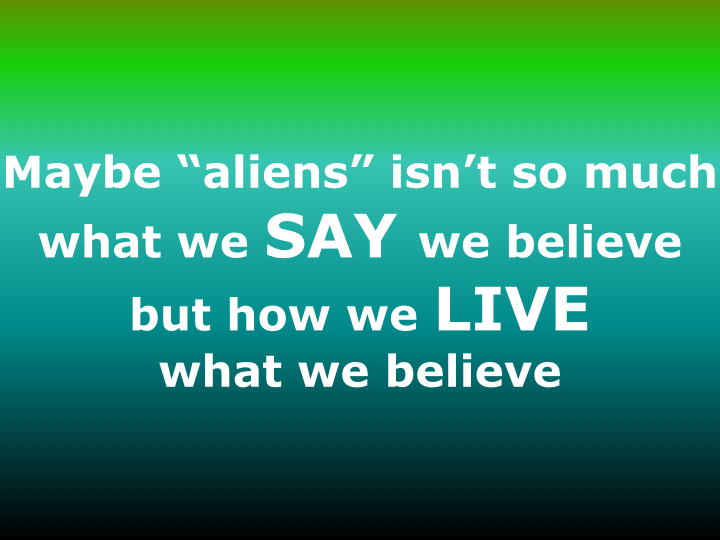
The Bible calls Christians “aliens and strangers in the world.” Perhaps the term “aliens” is not so much for what we say we believe, but how we live what we believe. 

So Peter opens his letter to “strangers in the world” by telling Christians how to live in a way that can reconnect this disconnection.

  • Humble—because we sinners have been chosen (v. 2a) to become citizens of Heaven.
  • Confident—because of the foreknowledge of God the Father (v. 2b) that can never be thwarted.
  • Teachable—because the process of the sanctifying work of the Spirit and obedience to Jesus Christ (v. 2c) requires us to be humbly-confident, teachable servants.
  • Graceful and peaceful (v. 2d)—because what we believe about God’s invitation to come to Him, Christ’s payment that makes that possible, and the Holy Spirit’s sanctification should be lived out in graceful and peaceful lives.

Would your Earthling family members say you are graceful and peaceful? 

Would your Earthling coworkers say you promote grace and peace on the job? 

Would your Earthling neighbors say you make the neighborhood graceful and peaceful? 

Would the Earthling business owners you frequent say your gracefulness and peacefulness is more evident than in the citizens of Earth?

Search me, God, and know my heart test me and know my anxious thoughts. See if there is ANY offensive way in me, and lead me in the way everlasting. (Psalm 139:23-24).

If you’ve missed any messages in this series, you may find the complete list by clicking here.

Live Blessed And Peaceful

SpockI think most people are familiar with Spock’s famous Vulcan hand signal that means “Live long and prosper.” But long before Star Trek, the origins of this idea were displayed in the pages of Scripture.

The Hebrew word for grace or favor is first used in relation to Noah: “BUT Noah found favor in the eyes of the Lord” (Genesis 6:8). The conjunction BUT at the beginning of this verse tells us that the favor Noah experienced is being contrasted to something exactly the opposite. Here’s what we read two verses earlier, “The Lord was grieved that He had made man on the earth, and His heart was filled with pain” (v. 6).

Noah had to make a choice: would he fear God, or would he fear man. It’s a choice we all have to make today. We have to weigh and decide:

  • Fear of God vs. fear of man
  • Pleasing God vs. pleasing myself or someone “important” to me
  • Humble reliance on God vs. self-reliance
  • Objective obedience to God vs. subjective agreement when it feels okay

In the section of Psalm 119 called shin (vv. 161-168), the psalmist wrestled with this as well. He decided that he wasn’t going to be afraid of government officials that could persecute him, BUT “my heart trembles at Your Word.” He decided that he wouldn’t look for worldly treasures, BUT he would “rejoice in Your promise” (v. 162). That he wouldn’t praise temporary things, BUT “I praise You for Your righteous laws” (v. 164). That he wouldn’t try to find satisfaction in the temporary, BUT he would bask in the “great peace [for them] who love Your law” (v. 165). On and on it goes…

  • …I wait for YOUR salvation
  • …I follow YOUR commands
  • …I obey YOUR statutes
  • …I obey YOUR precepts (vv. 166-168)

People that live this way experience the same favor and grace that Noah experienced.

The Lord BLESS you and keep you; the Lord make His face SHINE upon you and be GRACIOUS to you; the Lord turn His face toward you and give you PEACE. (Numbers 6:24-26)

You can live blessed and peaceful by choosing God above all else!

Next Sunday we wrap up our series on the 119th Psalm, and I would love it if you can join us!

Here is the video from yesterday’s message—

If you have missed any of the messages in our P119 series, you can access them all by clicking here.

Poetry Saturday—Not By Wrestling

Rockford bridgeNot by wrestling, but by clinging
  Shall we be most blest;
Wrestling only brings us sorrow;
  Clinging brings us rest.

When we stay our feeble efforts,
  And from struggling cease,
Unconditional surrender
  Brings us God’s own peace.

Lean we all our weight on Jesus,
  Who alone can save;
He by might of love hath triumphed
  O’er His willing slave.

Yielding, we shall know true conquest;
  Dying, we shall live;
“Not my will, but Thine” prevaileth,
  Victory to give. —J.H. Stuart

14 More Quotes From “Not Knowing Where”

Not Knowing WhereWhen I’m reading an Oswald Chambers book, I could practically highlight every line! Even when I restrain myself, I still find so much good material. I’ve already shared some quotes from Not Knowing Where, but I wanted to share a few more with you.

“In seeking the best we soon find that our enemy is our good things, not our bad. The things that keep us back from God’s best are not sin and imperfection, but the things that are right and good and noble from the natural standpoint.”

“Fanaticism is sticking true to my interpretation of my destiny instead of waiting for God to make it clear.”

“God will never have more power than He has now; if He could have, He would cease to be God.”

“Whenever God gives a vision to a saint, he puts the saint, as it were, in the shadow of His hand, and the saint’s duty is to be still and listen. Genesis 16 is an illustration of the danger of listening to good advice when it is dark instead of waiting for God to send the light (cf. Galatians 1:15-16). When God gives a vision and darkness follows, wait; God will bring you into accordance with the vision He has given if you will wait His time.”

“All God’s commands are enablings. Therefore it is a crime to be weak in His strength.” 

“God never hastens and He never tarries. He works His plans out in His own way, and we either lie like clogs on His hands or we assist Him by being as clay in the hands of the Potter.”

“Faith is not a bargain with God—I will trust You if you give me money, but not if You don’t. We have to trust in God whether He sends us money or not, whether He gives us health or not. We must have faith in God, not in His gifts.”

“The relation is to be that of a child; fling yourself clean over on to God and wash your hands of the consequences, and John 14:27―‘My peace I give unto you’―becomes true at once. The profound realization of God makes you too unspeakably peaceful to be capable of any self-interest.”

“Faith is not the means whereby we take God to ourselves for our select coterie; faith is the gift of God whereby He expresses His purposes through us.”

“Beware of insulting God by being a pious prude instead of a pure person.”

“It is the attitude of a spiritual prig to go about with a countenance that is a rebuke to others because you have the idea that they are shallower than you.”

“Friendship with God is faith in action in relation to God and to our fellow men.”

“The most amazing evidence of a man’s nature being changed is the way in which he sees God, to say ‘God led me here’; ‘God spoke to me’; is an everyday occurrence to him.”

“It is not that we prepare a palace for God, but that He comes into our mortal flesh and we do our ordinary work, in an ordinary setting, amongst ordinary people, as for Him.”

You can read my review of Not Knowing Where by clicking here.

You can read other quotes from this book by clicking here.

21 Benefits From Doing Things God’s Way

got wisdom?I was reading Proverbs 3 this morning, and the opening words are, “My son, do not forget my teaching….” As if to emphasize why we shouldn’t forget how God tells us to live, Solomon lists at least 21 benefits that come from doing things God’s way―

  • A life worth living
  • Tranquility
  • Favor
  • Good reputation with God and people
  • God will keep you on track
  • Health and strength
  • Overflowing success
  • God’s discipline
  • Wisdom and understanding
  • Better return on investments
  • Riches and honor
  • Peace
  • Blessing
  • Safety
  • Sweet sleep
  • Fearlessness
  • Confidence
  • God’s friendship
  • A blessed home life
  • Grace
  • Honor

Now that’s a list worth having! And it’s all there for the one who will heed God’s Word and obediently live out what He says.