


 “When you are preparing to do something challenging, you usually take time to enlist My help. But when you’re facing everyday tasks, you tend to dive in unassisted—as if you can handle these matters alone. How much better it is to approach everything in humble dependence on Me! Whenever you find yourself in ‘diving’ mode, ask Me to help you stop and seek Me—letting Me show you the way to go forward. I will guide you along the best pathway for your life.” —Jesus (in Sarah Young’s Jesus Always)
“Let Me Show You The Way”
March 4, 2020 — Craig T. Owens4 + 4 Strategies To Eliminate Distractions To Your Prayer Time
March 2, 2020 — Craig T. Owens There’s a quote that has been the theme for this series on prayer: “Prayer pursues joy in fruitful fellowship with Jesus, knowing that God is glorified when we bear fruit in answer to prayer. Why do God’s children so often fail to have consistent habits of happy, fruitful prayer? Unless I’m badly mistaken, one of the reasons is not so much that we don’t want to, but that we don’t plan to.” —John Piper
And unless I’m badly mistaken, the most obvious thing we need to plan to eliminate is distractions.
Some people say they can juggle a lot of things at once. “I’m a really good multitasker,” they say. But science says differently. MIT neuroscientist Earl Miller concluded that our brains are “not wired to multitask well…. When people think they’re multitasking, they’re actually just switching from one task to another very rapidly. And every time they do, there’s a cognitive cost.” What is that cognitive cost? “Multitasking can drop IQ as much as 15 points, essentially turning you into the cognitive equivalent of an 8-year-old” (Inc. Magazine).
If the devil can make you think you can multitask prayer with other things, he has seriously inhibited the effectiveness of your prayers.
Jesus was not a multitasker—but He was singularly focused on His Father’s plan. And yet He accomplished more in His three years of public ministry than anyone else in history!
Here are 4 strategies to help you get ready to pray:
- Try to have your prayer time in the same place and at the same time. Your brain likes routine and it will help you zero-in during your scheduled prayer times.
- Silence your cell phone or other noisy distractions.
- Keep a notepad handy for random thoughts that pop into your head. Writing them down will keep your brain from switching back-and-forth to them.
- Focus on listening, not on talking—Eugene Peterson said, “Prayer is first of all a means of listening. Prayer is an act of attention.”
When we get right down to it, prayer is spiritual warfare (2 Corinthians 2:11; Ephesians 6:10-18). In the context of warfare, the word strategy means the maneuvering that takes place prior to the battle. The devil is a masterful tactician, and he will do everything he can to keep you distracted.
That’s why three times Peter tells us to be clear-minded and singularly-focused in our thoughts SO THAT we can pray without the hindrances of distractions (1 Peter 1:13-14; 4:7; 5:8-9). And Paul tells us to take all our thoughts captive, so that no un-Christlike thoughts are inhibiting our prayer time (2 Corinthians 10:4-5).
Here are 4 strategies to help you stay focused in prayer:
- A—adoration. Enter into God’s presence with a Psalm or worship music.
- C—confession. Deal with unconfessed sin, unforgiveness, or relationship strife as quickly as possible (Psalm 66:18; Matthew 5:21-24).
- T—thanksgiving. Paul counseled us, “Do not be anxious about anything, but in everything, by prayer and petition WITH thanksgiving, present your requests to God” (Philippians 4:6).
- S—supplication. Intercede for your brothers and sisters in the battles they are facing (James 5:16; Job 42:10; Ephesians 6:18).
Remember—
Prayer isn’t preparation for the battle; prayer IS the battle! Let’s not be distracted from that!
Thursdays With Spurgeon—Born A King
February 27, 2020 — Craig T. Owens This is a weekly series with things I’m reading and pondering from Charles Spurgeon. You can read the original seed thought here, or type “Thursdays With Spurgeon” in the search box to read more entries.
Born A King
A very singular thing is this, that Jesus Christ was said to have been ‘born King of the Jews’ (Matthew 2:2). … The moment that He came on earth, He was a king. He did not wait till His majority that He might take His empire—but as soon as His eye greeted the sunshine, He was a King. From the moment that His little hands grasped anything, they grasped a scepter. As soon as His pulse beat and His blood begin to flow, His heart beat royally and His pulse beat an imperial measure and His blood flowed in a kingly current. He was born a King. He came ‘to be ruler in Israel.’ …
His goings forth as our Surety were from everlasting [Micah 5:2]. Pause, my soul, and wonder! You had goings forth in the person of Jesus from everlasting. Not only when you were born into the world did Christ love you, but His delights were with the sons of men before there were any sons of men! Often did He think of them; from everlasting to everlasting He had set His affection upon them. …
If He had not loved me with a love as deep as hell and as unutterable as the grave, if He had not given His whole heart to me, I am sure He would have turned from me long ago. He knew what I would be and He had time enough to consider it—but I am His choice and that is the end of it. … He knew me before I knew myself—yes, He knew me before I was myself. …
Sweet Lord Jesus! You whose going forth were of old, even from everlasting, You have not left Your goings forth yet. Oh, that You would go forth this day to cheer the faint, to help the weary, to bind up our wounds, to comfort our distresses! Go forth, we beseech You, to conquer sinners, to subdue hard hearts, to break the iron gates of sinners’ lusts and cut the iron bars of their sins in pieces! O Jesus! Go forth, and when You go forth, come to me!
From The Incarnation And Birth Of Christ
Think about that for a moment—Jesus had all of eternity to think about you, to see your whole life, and still, He loved you enough to die on a Cross for you!
That God should love a sinner such as I
Should yearn to change my sorrow into bliss
Nor rest till He had planned to bring me nigh
How wonderful is love like this
Such love, such wondrous love
Such love, such wondrous love
That God should love a sinner such as I
How wonderful is love like this
That Christ should join so freely in the scheme
Although it meant His death on Calvary
Did ever human tongue find nobler theme
Than love divine that ransomed me
That for a willful outcast such as I
The Father planned the Savior bled and died
Redemption for a worthless slave to buy
Who long had law and grace defied
And now He takes me to His heart a son
He asks me not to fill a servant’s place
The far off country wanderings all are done
Wide open are His arms of grace —C. Bishop, Such Love

Acceptable And Pleasing
February 25, 2020 — Craig T. Owens…acceptable to the Lord … an aroma pleasing to the Lord… (Leviticus 1:3, 9).
 Whether it’s a sacrifice or a lifestyle, these two phrases sum up the goal of obeying all of God’s directives: acceptable and pleasing.
“But,” you might say, “there is a lot of law to obey—a lot!”
And I would agree with you. Beginning with the Ten Commandments in Exodus 20 and going all the way through Numbers 9, there are 56(!) chapters of regulations.
“And I’m supposed to follow all of those?!”
Yes! Every single one of them. And not just those, but also the innumerable man-made rules that were added on top of all of those laws.
In the opening words of Leviticus, two key words emerge:
- Acceptable to the Lord
- An aroma pleasing to the Lord
“How can I ever get there?”
YOU can’t!
For EVERYONE has sinned; we ALL fall short of God’s righteous standard (Romans 3:23 NLT).
For NO PERSON will be justified—made righteous, acquitted, and judged acceptable—in God’s sight by observing the works prescribed by the Law… (Romans 3:20 AMP).
But here is our hope—Blessed be the God and Father of our Lord Jesus Christ, Who has blessed us with every spiritual blessing the heavenly places in Christ…to the praise and of the glory of His grace, by which HE MADE US ACCEPTABLE in the Beloved (Ephesians 1:3, 6 NKJV).
And when we are in Christ, we also become an aroma pleasing to God—Our lives are a Christ-like FRAGRANCE rising up to God (2 Corinthians 2:14-17 NLT).
On our own, we cannot accomplish any of this. But in Christ we are both ACCEPTABLE to the Lord … and an aroma PLEASING to the Lord….
Enjoying The Meal
February 24, 2020 — Craig T. Owens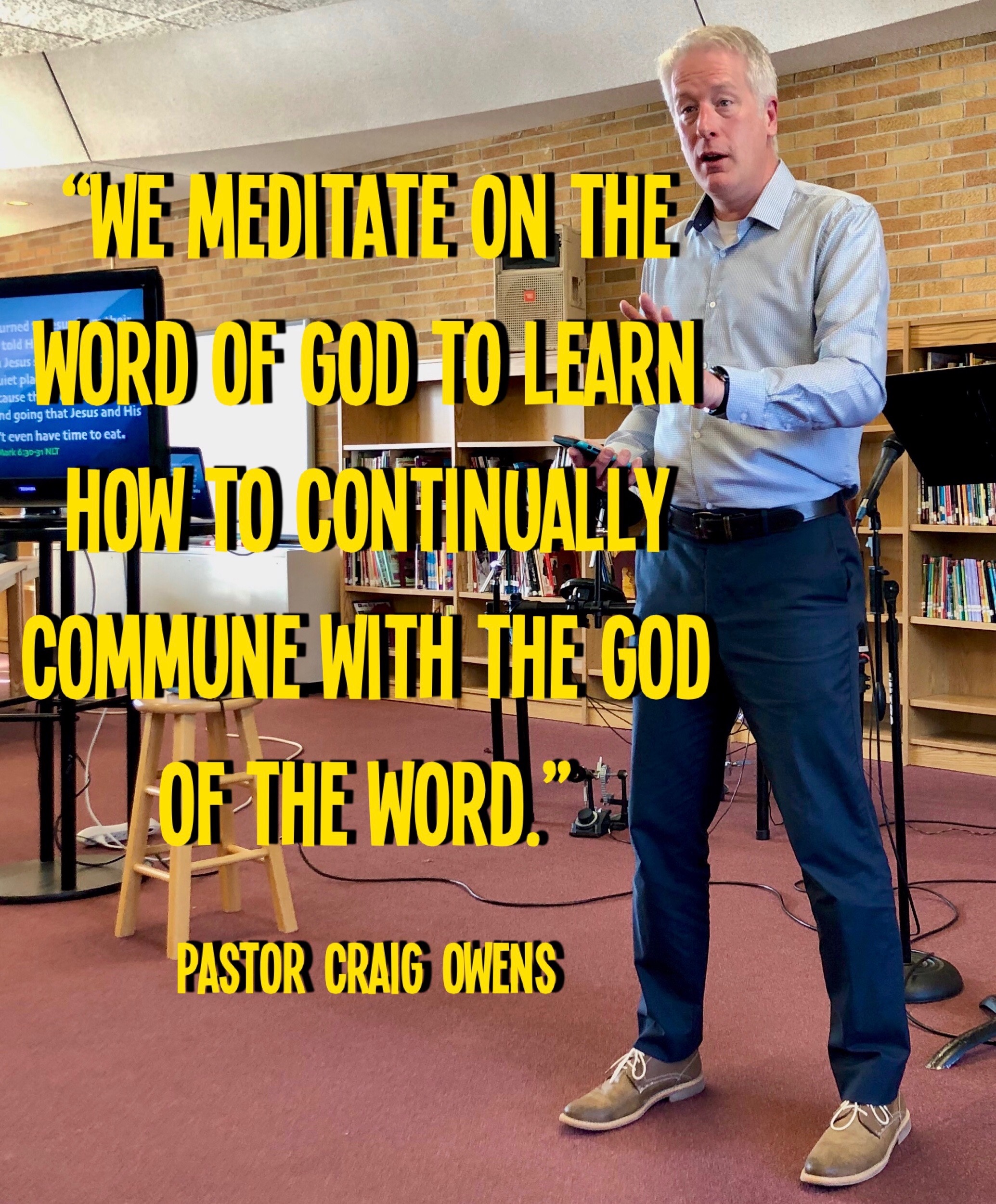 I am so active every day that I need to eat about 2700 calories just to maintain my weight. Eating that often, if I’m not careful, I can just simply put food in my mouth and really not taste it.
I think most people realize that there is a difference between eating and enjoying their food. Not only is gulping not very pleasurable, but doctors have even found some negative impacts on habitual food-gulpers. Things like:
- Indigestion
- Weight gain
- Disconnection from hunger/full signals
- Increasingly likelihood of unhealthy food choices
In the same way, there’s a difference between praying and enjoying our time with God (see Mark 6:30-31 and Revelation 3:20).
Just as there are many physical benefits to enjoying healthy food, there are also many spiritual benefits to enjoying our time in God’s Word and God’s presence. This spiritual eating and digestion process is called meditation.
Allow me to put a couple of thoughts together to show you the value of this spiritual discipline:
- The apostle Paul told us, “Pray continually” (1 Thessalonians 5:17).
- God told Joshua, “Keep this Book of the Law always on your lips; meditate on it day and night, so that you may be careful to do everything written in it. Then you will be prosperous and successful” (Joshua 1:8).
So the way we pray continually is to have something healthy to digest. We can feast on God’s Word and then allow the Holy Spirit to extract all of the healthy spiritual nutrients that will allow us to grow and mature.
David said, “Taste and see that the Lord is good” (Psalm 34:8). Don’t gulp down your meal of the Scripture—taste it. Don’t rush through your prayer time—enjoy it. Keep mulling over what you have read. Keep chewing on it to help the digestion of the good stuff you need to be healthy.
We meditate on the Word of God to learn how to continually commune with the God of the Word.
Meditating on God’s Word with the Holy Spirit’s help means you will never lack material for praying continually.
Thursdays With Spurgeon—Why Bethlehem?
February 20, 2020 — Craig T. OwensThis is a weekly series with things I’m reading and pondering from Charles Spurgeon. You can read the original seed thought here, or type “Thursdays With Spurgeon” in the search box to read more entries.
Why Bethlehem?
There [in Bethlehem] cleaved to [Naomi] Ruth the Moabitess, whose Gentile blood should unite with the pure untainted stream of the Jew and should thus bring forth the Lord our Savior, the great King both of Jews and Gentiles. … And in the streets of Bethlehem did Boaz and Ruth receive a blessing that made them fruitful, so that Boaz became the father of Obed and Obed the father of Jesse—and Jesse the father of David. …
There is something in the name of the place. Bethlehem Ephrathah. The word Bethlehem has a double meeting. It signifies ‘the house of bread’ and ‘the house of war.’ …
Bethlehem, you house of bread, rightly were you called, for there the Bread of life was first handed down for man to eat.
And it is called ‘the house of war,’ because Christ is to a man either ‘the house of bread’ or else ‘the house of war.’ While He is food to the righteous, He causes war to the wicked, according to His own words: ‘Do not think that I came to bring peace on earth. I did not come to bring peace but a sword…’ (Matthew 10:34–36).
Sinner, if you do not know Bethlehem as ‘the house of bread,’ it will be to you a ‘house of war.’ If from the lips of Jesus you never drink sweet honey—if you were not like the bee, which sips sweet luscious liquor from the Rose of Sharon, then out of the selfsame mouth there will go forth against you a two-edged sword! And that mouth from which the righteous draw their bread will be to you the mouth of destruction and the cause of your ill. …
Ephrathah … the meaning of it is ‘fruitfulness’ or ‘abundance.’ …
If we are like trees planted by the rivers of water, bringing forth our fruit in our season, it is not because we were naturally fruitful, but because of the rivers of water by which we were planted. It is Jesus who makes us fruitful. ‘If you abide in Me, and My words abide in you, you will ask what you desire, and it shall be done for you’ (John 15:7). Glorious Bethlehem Ephrathah! Rightly named! Fruitful house of bread—the house of abundant provision for the people of God!
From The Incarnation And Birth Of Christ
Bethlehem wasn’t just a random place for Jesus Christ to be born. God doesn’t do anything randomly. Everything He does has a plan and a purpose. We may have difficulty seeing what the purpose is. As Martin Tupper noted in one of his poems—
We look through a glass darkly, we catch but glimpses of truth;
But, doubtless, the sailing of a cloud hath Providence to its pilot…
Man doeth one thing at once, nor can he think two thoughts together;
But God compasseth all things, mantling the globe like air…
Not only was the birthplace of Jesus purposely chosen by God, so was your birthplace. And your birth parents. And, indeed, everything about you. You are not an accident or some chance encounter. You have been created by God on purpose and for a purpose.
Let the birthplace of Jesus—all the rich meaning of Bethlehem Ephrathah—be an encouragement to you that God knows and loves you dearly. Your life has meaning and purpose, which you can discover through a personal relationship with your Heavenly Father through Jesus Christ.


The Need For Confession
February 17, 2020 — Craig T. Owens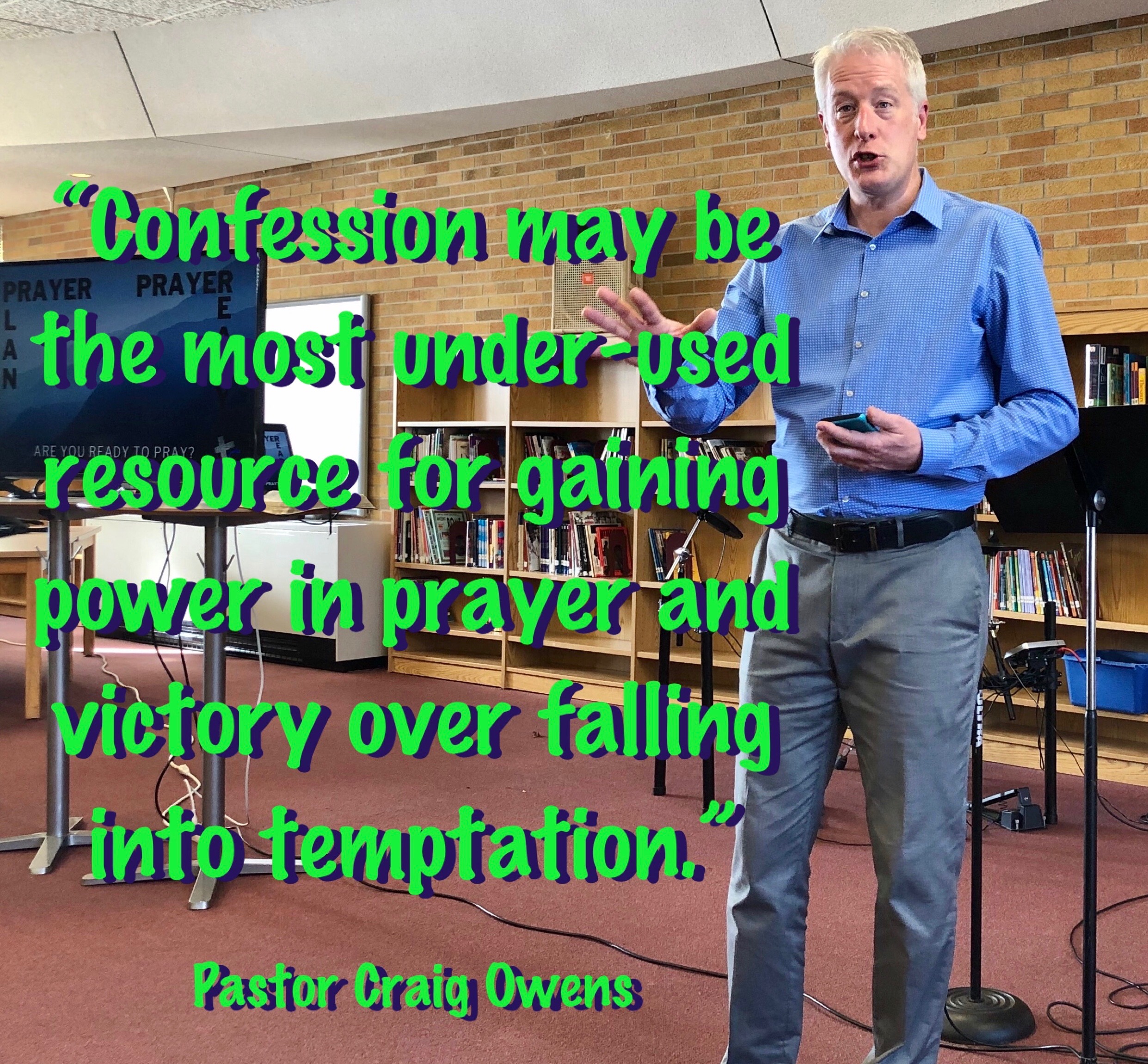 Jesus taught us to pray to OUR Father. This speaks of community and accountability. Ken Blanchard noted: “Accountability means: We owe each other for something we’ve agreed upon.” What have the saints of God agreed upon? That God is our Father, that Jesus is His Son and our Brother, and that the Holy Spirit is our Helper. We’ve agreed that if we are brothers and sisters in God’s family, we are mutually accountable to one another.
The part of accountability that some people don’t like is the realization that I make mistakes: I let people down; I sin. In a community of saints, my shortfall not only affects me but the rest of the community too. But there is a remedy—The remedy for my sin starts with my confession of my sin.
If people like David, Isaiah, Daniel, Nehemiah, and Paul confessed their sin and called themselves sinners, what makes me think that I’m exempt from that diagnosis or that cure?!
Confession is an owning of my sin. It’s saying to God, “I have sinned. I need forgiveness. I will repent of this. I need Your mercy.” And it’s saying to my fellow saints, “I need your help so I don’t have to repeat this sin.”
Unconfessed sin is life-draining (Psalm 32:1-5). The word confess in the Old Testament Hebrew means to “throw out your hand.” Expose it all! In the New Testament Greek confess means to acknowledge that my life does not measure up to God’s standard.
Confession may start in my personal prayer closet, but it needs to move to the public domain of the community of saints. Jesus made it plural, “Forgive US OUR debts, as WE have forgiven OUR debtors.”
Sometimes I cannot see my own debts that need to be forgiven (Psalm 19:12), so I need the conviction of the Holy Spirit and the loving confrontation of someone who loves me (Psalm 139:23-24; Proverbs 27:6, 2 Samuel 12:1-13).
The apostle James helps us see how a loving community brings healing, deliverance, and restoration. The key components that James lists are prayer and confession (James 5:13-16).
Dietrich Bonhoeffer echoed James when he wrote, “A man who confesses his sins in the presence of a brother knows that he is no longer alone with himself; he experiences the presence of God in the reality of the other person. As long as I am by myself in the confession of my sins everything remains in the dark, but in the presence of a brother the sin has to be brought into the light.”
Confession may be the most under-used resource for Christians to gain power in prayer and victory over falling into temptation!
Let’s continually make use of this wonderfully freeing discipline.
Poetry Saturday—How Good Is The God We Adore
February 15, 2020 — Craig T. Owens How good is the God we adore!
Our faithful, unchangeable Friend:
His love is as great as His pow’r
And knows neither measure nor end.
For Christ is the first and the last;
His Spirit will guide us safe home;
We’ll praise Him for all that is past
and trust Him for all that’s to come. —Joseph Hart
Thursdays With Spurgeon—All The Trinity In Salvation
February 13, 2020 — Craig T. OwensThis is a weekly series with things I’m reading and pondering from Charles Spurgeon. You can read the original seed thought here, or type “Thursdays With Spurgeon” in the search box to read more entries.
All The Trinity In Salvation
We are, alas, too apt to forget that while there are distinctions as to the persons in the Trinity, there are no distinctions of honor—and we do frequently ascribe the honor of our salvation, or at least the depths of its mercy and the extremity of its benevolence, more to Jesus Christ than we do to the Father. This is a very great mistake.
What if Jesus came? Did not His Father send Him? If He were made a Child, did not the Holy Spirit beget Him? If He spoke wondrously, did not His Father pour grace into His lips that He might be an able minister of the new covenant? If His Father did forsake Him when He drank the bigger cup of gall, did He not love Him still? And did He not, by and by, after three days, raise Him from the dead and at last receive Him up on high, leading captivity captive?
Ah, beloved, he who knows the Father, the Son, and the Holy Spirit as he should know them never sets one before another. He is not more thankful to one than the other; he sees them at Bethlehem, at Gethsemane, and on Calvary all equally engaged in the work of salvation.
From The Incarnation And Birth Of Christ
All of the Godhead is involved in our salvation. God doesn’t separate Himself—He is One.
God the Father planned our salvation and sent His Son (Micah 5:2; Matthew 10:40; Ephesians 1:4-5).
God the Son proclaimed the Father’s good news and purchased our salvation (Mark 10:45; John 3:17; Ephesians 1:9-10).
God the Holy Spirit seals and confirms our salvation (Galatians 4:4-6; Ephesians 1:13-14).
We come to the Father, through the Son, by the drawing of the Spirit. We need the full Trinity to bring us fully into His presence forever and ever!
Earthly Pursuits Can Inhibit Prayer
February 12, 2020 — Craig T. Owens “To pray for ‘things’ without a heavenly end in mind is close to idolatry. Use your material wealth with holy fear, dear saint, lest earth should rob heaven, and your temporal enjoyments endanger your heavenly interests. …
“Sometimes God lavishes us with things, not so we can hang on to them, but so we will have something to let go of to show our love for Him. … What enterprise will pay more lasting dividends than to invest what you possess in the cause of Christ? … You cannot labor for heavenly possessions if your hands and heart are loaded down with earthly pursuits.” —William Gurnall, The Christian In Complete Armour (emphasis added)
My most-viewed posts


 Craig T. Owens